
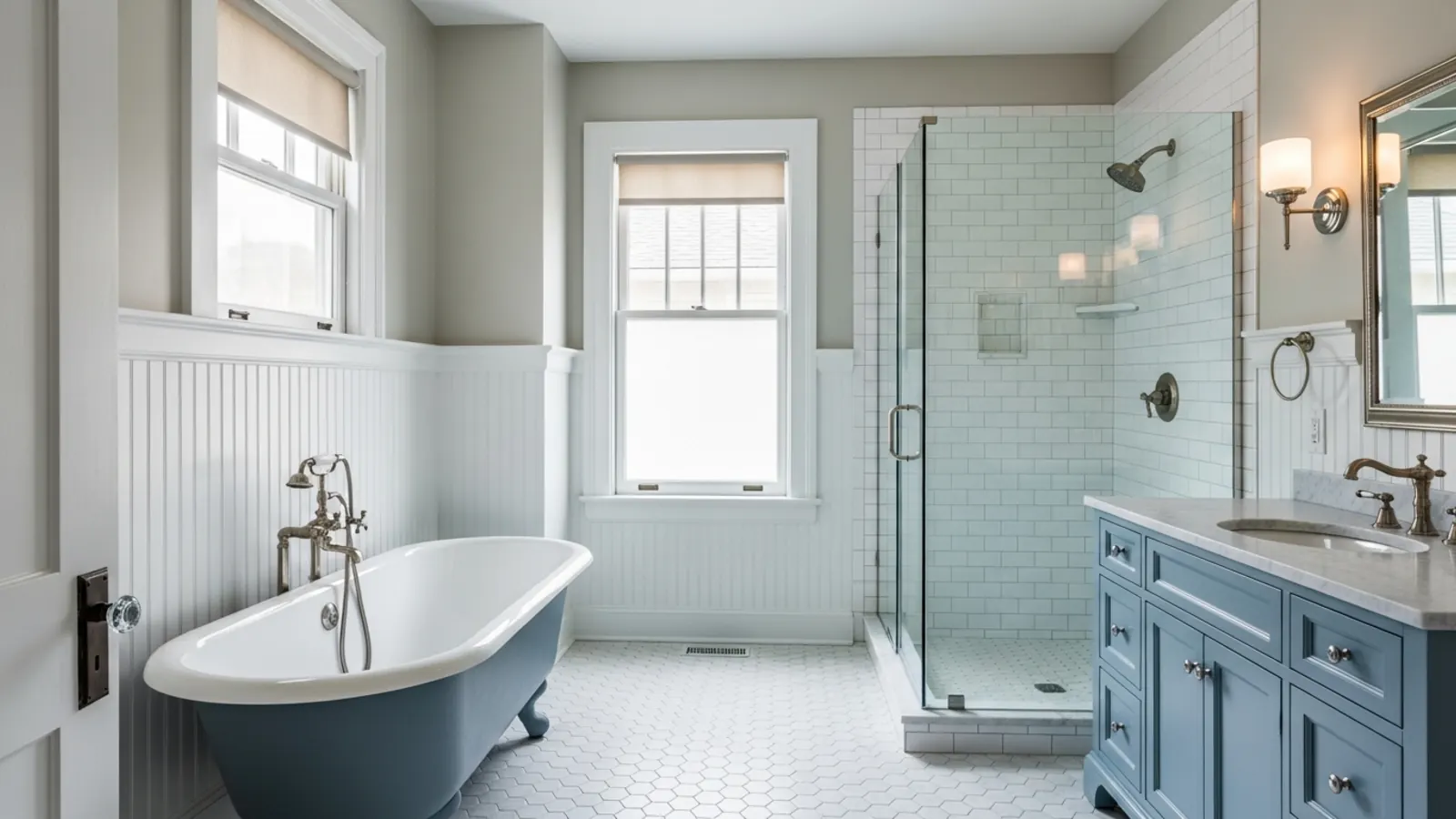
Bathroom Remodeling in Boise's North End
Clawfoot tub restorations, walk-in shower conversions, hex tile floors, period-correct vanities — bathroom design that respects 100-year-old plumbing, plaster, and architectural character.
Quick answer
Almost always yes. Original cast-iron clawfoot or alcove tubs in North End homes are 80–120 years old and are still serviceable when re-glazed. Re-glazing costs $400–$800 and refreshes the surface to look new while preserving the irreplaceable original fixture.
Remodeling a bathroom in Boise's North End is genuinely different from bathroom work in any newer Boise neighborhood. The original bathrooms in North End Craftsman bungalows and Tudor Revivals were small (often 35–55 sq ft), shoehorned into closets or tucked under stairs, and built around plumbing that ran through galvanized supply lines and cast-iron drain stacks that are now 80–120 years old. The walls hide original plaster over wood lath. The original cast-iron tubs — surprisingly often still in place — weigh 300+ pounds and were frequently set before the surrounding walls were finished, complicating any removal. The fixtures, when original, are heavy chromed brass on lead supply lines. Iron Crest Remodel has converted, restored, and rebuilt these bathrooms across every block of the North End — and we've developed the specific approach these older Boise bathrooms require to be safe, code-compliant, and beautifully period-sympathetic.
North End bathrooms reflect four distinct eras of plumbing technology, fixture design, and tile fashion. Knowing which era your bathroom belongs to determines almost every design and construction decision.
1900–1925: Original Craftsman bathrooms
The defining bathroom type of the North End. Small (35–55 sq ft) bathrooms with original cast-iron clawfoot tubs (often still in place under decades of paint), pedestal sinks with separate hot/cold cross-handle taps, hex floor tile or original wood floor, beadboard wainscoting to chair-rail height, single overhead light fixture. Original plumbing is galvanized steel supply with lead joints and cast-iron drains. Many homes have only one full bathroom; some still have the original separate water closet and bathing room.
1925–1940: Tudor Revival and Colonial Revival upgrades
The North End's larger 1920s–1930s homes typically had two or even three bathrooms — a primary, a hall bath, and sometimes a powder room. Bathrooms are bigger (55–80 sq ft), more formal, with built-in alcove tubs, chrome-and-porcelain accessories, hex or basket-weave tile floors, and tile wainscoting in colored ceramic patterns. Fixtures are often original chromed brass with porcelain inserts. Plumbing is mixed — original galvanized surviving alongside copper updates from later decades.
1945–1965: Post-war ranch bathrooms
Bathrooms in the post-war ranches of the eastern and northern North End are typically 50–70 sq ft, configured as 5-foot tubs against one wall with a vanity and toilet across, in pink, blue, mint green, or yellow tile from floor to mid-wall. Steel slab cabinets, single overhead globe fixture, ceiling exhaust vent (often non-functional). Plumbing is usually copper, drains are cast iron, electrical is grounded but minimal — typically one outlet and a switch.
1985–present: Infill and renovated bathrooms
Recent infill and previously-renovated bathrooms have modern mechanical systems and don't carry the structural and environmental complications of the older stock. They benefit from the North End location and architectural context but their bathrooms often need updating from the aesthetic of their renovation era — late-90s 'master bath spa' designs, early-2000s tan-and-beige palettes, and similar.
North End bathroom projects fall into recognizable shapes. Identifying which shape your project resembles helps with budget, timeline, and material strategy decisions.
1. The Tub-to-Shower Conversion — accessibility-driven primary bath update
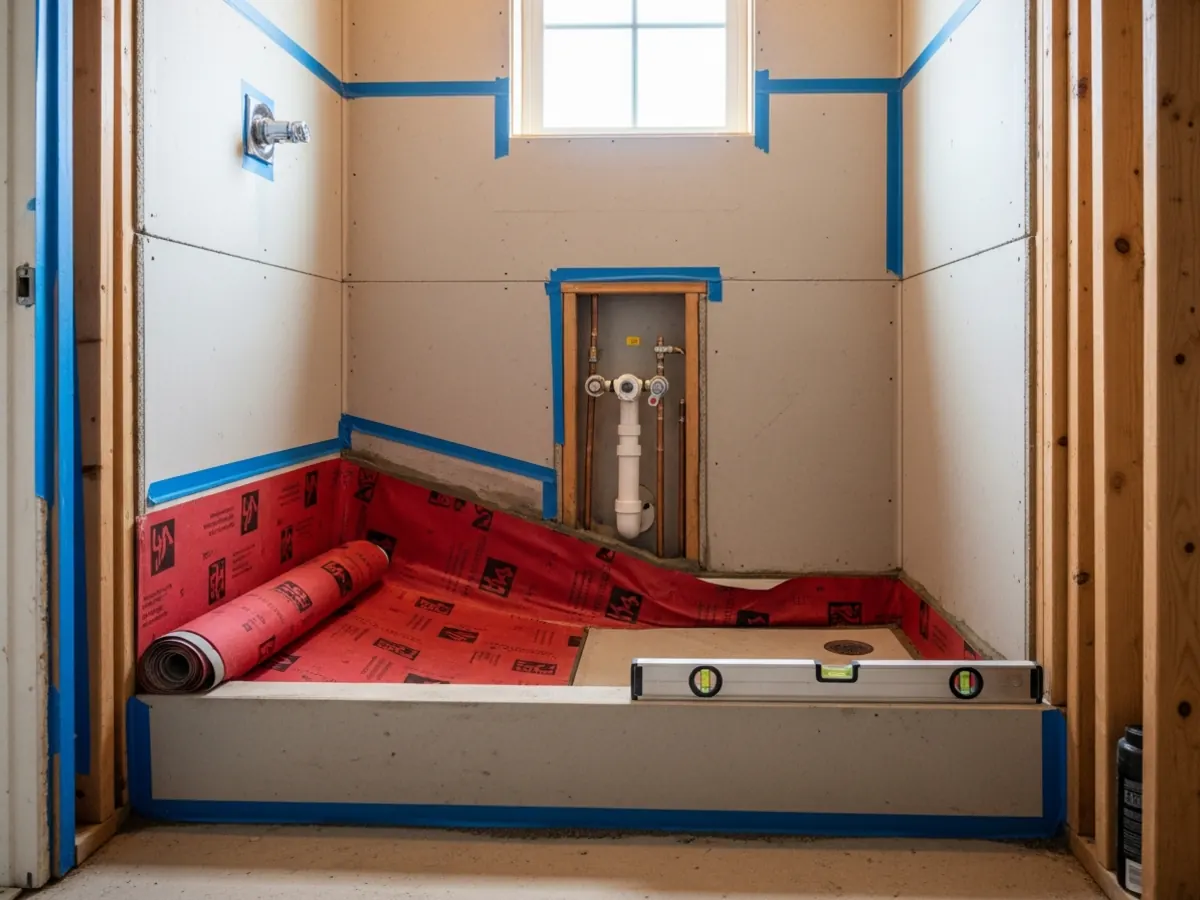
By far the most-requested bathroom remodel in the North End right now: removing the original cast-iron alcove tub (or the 1960s steel tub that replaced it) and installing a curbless or low-curb walk-in shower with tile, glass enclosure, niche, and bench. Drives accessibility for aging-in-place owners, and frequently improves the bathroom's sense of space dramatically. Requires waterproofing detail (Schluter Kerdi or red-board waterproof membrane), proper drain placement, plumbing rough-in changes, and full City of Boise plumbing permit.
Target homes: Any North End home with a primary bath the owner doesn't want to keep as a tub. Permit: plumbing permit required; building permit if any structural change.
2. The Period-Correct Restoration — preserving original character
For owners with intact original cast-iron tubs, original tile, or original fixtures, the right project is a careful restoration rather than a tear-out. Re-glaze the original cast-iron tub (saves the iron, refreshes the surface — $400–$800), replace the failing fixtures with period-correct reproductions (Kohler IV Georges Brass, Strom Plumbing Hercules, Sign of the Crab — all available with cross handles and chrome-on-brass construction), tile a new hex floor to match the original pattern, restore the original wood door hardware, and bring the plumbing up to modern code without touching the visible fixtures. Result: a bathroom that looks 1925 but functions 2026.
Target homes: Pre-1940 North End homes with intact original bathroom features. Often combines with a separate full bath addition elsewhere in the house.
3. The Full Gut + Reconfigure — borrowing space from a closet or hallway
Many North End primary bathrooms are simply too small to deliver a contemporary experience without borrowing space from an adjacent room. Common solution: take the adjacent bedroom closet (often 12–24 sq ft), or a section of hallway, into the bathroom footprint. This requires structural assessment of the wall being moved, a building permit, electrical and plumbing rework, and finish work to integrate the new layout. Result: a 35-sq-ft bathroom becomes a 55-65-sq-ft bathroom that can accommodate a real walk-in shower, a vanity, and a separate toilet.
Target homes: North End homes where the existing bathroom is too small for current preferences and an adjacent space can be sacrificed. Permit: building permit with structural drawings.
4. The Powder-Bath Add — converting a closet to a half bath
Many older North End homes have only one full bathroom on the main floor, plus the cramped original bathroom on the second floor. Adding a powder bath on the main floor — typically by converting an under-stair closet, a coat closet, or a small pantry — is a high-impact, lower-cost project that significantly improves the home's day-to-day livability and its resale story. Requires plumbing access (which often means routing supply and drain through floor or ceiling cavities), electrical for lighting and a fan, and ventilation.
Target homes: North End homes with only one full bath, where the main floor lacks any toilet at all. Permit: plumbing and building permits.
5. The Aging-in-Place Conversion — universal design
For North End homeowners committed to staying in their homes long-term, a comprehensive aging-in-place bathroom remodel addresses fall-prevention, mobility-friendly fixtures, and accessible storage in one project. Curbless walk-in shower with bench and grab bars (blocking installed behind the wall now even if bars come later), comfort-height toilet, lever-handle faucets, accessible vanity at proper height, slip-resistant flooring, motion-activated lighting. The work integrates these features with period-sympathetic aesthetics so the bathroom doesn't feel institutional.
Target homes: North End owners 55+ who plan to stay in their homes through retirement. Permit: full bath permit suite.
The North End is made up of distinct sub-neighborhoods, each with its own remodeling personality.
13th Street & Hyde Park
The cultural and commercial heart of the North End — boutique shops and restaurants along 13th between Brumback and Eastman, with the densest concentration of original Craftsman bungalows on the surrounding blocks. Lots are tight (typically 50' frontage), alley access is common, and the neighborhood is heavily walked. Most homes here are 1905–1925 Craftsman.
Camel's Back & Heron Streets
The streets immediately around Camel's Back Park, climbing slightly into the lower foothills. Mostly Craftsman bungalows with some Tudor Revival mixed in. Lots get larger toward the park edge, and some homes back to the Foothills Reserve with significant trees. Project budgets here tend to be higher — these are some of the most coveted blocks in the city.
Harrison Boulevard corridor
The grand divided boulevard running south-to-north through the heart of the North End, lined with the neighborhood's largest historic homes. Tudor Revival, Colonial Revival, and a few notable Prairie-style houses sit on deep lots with mature plantings. Projects here lean toward sympathetic upgrade rather than reconfiguration — these homes already have generous floor plans.
Fort Boise & Capitol-area North End
The streets around Fort Boise Park and stretching toward the State Capitol grounds — a mix of original Craftsman bungalows, larger 1920s and 1930s homes, and a higher proportion of post-war infill. Lots vary widely. Project scopes span the full range depending on house age and homeowner intent.
North of Hill Road / new infill
The northern fringe of the historic North End, where construction continued through the 1950s and where modern infill has been most active. Newer (1945–present), larger, less constrained by historic-district considerations. Projects here look more like SE Boise or Harris Ranch in scope and material strategy.
Lower-numbered streets (3rd–9th)
The streets between the State Capitol grounds and Fort Boise — traditionally a more working-class section of the North End, with a mix of smaller Craftsman bungalows, post-war houses, and some converted multi-family. Increasingly being renovated as North End demand pushes outward from the 13th Street core. Excellent value if you can find an unrenovated home here.
North End bathroom pricing runs slightly above the broader Boise average for an equivalent project scope, driven by the same factors that affect kitchen work in this neighborhood: longer permit cycles, environmental testing and abatement of pre-1980 materials, structural complexity in older homes, period-sympathetic material selections, and the operational overhead of working in tight blocks.
North End bathroom remodeling ranges
Cosmetic refresh (new vanity, new fixtures, new tile floor, new paint — no plumbing relocation): $18,000–$26,000 / 3–5 weeks end to end
Standard remodel (new tub or shower, vanity, tile floor, lighting, fixtures, partial plumbing relocation): $26,000–$42,000 / 5–8 weeks end to end
Tub-to-shower conversion (removal of tub, full waterproof shower build with tile and glass enclosure, plumbing rework): $28,000–$48,000 / 6–9 weeks end to end
Reconfigure / borrow space (add square footage by absorbing adjacent closet or hallway, structural change required): $45,000–$75,000 / 9–14 weeks end to end
Premium / aging-in-place (curbless shower, universal-design fixtures, premium materials, double vanity, comfort detail throughout): $55,000–$85,000 / 10–14 weeks end to end
Pricing assumes Iron Crest's standard scope: full City of Boise permitting, environmental testing and required abatement, EPA RRP lead-safe work practices for any pre-1978 home, structural engineering when required, professional waterproofing of any wet area (Schluter Kerdi system or equivalent red-board membrane), porcelain or ceramic tile, semi-custom or custom vanity, all new fixtures, and a 3-year workmanship warranty. Contingency budget of 12–15% above contract value should be held for older-home discovery work.
The North End Historic District boundary covers most — but not all — of the North End. The district is administered by the City of Boise Historic Preservation Commission, which reviews exterior modifications within the district boundary. Interior work, including comprehensive remodels, is exempt from Historic Preservation review. This is the single most important permitting fact to internalize: your interior work doesn't need historic review, regardless of how aggressive the scope.
Where Historic Preservation review enters the picture is when your project includes any exterior change. Examples we encounter regularly: enlarging a window, relocating an exterior door, adding an exterior-vented hood that requires a new wall penetration, building a small addition or bump-out, or replacing a side-yard window with a different style. Any of these requires a Certificate of Appropriateness from the Historic Preservation Commission, which can add several weeks to the permit timeline (confirm current timelines with PDS) and typically requires architectural drawings showing the proposed change in context.
For interior-only projects, the standard City of Boise permits apply: a building permit for structural work (wall removal, beam installation), an electrical permit for new circuits or panel work, a plumbing permit for fixture relocation or new water lines, and a mechanical permit for ducting or HVAC modifications. Permit fees for a typical mid-range project run several hundred to a few thousand dollars depending on scope. Processing times: electrical and plumbing permits are often same-day or next-day; building permits go through plan review, about two weeks for online plan review per Boise PDS and longer when structural drawings are involved.
One North End-specific permit consideration: parking and right-of-way. Placing a dumpster on the street or parking a construction trailer at the curb requires an ACHD temporary-use permit (fee varies), since North End residential streets are ACHD right-of-way. Some North End streets have additional restrictions related to the historic neighborhood designation. Iron Crest pulls all required temporary-use permits as part of project setup.
Bathroom material selection in a North End home requires balancing period-sympathetic aesthetics with modern waterproofing, water-conservation, and accessibility standards. Here's what works.
Floor tile
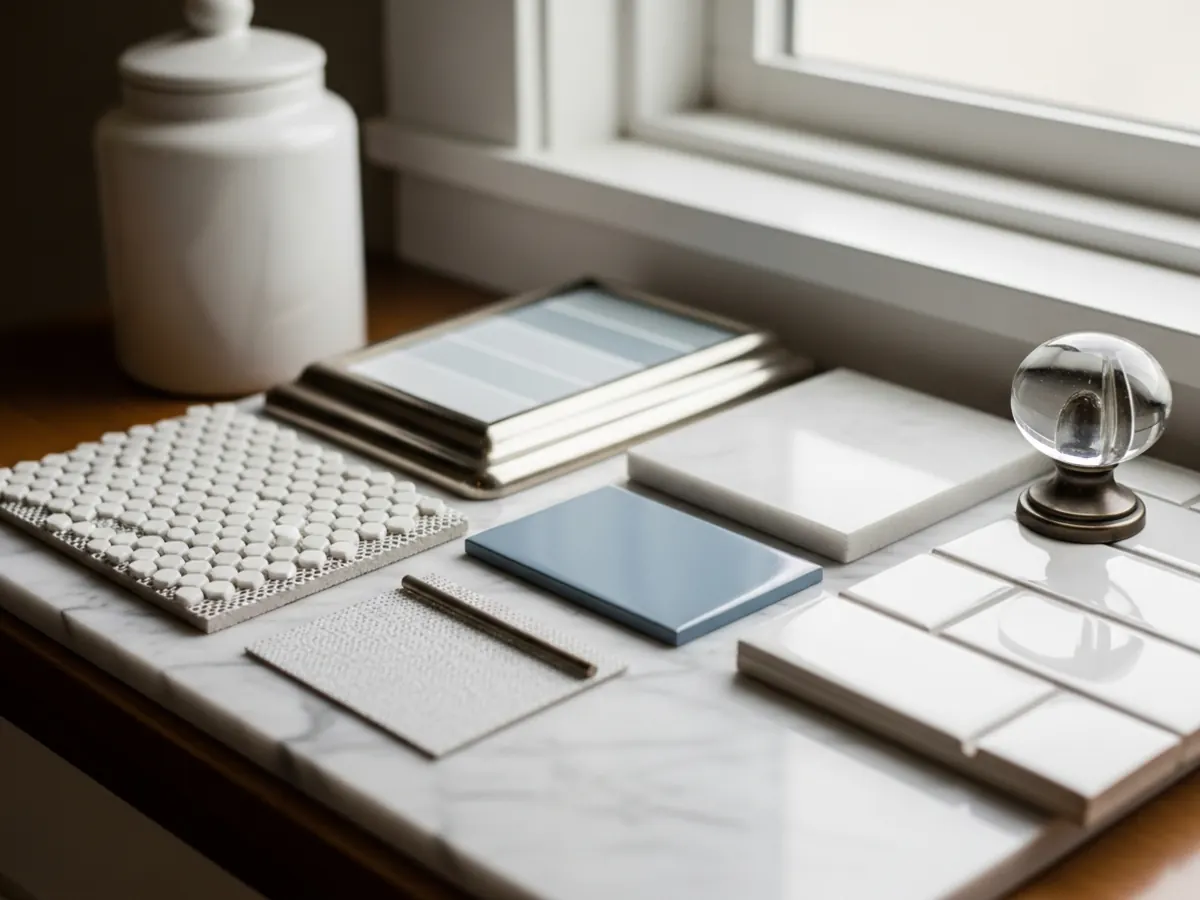
Hex mosaic tile in 1″–2″ white-with-black-dot pattern is the period-correct standard for pre-1940 North End bathrooms — historically appropriate, slip-resistant when grouted with appropriate-width joints, and instantly recognizable. Basket-weave mosaic in white-and-black is a strong alternative for the 1920s–1930s aesthetic. For Tudor and Colonial Revival homes, larger black-and-white mosaic patterns or octagon-with-dot work well. Avoid: large-format porcelain in any pre-1940 bathroom (reads too contemporary), wood-look LVP (water + bathroom = wrong material choice).
Wall tile
Subway tile in 3x6 or 4x12 with thin sanded grout joints is the safe and attractive choice for shower walls and wainscoting. Beveled subway tile adds period authenticity. Handmade-look ceramic with intentional irregularity reads more authentic than perfectly machined tile. For wainscoting, white tile to chair-rail height with a chair-rail trim piece in either tile or painted wood is the period standard. For showers, tile to ceiling on the wet wall and to top of valve on adjacent walls is the modern approach that performs well.
Tub & shower
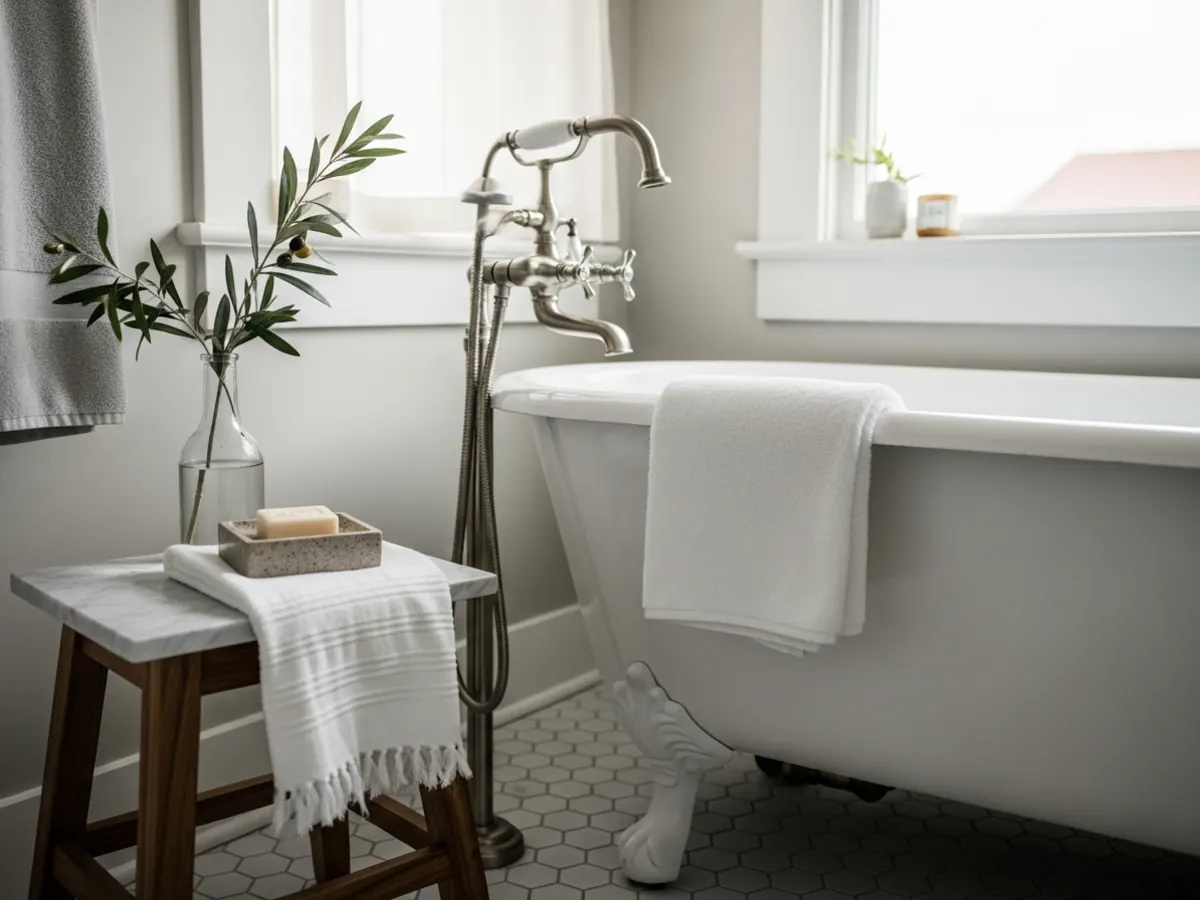
If you have an original cast-iron clawfoot tub, restore it — re-glazing costs $400–$800 and the result is a unique fixture that can't be replicated with new construction. For new clawfoot purchases, true cast-iron from Strom Plumbing or Sign of the Crab (Kohler stopped making true cast-iron clawfoots) costs $1,800–$3,500 and weighs 300+ pounds (floor structural assessment required). For walk-in showers, frameless 3/8″ glass enclosures, curbless or low-curb entry, Schluter Kerdi waterproofing membrane, and a properly-sloped mortar bed under the tile floor.
Vanity & sink
Furniture-style vanities (free-standing, with visible legs, painted finish) read more period-appropriate than built-in cabinetry for pre-1940 bathrooms. Pedestal sinks are the most authentic for very small Craftsman bathrooms. For larger bathrooms, a single or double vanity in painted shaker or flat-panel profile with a marble or quartz top works well. Apron-front, undermount, or vessel sink — vessel rarely fits the period aesthetic; undermount is the safest choice. Cross-handle widespread faucets in polished chrome, polished nickel, or oil-rubbed bronze.
Fixtures & hardware
Polished chrome is the most period-correct finish for pre-1940 bathroom fixtures — chromed brass over brass body, with cross-handle controls and porcelain inserts in the handles. Polished nickel is acceptable but reads slightly more luxe than typical original installations. Brushed nickel is a modern compromise that's broadly acceptable. Avoid: brushed gold, matte black, brushed bronze — these all read as 2020s contemporary in a 1920s bathroom. For accessories (towel bars, paper holder, robe hook), match the faucet finish and choose simple Craftsman or Colonial-revival profiles.
Lighting & ventilation
Sconces flanking the medicine cabinet or mirror are the most flattering bathroom lighting (eliminates the unflattering shadows of overhead-only lighting). Choose schoolhouse-style, milk-glass, or simple Craftsman profiles in bronze, brass, or chrome to match the rest of the period palette. Add a recessed can or two for general illumination. Ventilation is non-negotiable: a code-compliant exhaust fan rated for the room's cubic footage with humidity-sensing controls, ducted to the exterior (not to the attic). Original Craftsman bathrooms had no mechanical ventilation; this is a required modern upgrade.
Honest accounting of what we typically uncover during North End bathroom demolition. These items aren't optional surprises — they're predictable based on the home's age and original construction methods. Build them into your contingency budget upfront.
- •Galvanized steel supply lines. Original to most pre-1960 North End bathrooms. Internal corrosion has reduced flow capacity to 30–50% of original. Bathroom remodel includes replacement from main shutoff (or branch tap) to fixtures with PEX or copper. $800–$2,200 typical.
- •Lead supply line at the meter or main. Pre-1940 North End homes occasionally still have lead supply lines feeding into the house. Bathroom remodel is the right time to investigate and replace. Lead service line replacement: $4,500–$12,000 depending on length and access (sometimes covered partially by City of Boise programs).
- •Knob-and-tube wiring. Modern bathroom code requires GFCI-protected dedicated circuits for outlets, dedicated circuit for the exhaust fan, and proper grounding for fixtures. Knob-and-tube does not meet any of these requirements and must be replaced where it serves the bathroom. $1,800–$4,500 for the bathroom circuits.
- •Cast iron drain stacks with deteriorated joints. Original cast iron drain stacks in North End homes are 80–120 years old. Joints sometimes leak or have been previously patched with poorly-aged repairs. Spot replacement: $400–$1,200 per fitting; full bathroom drain replacement back to main stack: $2,200–$4,500.
- •Failed waterproofing under existing tub or shower. Vinyl or felt-paper waterproofing from 1950s–1980s installations rarely survives intact. Subfloor and joist damage from long-term water leaks is common. Subfloor patch: $400–$1,500. Joist sister or replacement: $800–$2,500.
- •Asbestos in vinyl floor tiles or sheet flooring. Pre-1980 sheet vinyl and 9″ vinyl tiles frequently contain asbestos. Required testing identifies extent. Abatement by licensed contractor before disturbance. $1,200–$3,500 typical for a bathroom.
- •Lead paint on bathroom walls and trim. Universal in pre-1978 North End bathrooms. EPA RRP lead-safe work practices for any disturbance — including sanding, scraping, or cutting. Built into Iron Crest's labor pricing.
- •Inadequate or non-existent ventilation. Original Craftsman bathrooms had only an operable window for ventilation. Modern code requires mechanical exhaust fan ducted to exterior. Routing the duct from a small interior bathroom to an exterior wall in an old home often requires creative solutions through wall cavities, soffits, or roof penetrations. $400–$1,500 above baseline fan installation.
- •Original bathroom door undersized for accessibility. Original Craftsman bathroom doors are often 24″–28″ wide, below the 32″ minimum for accessibility. If aging-in-place is part of your project goal, door replacement and frame widening adds $800–$2,500.
Consultation and home assessment (Week 1)
In-home walkthrough at no cost. We measure the bathroom, photograph existing conditions, identify obvious mechanical concerns (panel age, supply line type, visible knob-and-tube), discuss your goals, and confirm whether your home is in the Historic District (it affects exterior scope only).
Environmental testing (Week 1–2)
Asbestos and lead testing on suspect materials in the bathroom — vinyl flooring, joint compound, painted surfaces. Results back in 5–7 business days.
Design finalization and detailed estimate (Weeks 2–3)
Bathroom layout, fixture selections, tile and material specifications, and a line-item estimate with the contingency budget called out separately. We don't move forward until you've approved every line.
Permitting and material ordering (Weeks 3–5)
We submit the building/plumbing/electrical permit applications to City of Boise Planning & Development Services. Vanity, tub or shower hardware, tile, and fixtures ordered (most stock quickly; custom vanity adds 4–6 weeks).
Asbestos/lead abatement and demolition (Week 5–6)
Licensed abatement contractor handles any required asbestos work. Once cleared, containment and demolition begin. ZipWall barriers protect adjacent rooms; HEPA air scrubbers run continuously.
Plumbing and electrical rough-in (Week 6–7)
All supply line and drain reworks. New shower valve set, drain located, fixture rough-ins. Electrical: dedicated GFCI circuits, fan circuit, lighting circuits. City of Boise rough-in inspections.
Waterproofing, tile, and finish prep (Weeks 7–8)
Schluter Kerdi or red-board membrane installed across all wet areas with proper slope to drain. Wall tile installed; floor tile installed; grouting and sealing. Drywall and paint prep on non-tile surfaces.
Vanity, fixture, and finish installation (Weeks 8–9)
Vanity install, sink and counter set, faucet and handle install, toilet set, shower glass measured and ordered (1-week fabrication), accessories mounted, mirror and lighting installed. Final paint touch-up.
Final inspections and walkthrough (Weeks 9–10)
City of Boise final inspections (plumbing, electrical, building if applicable). Glass enclosure installed (last step). Punch-list walk with you. Any items addressed within 1 week. Final walkthrough and sign-off. 3-year workmanship warranty begins.
Bathroom remodels in the North End are not a generic renovation product — they're a specialized practice. Contractors who do excellent kitchen work in newer Boise neighborhoods are often surprised by what an older bathroom requires.
- City of Boise Historic Preservation Commission — Design review information, district maps, and Certificate of Appropriateness application.
- City of Boise Planning & Development Services — Building, electrical, plumbing, and mechanical permits. Online portal and in-person plan check.
- Idaho DEQ Air Quality (Asbestos) — Testing and abatement guidance for pre-1980 homes via the Idaho Department of Environmental Quality.
- EPA Lead Renovation, Repair and Painting (RRP) Program — Required certification and work practices for renovation in lead-paint homes.
- Preservation Idaho — Statewide nonprofit advocating for historic preservation. Resources and educational events.
Should I save my original cast-iron tub during a North End bathroom remodel?
Almost always yes. Original cast-iron clawfoot or alcove tubs in North End homes are 80–120 years old and are still serviceable when re-glazed. Re-glazing costs $400–$800 and refreshes the surface to look new while preserving the irreplaceable original fixture. New cast-iron clawfoot tubs cost $1,800–$3,500 and don't have the same patina or proportions. The exception: if the tub has cracks, severe rust through the porcelain, or has been moved and the cast iron itself is compromised, replacement is justified. We assess each tub individually during the consultation.
Can I do a tub-to-shower conversion in a small North End bathroom?
Yes, and it often dramatically improves the bathroom's sense of space. Removing a 5-foot alcove tub frees up 30–35 square feet of footprint that becomes a generous walk-in shower with bench and niche. The conversion does require plumbing rework (the drain location moves and the valve configuration changes), waterproofing of the new shower, and tile work. Total cost typically $22,000–$42,000 for a North End bathroom in this scope. Permit: plumbing permit with City of Boise required.
How do you handle waterproofing in a North End bathroom?
We use the Schluter Kerdi membrane system on all wet areas — a polyethylene sheet bonded to the substrate with thin-set mortar that creates a fully waterproof barrier behind the tile. This system is far more reliable than the old vinyl-and-felt method common in mid-century bathrooms and prevents the subfloor/joist water damage that's the most common pre-existing condition we find. For curbless showers, we install a Kerdi-Line linear drain with a properly-sloped mortar bed beneath, achieving slope-to-drain without a curb.
What about asbestos and lead paint in older North End bathrooms?
Both must be addressed. Asbestos is common in pre-1980 vinyl floor tiles, sheet flooring, and joint compound. Lead paint is universal in pre-1978 painted surfaces. Idaho DEQ requires asbestos abatement by a licensed contractor before any disturbance. The EPA RRP rule requires lead-safe work practices for any renovation in lead-paint homes. Iron Crest follows EPA RRP lead-safe work practices and we coordinate environmental testing as part of pre-construction. Budget $300–$600 for testing and $1,200–$3,500 for asbestos abatement.
How long does a North End bathroom remodel take?
6–10 weeks for a standard remodel scope (new vanity, tub or shower replacement, tile floor, fixtures); 10–14 weeks for a project that involves moving walls or borrowing space from an adjacent room. The biggest variables are environmental abatement (adds 1 week if needed), permit processing (2–4 weeks for standard, 4–6 for structural), and shower glass fabrication (1 week, scheduled at the end).
Can you do an aging-in-place bathroom in a Craftsman home without it looking institutional?
Yes — and we do this regularly. The key is integrating universal-design features (curbless shower, comfort-height toilet, lever-handle faucets, blocking for grab bars) with period-sympathetic materials (hex tile, painted shaker vanity, polished chrome fixtures, milk-glass sconces). Grab bars themselves can be added later or chosen in finishes that read as design accents (polished chrome or brass) rather than medical equipment. We design for current beauty and future accessibility simultaneously.
What if my North End home has only one bathroom and I need to live with the disruption?
We have specific experience working in homes where the bathroom under renovation is the only bathroom. Options: a portable shower trailer rented for the construction phase ($800–$2,000/month); use of an unrenovated half bath if one exists; staying with family or in a short-term rental for the most disruptive 2–3 weeks; or scheduling the project so the toilet and a temporary sink can be reinstalled most evenings. We discuss these options upfront and include relevant logistics in our schedule.
How much does it cost to add a powder bath to my main floor?
$14,000–$26,000 for a typical North End powder bath addition. The main cost drivers: routing plumbing supply and drain to the new location (often through floor or ceiling cavities), framing the new walls, electrical work for lighting and the exhaust fan, finishing (tile, paint, vanity install, fixture install), and City of Boise plumbing and building permits. The work typically takes 4–6 weeks. The ROI on a powder bath addition is excellent — it dramatically improves day-to-day livability and significantly improves the home's resale appeal.
Ready to start your North End bathroom remodeling project?
Free in-home consultation, honest contingency-based budgeting, and the experience Boise homes require. Iron Crest Remodel — Idaho RCE #6681702, EPA RRP lead-safe work practices, $2M general liability, 3-year workmanship warranty.
Get Your Free Estimate