Accessible Walk-In Showers Services
Iron Crest Remodel builds accessible showers that combine safety with style. Zero-entry thresholds, grab bars, fold-down bench seats, and handheld showerheads — designed for comfortable, independent bathing at every age.
Quick answer
Iron Crest Remodel builds accessible showers that combine safety with style. Zero-entry thresholds, grab bars, fold-down bench seats, and handheld showerheads are designed for comfortable, independent bathing at every age. We build each accessible shower with waterproofing, proper slopes, and blocking for grab bars, and a typical project takes 1 – 3 weeks.
- Zero-entry / curbless shower builds
- ADA-compliant grab bar installation
- Fold-down and built-in bench seats
- Handheld showerhead with slide bar
- Anti-slip tile flooring
- Wider doorways and entries
- Lever-handle fixtures (no knobs)
- Proper drain slope for curbless showers
- Reinforced wall blocking for grab bars
- Comfort-height toilet installation
Timeline
1 – 3 weeks
Accessibility Assessment
We evaluate your bathroom for accessibility needs — door width, threshold height, fixture reach, and mobility requirements. We discuss aging-in-place goals and any specific medical needs.
Accessible Design Plan
We design a shower and bathroom layout that meets ADA guidelines while maintaining an attractive, modern aesthetic. You approve materials, fixtures, and layout before work begins.
Construction & Installation
We build the accessible shower with waterproofing, proper slopes, blocking for grab bars, and all specified safety features.
Safety Verification
We test every grab bar mounting point, verify drain function, confirm anti-slip surfaces, and ensure all fixtures are within accessible reach ranges.

See Your Remodel Before You Build.
Upload a few photos of your kitchen, bathroom, flooring, or exterior and get AI-generated concept visuals tailored to your space, style, and materials — free, no obligation, in about five minutes. Then request a real estimate from our Idaho registered Boise team.
Free concept preview · No credit card · Idaho registered contractor
AI concepts are for inspiration and planning only. Final pricing, layout, materials, and feasibility are confirmed during your free in-home estimate.
What makes a shower ADA-compliant?
ADA-compliant showers include a zero-threshold entry (no curb), minimum 36x36-inch interior space, grab bars at specific heights, a fold-down seat, handheld showerhead, and anti-slip flooring. Iron Crest Remodel builds to these standards and beyond.
Can an accessible shower still look modern and stylish?
Absolutely. Modern accessible design uses sleek grab bars in brushed nickel or matte black, large-format tiles, linear drains, and frameless glass. The safety features blend seamlessly into contemporary bathroom design.
Do you work with VA or insurance programs for accessible bathrooms?
We can provide documentation and invoices formatted for VA home modification grants and insurance reimbursement programs. We recommend checking with your specific provider before starting the project.
Plan your accessible walk-in showers project with our in-depth guides.
Talk to a real project manager
Have Questions? Call Now for a Free In-Home Consultation.
Mon–Fri 7 AM–6 PM · Idaho registered & insured · No obligation
Russ Shloma — Project Manager
Russ Shloma — Project Manager
Ready to Start Your Remodeling Project?
Get a free, no-obligation estimate from Boise's trusted remodeling experts. Registered, insured, and ready to build.
Dive deeper into specific components and features for accessible shower installations in Boise homes.
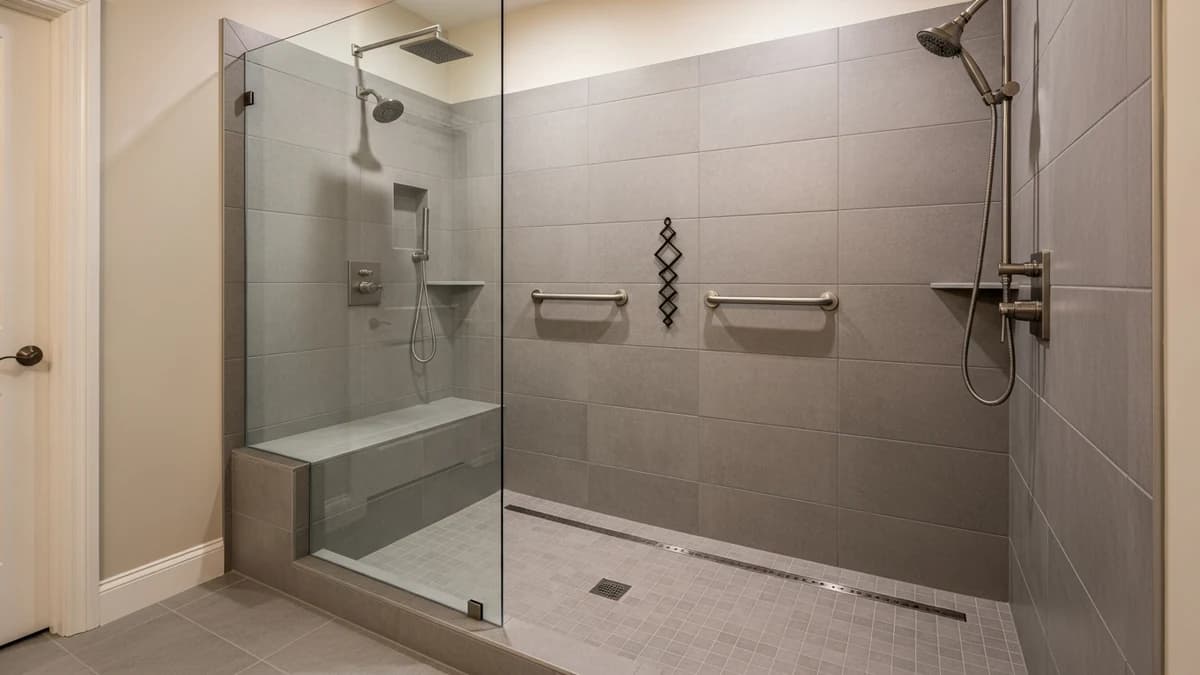
A truly accessible walk-in shower combines multiple safety features into a cohesive design that feels natural, not clinical. Each feature addresses a specific fall risk or mobility challenge. Here's what we incorporate into every accessible shower we build in Boise — and why each element matters.
Zero-Threshold Entry
The single most important accessibility feature. A zero-threshold (curbless) shower eliminates the raised curb that causes the majority of shower-related falls. The shower floor is flush with the bathroom floor, with a subtle 1/4" per foot slope toward a linear drain. This allows wheelchair and walker access, eliminates the step-over trip hazard, and creates a seamless, modern aesthetic. Building a true zero-threshold requires modifying the subfloor during construction — this is not a retrofit add-on but a structural element that must be planned from the start.
Removes the step-over at the tub or shower curb — the movement that most often puts a bather off balance
Allows wheelchair, walker, and rolling shower chair access
Boise code note: Zero-threshold showers require a waterproof membrane (Schluter Kerdi or similar) across the entire shower floor and up walls to 6" minimum above the shower head height
Grab Bars in Decorative Finishes
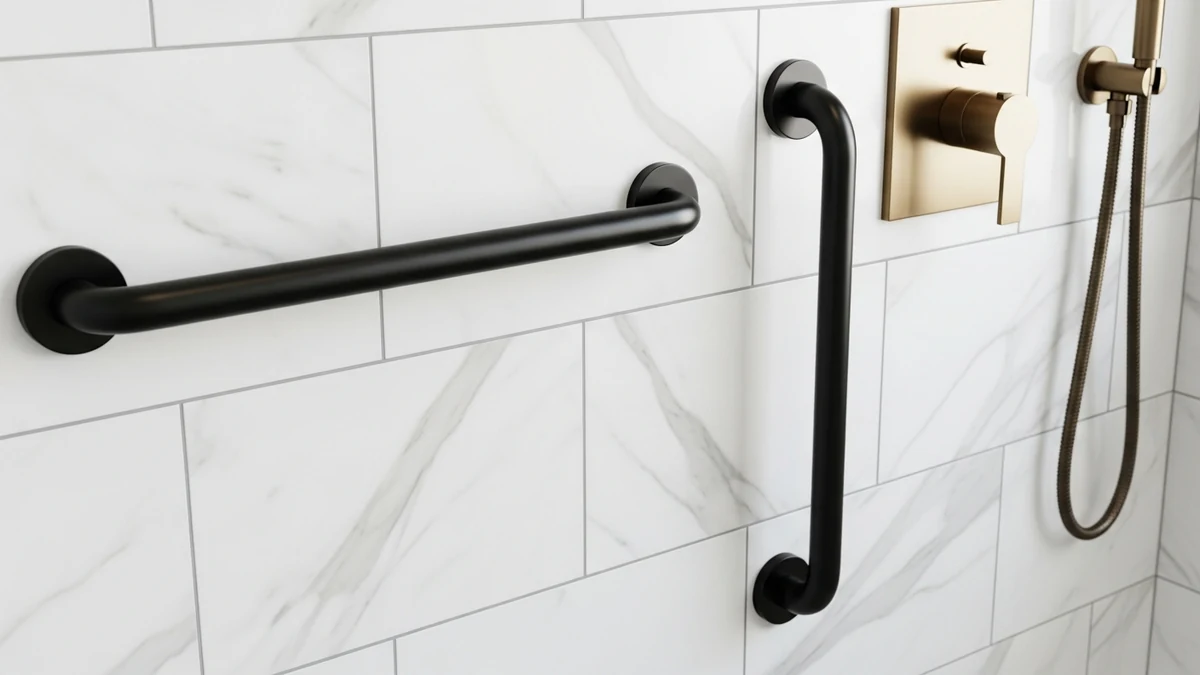
Modern grab bars are available in matte black, brushed nickel, champagne bronze, and polished chrome — finishes that match standard bathroom hardware from Kohler, Moen, Delta, and Brizo. We install grab bars at three critical locations: a horizontal bar on the control wall at 33–36" height, a horizontal bar on the back wall, and a vertical bar at the shower entry. All bars are anchored into wood blocking installed behind the wall surface during construction, rated to support 250+ pounds of static force.
Three-point grab bar placement covers entry, standing, and seated shower positions
Decorative finishes make grab bars look like intentional design elements, not medical afterthoughts
Boise ADA note: Idaho residential code does not require ADA compliance, but we build to ADA standards because they represent best-practice safety design
Built-In Bench Seating
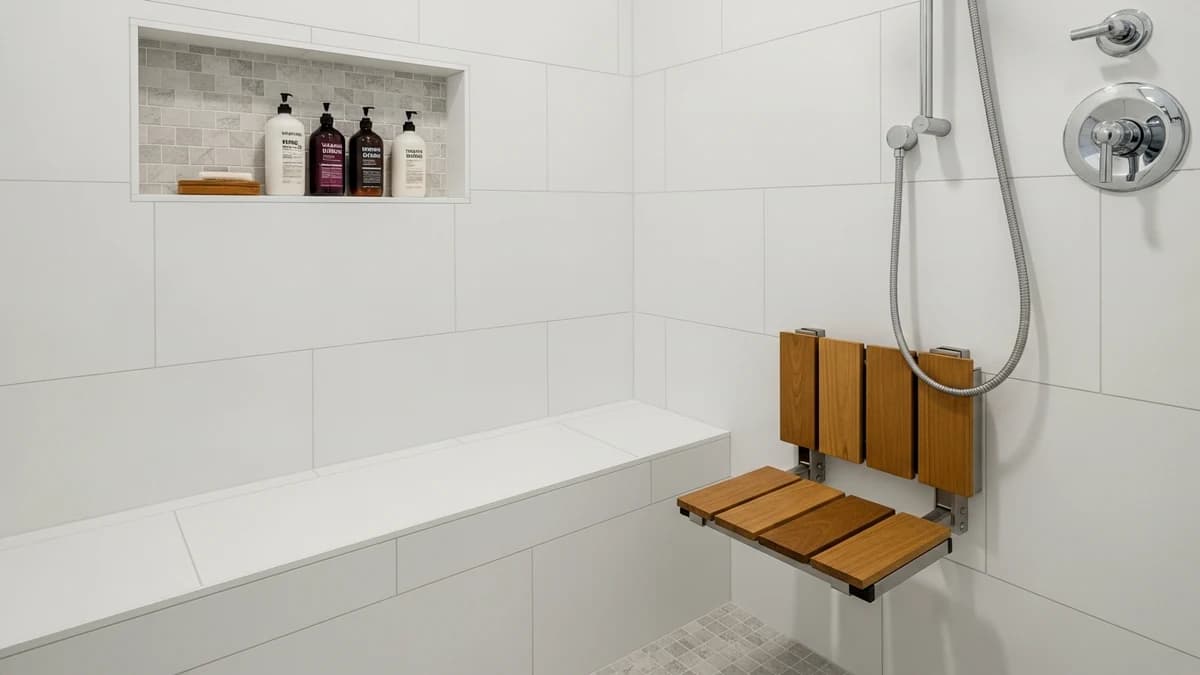
A built-in tiled bench at 17–19" height provides a permanent, stable seating surface for seated showering, foot washing, or simply resting. We build benches 15" deep minimum with a slight forward slope for drainage. For smaller showers where a full bench won't fit, fold-down teak or stainless steel seats mount to the wall and fold flat when not in use — they look like spa furniture and provide the same seated showering capability.
Built-in bench: 17–19" height, 15" depth, fully waterproofed and tiled to match walls
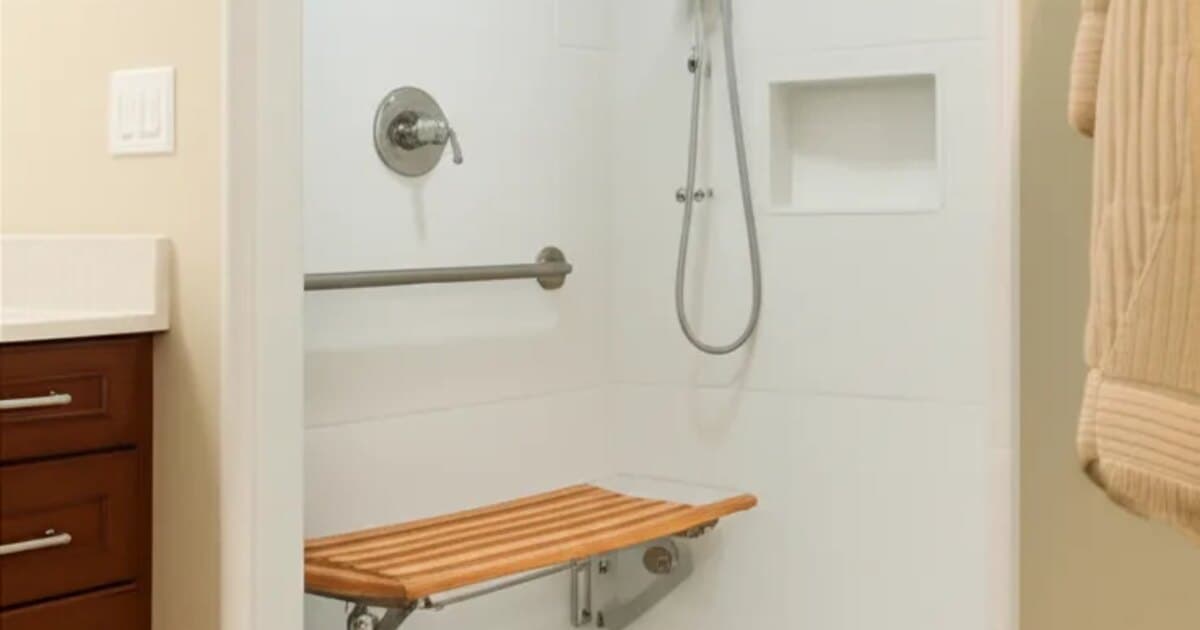
Fold-down seat: Teak or stainless steel, ADA-height, folds flat to save floor space
Both options support 300+ lbs and include slip-resistant surfaces
Handheld Shower Head on Slide Bar
A handheld shower head mounted on an adjustable slide bar allows users to shower while seated, adjusting spray height from 48" to 72". A diverter valve switches between the handheld and a fixed overhead rain showerhead. This dual-head setup serves all users — the overhead shower for standing users, the handheld for seated showering, bathing assistance, or rinsing down the shower after use.
Non-Slip Flooring
Shower floor tile must meet DCOF (Dynamic Coefficient of Friction) ratings of 0.42 or higher per ANSI A326.3 for wet conditions. Small-format mosaic tiles (1×1" or 2×2") create more grout lines, which provide additional traction. We use textured, matte-finish tiles rather than polished surfaces for all shower floors. For maximum safety, linear drains allow the entire shower floor to slope uniformly rather than pitching to a center drain, creating a flatter, more stable walking surface.
Mosaic tile with high-grip texture rated DCOF 0.42+ for wet conditions
Linear drain allows a flatter floor slope — more stable than the cone-slope to a center drain
Matte and textured finishes only — no polished stone or glossy porcelain on shower floors
Accessible walk-in shower costs in the Boise metro vary widely based on the level of finish, the size of the shower, and whether the project requires structural changes to the bathroom. Here are three common tiers we build for Treasure Valley homeowners.
Basic Barrier-Free — $8,000–$15,000
A straightforward curbless shower conversion using standard porcelain tile, three grab bar locations, a fold-down seat, handheld showerhead on slide bar, and a linear drain. Ideal for guest bathrooms, secondary baths, and budget-conscious aging-in-place projects.
Standard porcelain tile walls and mosaic tile floor
Three ADA-placement grab bars in brushed nickel or chrome
Fold-down teak or stainless seat
Handheld showerhead on slide bar with diverter
Linear drain, Kerdi waterproofing system
Standard glass panel (not full enclosure)
Mid-Range Accessible — $15,000–$25,000
Upgraded finishes with a built-in tiled bench, premium large-format tile, thermostatic valve, decorative grab bars, and niches. This is our most popular accessible shower tier — it delivers a spa-like aesthetic with full safety features. Suitable for master bathroom remodels.
Large-format porcelain tile walls (12×24 or 24×48) with mosaic floor
Built-in tiled bench seat at ADA height (17–19")
Decorative grab bars in matte black or champagne bronze
Thermostatic mixing valve with anti-scald protection
Dual showerhead system (rain + handheld on slide bar)
Two recessed niches with stone or tile shelves
Frameless glass panel or enclosure
Luxury Spa-Accessible — $25,000–$40,000
Full luxury finishes including natural stone or premium porcelain panels, body sprays, steam system, heated bench, LED lighting, and high-end fixtures. Every safety feature is seamlessly integrated into a design that looks like a five-star spa. For homeowners who want the best of both worlds — absolute safety and absolute luxury.
Natural stone or premium porcelain panel walls (Neolith, Dekton, or marble)
Heated built-in bench with electric radiant heating element
Kohler or Brizo luxury thermostatic digital valve system
Multiple body sprays, rain showerhead, and handheld on slide bar
Steam generator option for enclosed showers
LED niche lighting and accent lighting on dimmer
Frameless glass enclosure with custom hardware
Designer grab bars integrated as towel bars and shelf supports
All tiers include demolition, subfloor modification for zero-threshold, waterproofing, tile installation, plumbing, and cleanup. Costs reflect Boise metro market rates as of early 2026. Bathroom expansion, structural wall changes, and electrical upgrades are additional.
An accessible walk-in shower is often part of a larger bathroom accessibility project. Explore our related services and resources for a complete aging-in-place bathroom transformation.
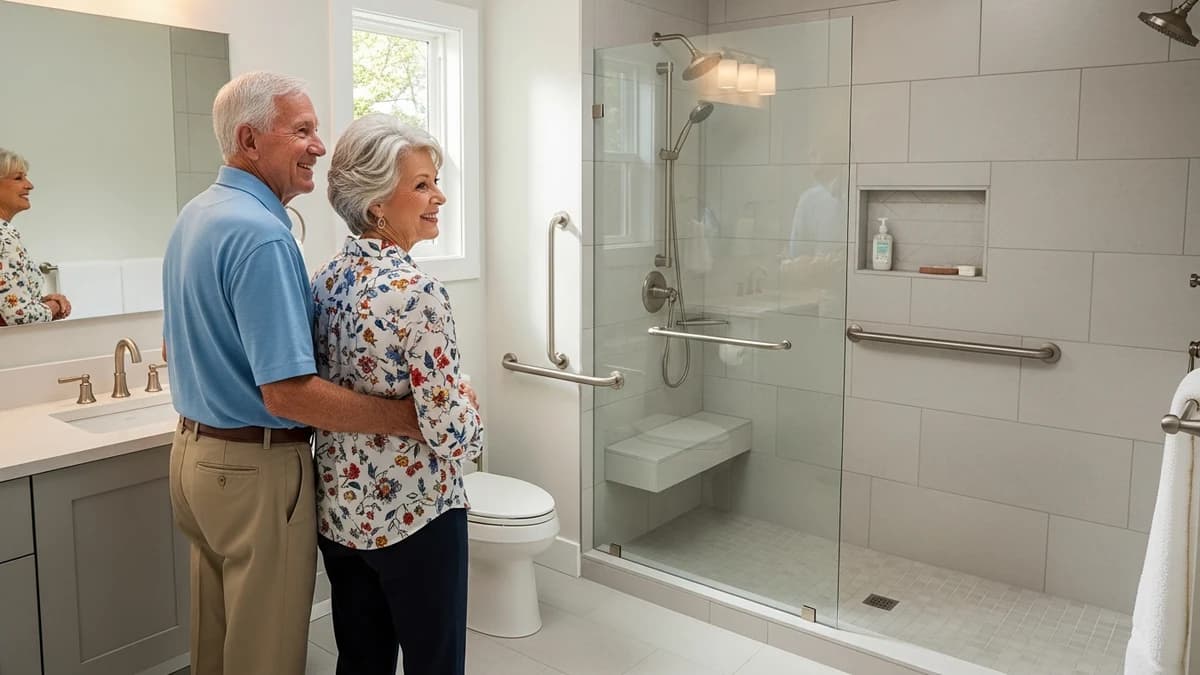
Idaho's 65-and-older population is growing, and more Boise-area homeowners are investing in accessible bathroom design — not just for current needs, but to age safely in the homes they love. A well-designed accessible shower removes the step-over at the tub wall, which is the movement that puts a bather off balance on a wet surface.
CDC: more than one in four adults 65 and older reports a fall each year
Zero-threshold showers eliminate the leading cause of bathroom falls
Universal design features increase home value — buyers of all ages prefer them
Aging-in-place saves $50,000+ per year compared to assisted living in Idaho
Accessible design benefits all users — including families with young children and anyone recovering from injury
Zero-Threshold (Curbless) Entry
The most important accessibility feature. A curbless shower eliminates the step-over barrier entirely, allowing wheelchair access and reducing trip hazards. The shower floor is flush with the bathroom floor, with a gentle slope (1/4" per foot) toward a linear drain. This requires precise subfloor work during construction but creates the safest possible entry.
Grab Bars
Properly placed grab bars are the most effective fall-prevention tool. ADA guidelines specify horizontal bars at 33-36" height on the control wall and back wall, and a vertical bar near the shower entry. We install blocking behind the wall during construction so bars can support 250+ pounds of force. Modern grab bars come in decorative finishes (matte black, brushed nickel, champagne bronze) that match standard bathroom hardware — they look like intentional design elements, not afterthoughts.
Built-In Shower Bench or Fold-Down Seat
A built-in tiled bench (typically 17-19" height, 15" depth) provides a permanent seating option that doubles as a shelf. Fold-down teak or stainless steel seats are another option — they fold flat against the wall when not in use, preserving floor space. ADA specifies a seat no less than 17" and no more than 19" above the shower floor.
Handheld Showerhead on Slide Bar
A handheld showerhead on an adjustable slide bar allows seated showering and adjustable height for all users. We install the slide bar with the lowest position at 48" and highest at 72" for maximum versatility. A diverter valve allows switching between the handheld and a fixed rain showerhead overhead.
Slip-Resistant Flooring
Shower floor tile must have a coefficient of friction (COF) rating of 0.42 or higher for wet conditions (DCOF per ANSI A326.3). Small-format mosaic tile (1×1 or 2×2) has more grout lines, which increases grip. We also recommend textured or matte-finish tiles rather than polished surfaces for shower floors.
Thermostatic Valve
A thermostatic mixing valve maintains a constant water temperature regardless of pressure changes in the plumbing system. This prevents scalding — a critical safety feature for seniors and anyone with reduced sensation. We set the maximum temperature to 120°F during installation and the valve maintains that limit even if the water heater is set higher.
Three decisions shape how an accessible shower works day to day: what the user sits on, how the water is controlled, and how wide and unobstructed the entry is. Here is how we approach each one.
Built-In Bench vs. Fold-Down Seat
Built-In Tiled Bench
A built-in bench is constructed from concrete block or foam shower bench forms (such as Schluter KERDI-BOARD), waterproofed with the same membrane system as the shower walls, and finished with matching tile. The result is a permanent, structurally integrated seat that eliminates the visual clutter of a separate seat and provides a wide sitting surface (typically 15 to 16 inches deep by 24 to 36 inches wide). This is our most-requested seating option for accessible showers in Boise.
Fold-Down Seat
A fold-down seat mounts to the wall with heavy-duty hinges and folds flat against the wall when not in use, maximizing floor space in smaller showers. It mounts into structural blocking, with teak, phenolic, or padded vinyl surfaces. Fold-down seats suit shared bathrooms where some users need seating and others prefer the full open floor. We install blocking during the framing phase so a fold-down seat can be added at any time — even years after the shower is built.
Thermostatic Valve and Lever Controls
A thermostatic mixing valve holds the water temperature steady when the home's supply fluctuates — for example, when a toilet is flushed or a dishwasher cycle starts. Along with the 120°F maximum, we install an anti-scald limit stop that prevents the handle from being turned beyond that point. Controls are lever-operated, so they work with a closed fist, an elbow, or limited grip strength, and they sit between 38 and 48 inches above the finished floor on the side wall near the entry, reachable seated or standing, so the user can set the temperature before stepping into the spray.
The 36-Inch Clear Opening
We build the entry to a 36-inch clear opening, measured between the finished wall surfaces rather than the rough framing. For a tub-to-shower conversion, a standard 60-inch tub alcove leaves room for a 36-inch entry with a glass panel or return wall on one side.
Fixed frameless glass panel (no door): the most accessible option, because there is nothing to open, close, or maneuver around; water containment comes from the linear drain and floor slope
Shower curtain on a ceiling-mounted curved rod: a soft barrier a wheelchair or walker can push through without resistance
Hinged glass door: the least accessible option, since it takes arm strength and coordination and narrows the effective opening; when a door is necessary, we hang it to swing outward so the shower interior stays open
Placement matters as much as the bars themselves. ADA guidelines specify grab bar locations by fixture type, and when bars are anchored into solid blocking at the right height and angle they provide reliable support for transfers, standing, and balance.
In the Shower
A horizontal bar on the control wall at 33–36 inches, a vertical bar at the entry for transitional support, and a horizontal bar on the back wall. We add a diagonal bar near the bench for seated-to-standing transfers. Bars are 1.25 to 1.5 inches in diameter with a 1.5-inch clearance from the wall.
At the Toilet
A 42-inch horizontal bar on the side wall and an 18-inch vertical bar near the toilet paper holder support sitting and standing. In larger accessible bathrooms, a swing-away bar mounted on the wall behind the toilet offers support on both sides without getting in the way of wheelchair transfers.
Blocking in Every Bathroom Remodel
Blocking is a piece of 2x6 or 3/4-inch plywood secured horizontally between the wall studs at grab bar height (33–36 inches from the floor). We install it around the toilet, shower, and tub as standard practice in every bathroom remodel, whether or not the client needs grab bars today. If bars are needed five or ten years later, installation is a simple, non-invasive job rather than a wall-cutting repair.
Accessible shower installations in Boise range from $10,000 for a basic curbless conversion to $30,000+ for a full luxury accessible bathroom. Here is a typical breakdown:
| Feature | Standard | Premium |
|---|---|---|
| Curbless shower build (subfloor + drain) | $2,500–$4,000 | $4,000–$6,000 |
| Waterproofing (Kerdi system) | $600–$900 | $800–$1,200 |
| Tile (walls + floor) | $3,000–$5,000 | $5,000–$10,000 |
| Grab bars (3 locations) | $400–$800 | $600–$1,200 |
| Bench (built-in tile or fold-down) | $400–$800 | $800–$1,500 |
| Glass panel or enclosure | $800–$1,500 | $1,500–$3,000 |
| Thermostatic valve + handheld | $500–$800 | $800–$1,500 |
| Permits & inspection | $200–$350 | $200–$350 |
| Total | $8,400–$14,150 | $13,700–$24,750 |
Beyond the Shower: Other Line Items in an Accessible Bathroom Estimate
The table above covers the shower itself. When the project extends to the rest of the bathroom, these are the modifications we itemize separately so they can be prioritized or phased:
Comfort-height toilet (supply and install)
Doorway widening (per opening, including header, framing, trim, and door)
Roll-under vanity with insulated drain pipes
Non-slip flooring for the full bathroom
Lever faucet and handle replacement
Motion-activated lighting upgrade
Accessibility work costs less when it is built into a planned remodel than when it is done as a standalone retrofit. When the walls are already open, the plumbing is exposed, and finish work is already in the budget, the incremental cost of blocking, drain relocation, and wider framing is modest. A standalone retrofit costs more per modification because each item needs its own demolition, patching, and finish work. Older homes in Boise's North End and Bench neighborhoods may need additional work — door header modification, subfloor leveling for zero-threshold showers, or plumbing relocation — while single-story ranch homes are typically easier to retrofit.
Home Age and Bathroom Footprint
Many Boise homes built before 2000 have smaller bathroom footprints that can make full ADA compliance challenging. A standard ADA roll-in shower requires a 36" × 60" clear floor space, which may not fit in older homes without expanding the bathroom. In these cases, we use ADA-informed design — incorporating the most impactful safety features (zero-threshold, grab bars, bench, handheld showerhead) within the existing space.
Single-Story vs Two-Story Homes
For aging-in-place planning, the ideal accessible shower is on the main floor. Many Boise ranch homes (common in the Bench, Southeast, and West Boise neighborhoods) have the master bathroom on the main level, making accessible conversions straightforward. In two-story homes where the master is upstairs, we can convert a main-floor half bath into a full bath with an accessible shower — though this requires plumbing work and may reduce closet or utility space.
North End & East End Older Homes
Craftsman bungalows, Tudor cottages, and early ranch houses built between the 1900s and 1950s were not designed with accessibility in mind. Bathrooms are often around 5 by 7 feet, with 24–26 inch doorways, load-bearing walls that limit layout changes, and plumbing stacks that complicate drain relocation for a curbless shower. Plaster-and-lath walls make blocking more involved, and original framing may need reinforcement for grab bar loads. Accessible conversions are still very achievable here: replacing the tub with a compact curbless shower, using a pocket door to reclaim swing clearance, and choosing wall-mounted fixtures that free up floor area for turning.
Ranch-Style Homes (Bench, Southeast Boise, Meridian)
Single-story ranch homes built from the 1950s through the 1980s are the best candidates for accessible conversions. Wider hallways, larger bathrooms, and direct bedroom-to-bathroom adjacency are common, and slab-on-grade or crawlspace foundations simplify the subfloor work for zero-threshold entry. In a typical ranch conversion we remove the tub/shower combination, reroute the drain for a linear drain, install a 36-by-60-inch (or larger) curbless shower, widen the doorway to 34 or 36 inches, and reconfigure the vanity as a roll-under design — all within the existing footprint.
Newer Two-Story Homes (Meridian, Eagle, Star, Nampa)
With the primary bathroom upstairs, the usual solution is a first-floor conversion: expanding a main-level half bath into a full accessible bathroom by borrowing space from an adjacent closet, laundry room, or den, or converting a formal dining room or home office into a combined bedroom-bathroom suite. Where no first-floor bathroom exists, a ground-floor addition involves foundation work, plumbing rough-in, and exterior wall changes, but solves the problem permanently.
Layout: Turning Radius, Transfer Space, Fixture Placement
Every accessible bathroom has to address three spatial requirements. ADA guidelines recommend a 60-inch turning radius for wheelchair users — a clear 5-foot circle of open floor. Transfer space alongside the toilet and shower, where a wheelchair can be positioned for a lateral transfer, should be at least 18 inches wide and unobstructed. For fixture placement, the toilet's grab bar wall goes on the user's strong side, the shower entry faces the door for a direct path, and the vanity sits within reach of the shower without blocking the turning circle.
Idaho Programs for Seniors
Several Idaho programs can help offset the cost of accessible bathroom modifications. The Idaho Commission on Aging coordinates home modification assistance through Area Agencies on Aging. The USDA Rural Development program offers grants and loans for home repairs for qualifying homeowners. Ada County Housing Authority may have programs for low-income seniors. We can provide cost documentation in the format these programs require.
What is the difference between ADA-compliant and ADA-informed design?
ADA-compliant showers meet every specification in the Americans with Disabilities Act guidelines — exact dimensions, grab bar placement, seat height, and clearances. ADA-informed (or universal design) showers incorporate key accessibility features like zero-threshold entry, grab bars, and bench seating but may adjust dimensions to fit the existing bathroom footprint. Most residential projects in Boise use ADA-informed design, which provides excellent safety and accessibility without requiring the full commercial ADA footprint.
Can I install grab bars without a full remodel?
Yes, grab bars can be added to an existing shower or tub area without a full remodel. The key requirement is solid blocking behind the wall surface — grab bars must be anchored into wood blocking or studs, not just drywall. If your shower walls don't have blocking, we can install reinforced mounting plates or open the wall in targeted areas to add blocking. This is a common standalone project that takes 1-2 hours per grab bar location.
Will an accessible shower look institutional?
Not at all. Modern accessible shower design uses the same premium materials, tile patterns, and fixtures as any high-end bathroom. Grab bars now come in decorative finishes (matte black, brushed nickel, brushed gold) that match standard bathroom hardware. Fold-down teak benches look like spa furniture. Linear drains create clean sightlines. The best accessible showers are indistinguishable from luxury walk-in showers — they just happen to be safer and easier to use.
Does Medicare or insurance cover accessible shower modifications?
Medicare does not typically cover bathroom remodeling, but it may cover specific durable medical equipment like shower chairs and handheld showerheads prescribed by a physician. Some long-term care insurance policies cover home modifications for accessibility. Idaho's Area Agency on Aging may offer grants or low-interest loans for qualifying seniors. VA benefits may also cover bathroom modifications for veterans with service-connected disabilities. We can provide the documentation needed for any of these programs.
An accessible shower is the centerpiece, but a truly safe bathroom includes modifications beyond the shower. Here is our complete aging-in-place bathroom checklist — the features we recommend Boise homeowners consider when planning an accessibility remodel.
Shower Area
- Zero-threshold (curbless) shower entry
- Grab bars at three ADA-specified locations
- Built-in bench or fold-down seat at 17–19" height
- Handheld showerhead on adjustable slide bar
- Thermostatic mixing valve with anti-scald protection
- Slip-resistant mosaic floor tile (DCOF 0.42+)
- Linear drain for flatter floor surface
- Recessed niches for shampoo/soap (eliminate tripping on bottles)
Rest of Bathroom
- Comfort-height toilet (17–19" seat height vs standard 15")
- Grab bar next to toilet (wall-mounted or floor-mounted)
- Lever-handle faucets (easier to operate than knobs)
- Wider doorway (32" minimum clear opening, 36" preferred)
- Pocket door or outswing door (allows rescue access)
- Non-slip bathroom floor tile or luxury vinyl plank
- Adequate lighting — vanity lights plus overhead on dimmer
- GFCI outlets at accessible height (15–48" above floor)
- Open-front vanity for wheelchair knee clearance (if needed)
A Phased Plan
A phased approach addresses the most critical safety concerns first, adds convenience features as needs evolve, and plans for full accessibility down the road. Each phase builds on the previous one.
Phase 1: Immediate Safety
Modifications aimed at the most common causes of bathroom injuries. Most need minimal construction and can often be completed in a single day.
- Grab bars at the toilet (42-inch horizontal on the side wall, 18-inch vertical near the toilet paper holder) and in the shower or tub (horizontal on the control wall, vertical at the entry)
- Brighter vanity lighting and a motion-activated night-light along the path from the bedroom to the bathroom
- Lever-style handles in place of round doorknobs
- Loose bath rugs removed and replaced with low-profile, non-slip alternatives
- Water heater set to 120°F, or anti-scald devices on shower and faucet valves
Phase 2: Convenience & Comfort
Changes that reduce daily physical strain. They typically need a plumber or contractor but can be completed within a few days without a full remodel.
- Comfort-height toilet (17–19 inches) in place of a standard 15-inch model
- Handheld showerhead on an adjustable slide bar for seated or standing use
- Single-lever faucets in place of twist-style handles
- Thermostatic or pressure-balancing shower valve
- Fold-down teak or phenolic shower seat
- Accessible storage: lower shelving, pull-out drawers, and recessed niches within reach from a seated position
Phase 3: Full Accessibility
A comprehensive remodel, best integrated into a planned bathroom renovation for cost efficiency.
- Zero-threshold (curbless) shower with a linear drain, waterproof membrane system, and slip-resistant tile in place of the tub or stepped shower
- Bathroom doorway widened to at least a 32-inch clear opening (34–36-inch door), with a pocket door or barn-style slider where space is tight
- Roll-under vanity with open knee space and insulated drain pipes
- Layout reconfigured for a 60-inch wheelchair turning radius
- Non-slip porcelain tile or luxury vinyl plank across the bathroom floor
- Under-cabinet LED lighting, an illuminated mirror, and motion-activated overhead lighting
You don't need to implement every item at once. Many homeowners start with the shower conversion and grab bars, then add toilet and doorway modifications over time. We design the plumbing and blocking infrastructure during the initial remodel to make future additions easy and cost-effective.
The following government agencies, industry organizations, and official resources provide additional information relevant to your remodeling project.
Research your accessible walk-in showers project with our in-depth Boise-area guides.
Researched reports on the specific accessible walk-in showers questions Boise homeowners run into — hard water, old housing stock, local code, and material performance in the Treasure Valley climate.
Ready to Start Your Remodeling Project?
Get a free, no-obligation estimate from Boise's trusted remodeling experts. Registered, insured, and ready to build.