
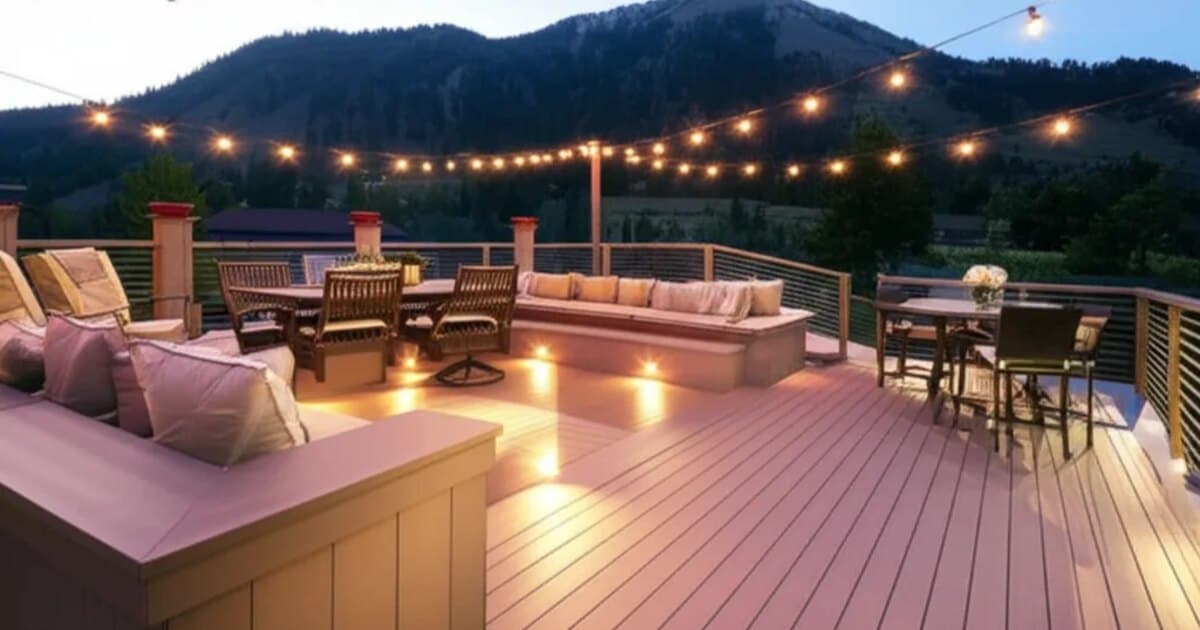
Decks & Patios in Boise, ID
Extend your living space outdoors with a custom deck or patio built for Idaho seasons. Iron Crest Remodel designs and constructs composite decks, wood decks, paver patios, stamped concrete, pergolas, and complete outdoor living areas.
- Composite decking (Trex, TimberTech, Fiberon)
- Pressure-treated and cedar wood decks
- Paver patio installation (interlocking, natural stone)
- Stamped and stained concrete patios
- Multi-level deck designs with stairs and landings
- Pergola, arbor, and shade structure integration
- Outdoor kitchen and fire pit preparation
- Cable, aluminum, and glass railing systems
- LED deck and patio lighting
- Under-deck drainage systems
Timeline
1 – 4 weeks
Site Assessment & Design
We evaluate your yard, grade, soil, drainage, and sun exposure. You receive a design with material options, dimensions, and a fixed-price estimate.
Permit & Engineering
Construction drawings are prepared and submitted for permits. Elevated decks require engineering. Patio projects typically do not require permits unless near property lines.
Foundation & Structure
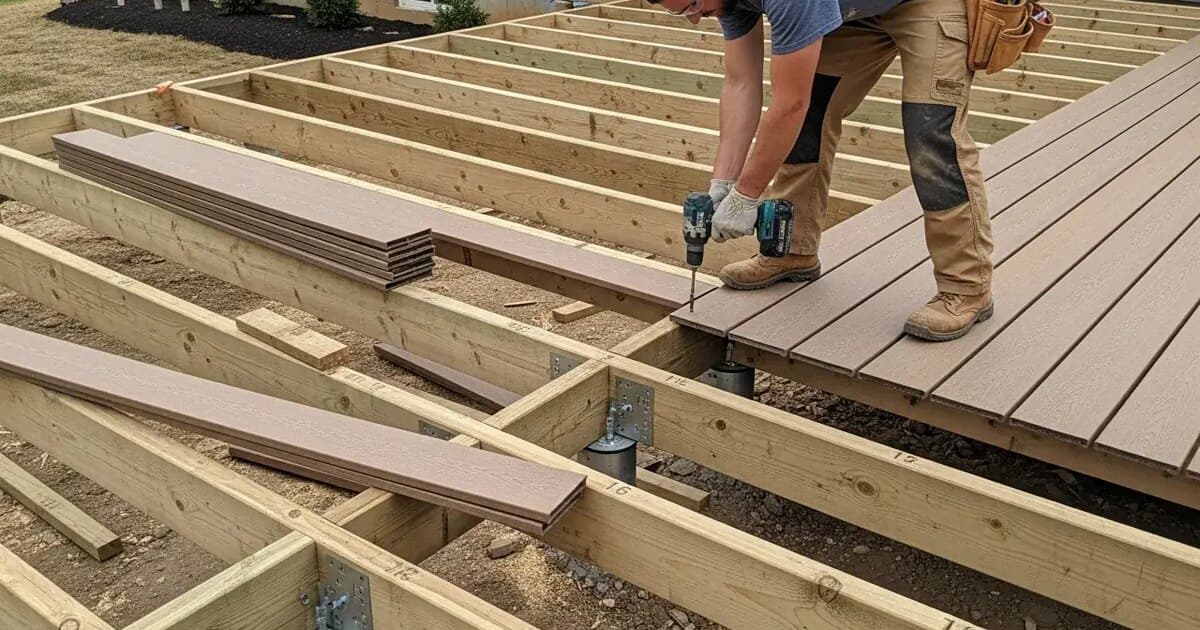
Deck footings are dug to 24-inch frost depth and poured. Patio base is excavated, graded, and compacted. Structural framing or base material is installed and inspected.
Surface & Finishing
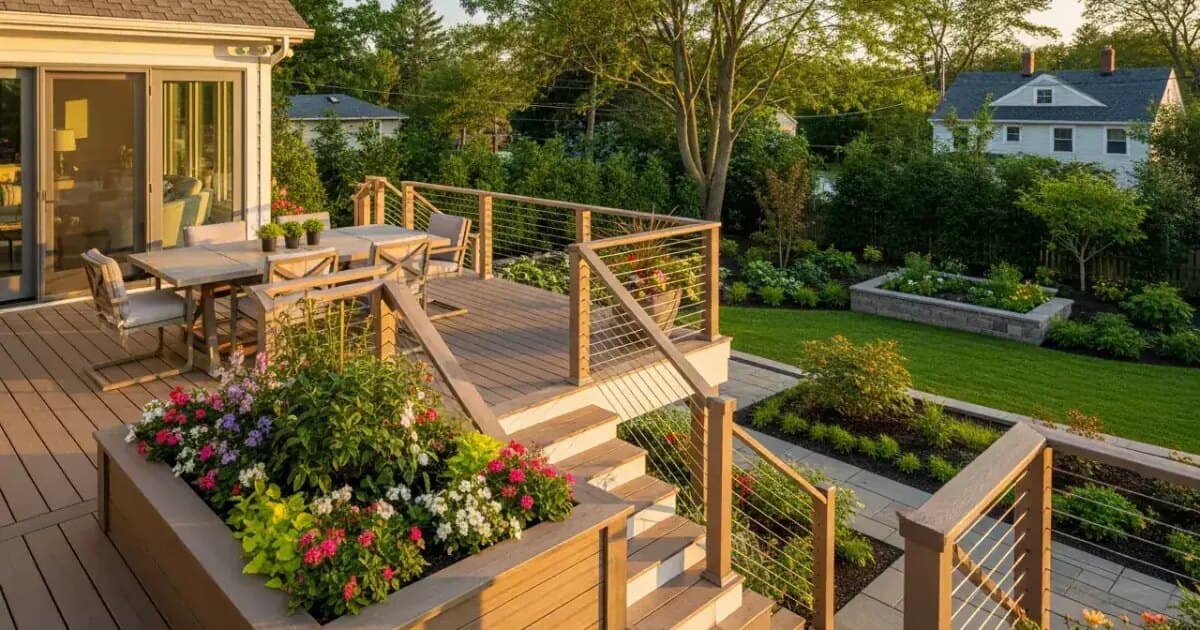
Decking boards, pavers, or concrete are installed. Railings, stairs, lighting, and accessories complete the project. Final inspection and care instructions provided.

See Your Remodel Before You Build.
Upload a few photos of your kitchen, bathroom, flooring, or exterior and get AI-generated concept visuals tailored to your space, style, and materials — free, no obligation, in about five minutes. Then request a real estimate from our licensed Boise team.
Free concept preview · No credit card · Licensed Idaho contractor
How much does a deck cost in Boise?
Composite decks in Boise typically cost $30–$60 per square foot installed. Pressure-treated wood runs $20–$40 per square foot. A standard 300 sq ft composite deck with railings and stairs costs $12,000–$20,000.
How much does a patio cost in Boise?
Paver patios cost $15–$30 per square foot installed. Stamped concrete runs $10–$20 per square foot. A 400 sq ft paver patio typically costs $6,000–$12,000 including base preparation and edging.
Deck vs. patio — which is better for my property?
Decks work best for elevated or sloped yards, second-story access, and homes where you want to be at floor level. Patios are ideal for flat yards, fire pit areas, and lower-maintenance ground-level outdoor spaces. Many homeowners combine both for maximum outdoor living flexibility.
Do I need a permit to build a deck or patio in Boise?
Decks over 30 inches above grade or attached to the house require a building permit in Boise and Ada County. Most patios at grade level do not require permits unless they affect drainage or setbacks. Iron Crest Remodel handles all permitting.
How deep do deck footings need to be in Idaho?
Deck footings in the Boise area must extend to 24 inches below grade to reach below the frost line. This prevents frost heave from shifting the deck structure. Ada County inspectors verify footing depth before framing can begin.
Not every decks & patios project is the same. Cosmetic updates are minor refreshes — not full remodels. Full remodels start at the Standard tier and above. Here are the most common scope levels we handle in the Boise area, with typical investment ranges.
Ground-Level Patio
$6,000 – $15,000
Paver or stamped concrete patio at grade. 200–400 sq ft with base preparation, edging, and basic landscaping integration.
Standard Deck
$12,000 – $25,000
300–500 sq ft composite or wood deck with railings, stairs, and basic lighting. Most common residential deck project.
Multi-Level Deck
$25,000 – $50,000+
Two or more connected deck levels with stairs, landings, railings, and integrated features like benches or planters.
Outdoor Living Suite
$40,000 – $80,000+
Deck or patio with pergola, outdoor kitchen prep area, fire pit, lighting, and integrated landscaping. Complete outdoor room.
Iron Crest coordinates trusted third-party financing for qualified homeowners — see financing options.
Remodeling in the Treasure Valley comes with local factors that affect scope, cost, and timeline. Here is what Boise-area homeowners should know.
Frost Line (24 inches)
All deck footings in Ada County must extend 24 inches below grade. Frost heave will shift footings that are too shallow, causing structural movement and railing misalignment over time.
UV and Temperature Extremes
Boise sees 200+ sunny days and temperature swings from -10°F to 105°F. Composite decking resists UV fading and thermal expansion better than wood. Dark-colored composites can reach 160°F surface temperature in direct summer sun.
Wildfire Considerations
Ada County foothills properties may fall within wildland-urban interface zones. Non-combustible decking (composite, aluminum) and ember-resistant design are recommended for foothill and bench-area homes.
Drainage and Grading
Patios require proper grading (1–2% slope away from the foundation) to prevent water pooling. Boise's clay-heavy soils in some areas drain poorly and may need French drain integration.
Choosing between composite deck and paver patio? Here is a side-by-side comparison to help you decide.
| Factor | Composite Deck | Paver Patio |
|---|---|---|
| Cost (installed) | $30–$60/sq ft | $15–$30/sq ft |
| Maintenance | Minimal (wash annually) | Minimal (re-sand joints every 3–5 yrs) |
| Lifespan | 25–50 years (warranty) | 25–50+ years |
| Best For | Elevated, multi-level, entertaining | Ground-level, fire pits, low profile |
| Permits Required | Yes (if >30" above grade) | Rarely (at grade level) |
Plan your decks & patios project with our in-depth guides.

Talk to a real project manager
Have Questions? Call Now for a Free In-Home Consultation.
Mon–Fri 7 AM–6 PM · Licensed & insured · No obligation
Russ S. — Project Manager
Russ S. — Project Manager
Ready to Start Your Remodeling Project?
Get a free, no-obligation estimate from Boise's trusted remodeling experts. Licensed, insured, and ready to build.
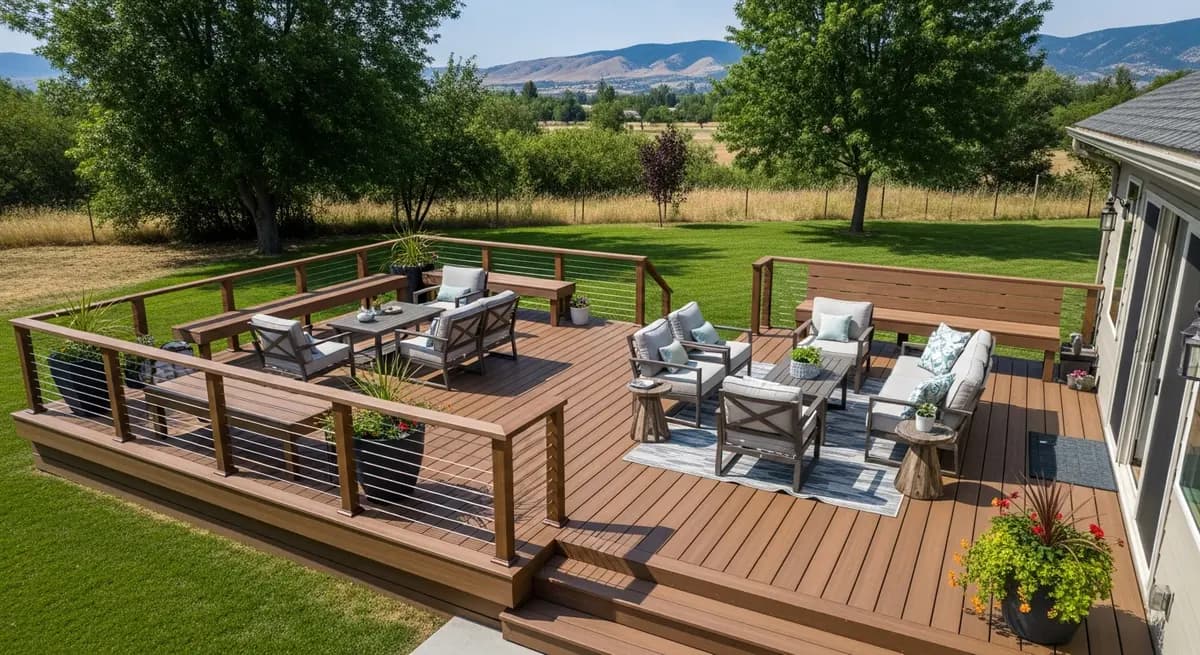
The fundamental choice in outdoor living design is whether to build up (a deck) or build out (a patio). Both create functional outdoor living space, but they solve different problems and work best on different properties. Understanding these differences is the first step toward maximizing your investment.
| Factor | Deck | Patio |
|---|---|---|
| Best Lot Type | Sloped, elevated, or walk-out lots | Flat or gently sloping lots |
| Structure | Elevated on posts and footings | Ground-level on compacted base |
| Typical Cost/Sq Ft | $20–$65 (material dependent) | $8–$50 (material dependent) |
| Permit Required | Yes (over 30" above grade) | Usually no (ground-level) |
| Materials | Wood, composite, PVC | Pavers, stamped concrete, flagstone |
| Lifespan | 15–50 years (material dependent) | 25–50+ years |
| Maintenance | Low (composite) to high (wood) | Very low (occasional sealing/re-sanding) |
| Main Floor Access | Direct step-out access | Requires stairs from elevated doors |
| Space Below | Usable for storage/covered patio | N/A (at grade) |
| Fire Pit Integration | Limited (safety concerns) | Ideal (ground-level, non-combustible) |
Many Boise homeowners get the best of both worlds by building a combined deck-and-patio design: an elevated deck off the main floor for dining with stairs leading to a paver patio at grade for a fire pit and lounge seating. This combination takes advantage of grade changes common across the Treasure Valley.
The patio material you choose determines appearance, durability, maintenance commitment, and how the surface performs through Idaho's demanding freeze-thaw cycles. Each option has distinct advantages depending on your aesthetic preferences, budget, and intended use.
Interlocking Concrete Pavers
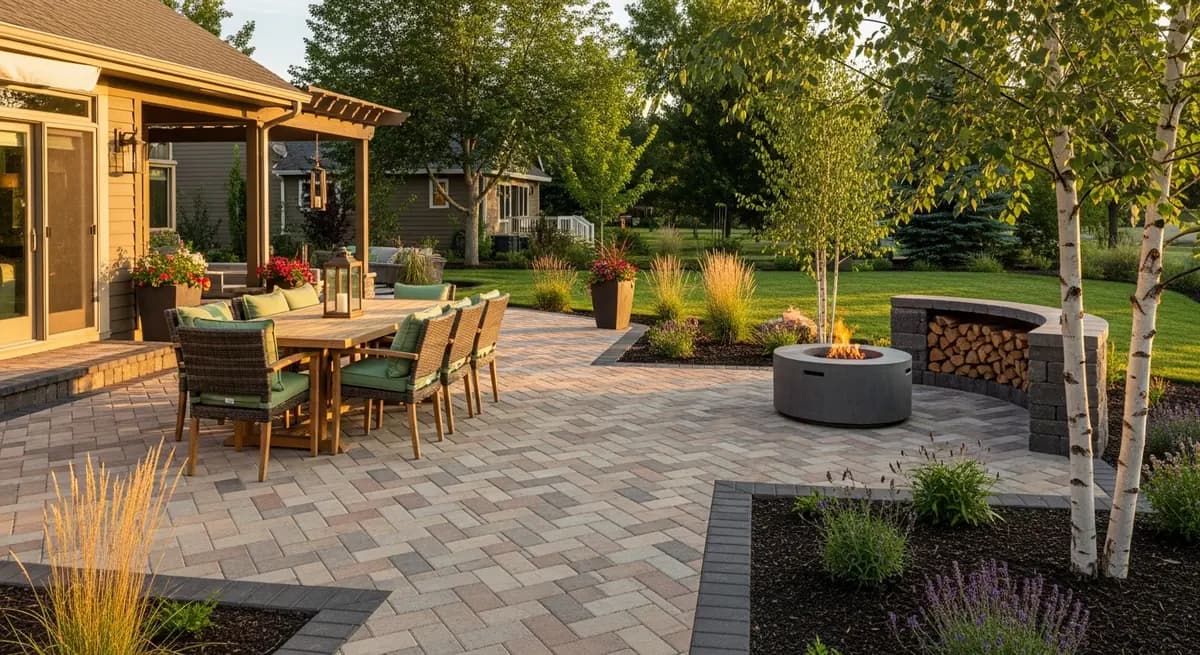
Concrete pavers are the most popular patio surface in the Treasure Valley. They come in dozens of shapes, colors, and patterns — from traditional brick-style rectangles to modern large-format slabs. Interlocking pavers are laid on a compacted gravel base with a sand leveling layer, then locked together with polymeric sand in the joints. This system is flexible by design: individual pavers can shift slightly during freeze-thaw cycles without cracking, and any damaged or stained paver can be replaced individually without disturbing the surrounding surface. Pavers are rated for vehicular loads and are among the most durable patio surfaces available. Cost: $15–$30 per square foot installed with standard base preparation.
Stamped Concrete
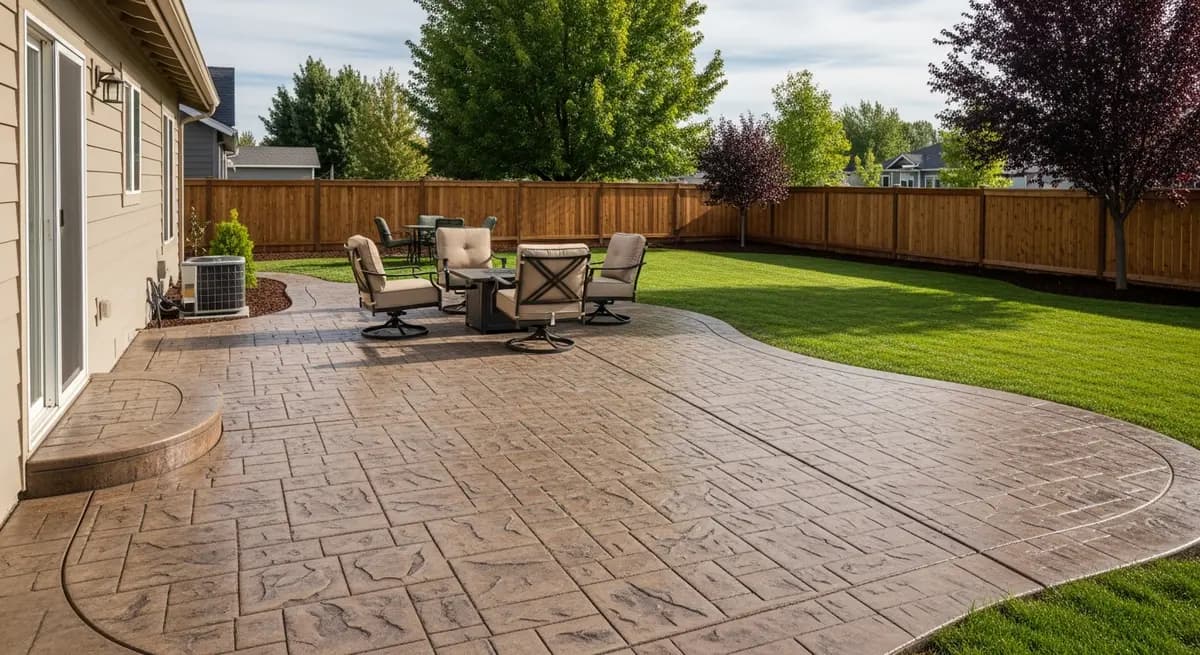
Stamped concrete uses patterns pressed into freshly poured concrete to replicate the appearance of natural stone, brick, slate, or tile. Integral color and release agents create realistic coloring, and a clear sealant protects the surface and enhances the pattern depth. Stamped concrete is a monolithic surface — no joints for weeds, no individual units to shift. The trade-off is that it can crack along control joints (a normal concrete characteristic) and requires sealant reapplication every 2–3 years. In Boise's climate, the sealant is essential to prevent freeze-thaw damage from water penetrating the surface. Cost: $12–$25 per square foot installed, making it often the most affordable way to achieve a natural stone appearance.
Natural Flagstone
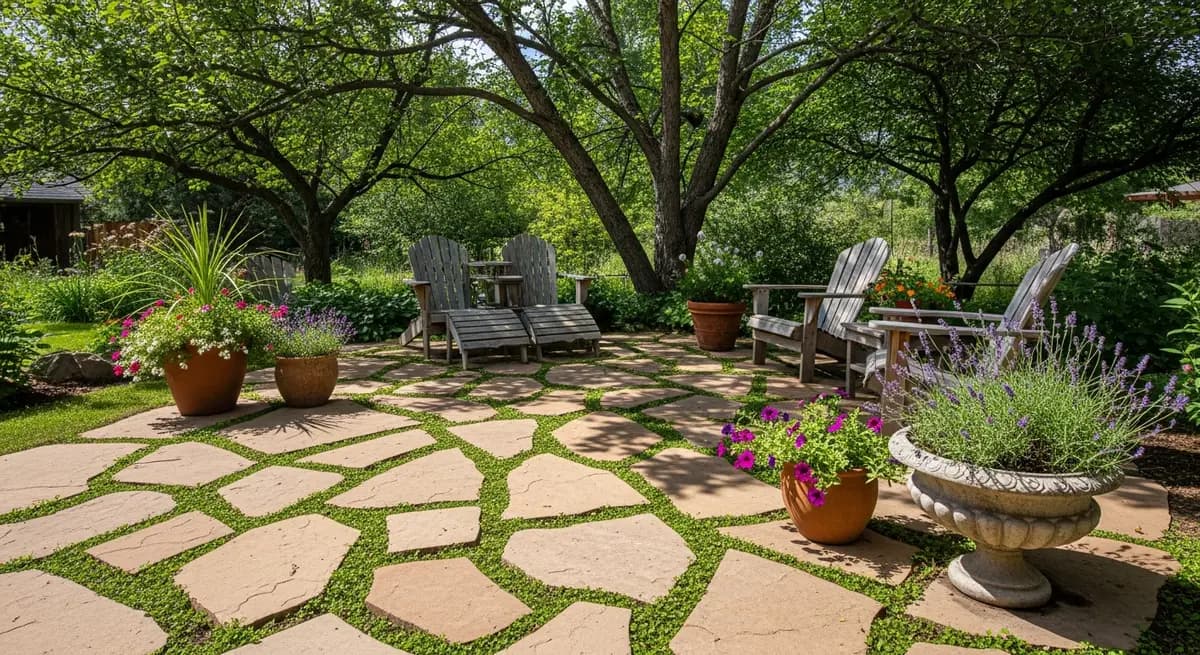
Natural flagstone creates a one-of-a-kind surface with irregular stone shapes fitted together like a puzzle. Local stone varieties include Idaho quartzite (blue-gray tones), Utah sandstone (warm red and tan), and Montana slate (dark gray to charcoal). Flagstone can be laid on a sand and gravel base (dry-laid) with gravel, moss, or groundcover between the stones for a natural look, or set in a mortar bed on a concrete slab (wet-laid) for a more refined, flush surface. Dry-laid flagstone handles Boise's freeze-thaw better than wet-laid because individual stones can shift independently without cracking. Flagstone is exceptionally durable — natural stone outlasts any manufactured surface. Cost: $20–$40 per square foot installed (dry-laid) or $25–$50+ per square foot (wet-laid on concrete).
Poured Concrete with Exposed Aggregate
Standard poured concrete with an exposed aggregate finish offers a clean, modern look with excellent slip resistance. The aggregate (small stones mixed into the concrete) is revealed by washing the surface before the concrete fully cures, creating a textured, durable surface. Exposed aggregate handles Boise winters well because the textured surface provides traction on wet or icy mornings. It is the most affordable patio option at $8–$15 per square foot installed, making it ideal for large patios where material cost is a primary concern. A quality sealant every 2–3 years protects the surface and prevents aggregate pop-outs from freeze-thaw cycling.
Porcelain Pavers
Porcelain pavers are a premium option that combines the look of natural stone or wood with near-zero water absorption (less than 0.5%). This makes them virtually freeze-thaw proof — water cannot penetrate the surface to cause cracking or scaling. Porcelain pavers come in large formats (24×24 and 24×48 inches) and are available in wood-plank, stone, and concrete textures. They are stain-resistant, fade-resistant, and do not require sealing. The trade-off is cost: $25–$50 per square foot installed. Porcelain pavers are best for homeowners who want a premium, maintenance-free surface that will look new for decades.
Decking material selection determines your upfront cost, long-term maintenance commitment, and how the deck performs through Idaho's demanding climate — where temperatures swing from single digits in January to triple digits in July and UV exposure is intense at 2,700+ feet of elevation.
| Material | Cost / Sq Ft | Lifespan | Maintenance | Best For |
|---|---|---|---|---|
| Pressure-Treated Pine | $20–$35 | 15–20 yrs | Annual stain/seal | Budget projects |
| Western Red Cedar | $28–$45 | 20–25 yrs | Annual oil/stain | Natural wood aesthetic |
| Redwood | $35–$55 | 25–30 yrs | Annual oil/seal | Premium natural look |
| Trex Composite | $35–$55 | 25–30 yrs | Soap & water | Low maintenance |
| TimberTech AZEK PVC | $45–$65 | 30–50 yrs | Soap & water | Near water / max durability |
Composite and PVC decking cost more upfront but eliminate annual maintenance costs entirely. By year 8–10, the total cost of ownership for composite equals pressure-treated wood — and every year after that, composite saves money. For a deep dive into deck materials including structural requirements, railing options, and maintenance schedules, see our comprehensive deck builder guide.
Costs vary by material, size, elevation, and features. Below are typical Treasure Valley price ranges, including materials, labor, base preparation (patios), structural framing (decks), and standard finishes.
Patio Costs by Material and Size
| Patio Material | 200 Sq Ft | 400 Sq Ft | 600 Sq Ft |
|---|---|---|---|
| Exposed Aggregate Concrete | $1,600–$3,000 | $3,200–$6,000 | $4,800–$9,000 |
| Stamped Concrete | $2,400–$5,000 | $4,800–$10,000 | $7,200–$15,000 |
| Concrete Pavers | $3,000–$6,000 | $6,000–$12,000 | $9,000–$18,000 |
| Natural Flagstone (Dry-Laid) | $4,000–$8,000 | $8,000–$16,000 | $12,000–$24,000 |
| Porcelain Pavers | $5,000–$10,000 | $10,000–$20,000 | $15,000–$30,000 |
Deck Costs by Material and Size
| Deck Material | 200 Sq Ft | 350 Sq Ft | 500 Sq Ft |
|---|---|---|---|
| Pressure-Treated Wood | $4,000–$7,000 | $7,000–$12,250 | $10,000–$17,500 |
| Western Red Cedar | $5,600–$9,000 | $9,800–$15,750 | $14,000–$22,500 |
| Trex Composite | $7,000–$11,000 | $12,250–$19,250 | $17,500–$27,500 |
| TimberTech AZEK PVC | $9,000–$13,000 | $15,750–$22,750 | $22,500–$32,500 |
Popular Add-On Features
| Feature | Typical Cost |
|---|---|
| Built-in fire pit (gas or wood-burning) | $2,000–$6,000 |
| Outdoor kitchen island (built-in grill, counter) | $5,000–$15,000 |
| Pergola (wood or aluminum) | $3,000–$12,000 |
| LED landscape & deck lighting | $800–$3,000 |
| Seat walls (paver or stone) | $50–$100 per linear foot |
| Retaining walls (if grade requires) | $25–$50 per sq ft of face |
| Hot tub pad (reinforced) | $1,500–$4,000 |
| Under-deck drainage system | $5–$8 per sq ft |
| Aluminum railings (per linear foot) | $30–$50 per LF |
| Cable railings (per linear foot) | $50–$80 per LF |
The base beneath a patio is invisible once the project is complete — but it determines whether the surface stays level, drains properly, and survives Boise's 100+ annual freeze-thaw cycles without shifting or heaving. Cutting corners on base preparation is the number-one cause of patio failure in the Treasure Valley.
Excavation and Subgrade
We excavate 8–12 inches below finished grade to accommodate the gravel base, sand layer, and paver thickness. The subgrade (native soil) is compacted with a plate compactor to prevent settling. In areas with expansive clay soil — common in Boise Bench neighborhoods, parts of Eagle, and southern Meridian — we excavate deeper and add additional gravel to create a buffer between the clay and the patio surface. Clay soil expands when wet and contracts when dry, causing differential movement that cracks rigid surfaces.
Gravel Base Layer
A 4–6 inch layer of compacted 3/4-inch crushed gravel (road base) provides the structural foundation for the patio. This layer distributes weight, provides drainage below the surface, and prevents frost heave by allowing water to drain away from the bottom of the pavers. We compact the gravel in 2-inch lifts with a plate compactor to achieve 95%+ compaction density. Proper compaction at this stage prevents settling that causes uneven surfaces, tripping hazards, and water pooling.
Sand Leveling Layer
A 1-inch layer of coarse bedding sand (ASTM C33 concrete sand) is screeded level on top of the compacted gravel. This layer provides a smooth, level surface for setting pavers and allows fine-grain drainage through the joints. We use screed rails and a straightedge to achieve level accuracy within 1/8 inch over 10 feet. The sand layer is NOT compacted before setting pavers — the pavers are set on the loose sand and then the entire surface is compacted together, locking the pavers into the sand bed.
Slope and Drainage
Every patio must slope away from the house foundation at a minimum 1% grade (1/8 inch per foot). This prevents water from pooling against the foundation wall and ensures surface runoff drains toward the yard. For patios adjacent to the house, we also install a perimeter drain (French drain or channel drain) to capture runoff before it reaches the foundation. Boise's dry climate makes drainage seem less critical — but spring snowmelt and summer thunderstorms can deliver heavy water volumes quickly. Proper drainage is non-negotiable.
Edge Restraints
Paver patios require rigid edge restraints — typically aluminum or plastic paver edging secured with 10-inch spikes — to prevent the outer row of pavers from migrating outward over time. Without edge restraints, foot traffic and freeze-thaw cycles gradually push pavers apart, opening joints and destabilizing the surface. We install edge restraints on all sides where the patio meets soil or lawn, spiked into the compacted gravel base. Where the patio meets the house, the foundation wall serves as a natural edge restraint.
The Treasure Valley's climate, soil, and regulations create specific considerations for deck and patio projects that contractors from other regions may not account for.
Freeze-Thaw Performance
Boise averages 100+ freeze-thaw cycles per year — far more than many homeowners realize. Temperatures frequently cross the 32°F threshold during fall, winter, and spring nights, then warm above freezing during the day. This constant cycling causes water to repeatedly expand and contract within porous materials, leading to surface scaling, cracking, and structural damage over time. Material choices that minimize water absorption — porcelain pavers, PVC decking, properly sealed concrete — perform best in this environment.
UV Exposure at 2,700+ Feet
Boise's elevation increases UV radiation intensity compared to sea-level locations. This accelerates fading and surface degradation on wood decking, patio sealants, and furniture. UV-resistant materials (composite decking with polymer caps, porcelain pavers, and UV-stable sealants) are essential investments. Wood decking requires UV-blocking stains reapplied every 1–2 years; stamped concrete needs UV-resistant sealant every 2–3 years.
Building Season and Timing
The optimal building season for outdoor projects in Boise runs April through October. Spring (April–June) and fall (September–October) offer the most comfortable working conditions and competitive scheduling. Summer projects are feasible but demand peaks June through August, which can extend lead times. Concrete work (stamped patios, deck footings) requires temperatures above 50°F for proper curing. We can pour concrete in November through March using heated enclosures and curing blankets, but this adds cost and is best avoided when scheduling allows.
Wildfire-Urban Interface Zones
Properties in the Boise foothills, northeast Eagle, and hillside areas along Table Rock are within wildfire-urban interface zones. Decks in WUI zones must use non-combustible materials (composite, PVC, or aluminum) and include enclosed undersides with ember-resistant screening. Patios are inherently fire-resistant (concrete, stone, pavers) and are often the preferred outdoor surface in WUI zones. We assess WUI classification during the design phase and specify compliant materials.
Permits and Setbacks
Decks over 30 inches above grade require building permits from the City of Boise or Ada County Development Services. Ground-level patios typically do not require permits unless they include permanent structures (pergolas, gas lines, electrical). All structures must comply with property line setbacks — rear yard setbacks of 15–20 feet and side yard setbacks of 5–10 feet apply depending on zone. HOA review may be required in many Eagle, Meridian, and Star subdivisions. We verify all requirements during the design consultation.
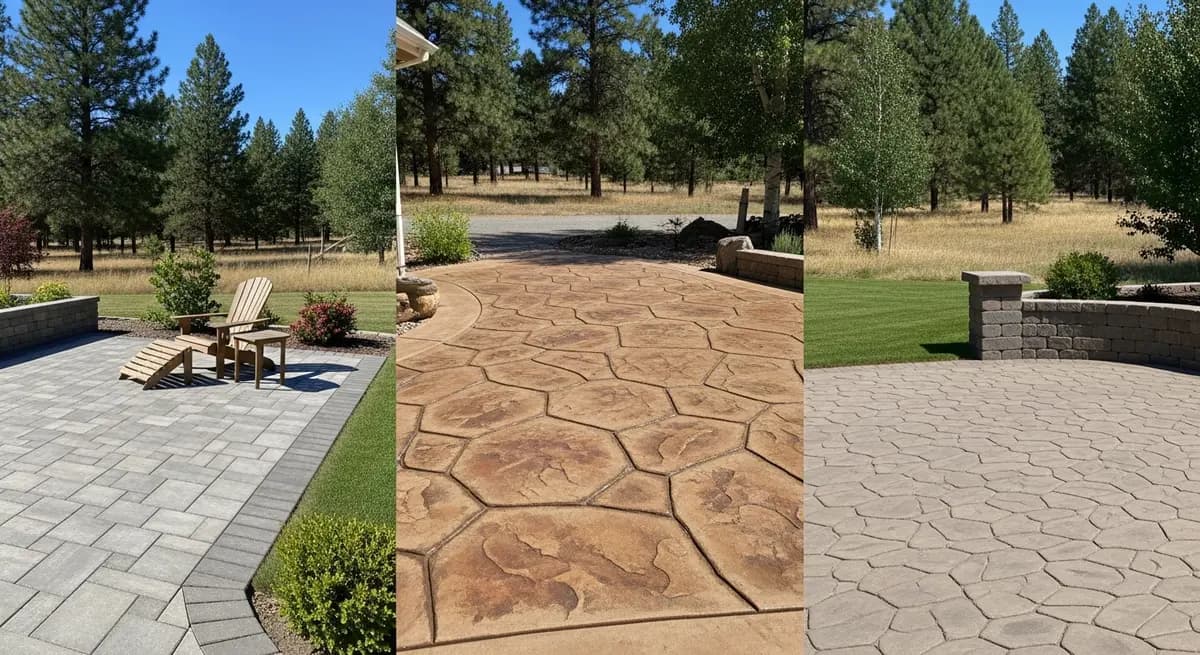
A deck or patio is the foundation — the features you add on top transform it into a complete outdoor living space. Boise's climate supports 7–8 months of outdoor use (March through October, with comfortable evenings May through September), making these investments highly usable.
Fire Pits and Fireplaces
A fire pit extends outdoor season by 4–6 weeks in spring and fall, making your patio comfortable when evening temperatures drop into the 40s and 50s. Options include natural gas fire pits (clean, instant on/off, no ash, $2,000–$4,500 installed), wood-burning fire pits (traditional ambiance, lower cost, $1,500–$3,500 installed), and outdoor fireplaces (permanent masonry or stone structure, $5,000–$15,000+). Gas fire pits require a gas line from the house — we coordinate with Intermountain Gas for connection. Fire pits must be placed on non-combustible surfaces (paver or concrete patios are ideal) with adequate clearance from structures and property lines per Boise fire code.
Outdoor Kitchens
Outdoor kitchens range from a simple built-in grill island ($5,000–$8,000) to full outdoor cooking stations with grill, side burner, sink, refrigerator, and countertop space ($10,000–$25,000+). Counter materials include granite, concrete, and porcelain — all weather-resistant in Boise's climate. Outdoor kitchens require gas line, water supply, electrical, and drain connections. We recommend placing outdoor kitchens on paver or concrete patios (not wood decks) for fire safety and to support the weight of counters and appliances.
Pergolas and Shade Structures
Shade is essential for comfortable summer use — south- and west-facing decks and patios can be uncomfortably hot during July and August afternoons. Pergola options include cedar or treated lumber (traditional, $3,000–$8,000), aluminum (modern, maintenance-free, $5,000–$12,000), and vinyl ($4,000–$10,000). Pergolas attached to the house require building permits. Retractable shade canopies ($1,500–$4,000) and shade sails ($500–$2,000) provide flexible options that can be adjusted for sun angle. Louvered pergolas ($8,000–$18,000) offer motorized louvers that rotate to control sun exposure — open for winter warmth, closed for summer shade.
Lighting
Integrated LED lighting extends outdoor use after sunset and enhances safety on stairs and pathways. Common configurations include recessed stair lights ($30–$60 per light), post cap lights ($40–$80 per light), under-rail strip lighting ($15–$25 per linear foot), and in-ground path lights for patio walkways ($50–$100 per fixture). Low-voltage LED systems are energy-efficient, long-lasting, and can be controlled by timer, dimmer, or smart home integration. A complete deck or patio lighting package typically runs $800–$3,000 installed.
Your outdoor space layout should complement your home's architecture, work with your lot's topography, and support how you actually use outdoor space. Boise's neighborhoods present a wide range of conditions — from flat subdivision lots in Meridian and Kuna to sloped foothills properties in northeast Boise and Eagle.
Flat Lot Designs (Meridian, Nampa, Star, Kuna)
Flat lots are ideal for ground-level patios that extend the living space at grade. Large-format paver patios with defined zones — dining area, fire pit circle, lounge seating — work beautifully on flat terrain. Ground-level platform decks (under 30 inches) are also excellent for flat lots, often eliminating the need for expensive footings. If the main floor is elevated 3+ feet above grade, an elevated deck with stairs to a patio below creates a multi-level outdoor living space on an otherwise single-plane lot.
Sloped Lot Designs (Boise Foothills, Eagle, East Bench)
Sloped lots offer excellent multi-level deck opportunities. The grade change creates natural elevation differences for distinct outdoor zones — an upper deck for dining off the main floor, a mid-level landing, and a lower patio at grade for a fire pit or hot tub. Retaining walls integrated into the patio design manage slope and create level areas on otherwise unusable terrain. Under-deck drainage systems capture water from the upper deck and channel it away, creating dry usable space beneath elevated sections.
Combined Deck-and-Patio Designs
The most popular outdoor living configuration we build combines an elevated composite deck (for dining, grilling, and direct house access) with a paver or flagstone patio at grade (for fire pit, lounge seating, and ground-level entertaining). Building both together saves 10–15% compared to separate projects — shared mobilization, excavation, and cleanup costs. The design coordinates materials and colors so the deck and patio flow as one cohesive outdoor room.
Maintenance requirements vary dramatically by material. Boise's climate creates specific challenges: intense UV causes fading, low humidity dries out wood, and 100+ freeze-thaw cycles work moisture into every crack and joint.
Deck Maintenance
- Wood decks: power wash, sand, and re-stain every 1–2 years ($500–$1,200/year)
- Composite/PVC decks: wash with soap and water 1–2x per year ($0–$100/year)
- Inspect fasteners and post bases annually for loosening or settling
- Clear debris from board gaps to prevent moisture retention
- Remove snow with plastic shovels to avoid scratching deck surface
Patio Maintenance
- Pavers: re-apply polymeric sand every 2–3 years to maintain joint integrity
- Stamped concrete: re-seal every 2–3 years to protect color and prevent water penetration
- Flagstone: replace displaced joint material (gravel or sand) as needed
- All types: sweep debris regularly to prevent staining and organic growth
- Address any settled or shifted pavers immediately to prevent trip hazards
Whether you're building a deck, a patio, or both — here's a checklist to keep your project organized from concept through completion.
Before Design
- Determine primary use: dining, lounging, fire pit, hot tub, cooking
- Identify preferred surface type: deck, patio, or combination
- Measure available space and note grade changes
- Check property line setbacks and HOA requirements
- Set budget range (including add-on features)
- Consider orientation for sun/shade preferences
During Design & Construction
- Finalize material selections (samples available)
- Confirm utility locations (gas, water, electrical for features)
- Submit permit application (decks over 30" above grade)
- Schedule project for optimal building season (April–October)
- Plan landscape restoration around construction zone
- Coordinate furniture and accessory purchases with completion date
Explore our in-depth guides to plan your Boise outdoor living project with confidence.
Is a deck or a patio better for my Boise backyard?
The best choice depends on your lot, budget, and how you use outdoor space. Decks are ideal for homes with grade changes, walk-out basements, or elevated main floors — they create level outdoor living space where the ground slopes away. Patios work best on flat or gently sloping lots and provide a ground-level surface with no height limitations. Patios are typically less expensive per square foot and require less structural engineering. Decks offer better ventilation, elevated views, and direct access from upper-level doors. Many Boise homeowners build both — a deck off the main floor for dining and a patio at grade for a fire pit or lounge area.
How much does a paver patio cost in Boise?
Paver patio costs in Boise range from $15–$30 per square foot installed for standard concrete pavers to $25–$50+ per square foot for premium natural stone or porcelain pavers. A typical 300-square-foot paver patio costs $4,500–$9,000 with standard pavers and base preparation. Add-ons like a fire pit ($2,000–$6,000), seat walls ($50–$100 per linear foot), and landscape lighting ($800–$2,500) increase the total. The base preparation (excavation, compacted gravel, sand leveling) represents 30–40% of the total cost and is critical for long-term stability in Boise's freeze-thaw climate.
Do I need a permit to build a patio in Boise?
In most cases, a standard ground-level patio does not require a building permit in Boise or Ada County. However, permits may be required if the patio includes a permanent structure (pergola, covered roof), includes gas lines for a fire pit or outdoor kitchen, involves retaining walls over 4 feet tall, or alters drainage patterns that affect neighboring properties. Covered patios and pergolas attached to the house almost always require permits. Iron Crest verifies permit requirements for every project during the design phase.
How long does a stamped concrete patio last in Idaho's climate?
A properly installed stamped concrete patio lasts 25–30+ years in Boise's climate. The key to longevity is correct base preparation (4–6 inches of compacted gravel), adequate concrete thickness (minimum 4 inches, 5–6 inches for vehicular areas), proper control joints to manage cracking, and high-quality sealant reapplication every 2–3 years. Idaho's freeze-thaw cycles are the primary stress factor — water that penetrates the surface can expand when frozen and cause surface scaling. Quality sealant prevents water penetration and protects the color and texture of the stamped pattern.
Can you build a deck and patio as one combined project?
Absolutely — and this is one of the most popular configurations we build. A combined deck-and-patio project typically features an elevated deck off the main floor (for dining and grilling) with stairs leading down to a paver or stamped concrete patio at grade (for a fire pit, lounge seating, or hot tub). Building both together saves 10–15% compared to separate projects because we share site mobilization, equipment, excavation, and disposal costs. The design is coordinated so materials, colors, and style flow seamlessly between the two spaces.
We provide deck building to homeowners across the Treasure Valley and southwest Idaho. Each city has its own dedicated page with local permitting, climate, and project detail — and each county hub covers the surrounding communities we also serve.
Ready to Start Your Remodeling Project?
Get a free, no-obligation estimate from Boise's trusted remodeling experts. Licensed, insured, and ready to build.