Deck Builder Services
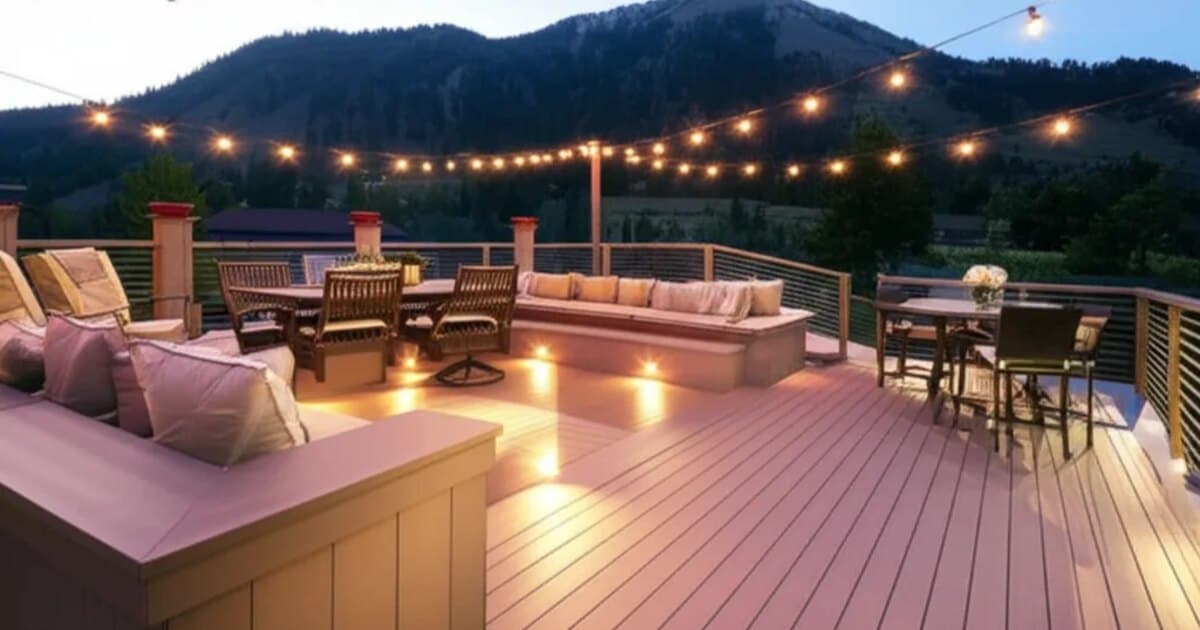
Iron Crest Remodel designs and builds custom decks that extend your living space outdoors. Composite, hardwood, and pressure-treated options with railings, stairs, built-in seating, and pergola integration — engineered for Idaho seasons.

- Composite decking (Trex, TimberTech, Fiberon)
- Pressure-treated and cedar wood decks
- Multi-level deck designs
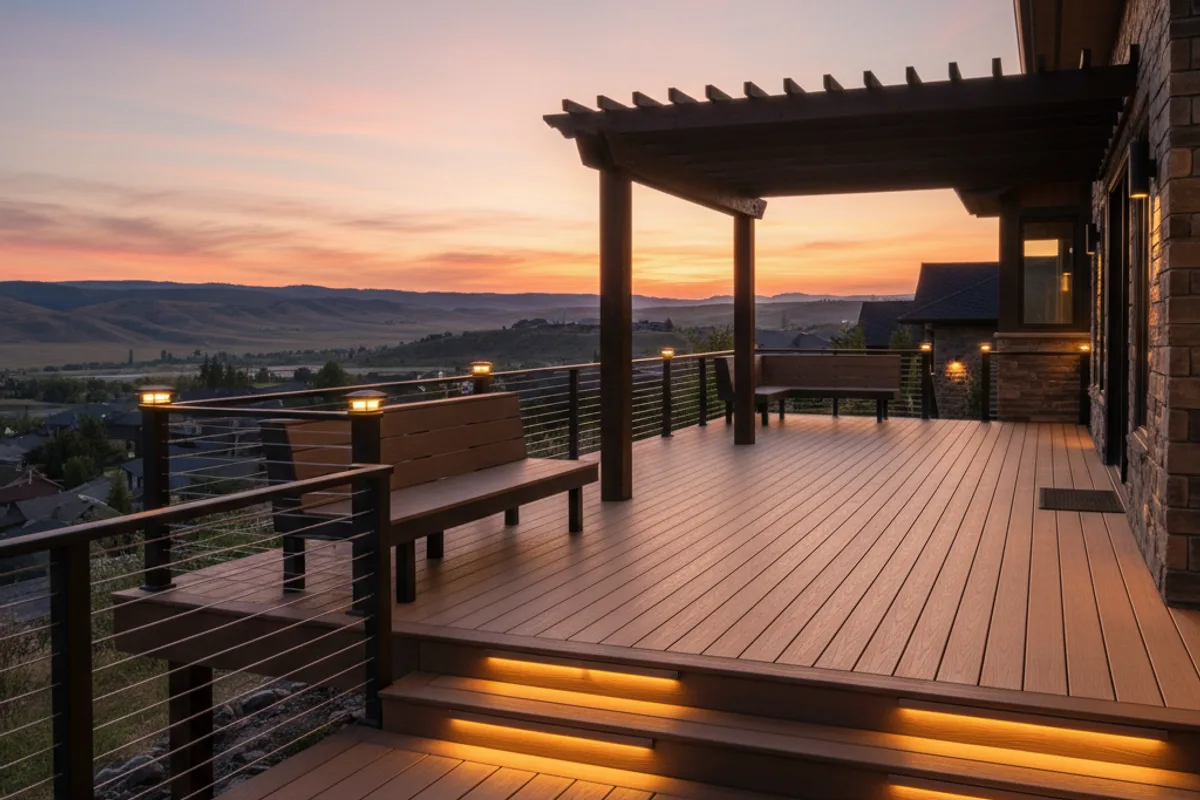
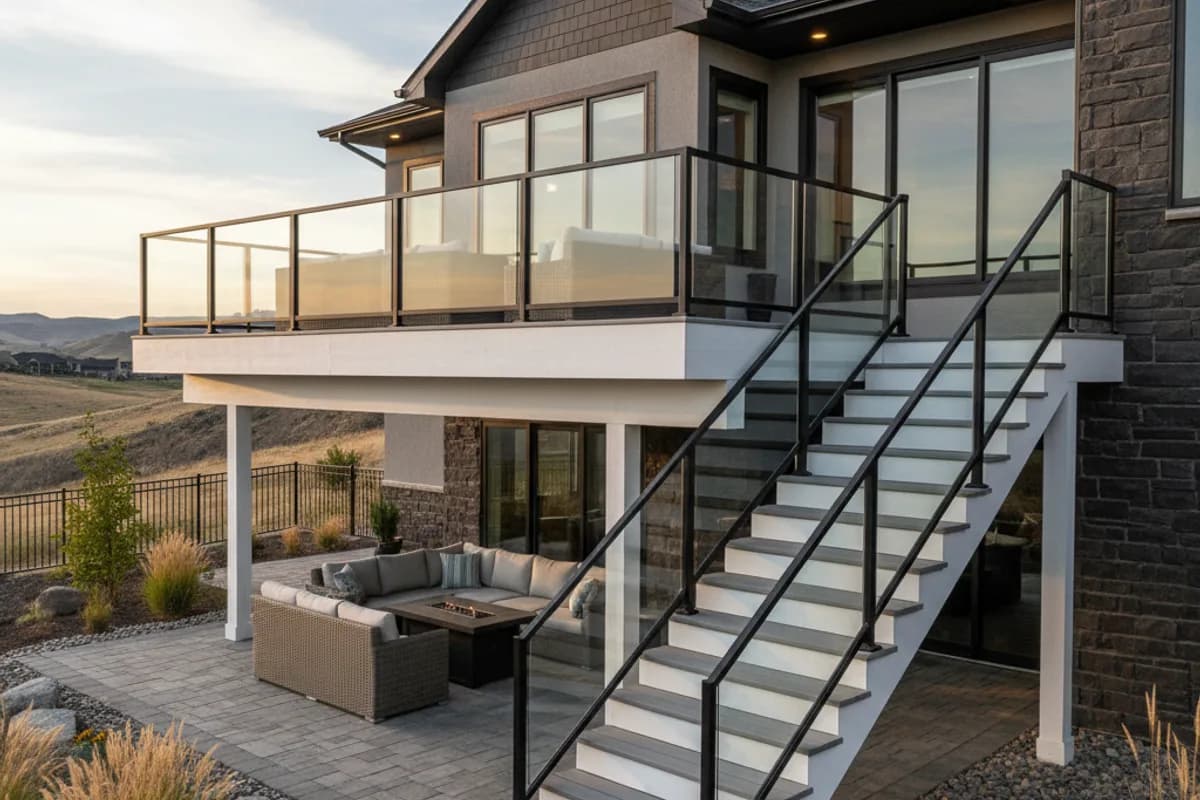
- Cable, aluminum, and glass railing systems
- Stair and landing construction
- Pergola and shade structure integration
- Built-in bench and planter construction
- Under-deck drainage systems
- LED deck lighting
- Deck resurfacing and repair
Timeline
2 – 4 weeks
Design Consultation
We visit your property, assess the site, discuss your outdoor living goals, and develop a deck design with material options, size, and features.
Permit & Engineering
We prepare construction drawings, submit permit applications, and coordinate any required engineering for elevated decks or complex structures.
Foundation & Framing
Footings are dug and poured, posts set, and the structural frame is built with proper spacing and hardware. All framing is inspected before decking.
Decking & Finishing
Deck boards, railings, stairs, lighting, and accessories are installed. Final inspection, cleanup, and care instructions provided.
How much does a deck cost in Boise?
Decks in Boise typically cost $30-$60 per square foot for composite and $20-$40 per square foot for pressure-treated wood. A standard 300 sq ft composite deck runs $12,000-$20,000 including railings and stairs.
Composite vs. wood — which is better for Idaho?
Composite decking handles Idaho extremes better — it resists UV fading, moisture damage, and does not splinter, crack, or require annual staining. Wood costs less upfront but requires annual maintenance. We recommend composite for long-term value.
Do I need a permit to build a deck in Boise?
Yes. Most deck projects in Boise and Ada County require a building permit, especially if the deck is over 30 inches above grade or attached to the house. Iron Crest Remodel handles all permit applications and inspections.
Plan your deck builder project with our in-depth guides.
Explore our in-depth guides to understand deck builder costs, timelines, and planning details for cities across the Treasure Valley.
See detailed deck builder information specific to your city, including local permit requirements, housing stock insights, and neighborhood-level recommendations.
Ready to Start Your Remodeling Project?
Get a free, no-obligation estimate from Boise's trusted remodeling experts. Licensed, insured, and ready to build.
Explore our detailed guides for each decking material and component. Compare costs, maintenance, lifespan, and climate performance for your Boise deck project.
Not sure which decking material to choose or when to build? Our comparisons, ROI analysis, and seasonal timing guides cover everything for Boise decks.

Choosing the right decking material is the single most important decision in your project. It determines your upfront cost, annual maintenance commitment, lifespan, and how the deck performs through Idaho's demanding climate — where temperatures swing from single digits in January to triple digits in July, UV exposure is intense at 2,700+ feet of elevation, and freeze-thaw cycles can exceed 100 per winter.
Pressure-Treated Lumber
Pressure-treated southern yellow pine is the most affordable decking material and the most common choice for budget-conscious projects. It accepts stain well, is widely available at Boise lumber yards, and has adequate structural strength. The trade-off is maintenance: pressure-treated lumber must be cleaned, sanded, and re-stained every 1–2 years to prevent graying, splintering, and surface checking. In Boise's dry climate, untreated boards can crack and split within 2–3 seasons as moisture evaporates rapidly from the wood cells. Expect a 15–20 year lifespan with diligent maintenance, or 8–12 years without it. Cost: $20–$35 per square foot installed.
Western Red Cedar
Cedar is naturally resistant to rot, insects, and moisture thanks to its high tannin content. It has a warm, rich appearance that many Boise homeowners prefer over treated pine. However, cedar is significantly more expensive than pressure-treated lumber and still requires annual maintenance — oiling or staining to preserve its color and prevent surface weathering. Without treatment, cedar weathers to a silver-gray within 1–2 years. Cedar is softer than treated pine, which means it dents and scratches more easily under furniture and foot traffic. Expect a 20–25 year lifespan with proper maintenance. Cost: $28–$45 per square foot installed.
Redwood
Redwood is a premium natural wood with exceptional beauty and natural decay resistance. It is the most dimensionally stable softwood, meaning it resists warping and cupping better than cedar or treated pine — a significant advantage in Boise's low-humidity environment. The downside is cost and availability: redwood is substantially more expensive than cedar and increasingly difficult to source sustainably. We recommend redwood primarily for high-visibility applications like front-facing decks or poolside surrounds where its appearance justifies the investment. Expect a 25–30 year lifespan. Cost: $35–$55 per square foot installed.
Trex Composite Decking
Trex is the most widely recognized composite decking brand and our most-requested material. Trex boards are made from a blend of recycled wood fibers and polyethylene plastic, capped with a protective polymer shell that resists fading, staining, scratching, and mold. The Trex Transcend and Trex Enhance lines handle Boise's UV exposure well — the shell blocks UV penetration that causes color fading. Trex carries a 25-year limited residential warranty on both fading and staining. No sanding, staining, or sealing is ever required. The primary drawback is heat retention: composite boards can get hot underfoot in direct afternoon sun during Boise summers. Lighter color options mitigate this. Cost: $35–$55 per square foot installed.
TimberTech AZEK PVC Decking
TimberTech AZEK is a full PVC (polyvinyl chloride) decking product — no wood fibers at all. This makes it the most moisture-resistant decking material available: it will not absorb water, swell, rot, or support mold growth under any conditions. AZEK boards are lighter than composite, cooler underfoot in direct sun, and carry an industry-leading 50-year limited warranty on fade and stain resistance. The Vintage Collection and Harvest Collection offer realistic wood-grain textures that are difficult to distinguish from natural hardwood. AZEK is our top recommendation for decks near hot tubs, pools, or any area with sustained moisture exposure. It is also the best performer in Idaho's freeze-thaw cycles because it has zero moisture absorption. Cost: $45–$65 per square foot installed.
| Material | Cost / Sq Ft | Lifespan | Maintenance | Best For |
|---|---|---|---|---|
| Pressure-Treated Pine | $20–$35 | 15–20 yrs | Annual stain/seal | Budget projects |
| Western Red Cedar | $28–$45 | 20–25 yrs | Annual oil/stain | Natural wood look |
| Redwood | $35–$55 | 25–30 yrs | Annual oil/seal | Premium aesthetics |
| Trex Composite | $35–$55 | 25–30 yrs | Soap & water | Low maintenance |
| TimberTech AZEK PVC | $45–$65 | 30–50 yrs | Soap & water | Near water / max durability |
We help every client match the right material to their budget, lifestyle, and maintenance tolerance. For a detailed cost analysis specific to your deck size and layout, request a free estimate.
Your deck layout should complement your home's architecture, work with your lot's topography, and support how you actually use outdoor space. Boise's Treasure Valley neighborhoods present a wide range of conditions — from flat subdivision lots in Meridian and Kuna to sloped foothills properties in northeast Boise and Eagle — and each demands a different design approach.
Ground-Level Platform Decks
Ground-level decks sit within 30 inches of grade and are the simplest, most cost-effective design. They work best on flat or gently sloping lots — common in south Meridian, Nampa, and Star subdivisions. Because they are under 30 inches, many jurisdictions do not require guardrails (though we always recommend them for raised edges). Ground-level decks can often be built on concrete deck blocks rather than poured footings, which reduces cost and construction time. They are ideal for outdoor dining areas, hot tub pads, and transitional spaces between the house and yard.
Elevated Single-Level Decks
Elevated decks are the most common type in the Treasure Valley. They attach to the house at the main floor level — typically 3 to 8 feet above grade — and are supported by posts on concrete footings. This design provides convenient step-out access from a kitchen, dining room, or living area and creates usable space underneath for storage or a covered patio. Elevated decks require engineered footings, code-compliant guardrails, and at least one stairway to grade. Most Boise-area homes with walk-out sliders or back doors are well suited to this layout.
Multi-Level Decks
Multi-level decks use two or more platforms at different elevations connected by stairs or landings. This design excels on sloped lots — particularly common in the Boise foothills, East Boise bench areas, and hillside properties in Eagle. Multi-level designs allow you to create distinct zones: an upper grilling and dining platform off the main floor, a mid-level lounge area, and a lower-level fire pit or hot tub pad at grade. Each level requires independent structural support and must meet code for guardrails, stair width, riser height, and landing dimensions. Multi-level decks cost 30–50% more than single-level designs of equivalent total area due to the additional framing, footings, and stair construction.
Wraparound Decks
Wraparound decks extend along two or more sides of the house, creating a continuous outdoor pathway and maximizing usable space. They are especially popular on corner lots, homes with multiple exterior doors, and ranch-style properties common in Boise's Bench neighborhoods and older Meridian areas. A wraparound design lets you take advantage of morning sun on the east side and afternoon shade on the north side — a practical consideration in Boise where summer afternoon temperatures regularly exceed 95 degrees.
Freestanding vs Attached Decks
Most residential decks are attached to the house via a ledger board bolted to the rim joist or foundation. This provides structural support on one side and requires proper flashing to prevent water intrusion at the connection point. Freestanding decks are fully self-supporting on their own posts and footings — they do not connect to the house structure at all. Freestanding designs are useful when the house wall cannot support a ledger (stucco exteriors, stone veneer, or structural concerns), when the deck is positioned away from the house near a pool or fire pit, or when a homeowner wants to avoid any potential moisture issues at the house connection. Both types require permits in Boise and must meet the same structural and safety codes.
A deck is only as strong as its structural foundation. In the Boise area, soil conditions, frost depth, and seismic considerations all influence how footings and framing must be designed. Cutting corners on structure is the most common cause of deck failures nationwide — and the most dangerous. Every Iron Crest deck is engineered to meet or exceed current IRC residential code and Ada County building requirements.
Frost Line and Footing Depth
The frost line in the Boise metropolitan area is 30 inches below grade. All deck footings must extend below this depth to prevent frost heave — the upward movement of footings caused by expanding ice in the soil. Footings that do not reach below the frost line will shift, crack, and eventually destabilize the entire deck structure. We dig footing holes to a minimum of 36 inches (6 inches below frost line for safety margin) and pour concrete footings with a minimum 18-inch diameter for standard residential loads. Soils in many Boise-area neighborhoods — particularly those near the Boise River, in the West Bench, and in parts of Eagle — contain expansive clay that requires larger footings or gravel drainage collars to manage soil movement.
Post and Beam Sizing
Deck posts must be sized to carry the tributary load of the deck area they support. For most residential decks, 6x6 pressure-treated posts are standard. Posts are anchored to footings using Simpson Strong-Tie post bases (AB or ABU series) that elevate the post above the concrete surface and provide positive mechanical connection. Beams are typically built-up (doubled or tripled 2x10 or 2x12 lumber) or engineered LVL beams for longer spans. Beam size is determined by the span between posts and the joist span the beam supports. We calculate beam loads using IRC span tables and adjust for Idaho's 30 PSF ground snow load requirement.
Joist Spacing and Span
Joists are the horizontal framing members that directly support the decking boards. Standard joist spacing is 16 inches on center for most wood decking and 12 inches on center for composite and PVC decking (manufacturer requirements vary — Trex requires 16" OC for standard installation and 12" OC for diagonal or 45-degree patterns). Joist material is typically pressure-treated 2x8 or 2x10 depending on span. Maximum allowable joist spans vary by species, grade, and spacing — for example, a #2 grade pressure-treated 2x10 at 16" OC can span approximately 13 feet. We use joist hangers (Simpson LUS series) at every connection point and blocking at mid-span for joists longer than 8 feet to prevent twisting.
Ledger Board Attachment and Flashing
The ledger board is the structural member that connects an attached deck to the house. Improper ledger attachment is the number-one cause of catastrophic deck collapses. We bolt ledger boards to the house rim joist using 1/2-inch lag screws or through-bolts in a staggered pattern per IRC Table R507.9.1.3. The ledger must be attached to solid wood framing — never to siding, sheathing, or brick veneer alone. Flashing is critical: we install self-adhering membrane flashing behind the ledger and a metal Z-flashing or drip cap above to prevent water from entering the wall cavity. In Boise's dry climate, water damage at the ledger connection can go undetected for years because it dries out between rain events — but the cumulative damage weakens the rim joist and can cause sudden failure under load.
Idaho Building Code Requirements
Idaho adopts the International Residential Code (IRC) with local amendments. Key structural requirements for decks include: minimum 40 PSF live load (occupant) and 10 PSF dead load (materials), 30 PSF ground snow load for the Boise area, positive connections at all post-to-beam and beam-to-ledger joints using approved hardware, lateral bracing to resist racking forces, and guardrails capable of withstanding 200 pounds of concentrated force at the top rail. Decks over 200 square feet or over 30 inches above grade require a building permit and inspections at the footing, framing, and final stages. We schedule all inspections and are present for each one.
Railings serve two purposes: safety and aesthetics. Idaho building code requires guardrails on any deck surface 30 inches or more above grade. Guardrails must be at least 36 inches high (measured from the deck surface to the top of the rail), with balusters spaced no more than 4 inches apart so that a 4-inch sphere cannot pass through at any point. These are non-negotiable code requirements — the 4-inch rule prevents children from getting their heads through the openings.
Wood Railings
Wood railings match wood decking and offer the most traditional appearance. They can be built from pressure-treated pine, cedar, or redwood and customized with turned balusters, flat-sawn pickets, or craftsman-style designs. The downside is maintenance: wood railings require the same annual staining and sealing as the deck surface, and because they are vertical and exposed on all sides, they weather faster than horizontal deck boards. In Boise's intense UV environment, unfinished wood railings can gray and split within a single season. Cost: $20–$35 per linear foot installed.
Aluminum Railings
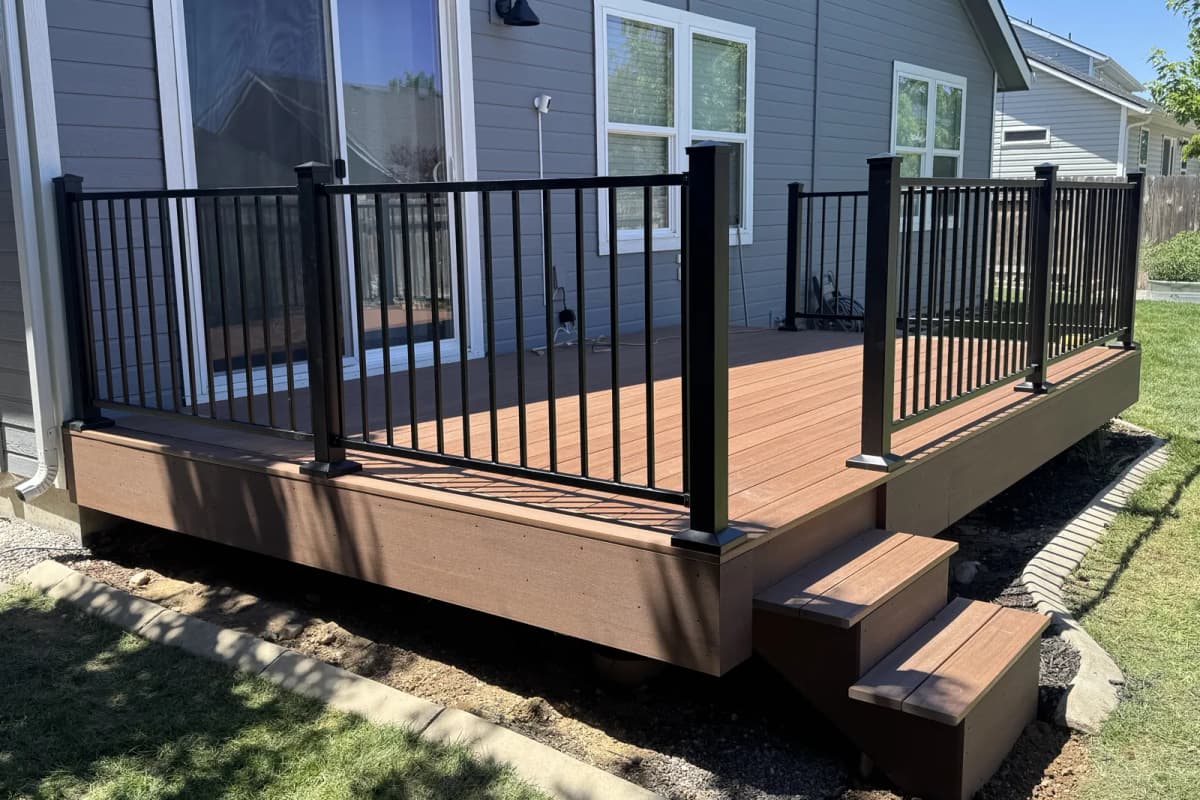
Powder-coated aluminum railings (brands like Deckorators ALX, Fortress FE26, and RDI Excalibur) are our most popular railing choice. They are lightweight, corrosion-resistant, maintenance-free, and available in black, bronze, and white finishes that complement any decking material. Aluminum railings will not rust, rot, warp, or require painting. The powder-coat finish withstands Boise's UV exposure without fading or chalking. Aluminum railing systems are designed with pre-welded panels that install quickly and meet code for both baluster spacing and structural strength. Cost: $30–$50 per linear foot installed.
Cable Railings
Cable railing systems use horizontal stainless steel cables tensioned between metal or wood posts. They provide an unobstructed view — ideal for decks with mountain, foothills, or valley views that are common in Eagle, north Boise, and the East Bench. Cables must be spaced no more than 3 inches apart (more restrictive than the 4-inch baluster rule) and must be tensioned to prevent deflection that could create openings exceeding 4 inches. Cable railings are low maintenance but do require periodic re-tensioning as cables stretch over time, especially through Boise's temperature cycles where summer-to-winter temperature differentials can exceed 100 degrees. Cost: $50–$80 per linear foot installed.
Glass Panel Railings
Tempered glass panel railings provide a completely transparent barrier that maximizes views. They are frameless or semi-framed with aluminum posts, creating a modern, high-end look. Glass railings are ideal for view properties but require regular cleaning to maintain their appearance — Boise's dust, pollen, and hard water spots are visible on glass in a way they are not on solid materials. Tempered glass is required by code and is four times stronger than regular glass. Cost: $70–$120 per linear foot installed.
Composite Railings
Composite railings from Trex, TimberTech, and Fiberon match their respective decking lines for a cohesive look. They offer the same low-maintenance benefits as composite decking — no painting, staining, or sealing. Composite railings are available in multiple profiles including traditional, contemporary, and square baluster styles. They integrate well with composite decking but are bulkier than aluminum options and limit the view more due to thicker baluster profiles. Cost: $35–$60 per linear foot installed.
Building a deck in the Treasure Valley involves local factors that contractors from other regions may not account for. From permit procedures to wildfire zones, here are the Boise-specific details that affect your deck project.
Building Permits: City of Boise and Ada County
The City of Boise and Ada County Development Services both require building permits for deck construction. Within Boise city limits, you submit through the City of Boise Planning and Development Services department. In unincorporated Ada County (parts of Eagle, Star, and surrounding areas), permits go through Ada County Development Services. Both require a site plan, construction drawings showing footing details and spans, and must demonstrate compliance with current IRC standards. Permit fees in Boise are based on project valuation — a typical deck permit costs $250–$600. Expect 2–4 weeks for permit review and approval. We submit complete, code-compliant plans that minimize revision requests and avoid delays.
Setback Requirements
All deck structures must comply with property line setback requirements. In most Boise residential zones (R-1C, R-1B, R-1A), the rear yard setback is 15–20 feet and side yard setbacks are 5–10 feet, depending on the zone. Decks cannot encroach into these setback areas. Corner lots, flag lots, and properties in planned unit developments (PUDs) may have different setback requirements. We verify your property's specific setback dimensions during the design consultation by reviewing your plat map and zoning designation.
HOA Considerations in Eagle, Meridian, and Star
Many newer subdivisions in Eagle (Banbury Meadows, Lakemoor, Avimor), Meridian (Paramount, Ten Mile Crossing, The Oaks), and Star (Star River Ranch, Middleton Estates) have homeowner association (HOA) architectural review requirements for exterior modifications including decks. HOA guidelines may restrict deck materials, colors, heights, locations, railing styles, and even lighting. We recommend submitting your deck design to the HOA architectural review committee before applying for a building permit. We provide the drawings and specifications needed for HOA submission and can modify designs to meet community standards while preserving your functional goals.
Wildfire-Urban Interface Zones
Properties in the Boise foothills, portions of northeast Eagle, and hillside areas along Table Rock and the East Bench are within wildfire-urban interface (WUI) zones. Decks in these areas must comply with additional fire-resistance requirements under Idaho's wildfire-resistant construction standards. We recommend non-combustible decking materials (composite, PVC, or aluminum) for WUI zone projects, metal or fire-rated railing systems, enclosed undersides with ember-resistant screening, and a minimum 5-foot non-combustible zone between the deck and any vegetation. Pressure-treated wood decking is permitted but not recommended in WUI zones because it can ignite from windblown embers during wildfire events.
Snow Load and Wind Load
Boise's design ground snow load is 30 PSF (pounds per square foot) per the IRC and local amendments. This means your deck's structural frame must support 30 pounds of snow weight per square foot in addition to the standard 40 PSF live load and 10 PSF dead load. For elevated decks and pergola-covered decks, snow load can significantly increase the required beam and joist sizes. Wind load in the Boise area is rated at 90 MPH per ASCE 7 standards. Deck railings and overhead structures (pergolas, shade sails) must be designed to resist these wind forces. We engineer every deck to handle both snow and wind loads with appropriate safety factors.
Best Orientation for Sun and Shade
In the Treasure Valley, south- and west-facing decks receive the most sun exposure — which is desirable in spring and fall but can make afternoon summer use uncomfortable without shade. North-facing decks stay cooler but may feel cold in shoulder seasons. East-facing decks get morning sun and afternoon shade, making them the most comfortable year-round orientation for outdoor dining and lounging. We evaluate your home's orientation, existing shade from trees and structures, and your usage patterns to recommend the best deck placement. For south- and west-facing decks, we often integrate pergolas, retractable shade canopies, or strategically placed shade sails to extend comfortable use through July and August.
Deck costs vary significantly based on material choice, deck size, elevation, and features like railings, stairs, and lighting. Here is a realistic cost breakdown for the Boise market as of 2025–2026, based on our project experience. All figures include materials, labor, hardware, and standard finishes.
Total Installed Cost by Material and Deck Size
| Material | 200 Sq Ft | 350 Sq Ft | 500 Sq Ft |
|---|---|---|---|
| Pressure-Treated Wood | $4,000–$7,000 | $7,000–$12,250 | $10,000–$17,500 |
| Western Red Cedar | $5,600–$9,000 | $9,800–$15,750 | $14,000–$22,500 |
| Trex Composite | $7,000–$11,000 | $12,250–$19,250 | $17,500–$27,500 |
| TimberTech AZEK PVC | $9,000–$13,000 | $15,750–$22,750 | $22,500–$32,500 |
Additional Cost Line Items
| Item | Typical Cost Range |
|---|---|
| Building permit (Boise / Ada County) | $250–$600 |
| Design and engineering | $500–$1,500 |
| Railings (aluminum, per linear foot) | $30–$50 / LF |
| Railings (cable, per linear foot) | $50–$80 / LF |
| Stairs (per step, with stringers and treads) | $150–$350 / step |
| LED deck lighting package | $800–$2,500 |
| Under-deck drainage system | $5–$8 / sq ft |
| Pergola integration | $3,000–$10,000 |
| Built-in bench seating | $50–$100 / LF |
| Demolition of existing deck | $1,000–$3,000 |
Budget tip: The most cost-effective approach for long-term value is composite or PVC decking with aluminum railings. The higher upfront material cost is offset by zero maintenance expense over the 25–50 year life of the deck. Homeowners who choose wood decking should budget an additional $500–$1,200 per year for cleaning and staining.
Maintenance requirements vary dramatically by material. Understanding these commitments upfront helps you choose a decking material that fits your lifestyle — not just your budget. Boise's climate creates specific maintenance challenges: intense UV causes fading and surface degradation, low humidity causes wood to dry and crack, and freeze-thaw cycles work moisture into any crack or joint.
Pressure-Treated Wood Maintenance
- Power wash annually (spring) to remove dirt, mildew, and surface graying
- Sand rough spots and raised grain before re-staining
- Apply penetrating stain or sealant every 1–2 years (semi-transparent stain provides UV protection and water repellency)
- Inspect fasteners annually — screws can back out as wood expands and contracts through temperature cycles
- Replace cracked, split, or warped boards as needed (typically 2–4 boards per year on an aging deck)
- Check post bases and footings for shifting or settling
Estimated annual maintenance cost: $500–$1,200 for a 300 sq ft deck (DIY staining) or $800–$1,800 with professional staining.
Cedar and Redwood Maintenance
- Clean with a wood-safe cleaner and soft brush or low-pressure wash (high pressure can damage cedar’s soft grain)
- Apply UV-protective oil or stain annually to maintain color — without treatment, cedar and redwood gray within 6–12 months in Boise’s sun
- Inspect for and treat any early signs of surface mold, especially on north-facing sections or areas near landscaping irrigation
- Sand and re-oil any boards showing surface checking or raised grain
Estimated annual maintenance cost: $600–$1,500 for a 300 sq ft deck.
Composite Decking Maintenance (Trex, TimberTech, Fiberon)
- Wash with soap and water 1–2 times per year to remove pollen, dirt, and tree debris
- Clean between board gaps where leaves and debris accumulate (a putty knife or specialized tool works well)
- Remove snow with a plastic shovel — metal shovels can scratch the cap surface
- Address food and grease stains promptly with a composite deck cleaner (we recommend Trex or DeckMAX products)
- No sanding, staining, sealing, or painting — ever
Estimated annual maintenance cost: $0–$100 (soap and water only). Warranty coverage: 25-year limited (Trex Enhance, Transcend) covering fade, stain, and structural defects.
PVC Decking Maintenance (TimberTech AZEK)
- Wash with soap and water or a garden hose 1–2 times per year
- PVC does not absorb moisture, so mold grows on surface dirt rather than into the material — it wipes off easily
- Heat marks from grills or fire pits on the deck surface should be avoided with grill pads
- No sanding, staining, sealing, or painting required
Estimated annual maintenance cost: $0–$50. Warranty coverage: 50-year limited (TimberTech AZEK) — the strongest warranty in the decking industry, covering fade, stain, structural integrity, and moisture damage.
Explore our in-depth guides to plan your Boise-area deck project with confidence.
Do I need a permit to build a deck in Boise, and what does the process involve?
Yes. In Boise and Ada County, any deck over 30 inches above grade or attached to the house requires a building permit. You will need to submit a site plan showing the deck footprint relative to property lines and structures, a construction plan with footing details, framing spans, and railing specifications, and proof that the project meets current IRC residential code. Iron Crest Remodel handles the entire permit application, plan submission, and inspection scheduling. Typical permit turnaround in Boise is 2–4 weeks. Inspections occur at the footing stage, framing stage, and final completion.
Is composite decking actually cheaper than wood over the long term?
Yes, in nearly every case. Pressure-treated wood costs $20–$35 per square foot installed but requires annual power washing, sanding, and staining at $1.50–$3.00 per square foot per year. Over 20 years, that adds $6,000–$12,000 in maintenance on a 300 sq ft deck. Composite decking costs $35–$55 per square foot installed but requires only occasional soap-and-water cleaning and carries a 25–50 year warranty against fading, staining, and structural defects. By year 8–10, the total cost of ownership for composite is typically equal to wood — and every year after that, composite saves money.
How long does it take to build a deck in Boise?
A standard 300–400 sq ft deck typically takes 2–3 weeks from the start of construction to final inspection, assuming permits are already approved. The timeline breaks down as follows: footings and concrete cure (3–5 days), framing (2–4 days), decking installation (2–3 days), railings and stairs (2–3 days), and final details like lighting and trim (1–2 days). Multi-level decks, pergola integrations, or decks requiring engineered beams may take 3–4 weeks. Weather delays are uncommon during Boise’s building season (April through October) but can extend winter projects.
Can you build a deck on a house with a raised foundation or walkout basement?
Absolutely. Raised foundations and walkout basements are common in the Boise foothills, parts of Eagle, and north Meridian where lots have grade changes. These situations actually present excellent deck opportunities because the elevation gain creates space for covered patios or storage underneath the deck. We install under-deck drainage systems (like DrySpace or Trex RainEscape) that channel water away from the area below, creating a dry, usable space. Elevated decks over 30 inches require engineered post-and-beam framing, deeper footings, and code-compliant guardrails at 36 inches minimum height.
The following government agencies, industry organizations, and official resources provide additional information relevant to your remodeling project.
Browse completed deck building projects from across the Treasure Valley. See real results, project details, and transformation stories.
Deck projects often pair with exterior painting, siding, and outdoor living upgrades.
Ready to Start Your Remodeling Project?
Get a free, no-obligation estimate from Boise's trusted remodeling experts. Licensed, insured, and ready to build.