

Accessible Bathroom Remodels in Boise
ADA-compliant bathroom designs that preserve independence, dignity, and comfort — built for how you live today and how you want to live tomorrow.
Quick answer
Accessible bathroom modifications in Boise typically add $2,000 to $8,000 on top of a standard bathroom remodel, depending on the scope. Basic upgrades like grab bars, a comfort-height toilet, and lever faucets fall in the $2,000–$3,500 range.
Explore our full Boise bathroom remodeling services
As Idaho's population ages, more Boise homeowners are asking a practical question: can my bathroom safely support me as my needs change? The answer, in nearly every case, is yes. Accessible bathroom remodeling transforms an existing space into one that is safer, more comfortable, and designed to support independence for years to come.
Iron Crest Remodel designs and builds accessible bathrooms throughout the Treasure Valley. Every project follows ADA residential guidelines and universal design principles, but the real goal is simpler than compliance: we create bathrooms where you feel confident, comfortable, and in control. Whether you are planning for future needs, recovering from surgery, or caring for a family member with mobility challenges, these modifications make a meaningful difference in daily life.
Boise's housing stock presents a real advantage for accessibility remodeling. The city's large inventory of ranch-style homes — particularly across South Boise, Meridian, and Eagle — means single-story layouts with wider hallways and direct bedroom-to-bathroom access are already in place. Older homes in the North End and Bench neighborhoods may need more structural work, including door widening and subfloor modifications, but these are well within the scope of a planned remodel. The key is approaching accessibility as an integrated design decision, not a compromise.
The bathroom is the most dangerous room in any home. According to the CDC, more than 230,000 Americans visit the emergency room each year due to bathroom-related injuries, and the majority involve adults over 65. Wet surfaces, tight spaces, hard fixtures, and the physical demands of bathing create a combination of risk factors that no other room matches.
Planning for accessibility before an emergency is both more affordable and less stressful. When accessibility features are integrated during a standard remodel, they cost a fraction of what emergency retrofits require. And the design can be thoughtful rather than reactive — blending seamlessly with the overall aesthetic instead of looking like an afterthought.
Ada County alone has seen its senior population grow steadily, and many of these residents are long-time homeowners who want to stay in the homes where they raised families and built community. Aging in place is not just a financial decision — it is deeply personal. A well-designed accessible bathroom preserves dignity, reduces dependence on caregivers, and gives homeowners confidence in their daily routines.
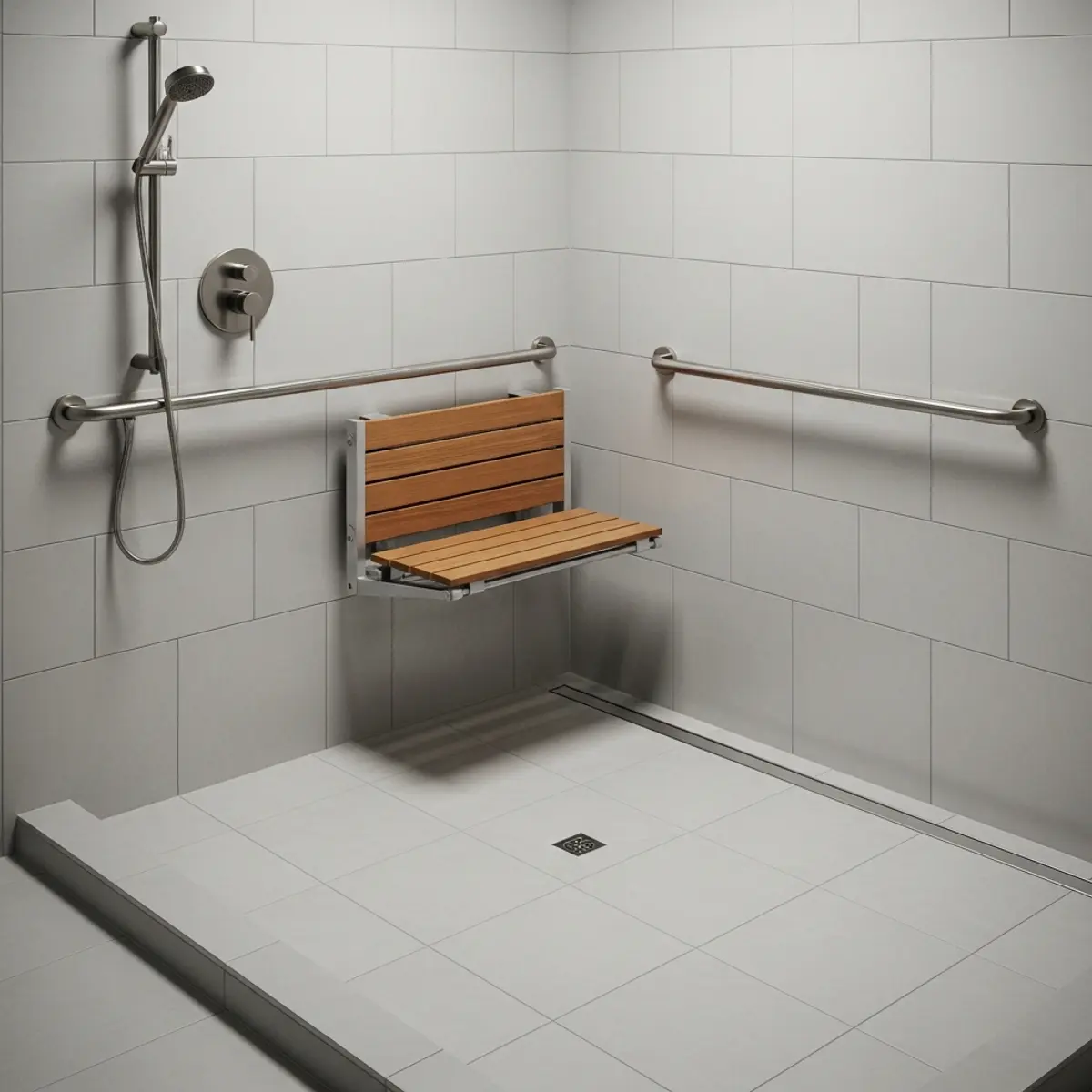
The most impactful single modification in an accessible bathroom is replacing a traditional tub or stepped shower with a zero-threshold (curbless) entry shower. These showers eliminate the step-over barrier entirely, creating a flush transition from the bathroom floor into the shower area. The floor is sloped at a gentle gradient — typically 1/4 inch per foot — toward a linear drain to manage water containment.
For wheelchair users, a barrier-free shower with a roll-in design provides full independence. For ambulatory users with balance concerns, eliminating the curb removes one of the most common tripping points. The shower interior should include a fold-down teak or phenolic bench seat, a hand-held shower head on an adjustable slide bar, and strategically placed grab bars.
Read more about barrier-free shower installation in Boise | View our accessible walk-in shower services
Key Shower Accessibility Features
- Zero-threshold entry — no curb, lip, or step to navigate
- Non-slip porcelain or natural stone tile with textured finish (coefficient of friction ≥ 0.60)
- Linear drain positioned along the shower wall for clean sightlines and effective water capture
- Fold-down bench seat rated for 500+ pounds — teak or solid phenolic
- Hand-held shower head on 60-inch hose with adjustable slide bar
- Built-in recessed niches at accessible heights for soap, shampoo, and supplies
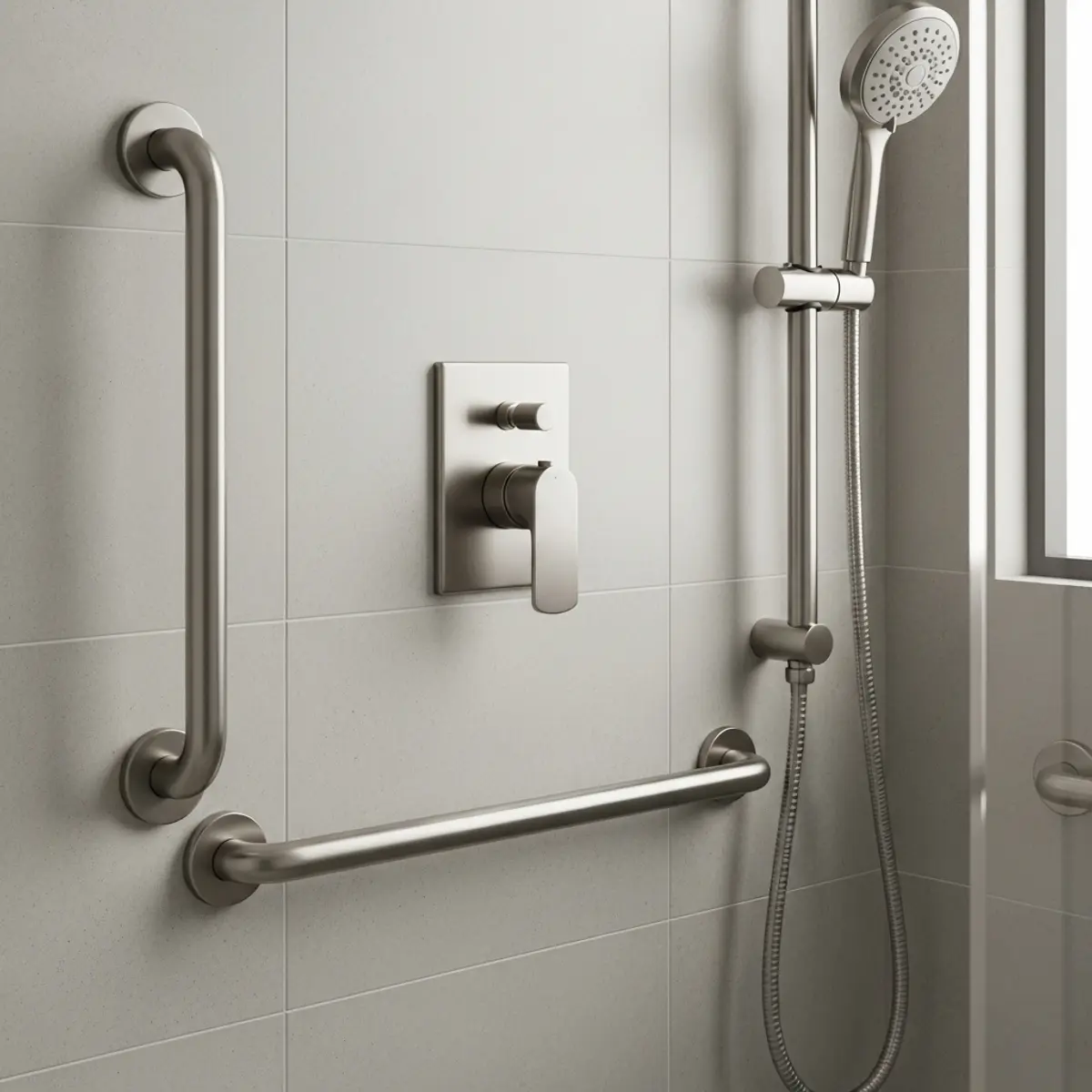
Grab bars are the foundation of bathroom safety, but placement matters as much as the bars themselves. ADA guidelines specify grab bar locations based on fixture type and user needs. When installed correctly — anchored into solid blocking, at the right height and angle — grab bars provide reliable support for transfers, standing, and balance.
Shower Grab Bars
ADA guidelines recommend a horizontal grab bar on the control wall (33–36 inches from the floor), a vertical bar at the shower entry for transitional support, and a horizontal bar on the back wall. We install additional diagonal bars near the bench seat for seated-to-standing transfers. All bars are 1.25 to 1.5 inches in diameter with a 1.5-inch clearance from the wall.
Toilet-Area Grab Bars
A 42-inch horizontal grab bar on the side wall and an 18-inch vertical bar near the toilet paper holder provide support for sitting and standing. For accessible bathrooms with more space, swing-away grab bars mounted on the wall behind the toilet offer bilateral support without impeding wheelchair transfers.
Design-Forward Options
Modern grab bars are available in brushed nickel, matte black, oil-rubbed bronze, and chrome finishes that coordinate with other bathroom hardware. Some integrate with towel bars and shelf systems so they serve a dual purpose. The goal is safety hardware that looks intentional, not institutional.
Wider Doorways for Wheelchair and Walker Access
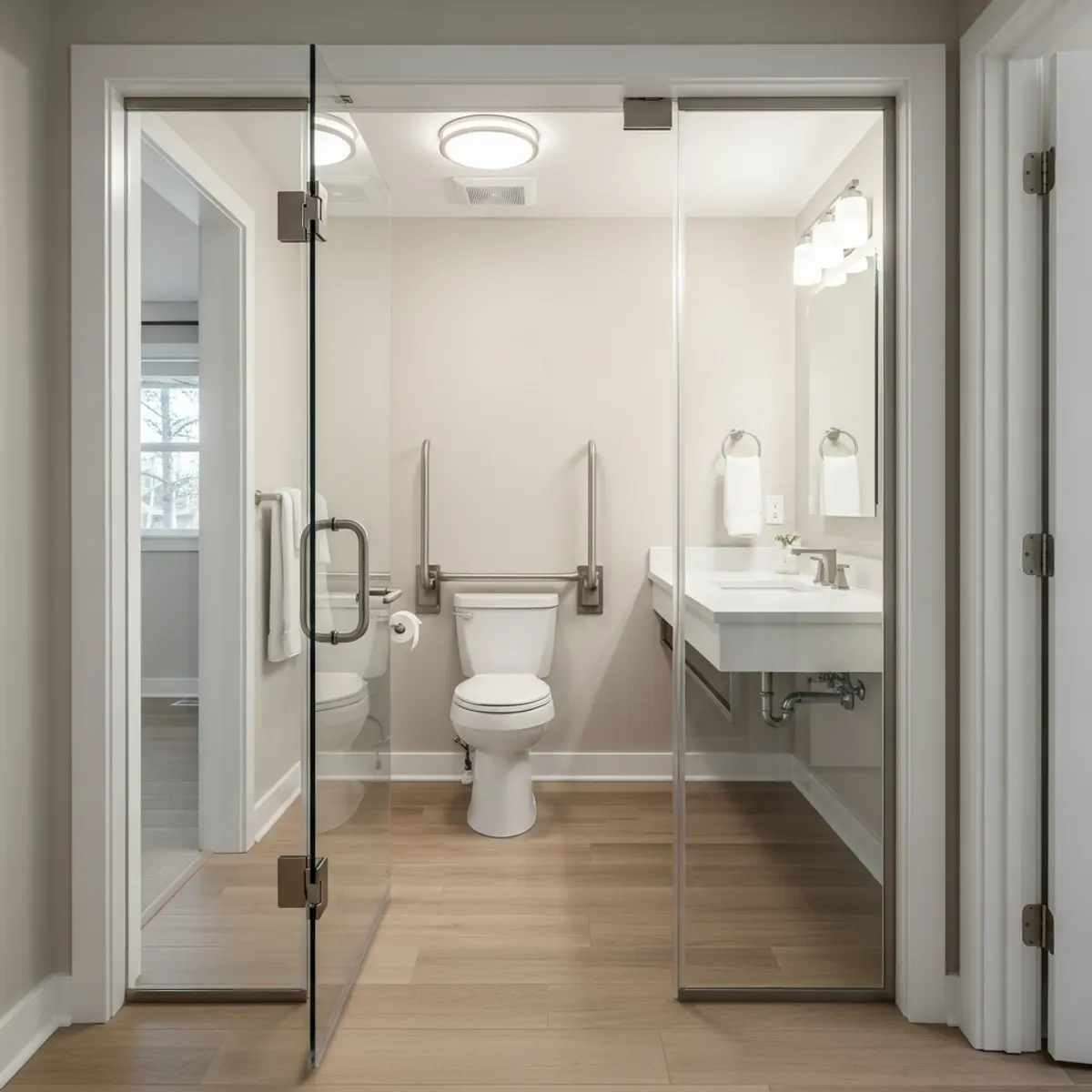
Standard interior doors in most Boise homes are 24 to 28 inches wide — too narrow for a wheelchair or even a standard walker. ADA guidelines require a minimum 32-inch clear opening, which typically means installing a 34- or 36-inch door. Older homes in the North End and Bench neighborhoods often have narrower original door frames that require structural header modification. Pocket doors or barn-style sliding doors are excellent space-saving solutions when swing clearance is limited in small hallways.
Comfort-Height Toilets
Standard toilets sit 15 inches from floor to seat. Comfort-height (ADA-compliant) toilets sit 17 to 19 inches, making it significantly easier to sit down and stand up — especially for anyone with knee, hip, or back issues. Wall-hung toilets offer adjustable height mounting and make floor cleaning easier, which is an important consideration for wheelchair users who need clear floor space.
Anti-Slip Flooring
Bathroom floors must provide traction when wet. We specify porcelain tile with a textured matte finish (rated R10 or higher for slip resistance), luxury vinyl plank with textured surfaces, or small-format mosaic tile with additional grout lines for grip. High-gloss polished tile and natural marble, while beautiful, are not appropriate for accessible bathrooms due to their low friction coefficients when wet.
Adequate Lighting
Good lighting is a safety essential. We install layered lighting — bright overhead ambient lighting (minimum 50 foot-candles at the vanity), task lighting at the mirror, and night-lights along the floor path from the bedroom to the bathroom. Motion-activated switches eliminate the need to fumble for a light switch in the dark, and dimmer controls allow adjustment for nighttime use without harsh glare.
Beyond the major modifications, several smaller upgrades make a significant difference in daily comfort and safety.
Lever Handles and Faucets
Lever-style door handles and single-lever faucets require minimal grip strength. They are easier to operate for anyone with arthritis, limited hand strength, or wet hands.
Roll-Under Vanities
Wall-mounted vanities with open space below accommodate wheelchair users. Insulated drain pipes prevent burns, and the counter height is set at 34 inches for seated access.
Thermostatic Shower Valves
Pressure-balancing and thermostatic valves prevent scalding by maintaining consistent water temperature. This is especially important for users with reduced sensation or slower reaction times.
Fold-Down Shower Seats
Wall-mounted fold-down seats provide a secure sitting option in the shower without taking up space when not in use. We install models rated for 400–500 pounds with teak or phenolic surfaces.
Accessible modifications typically add $2,000 to $8,000 to a standard bathroom remodel, depending on scope. When integrated into a planned remodel — rather than done as a standalone project — costs are significantly lower because demolition, plumbing, and finish work are already part of the budget.
| Modification | Typical Cost Range |
|---|---|
| Grab bar installation (per bar, with blocking) | $150–$350 |
| Comfort-height toilet (supply and install) | $400–$900 |
| Zero-threshold shower conversion | $3,500–$7,000 |
| Doorway widening (per opening) | $800–$2,500 |
| Fold-down shower bench (wall-mounted) | $300–$800 |
| Hand-held shower head with slide bar | $150–$400 |
| Lever faucet and handle replacement | $200–$600 |
| Roll-under vanity installation | $1,200–$3,000 |
| Anti-slip flooring (full bathroom) | $1,000–$3,000 |
| Motion-activated lighting upgrade | $300–$800 |
Older homes in Boise's North End and Bench neighborhoods may require additional work — door header modification, subfloor leveling for zero-threshold showers, or plumbing relocation — that adds to the cost. Ranch-style homes across Meridian, Eagle, and South Boise are typically easier and less expensive to retrofit because they have single-story layouts, wider hallways, and slab-on-grade or crawlspace foundations that simplify drain relocation.
Some homeowners qualify for financial assistance through Idaho's Medicaid waiver programs or Veterans Affairs home modification grants. We can help you understand whether your project may qualify and connect you with the appropriate agencies during the planning phase. For most families, the investment in accessibility pays for itself many times over by avoiding the far greater cost of assisted living or nursing care.
Not all homes present the same challenges — or the same opportunities — when it comes to accessible bathroom design. Boise's housing stock spans more than a century of construction styles, and each type requires a different approach. Understanding your home's layout, structure, and limitations before design begins saves time, money, and frustration during the remodel.
North End & East End Older Homes
Boise's North End and East End neighborhoods are defined by character-rich homes built between the 1900s and 1950s — Craftsman bungalows, Tudor cottages, and early ranch-style houses. These homes were not designed with accessibility in mind. Bathrooms are typically small, often just 5 by 7 feet, with narrow doorways (24–26 inches), load-bearing walls that limit layout changes, and plumbing stacks positioned in ways that complicate drain relocation for curbless showers.
Structural challenges in these older homes include plaster-and-lath walls that make blocking installation more involved, original 2x4 framing that may need reinforcement for grab bar loads, and finished hardwood floors in adjacent hallways that must be carefully matched when doorways are widened. Despite these challenges, accessible conversions are very achievable in North End and East End bathrooms. The key is creative space planning — replacing a tub with a compact curbless shower, using a pocket door to reclaim swing clearance, and selecting wall-mounted fixtures that free up floor area for wheelchair turning.
Ranch-Style Homes (Bench, Southeast Boise, Meridian)
Ranch-style homes are the ideal candidates for accessible bathroom conversions, and Boise has an abundance of them. Built primarily from the 1950s through the 1980s across the Bench, Southeast Boise, West Boise, Meridian, and Eagle, these single-story homes typically feature wider hallways (36–42 inches), larger bathrooms (often 7 by 9 feet or more), and direct bedroom-to-bathroom adjacency. Many sit on slab-on-grade or crawlspace foundations, both of which simplify the subfloor modifications needed for zero-threshold shower conversions.
In a typical ranch-style accessible conversion, we can remove the existing tub/shower combination, reroute the drain for a linear drain system, install a 36-by-60-inch (or larger) curbless shower, widen the doorway to 34 or 36 inches, and reconfigure the vanity as a roll-under design — all within the existing bathroom footprint. Because the single-story layout eliminates stairs entirely, the entire home becomes accessible with relatively modest modifications.
Two-Story Homes (Meridian, Eagle, Star, Nampa)
Newer two-story homes across Meridian, Eagle, Star, and Nampa present a unique challenge: the primary bedroom and bathroom are often on the second floor. When a homeowner needs first-floor accessibility, the solution is typically a first-floor bathroom addition or conversion. Many of these homes have a half-bath on the main level that can be expanded into a full accessible bathroom by borrowing space from an adjacent closet, laundry room, or underutilized den.
If no existing first-floor bathroom is available, a ground-floor addition may be necessary. This involves more significant construction — foundation work, plumbing rough-in, exterior wall modifications — but it solves the accessibility problem permanently and adds substantial value to the home. We design these additions to match the existing architecture seamlessly, using materials and finishes that complement the original construction.
Another option for two-story homes is converting an existing first-floor room — such as a formal dining room, home office, or oversized laundry — into a combined bedroom-bathroom suite. This approach avoids the cost and complexity of a building addition while creating a self-contained accessible living space on the main floor. This conversion is well suited to the Meridian and Eagle areas, where newer construction often includes flexible-use rooms on the ground floor that adapt well to this purpose.
Layout Considerations for Accessible Bathrooms
Regardless of home type, every accessible bathroom must address three spatial requirements: turning radius, transfer space, and fixture placement. ADA guidelines recommend a 60-inch turning radius for wheelchair users, which translates to a clear 5-foot circle of open floor space in the center of the bathroom. Transfer space — the area alongside the toilet and shower where a wheelchair can be positioned for lateral transfer — must be at least 18 inches wide and unobstructed.
Fixture placement follows a logical flow. The toilet should be positioned with the grab bar wall on the user's strong side (which varies by individual). The shower entry should face the door for a direct path. The vanity should be within reach of the shower area but not blocking the turning radius. In smaller bathrooms, every inch matters, and we use 3D design software to model layouts before construction begins so homeowners can see exactly how the space will function.
Making Accessible Bathrooms Beautiful
One of the most persistent myths about accessible bathrooms is that they have to look institutional. The opposite is true. Many of the most popular design trends in modern bathrooms — curbless showers, floating vanities, wall-mounted toilets, large-format tile, linear drains, and open floor plans — happen to be inherently accessible. A well-designed accessible bathroom is simply a well-designed bathroom.
Design-forward grab bars in matte black, brushed gold, or oil-rubbed bronze finishes coordinate with modern hardware. Teak fold-down benches add a spa-like quality to the shower. Large-format porcelain tile with subtle texture provides both visual elegance and slip resistance. Under-vanity LED lighting serves as both a design accent and a nighttime safety feature. The goal is a bathroom that looks intentional and sophisticated — one where the accessible features are woven so naturally into the design that they don't draw attention as “medical” equipment.
We encourage clients to browse design magazines and portfolio sites for inspiration before the design consultation. Many of the most award-winning bathroom designs in recent years incorporate universal design principles — open showers, floating fixtures, clean sightlines, and generous floor space. When accessibility is treated as a design driver rather than an afterthought, the result is a bathroom that is both more beautiful and more functional than a conventional layout. Iron Crest Remodel's design team specializes in this approach, and our portfolio includes accessible bathrooms that rival high-end spa installations in both finish quality and visual impact.
Understanding the true cost of an accessible bathroom remodel helps homeowners plan realistically and prioritize the modifications that matter most. Boise's construction costs have risen steadily over the past several years, driven by strong demand and a tight labor market across the Treasure Valley. The numbers below reflect current 2025–2026 pricing for licensed, insured contractors in the Boise metro area.
Detailed Cost Breakdown
| Modification | Cost Range | Notes |
|---|---|---|
| Curbless shower conversion | $8,000–$18,000 | Includes subfloor work, waterproofing, linear drain, tile, and bench |
| Grab bar installation (per bar) | $200–$600 | Proper blocking required; price includes backing and finish |
| Comfort-height toilet | $400–$1,200 | Supply and installation; wall-hung models at higher end |
| Roll-under vanity | $2,000–$5,000 | Custom or semi-custom; includes insulated drain pipes |
| Non-slip flooring (full bathroom) | $2,000–$6,000 | Porcelain, LVP, or mosaic tile; price varies by material and size |
| Wider doorway (per opening) | $800–$2,500 | Includes header modification, framing, trim, and door |
| Complete accessible bathroom remodel | $20,000–$45,000 | Full gut and rebuild with all accessibility features |
How Accessible Remodels Compare to Standard Bathroom Remodels
A standard mid-range bathroom remodel in Boise typically runs $15,000–$30,000, while a high-end remodel ranges from $30,000–$55,000. Adding comprehensive accessibility features to a planned remodel raises the total, but by far less than the same modifications cost as a standalone retrofit. The reason is straightforward: when walls are already open, plumbing is already exposed, and finish work is already in the budget, the incremental cost of blocking, drain relocation, and wider framing is relatively modest.
Standalone accessibility retrofits — done outside of a full remodel — cost more per modification because each item requires its own demolition, patching, and finish work. This is why we strongly recommend incorporating accessibility planning into any bathroom remodel, even if the homeowner does not currently need the features. Installing blocking in walls during a remodel costs almost nothing; adding it after the walls are closed requires cutting and patching drywall, which can cost $300–$500 per location.
Accessible features also widen the pool of buyers a home suits. A curbless shower, a comfort-height toilet, and a wider doorway read as current design choices rather than medical concessions when they are detailed well. We do not publish a figure for what they add at sale — we have no Boise sales data that would support one.
Financing & Funding Options
Several programs can help offset the cost of accessible bathroom modifications for Boise homeowners:
- Idaho Medicaid Home & Community-Based Services (HCBS) Waiver — covers qualifying home modifications for eligible individuals, including bathroom accessibility features
- VA Specially Adapted Housing (SAH) and Home Improvement & Structural Alteration (HISA) Grants — available to qualifying veterans for accessibility modifications including bathroom remodeling
- Idaho Housing and Finance Association (IHFA) — offers home rehabilitation loans and programs for qualifying homeowners, including accessibility upgrades
- Home equity loans and HELOCs — allow homeowners to borrow against existing equity at competitive rates for remodeling projects
- Contractor financing — Iron Crest Remodel partners with lending institutions to offer project financing with fixed monthly payments, making large-scale accessible remodels manageable for most budgets
We help clients navigate these options during the planning phase and can connect homeowners with the appropriate agencies and lenders. For many families the comparison that matters is against the cost of assisted living. Get a current monthly figure from facilities you would actually consider in the Boise area — those rates move, and the comparison only means something with a real number in it.
Not every homeowner needs a complete accessible bathroom on day one. A phased approach allows you to address the most critical safety concerns immediately, add convenience features as needs evolve, and plan for full accessibility down the road. This three-phase checklist is the framework we use with every aging-in-place client in the Boise area. Each phase builds on the previous one, and the modifications within each phase are listed in order of impact and priority.
Phase 1: Immediate Safety
These modifications address the most common causes of bathroom injuries and can often be completed in a single day. They require minimal construction and deliver immediate safety improvements.
- Install grab bars at the toilet (42-inch horizontal on the side wall, 18-inch vertical near the toilet paper holder) and in the shower/tub (horizontal on the control wall, vertical at the entry)
- Apply non-slip adhesive strips or replace bath mats with suction-backed options in the tub or shower floor
- Upgrade lighting to a minimum of 50 foot-candles at the vanity and add a motion-activated night-light along the path from the bedroom to the bathroom
- Replace round doorknobs with lever-style handles that require minimal grip strength to operate
- Remove loose bath rugs that create tripping hazards and replace with low-profile, non-slip alternatives
- Set the water heater to 120°F or install anti-scald devices on shower and faucet valves
Phase 2: Convenience & Comfort
Phase 2 modifications improve daily comfort and reduce physical strain. They typically require a plumber or contractor but can be completed within a few days without a full remodel.
- Replace the standard-height toilet (15 inches) with a comfort-height model (17–19 inches) to reduce strain on knees and hips during sitting and standing
- Install a hand-held shower head on a 60-inch hose with an adjustable slide bar, allowing seated or standing use
- Replace twist-style faucet handles with single-lever faucets that are easier to operate with limited hand strength or arthritis
- Add a thermostatic or pressure-balancing shower valve to prevent sudden temperature changes and scalding
- Install a fold-down teak or phenolic shower bench rated for 400–500 pounds
- Add accessible storage — lower shelving, pull-out drawers, and recessed niches within reach from a seated position
Phase 3: Full Accessibility
Phase 3 is a comprehensive remodel that transforms the bathroom into a fully accessible space compliant with ADA residential guidelines. This phase is best integrated into a planned bathroom remodel for maximum cost efficiency.
- Remove the existing tub or stepped shower and install a zero-threshold (curbless) shower with a linear drain, waterproof membrane system, and slip-resistant tile
- Widen the bathroom doorway to a minimum 32-inch clear opening (34–36-inch door) and consider a pocket door or barn-style slider for space efficiency
- Install a roll-under vanity with open knee space, insulated drain pipes to prevent burns, and a counter height of 34 inches for seated access
- Reconfigure the bathroom layout to provide a 60-inch wheelchair turning radius in the center of the room
- Install non-slip porcelain tile or luxury vinyl plank flooring throughout the bathroom with a coefficient of friction of 0.60 or higher
- Add under-cabinet LED lighting, illuminated mirror, and motion-activated overhead lighting for complete visibility at all hours
Tip: If your household includes multiple people with different needs, prioritize the features that benefit the widest range of users first. Lever handles, comfort-height toilets, and improved lighting benefit everyone in the home regardless of age or ability.
Planning Ahead: Blocking in Walls During Any Remodel
If you are doing any bathroom remodel — even if you don't need accessible features today — we strongly recommend installing solid blocking between studs in the walls around the toilet, shower, and tub areas. Blocking is simply a piece of 2x6 or 3/4-inch plywood secured horizontally between the wall studs at grab bar height (33–36 inches from the floor). The cost during an open-wall remodel is negligible — typically $50–100 in materials and 30 minutes of labor. But if you need grab bars five or ten years from now, the blocking is already in place, and installation is a simple, non-invasive project rather than a wall-cutting repair.
Iron Crest Remodel installs blocking as a standard practice in every bathroom remodel we complete, regardless of whether the client currently needs grab bars. It is one of the simplest and most forward-thinking steps a homeowner can take.
Working with Occupational Therapists
For homeowners with specific mobility challenges, medical conditions, or recovery needs, we recommend involving a certified occupational therapist (OT) early in the design process. OTs specialize in assessing how individuals interact with their physical environment and can provide personalized recommendations that go beyond generic ADA guidelines.
An OT can evaluate which side of the toilet needs grab bars based on the user's dominant hand and affected limbs, determine the ideal shower bench height and position, recommend specific faucet and handle types based on hand strength and dexterity, and identify additional modifications that a general contractor might not consider. Several occupational therapy practices in the Boise area specialize in home accessibility assessments, and we have working relationships with local OTs whose recommendations we can incorporate directly into our design and build process.
For clients recovering from surgery — hip replacements, knee replacements, and stroke rehabilitation are the most common scenarios we encounter — an OT assessment before the remodel begins ensures that the bathroom is optimized for the specific recovery trajectory. This is particularly valuable because recovery needs often evolve over time: what a patient requires in the first three months post-surgery may differ significantly from their long-term functional needs. A well-designed accessible bathroom accommodates both the acute recovery phase and the eventual goal of maximum independence.
Iron Crest Remodel includes an initial accessibility consultation at no charge for every aging-in-place project. During this visit, we assess the existing bathroom, discuss current and anticipated needs, review the phased checklist above, and provide a preliminary scope and budget. If an OT referral is appropriate, we coordinate that as part of the design process. Our goal is a bathroom that works perfectly for the person who uses it — not just a bathroom that checks compliance boxes.
How much does an accessible bathroom remodel cost in Boise?
Accessible bathroom modifications in Boise typically add $2,000 to $8,000 on top of a standard bathroom remodel, depending on the scope. Basic upgrades like grab bars, a comfort-height toilet, and lever faucets fall in the $2,000–$3,500 range. A full barrier-free shower conversion with reinforced walls, zero-threshold entry, fold-down bench, and hand-held shower head runs $4,000–$8,000. If doorway widening or structural changes are needed — common in older North End and Bench homes — costs may reach the higher end.
Do I need a permit for an accessible bathroom remodel in Boise?
In most cases, yes. The City of Boise requires building permits for plumbing modifications, electrical work, and structural changes like doorway widening. Simple additions like grab bars mounted into existing blocking typically do not require a permit, but relocating a shower drain for a zero-threshold conversion or moving walls does. Iron Crest Remodel handles all permit applications and scheduling as part of every project.
What is a zero-threshold shower and why is it recommended for accessibility?
A zero-threshold shower, also called a barrier-free or curbless shower, has no step or lip at the entry. The shower floor is flush with the bathroom floor, allowing easy entry for wheelchair users, people using walkers, and anyone with limited mobility. The shower floor is sloped gently toward a linear or center drain to contain water. Zero-threshold showers are the single most impactful accessibility upgrade in a bathroom and are recommended by the ADA and occupational therapists alike.
Can my existing Boise bathroom be converted to an accessible design?
Almost always, yes. Most Boise bathrooms — even compact ones in older North End bungalows or mid-century Bench homes — can be retrofitted for accessibility. Ranch-style homes, which are common across Boise, Meridian, and Eagle, are especially well-suited because they are single-story and have wider hallways. Key modifications include removing the bathtub and replacing it with a zero-threshold shower, widening the doorway to at least 32 inches clear, and reconfiguring fixtures for better wheelchair turning radius.
Are grab bars safe if my walls don't have blocking?
Grab bars must be anchored into solid blocking behind the drywall to meet ADA load requirements of 250 pounds of force. If your walls lack blocking — which is common in homes not originally built with accessibility in mind — we install wood or metal blocking between studs before mounting. This is a straightforward process during a remodel and ensures every grab bar is rated for safe, long-term use. We never use toggle bolts or drywall anchors for grab bars.
Should I remodel for accessibility now or wait until I need it?
Planning ahead is almost always more cost-effective and less disruptive. Retrofitting a bathroom for accessibility during a planned remodel costs significantly less than doing it as an emergency project after a fall or health event. Many of the features — comfort-height toilets, lever handles, better lighting, non-slip flooring — improve daily comfort for everyone in the household regardless of age or mobility. Universal design principles make the space better for all users now while preparing for future needs.
The following government agencies, industry organizations, and official resources provide additional information relevant to your remodeling project.
Plan Your Accessible Bathroom Remodel
Free in-home assessments for accessible bathroom design. ADA-compliant solutions for Boise, Meridian, Eagle, and the Treasure Valley.