

Water Damage Repair & Reconstruction in Boise, Idaho
We rebuild what water damaged — framing, subfloor, drywall, flooring, and tile — to a properly waterproofed, finished standard, and help you document the loss for your insurance claim.
Drying out a wet room is only the first half of the job. Once the water is gone, you're often left with materials that can't simply be wiped down and reused — swollen subfloor, rotted or compromised framing, saturated drywall, delaminated flooring, and tile sitting over a failed waterproofing layer. That's where a remodeling-grade rebuild comes in. Iron Crest Remodel is a Boise remodeling contractor registered with Idaho DOPL, and we repair and rebuild the parts of your home that water damaged, restoring them to a finished, properly waterproofed condition.
To be clear about what we do: we are not an emergency water-extraction or drying service. We don't run 24/7 response crews, water-extraction trucks, or industrial drying equipment, and we're not a mold-remediation company. If you have an active leak or standing water, the first steps are to shut off the water source and have the space dried out. Once it's dry and stable, we take over the reconstruction — repairing structural framing, replacing subfloor, hanging and finishing drywall, installing flooring, and rebuilding showers and tile with proper waterproofing so the same failure doesn't happen again.
A rebuild done right addresses the root cause, not just the surface. Painting over a stained ceiling or re-tiling over a substrate that was never waterproofed correctly buys you a year or two before the problem returns. Our work rebuilds the assembly from the structure out — the way it should have been built in the first place — so the repair lasts.
Structural Rebuild
Repair and replace water-damaged framing, subfloor, and sheathing — not just the visible finishes on top.
Proper Waterproofing
Membrane systems and correctly sloped, flood-tested substrates so the failure doesn't recur.
Insurance Documentation
Photos and a detailed, itemized scope you can share with your insurance adjuster.

Water finds the path of least resistance, so the damage often extends well beyond where you first see it. Here is what we typically repair and rebuild after a water loss in a Boise-area home.
Water-Damaged Bathrooms & Showers
Bathrooms are the most common source of hidden water damage we rebuild. The pattern we open up again and again in Treasure Valley homes is a builder-grade fiberglass shower surround installed directly against drywall or greenboard with no waterproofing membrane behind it. The fiberglass sheds most water, but moisture migrates through seams, around the valve and drain, and behind the surround over months and years — quietly rotting the framing and subfloor before anyone notices a stain. When we open one of these up, we routinely find compromised studs, soft subfloor, and mold on the drywall backing. We remove all the damaged substrate, repair the framing and subfloor, and rebuild the shower with a real waterproofing system over a correctly sloped, flood-tested pan — the way it should have been built originally.
Kitchens
Under-sink supply lines, dishwasher and refrigerator water lines, and failed fixtures can soak cabinet bases, swell particleboard, and damage flooring and the subfloor beneath. We repair or replace the affected cabinetry, rebuild damaged subfloor and base materials, and restore flooring and finishes — and we make sure the failed supply line or fixture that caused the problem is addressed, not just covered back up.
Subfloors & Framing
Prolonged moisture weakens the wood that holds your floors and walls together. Saturated subfloor delaminates and loses its structural integrity, and framing exposed to standing water or chronic leaks can rot or grow soft. We cut out and replace damaged subfloor, sister or replace compromised joists and studs, and bring the structure back to a sound, code-compliant condition before any finish material goes back on top.
Drywall & Paint
Wet drywall loses strength, holds odor, and is a breeding ground for mold. We remove water-damaged drywall and insulation, allow the cavity to be confirmed dry, and rehang, tape, texture, and repaint to match the surrounding finish so the repair blends seamlessly with the rest of the room.
Flooring & Tile
Water cups and warps hardwood, swells laminate, and loosens tile when the substrate beneath fails. We replace damaged flooring — hardwood, laminate, luxury vinyl, or tile — over a repaired, properly prepared subfloor. For tile in wet areas, that includes a waterproofing membrane beneath the surface so the new floor or shower is built to resist moisture rather than trap it.
Understanding what caused the damage matters as much as repairing it — because if the root cause isn't addressed, the problem returns. These are the water-damage sources we see most often in Boise-area homes.
Failed Shower & Tub Waterproofing
The single most common hidden cause we encounter. Builder-grade fiberglass surrounds installed with little or no waterproofing behind them let moisture seep into the wall cavity and subfloor for years. By the time it surfaces, the framing underneath often needs repair, not just the tile or surround.
Frozen & Burst Pipes During Idaho Cold Snaps
Boise winters bring stretches of sub-freezing temperatures that can freeze water in pipes running through exterior walls, unheated garages, and crawl spaces. When the water freezes and expands, the pipe ruptures — and the damage often appears suddenly once it thaws, soaking walls, ceilings, and floors in a short time.
Roof & Gutter Overflow
Spring runoff, ice dams in winter, and clogged or undersized gutters can send water where it doesn't belong — over the edge, behind fascia, and into wall and ceiling cavities. Interior damage from roof and gutter issues frequently shows up as ceiling stains and damaged drywall on upper floors.
Hard-Water-Related Fixture & Plumbing Failures
Boise's drinking water comes from Veolia Water Idaho and carries meaningful mineral content — an average around 6 grains per gallon system-wide, running up to roughly 13 gpg in the harder source zones. Over time, mineral buildup stresses valves, supply lines, water heaters, and fixture connections, accelerating the corrosion and failures that lead to leaks. A worn cartridge or a corroded supply line that finally lets go can release a lot of water before it's noticed.
Appliance & Supply-Line Leaks
Dishwashers, washing machines, refrigerators with ice makers, and water heaters all rely on supply lines and connections that eventually wear out. A failed washing-machine hose or a leaking water heater can flood a laundry room, garage, or finished basement and travel into adjacent rooms before it's caught.
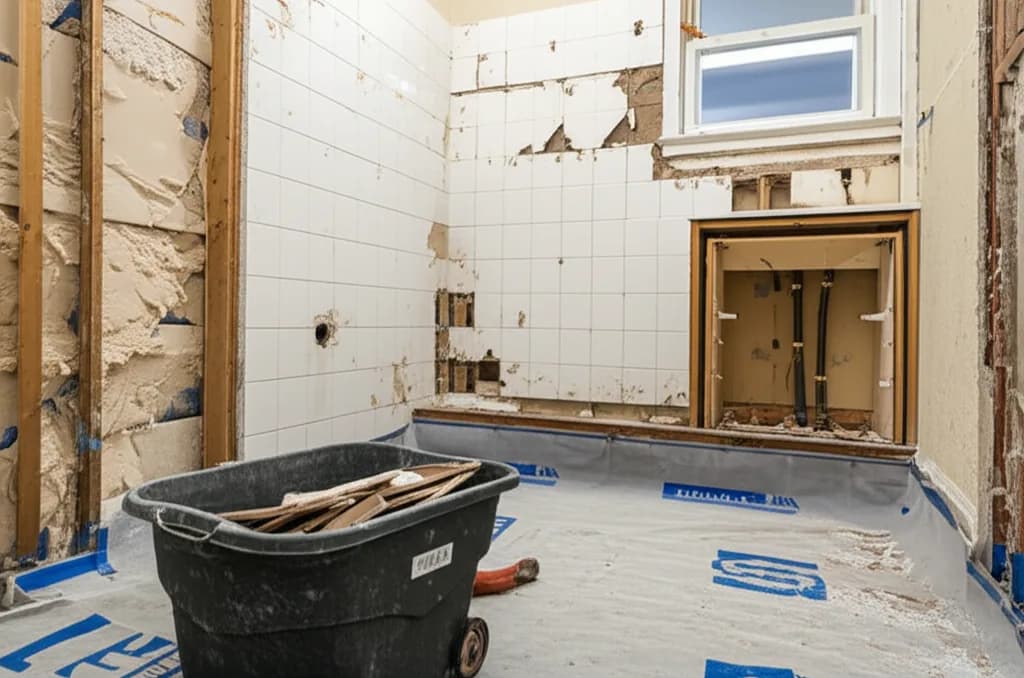
Every reconstruction follows a structured process designed to address the root cause, rebuild the structure correctly, and finish to a properly waterproofed standard. Here is what to expect.
Assessment & Documentation
We inspect the affected area to determine how far the damage extends — into framing, subfloor, wall cavities, and adjacent rooms. We photograph the damage and note the likely cause, building the documentation you'll want when discussing the loss with your insurance adjuster.
Scope & Estimate
We prepare a detailed, itemized scope of the repair and reconstruction work with a written estimate. This scope can be compared directly against your adjuster's estimate so everyone is working from the same picture of what the rebuild requires.
Controlled Demolition
We remove the water-damaged materials — saturated drywall and insulation, swollen subfloor, failed flooring and tile, and compromised substrate — using controlled, contained demolition to protect the rest of your home and expose the structure for inspection.
Structural & Subfloor Repair
With the damage exposed, we repair the bones of the room: replacing or reinforcing rotted framing, cutting out and replacing failed subfloor, and confirming the structure is sound, dry, and code-compliant before any new finish material goes on.
Proper Waterproofing
In wet areas, we install a real waterproofing system — Schluter KERDI, Laticrete Hydro Ban, or RedGard liquid membrane — over correctly sloped, flood-tested substrates. This is the step builder-grade construction so often skipped, and it's how we keep the damage from recurring.
Rebuild & Finish
We rebuild the space to a finished standard: drywall, texture, and paint; flooring and tile; cabinetry and trim; and fixtures. The repaired area is built to match the surrounding finishes so the result looks intentional, not patched.
Final Walkthrough
We walk the completed reconstruction with you, reviewing every detail — flooring transitions, grout and caulk lines, paint match, fixture operation, and waterproofing. Punch-list items are addressed, and we don't consider the project complete until you're satisfied.
A water loss often arrives with an insurance claim attached, and the documentation matters. Here is how we fit into that process — and, just as importantly, what stays between you and your insurer.
What we do
- Document the damage with clear photographs of the affected framing, subfloor, finishes, and likely source.
- Prepare a detailed, itemized scope of the repair and reconstruction work in writing.
- Work alongside your insurance adjuster's estimate so both are based on the same scope.
- Rebuild to a finished, properly waterproofed standard and keep records of materials and methods.
What stays with your insurer
- Whether your claim is approved is a coverage decision made by your insurance company.
- Your deductible and the dollar amount approved are governed by the terms of your policy.
- We don't file, handle, or guarantee your claim — and we never promise a specific approval or payout.
- If a claim is denied or only partially covered, you decide how to proceed with the rebuild.
In short: our job is to give you and your adjuster an accurate, professional picture of what it takes to rebuild your home correctly, and then to do that work to a high standard. The claim itself — coverage, deductible, and approval — is between you and your insurance company.
Water-damage reconstruction isn't a cosmetic job. It frequently involves structural framing, subfloor replacement, plumbing and electrical in wet locations, and waterproofing systems that have to be installed correctly to prevent a repeat failure. That's work that belongs with a registered, insured contractor — and here is exactly what backs every reconstruction project we take on.
Registration & Insurance That Protects You
Idaho registers contractors rather than licensing them, and the exemption for casual, minor or inconsequential work runs out at an aggregate contract price of $2,000 (Idaho Code § 54-5205(2)(f)) — the statute also bars splitting a job into smaller contracts to stay under it. Our active RCE-6681702 registration, $2 million general liability coverage, and full workers' compensation insurance mean your home and the people working in it are properly protected, which also matters for your insurance and resale documentation. An unregistered handyman may skip permits and use shortcuts that pass a glance but fail under daily water exposure. You can check any Idaho contractor's registration yourself on DOPL's public search before you sign.
Warranties on the Work We Stand Behind
Our reconstruction work is backed by a 3-year workmanship warranty covering labor and installation, including structural modifications and subfloor or framing repairs. Manufacturer warranties on materials are registered in your name and passed through to you.
Safe Practices in Older Homes
Many Boise neighborhoods include homes built before 1978, when lead-based paint and asbestos-containing materials were common. We follow EPA Renovation, Repair, and Painting (RRP) lead-safe work practices and maintain Idaho DEQ asbestos awareness, so demolition and reconstruction in older homes is handled responsibly.
The most expensive water-damage repair is the one you have to do twice. When a rebuild treats only the symptoms — fresh paint over a stained ceiling, new tile over a substrate that was never waterproofed — the underlying failure is still there, and the damage comes back, often worse and more expensive than the first time.
- We address the root cause — failed waterproofing, a worn supply line, a drainage issue — not just the visible finish.
- We rebuild the structure to a sound, code-compliant condition before any finish material is installed.
- We install proper waterproofing membrane systems in wet areas and flood-test shower pans before tile.
- We document concealed work so you have a record of how the rebuild was done.
- We match the repair to the surrounding finishes so the result looks intentional, not patched.
Hidden Conditions & Change Orders
Water damage frequently hides more than it shows. When demolition reveals additional rotted framing, a wider area of failed subfloor, or moisture damage in an adjacent wall, we stop, document it with photos, explain the issue and your options, and get your written approval before any additional work begins. No surprise charges, no scope creep without your knowledge — and the documentation supports your insurance discussion.
Water-damage reconstruction often overlaps with our core remodeling work. Explore the related services we provide across the Treasure Valley.
Does homeowner's insurance cover water damage repair?
It depends on your policy and the cause of the loss. Most homeowner's policies cover sudden and accidental water damage — a burst supply line, a failed water heater, or a frozen pipe that ruptures during a cold snap. Damage from long-term, gradual leaks or deferred maintenance is often excluded, and flood damage from outside the home typically requires separate flood insurance. We document the damage with photos and a detailed scope of work so you have what you need to discuss coverage with your insurer. Whether a claim is approved, and for how much, is between you and your insurance company — we cannot guarantee approval, but we can give you and your adjuster a clear, itemized picture of what it takes to rebuild.
Do you do emergency water extraction or 24/7 response?
No. Iron Crest Remodel is a remodeling and reconstruction contractor — we focus on repairing and rebuilding what water damaged, not on emergency water extraction or active drying. If you have standing water or an active leak, the right first step is to stop the water source (shut off the supply) and have the area dried out, then address the structural and finish repairs. Once the space is dry and stable, we step in to rebuild the framing, subfloor, drywall, flooring, tile, and finishes to a properly waterproofed, finished standard. We're happy to coordinate timing so our rebuild begins once mitigation is complete.
How do you prevent water damage from happening again?
Repairing the visible damage without fixing the root cause is the most common mistake we see. Our rebuilds address the underlying failure: in showers and tubs, that means replacing builder-grade fiberglass surrounds with a proper waterproofing membrane system (Schluter KERDI, Laticrete Hydro Ban, or RedGard) over correctly sloped, flood-tested substrates. For plumbing-related damage, we make sure failed supply lines and fixtures are replaced, not just the drywall around them. For roof or gutter overflow, we coordinate the exterior repair so water is directed away from the structure. The goal is a finished space that's built to handle daily water exposure for the life of the home — not a cosmetic patch that fails again in two years.
What are the signs of hidden water damage in a Boise home?
Common warning signs include soft or spongy spots in flooring, especially near tubs, showers, and toilets; bubbling, peeling, or discolored paint and drywall; a persistent musty odor; warped or cupped wood and laminate flooring; loose or hollow-sounding tile; staining on ceilings below bathrooms; and grout or caulk that's cracked or pulling away in a shower. Behind builder-grade fiberglass surrounds, moisture can migrate through seams and around fixtures for years before it shows on the surface — so by the time you notice a stain, the framing or subfloor underneath may already need repair. If you suspect hidden damage, a contractor can open a small inspection area to assess the extent before scoping a full repair.
Do you work with my insurance company?
Yes — we work alongside your insurance adjuster's process. We document the damage with photographs and prepare a detailed, itemized scope of the repair and reconstruction work so it can be compared against your adjuster's estimate. We rebuild to a finished standard and keep records of the materials and methods we use. What we don't do is handle, file, or guarantee your claim — coverage decisions, deductibles, and the dollar amount approved are determined by your insurer under the terms of your policy. Our role is to give you and your adjuster an accurate, professional picture of the rebuild.
What areas do you serve for water damage repair?
Iron Crest Remodel serves Boise and the greater Treasure Valley, including Meridian, Eagle, Nampa, Caldwell, Kuna, Star, and Garden City. We are registered with the Idaho Division of Occupational and Professional Licenses as RCE-6681702 — Idaho registers contractors rather than licensing them — and we handle water-damage reconstruction projects throughout the metro area. If you're outside the immediate Boise metro, reach out — we serve a wide radius across southwest Idaho and can let you know whether your location is within our service area.
How long does water damage repair take?
It depends entirely on the extent of the damage and the scope of the rebuild. A contained repair — say, replacing a section of subfloor and drywall after a fixed supply-line leak — may take one to two weeks. A full bathroom rebuild with structural framing repair, new waterproofing, tile, and fixtures can run several weeks. Larger losses that affect multiple rooms, flooring throughout, or structural framing take longer. The space also has to be fully dry and stable before reconstruction begins. Once we assess the damage, we provide a written scope and a realistic timeline rather than a generic promise.
Why hire a registered contractor instead of a general handyman for water damage repair?
Water-damage rebuilds frequently involve structural framing, subfloor replacement, electrical and plumbing in wet locations, and waterproofing systems that must be installed correctly to prevent the damage from recurring. Idaho requires contractor registration for this work: under Idaho Code section 54-5205(2)(f), the exemption for casual, minor or inconsequential work stops at an aggregate contract price of $2,000, and the statute explicitly bars splitting a job into sub-$2,000 contracts to get under it. A registered contractor carries general liability and workers' compensation insurance, pulls the required permits, and builds to code — which matters both for safety and for your insurance and resale documentation. For homes built before 1978, lead-safe work practices and testing before demolition are also part of doing the job properly. Iron Crest Remodel is registered with Idaho DOPL as RCE-6681702, insured, and backs its reconstruction work with a 3-year workmanship warranty.
The following government agencies, industry organizations, and official resources provide additional information relevant to your remodeling project.
Rebuild Your Water-Damaged Home
Get a free, detailed estimate for water damage repair and reconstruction. We serve Boise, Meridian, Eagle, Nampa, Kuna, and the entire Treasure Valley. Call (208) 779-5551.