

Demolition Contractor in Boise, Idaho
Safe, permitted interior and selective demolition that preps your home for remodeling — dust-contained, code-compliant, and cleaned up before the rebuild begins.
Every remodel starts with subtraction. Before a new kitchen, bathroom, or open floor plan can take shape, the old layout has to come out — and how that demolition is done sets the tone for everything that follows. Done carelessly, demolition spreads dust through the whole house, damages the structure and finishes you meant to keep, and uncovers problems that get buried instead of solved. Done right, it is a controlled, methodical first phase that leaves a clean, sound, well-prepared space for the rebuild.
Iron Crest Remodel approaches demolition with the same care we bring to finish work. We contain dust before the first wall comes down, protect the parts of your home that are staying, remove only what the plan calls for, haul the debris away, and respect the structure underneath. We identify load-bearing elements, treat older homes as potentially containing lead paint or asbestos until testing says otherwise, and pull the permits the work requires. The result is a space that is genuinely ready to build on — not just emptied out.
Whether your demolition is the opening phase of a remodel we are building or a standalone teardown to clear a space, the standard is the same: safe, clean, code-compliant, and done by a contractor registered with the Idaho Division of Occupational and Professional Licenses and insured, who is accountable for the whole job.
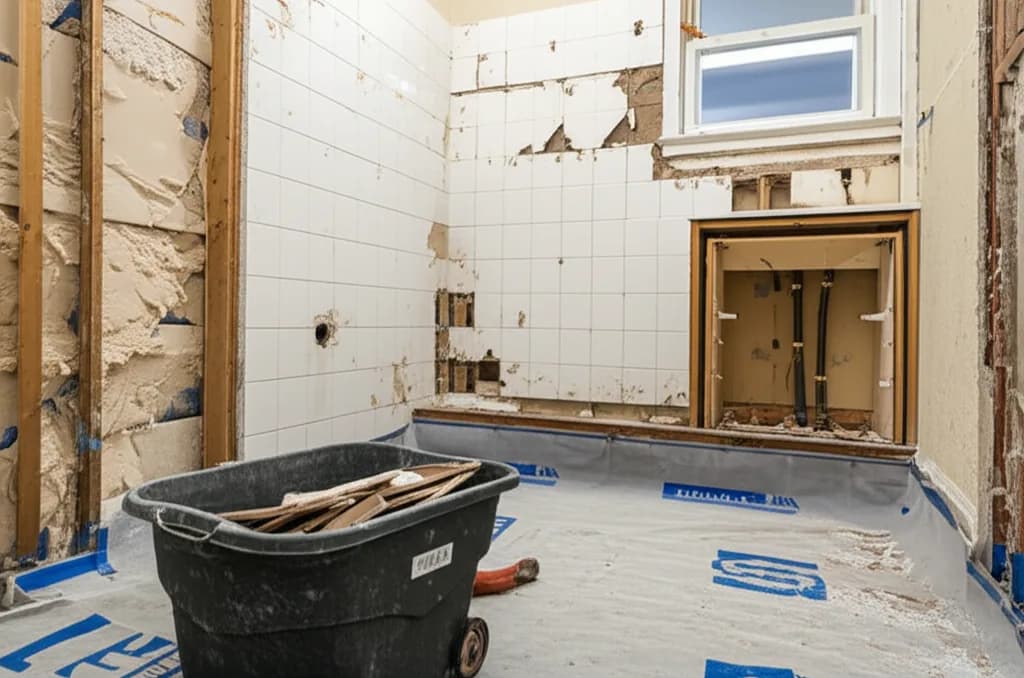
We handle the full range of residential demolition that a remodel calls for — from removing a single fixture to taking an entire home down to the framing. Every scope is planned in advance, contained for dust, and cleaned up when we are done.
Interior Demolition
Kitchens, bathrooms, flooring, walls, ceilings, and finishes removed cleanly to make room for a new layout. We pull cabinetry, counters, tile, drywall, and fixtures and prepare the space for rough-in.
Selective & Surgical Demolition
Removing only what the plan calls for while protecting everything that stays — a single wall, one flooring layer, a tub and surround. More planning, more care, no collateral damage.
Full Gut-to-Studs
Whole-room or whole-home demolition back to the framing for major renovations. Sequenced around utility shutoffs, hazardous-material handling, and inspections so the rebuild starts on a clean slate.
Fixture, Cabinetry, Tile & Deck Removal
Tear-out of cabinets, countertops, tile, vanities, tubs, toilets, sinks, old flooring, and exterior decks — removed without disturbing the surrounding finishes you intend to keep.
Debris Hauling & Disposal
Sorting, loading, and hauling debris to licensed disposal and recycling facilities. Recyclable metal, concrete, and clean wood are diverted where practical; hazardous material is handled separately.
Site Cleanup & Rebuild Prep
A clean, swept, sound space handed back ready for rough-in. We leave the framing, subfloor, and systems in the condition the next phase needs them to be in.
A significant share of Boise's housing stock predates modern materials regulations, and that changes how demolition has to be done. Disturbing the wrong material without precautions does not just risk a citation — it can release hazards into the home you and your family live in. We plan for this from the start rather than discovering it mid-teardown.
Lead-Based Paint in Pre-1978 Homes
Homes built before 1978 may contain lead-based paint on walls, trim, doors, and windows. Sanding, scraping, or demolishing painted surfaces in these homes can generate lead dust. We follow EPA Renovation, Repair, and Painting (RRP) lead-safe work practices: contained work areas, dust-minimizing techniques, HEPA-vacuum cleanup, and proper disposal of contaminated debris. Where the presence of lead is uncertain, we treat painted surfaces as presumed lead until testing confirms otherwise.
Asbestos in Pre-1980 Materials
Homes built before roughly 1980 may contain asbestos in floor tile and mastic, popcorn ceilings, pipe and duct insulation, certain joint compounds, and other building materials. Asbestos is dangerous when it is disturbed and fibers become airborne — exactly what demolition does. Before we disturb any suspect material, we coordinate testing, and where asbestos is confirmed we coordinate abatement in accordance with Idaho Department of Environmental Quality (DEQ) asbestos rules before demolition proceeds. We do not cut corners around suspect materials.
Dust Barriers & Containment
Even in a newer home where no hazardous materials are present, demolition produces a tremendous amount of dust. Before work begins we build dust barriers to seal the work area off from the rest of the home, mask HVAC returns so demolition dust does not circulate through the ductwork, protect the floors and finishes along crew travel paths, and use negative-air and HEPA filtration where the scope warrants it. Containment keeps the rest of your home clean and livable while the work is underway.
If your home was built before 1980, plan for the possibility of testing and abatement before demolition. It is far less costly and far safer to identify and address lead or asbestos up front than to disturb it unknowingly. We build this step into the scope and schedule for older Treasure Valley homes.
Not all demolition is equal in the eyes of the building department. Pulling out cabinetry and a non-bearing partition is one thing; removing a wall that holds up the roof or the floor above is another. Getting that distinction wrong is one of the most expensive and dangerous mistakes a remodel can make.
Identifying Load-Bearing Elements
During the walkthrough we identify which walls and elements carry structural load — walls that support roof framing, upper floors, or point loads from above. Removing a load-bearing wall is not a demolition task in isolation; it requires a properly engineered beam or header to carry the load that the wall was carrying, sized by an engineer and built to spec. We flag these conditions before any wall comes out so there are no surprises.
Permits Through the Correct Jurisdiction
Structural demolition — removing or modifying load-bearing walls and the like — requires a building permit and, in most cases, an engineered design. Depending on where your home sits, that permit is issued by the City of Boise, Ada County, or Canyon County, each of which runs its own plan review and inspections. We confirm the correct authority for your address, prepare and submit the application, schedule inspections, and see the work through final sign-off. Inside city limits that is the Boise Building Division at (208) 608-7070, with zoning and setback questions going to Planning & Zoning at (208) 608-7100. You do not have to navigate the permitting office yourself.
Protecting What Stays Standing
Even when a wall is non-bearing, there are usually electrical circuits, plumbing supply and drain lines, and HVAC runs hidden inside it. Part of responsible demolition is locating and safely handling these systems — capping, rerouting, or disconnecting them under the appropriate trade permits — rather than cutting blindly. We treat the framing and systems that remain as part of the finished project, because they are.
Demolition follows a deliberate sequence designed to protect your home, control dust, and leave a space that is genuinely ready for the rebuild. Here is what to expect from walkthrough to handoff.
Walkthrough & Scope
We walk the space with you, define exactly what comes out and what stays, identify load-bearing elements, and assess the age of the home for potential lead or asbestos. You receive a written scope and estimate, plus a plan for any testing, abatement, or permits the project requires.
Utility Shutoffs & Protection
Before anything is removed, we shut off and isolate the affected utilities — water, gas, and electrical circuits in the work area — and protect floors, finishes, and crew travel paths throughout the home. We confirm what is hidden inside the walls so nothing is cut blindly.
Containment Setup
We build dust barriers to seal the work area, mask HVAC returns, and set up negative-air and HEPA filtration where the scope calls for it. Where lead-safe practices apply, the containment is built to those standards before demolition starts.
Demolition
Crews remove the planned materials methodically — finishes, fixtures, cabinetry, tile, flooring, walls, and structure as the scope dictates — protecting everything that stays. Selective work is done by hand where precision matters, not by brute force.
Haul-Off & Disposal
Debris is sorted, loaded, and hauled to licensed disposal and recycling facilities. Recyclable materials are diverted where practical, and any hazardous material is handled and disposed of separately under the rules that govern it. You are not left with debris to manage.
Inspection & Rebuild Handoff
We schedule any required inspections, then clean and sweep the space and confirm the framing, subfloor, and systems are in the condition the next phase needs. The space is handed off ready for rough-in and rebuild.
Demolition carries real risk: structural collapse from removing the wrong wall, exposure to lead or asbestos, injury, and property damage. Idaho does not issue a general contractor's licence — it registers contractors through the Division of Occupational and Professional Licenses (DOPL), and hiring a registered, insured contractor is how you protect your home, your family, and yourself from liability. Here is exactly what backs every demolition project we take on.
Iron Crest Remodel is registered with Idaho DOPL as an RCE contractor. You can verify any Idaho contractor's registration through the DOPL contractor search — and any legitimate contractor will share their RCE number without hesitation. Workers' compensation coverage matters especially in demolition: without it, you could be held personally liable if someone is injured on your property. We carry it, along with $2 million in general liability, on every job.
We serve homeowners across the Treasure Valley — Boise, Meridian, Eagle, Nampa, Caldwell, Kuna, Star, and Garden City — and we stand behind our work with a 3-year workmanship warranty.
Do I need a permit to demolish an interior wall in Boise?
It depends on whether the wall is load-bearing. Removing a non-load-bearing partition wall as part of an interior remodel generally does not require a structural permit, though any electrical, plumbing, or HVAC lines running inside that wall must be rerouted under the appropriate trade permit. Removing a load-bearing wall is a different matter entirely — it requires an engineered beam or header design and a building permit through the City of Boise, Ada County, or Canyon County depending on your address. Iron Crest Remodel identifies which walls carry structural load during the walkthrough, coordinates the engineering when needed, and pulls every permit your project requires before any demolition begins.
How do you handle asbestos and lead paint in older Boise homes?
Homes built before 1978 may contain lead-based paint, and homes built before roughly 1980 may contain asbestos in materials such as floor tile, mastic, popcorn ceilings, pipe insulation, and certain drywall joint compounds. We treat any suspect material in an older home as presumed hazardous until proven otherwise. Before disturbing those materials we coordinate testing, and where lead is present we follow EPA Renovation, Repair, and Painting (RRP) lead-safe work practices — contained work areas, HEPA cleanup, and proper waste handling. Where asbestos is confirmed, we coordinate abatement in line with Idaho Department of Environmental Quality (DEQ) asbestos rules before demolition continues. We never knock out suspect materials and deal with the consequences later.
Do you only demolish as part of a remodel, or can you do standalone demolition?
Both. Demolition is most often the controlled first phase of a remodel we are already building — gutting a kitchen, opening up a bathroom, or taking a space down to the studs so a new layout can take shape. But we also perform standalone interior and selective demolition for homeowners who want a space cleared, a deck or cabinetry removed, or a room prepped for another contractor's rebuild. Either way the work is permitted where required, contained for dust, and cleaned up before we hand the space back to you.
How is the debris disposed of after demolition?
Debris is sorted, loaded, and hauled to the appropriate licensed disposal or recycling facility. Clean materials such as metal, concrete, and untreated wood are routed for recycling where practical, while general construction debris goes to an approved landfill. Any material identified as hazardous — for example confirmed asbestos-containing material — is handled and disposed of separately under the rules that govern it. Disposal and haul-off are part of our scope, so you are not left with a pile in the driveway or a dumpster to manage on your own.
How do you protect the rest of my home during demolition?
Containment is built before the first wall comes down. We set up dust barriers (typically poly sheeting with zipper access) to seal the work area off from the rest of the home, protect floors and finishes along the path crews travel, mask off HVAC returns so demolition dust does not circulate through the ducts, and run negative-air and HEPA filtration where the scope calls for it. Selective demolition is, by definition, about removing only what is planned while protecting everything that stays. The goal is that the rest of your home stays livable and clean while we work.
What areas do you serve for demolition?
Iron Crest Remodel provides demolition services across the Treasure Valley, including Boise, Meridian, Eagle, Nampa, Caldwell, Kuna, Star, and Garden City. Because permitting and jurisdiction vary between the City of Boise, Ada County, and Canyon County, we confirm the correct authority for your address as part of the scoping process.
How long does demolition take?
Most interior demolition phases are measured in days rather than weeks. A single bathroom or a focused selective-demolition scope can often be completed in one to two days. A full kitchen gut typically runs two to four days. A whole-home gut-to-studs takes longer and is sequenced around utility shutoffs, hazardous-material handling, and inspections. The exact timeline depends on the size of the space, what is being removed, the age of the home, and whether any abatement is required. We give you a realistic schedule in writing before work starts.
What is selective or surgical demolition?
Selective (sometimes called surgical) demolition means removing only the specific elements your project calls for while leaving the surrounding structure, finishes, and systems intact and protected. Instead of clearing an entire room, we might remove a single wall, take out a tub and surround, pull up one flooring layer, or strip cabinetry — and nothing else. It demands more planning and care than blunt-force demolition, but it is what allows a remodel to move forward cleanly without damaging the parts of your home you are keeping.
Plan Your Demolition Phase
Get a free, detailed estimate for safe, dust-controlled, code-compliant demolition. We serve Boise, Meridian, Eagle, Nampa, Kuna, and the entire Treasure Valley.