
Interior Painting Services in Boise & the Treasure Valley
Iron Crest Remodel delivers professional interior painting with meticulous prep work, premium paints, and clean, sharp lines. From single accent walls to whole-house repaints, we work efficiently with minimal disruption.
- Wall and ceiling painting
- Trim, baseboard, and crown molding painting
- Cabinet painting and refinishing
- Drywall repair and texture matching
- Color consultation
- Premium paint brands (Benjamin Moore, Sherwin-Williams)
- Wallpaper removal
- Accent walls and feature walls
- Garage and utility space painting
- Dust-free sanding and prep
Timeline
3 – 10 days
A real interior painting project — see the finished result, the project details, and the full transformation story.
Color Consultation & Estimate
We visit your home, discuss color preferences, assess surface conditions, and provide a fixed-price estimate with material specifications.
Prep & Protection
Furniture is moved and covered, floors are protected, trim is taped, and all surfaces are cleaned, patched, sanded, and primed as needed.
Paint Application
Professional spray, roll, and brush application depending on the surface. Two coats of premium paint are standard. Trim and detail work is done by hand.
Cleanup & Touch-Up
Protection materials are removed, furniture is replaced, and a detailed touch-up inspection is completed. We leave your home cleaner than we found it.

See Your Remodel Before You Build.
Upload a few photos of your kitchen, bathroom, flooring, or exterior and get AI-generated concept visuals tailored to your space, style, and materials — free, no obligation, in about five minutes. Then request a real estimate from our Idaho registered Boise team.
Free concept preview · No credit card · Licensed Idaho contractor
How much does interior painting cost in Boise?
Interior painting in Boise costs $2-$4 per square foot of wall space, or roughly $3,000-$6,000 for an average 3-bedroom home. Cabinet painting typically adds $3,000-$6,000 depending on kitchen size.
How long does it take to paint a house interior?
A typical 3-bedroom home takes 3-5 days for walls and ceilings. Adding trim, cabinets, or extensive prep work extends the timeline to 1-2 weeks.
What paint do you use?
We use premium paints from Benjamin Moore and Sherwin-Williams. For walls, we recommend their mid-sheen (eggshell or satin) lines for durability and washability. For trim, semi-gloss provides a clean, durable finish.
Plan your interior painting project with our in-depth guides.
Explore our in-depth guides to understand interior painting costs, timelines, and planning details for cities across the Treasure Valley.
See detailed interior painting information specific to your city, including local permit requirements, housing stock insights, and neighborhood-level recommendations.

Talk to a real project manager
Have Questions? Call Now for a Free In-Home Consultation.
Mon–Fri 7 AM–6 PM · Idaho registered & insured · No obligation
Russ S. — Project Manager
Russ S. — Project Manager
Ready to Start Your Remodeling Project?
Get a free, no-obligation estimate from Boise's trusted remodeling experts. Licensed, insured, and ready to build.
From cabinet refinishing to accent walls and specialty finishes, explore our detailed guides to interior painting services for Boise homes.
Choosing the right colors and finishes for your Boise home? Our guides cover color selection, where paint earns its keep, and expert painting decisions.

Choosing the right paint sheen is just as important as selecting the right color. Each finish offers a different balance of durability, washability, and visual appearance. The wrong sheen in the wrong room leads to walls that show every imperfection or fail to hold up to daily wear. Here is what we recommend for Boise homeowners based on decades of painting experience.
Flat / Matte
Flat paint has zero sheen and hides surface imperfections better than any other finish. It creates a smooth, velvety appearance that absorbs light rather than reflecting it. We use flat paint primarily on ceilings throughout the home and occasionally on formal living room or bedroom walls in homes without young children or pets. The trade-off: flat paint is the least washable finish. Scrubbing marks or stains into flat paint often removes the paint itself. For ceilings, we use Sherwin-Williams ProMar 200 Flat or Benjamin Moore Ceiling Paint — both are formulated to minimize spatter during application and dry to a perfectly uniform finish.
Eggshell
Eggshell has a soft, low-luster sheen (typically 10–25% gloss) that hides minor wall imperfections while offering significantly better washability than flat paint. This is the most popular finish for living rooms, bedrooms, dining rooms, and hallways in Boise homes. Eggshell cleans up easily with a damp cloth and resists scuffing from everyday contact. We recommend eggshell as the default wall finish for most rooms — it strikes the ideal balance between appearance and practicality.
Satin
Satin paint has a smooth, pearl-like sheen (25–35% gloss) with excellent washability and stain resistance. We recommend satin for high-traffic areas: hallways, stairwells, kids' bedrooms, mudrooms, and laundry rooms. Satin is also the standard choice for kitchens and bathrooms where moisture resistance matters. The higher sheen means satin shows wall imperfections more readily than eggshell, so proper surface prep — filling nail holes, skim-coating drywall seams, and sanding — is essential before applying satin paint.
Semi-Gloss
Semi-gloss (35–70% gloss) is highly durable, moisture-resistant, and easy to clean. This is the standard finish for all interior trim work — baseboards, window casings, door frames, and crown molding. Semi-gloss is also used for bathroom walls, laundry room walls, and any surface that needs to withstand frequent wiping or scrubbing. The reflective surface creates a clean contrast against eggshell or satin walls, defining architectural details and making trim pop.
High-Gloss
High-gloss (70%+ gloss) creates a hard, mirror-like finish that is extremely durable and easy to clean. We use high-gloss primarily on front doors, built-in cabinetry, and accent furniture pieces. High-gloss paint shows every surface imperfection, so it requires meticulous preparation — often multiple rounds of sanding and priming. The payoff is a rich, lacquer-like appearance that elevates architectural millwork.
VOC Levels and Indoor Air Quality
VOC (Volatile Organic Compound) levels determine how much chemical off-gassing a paint produces during and after application. Traditional paints contain 300–400 grams per liter of VOCs. Modern low-VOC paints contain less than 50 g/L, and zero-VOC formulations contain less than 5 g/L. We default to low-VOC and zero-VOC paints on all interior projects — they perform identically to conventional paints in terms of coverage, durability, and color accuracy, with significantly less odor and no harmful off-gassing. This is especially important for homes with young children, pregnant occupants, or anyone with respiratory sensitivities. Boise's dry climate helps paint cure quickly, but we still recommend ventilation for 48 hours after painting regardless of VOC level.
The difference between contractor-grade premium paint and consumer-grade big-box store paint is substantial. Premium paints contain higher concentrations of titanium dioxide (the pigment that provides coverage and hiding power), superior resin systems for adhesion and durability, and finer pigment grinds for smoother application. The result: better one-coat hide, longer life between repaints, superior washability, and more accurate color consistency. We buy direct from professional paint dealers, not retail stores, which gives us access to contractor pricing and formulations not available to homeowners.
Sherwin-Williams
Sherwin-Williams is our primary paint supplier for most interior projects. We use three product lines depending on the application and budget:
- Duration Home — Our go-to for walls and ceilings. Excellent coverage, superior washability, and antimicrobial properties that resist mold and mildew. One coat often covers in same-color repaints. Available in flat, matte, satin, and semi-gloss.
- Emerald — Sherwin-Williams' top-tier line. Zero-VOC formula with outstanding stain resistance and color accuracy. We recommend Emerald for kitchens, bathrooms, kids' rooms, and any high-traffic area where washability matters most. Also available in a urethane-modified alkyd for trim (Emerald Urethane Trim Enamel) that levels beautifully for a factory-smooth finish.
- ProClassic — Our standard for trim, doors, and cabinetry. ProClassic is a hybrid alkyd-acrylic that flows and levels like oil-based paint but cleans up with water and has low VOC. It creates a hard, durable finish that resists chipping, yellowing, and fingerprints.
Benjamin Moore
Benjamin Moore is known for exceptional color accuracy and their proprietary Gennex colorant system, which maintains color consistency across sheens. We use Benjamin Moore when clients have specific color preferences from their palette or when the project demands the absolute best color match:
- Regal Select — Premium interior paint with excellent hide, coverage, and a smooth, even finish. Regal Select is stain-resistant and easy to touch up, making it ideal for whole-home repaints. Available in flat, matte, eggshell, pearl, and semi-gloss.
- Advance — Benjamin Moore's waterborne alkyd formula designed specifically for trim, doors, and cabinetry. Advance dries to a beautiful, furniture-like finish with exceptional leveling and minimal brush marks. Longer dry time (16 hours between coats) but the result is worth the wait.
Behr
Behr paints are available at The Home Depot and offer solid performance at a lower price point. We use Behr Dynasty and Behr Marquee on budget-conscious projects where the client wants good coverage and durability without the premium price tag of Sherwin-Williams or Benjamin Moore. Behr Dynasty, in particular, offers one-coat coverage in many colors and excellent stain-blocking properties. However, for cabinets, trim, and high-visibility surfaces, we strongly recommend stepping up to ProClassic or Advance for the superior leveling and hardness that trim work demands.
We never thin our paint, never skip primer when it's needed, and never substitute a lesser product than what was specified. Every project proposal includes the exact brand, product line, and sheen for each surface so you know exactly what you're getting.
Paint color trends evolve, but the best color choices for your home depend on your specific lighting, architectural style, and personal preferences more than any trend cycle. That said, here are the palettes and approaches we see working well in Boise homes right now — and the reasoning behind each.
Warm Neutrals and Greiges
The gray-beige hybrid known as “greige” continues to dominate Boise interiors, and for good reason. Greige tones adapt well to Idaho's bright, warm natural light without feeling cold or sterile. Popular picks include Sherwin-Williams Accessible Beige (SW 7036), Agreeable Gray (SW 7029), and Benjamin Moore Revere Pewter (HC-172). These colors work as whole-house neutrals that complement both warm wood tones and cooler gray cabinetry. They also photograph well for resale listings — an important consideration in Boise's competitive real estate market.
Navy and Deep Blue Accents
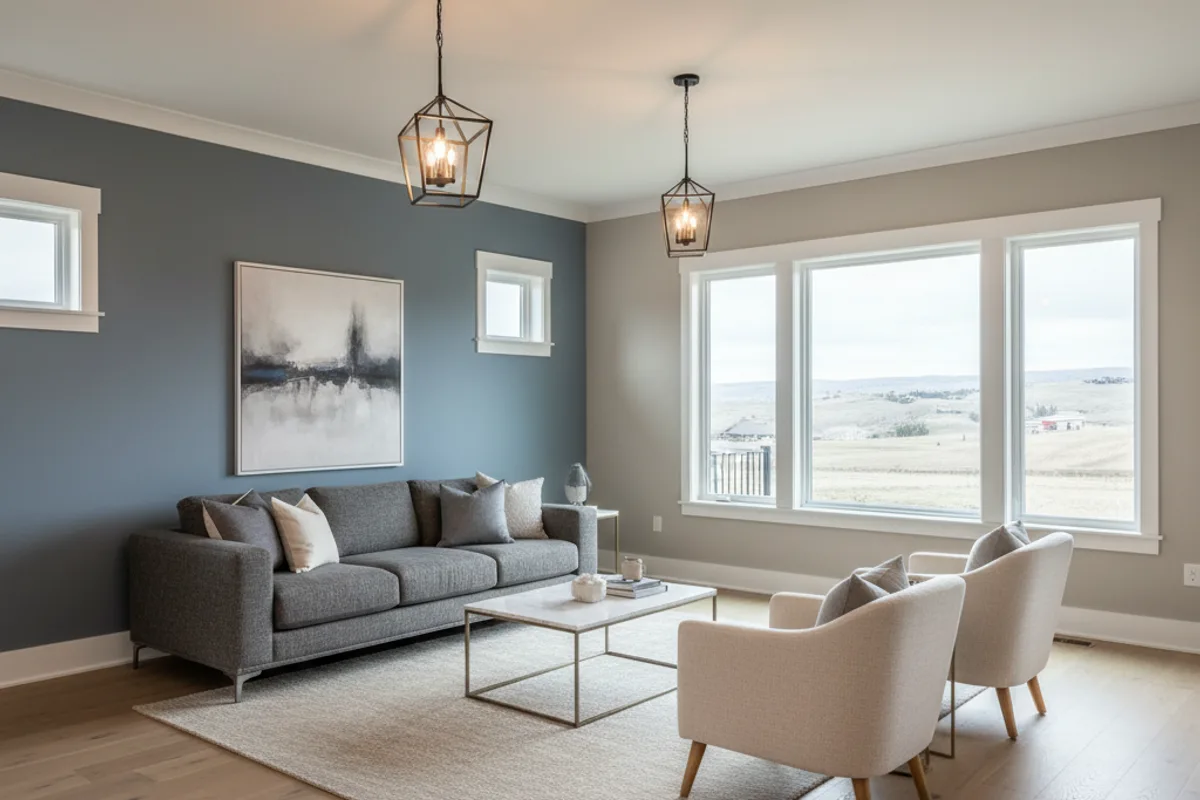
Navy accent walls have become one of our most-requested painting projects in Boise. Deep blues like Sherwin-Williams Naval (SW 6244) and Benjamin Moore Hale Navy (HC-154) create dramatic focal points in living rooms, primary bedrooms, and home offices. Navy pairs beautifully with white trim, brass hardware, and warm wood — a combination that resonates with Idaho's blend of modern and rustic aesthetics. We typically recommend limiting bold colors to one accent wall per room to avoid overwhelming the space.
White Trim and Bright Whites
Bright white trim against slightly toned walls remains the most popular trim approach in Boise. For trim, we recommend Sherwin-Williams Extra White (SW 7006) or Benjamin Moore Chantilly Lace (OC-65) in semi-gloss for a clean, crisp contrast. For walls, pure white works in modern and minimalist homes with large windows, but most Boise homes benefit from a warm white like Benjamin Moore White Dove (OC-17) or Sherwin-Williams Alabaster (SW 7008) to avoid the clinical feel that pure white can create in rooms with less natural light.
Earth Tones and Nature-Inspired Palettes
Boise homeowners increasingly draw inspiration from the surrounding landscape — the sage-covered foothills, warm sandstone, and deep evergreen ridgelines. Sage greens (Sherwin-Williams Evergreen Fog, SW 9130), warm terracottas, and dusty olive tones feel natural and grounded in homes with views of the Boise Front. These earth tones work especially well in Boise's newer subdivisions in Southeast Boise, Eagle, and Meridian, where large windows connect interior spaces to the surrounding high-desert landscape.
How Idaho's Natural Light Affects Color Choices
Boise receives about 120 clear days a year, plus another 90 partly cloudy (NOAA normals, Boise Air Terminal), and the intense, high-altitude light at 2,700 feet elevation affects how paint colors appear indoors. South- and west-facing rooms receive warm, golden light that intensifies warm tones and can make cool grays look dingy. North-facing rooms get cooler, more consistent light that flatters blue-grays and cooler greens. East-facing rooms receive bright morning light that shifts to shadow by afternoon. We always recommend testing paint samples in your specific rooms and viewing them at multiple times of day before committing. Large brush-out samples on poster board (not small swatches) give the most accurate preview of how a color will look on your walls.
Popular Palettes by Home Era
North End bungalows and craftsman homes (1910–1950): Period-appropriate palettes with warm whites, deep greens, and rich cream tones honor the architectural character. We often use Benjamin Moore's Historical Colors collection for trim and accent colors.
Bench and Vista ranch homes (1950–1980): These homes benefit from updated neutrals that brighten and modernize without fighting the low ceilings and compartmented floor plans. Lighter greiges and warm whites open up smaller rooms visually.
Newer subdivisions (1990–present): Open floor plans with tall ceilings and large windows can handle bolder choices — deep accent walls, contrasting ceiling colors, and two-tone palettes that define zones within open-concept spaces.
The most common reason paint jobs fail prematurely — peeling, bubbling, uneven coverage, visible roller marks — is inadequate surface preparation. Professional prep work is what separates a paint job that looks good for 2 years from one that looks good for 10. Our prep process is thorough and non-negotiable because we guarantee our work and our reputation depends on long-lasting results.
Cleaning and Degreasing
Every surface is cleaned before painting. Kitchen walls accumulate grease and cooking residue that prevents paint adhesion. Bathroom walls have soap scum and moisture buildup. Even bedroom walls collect dust, cobwebs, and skin oils from years of contact near headboards and light switches. We wash all surfaces with TSP (trisodium phosphate) or a TSP substitute, rinse thoroughly, and allow surfaces to dry completely before priming. Skipping this step is the number-one cause of paint adhesion failure.
Sanding
We sand all previously painted surfaces to create a uniform “tooth” that new paint can grip. For walls, we use 120–150 grit sandpaper with dust-free sanding systems to minimize airborne dust. Trim and doors are sanded to 220 grit for a smoother finish. Any glossy surfaces (previously painted with semi-gloss or high-gloss) must be sanded or chemically deglossed before recoating — painting over gloss without scuffing it is very likely to peel.
Priming
Primer is essential in several situations: new drywall, drywall repairs, raw wood, stain-blocking (water stains, smoke damage, marker, crayon), drastic color changes, and any surface that has been heavily sanded. We use Sherwin-Williams PrimeRx for general priming, Zinsser BIN shellac-based primer for stain blocking (the only product that reliably blocks water stains, tannin bleed, and nicotine), and Sherwin-Williams Extreme Bond for slick or glossy surfaces. Tinting the primer close to the finish color improves coverage and reduces the number of finish coats needed.
Caulking
Every gap between trim and wall, baseboard and floor, window casing and wall, and crown molding and ceiling is caulked with high-quality paintable acrylic latex caulk. Caulking creates clean, seamless transitions that make trim work look precise and professional. In Boise's dry climate with significant seasonal temperature swings (from below freezing in winter to over 100°F in summer), gaps open up more readily than in temperate climates. We use DAP Alex Flex or Sherwin-Williams 950A, both of which remain flexible after curing and resist cracking through temperature cycles.
Patching and Skim Coating
Nail holes, screw pops, drywall dings, and small cracks are filled with lightweight spackle, sanded flush, and spot-primed. Larger repairs — holes from old wall-mounted TVs, doorknob damage, or failed drywall tape seams — are repaired with setting-type joint compound, taped as needed, and feathered smooth over multiple coats. We match the existing wall texture (orange peel, knockdown, or smooth) so that repairs are invisible after painting.
Common Boise-Specific Prep Challenges
Textured walls: Many Boise homes built in the 1980s–2000s have orange peel or knockdown texture. Painting textured walls requires back-rolling to work paint into the texture valleys. We also offer texture removal and skim-coating for homeowners who want smooth walls — a multi-step process that adds time but dramatically modernizes the look of a room.
Popcorn ceilings: Popcorn (acoustic) ceilings are common in Boise homes built before 1990. We offer popcorn ceiling removal (including asbestos testing for pre-1980 homes), skim coating to smooth, and repainting. Removing popcorn texture is one of the highest-impact cosmetic upgrades we perform.
Water stains: Boise's occasional heavy spring rains and ice dam issues can cause ceiling and wall stains. These must be primed with shellac-based stain blocker (Zinsser BIN) before painting — latex primers will not block water stains, and the discoloration will bleed through the finish coat within weeks.
Beyond standard wall and ceiling painting, we offer specialty painting services that require additional skills, equipment, and techniques. These services are priced separately based on scope and complexity.
Accent Walls and Feature Walls
A single bold wall can transform a room without the commitment of painting every surface in a saturated color. We handle color selection, precise taping for clean edges, and multi-coat application to achieve deep, even coverage with dark or saturated colors. Popular accent wall colors in Boise include deep navy (Naval SW 6244), forest green (Jasper SW 6216), and charcoal (Iron Ore SW 7069). Accent walls work best on the wall that draws the eye when you enter the room — typically the wall behind the bed in a bedroom, the fireplace wall in a living room, or the wall behind a home office desk.
Cabinet Painting
Cabinet painting is one of the most transformative and cost-effective kitchen updates available. We remove all doors and drawer fronts, label every piece, and transport them to our spray setup for a factory-quality finish. Box frames are hand-brushed or sprayed in place after thorough degreasing, sanding, and priming. We use Sherwin-Williams ProClassic or Benjamin Moore Advance for cabinets — both are hybrid alkyd formulas that cure to a hard, durable, furniture-quality finish. Cabinet painting typically takes 5–7 days and costs $3,000–$6,000 for an average kitchen, compared to $15,000–$40,000 for new cabinets.
Trim and Door Painting
Crisp, clean trim work is the detail that separates professional painting from DIY. We hand-brush all trim — baseboards, window casings, door frames, and crown molding — with premium semi-gloss or satin paint. Interior doors are removed from hinges, laid flat, and brushed or sprayed for a smooth, drip-free finish. All hardware is removed (never taped over), and hinges are reinstalled after paint has fully cured. For homes with stained wood trim transitioning to painted, we use bonding primer to ensure adhesion over polyurethane finishes.
Ceiling Painting
Ceiling painting is often overlooked, but yellowed or discolored ceilings make an entire room look tired. We use specialized ceiling paint (Sherwin-Williams ProMar 200 Flat Ceiling Paint or Benjamin Moore Ceiling Paint) that is formulated with a thicker consistency to minimize spatter and drips during overhead application. Ceiling paint dries dead flat to eliminate light reflections that would highlight roller marks or surface imperfections. We recommend repainting ceilings whenever walls are being painted — the contrast between fresh walls and a dingy ceiling is immediately noticeable.
Stairwell and Vaulted Ceiling Work
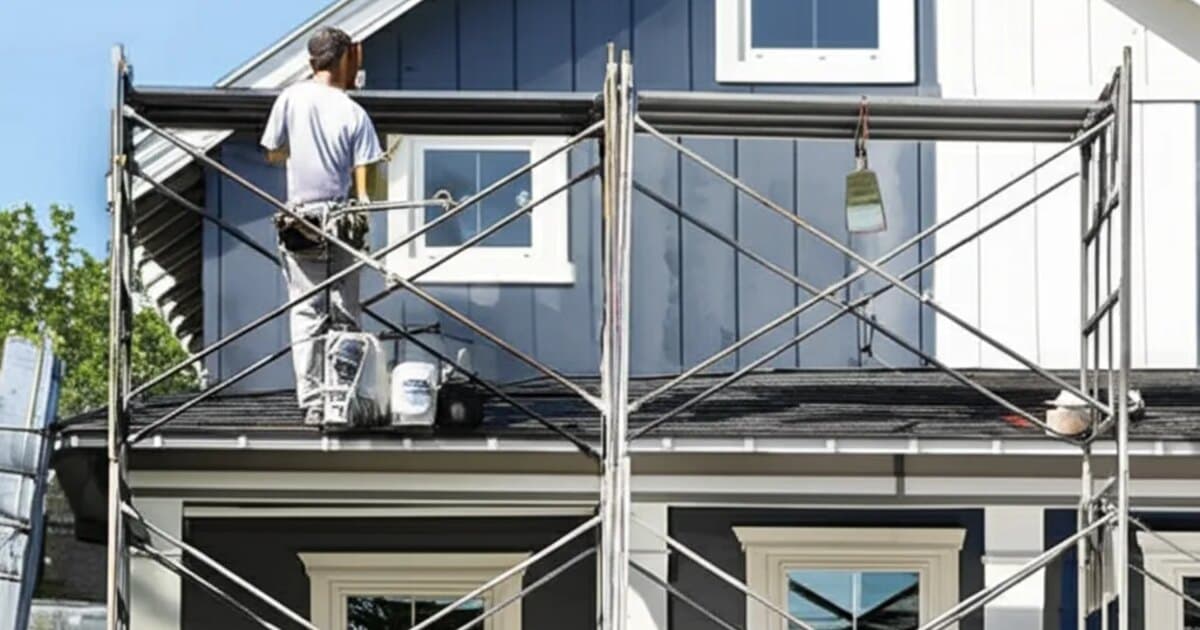
Stairwells and rooms with vaulted ceilings present unique challenges: difficult access, heights exceeding standard ladder reach, and complex angles where walls meet sloped ceilings. We use scaffolding systems, extension ladders, and sometimes rolling baker scaffolds to safely reach every surface. Many Boise homes — particularly those in the Foothills and newer Eagle subdivisions — have two-story entryways and great rooms with cathedral ceilings that require this specialized approach. Stairwell and vaulted ceiling work is priced based on height, access difficulty, and surface area.
Texture Removal and Smooth Wall Conversion
Removing orange peel, knockdown, or popcorn texture and converting to smooth walls is a multi-step process: the existing texture is skim-coated with joint compound (typically 2–3 thin coats), each coat is sanded smooth, and the surface is primed and painted. For popcorn ceilings, the texture is first wetted and scraped, then skim-coated. We test all pre-1980 popcorn texture for asbestos before removal — if asbestos is present, remediation by a licensed abatement contractor is required before we can proceed. Smooth wall conversion is one of the most requested upgrades in Boise homes built in the 1980s and 1990s.
Interior painting costs depend on room size, ceiling height, surface condition, paint quality, and the scope of prep work required. Below are typical price ranges for Boise-area homes. All estimates include prep, primer (when needed), two coats of premium paint, and cleanup.
Cost Per Room
| Room | Walls Only | Walls + Ceiling | Walls + Ceiling + Trim |
|---|---|---|---|
| Bedroom (12×12) | $350 – $550 | $500 – $750 | $700 – $1,000 |
| Living Room (16×20) | $600 – $900 | $850 – $1,200 | $1,100 – $1,600 |
| Kitchen (walls only) | $400 – $700 | $600 – $950 | $800 – $1,200 |
| Bathroom | $250 – $400 | $350 – $550 | $500 – $750 |
| Hallway / Stairwell | $300 – $600 | $450 – $800 | $600 – $1,000 |
Whole-House Estimates
| Home Size | Walls + Ceilings | Walls + Ceilings + All Trim |
|---|---|---|
| 1,500 sq ft (3 bed / 2 bath) | $3,000 – $5,000 | $4,500 – $7,500 |
| 2,500 sq ft (4 bed / 2.5 bath) | $5,000 – $8,000 | $7,500 – $12,000 |
| 3,500 sq ft (5 bed / 3 bath) | $7,000 – $11,000 | $10,000 – $16,000 |
What Affects Your Final Price
- Ceiling height — Standard 8-foot ceilings are included in base pricing. Vaulted ceilings, two-story rooms, and stairwells cost 20–40% more due to scaffolding and additional labor
- Surface condition — Walls in good condition need minimal prep. Walls with extensive damage, texture removal, or multiple layers of old paint require significantly more preparation time
- Color change severity — Painting white over white requires less material than painting white over dark red. Dramatic color changes require tinted primer plus extra finish coats
- Paint quality — Our pricing reflects premium paint (Sherwin-Williams Duration / Emerald, Benjamin Moore Regal Select). Budget-friendly options using Behr Dynasty reduce material cost by 15–25%
- Trim complexity — Homes with simple baseboards and casings cost less to paint than homes with crown molding, chair rail, wainscoting, and built-in shelving
- Cabinet painting — Kitchen cabinet painting is priced separately ($3,000–$6,000) due to the specialized prep, spray equipment, and multi-day process involved
Every estimate we provide is fixed-price and written. No hourly billing, no surprise charges for prep work, and no hidden fees for moving furniture or covering floors. Any owner-requested changes or unforeseen conditions requiring additional work are documented and approved before additional work proceeds.
We schedule painting projects efficiently to minimize disruption to your daily routine. Here are typical timelines based on project scope. All timelines include prep, priming, two coats of paint, and cleanup.
| Scope | Timeline | Notes |
|---|---|---|
| Single room (walls + ceiling) | 1 day | Standard prep, 8-foot ceilings |
| 2–3 rooms | 2 – 3 days | Rooms painted sequentially |
| 3-bedroom home (walls + ceilings) | 3 – 5 days | 2-person crew, standard prep |
| Whole house + all trim | 1 – 2 weeks | 2–3 person crew, phased by area |
| Cabinet painting (kitchen) | 5 – 7 days | Doors removed, sprayed off-site |
| Texture removal + repaint | Add 2 – 4 days | Per room, 2–3 coats of skim coat |
Factors That Affect Timeline
- Surface condition — Walls with extensive damage, wallpaper removal, or texture removal add significant prep time. We always quote these accurately upfront.
- Dry time between coats — Most latex paints require 2–4 hours between coats in Boise's dry climate (compared to 4–6 hours in humid regions). We use this time to prep or paint adjacent rooms.
- Trim complexity — Cutting in around detailed trim, crown molding, and built-ins takes longer than painting simple rooms with basic baseboards.
- Color changes — Going from dark to light requires additional primer coats and potentially an extra finish coat, each requiring dry time.
- Accessibility — Vaulted ceilings, stairwells, and two-story spaces require scaffolding setup and breakdown time.
- Season — Boise's dry summer months are ideal for interior painting because low humidity accelerates dry times. Winter painting works well too since homes are heated and dry — we simply need to manage ventilation for odor control.
Explore our in-depth guides to plan your Boise interior painting project with confidence.
How many coats of paint do I need for interior walls?
Two coats of finish paint over a coat of primer is the standard for quality interior painting. If you are making a dramatic color change — such as going from dark red to white — a tinted primer plus two finish coats is essential. Touching up a wall in the same color may require only one coat, but full repaints always look best with two coats for uniform sheen and opacity. We apply two coats on every project as standard practice.
How do I choose interior paint colors for my Boise home?
Start by considering the natural light in each room. North-facing rooms in Boise receive cooler, indirect light and benefit from warm tones like greige or soft beige. South- and west-facing rooms receive abundant warm light and can handle cooler colors like blue-grays or sage greens without feeling cold. We offer color consultation as part of every painting project — we bring large paint samples to your home so you can see how colors look in your actual lighting at different times of day.
How long does paint smell last after interior painting?
With modern low-VOC and zero-VOC paints like Sherwin-Williams Emerald and Benjamin Moore Regal Select, the strong paint odor typically dissipates within 24 to 48 hours. Full off-gassing can take 2 to 4 weeks. We recommend keeping windows open and running fans for the first 48 hours after painting. Boise's dry climate actually helps — lower humidity means paint cures and off-gasses faster than in humid regions. We default to low-VOC products on all interior projects unless you specifically request otherwise.
Do I need to move all my furniture before painters arrive?
No. We handle furniture moving as part of the prep process. We shift furniture to the center of each room and cover everything with clean drop cloths and plastic sheeting. Large items that cannot be moved (built-in shelving, heavy entertainment centers) are masked in place. Floors are fully covered with canvas drop cloths — we never use thin plastic on floors because it is a slip hazard. After painting, we move furniture back and remove all protection materials.
The following government agencies, industry organizations, and official resources provide additional information relevant to your remodeling project.
Research your interior painting project with our in-depth Boise-area guides.
Browse completed interior painting projects from across the Treasure Valley. See real results, project details, and transformation stories.
Interior painting is often combined with flooring, kitchen, and bathroom projects for a complete home refresh.
We provide interior painting to homeowners across the Treasure Valley and southwest Idaho. Each city has its own dedicated page with local permitting, climate, and project detail — and each county hub covers the surrounding communities we also serve.
Ready to Start Your Remodeling Project?
Get a free, no-obligation estimate from Boise's trusted remodeling experts. Licensed, insured, and ready to build.