
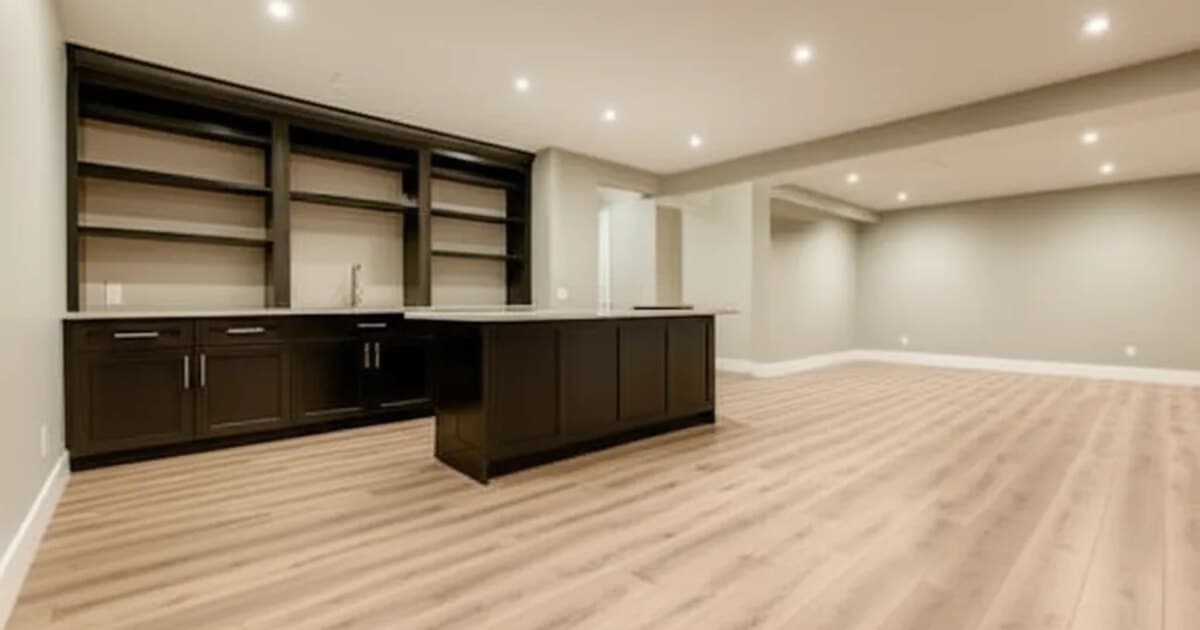
Basement Remodel in Boise and the Treasure Valley
Turn your unfinished basement into usable living space. Iron Crest Remodel handles framing, insulation, electrical, plumbing, flooring, and finish work to create recreation rooms, home theaters, guest suites, offices, and more.
Quick answer
Finishing a basement in Boise and the Treasure Valley runs about $25–$80+ per square foot depending on finish level — roughly $25,000 to $80,000+ for a 1,000 sq ft basement. A City of Boise building permit is required, and most projects take 6–10 weeks from framing start to final walkthrough.
- Basement framing and insulation
- Egress window installation (code-compliant)
- LVP, carpet, and tile flooring
- Wet bar and kitchenette builds
- Home theater and media room design
- Basement bathroom addition
- Recessed and track lighting
- Soundproofing and acoustics
- Sump pump and moisture management
- Storage and utility room design
Timeline
6 – 10 weeks
A real basement remodeling project — see the finished result, the project details, and the full transformation story.
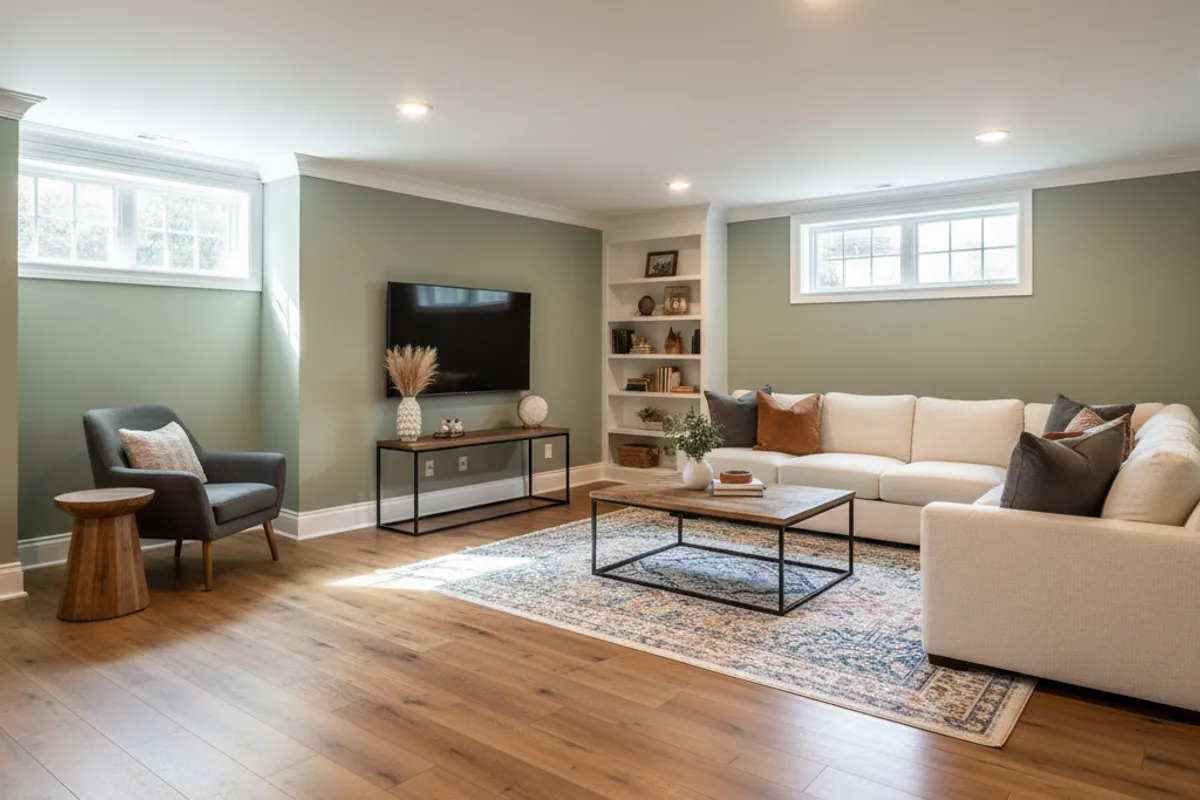
Basement Evaluation
We inspect your unfinished basement for moisture issues, ceiling height, existing utilities, and structural considerations. We discuss your intended use and design preferences.
Layout & Design
We create a floor plan with room divisions, electrical layout, plumbing (if adding a bathroom or wet bar), and finish selections. Egress window locations are determined per code.
Rough Construction
Framing, electrical, plumbing, HVAC ductwork, insulation, and drywall are completed. Egress windows are cut and installed. All rough work is inspected before closing walls.
Finishing & Handoff
Flooring, trim, paint, fixtures, and built-ins are installed. Final inspections, cleanup, and walkthrough complete the project.

See Your Remodel Before You Build.
Upload a few photos of your kitchen, bathroom, flooring, or exterior and get AI-generated concept visuals tailored to your space, style, and materials — free, no obligation, in about five minutes. Then request a real estimate from our Idaho registered Boise team.
Free concept preview · No credit card · Licensed Idaho contractor
How much does it cost to finish a basement in Boise?
Basement finishing in Boise typically costs $25-$80+ per square foot, or roughly $25,000-$80,000+ for a standard 1,000 sq ft basement, depending on finish level. Adding a bathroom, wet bar, or premium finishes increases the cost.
Do I need egress windows to finish my basement?
Yes. Idaho building code requires at least one egress window in any basement bedroom. Even if you are not adding a bedroom, egress windows are strongly recommended for safety and they add natural light. Iron Crest Remodel handles the complete egress window installation including window well and drainage.
What about moisture and waterproofing?
We assess moisture conditions before starting any basement project. Solutions range from interior sealants and vapor barriers to sump pump installation and exterior drainage corrections. All basement projects include appropriate moisture management.
Plan your basement remodeling project with our in-depth guides.

Talk to a real project manager
Have Questions? Call Now for a Free In-Home Consultation.
Mon–Fri 7 AM–6 PM · Idaho registered & insured · No obligation
Russ S. — Project Manager
Russ S. — Project Manager
Ready to Start Your Remodeling Project?
Get a free, no-obligation estimate from Boise's trusted remodeling experts. Licensed, insured, and ready to build.
From moisture control to egress windows and legal rental suites, explore our specialized guides for finishing and remodeling basements in Boise homes.

A well-planned basement layout transforms unused square footage into the most versatile living space in your home. Unlike above-grade rooms where windows and exterior walls dictate furniture placement and traffic flow, basements offer a blank canvas — but they also come with unique constraints like support columns, mechanical systems, low ceilings, and limited natural light. The key to a successful basement finish is designing around these realities rather than fighting them.
Before we frame a single wall, we map every existing element in your basement: support posts and beams, water heater, furnace, electrical panel, sump pit, floor drains, water and gas lines, and ductwork routing. These fixed elements define zones and influence where rooms, hallways, and doors can practically be placed. Here are the most common room types Boise homeowners request:
Family Room / Recreation Room
The anchor of most finished basements. We recommend placing the family room in the largest open area, ideally near the stairway for easy access. A well-designed basement family room includes recessed lighting on dimmable circuits, dedicated media wall framing for a mounted TV, pre-wired surround sound or soundbar connections, and at least two duplex outlets per wall. If your basement has an exterior walkout or daylight windows, orienting the family room toward natural light makes the space feel more open and connected to the rest of the home.
Bedroom
A basement bedroom must include a code-compliant egress window (IRC R310) to count as a conforming bedroom on your home's listing. The room must also have a closet to be classified as a bedroom by most appraisers. We size basement bedrooms at a minimum of 70 square feet with no dimension less than 7 feet, per IRC requirements. Basement bedrooms benefit from soundproofing — we typically install mineral wool insulation in interior walls and resilient channel on the ceiling to reduce sound transmission from the floor above.
Bathroom
Adding a bathroom is the single most impactful upgrade in a basement remodel. If your home has a plumbing rough-in (drain lines and vent stack stubbed through the slab during original construction), the cost is significantly lower. If no rough-in exists, we cut the concrete slab to install drain lines, then patch and seal the slab. Every basement bathroom requires a toilet, vanity with sink, and either a shower or tub. GFCI-protected outlets, a code-compliant exhaust fan ducted to the exterior, and waterproof wall and floor systems (we use Schluter DITRA and Kerdi membrane) are non-negotiable.
Home Office
Basement home offices are increasingly popular in the Boise market, especially among remote workers who need a quiet, dedicated workspace separated from the main living area. We design home offices with hardwired Ethernet drops, dedicated 20-amp circuits for equipment, task lighting on separate switches from overhead lighting, and sound-dampening wall assemblies. If the office will also serve as a guest bedroom, we include an egress window and closet to maintain bedroom conformance.
Home Gym
Basements are ideal for home gyms because of their concrete slab floors (which support heavy equipment without deflection), naturally cool temperatures, and isolation from the rest of the house. We install rubber gym flooring over the slab, reinforce walls for mounted equipment like pull-up bars and cable systems, and add dedicated 20-amp circuits for treadmills and other motorized equipment. Ceiling height is critical — if your basement has less than 8 feet of clearance, overhead exercises may be limited.
Wet Bar and Kitchenette
A wet bar or kitchenette adds entertainment functionality and is especially popular in walkout basements. A basic wet bar includes a sink, undercounter refrigerator, cabinetry, and countertop. A full kitchenette adds a microwave, dishwasher, and sometimes a small cooktop. Both require plumbing supply and drain connections, dedicated electrical circuits, and (if a cooktop is included) ventilation. We position wet bars and kitchenettes near existing drain lines whenever possible to minimize slab cutting and plumbing costs.
We create a detailed floor plan during the design phase that optimizes your basement's footprint around existing structural and mechanical elements. Every plan includes electrical layout, lighting placement, HVAC distribution, and egress compliance before framing begins.

Moisture is the single greatest threat to a finished basement. Even in Boise's semi-arid climate — where annual rainfall averages just 12 inches — basements face moisture from multiple sources: groundwater hydrostatic pressure, surface water drainage toward the foundation, spring snowmelt from the Boise foothills, and interior humidity from concrete slab moisture vapor transmission. Addressing moisture before finishing is not optional; it is the foundation of a basement that lasts.
Interior Waterproofing
Interior waterproofing manages water that has already entered or is migrating through the foundation. The most effective interior approach is an interior French drain (perimeter drain tile) installed along the base of the foundation walls, channeling water to a sump pit with an automatic pump. We also apply crystalline waterproofing compounds to the interior face of concrete walls before framing, which penetrate the concrete and seal capillary pores from the inside. Interior waterproofing is less disruptive and less expensive than exterior methods, and in most Boise basements it provides adequate protection.
Exterior Waterproofing
Exterior waterproofing addresses water at the source — before it reaches the foundation. This involves excavating around the exterior foundation walls, applying a waterproof membrane (typically rubberized asphalt or dimple board), and installing or replacing footing drains that channel water to a daylight outlet or sump system. Exterior waterproofing is the most thorough approach and is recommended when active water intrusion through foundation walls is present. In Boise, exterior waterproofing is most commonly needed on hillside properties in the East End and North End where surface water flows toward foundations during spring snowmelt.
Vapor Barriers
Concrete is porous, and moisture vapor continuously migrates through basement slabs and walls. Before installing any finished flooring or wall system, we install vapor barriers to prevent this moisture from reaching finish materials. On walls, we use 6-mil polyethylene sheeting or closed-cell spray foam insulation (which acts as both insulation and vapor barrier). On floors, we install a dimpled polyethylene subfloor membrane or sealed 6-mil poly sheeting before any flooring underlayment. Without a vapor barrier, finished basement flooring can develop mold, delaminate, or produce musty odors within months.
Sump Pumps
If your basement has a sump pit — or if we install a perimeter drain system that requires one — the sump pump is a critical component of your moisture management system. We install submersible pumps with automatic float switches, check valves to prevent backflow, and discharge lines routed at least 10 feet from the foundation. For Boise homeowners concerned about power outages during spring storms, we offer battery-backup sump pump systems that continue operating during outages. We also recommend a high-water alarm as an early warning system.
Foundation Crack Repair
Hairline cracks in poured concrete foundations are common and not structurally concerning, but they are pathways for water intrusion. We seal non-structural cracks with flexible polyurethane injection, which expands to fill the crack completely and remains flexible to accommodate normal foundation movement. Cracks wider than 1/4 inch or showing vertical displacement may indicate a structural issue and require evaluation by a structural engineer before basement finishing proceeds.
Every Iron Crest basement project begins with a thorough moisture assessment. We test slab moisture levels, inspect walls for efflorescence and staining, and evaluate exterior grading and drainage before recommending a waterproofing strategy tailored to your home's specific conditions.
The ceiling is one of the most consequential decisions in a basement finish because it affects headroom, acoustics, access to mechanical systems, and overall aesthetics. Boise homes vary significantly in basement ceiling height — older homes may have as little as 7 feet from slab to joist, while newer construction typically provides 8–9 feet. The IRC requires a minimum finished ceiling height of 7 feet in habitable basement rooms. Beams, girders, ducts, and other obstructions in a basement that contains habitable space may project down to within 6 feet 4 inches of the finished floor (IRC R305.1, Exception 3). The 6-foot-8-inch figure often quoted for basements comes from R305.1.1 and applies only to portions of a basement with no habitable space. Here are the three most common ceiling approaches:
Drywall Ceiling
A drywall ceiling provides the cleanest, most finished appearance and maximizes the sense that the basement is a true living space rather than a "finished basement." Drywall is installed directly to the underside of the floor joists (or to furring strips or resilient channel for soundproofing), taped, mudded, sanded, and painted. The result is a smooth, seamless ceiling that looks identical to any above-grade room. The trade-off is access: once drywall is installed, reaching plumbing valves, electrical junctions, or HVAC dampers above the ceiling requires cutting access panels or removing drywall. We install access panels at critical points (shutoff valves, junction boxes, cleanouts) to mitigate this concern.
Drop Ceiling (Suspended Ceiling)
A drop ceiling uses a metal grid suspended from the joists with individual tiles that lift out for easy access to everything above. This is the most practical option when ductwork, plumbing, or electrical runs below the joists and would be difficult to conceal with drywall. Modern drop ceiling tiles are available in a wide range of styles — including smooth, textured, and coffered designs — that look far better than the institutional tiles of decades past. The downside is that a drop ceiling requires 3–4 inches of clearance below the lowest obstruction, which reduces headroom. In basements with limited ceiling height, this loss can be significant.
Exposed Industrial Ceiling
Painting the joists, ductwork, pipes, and wiring a uniform dark color (typically flat black, charcoal, or dark navy) creates a modern industrial aesthetic that preserves maximum headroom and provides unrestricted access to all mechanical systems. This approach works particularly well in home theaters, recreation rooms, and home gyms where a casual, loft-like feel is appropriate. We clean and prep all surfaces, wrap or relocate any unsightly wiring, and spray-paint everything for a cohesive look. The exposed ceiling also allows for creative lighting options like track lighting and pendant fixtures mounted directly to the joists.
Maximizing Headroom
If your basement ceiling height is marginal (under 8 feet from slab to joist), every inch matters. Strategies we use to maximize headroom include: relocating ductwork to run between joists rather than below them, rerouting plumbing laterals to tighter paths, using low-profile recessed LED lighting (which requires only 3–4 inches above the ceiling plane compared to 6+ inches for traditional cans), and selecting thin-profile flooring like luxury vinyl plank (3–5mm) rather than carpet with thick pad (which can add nearly an inch of floor height). In extreme cases, underpinning (lowering the slab) is possible but is a major structural undertaking that typically costs $30,000–$50,000 or more.
Heating, cooling, and ventilation are critical to making a finished basement comfortable year-round. Basements in Boise tend to stay naturally cool in summer (a benefit) but can feel cold and damp in winter without proper heating. Additionally, your basement contains your home's most important mechanical equipment — furnace, water heater, electrical panel, and sometimes a water softener or radon mitigation system — and the finished design must maintain access to all of these systems.
Extending Existing HVAC
The most common approach is extending your existing furnace and air conditioning system into the basement by adding supply registers and return air grilles. This works well when your existing equipment has sufficient capacity to handle the additional square footage. We perform a load calculation (Manual J) to determine whether your furnace and AC can support the added space. In many Boise homes, the existing system has enough capacity because basements are partially conditioned even when unfinished — the ductwork running through the space already radiates some heating and cooling. Supply ducts are typically run between joists and dropped into the finished ceiling, with registers positioned to distribute air evenly across each room.
Ductwork Routing
Existing trunk lines and branch ducts often run below the joists in an unfinished basement, consuming valuable headroom. During a basement finish, we evaluate opportunities to reroute ductwork between joists, shorten runs, and optimize register placement. In some cases, replacing large rectangular ducts with smaller round flex duct (properly sized for airflow) allows us to tuck runs above the ceiling plane. Every duct modification is designed to maintain proper static pressure and airflow — poorly designed ductwork causes hot and cold spots, excessive noise, and increased energy costs.
Ductless Mini-Split Systems
When the existing HVAC system lacks capacity or when extending ductwork is impractical, a ductless mini-split heat pump is an excellent alternative. Mini-splits provide both heating and cooling through a wall-mounted indoor unit connected to an outdoor compressor. They are highly efficient (many models exceed 20 SEER), provide independent temperature control for the basement, and require only a 3-inch hole through an exterior wall for the refrigerant line — no ductwork at all. A single-zone mini-split adequate for a typical Boise basement (600–1,000 sq ft) costs $3,000–$5,000 installed. This is often the most cost-effective solution when duct extension would require significant rework.
Return Air
One of the most overlooked elements in basement HVAC is return air. Without adequate return air paths, conditioned air has no way to circulate back to the furnace, resulting in pressure imbalances, drafty rooms, and inefficient heating and cooling. We install at least one return air grille in the basement's main living area, sized to match the total supply airflow. For bedrooms with doors that close, we install either a dedicated return duct or a jump duct (a short duct through the wall above the door) to prevent the room from pressurizing when the door is shut.
Bathroom Ventilation
Every basement bathroom requires a ventilation fan that exhausts to the building exterior — not into the joist cavity or attic. Because basement bathrooms are below grade, the exhaust duct must run horizontally through the rim joist or foundation wall to reach the exterior. We install fans rated at a minimum of 50 CFM (for bathrooms up to 50 sq ft) with insulated duct to prevent condensation inside the duct run during Boise's cold winters. Humidity-sensing fans that activate automatically are a smart upgrade for basement bathrooms where moisture management is especially important.
Working Around Existing Mechanicals
Your water heater, furnace, and electrical panel must remain accessible after the basement is finished. Building code requires specific clearances: 30 inches of clear width and 36 inches of depth in front of the electrical panel, and adequate combustion air and clearance around gas-fired equipment. We typically design a dedicated mechanical room or utility closet with a solid door (for noise reduction) and louvered vents or a dedicated combustion air duct for gas appliances. This keeps equipment accessible for maintenance and inspection while containing noise and hiding unsightly equipment from the finished living space.
Egress windows are a life-safety requirement and one of the most important investments in a basement remodel. The International Residential Code (IRC R310) requires every basement bedroom to have at least one egress window — a window large enough for an occupant to escape and a firefighter to enter in an emergency. Even if your basement will not include a bedroom, we strongly recommend installing at least one egress window for safety, natural light, and resale value.
IRC R310 Requirements
- Minimum net clear opening: 5.7 square feet (5.0 sq ft at grade level)
- Minimum opening height: 24 inches
- Minimum opening width: 20 inches
- Maximum sill height: 44 inches above the finished floor
- Window must open from the inside without tools, keys, or special knowledge
- If the sill is below grade, a window well is required: at least 9 sq ft of horizontal area, with a horizontal projection and width of not less than 36 inches (IRC R310.2.3)
Window Well Requirements
When the egress window sill is below grade, a window well must be installed to create a clear escape path. Under IRC R310.2.3 the well must provide at least 9 square feet of horizontal area, with a horizontal projection and a width of not less than 36 inches — the width requirement is a fixed 36-inch minimum, not simply the width of the window opening — and the well must be sized so the escape opening can be fully opened. If the window well depth exceeds 44 inches, a permanently affixed ladder or steps must be provided (R310.2.3.1); that ladder may encroach no more than 6 inches into the required well dimensions. We install corrugated steel or concrete window wells with a gravel base and drain connected to the footing drain or a dedicated dry well to prevent water accumulation. A window well cover (grate) can be installed for safety and debris protection, but it must be operable from the inside without tools.
Excavation in Boise Soil Types
Egress window installation requires cutting through the foundation wall and excavating the exterior for the window well. Boise's soil conditions vary by neighborhood: the Bench area typically has compacted clay and caliche (a hardened calcium carbonate layer) that requires specialized excavation equipment. North End and East End properties may encounter decomposed granite and rocky soil near the foothills. Southeast Boise and Meridian-adjacent areas tend to have sandier, easier-to-excavate soil. We assess soil conditions during the initial evaluation and plan excavation methods accordingly. Most egress window installations in Boise take 2–3 days from start to finish, including concrete cutting, excavation, window and well installation, backfill, and waterproofing.
Drainage
A window well without proper drainage is a pool waiting to happen. We install a minimum of 12 inches of washed gravel at the base of every window well, connected to either the home's footing drain system or a dedicated drain line that runs to daylight or a dry well. The gravel fill extends several inches above the window well drain connection to ensure water never reaches the window sill. We also slope the surrounding grade away from the window well to direct surface water away from the opening.
Basement finishing costs in Boise depend on the size of the space, the complexity of the layout, and the level of finish you choose. Below is a breakdown of typical costs by finish level and square footage, followed by a detailed line-item breakdown so you can understand where your budget goes.
Cost by Finish Level and Square Footage
| Finish Level | 400 sq ft | 600 sq ft | 800 sq ft | 1,000 sq ft |
|---|---|---|---|---|
| Basic ($25–$35/sq ft) | $10,000–$14,000 | $15,000–$21,000 | $20,000–$28,000 | $25,000–$35,000 |
| Standard ($35–$55/sq ft) | $14,000–$22,000 | $21,000–$33,000 | $28,000–$44,000 | $35,000–$55,000 |
| Premium ($55–$80+/sq ft) | $22,000–$32,000+ | $33,000–$48,000+ | $44,000–$64,000+ | $55,000–$80,000+ |
Basic: open-concept, no bathroom, carpet/LVP, painted drywall. Standard: 1–2 rooms, bathroom, LVP flooring, recessed lighting. Premium: multiple rooms, bathroom, wet bar, upgraded finishes, custom built-ins.
Line-Item Cost Breakdown (1,000 sq ft, Standard Finish)
Each line below is an independent range, and the bathroom and egress window are shown separately because not every standard finish includes them. Adding up every low figure gives $33,500 and every high figure gives $65,000, but no real project lands at one extreme across all eleven lines at once — that is why the totals in the table above ($35,000–$55,000 for a 1,000 sq ft standard finish) are narrower than the arithmetic floor and ceiling of this list. Use the table above for your budget and the list below to see where the money goes.
| Line Item | Typical Cost Range | Notes |
|---|---|---|
| Framing | $3,000–$5,000 | Interior walls, soffits, blocking |
| Electrical | $4,000–$7,000 | Panel capacity, circuits, fixtures, low-voltage |
| Plumbing | $3,000–$8,000 | Bathroom rough-in, wet bar, slab cutting if needed |
| HVAC | $2,000–$5,000 | Duct extension or mini-split installation |
| Insulation | $1,500–$3,000 | Exterior walls, rim joist, soundproofing |
| Drywall | $3,500–$5,500 | Walls and ceiling, taping, finishing, painting |
| Flooring | $3,000–$6,000 | LVP, carpet, tile (material + labor) |
| Bathroom | $8,000–$15,000 | Fixtures, tile, vanity, shower/tub (if included) |
| Egress window | $3,500–$6,000 | Per window, including well, excavation, drainage (if added) |
| Trim and doors | $1,500–$3,000 | Baseboards, casing, interior doors |
| Permits and inspections | $500–$1,500 | City of Boise building permit |
These ranges reflect 2025–2026 pricing in the Boise market. We recommend budgeting a 10–15% contingency for unforeseen conditions such as moisture issues, outdated wiring, or structural modifications. Every Iron Crest basement project includes a detailed written estimate with line-item pricing before work begins — no surprise charges, and any owner-requested changes or unforeseen conditions requiring additional work are documented and approved before additional work proceeds.
Building Permits and Inspections
The City of Boise requires permits for all basement finishing work that involves structural changes, electrical, plumbing, or mechanical systems. The permitting process begins with submitting a floor plan showing room layouts, egress windows, electrical panel location, and HVAC distribution. Boise PDS publishes its actual permit processing timeframes every quarter. For the June 1 – August 31, 2026 report, Residential Additions/Alterations/Repairs Level 2 — the category a basement finish falls in — carried a target of under 10 business days with an average first review of 8 business days, while the average time to “ready to issue” was 28 business days. The difference between those two numbers is correction cycles, which is the part a complete submittal controls. Check the current report before building a schedule on it. During construction, inspections are required at key milestones: framing, rough electrical, rough plumbing, rough mechanical, insulation, and final. We schedule and coordinate all inspections as part of every project. Ada County and Canyon County jurisdictions (Meridian, Eagle, Nampa, Caldwell) have similar requirements with slight variations in fees and review timelines.
Radon Testing and Mitigation
Radon is a naturally occurring radioactive gas that enters homes through cracks and openings in the foundation. The Idaho Department of Health and Welfare reports that 2 out of 5 Idaho homes have elevated radon levels, measured against the EPA guideline of 4.0 pCi/L. Before finishing a basement in Boise, radon testing is strongly recommended. If levels exceed 4 pCi/L, a sub-slab depressurization system (radon mitigation) should be installed before the basement is sealed. This system uses a PVC pipe run from beneath the slab to above the roofline with a small inline fan that continuously exhausts radon gas. Installation costs $800–$1,500 and is far easier to install before the basement is finished than after. We can coordinate radon testing and mitigation as part of your basement project.
Foundation Types by Era
Boise's housing stock includes several foundation types that affect basement finishing approaches. Homes built before the 1960s may have rubble stone or unreinforced concrete block foundations that require additional waterproofing and sometimes structural reinforcement before finishing. Homes from the 1960s through 1980s typically have poured concrete foundations of varying thickness (6–10 inches) with minimal or no waterproofing membrane on the exterior. Newer homes (1990s–present) generally have poured concrete foundations with exterior waterproofing, footing drains, and sometimes pre-installed radon piping. We evaluate your foundation type and condition during the initial assessment and tailor our waterproofing and finishing approach accordingly.
HOA and Rental Regulations
If you plan to use your finished basement as a rental unit (an accessory dwelling unit or mother-in-law suite), additional building code requirements apply. A basement ADU in Boise must have its own egress, a full kitchen, a bathroom, and meets specific fire separation requirements between the ADU and the primary dwelling. Zoning approval may be required depending on your neighborhood. Some Boise-area HOAs have covenants that restrict rental use or require architectural review for exterior changes like egress window wells. We recommend checking your HOA CC&Rs and consulting with the City of Boise Planning and Zoning department before designing a basement with rental intent. Learn more on our ADU construction page.
Explore our in-depth guides and resources to plan your Boise basement remodel with confidence.
Do I need a building permit to finish my basement in Boise?
Yes. The City of Boise requires a building permit for any basement finishing or remodeling project that involves framing, electrical, plumbing, or HVAC work. The permit process includes plan review, a framing inspection, rough-in inspections for electrical, plumbing, and mechanical systems, an insulation inspection, and a final inspection. Finishing a basement without a permit can create serious problems when you sell your home — appraisers and buyers will flag unpermitted finished square footage, and your insurance may not cover damage in unpermitted spaces. Iron Crest Remodel handles all permitting and scheduling of inspections as part of every basement project.
Can I add a bathroom to my basement?
Yes, and it is one of the most common upgrades in Boise basement remodels. If your home was built with a rough-in (pre-positioned drain lines and a vent stack), adding a basement bathroom is significantly less expensive — typically $8,000–$15,000 depending on fixture selections. If no rough-in exists, we can cut into the concrete slab to install drain lines, though this adds $3,000–$6,000 for the slab work alone. A basement bathroom requires a properly vented drain system, GFCI-protected outlets, a code-compliant exhaust fan ducted to the exterior, and waterproof wall and floor finishes in the shower or tub area. We design and build basement bathrooms that meet all IRC and City of Boise plumbing codes.
How long does it take to finish a basement in Boise?
Most basement finishing projects in Boise take 6–10 weeks from demolition or framing start to final walkthrough. A basic open-concept finish (one large room, no bathroom, no wet bar) can be completed in 4–6 weeks. Projects that include a bathroom addition, egress window installation, wet bar or kitchenette, or extensive custom built-ins typically require 8–10 weeks. The primary variables are City of Boise plan review turnaround, inspection scheduling, and the scope of plumbing and electrical work. Boise PDS publishes its actual review times each quarter: for the June 1 – August 31, 2026 report, Residential Additions/Alterations/Repairs Level 2 — the category a basement finish falls in — had a target of under 10 business days and an average first review of 8 business days, but an average of 28 business days to “ready to issue,” and that gap is correction cycles on incomplete submittals. We provide a detailed project timeline during the planning phase so you know what to expect each week.
Does finishing a basement increase my home's value?
Finishing a basement adds usable living space, and a finished basement with a conforming bedroom (egress window plus a closet) and a full bathroom generally adds the most value because it effectively adds a bedroom to your home's listing. We do not publish a cost-recouped percentage for basements: appraisers treat below-grade square footage differently from above-grade space, and the return depends on your specific home, neighborhood, and how the space is finished. Ask your agent or appraiser what finished below-grade space is worth on your street before you set a budget. What we can control is the part that consistently protects value — quality finishes, a permitted job with passed inspections, and code-compliant egress.
The following government agencies, industry organizations, and official resources provide additional information relevant to your remodeling project.
Research your basement remodeling project with our in-depth Boise-area guides.
Researched reports on the specific basement remodeling questions Boise homeowners run into — hard water, old housing stock, local code, and material performance in the Treasure Valley climate.
Browse completed basement remodeling projects from across the Treasure Valley. See real results, project details, and transformation stories.
Basement projects often include bathroom additions, flooring, and painting. Bundling services ensures a cohesive finished space.
Ready to Start Your Remodeling Project?
Get a free, no-obligation estimate from Boise's trusted remodeling experts. Licensed, insured, and ready to build.