
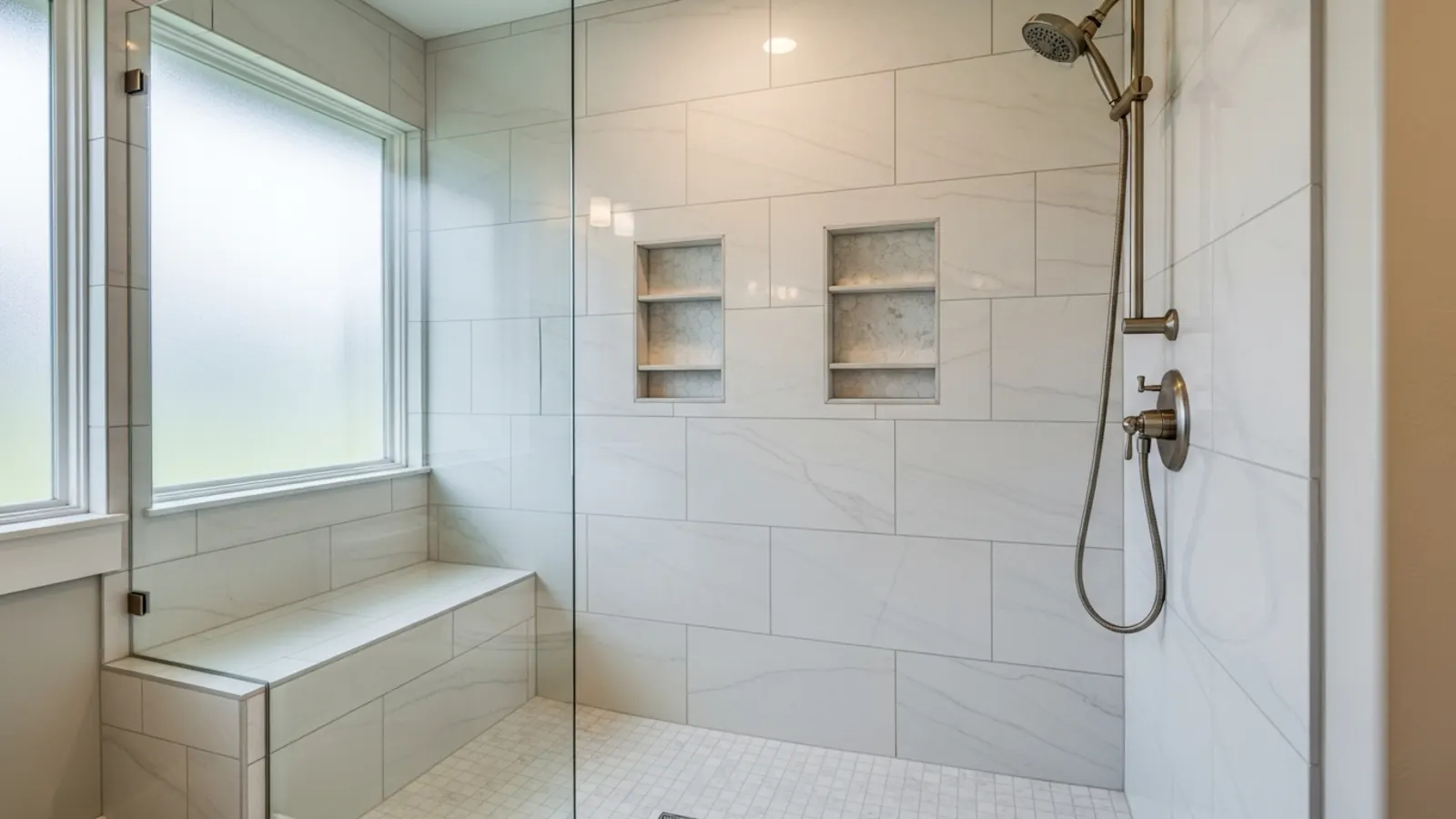
Shower Remodeling Across Hyde Park, Camel's Back, Harrison Boulevard & the Lower-Numbered Streets
Cast iron tub-to-shower conversions on 1905 Craftsman bungalows, period-preserved walk-ins in Tudor Revivals where original 1930s hex floor tile is intact, curbless accessibility builds — Schluter Kerdi waterproofing, EPA RRP lead-safe practices, and interior scope that proceeds at standard City of Boise speed because HPC review applies only to exterior work.
Quick answer
5–8 weeks from contract signing to final walkthrough for a standard curbed conversion. Breakdown: 1 week design and material selection, 2 weeks permit + environmental testing + material ordering (concurrent), 1 week demolition + plumbing rough-in, 1 week waterproofing + substrate, 2 weeks tile install (including grout cure), 1 week glass enclosure templating and install plus final inspections. 1905 Craftsman bungalow scope with plaster-and-lath demolition adds 3–5 days; 1930s Tudor preserved-floor scope adds 1–2 weeks for careful hand-tool demolition.
Shower remodeling in the North End sits at a specific intersection: housing stock 80–120 years old where original cast iron clawfoot and alcove tubs still occupy 35-to-55-square-foot original bathrooms, plumbing that's almost universally galvanized supply and cast iron drain on the pre-1960 stock and almost always needs rework when the shower valve location moves, wall framing that predates modern stud spacing standards (balloon framing on the 1905–1925 Craftsman bungalows around Hyde Park and Camel's Back, more standardized framing on the 1925–1940 Harrison Boulevard Tudor Revivals), and existing tile that sometimes survives original from 1925 in a state worth preserving rather than demolishing. The dominant project is the tub-to-shower conversion on a 1908 Craftsman bungalow in Hyde Park or a 1955 minimal-traditional on the lower-numbered streets — remove the original cast iron tub (300+ pounds on the bungalow stock, often break-out demolition in place because the tub can't fit through a 26-inch original doorway), abate the asbestos mortar bed and lead-painted substrate, rebuild on Schluter Kerdi waterproofing, install a walk-in with period-correct or modern tile vocabulary depending on the home's architectural brief. A critical permit fact distinguishes North End shower work from the rest of Boise: interior scope is fully exempt from Historic Preservation Commission review even when the home is squarely inside the District boundary, so shower projects proceed at standard City of Boise speed (2–4 weeks over-the-counter plumbing permit, 3–5 weeks for full plan review when structural work is in scope). HPC only enters the picture when scope crosses the exterior wall — a new hood vent through siding, a window enlarged for natural light at the shower wall, an exterior penetration for a relocated drain. Iron Crest's North End shower work is anchored on Schluter Kerdi waterproofing, EPA RRP lead-safe practices throughout (universal on the pre-1978 stock that comprises nearly the entire District), pre-1980 asbestos pre-screen on mortar beds and substrates, and the demolition-in-place cast iron tub protocols that bungalow alcove geometry requires.
North End shower strategy varies sharply by era because the original tub type, bathroom dimensions, wall framing, and what tile is worth preserving all change between the Craftsman bungalow stock, the Tudor and Colonial Revival wave, the post-war infill, and the modern infill north of Hill Road.
1905–1925 original Craftsman bathrooms (Hyde Park, Camel's Back, 13th Street area)
Tiny 35–55 sq ft bathrooms with original cast iron clawfoot or alcove tubs (300–400 lbs, almost always require break-out demolition in place because they can't fit through original 26-inch doorways), original 1-inch hex floor tile sometimes preserved in remarkable condition, original beadboard wainscoting on the homes that have it. Balloon framing with lath-and-plaster walls — different demolition protocol than drywall, and plaster repair where preserved-wall sections meet new tile substrate runs $35–$85 per square foot. Galvanized supply and cast iron drain universal. Pre-1978 trim lead-painted — EPA RRP applies throughout. Original mortar beds frequently contain asbestos.
1925–1940 Tudor Revival and Colonial Revival (Harrison Boulevard, Fort Boise area)
Slightly larger 55–80 sq ft bathrooms with original tile work in colored ceramic patterns (occasionally preserved in original 1930s condition with patina that buyers pay premiums for), often built-in alcove tubs that may be heavy steel by the late 1930s rather than cast iron, more substantial original plumbing with copper supply appearing late in this era. Tudor steel-sash leaded-glass windows in some bathrooms — preserved as architectural feature. Modern scope can sometimes preserve original tile floor while replacing the tub area with new walk-in shower — period continuity that newer-era bathrooms can't replicate.
1945–1965 post-war ranch and minimal-traditional infill (lower-numbered streets 3rd–9th, parts of Fort Boise area)
5-foot steel alcove tubs (lighter than the cast iron predecessor at 60–80 lbs) in post-war pink, blue, mint-green, or sea-foam tile bathrooms. Copper supply standard, cast iron drains still common, drywall + plaster-skim walls. Wall framing is modern stud spacing. Pre-1978 lead applies. Modern scope: standard tub-to-shower conversion with full demolition, asbestos abatement of mortar bed, Schluter Kerdi rebuild. Aesthetics typically favor complete refresh rather than period preservation since the pastel tile is what owners are escaping, not embracing.
1985+ modern infill north of Hill Road and on a few non-contributing parcels
Modern construction. Standard walk-in shower builds with current materials and methods, no asbestos or lead concerns, no balloon-framed plaster-and-lath demolition. Sometimes outside the Historic District boundary entirely, which simplifies permit processing on any scope that touches exterior.
Five recurring shower-remodel shapes account for nearly every North End project. Era of the original house, owner aging-in-place priority, and accessibility brief drive which one fits.
1. The 1905 Bungalow Cast Iron Tub-to-Shower Conversion (Period-Sensitive)
Remove the original cast iron clawfoot or alcove tub (typically break-out demolition in place with a chipping hammer because the 300–400 lb tub can't be carried through a 26-inch original doorway). Abate asbestos mortar bed substrate. Rebuild with Schluter Kerdi waterproofing on cement-board, install a walk-in shower with period-correct vocabulary: 1-inch or 2-inch hex mosaic floor in white-with-black-dot, 3×6 subway walls to chair-rail height with pencil-liner cap rail, polished chrome or polished nickel valve from House of Rohl Country Bath or Newport Brass Astor, frameless 3/8" tempered glass. Plaster-keyed connection where preserved-wall sections meet new substrate.
Target homes: Pre-1925 original Craftsman bungalows around Hyde Park, Camel's Back, and the 13th Street area with intact period architectural character. Permit: plumbing permit; building permit when structural change is in scope. Interior-only — no HPC review required.
2. The 1930s Tudor Preserved-Floor Walk-In Build
Walk-in shower built in a 1925–1940 Tudor Revival or Colonial Revival bathroom where the original 1930s tile floor is intact and worth preserving. New shower goes in the existing tub alcove with careful demolition (hand tools rather than power demolition) at the tile-meets-tub boundary so the original hex or geometric pattern stays intact on the rest of the floor. Schluter Kerdi waterproofing within the new shower footprint, period-correct subway or geometric tile walls keyed to the original floor pattern, frameless glass enclosure, period-appropriate plumbing trim. Rare and rewarding scope — period continuity that newer bathrooms can't replicate at any cost.
Target homes: Pre-1940 Tudor Revival and Colonial Revival North End homes with intact original tile floors worth preserving. Permit: plumbing permit; building permit when structural change is in scope.
3. The Standard Curbed Tub-to-Shower Conversion
Remove the existing tub (cast iron, steel, or fiberglass depending on era), abate asbestos and lead substrate as required, install a curbed walk-in shower in the same footprint with Schluter Kerdi waterproofing, modern porcelain or subway tile, frameless 3/8" tempered glass, new anti-scald thermostatic shower valve. Most common North End shower scope by volume — works on every era of the District's housing stock and doesn't require the structural assessment that curbless designs need.
Target homes: Any North End bathroom with an existing tub the owner doesn't want to keep. Permit: plumbing permit; building permit when drain location moves or framing changes.
4. The North End Curbless Walk-In (Modernist Brief Plus Aging-in-Place)
Walk-in shower with no threshold between bathroom floor and shower floor — floor slopes continuously to a Schluter Kerdi-Line linear drain at the wall. Reads as the highest-end modern shower aesthetic and provides genuine wheelchair accessibility. Requires careful waterproofing detail and structural assessment of joist depth — the 1905–1925 Craftsman bungalow stock has variable joist depth and sometimes inadequate clearance for the subfloor depression required to create slope, so feasibility is verified at consultation. 1925–1940 Tudor and Colonial Revival joist depths are more often viable.
Target homes: North End bathrooms with floor structure that supports subfloor depression for slope; aging-in-place priority. Permit: building and plumbing permits. Interior-only — no HPC review.
5. The District Aging-in-Place Shower (Universal Design Built to Read Modern)
Walk-in shower designed for full mobility-impaired access for North End owners staying long-term: curbless entry with continuous floor slope, 60-inch width minimum (often requires absorbing a small adjacent closet or hallway corner on tight 35–55 sq ft Craftsman bathroom footprints), wall-mounted teak bench at chair-transfer height, plywood blocking installed in walls for current or future grab bars, hand-shower on slide bar, anti-scald thermostatic valve with paddle handle for arthritic dexterity, slip-resistant hex mosaic floor tile. Designed to read as a beautiful modern shower rather than as medical equipment — important for North End owners whose home value depends on resale presentation as well as accessibility.
Target homes: North End owners 55+ planning to age in the District; rental properties optimizing for senior tenant durability. Permit: building and plumbing permits.
The North End is made up of distinct sub-neighborhoods, each with its own remodeling personality.
13th Street & Hyde Park
The cultural and commercial heart of the North End — boutique shops and restaurants along 13th between Brumback and Eastman, with the densest concentration of original Craftsman bungalows on the surrounding blocks. Lots are tight (typically 50' frontage), alley access is common, and the neighborhood is heavily walked. Most homes here are 1905–1925 Craftsman.
Camel's Back & Heron Streets
The streets immediately around Camel's Back Park, climbing slightly into the lower foothills. Mostly Craftsman bungalows with some Tudor Revival mixed in. Lots get larger toward the park edge, and some homes back to the Foothills Reserve with significant trees. Project budgets here tend to be higher — these are some of the most coveted blocks in the city.
Harrison Boulevard corridor
The grand divided boulevard running south-to-north through the heart of the North End, lined with the neighborhood's largest historic homes. Tudor Revival, Colonial Revival, and a few notable Prairie-style houses sit on deep lots with mature plantings. Projects here lean toward sympathetic upgrade rather than reconfiguration — these homes already have generous floor plans.
Fort Boise & Capitol-area North End
The streets around Fort Boise Park and stretching toward the State Capitol grounds — a mix of original Craftsman bungalows, larger 1920s and 1930s homes, and a higher proportion of post-war infill. Lots vary widely. Project scopes span the full range depending on house age and homeowner intent.
North of Hill Road / new infill
The northern fringe of the historic North End, where construction continued through the 1950s and where modern infill has been most active. Newer (1945–present), larger, less constrained by historic-district considerations. Projects here look more like SE Boise or Harris Ranch in scope and material strategy.
Lower-numbered streets (3rd–9th)
The streets between the State Capitol grounds and Fort Boise — traditionally a more working-class section of the North End, with a mix of smaller Craftsman bungalows, post-war houses, and some converted multi-family. Increasingly being renovated as North End demand pushes outward from the 13th Street core. Excellent value if you can find an unrenovated home here.
Pricing reflects three North End realities: waterproofing rigor (Schluter Kerdi on every shower), demolition complexity in 80–120-year-old stock (cast iron break-out demolition, plaster-and-lath protocols on pre-1925 walls, asbestos abatement universal on pre-1980 mortar beds), and the labor of period-correct tile patterns where architectural brief calls for hex-and-subway vocabulary rather than modern large-format.
North End shower remodeling ranges
New shower in comprehensive bathroom remodel (incremental) (Marginal cost above bathroom-remodel base scope): $14,000–$26,000 / Aligned with bath remodel end to end
Standard curbed tub-to-shower conversion (Tub removal, traditional curbed walk-in with Schluter Kerdi, modern tile, frameless glass): $22,000–$36,000 / 5–7 weeks end to end
1905 bungalow period-sensitive conversion (Cast iron break-out demolition, plaster-keyed connections, period hex-and-subway tile vocabulary): $28,000–$42,000 / 6–8 weeks end to end
Curbless walk-in conversion (Joist depression for slope, curbless entry, Kerdi-Line linear drain, frameless glass): $28,000–$45,000 / 6–9 weeks end to end
1930s Tudor preserved-floor walk-in (Build new walk-in shower while preserving intact original 1930s tile floor outside the shower footprint): $30,000–$45,000 / 6–9 weeks end to end
Accessible aging-in-place shower (Curbless entry, in-wall blocking for grab bars, transfer-height teak bench, ADA-compliant trim, slip-rated hex mosaic floor): $32,000–$48,000 / 7–10 weeks end to end
Pricing assumes Iron Crest's standard North End scope: City of Boise plumbing and building permits (interior-only shower scope is exempt from Historic Preservation Commission review, so the work proceeds at standard City speed rather than carrying the 4–8 week HPC overlay that exterior scope triggers), pre-1980 asbestos pre-screen on mortar beds and substrates with licensed abatement when triggered, EPA RRP lead-safe practices on every pre-1978 home (universal in the District), Schluter Kerdi waterproofing membrane on every shower, premium porcelain or period-correct ceramic tile install, frameless 3/8" tempered glass enclosure with hardware in matched finish family, anti-scald thermostatic shower valve, right-of-way permits for dumpster on tight 50' Hyde Park or Camel's Back streets, and our 3-year workmanship warranty. Contingency budget of 12–15% above contract value for older-home discovery on pre-1925 Craftsman stock.
The North End Historic District boundary covers most — but not all — of the North End. The district is administered by the City of Boise Historic Preservation Commission, which reviews exterior modifications within the district boundary. Interior work, including comprehensive remodels, is exempt from Historic Preservation review. This is the single most important permitting fact to internalize: your interior work doesn't need historic review, regardless of how aggressive the scope.
Where Historic Preservation review enters the picture is when your project includes any exterior change. Examples we encounter regularly: enlarging a window, relocating an exterior door, adding an exterior-vented hood that requires a new wall penetration, building a small addition or bump-out, or replacing a side-yard window with a different style. Any of these requires a Certificate of Appropriateness from the Historic Preservation Commission, which can add several weeks to the permit timeline (confirm current timelines with PDS) and typically requires architectural drawings showing the proposed change in context.
For interior-only projects, the standard City of Boise permits apply: a building permit for structural work (wall removal, beam installation), an electrical permit for new circuits or panel work, a plumbing permit for fixture relocation or new water lines, and a mechanical permit for ducting or HVAC modifications. Permit fees for a typical mid-range project run several hundred to a few thousand dollars depending on scope. Processing times: electrical and plumbing permits are often same-day or next-day; building permits go through plan review, about two weeks for online plan review per Boise PDS and longer when structural drawings are involved.
One North End-specific permit consideration: parking and right-of-way. Placing a dumpster on the street or parking a construction trailer at the curb requires an ACHD temporary-use permit (fee varies), since North End residential streets are ACHD right-of-way. Some North End streets have additional restrictions related to the historic neighborhood designation. Iron Crest pulls all required temporary-use permits as part of project setup.
Shower material selection in a North End bathroom is about durability, waterproofing performance, and period-sympathetic aesthetics that complement Craftsman or Tudor architectural context. Modern engineering meets the District's historic character.
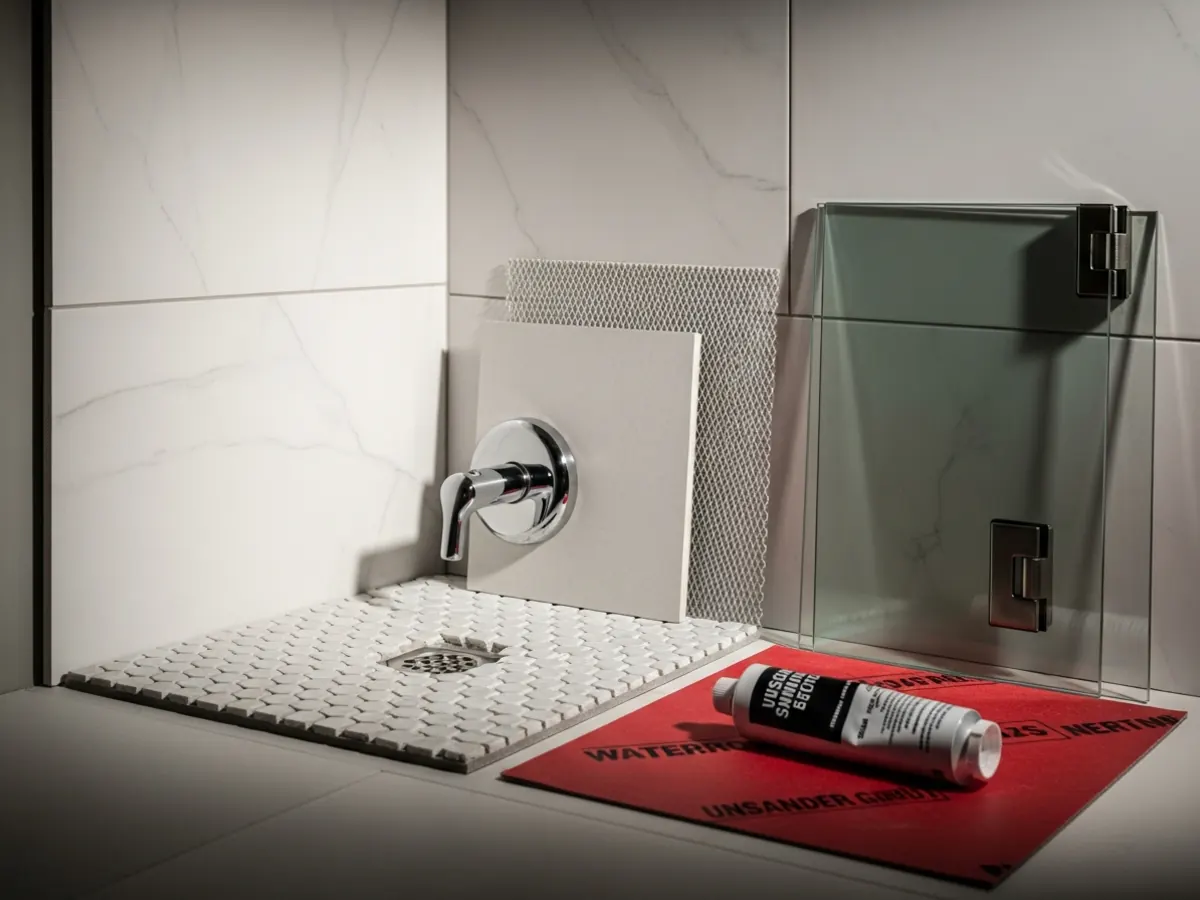
Waterproofing — Schluter Kerdi membrane on every shower
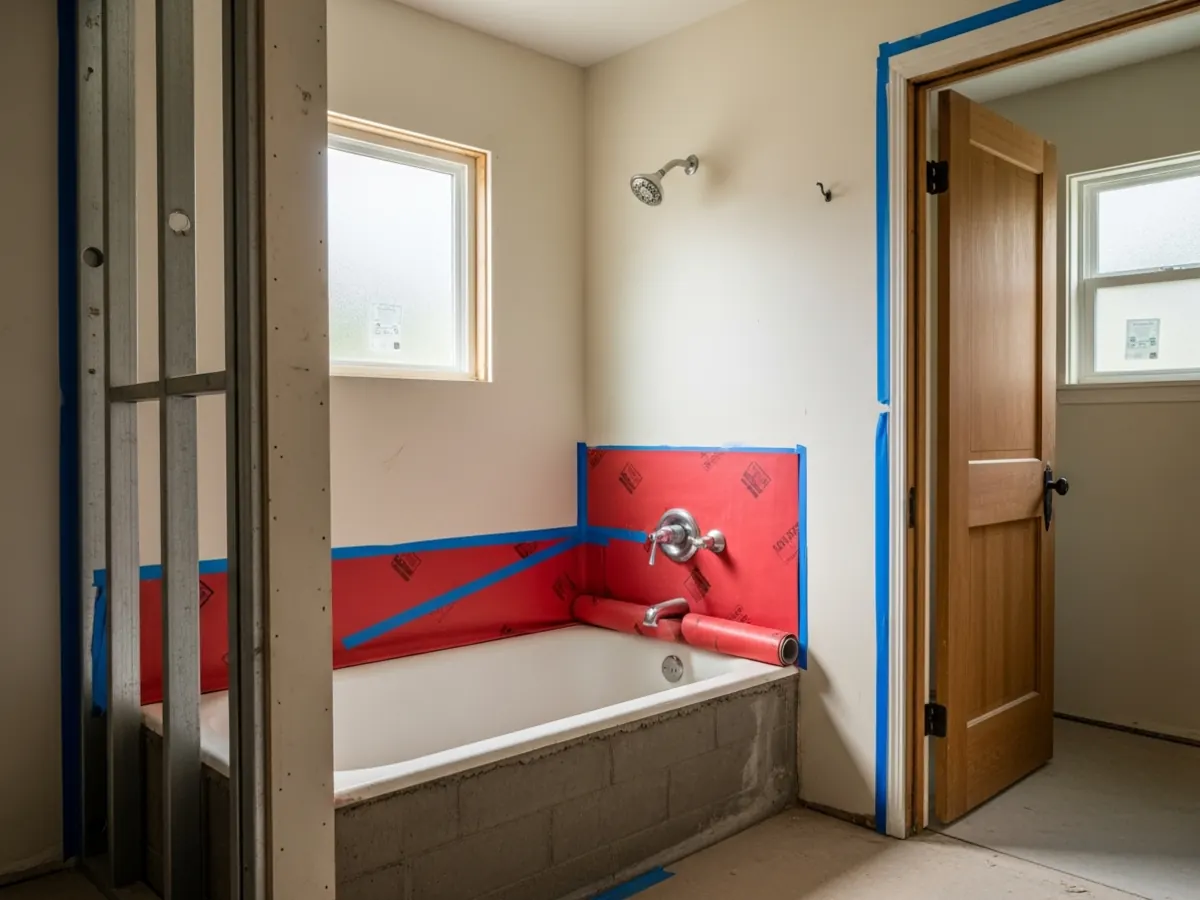
Schluter Kerdi (orange polyethylene fabric bonded to cement-board substrate with thin-set mortar) is the standard on every North End shower we build. Lifetime Schluter manufacturer warranty when installed to Schluter's published specifications. The Kerdi system far outperforms the vinyl-and-felt or cement-board-only methods that failed in countless North End bathrooms over the decades — those failures are why we get called in to remediate hidden mold in 'remodeled in 2005' Hyde Park bungalow bathrooms.
Wall tile — period vocabulary on pre-1940 stock, modern on post-war
Pre-1940 vocabulary: 3×6 subway tile in matte finish with thin sanded grout joints to chair-rail height, pencil-liner cap rail, beveled or handmade-look ceramic (Pratt & Larson, Heath, Zia Tile) for period authenticity on bungalow and Tudor scope. Post-war and modern brief: large-format porcelain (12×24 or 24×48) in stone-look or solid color for cleaner contemporary aesthetic. Grout: epoxy or premium sanded with sealer — standard cementitious grout stains and erodes in shower applications.
Floor tile and slope — small-format mosaic for grip and period read
Mosaic tile (1-inch or 2-inch hex, penny round) is required for shower floor — the small grout joints provide slip resistance and the small tiles allow proper slope to drain. Period-correct white-hex-with-black-dot reads beautifully in a Craftsman bathroom and is what original 1908 builders specified. Penny round in white or matte grey is another period-appropriate option. Floor slope minimum 1/4 inch per foot to drain location. Curbless designs require subfloor depression to achieve slope within the bathroom floor itself.
Drain selection — center round for curbed, Kerdi-Line linear for curbless
Standard center drain (round, 4-inch chrome strainer) for traditional curbed showers — period-correct on bungalow and Tudor scope. Schluter Kerdi-Line or Infinity Drain linear drain for curbless designs, positioned along the wall opposite the shower head for single-direction floor slope and refined aesthetic. Linear drain costs $400–$1,200 above standard but is non-negotiable on curbless work.
Glass enclosure — frameless 3/8" tempered, low-iron for premium scope
Frameless 3/8-inch tempered glass is the modern North End standard — minimal hardware, clean aesthetic, durable. Configuration options: single fixed panel (for walk-in alcoves), single fixed plus pivot door, or full enclosure depending on layout. Low-iron Starphire glass available as upgrade for the cleanest read; standard tempered appropriate for most scope. Brushed nickel, polished chrome, oil-rubbed bronze, or matte black hinges and clips chosen to match the rest of the bathroom finish family — chrome and nickel for bungalow period work, matte black for the modern brief.
Fixtures — period-correct or modern depending on architectural brief
Thermostatic shower valve (vs. pressure-balance) is the higher-quality choice and required for accessibility scope — maintains constant temperature regardless of pressure changes elsewhere in the house. Period-correct bungalow brief: exposed valve assembly with cross-handle controls (House of Rohl Country Bath, Newport Brass Astor), single shower head on a 6-inch arm, polished chrome or polished nickel. Modern brief: rain shower head (8-inch to 12-inch ceiling-mount) plus hand-shower on slide bar, single-handle thermostatic valve from Brizo Litze or Hansgrohe Talis.
Shower demolition in older North End bathrooms surfaces a predictable set of conditions across the pre-1978 District housing stock. We pre-screen at the consultation walkthrough so the budget is honest up front.
- •Cast iron tub demolition — break-out in place on Craftsman bungalow alcoves Original cast iron clawfoot or alcove tubs in 1905–1925 Craftsman bungalow bathrooms weigh 300–400 pounds and almost always require break-out demolition in place with a chipping hammer because the tub can't be carried through an original 26-inch doorway. $200–$600 above standard tub removal.
- •Original tub set on reinforced floor framing Cast iron tubs were often installed before surrounding flooring was finished, with framing reinforced specifically for the tub load. Removing the tub and rebuilding the floor for shower load can require subfloor and joist work. $400–$1,500.
- •Plaster-and-lath wall demolition on pre-1925 Craftsman bathrooms Heavier debris, wider dust footprint, different cuts than drywall. Adds 3–5 days to demolition. Plaster repair where preserved-wall sections meet new substrate: $35–$85 per square foot.
- •80–120-year-old galvanized supply that splits at fittings during bungalow demolition Existing galvanized supply lines feeding the original tub valve are 80–120 years old on the bungalow stock and often fail at fittings during demolition. Replacement of nearby supply runs to PEX or copper: $400–$1,500.
- •Drain location requiring subfloor adjustment Original clawfoot and alcove tubs in District bathrooms drain at the wall end, while new shower drains land centered or linear along the back. Relocating the drain cuts through original Craftsman subfloor and reroutes through century-old joist bays. $400–$1,500.
- •Failed waterproofing under existing tub or shower with subfloor and joist damage Universal on pre-1990 showers because original construction used felt-paper-only construction. Patch repair: $400–$1,500. Joist sister or replacement: $800–$2,500.
- •Original valve assembly missing the anti-scald protection current code requires The pre-1990s District valves we pull are almost always missing the thermostatic anti-scald protection Idaho plumbing code now requires — replacement is non-negotiable on any North End shower scope. $400–$1,200 above standard.
- •Asbestos in pre-1980 mortar bed and tile substrate Pre-1980 ceramic-tile mortar beds and cement-board backing materials frequently contain asbestos. Required pre-screen testing identifies. Licensed abatement before tile removal: $1,200–$3,500.
- •Lead paint on bathroom walls (universal in pre-1978 District housing) Universal in the pre-1978 stock that comprises nearly the entire North End Historic District. EPA RRP lead-safe work practices throughout — HEPA-only sanding, wet-paste paint scraping, lead-safe disposal. Built into our North End pricing.
- •Floor structure inadequate for curbless slope on pre-1925 Craftsman joist depths Achieving curbless slope sometimes requires subfloor depression that 1905–1925 Craftsman bungalow framing can't accommodate without joist reinforcement. Engineering review and joist sister: $1,500–$4,500. Detected at consultation by depth measurement.
Consultation and assessment (Week 1)
In-home walkthrough. Measurement of original bathroom and existing tub. Identification of mechanical concerns (galvanized supply universal in pre-1960 stock, original 60A or 100A service common, knob-and-tube wiring on pre-1950 bungalow circuits). Discussion of shower shape, period-sensitive vs. modern brief, and aging-in-place priorities. Joist depth measurement on curbless scope. Confirmation that scope is interior-only so no HPC review is triggered.
Environmental testing (Weeks 1–2)
Asbestos pre-screen on suspect tile mortar bed and substrate. Lead testing assumed universal on pre-1978 trim. Results in 5–7 business days. On the rare scope where exterior work is required (new hood vent through siding for example), HPC Certificate of Appropriateness submittal is sequenced in parallel.
Design and material selection (Week 2)
Tile selections calibrated to architectural brief (period hex-and-subway for bungalow scope, modern large-format for post-war or contemporary brief), glass enclosure layout, fixture and valve selections, drain placement. Detailed line-item estimate with contingency called out.
Permitting and material ordering (Weeks 2–4)
City of Boise plumbing permit (and building permit when structural work is in scope). Interior-only shower scope is exempt from HPC review — no Certificate of Appropriateness needed. Period-correct fixtures from House of Rohl, Newport Brass, or specialty suppliers can run 4–6 weeks lead time; modern Brizo or Kohler typically 2–3 weeks.
Demolition (Week 4–5)
Tub or existing shower removal. Cast iron tub break-out demolition in place on bungalow alcove geometry. Plaster-and-lath demolition protocol on pre-1925 Craftsman wall sections. Asbestos abatement when pre-screen returned positive (by licensed contractor under Idaho DEQ containment). EPA RRP containment throughout. Subfloor inspection and repair when needed.
Plumbing rough-in (Week 5)
Drain location adjustment, galvanized-to-PEX supply line replacement at the wet wall, new anti-scald thermostatic shower valve set. Joist depression and reinforcement on curbless scope. City of Boise plumbing rough-in inspection.
Waterproofing and substrate (Week 5–6)
Cement board on shower walls. Schluter Kerdi membrane install across all wet areas (walls, floor, niche, bench if applicable). Pre-slope mortar bed. Curb construction if curbed design. Plaster repair where preserved-wall sections meet new substrate on bungalow and Tudor scope.
Tile install (Weeks 6–8)
Wall tile install with thin grout joints. Floor mosaic install on properly sloped substrate. Period-vocabulary scope (hex floor + subway walls + pencil-liner cap) takes longer than modern large-format. Grout install per Schluter spec. Sealer application after grout cure.
Frameless glass templating, period or modern trim, and District-permit sign-off (Weeks 8–10)
Glass enclosure templated only after tile is set and grouted (5–10 business day fabrication, longer for low-iron Starphire upgrade). Shower head, hand-shower on slide bar, valve trim. Final City of Boise plumbing and building inspections. Owner walkthrough. Punch resolution. 3-year Iron Crest workmanship warranty begins.
Shower waterproofing is the highest-stakes detail in any bathroom — failure means hidden water damage, joist rot, mold, and tens of thousands of dollars of repair work years later. In the North End you also need a contractor fluent in cast iron break-out demolition for bungalow alcove geometry, plaster-and-lath wall protocols on pre-1925 stock, period vocabulary specification, and the regulatory texture (universal EPA RRP, pre-1980 asbestos pattern, HPC exemption for interior-only scope).
- City of Boise Historic Preservation Commission — Design review information, district maps, and Certificate of Appropriateness application.
- City of Boise Planning & Development Services — Building, electrical, plumbing, and mechanical permits. Online portal and in-person plan check.
- Idaho DEQ Air Quality (Asbestos) — Testing and abatement guidance for pre-1980 homes via the Idaho Department of Environmental Quality.
- EPA Lead Renovation, Repair and Painting (RRP) Program — Required certification and work practices for renovation in lead-paint homes.
- Preservation Idaho — Statewide nonprofit advocating for historic preservation. Resources and educational events.
How long does a North End tub-to-shower conversion take?
5–8 weeks from contract signing to final walkthrough for a standard curbed conversion. Breakdown: 1 week design and material selection, 2 weeks permit + environmental testing + material ordering (concurrent), 1 week demolition + plumbing rough-in, 1 week waterproofing + substrate, 2 weeks tile install (including grout cure), 1 week glass enclosure templating and install plus final inspections. 1905 Craftsman bungalow scope with plaster-and-lath demolition adds 3–5 days; 1930s Tudor preserved-floor scope adds 1–2 weeks for careful hand-tool demolition.
Will my Hyde Park or Camel's Back shower scope trigger HPC review?
No — interior-only shower scope is exempt from HPC review even when your home is squarely inside the North End Historic District boundary. The shower project proceeds at standard City of Boise speed (2–4 weeks plumbing permit, 3–5 weeks building permit when structural work is in scope). HPC only enters the picture if your scope crosses the exterior wall — a new hood vent through siding for example. Iron Crest tells you upfront which scope items would trigger HPC review and sequences submittal accordingly when they do.
What waterproofing system do you use for North End showers?
Schluter Kerdi membrane on every shower — orange polyethylene fabric bonded to cement-board substrate with thin-set mortar that creates a fully waterproof barrier behind the tile. Lifetime Schluter manufacturer warranty when installed to Schluter's published specifications. The Kerdi system far outperforms the vinyl-and-felt or cement-board-only methods that failed in countless North End bathrooms over the decades — those failures are why we get called in to remediate hidden mold in 'remodeled in 2005' Hyde Park bungalow bathrooms. For curbless designs, we use Schluter Kerdi-Line linear drains.
Can you do a curbless walk-in shower in my Craftsman bathroom?
Usually, but requires structural assessment. Curbless showers need the bathroom floor itself to slope toward the drain — typically requires depressing the subfloor in the shower area. The 1905–1925 Craftsman bungalow stock has variable joist depths and sometimes inadequate clearance for the depression on the tight 35–55 sq ft bathroom footprints in Hyde Park and Camel's Back. 1925–1940 Tudor and Colonial Revival framing more often supports curbless. We measure joist depth during consultation and tell you whether your specific floor structure supports curbless before quoting that scope.
What does a North End tub-to-shower conversion cost?
$22,000–$42,000 typical range. Lower end: tub removal, traditional curbed walk-in with subway tile and frameless glass on a post-war ranch on the lower-numbered streets. Higher end: cast iron break-out demolition with plaster-keyed connection details, period-correct hex-and-subway vocabulary, House of Rohl chrome plumbing on a 1908 Hyde Park bungalow. 1930s Tudor preserved-floor scope: $30,000–$45,000. Curbless: $28,000–$45,000. Accessibility scope: $32,000–$48,000.
How do you handle the 100-year-old plumbing in a North End shower remodel?
We assume galvanized supply lines and original cast iron drains in any pre-1960 North End bathroom and budget for replacement of supply runs feeding the shower valve from the main shutoff or branch tap to the new valve. New supply: PEX or copper. New drain: PVC from new shower drain back to the existing main drain stack (or replacement of the drain stack if it shows advanced deterioration on the bungalow stock). Standard scope on our North End shower work, not a surprise change order.
Can I save my original 1930s Tudor bathroom tile while installing a new shower?
Sometimes — and when the original tile is intact and in good condition, this is one of the most rewarding scopes we run. Original hex mosaic floor tile or vintage colored wall tile in 1925–1940 Tudor Revival or Colonial Revival bathrooms can be preserved when the shower work is contained to the tub alcove only. Requires careful demolition with hand tools rather than power demolition at the tile-meets-tub boundary, and accepting that occasional tile replacement may be needed where new construction abuts old. We discuss preservation goals at consultation and develop the demolition plan accordingly. Worth a 1–2 week timeline extension for the period continuity it preserves.
How do you handle asbestos in a pre-1980 District tile mortar bed?
Pre-1980 ceramic tile mortar beds in North End bathrooms frequently contain asbestos. Required pre-screen testing identifies. If positive, licensed abatement before tile removal: $800–$2,500 incremental. Built into our North End shower pricing as a probable rather than a surprise discovery on pre-1980 stock.
How do you keep frameless glass clear in District bathrooms with Boise's up to ~13 gpg (avg ~6) hard water?
Boise's hard water (up to ~13 grains per gallon; ~6 average) leaves visible mineral deposits on glass enclosures over time. Application of a hydrophobic glass coating (EnduroShield or ShowerGuard) at install substantially reduces deposit accumulation. Adds $200–$400 to install cost. Without coating, weekly squeegee after each use plus a monthly deep clean with vinegar-based cleaner is the maintenance routine that keeps the glass clear.
Do you offer fixed-price contracts for North End shower remodels?
Yes — with a clearly defined contingency line for older-home discovery. Every Iron Crest contract includes a 12–15% contingency budget for the surprises that emerge when older Hyde Park, Camel's Back, or Harrison Boulevard bathroom walls and floors open — galvanized fittings that fail when disturbed, asbestos mortar that pre-screen didn't sample, joist conditions revealed only after demolition. Base contract price is fixed; the contingency is drawn against only when documented discovery issues arise, with itemized change orders.
Ready to start your North End shower remodeling project?
Free in-home consultation, honest contingency-based budgeting, and the experience Boise homes require. Iron Crest Remodel — Idaho RCE #6681702, EPA RRP lead-safe work practices, $2M general liability, 3-year workmanship warranty.
Get Your Free Estimate