
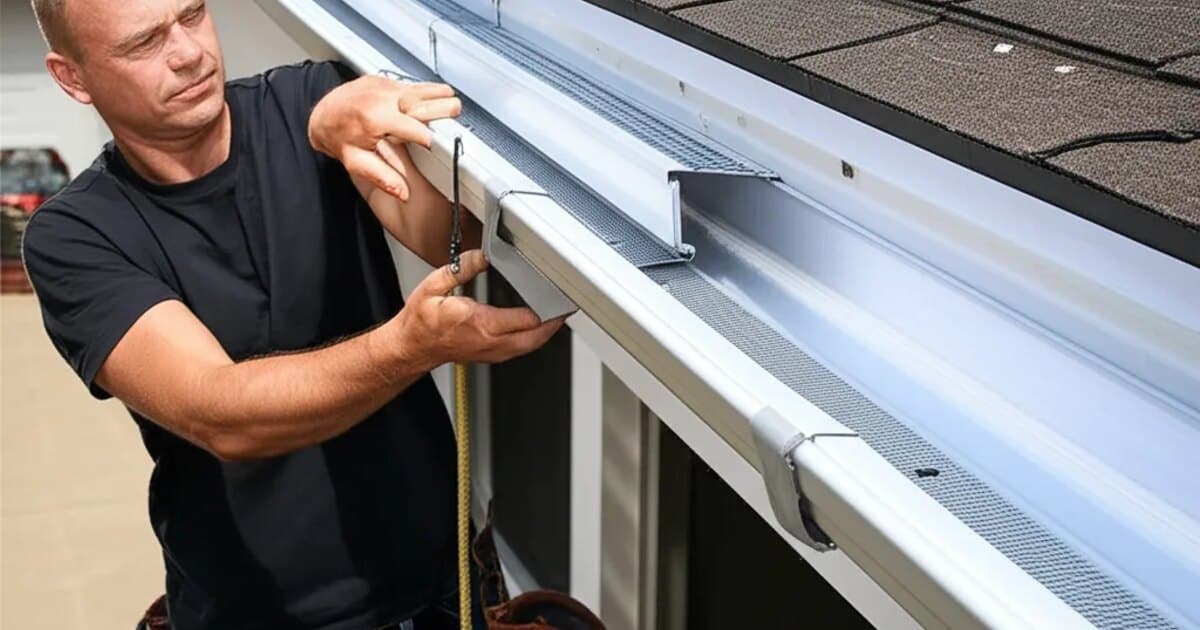
Gutters Services
Protect your foundation, landscaping, and exterior finishes with properly sized and installed gutters. Iron Crest Remodel installs seamless aluminum, copper, and steel gutters with correct pitch, secure mounting, and complete downspout systems.
- Seamless aluminum gutters (5" and 6")
- Copper gutter systems
- Steel half-round gutters
- Downspouts and extensions
- Gutter guard installation
- Fascia board repair and replacement
- Rain chain installation
- Custom gutter colors
- Underground drain connections
- Ice dam prevention solutions
Timeline
1 – 2 days
Gutter Assessment
We inspect your roofline, existing gutters, fascia condition, and drainage patterns. We calculate proper gutter sizing based on roof area and pitch.
Material & Color Selection
Choose gutter material, style, and color. We offer 20+ colors in aluminum and multiple copper and steel options.
Installation
Old gutters are removed, fascia is repaired if needed, and new seamless gutters are fabricated on-site and installed with proper pitch and hidden hangers.
Downspout & Drainage
Downspouts are routed for optimal drainage away from your foundation. Extensions, splash blocks, or underground drains are installed as needed.

See Your Remodel Before You Build.
Upload a few photos of your kitchen, bathroom, flooring, or exterior and get AI-generated concept visuals tailored to your space, style, and materials — free, no obligation, in about five minutes. Then request a real estimate from our Idaho registered Boise team.
Free concept preview · No credit card · Licensed Idaho contractor
How much do new gutters cost in Boise?
Seamless aluminum gutters in Boise cost $6-$12 per linear foot installed. A typical home with 150-200 linear feet of gutter runs $900-$2,400. Copper gutters cost $25-$40 per linear foot.
What size gutters do I need?
Most Boise homes need 5-inch gutters. Homes with large roof areas, steep pitches, or heavy tree coverage benefit from 6-inch gutters for increased capacity. We calculate the right size based on your specific roof.
Do I need gutter guards?
If you have trees near your roofline, gutter guards significantly reduce maintenance. We recommend micro-mesh guards for the best performance in Boise — they keep leaves, pine needles, and debris out while allowing full water flow.
Plan your gutters project with our in-depth guides.

Talk to a real project manager
Have Questions? Call Now for a Free In-Home Consultation.
Mon–Fri 7 AM–6 PM · Idaho registered & insured · No obligation
Russ S. — Project Manager
Russ S. — Project Manager
Ready to Start Your Remodeling Project?
Get a free, no-obligation estimate from Boise's trusted remodeling experts. Licensed, insured, and ready to build.
Different gutter materials and styles offer distinct advantages for Boise homes. Explore our guides to find the right gutter system for your property.
Choosing between gutter materials? Our head-to-head comparison breaks down cost, lifespan, and performance for Boise homes.

Not every gutter material performs equally in Idaho's demanding climate. Between heavy spring snowmelt, summer thunderstorm downpours, and winter ice loads, your gutters need to handle rapid water volume while resisting corrosion and freeze-thaw stress. Here's how the four most common gutter materials compare for Boise-area homes.
Aluminum Seamless (Our Recommendation)
Aluminum seamless gutters are the default choice on most Boise homes. Formed on-site from continuous coil stock, each run is a single piece with no mid-run seams to separate or leak. Aluminum resists rust, handles freeze-thaw without cracking, and weighs enough to stay put in Treasure Valley wind gusts. Available in 30+ factory colors and 0.027" or 0.032" thickness (we use 0.032" exclusively for longer life).
Best for: Standard residential homes throughout Ada and Canyon counties
Lifespan: 20–30 years with proper maintenance
Cost: $6–$12/linear ft installed depending on size (5" or 6")
Idaho advantage: Won't rust in irrigation overspray zones common in Boise suburbs
Copper Gutters

Copper gutters are the premium choice for historic homes, high-end custom builds, and properties in Boise's North End and Harrison Boulevard neighborhoods where architectural character matters. Copper develops a natural patina over time, never needs painting, and lasts 50 years or more. The material cost is 3–4x aluminum, but the longevity and aesthetic are unmatched.
Best for: Historic, Craftsman, and luxury homes where aesthetics justify the premium
Lifespan: 50 years or more with minimal maintenance
Cost: $25–$40/linear ft installed
Idaho note: the patina darkens to brown first and only turns green much later — the dry Boise air slows the change rather than speeding it up
Galvanized Steel Gutters
Steel gutters offer superior strength for high-impact areas and heavy snow-load zones. They're common on commercial buildings and rural properties in the Boise Foothills where falling branches and heavy ice are concerns. The downside is corrosion — the zinc coating eventually wears through, and rust tends to start at downspout connections and anywhere standing water sits.
Best for: Commercial properties, barns, and high-impact/heavy snow-load applications
Lifespan: 15–25 years (rust is the limiting factor)
Cost: $8–$15/linear ft installed
Idaho caution: irrigation overspray and the mineral deposits it leaves behind keep joints wet, which is where corrosion starts
Vinyl Gutters (Not Recommended)
We do not install vinyl gutters. While vinyl is the cheapest option available at home improvement stores, it performs poorly in Idaho's climate. Vinyl becomes brittle in sub-zero winter temperatures and cracks under snow and ice loads. UV radiation at Boise's elevation degrades vinyl rapidly, causing color fading and structural weakening within a few years. Sectional vinyl gutters are prone to leaking at the seams.
Not recommended: brittle in Idaho winters, degrades in Boise UV, and the shortest service life of any gutter material
Sold cheaply for DIY installation — but the replacement cycle is short enough to cancel the saving
If budget is the primary concern, aluminum seamless still costs less per year of service

Boise averages about 11.5 inches of precipitation a year (NOAA 1991–2020 normals, Boise Air Terminal), which leads many homeowners to assume gutters aren't critical. That assumption is wrong — and costly. The Treasure Valley's unique combination of freeze-thaw cycling, rapid snowmelt, intense summer cloudbursts, and clay-heavy soils makes proper gutter systems essential for protecting your home's foundation, siding, and landscaping.
Freeze-Thaw Cycles
Boise averages about 87 freeze-thaw cycles a year — nights below 32°F followed by daytime thaws above freezing (KBOI daily records 1996–2025, Iowa Environmental Mesonet). Without gutters, water dripping from the roof edge saturates the soil at the foundation line. When that saturated soil freezes, it expands and pushes against the foundation (frost heave). Over years, this creates cracks, bowing walls, and basement moisture intrusion. Gutters direct this water away from the foundation before it can freeze in place.
Spring Snowmelt Runoff
Late winter and early spring put sustained water on the roof. Accumulated snow and ice melts during warm spells, sending steady streams of water off every roof edge. A 2,000 sq ft roof sheds roughly 1,200 gallons for every inch of water it releases, and a deep snowpack holds several inches. Without gutters to capture and redirect this volume, the water cascades directly onto the soil at the foundation perimeter, overwhelming the grading and pooling against the house.
Summer Thunderstorms
While Boise is dry overall, summer thunderstorms in June through August deliver their rain in short, intense bursts rather than steadily. Those bursts overwhelm landscaping and create flash-flooding conditions at the foundation. Properly sized gutters (5" K-style for most homes, 6" for large or steep roofs) with 3×4" downspouts handle these peak flows and direct them safely away from the house through downspout extensions or underground drain lines.
Landscape and Hardscape Protection
Without gutters, roof runoff erodes landscaping beds, washes away bark mulch, and stains concrete walkways and driveways. In Boise's clay soils, uncontrolled runoff creates mud trenches along the house perimeter that are impossible to plant or maintain. Gutters with properly placed downspout extensions preserve your landscaping investment and keep walkways clean and ice-free in winter.
Gutter installation pairs naturally with other exterior projects. Coordinating work saves on mobilization costs and ensures seamless integration between your gutters, guards, siding, and trim.
| Home Size | Linear Feet | 5" K-Style | 6" K-Style |
|---|---|---|---|
| Small ranch (1,200 sq ft) | 100–130 ft | $600–$1,300 | $700–$1,560 |
| Standard home (1,800 sq ft) | 140–170 ft | $840–$1,700 | $980–$2,040 |
| Larger home (2,500 sq ft) | 170–210 ft | $1,020–$2,100 | $1,190–$2,520 |
| Custom / two-story (3,500+ sq ft) | 220–300+ ft | $1,320–$3,000 | $1,540–$3,600 |
Aluminum at $6–$10 per foot for 5-inch and $7–$12 for 6-inch, matching our cost guide. Includes gutters, downspouts, hangers, end caps, corners, and extensions. Fascia repair and gutter guards are additional.
Cottonwood Trees
Boise is known as the "City of Trees," and cottonwoods are everywhere — particularly along the Boise River corridor, in the North End, and throughout older neighborhoods. Cottonwood seeds clog gutters rapidly in early summer, and the large leaves fill them again in fall. If your home is near cottonwoods, we strongly recommend gutter guards to prevent constant clogging and overflow.
Ice Dams and Snow Load
Boise averages about 17.6 inches of snow a year (NOAA 1991–2020 normals, Boise Air Terminal), with occasional heavy storms. Snow accumulation on the roof can create ice dams at the eaves when heat from the attic melts snow that refreezes at the cold gutter line. Proper attic insulation and ventilation are the primary defense, but heated gutter cables and adequate gutter sizing help prevent ice damage. We install gutter hangers every 24 inches, closer than the spacing most gutters are hung at, for additional snow-load capacity.
Drainage and Grading
Downspout discharge must direct water at least 4-6 feet away from the foundation. In Boise's clay-heavy soils, water that pools near the foundation can cause significant hydrostatic pressure and eventual basement moisture problems. We install downspout extensions or underground drain lines connected to pop-up emitters in the yard to ensure proper drainage away from the home.
The single most important decision in gutter selection is not the material — it's whether the gutters are seamless or sectional. This distinction affects leak resistance, longevity, maintenance, and appearance more than any other factor.
Seamless Gutters
- Each run is formed from a single continuous piece of aluminum — no mid-run joints
- Only seams occur at corners, end caps, and downspout outlets where they are sealed with urethane sealant
- Formed on-site with a portable roll-forming machine to match your home's exact measurements
- Available in 30+ factory-baked enamel colors that match any trim or siding color
- Smoother appearance with clean sight lines — no visible joints every 10 feet
- The standard for professional installation — sectional gutters are largely a DIY product
Sectional Gutters
- Pre-cut 10-foot sections joined with slip connectors or pop rivets
- Every joint is a potential leak point — a 150-ft system has 15+ seams
- Seams separate over time as aluminum expands and contracts through the Boise year, from January nights below freezing to July afternoons in the nineties
- Available at home improvement stores for DIY installation
- Visible seams every 10 feet interrupt the gutter line aesthetically
- Higher lifetime cost due to leak repairs, sealant maintenance, and earlier replacement
We install exclusively seamless gutters because the performance difference is not marginal — it's fundamental. In Boise, where the January normal low is 25.9°F and the July normal high is 93.5°F (NOAA 1991–2020 normals, Boise Air Terminal), sectional gutter seams are under constant thermal stress, and a run of Idaho winters tends to find every one of them. Seamless systems eliminate this failure mode entirely.

A professional gutter installation is more than screwing troughs to your fascia. Proper slope, hanger spacing, downspout placement, and sealant application determine whether your gutters perform for 5 years or 25. Here is exactly how we approach every gutter project in the Boise metro area.
On-Site Assessment and Measurement
We measure every roof edge, identify valley convergence points where water volume concentrates, assess fascia condition (checking for rot or damage behind existing gutters), and photograph the existing drainage setup. We calculate the required gutter capacity for each roof section using SMACNA guidelines — roof area × pitch factor × local rainfall intensity. This determines whether 5-inch or 6-inch gutters are needed and where 3×4-inch downspouts are required instead of standard 2×3-inch.
Fascia Inspection and Repair
Before new gutters go up, the fascia must be sound. We remove the old gutters and inspect every linear foot of fascia for wood rot, insect damage, delamination, and paint failure. Damaged sections are replaced with primed, factory-finished fascia board or PVC fascia wrap for long-term moisture resistance. Installing new gutters over rotted fascia is a common shortcut that guarantees premature failure — we never do it.
Gutter Fabrication On-Site
We bring our portable roll-forming machine to your home and fabricate each gutter run on-site from 0.032-inch aluminum coil stock. This means each run is cut to the exact length of your fascia — no splices, no joints, no compromise. You choose from 30+ factory-baked enamel colors to match your trim. The machine produces a perfectly straight, factory-finish gutter in minutes.
Installation with Proper Slope and Hanger Spacing
Gutters must slope toward each downspout at a rate of approximately 1/4 inch per 10 feet of run. Too little slope causes standing water and mosquito breeding. Too much slope creates a visible sag that looks wrong from the ground. We use a laser level to establish the correct slope on every run. Hidden hangers are installed every 24 inches — tighter than gutters are commonly hung, which provides better snow-load capacity for Idaho winters and prevents sagging between supports over time.
Sealing, Downspouts, and Drainage Termination
All corner joints, end caps, and downspout outlets are sealed with premium urethane gutter sealant — not silicone, which breaks down under UV exposure. Downspouts are secured with aluminum straps screwed to the wall (not nailed) and discharge into extensions, splash blocks, or underground drain lines that terminate at least 6 feet from the foundation. We test every run with water before calling the job complete.

Gutters only work if the water they collect is discharged far enough from the foundation. Downspout placement and drainage termination are the most overlooked elements of gutter systems — and the most common cause of foundation moisture problems in Boise homes.
Downspout Sizing and Placement
Downspouts are placed at intervals set by the roof area and pitch each run has to carry, which on most Boise homes works out to one every 20–30 linear feet. Where multiple roof planes converge into a valley, the gutter section below receives double or triple the water volume — these areas often need a dedicated downspout within 5 feet of the valley discharge point. We use 2×3-inch downspouts as standard and upgrade to 3×4-inch downspouts on high-volume runs, 6-inch gutter systems, and at valley convergences.
Surface Extensions vs Underground Drain Lines
The minimum standard is a surface extension (aluminum elbow and straight section) that discharges water 4–6 feet from the foundation. However, surface extensions can be tripped over, damaged by lawn mowers, and are aesthetically intrusive. For a cleaner solution, we offer underground drain lines — 4-inch solid PVC pipe buried in a shallow trench that connects each downspout to a pop-up emitter 8–12 feet from the house. Pop-up emitters open under water pressure and close when flow stops, keeping debris and rodents out of the drain line.
Boise Clay Soils and Foundation Drainage
Many Boise neighborhoods — particularly in the Bench, West Boise, and throughout Canyon County — sit on expansive clay soils that absorb water slowly and swell significantly when saturated. When gutter downspouts dump water at the foundation line on clay soil, the soil expands and pushes laterally against the foundation wall. Over years, this hydrostatic pressure causes cracks, bowing, and water intrusion. Underground drain lines that discharge well away from the foundation are especially important on clay soils. We also recommend the grade the code asks for — a fall of at least 6 inches within the first 10 feet away from the foundation (2018 IRC R401.3, as adopted in Idaho).
Rain Barrels and Water Collection
Idaho allows rooftop rainwater to be collected and used on the property where it falls; confirm the current Idaho Department of Water Resources guidance before designing a large system. A 2,000 sq ft roof sheds approximately 1,200 gallons per inch of rain — even on Boise's 11.5-inch annual normal, that is more than 14,000 gallons a year. We can install diverter valves on downspouts that feed rain barrels (typically 50–100 gallon capacity) for garden irrigation while maintaining normal drainage when the barrel is full. This is especially appealing to Boise homeowners who want to offset irrigation water costs during the dry summer months.

Many Boise homeowners don't think about their gutters until something goes visibly wrong. By then, hidden damage to the fascia, soffit, or foundation may have already accumulated. Here are the warning signs that indicate it's time to replace rather than repair your gutter system.
Visible Cracks or Splits
Small cracks in aluminum gutters propagate rapidly through Boise's freeze-thaw cycles. Water trapped in a crack expands when it freezes, splitting the crack wider with each cycle. By the time you see a crack from the ground, it has likely been leaking for months.
Sagging or Pulling Away from Fascia
Gutters that sag or pull away indicate failed hangers, rotted fascia, or both. Standing water in a sagged section accelerates the problem because the added weight pulls the gutter further from the house. Re-hanging on rotted fascia is a temporary fix — the fascia must be replaced first.
Peeling Paint or Rust Streaks on Siding
Orange rust stains or paint peeling on the siding directly below the gutter line indicates chronic overflow or leaking. The water is running behind the gutter and down the wall, damaging the siding and potentially the sheathing behind it.
Water Pooling at the Foundation
If you see ponding water, erosion channels, or muddy trenches at the foundation during or after rain, your gutters are either clogged, undersized, or have failed seams. This is the most urgent sign because foundation damage is the most expensive consequence of gutter failure.
Mold or Mildew on Exterior Walls
Persistent moisture from leaking or overflowing gutters creates conditions for mold and mildew growth on siding, soffits, and trim — especially on north-facing walls that receive less drying sunlight.
Multiple Repairs in the Past 2 Years
If you've had your gutters repaired or resealed more than twice in two years, the system has reached the end of its service life. Continued patching becomes more expensive than replacement and doesn't address the underlying deterioration.
If you notice any of these signs, we offer a free on-site gutter assessment. We'll inspect the full system, document the condition of your fascia and soffits, and recommend whether repair or replacement is the most cost-effective path forward.
Even the best gutter system requires periodic attention. Here's a seasonal maintenance schedule tailored to Boise's specific climate and vegetation conditions to maximize the life of your gutters.
Spring (March–April)
- Clear any winter debris — pine needles, twigs, and accumulated grit from roofing granules
- Check all seams and end caps for sealant deterioration after freeze-thaw stress
- Flush gutters with a hose and verify downspouts are flowing freely (not clogged with leaf compaction)
- Inspect fascia behind gutters for moisture damage from winter ice or condensation
- Verify downspout extensions are in place and discharging away from the foundation
Summer (June–July)
- Remove cottonwood seeds and fluff — Boise's most prolific gutter-clogging debris, peaking in late June
- Check for wasp and bird nests in downspout elbows and covered gutter ends
- Verify that sprinkler systems are not spraying directly onto gutters (accelerates corrosion on steel gutters and stains aluminum)
- Inspect gutter slope after any heavy thunderstorm — extreme rainfall can shift loose hangers
Fall (October–November)
- Complete a thorough cleaning after all leaves have dropped — this is the most critical cleaning of the year
- Pay special attention to areas below tree canopy, valleys, and inside corners where debris accumulates fastest
- Apply fresh urethane sealant to any joints showing separation before winter freeze
- Confirm downspouts and underground drain lines are completely clear before freezing temperatures arrive
- Consider installing gutter guards before winter if clogging is a recurring problem
Winter (December–February)
- After heavy snow, check for ice dam formation at the gutter line — ice dams indicate insufficient attic insulation or ventilation
- Do not attempt to chip ice from gutters (it damages the metal) — use calcium chloride ice melt in a sock laid across the ice dam
- Keep gutters clear of heavy snow accumulation that exceeds the hanger load capacity
- If heated gutter cables are installed, verify they are functioning before each storm event
Homeowners with gutter guards can skip most cleaning tasks but should still perform an annual visual inspection in spring and clear any surface debris from the guard mesh or cover.
What size gutters do I need for my Boise home?
Most Boise homes use 5-inch K-style gutters with 2×3 or 3×4 inch downspouts. Homes with steep roofs, large roof areas, or sections where multiple roof planes converge may need 6-inch gutters with 3×4 inch downspouts for increased capacity. We calculate the required gutter size based on your roof area, pitch, and local rainfall intensity — Boise averages about 11.5 inches of precipitation a year (NOAA 1991–2020 normals, Boise Air Terminal), but thunderstorms can drop heavy rain in short bursts.
How often should gutters be cleaned in Boise?
Without gutter guards, Boise gutters should be cleaned at least twice per year — once in late fall after cottonwood leaves drop, and once in spring to clear winter debris and check for ice damage. Homes near mature cottonwood trees (common throughout Boise) may need cleaning 3-4 times per year due to the heavy seed and leaf fall. Gutter guards reduce cleaning to once per year or less, depending on the guard type and surrounding vegetation.
Do seamless gutters leak at corners and seams?
Seamless gutters eliminate leaks along the straight runs because each section is formed from a single piece of aluminum — no seams to separate. However, every gutter system has joints at inside corners, outside corners, and end caps. We seal these joints with high-quality urethane gutter sealant (not silicone, which deteriorates in UV exposure). Those sealed joints are the only points that will eventually need attention, and they are few — a significant advantage over sectional gutters, which have seams every 10 feet.
Should I replace gutters when I replace my roof or siding?
Yes — coordinating gutter replacement with a roof or siding project is the most cost-effective approach. When the roof edge or fascia is already exposed during siding or roofing work, gutter installation is faster, the fascia can be repaired or replaced as needed, and proper drip-edge integration is easier. Running the gutter work alongside a siding project also avoids paying twice to mobilize a crew and set up access. Iron Crest does not offer roofing, but if a roofing contractor is replacing your roof, we schedule the gutter installation right behind it.
The following government agencies, industry organizations, and official resources provide additional information relevant to your remodeling project.
Research your gutters project with our in-depth Boise-area guides.
Gutter installation pairs naturally with siding and exterior painting projects.
Get a Free Gutter Estimate
Schedule a free on-site assessment for your Boise home. We measure, recommend the right gutter system, and provide a fixed-price quote — no obligation.