
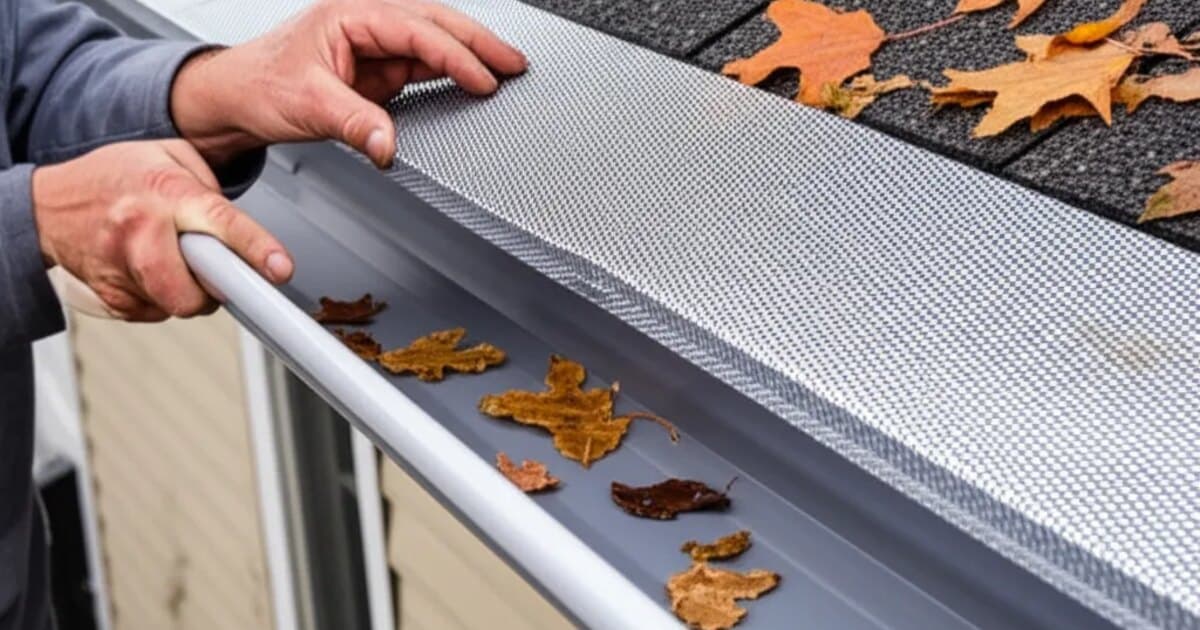
Gutter Guards Services
Stop cleaning your gutters. Iron Crest Remodel installs micro-mesh gutter guard systems that block leaves, pine needles, and debris while maintaining full water flow — backed by manufacturer warranties.
- Micro-mesh gutter guard systems
- Screen-style gutter protection
- Reverse-curve gutter helmets
- Custom fit for 5" and 6" gutters
- Compatible with existing gutter systems
- No-clog warranty options
- Stainless steel mesh construction
- Low-profile design
- Ice dam compatible
- Professional mounting (no glue or screws into roof)
Timeline
1 day
Gutter Inspection
We clean and inspect your existing gutters, verify they are in good condition and properly pitched, and recommend the best guard system for your situation.
Guard Selection
Based on your tree types (broadleaf, pine, cottonwood), roof style, and budget, we recommend the optimal gutter guard system.
Professional Installation
Guards are measured, cut, and installed on every gutter run. We ensure proper fit at corners, transitions, and downspout connections.
Testing & Warranty
Water flow is tested, all sections are verified for secure fit, and warranty documentation is provided.

See Your Remodel Before You Build.
Upload a few photos of your kitchen, bathroom, flooring, or exterior and get AI-generated concept visuals tailored to your space, style, and materials — free, no obligation, in about five minutes. Then request a real estimate from our Idaho registered Boise team.
Free concept preview · No credit card · Licensed Idaho contractor
Do gutter guards really work?
Yes — quality micro-mesh gutter guards block 99%+ of debris while allowing full water flow. They eliminate routine gutter cleaning and prevent clogs, overflow, and ice dams. Lower-quality screen guards work but may allow small debris through.
How much do gutter guards cost?
Professional gutter guard installation in Boise costs $10-$25 per linear foot depending on the system type. Micro-mesh systems are at the higher end but offer the best performance and warranty. A typical home runs $2,000-$5,000.
Can gutter guards be installed on existing gutters?
Yes. Most gutter guard systems are designed to retrofit onto existing 5" and 6" gutters. We inspect your gutters first and repair any issues before installing guards.
Plan your gutter guards project with our in-depth guides.

Talk to a real project manager
Have Questions? Call Now for a Free In-Home Consultation.
Mon–Fri 7 AM–6 PM · Idaho registered & insured · No obligation
Russ S. — Project Manager
Russ S. — Project Manager
Ready to Start Your Remodeling Project?
Get a free, no-obligation estimate from Boise's trusted remodeling experts. Licensed, insured, and ready to build.
Not all gutter guards perform equally against Boise’s cottonwood seeds, pine needles, and heavy debris. Compare the options below.
Compare guard types side by side to find the best match for your Boise home’s debris challenges and budget.

Idaho's debris profile is unique. Boise's famous cottonwood trees produce clouds of fine white fluff from late May through July. Mature ponderosa and lodgepole pines in the Foothills and East Boise drop needles year-round. Fall brings heavy leaf loads from maples, elms, and ash trees throughout the Treasure Valley. Each debris type requires a different guard technology to handle effectively. Here's how the four main gutter guard categories perform against Boise's specific challenges.
Micro-Mesh Guards
The top performer for Boise conditions. Micro-mesh guards use a fine woven stainless steel mesh stretched over a rigid aluminum frame. The mesh openings are small enough to block cottonwood seeds, pine needles, roof grit from aging shingles, and even windblown pollen — while allowing water to pass through via surface tension. This is the guard type we recommend for any home with cottonwood trees nearby.
Cottonwood fluff: Excellent — seed and fibre sit on the mesh rather than passing through
Pine needles: Very good — needles sit on top and blow off or can be brushed away
Fall leaves: Excellent — leaves slide off the angled mesh surface
Roof grit/shingle debris: Excellent — fine mesh blocks granule wash-off
Heavy rain performance: Very good — water passes through the full mesh area, not a single slot
Screen Guards (Metal Mesh)
Metal screen guards use a coarser mesh — openings you can see through from the ground — that blocks leaves and large debris but allows smaller particles through. Effective for homes with standard deciduous tree coverage but inadequate against cottonwood seeds and pine needles — both of which pass through the larger mesh openings.
Cottonwood fluff: Poor — seeds pass through larger mesh openings
Pine needles: Poor — needles orient vertically and slip through screens
Fall leaves: Good — blocks most leaf debris effectively
Heavy rain: Excellent — large openings handle high water volume easily
Reverse-Curve (Surface Tension) Guards
Reverse-curve guards use a solid aluminum cover with a curved nose that directs water into the gutter via surface tension while debris slides off the front edge. They work well for large leaves but have significant limitations in Boise. Cottonwood fluff adheres to the wet curve surface and accumulates. Pine needles wedge into the slot opening. And during Boise's intense summer thunderstorms, water can overshoot the narrow intake slot entirely.
Cottonwood fluff: Fair — fluff sticks to wet surfaces and clogs the intake slot
Pine needles: Poor — needles bridge across the intake opening
Fall leaves: Good — large leaves slide off the curved surface effectively
Heavy rain: Fair — water overshoots the intake during intense downpours
Foam Inserts (Not Recommended)
Foam gutter inserts are porous foam blocks that sit inside the gutter. They are the cheapest option on the shelf and the easiest to fit, but they perform poorly here and we do not install them. Debris accumulates on top of and within the foam, seeds germinate in the trapped moisture, and UV exposure breaks the foam down years before any metal guard would need attention. They also hold water against the gutter bottom, which accelerates corrosion and gives mosquitoes somewhere to breed.
Not recommended for any Idaho application — UV degradation, debris trapping, and pest habitat
Seeds from cottonwoods and other trees germinate inside the foam, creating gutter gardens
Foam deteriorates and needs complete replacement far sooner than a metal guard
Gutter guards are a maintenance and protection investment rather than a resale one. We do not publish a payback period or a return multiple, because the honest inputs are not available: there is no Boise-specific study of gutter-guard economics, and the two numbers the calculation turns on — what you currently pay to have gutters cleaned and how often you need it — differ enormously between a ranch on a bare lot in Meridian and a two-storey under mature cottonwoods in the North End. What follows is what the guards do, without the arithmetic dressed up as a finding.
Reduced Cleaning
An unprotected gutter under heavy tree cover needs the interior scooped out and flushed several times a year. With quality guards that work becomes a surface brush-off — less often, faster when it happens, and done from the top of the mesh rather than by reaching into the trough. If you pay someone for that work today, ask them what they charge and how many visits they schedule for your house; that is the only cleaning figure worth putting against a quote.
Damage Prevention
A gutter that overflows repeatedly rots the fascia behind it, stains and eventually rots siding from splash-back, erodes planting beds, and dumps roof water against the foundation instead of carrying it away. Those repairs are the expensive ones, and they are the reason to keep a gutter flowing. We do not attach dollar figures to them here — the cost of any one of them depends entirely on how long the overflow went unnoticed and what it reached.
Ice Dams — What Guards Do Not Do
Gutter guards do not prevent ice dams. An ice dam forms when heat escaping through the roof melts snow on the upper roof and the meltwater refreezes at the cold eave, and it will form over a gutter that is empty, full, guarded or absent. The fix for ice dams is air sealing and attic insulation, not gutter hardware. What a clear gutter does is give meltwater somewhere to go during a thaw instead of standing in packed debris, and a guard helps keep it clear — but anyone selling you guards as an ice-dam cure is selling you the wrong product.
How to Judge the Quote
Compare the per-foot installed price against how long the system should last and what it actually filters. A screen guard that lets cottonwood seed straight through has not solved the problem it was bought for, however cheap it was per foot. A micro-mesh system on gutters that sag and leak has not solved it either. That is why every quote we write starts with the condition of the gutters rather than the guard.
Gutter guards work best as part of a complete gutter and exterior drainage system. Pair guard installation with new gutters for bundle savings, or explore our full exterior remodeling services.

Boise is called the "City of Trees" for good reason — mature cottonwoods, maples, and elms line streets throughout the North End, East End, Bench, and older neighborhoods. These trees shed massive amounts of leaves, seeds, and debris that clog unprotected gutters within weeks. Clogged gutters overflow, causing foundation damage, fascia rot, landscape erosion, and ice dam formation in winter.
Turns several interior gutter cleanouts a year into an occasional surface brush-off
Prevents overflow that damages foundations and landscaping
Stops fascia and soffit rot from standing water
Keeps the gutter clear so thaw water can drain rather than standing in packed debris
Prevents mosquito breeding in standing gutter water
Extends gutter lifespan by reducing rust-causing debris contact
Eliminates the fall hazard of climbing ladders to clean gutters
Not all gutter guards are created equal. The best system for your home depends on the type of debris you're dealing with, your budget, and your gutter configuration.
| Type | Cost/ft | Debris Blocked | Water Flow | Best For |
|---|---|---|---|---|
| Micro-Mesh | $12–$20 | Excellent — blocks fine debris | Very Good | Cottonwood, pine needles |
| Perforated Aluminum | $8–$15 | Good — blocks leaves | Excellent | Standard leaf debris |
| Screen (metal mesh) | $7–$12 | Good — blocks leaves | Good | Budget-friendly option |
| Reverse Curve | $15–$25 | Good — large debris only | Good in rain | Large leaves only |
| Foam Insert | We do not install | Fair | Fair | Not recommended |
| Brush Insert | We do not install | Fair | Fair | Not recommended |

Micro-Mesh (Premium)
Our top recommendation for Boise homes near cottonwoods, pines, or mature deciduous trees. Micro-mesh guards use a fine woven stainless steel mesh over an aluminum frame. The mesh blocks cottonwood seeds, pine needles, roof grit, and even pollen while allowing water to pass through via surface tension. We fit contractor-supplied micro-mesh systems and install to the manufacturer's published specifications. We hold no manufacturer certification or dealer appointment for any gutter guard brand, and several of the brands advertised nationally are sold only through the manufacturer's own installation teams.
Perforated Aluminum (Mid-Range)
A solid aluminum cover with perforated holes that blocks leaves while maintaining excellent water throughput. Handles heavy rain better than micro-mesh and is effective against standard leaf and twig debris. Less effective against cottonwood seeds and pine needles. Best for homes with moderate tree coverage.
What We Don't Install
We do not install foam inserts, brush inserts, or plastic screen guards. Foam and brush systems trap debris inside the gutter, creating worse clogs, and both deteriorate under UV long before a metal guard would need attention. Plastic screens become brittle in Idaho's dry, sun-exposed climate and snap during freeze-thaw. These products create a false sense of security.
| Home Size | Linear Feet | Perf. Aluminum | Micro-Mesh |
|---|---|---|---|
| Small (1,200 sq ft) | 120–150 ft | $1,000–$2,250 | $1,440–$3,000 |
| Medium (1,800 sq ft) | 150–200 ft | $1,200–$3,000 | $1,800–$4,000 |
| Large (2,500 sq ft) | 200–275 ft | $1,600–$4,125 | $2,400–$5,500 |
| XL (3,500+ sq ft) | 275–350 ft | $2,200–$5,250 | $3,300–$7,000 |
Includes gutter cleaning, inspection, and guard installation. Fitting guards during new gutter installation costs less than a separate visit, because the crew, ladders and access are already on site. Your estimate shows the combined figure.

Proper installation is as important as the guard quality itself. A premium micro-mesh guard installed incorrectly will underperform a mid-range guard installed correctly. Here is our proven installation process for every gutter guard project in the Boise metro area.
Gutter Cleanout and Inspection
Before any guards are installed, we thoroughly clean the interior of every gutter run — removing all leaves, seeds, compacted debris, and roof grit. We then inspect the gutter system for proper slope (1/4 inch per 10 feet toward each downspout), verify all hangers are secure, check seams for leaks, and test every downspout for unobstructed flow. Any issues are repaired before guard installation begins.
Fascia and Drip Edge Assessment
We inspect the fascia board behind the gutter and the drip edge flashing along the roof edge. The guard must integrate properly with the drip edge to prevent water from bypassing the gutter entirely. If the drip edge is missing, improperly installed, or corroded, we correct it before attaching the guards. Fascia rot behind the gutter — a common hidden problem in Boise homes — is repaired at this stage.
Guard Fitting and Installation
Each guard panel is measured and cut to fit the exact dimensions of the gutter run, including inside corners, outside corners, and downspout outlets. Micro-mesh guards are attached using stainless steel self-tapping screws into the front lip of the gutter (never into the roof deck or shingles). The rear edge slides under the first row of shingles or clips to the gutter back lip, depending on the system. Proper fit ensures no gaps for debris to enter.
Water Flow Testing
After installation, we test every gutter run with a hose at full volume to verify water passes through the mesh without overshooting, pooling, or backing up. We check for proper drainage at every downspout and verify that water is not bypassing the guards at corners, end caps, or roof valleys where water volume is highest. Any sections that don't pass the flow test are adjusted on the spot.
Cleanup and Maintenance Walkthrough
We clean the work area, remove all debris, and walk you through the installed system. We show you how to perform the one simple maintenance task gutter guards require — an annual surface brush-off of any accumulated debris on top of the mesh. We also document the installation for your records and provide warranty information for the specific guard system installed.
Not all gutter guard installations deliver the results homeowners expect. Here are the most common mistakes we see in the Boise area — and how to avoid them.
Choosing the Wrong Guard Type
The most common mistake is selecting a guard on price alone without considering your specific debris. A cheap screen guard near cottonwood trees stops solving the problem it was bought for. Match the guard technology to your debris profile — micro-mesh for cottonwood and pine, perforated aluminum for standard leaves.
Installing Over Damaged Gutters
Guards don't fix existing gutter problems — they hide them. If your gutters are sagging, leaking at seams, or have rotted fascia behind them, guards installed over these issues will still fail. Always repair or replace gutters before adding guards.
DIY Installation with Incorrect Fit
Big-box store gutter guards are generic sizes that rarely fit perfectly. Gaps at corners, end caps, and along the front lip allow debris in — defeating the purpose. Professional installation uses guards cut to exact dimensions with no gaps.
Screwing Through the Roof Deck
Some guard systems and installers attach the rear edge of the guard by screwing through the roof shingles into the roof deck. This creates roof penetrations that void most roofing warranties and can cause leaks. Our systems clip under shingles or attach to the gutter only — never to the roof.
Ignoring Roof Valleys
Roof valleys concentrate large volumes of water at specific gutter locations. If the guard system isn't designed to handle the concentrated flow at valley discharge points, water overshoots the gutter during heavy rain. We install valley splash guards or wider mesh panels at these critical locations.
Assuming Zero Maintenance
No gutter guard system is maintenance-free, whatever the advertising says. Fine debris, pollen, and roof grit accumulate on top of the mesh over time and need periodic brushing. Expect a quick surface cleaning rather than the full interior cleanouts an unprotected gutter needs.
Cottonwood Seed Season
Boise's cottonwood trees release seeds (white "cotton" fluff) from late May through July. This fine material is the debris that defeats most guard types in the Treasure Valley, and it is the reason we steer cottonwood-adjacent homes to micro-mesh: the woven mesh is the only guard surface fine enough to hold seed and fibre out while still passing water.
Pine Needle Challenge
Homes in the Boise Foothills, Southeast Boise, and Eagle's wooded neighborhoods deal with pine and fir needles year-round. Pine needles slip through most screen-type guards. Micro-mesh is the most effective solution, though needles accumulate on top of the mesh and need periodic brushing.
Winter Performance
Snow and ice on gutter guards can prevent snowmelt from entering the gutter, potentially contributing to ice dams. We install guards with adequate pitch and recommend heated gutter cable systems for homes with chronic ice dam issues. Guard frames must be aluminum (not plastic) to withstand snow-load forces.
Do gutter guards really work in Boise?
Quality gutter guards reduce gutter maintenance substantially in Boise, but no guard eliminates cleaning entirely — surface debris still accumulates on top of the guard. What they do is prevent the interior clogs that cause overflow and damage. For Boise homes near cottonwood trees the case is strongest, because unprotected gutters fill again quickly after a cleaning. The key is choosing the right guard type for your specific debris challenges, and we do not publish effectiveness percentages: there is no independent test of gutter guards under Treasure Valley debris conditions, and manufacturer test figures are generated on clean product in a lab rather than on a roof under cottonwood.
Which gutter guard type is best for cottonwood seeds?
Micro-mesh gutter guards are the most effective against Boise's cottonwood seeds. The woven stainless mesh openings are far finer than the openings in a screen guard — fine enough that cottonwood fluff and seed sit on the surface rather than passing through, while water still flows through by surface tension. Screen-type guards and reverse-curve systems can trap cottonwood seeds in their openings. If your home is surrounded by cottonwoods, micro-mesh is the only guard type we recommend.
Can gutter guards be added to existing gutters?
Yes, most gutter guard systems are designed to retrofit onto existing 5-inch or 6-inch K-style gutters. We clean and inspect the existing gutters before installation, repairing any loose hangers, resealing joints, and ensuring proper slope. If the existing gutters are in poor condition (rusted, bent, or badly misaligned), we recommend replacing both gutters and guards together for the best long-term result.
How much do gutter guards cost in Boise?
Gutter guard costs in Boise run from $7-$12 per linear foot for screen-type guards up to $12-$20 per linear foot for micro-mesh systems, installed. For a typical Boise home with 150-200 linear feet of gutters, that is roughly $1,050-$4,000 depending on the system. Micro-mesh costs more up front and repays that over time in reduced cleaning, but we do not publish a payback period: the figure depends on what you currently pay to have gutters cleaned and how often, and those vary too much between households for an average to mean anything.
The following government agencies, industry organizations, and official resources provide additional information relevant to your remodeling project.
Research your gutter guards project with our in-depth Boise-area guides.
Ready to Start Your Remodeling Project?
Get a free, no-obligation estimate from Boise's trusted remodeling experts. Licensed, insured, and ready to build.