
| Cost item | Behaviour | Why |
|---|---|---|
| Toilet, vanity, shower or tub | Fixed | A small bathroom needs the same fixtures as a large one. |
| Plumbing connections | Fixed | The same number of supply and drain connections regardless of room size. |
| Shower valve and trim | Fixed | One valve either way, and quality matters more than quantity. |
| Exhaust ventilation | Fixed | One fan, ducted to the exterior. Boise's checklist requires fan location and cfm on plans. |
| Electrical — lighting, receptacles | Mostly fixed | Circuit work and GFCI protection are similar; a large room may add fittings. |
| Demolition and disposal | Partly fixed | Fewer square feet of material, but the same trades and the same set-up. |
| Protection and containment | Fixed | Protecting the rest of the house is the same job either way. |
| Permit and inspections | Fixed | The same trade permits and inspection visits. |
| Waterproofing | Partly variable | Detail work at corners, curbs and niches dominates over flat area. |
| Tile material and setting | Variable | Genuinely scales with area — the clearest saving in a small room. |
| Flooring | Variable | Scales with area. |
| Paint | Variable | Scales with area, and is a small share either way. |
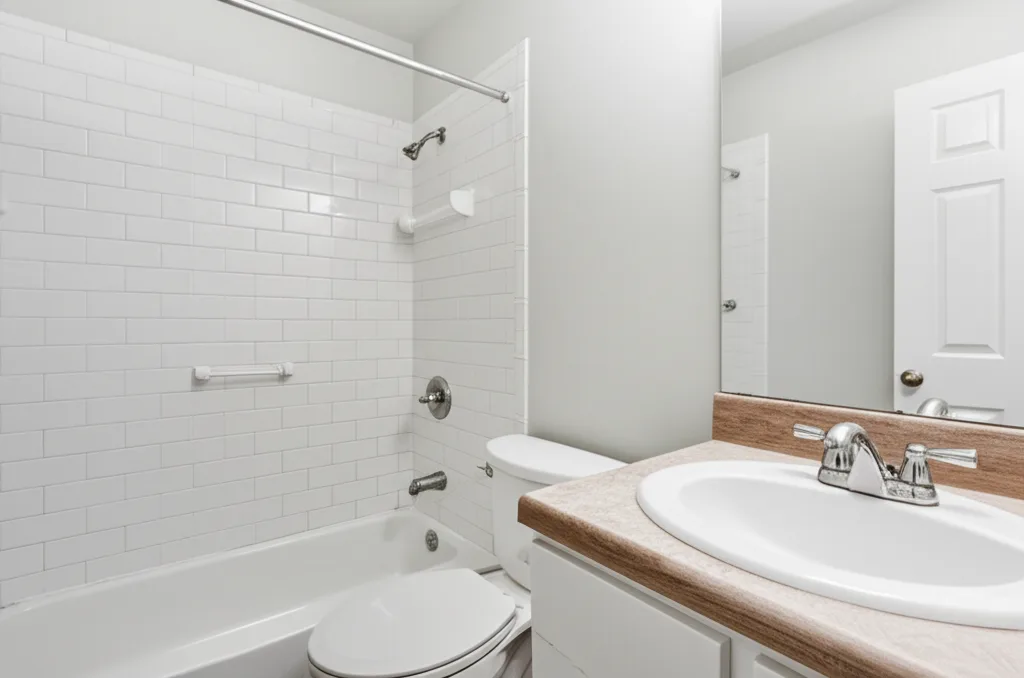
Cost per square foot is a reasonable comparison tool when the underlying costs scale with area. In bathrooms they largely do not. Dividing a mostly-fixed cost by a small floor area produces a high per-square-foot figure that says nothing useful about value, and dividing the same cost structure by a large area produces a flattering one.
The metric is not dishonest — it is simply the wrong instrument. If you want a number to sanity-check a quote against, our Boise bathroom remodel cost guide gives ranges by project scope, which is the more meaningful basis for a compact room.
Spend here / economise here
Worth spending on
- The waterproofing system behind the tile — the one failure that is expensive to fix later
- The shower valve, which you operate daily and which is buried in the wall
- Exhaust ventilation sized and ducted properly to the exterior
- Tile — a small room makes a premium selection genuinely affordable
Everything in this list except the tile is invisible when it is working, which is exactly why it gets cut first.
Reasonable to economise on
- Vanity cabinetry, where a stock unit in a small room is often the right size anyway
- Accessory hardware and mirrors, which are easy to upgrade later
- Paint and non-wet-area finishes
- Decorative lighting, provided the functional lighting is adequate
Economising is fine where the item can be swapped later without demolition. That is the test.
Ventilation deserves particular attention in the Treasure Valley's dry climate, where homeowners often assume moisture is not an issue — our bathroom ventilation guide covers sizing and duct routing, and the waterproofing systems guide covers what should sit behind the tile.
In a compact bathroom, relocating fixtures has a disproportionate budget effect because it adds a large variable cost on top of an already fixed-cost-heavy project. It is sometimes still the right call — a bathroom where the door hits the vanity, or where the shower is genuinely too small to use, has a functional problem that finishes cannot fix.
What decides the cost of that change is drain geometry and floor construction, not distance. Our guide to moving bathroom plumbing covers it fixture by fixture, including why a slab floor changes the answer entirely.
The most common high-value small-bathroom change is replacing a tub with a shower in the same footprint — it reclaims usable space and removes a visual barrier without relocating the drain far. That specific project is covered on our tub-to-shower conversion cost page.

Mistakes that cost the most
1.Expecting the price to scale with floor area
Leads to a budget set too low and a project that either stalls or gets value-engineered in exactly the wrong places.
2.Cutting the waterproofing to protect the tile budget
The one component whose failure means demolishing the finished room to reach it. In a small bathroom that is the entire room.
3.Reusing an undersized or unducted exhaust fan
A small room concentrates moisture. A fan that vents into a loft space rather than outside relocates the problem rather than solving it.
4.Relocating plumbing for a marginal layout gain
In a small room the relocation can cost more than the entire finish package, for a change of a few inches.
5.Choosing a vanity before measuring the door swing
Small bathrooms fail on clearances. A vanity that fits the wall may still block the door or the toilet.
Does a small bathroom cost less to remodel?
Less in absolute terms, but far less than proportionally — and the cost per square foot is usually higher than in a large bathroom. The reason is that most of what a bathroom remodel costs is fixed by the room existing at all rather than by how big it is. A small bathroom still has a toilet, a vanity, a shower or tub, an exhaust fan, supply and drain connections, waterproofing, a door, lighting and a permit where trades are involved. Halving the floor area reduces the tile quantity and a little of the labour. It does not halve the fixture count, the trade visits, the inspections or the waterproofing detail work. In Boise, a compact bathroom taken through a full cosmetic-to-mid-range refresh — new tile, vanity, toilet, fixtures, paint and lighting, with no plumbing reconfiguration — sits in the lower part of our bathroom range, $12,000 to $22,000. Relocating plumbing, or taking a small room to a primary-suite finish level, moves it up from there.
Why is cost per square foot misleading for small bathrooms?
Because it divides a largely fixed cost by a small number. A cost-per-square-foot figure derived from large bathrooms will always understate a small one, and a figure derived from small bathrooms will always look alarming next to a large-room benchmark. Neither is wrong; the metric is simply the wrong tool for a room where fixed costs dominate. A more useful way to budget a small bathroom is to count the items — fixtures, trade connections, surfaces — rather than measure the floor.
Is it cheaper to keep the same bathroom layout?
Yes, and in a small bathroom the saving is proportionally larger than in a big one. Because fixed costs already dominate a small room's budget, adding plumbing relocation on top has an outsized effect on the total. A small bathroom that keeps its toilet, shower and vanity positions can absorb genuinely good materials for what a relocated layout would cost in bare trade work. Where the existing layout is workable, keeping it is usually the highest-value decision available in a small room.
What is the best way to make a small bathroom feel bigger?
The changes that work are the ones that remove visual interruptions and free up floor area, rather than the ones that simply lighten the colour. Replacing a tub with a well-proportioned shower and a clear glass enclosure removes a visual barrier and reclaims usable floor. A wall-hung or floating vanity exposes floor beneath it, which reads as more space. Recessed niches remove the shelving that would otherwise project into the shower. Larger-format tile reduces grout lines and visual busyness. Our small bathroom ideas guide covers the design side in more depth.
Where should the budget go in a small bathroom?
Into the things you touch and the things that fail. In a small room the tile quantity is modest, which means a better tile costs comparatively little in absolute terms — a rare case where upgrading the material is genuinely affordable. The same applies to the vanity top and the fixtures. What should never be economised is the waterproofing behind the tile, the exhaust ventilation, and the quality of the shower valve, because those are the items that are expensive and disruptive to put right later and are invisible while they are working.
Each reference below is cited for a specific claim on this page. Codes, fees and product specifications change — confirm current requirements with the authority having jurisdiction before relying on them for a project decision.
- City of Boise — Residential Addition, Alteration & Accessory Building Submittal Checklist (#406)
Cited for: That bathroom exhaust fan locations and cfm must be noted on submitted plans, and how Boise categorises interior remodels.
- Idaho DOPL — Idaho Adopted Codes
Cited for: The code editions Idaho enforces — the 2018 IRC with Idaho amendments, the 2023 NEC, and the UPC-based Idaho State Plumbing Code.