Tub-to-Shower Conversion Cost in Boise
A comprehensive pricing guide for Boise and Treasure Valley homeowners planning a tub-to-shower conversion in 2026. Real numbers, local cost factors, and transparent breakdowns from an experienced Boise remodeling contractor.
Quick answer
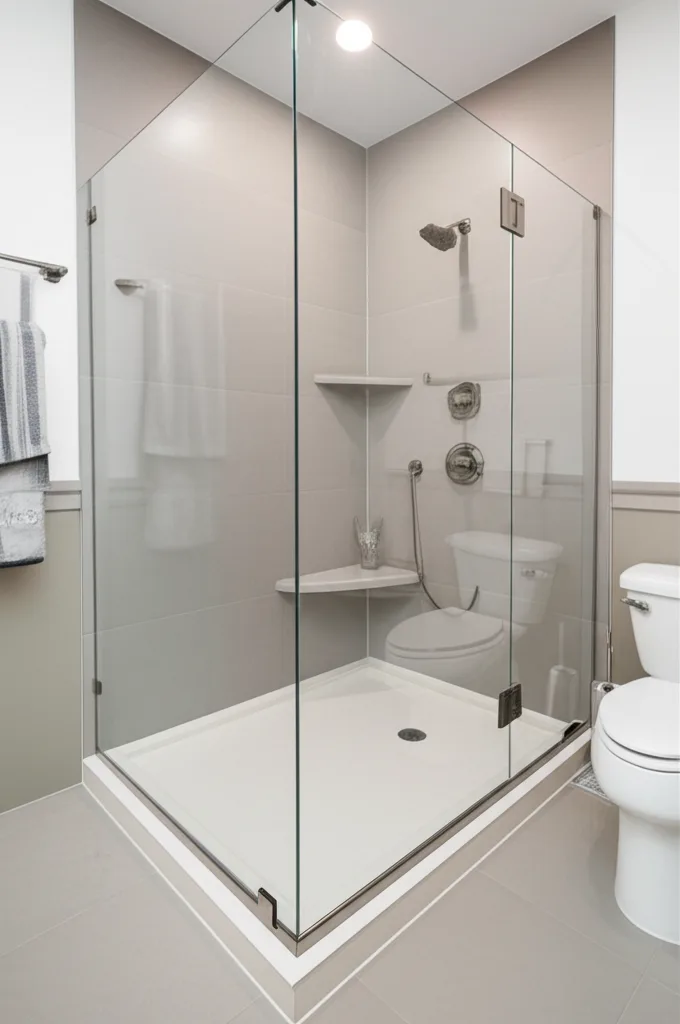
Most tub-to-shower conversions in Boise cost $6,000 to $15,000. A curbed walk-in shower with porcelain tile and a waterproofed pan runs about $8,500 to $14,000. Upgrades push a project above that typical range: mid-range conversions — large-format porcelain, a Schluter Kerdi system, a frameless enclosure and quality fixtures — sit between $14,000 and $22,000, and a curbless spa shower with natural stone, custom frameless glass, a thermostatic valve and body sprays can reach $35,000 or more.
Tub-to-shower conversion costs in Boise vary based on the type of conversion, tile selection, glass enclosure, fixture quality, and whether structural modifications are needed for curbless entry. Because a conversion involves tub demolition, disposal, drain relocation, and building a shower from scratch, costs are generally higher than a simple shower refresh. Most Boise conversions total $6,000 to $15,000; the Mid-Range and Luxury Spa tiers below are upgrade scopes that push a project above that typical range. Here are the three primary investment tiers we see across the Treasure Valley market.
Essential
$8,500 – $14,000
Standard curbed walk-in shower
- Tub demolition and disposal included
- Ceramic or basic porcelain tile
- Standard 4–6 inch curb entry
- Framed or semi-frameless glass enclosure
- Pressure-balance valve and single showerhead
- Liquid-applied waterproofing (RedGard)
Mid-Range
Upgrades above the typical range
$14,000 – $22,000
Walk-in shower with quality materials
- Complete tub removal and subfloor prep
- Large-format porcelain tile walls
- Schluter Kerdi waterproofing system
- Frameless glass enclosure
- Rain showerhead + handheld combo
- Built-in tiled bench and recessed niche
- Glass mosaic accent band
Luxury Spa
$22,000 – $35,000+
Curbless spa conversion with premium features
- Natural stone or premium porcelain tile
- Curbless zero-threshold entry
- Custom frameless glass with protective coating
- Thermostatic valve with body sprays
- Linear drain system with subfloor modification
- Heated tile floor and steam option
- ADA-informed grab bars and bench
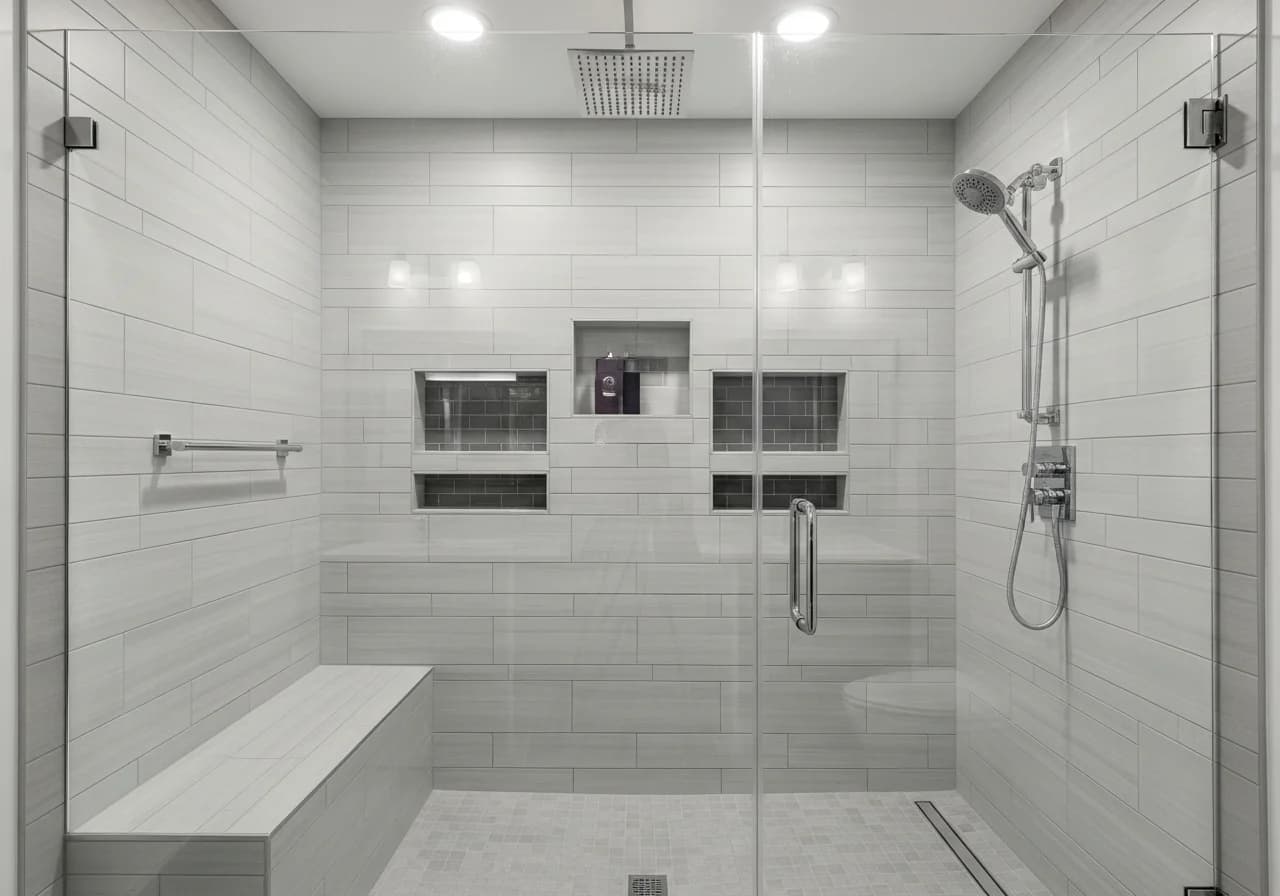
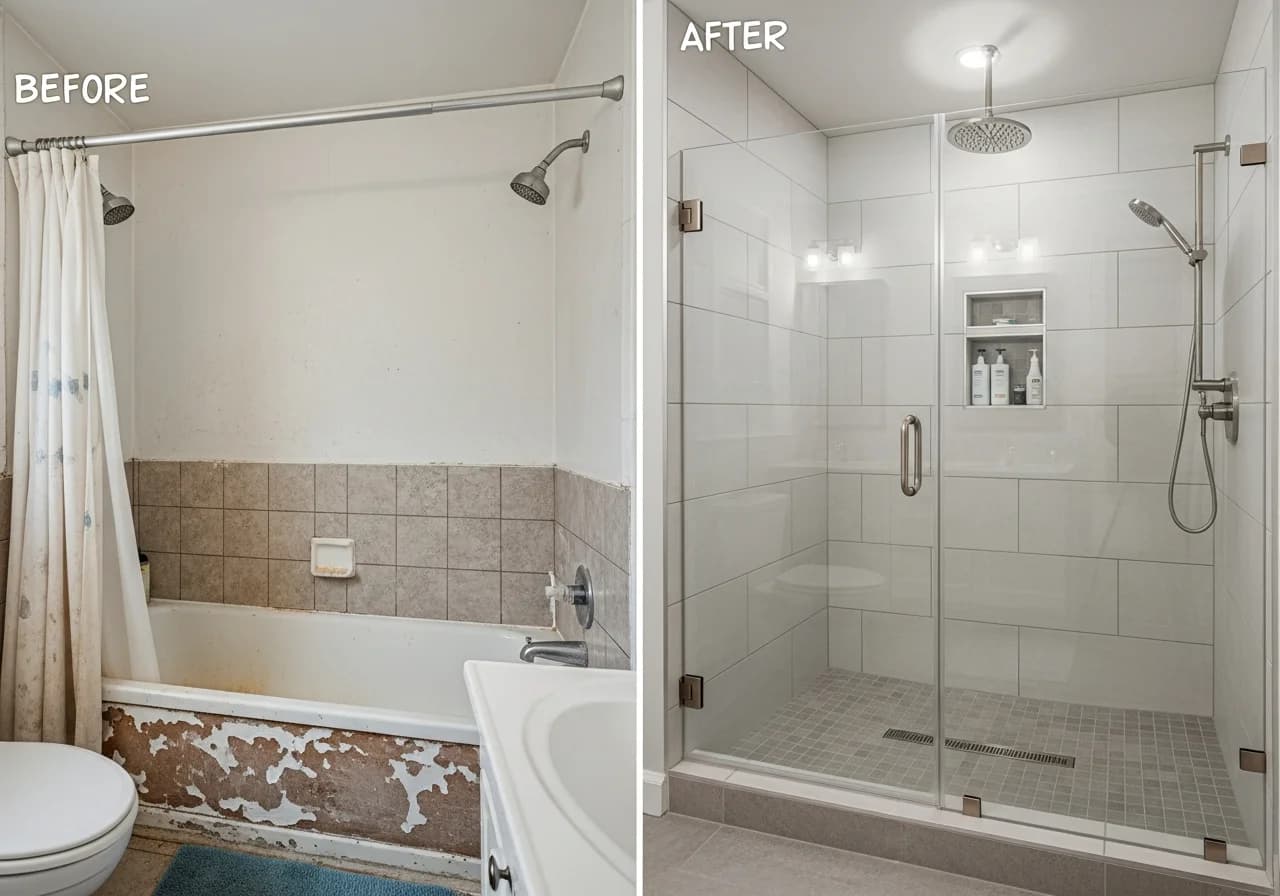
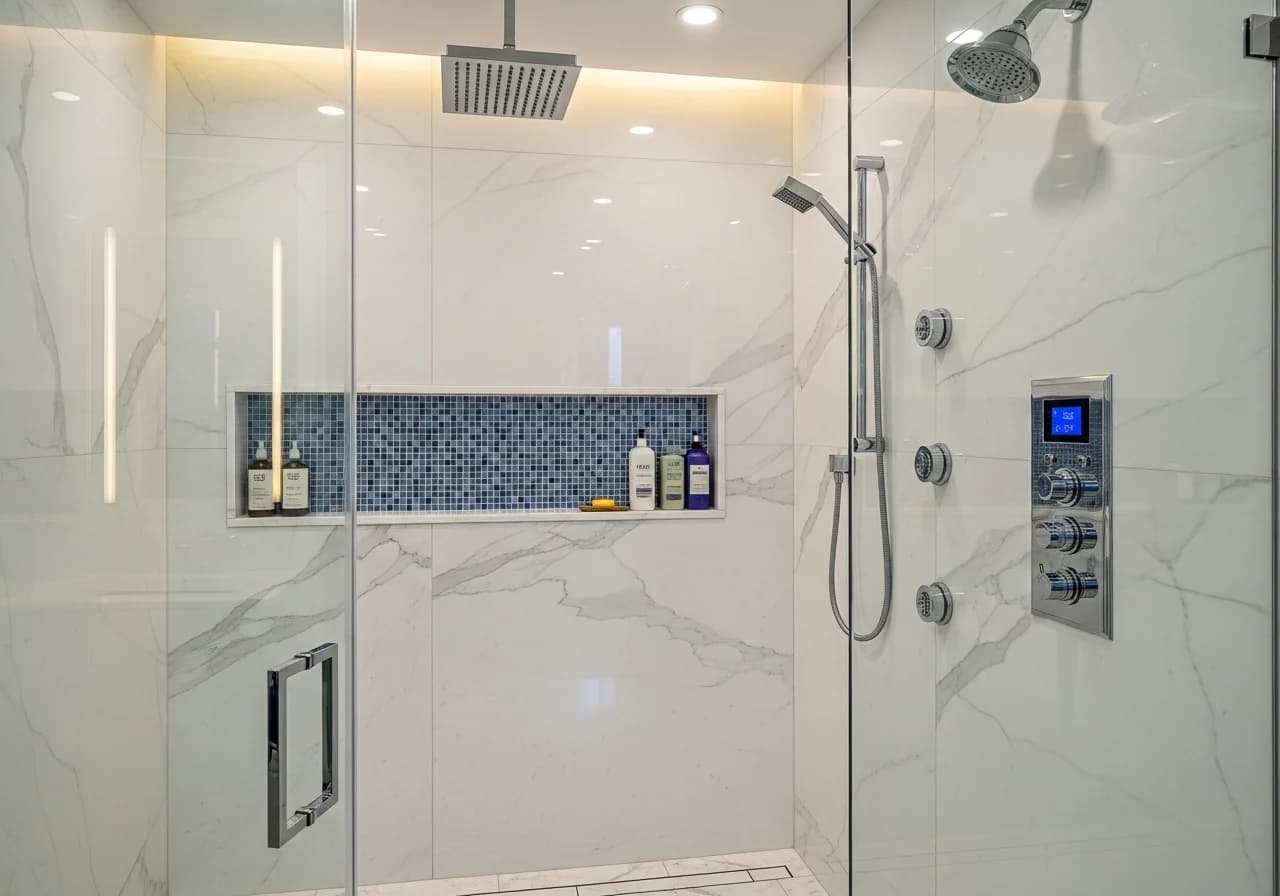
Understanding exactly what your investment buys helps you make informed decisions. A tub-to-shower conversion includes more scope than a standard shower remodel because the bathtub must be demolished, hauled away, and the entire shower area built from scratch — including new drain plumbing, waterproofing, tile, glass, and fixtures.
Essential Tier ($8,500 – $14,000)
Demolition & Prep
Removal of the existing bathtub (fiberglass, acrylic, or steel), surrounding tile or surround panels, and any deteriorated drywall or greenboard. Disposal of the old tub and debris is included. New cement board substrate is installed on all shower walls. Subfloor is inspected and repaired if needed. Demolition and prep at this tier typically costs $500 to $1,000 including hauling.
Tile & Waterproofing
Ceramic subway tile or basic porcelain on walls, with 2×2 mosaic tile on the shower floor for proper slope to the drain. Waterproofing via liquid-applied membrane (RedGard or Hydroban) over cement board substrate. This is a reliable, code-compliant approach that protects against water damage while keeping tile material and labor costs between $1,500 and $3,500.
Plumbing & Drain
The bathtub drain is repositioned or adapted for a standard center-drain shower pan. New shower valve rough-in replaces the old tub/shower combo valve. If the existing drain location works for the new shower layout, plumbing costs stay between $800 and $1,500. Drain relocation to a different position adds $500 to $1,500 depending on distance and access.
Glass & Fixtures
Framed or semi-frameless glass enclosure in clear tempered glass at $800 to $1,500. Pressure-balance valve with a single showerhead in chrome or brushed nickel finish. Brands like Moen Posi-Temp or Delta Monitor provide reliable temperature control at $300 to $600. A single recessed niche for shampoo storage is standard at this tier.
Mid-Range Tier ($14,000 – $22,000)
Demolition & Subfloor
Full tub removal including any cast iron or steel units (heavier tubs require additional labor). Complete subfloor inspection and replacement of damaged plywood with 3/4" exterior-grade plywood. Cement board or Schluter Kerdi-Board substrate installed on all walls and the shower pan area. Any mold or water damage behind the old tub is remediated before new work begins.
Tile & Waterproofing
Large-format porcelain tile (12×24 or 24×24) on walls for a contemporary look with fewer grout lines — a significant maintenance advantage in Boise's hard-water environment. Schluter Kerdi sheet membrane waterproofing system with pre-formed corners and pipe collars. A glass mosaic accent band adds visual interest. Tile material and labor costs range from $3,000 to $6,000 at this tier.
Glass & Entry
Frameless glass enclosure in 3/8-inch tempered glass with minimal hardware in brushed nickel, matte black, or polished chrome. Frameless glass is the most requested shower upgrade in the Boise market — it creates a clean, open look and makes the bathroom feel larger. Cost ranges from $1,500 to $3,000 depending on configuration. A low-threshold curb (1–2 inches) is an option at this tier.
Fixtures & Features
Pressure-balance or thermostatic valve with a rain showerhead (8–10 inch diameter) and a handheld showerhead on a slide bar. Brushed nickel or matte black finishes that resist hard-water spotting. Built-in tiled bench seat and one or two recessed niches. Decorative grab bars that double as towel bars. Fixture budget at this tier runs $800 to $1,800.
Luxury Spa Tier ($22,000 – $35,000+)
Tile & Surfaces
Natural stone (marble, travertine) or premium large-format porcelain with bookmatched patterns. Full-height tile to the ceiling. Custom mosaic accent walls or feature niches with LED backlighting. Tile material and labor at this tier ranges from $6,000 to $12,000. Natural stone requires annual sealing — a maintenance commitment worth discussing before selecting marble in Boise's hard-water conditions (up to ~13 grains per gallon; ~6 average).
Curbless Entry & Glass
Custom frameless glass enclosure in 1/2-inch ultra-clear (low-iron) tempered glass with a factory-applied protective coating (ShowerGuard or EnduroShield) that repels hard-water deposits. Curbless zero-threshold entry with a linear drain system for a seamless floor transition. Subfloor modification to create the necessary recess for slope-to-drain. Glass and linear drain costs range from $3,000 to $6,000.
Fixtures & Systems
Thermostatic valve system (3/4-inch) with separate volume controls for a ceiling-mounted rain head, handheld showerhead, and 4–6 body sprays. Premium brands (Kohler, Delta, Grohe) in designer finishes. Steam generator option for a home steam shower experience. ADA-informed grab bars and fold-down teak bench. Fixture and valve system costs range from $2,000 to $5,000.
Structural & Specialty
Subfloor modification for curbless entry, floor joist sistering for upper-floor installations, heated tile floor (electric radiant mat), recessed LED lighting on a dimmer, and premium exhaust fan (110+ CFM with humidity sensor). Additional plumbing for body sprays and steam systems adds $2,500 to $5,000 in rough-in costs. Complete tub area transformation including wall framing adjustments if the shower footprint is being expanded.
Every tub-to-shower conversion is composed of individual components. This breakdown shows the typical cost range for each element in the Boise market, helping you understand where your money goes and where to prioritize your budget.
| Component | Low Range | High Range | % of Budget |
|---|---|---|---|
| Demolition & Tub Disposal | $500 | $1,500 | 5-8% |
| Plumbing (drain relocation, valve, supply) | $800 | $3,000 | 10-18% |
| Waterproofing System | $400 | $1,500 | 5-8% |
| Tile (material + labor) | $1,500 | $12,000 | 30-40% |
| Glass Enclosure | $800 | $6,000 | 12-20% |
| Fixtures (valve, showerhead, trim) | $300 | $5,000 | 5-15% |
| Electrical (fan, lighting, heated floor) | $200 | $2,000 | 3-8% |
| Permits & Inspection (Boise) | $42 | $232 | under 2% |
* Each line is an independent range across all three tiers, not a column that adds up to a project total — a conversion that sits at the low end on tile rarely sits at the low end on glass. Labor is included in each line item. Cast iron tub removal adds $200–$500 versus fiberglass due to weight and cutting requirements. Most Boise conversions land between $6,000 and $15,000 all-in; use the tier pricing above for a total and this table to see where the money moves.
Tub-to-shower conversion costs are not uniform across the country. Several factors unique to Boise, Ada County, and the Treasure Valley directly impact what you will pay for your project.
Tub Disposal Costs
Tub disposal in Ada County depends on the tub material. Fiberglass and acrylic tubs are lightweight and go to the landfill for $50 to $100 in dump fees. Cast iron tubs (common in Boise's North End and Bench neighborhoods from the 1950s–1970s) weigh 300–500 pounds and require 2–3 workers to remove. Some scrap metal recyclers in the Treasure Valley will accept cast iron for free, offsetting the extra labor cost of $200 to $500 for removal.
Housing Stock Age
Older homes in Boise's North End, Bench, and Vista neighborhoods (built 1950s–1980s) often have galvanized steel plumbing, cast iron tubs set in mortar, and showers built on greenboard instead of cement board. Replacing corroded pipes and remediation of inadequate substrates can add $1,000 to $4,000 to the budget. Newer homes in Meridian, Eagle, Star, and Southeast Boise typically have PEX plumbing and lighter fiberglass tubs that simplify the conversion.
Plumbing Condition
The condition of existing plumbing behind the tub wall is the single biggest cost variable in a conversion. If supply lines are copper or PEX and in good condition, you'll only pay for the new valve and drain work. If we discover galvanized steel supply lines, corroded fittings, or outdated drain assemblies during demo, replacing them adds $800 to $2,500 but is essential for a reliable long-term result. We assess plumbing condition during our free in-home estimate.
Hard Water Impact
Boise's drinking water averages about 6 grains per gallon and reaches roughly 13 gpg in the hardest well-fed zones — moderately hard on average, hard at the top of the range. This directly affects material choices and long-term maintenance costs. Glass enclosures without protective coatings will develop permanent mineral etching. We recommend budgeting $200–$500 for a glass coating (EnduroShield or Diamon-Fusion) and selecting finishes that resist spotting — matte black and brushed nickel outperform polished chrome in hard-water areas.
Seasonal Pricing
Tub-to-shower conversions are interior projects, making them ideal for Boise's winter months (November through February) when contractor schedules are less compressed by exterior work. You may find more competitive pricing, shorter lead times for frameless glass fabrication, and better tile availability during the off-season. Spring and summer scheduling can be tighter as contractors balance interior and exterior projects across the Treasure Valley.
Permit Costs
A tub-to-shower conversion relocates a fixture and disturbs concealed plumbing, so the City of Boise requires a plumbing permit — its Homeowner's Guide says plumbing permits are required for most bathroom remodels when fixtures are replaced. Boise's adopted plumbing fee schedule charges a $30 base fee plus $12 per fixture, so a four-fixture bathroom is $78. Adding or replacing a bath exhaust fan triggers a mechanical permit ($32 base plus $12 per appliance), and electrical work — recessed lighting, fan circuit, heated floor — is $110 flat when more than one fixture is involved. Iron Crest handles all permit applications and inspections as part of our service.
The type of entry you build in place of your bathtub is the structural decision that moves the number most. Rather than publish a separate price grid per entry type — which would imply a precision we do not have — the table below shows how each type sits against the standard curbed conversion that the tier pricing above is based on.
| Conversion Type | Cost vs. Standard Curbed | What Drives the Difference |
|---|---|---|
| Standard curbed (4–6″) | Baseline — most conversions run $6,000 to $15,000; upgrade tiers above run higher | Pre-sloped pan or mud bed inside the existing tub alcove; no floor structure is touched. |
| Low-threshold (1–2″) | Modest premium over the baseline | A shallower curb needs a thinner pan build-up and tighter drain tolerances, but not a recessed subfloor. Our Caldwell conversion used a 1.5-inch curb and ran $12,000–$16,000. |
| Curbless (zero-threshold) | Adds roughly $2,000–$5,000 | The drainage plane has to be achieved inside the floor structure: recessed subfloor or a cut slab, a linear drain ($300–$1,200), and more complex waterproofing at a barrier-free entry. |
| Multi-head spa | Sits in the top tier regardless of entry type | A 3/4-inch thermostatic valve, separate volume controls and a dedicated supply line per body spray. Rough-in, not finish, is what costs. |
* All conversion types include tub demolition, disposal, plumbing rough-in, waterproofing, tile, glass, and fixtures. Cast iron tub removal adds $200–$500 versus fiberglass or acrylic.


A tub-to-shower conversion is one of the most impactful bathroom improvements you can make for both daily living and resale value in the Treasure Valley market. Here is what we will and will not claim about it.
Resale Value Data
We don't publish a recoup percentage
You will find “65–75% ROI” figures on plenty of remodeling sites. We have no Boise-specific resale study behind a number like that, and national cost-versus-value averages do not transfer to one address in one Treasure Valley neighbourhood. What we will say is what we can observe: a conversion reclaims the tub footprint and removes a dated surface, and both show in listing photos.
Keep one tub in the house
The one resale rule we do apply on every job: convert the primary bath, not the only bath. Buyers with young children look for a tub somewhere in the house, so the hall or guest bath is where it should stay.
Accessibility Premium
Curbless and low-threshold conversions appeal to the growing aging-in-place market. In Boise, where Baby Boomers represent a significant homeowner demographic, accessible showers are increasingly valued at resale. See our accessible walk-in shower options.
Beyond Resale: Daily Living Value
ROI calculations focus on resale, but most Boise homeowners stay in their homes for 7 to 12 years after a bathroom remodel. The daily improvement — stepping into a clean, spacious, modern walk-in shower instead of climbing over a tub ledge every morning — delivers quality-of-life value that does not appear on a spreadsheet.
Safety is a major factor. Stepping over a 14- to 16-inch tub wall onto a wet surface is the hardest movement in most bathrooms, and it is the one that gets harder with age. Replacing it with a low-threshold or curbless entry removes that step entirely — a real consideration for Boise homeowners planning to stay in the house.
A properly waterproofed, well-built shower also prevents expensive damage. A failed tub/shower combo leaks slowly through deteriorated caulk and grout into the subfloor, the wall cavity and sometimes the room below, and the repair is framing and finish work rather than a tile job. On our Caldwell tub-to-shower conversion the existing surround already had cracked grout and signs of moisture behind the wall before demolition started.
Maintenance is simpler too. A walk-in shower with large-format porcelain tile and epoxy grout has far fewer grout lines than a tub/shower combo with small tile and cement grout, and fewer grout lines is less surface for Boise's mineral deposits to collect in.
Common questions Boise homeowners ask about tub-to-shower conversion costs.
How much does a tub-to-shower conversion cost in Boise, Idaho?
Most tub-to-shower conversions in Boise cost $6,000 to $15,000. A curbed walk-in shower with porcelain tile and a waterproofed pan runs about $8,500 to $14,000. Upgrades push a project above that typical range: mid-range conversions — large-format porcelain, a Schluter Kerdi system, a frameless enclosure and quality fixtures — sit between $14,000 and $22,000, and a curbless spa shower with natural stone, custom frameless glass, a thermostatic valve and body sprays can reach $35,000 or more. For a real reference point, our Caldwell tub-to-shower conversion with a 1.5-inch curb, a tile bench, dual niches and grab bars ran $12,000 to $16,000.
Is a tub-to-shower conversion worth it for resale in Boise?
It depends on what else the house has. A conversion in a secondary bathroom is generally well received in the Treasure Valley market, and converting a rarely used primary-bath tub to a walk-in shower reclaims floor space that buyers notice. The rule worth following is to keep at least one bathtub in the home, usually in a hall or guest bath, for families with young children. We do not publish a percentage recouped: we have no Boise-specific resale study to cite, and national cost-versus-value averages do not transfer to a single Treasure Valley address.
Does a curbless tub-to-shower conversion cost more?
Yes. A curbless (zero-threshold) tub-to-shower conversion typically adds $2,000 to $5,000 compared to a standard curbed conversion. The premium covers subfloor modification to create the necessary recess for slope-to-drain, a linear drain system ($300–$1,200), and more complex waterproofing for a barrier-free entry. On upper floors, the cost is higher because floor joists may need to be modified. Despite the added cost, curbless conversions are increasingly requested in Boise for aging-in-place planning — note that the ADA governs public accommodations, not private homes, so an accessible home shower is built to ADA-informed dimensions rather than certified to the standard.
How long does a tub-to-shower conversion take in Boise?
A standard tub-to-shower conversion typically takes 2 to 3 weeks from demolition to final walkthrough. The timeline includes 1 day for tub demolition and disposal, 2–3 days for plumbing rough-in and waterproofing, 3–5 days for tile installation and curing, 1–3 weeks for custom glass fabrication (after tile is complete), and 1–2 days for fixtures, glass install, and finishing. Curbless designs or extensive subfloor work can extend the project to 3–4 weeks.
Can I reduce the cost of a tub-to-shower conversion in Boise?
Several strategies can lower costs without sacrificing quality: keep the drain as close to the original tub drain as possible to minimize plumbing relocation ($800–$2,500 savings), choose porcelain tile that mimics natural stone instead of real marble, select a semi-frameless glass enclosure instead of fully frameless ($500–$1,500 savings), use a standard 4–6 inch curb instead of a curbless design, and schedule during Boise's slower winter months (November–February) when contractors may offer more competitive pricing.
Cost is just one piece of the puzzle. Explore our other tub-to-shower conversion and bathroom remodeling guides to make fully informed decisions about your project.
Tub-to-Shower Conversion Service
Our full tub-to-shower conversion overview
Shower Remodeling Service
Complete shower remodeling options
Case Study: Caldwell Tub-to-Shower Conversion
A real conversion at $12,000–$16,000 — 1.5″ curb, tile bench, Kerdi
Case Study: Mountain Home Shower Pan Rebuild
What it costs in scope when a pan is built wrong the first time
Bathroom Remodel Cost Guide
Full bathroom pricing for Boise
Accessible Walk-In Showers
ADA-informed and aging-in-place options
Conversion Timeline
Phase-by-phase scheduling breakdown
Conversion Materials Guide
Tile, glass, fixtures & waterproofing
Conversion Design Ideas
Styles, layouts, and trending features
Conversion Permits & Regulations
Boise & Ada County permit requirements
Get a Free Estimate
Request your personalized conversion quote
Financing Options
Flexible payment plans for your remodel
Three decisions move a conversion quote more than any finish selection, and all three have to be made before demolition rather than during it.
Curbed or curbless
A structural decision, not a finish one. Curbless needs the drainage plane achieved within the floor structure, which means recessing the subfloor — or cutting a slab. Decided late, it either becomes expensive or quietly disappears.
Where the drain can go
A tub drain and a shower drain sit in different places. Whether the new position works depends on fall to the waste line and on vent geometry under Idaho’s UPC-based plumbing code — and on whether the floor is framed or slab.
Tile complexity
Setting labour usually exceeds tile material cost, and it is driven by format, pattern, niches, benches and mitred corners — not by the price per square foot of the tile you choose.
The footprint you already have is a good one. A standard tub alcove is long and narrow, which happens to be an excellent shower proportion — it separates the entry, the controls and the spray, and it is long enough that a fixed glass panel can often replace a hinged door entirely. That removes the door-swing conflict that causes most bathroom layout failures, and it is usually cheaper than a hinged enclosure.
Plan the detail before you price it
The following government agencies, industry organizations, and official resources provide additional information relevant to your remodeling project.
Get Your Tub-to-Shower Conversion Estimate
Every conversion is different. Contact Iron Crest Remodel for a free, detailed estimate tailored to your Boise home, your bathroom layout, and your budget.