
| Decision | Effect on labour | Worth paying for? |
|---|---|---|
| Tile format — very small (mosaic, penny) | Highest piece count per square foot; most grout joint length | Only where the look genuinely requires it; consider limiting it to a feature area. |
| Tile format — mid-size | The efficient middle: manageable piece count, forgiving of minor substrate deviation | Usually the best value, and the default worth starting from. |
| Tile format — large | Fewer joints and fast to set, but substrate flatness becomes critical, so prep rises | Yes where the substrate is good — a clean, modern result with less grout to clean. |
| Straight-set layout | Baseline | The efficient default. |
| Patterned layout (herringbone, chevron) | More cuts, more waste, slower setting, more alignment control | Yes as a deliberate feature — expensive as a whole-shower default. |
| Mitred external corners | Significantly slower than trim; demands accuracy | Yes — one of the clearest visible upgrades available. |
| Trim-profile corners | Fast and reliable | Perfectly acceptable; simply visible. |
| Niche | Framing, critical waterproofing detail, cut and mitred tile | Yes — genuinely improves daily use. |
| Bench | Structural support, drainage slope, continuous waterproofing | Yes if it will be used and the shower is big enough to spare the floor area. |
| Curbless threshold | Floor structure work plus the most demanding waterproofing detail | Yes for accessibility or a continuous floor — but decide before demolition. |
| Full-height tiling to ceiling | More area, plus overhead work | A design choice; costs real money for a real visual effect. |
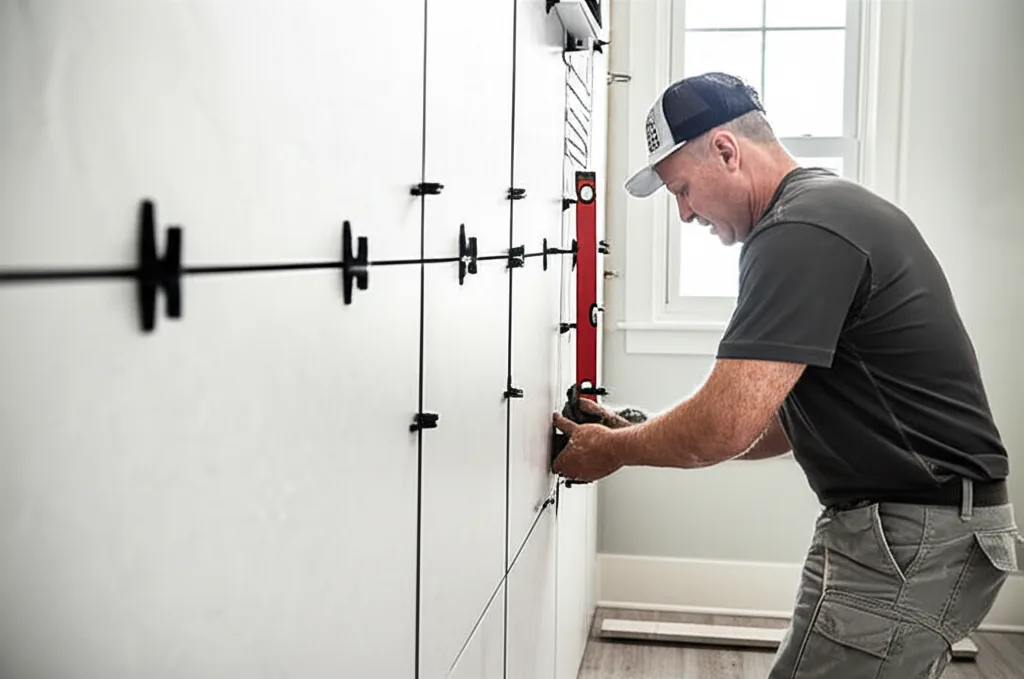
The waterproofing system is what makes a tiled shower a shower rather than a decorated wall. Tile and grout are not waterproof; they are a wearing surface over a system that is. The places that fail are almost never the flat areas — they are the internal corners, the niche returns, the bench junction, the threshold and the drain connection. Those are precisely the details that the complexity decisions above create more of.
Adding features adds failure points, which is an argument for specifying the waterproofing properly rather than an argument against features. Our waterproofing systems guide explains what the options are and how they differ — and it is worth asking any contractor to name the system rather than to describe the outcome.
Where to concentrate the labour budget
Concentrate complexity in one place
- A single feature wall in a patterned or premium tile
- Straightforward, efficient tile everywhere else
- One well-detailed niche rather than several
A shower where everything is a feature reads as busy and costs accordingly.
Spend on the details you touch and see
- Mitred external corners at the shower entry
- A niche at a genuinely useful height
- Good quality grout appropriate to the exposure
These are the details that read as craftsmanship at close range, where people actually stand.
Simplify where it will not be noticed
- The wall behind the shower head, which is largely obscured in use
- Areas above sight line where full-height tiling adds cost for little effect
- The layout pattern on secondary walls
Do not simplify the waterproofing anywhere — this is about visible finish only.
Decide structural features early
- Curbless threshold
- Bench with structural support
- Linear drain requiring floor recessing
All three are framing-stage decisions. Deferring them means they will not happen.

Mistakes that cost the most
1.Comparing shower quotes on tile price per square foot
Setting labour usually exceeds material cost, so the comparison omits most of the difference between two bids.
2.Choosing mosaic tile for the whole shower to get a look
Multiplies both setting labour and grout-joint length across every surface, and produces the highest ongoing cleaning burden.
3.Specifying large-format tile without checking substrate flatness
Lippage between adjacent tiles becomes visible, and correcting the substrate to prevent it can cost more than the tile saving.
4.Adding niches and benches after framing is closed
Both are framed, waterproofed and tiled as an integrated detail. Retrofitting means undoing finished work.
5.Treating curbless as a finish-level decision
It requires the floor structure to be prepared. Decided late, it either becomes very expensive or quietly disappears from the project.
6.Buying complexity everywhere instead of somewhere
A uniformly complex shower costs far more and often looks less considered than one with a single well-executed feature.
Why do custom tile showers vary so much in price?
Because the price is dominated by setting labour, and setting labour is driven by decisions that are invisible in a material quote. Two showers using identical tile at identical cost per square foot can differ substantially in total price depending on the tile format, the layout pattern, how many internal and external corners exist, whether the edges are mitred or trimmed, whether there are niches and benches, and whether the threshold is curbed or curbless. A quote that only tells you the tile price is describing the smaller half of the cost.
Is smaller tile more expensive to install?
Substantially, per square foot. A mosaic or penny-round tile has many times the number of individual pieces per square foot compared with a large-format tile, and each piece needs positioning, spacing and grouting. It also means far more linear feet of grout joint, which is more grouting labour and, later, more cleaning. Large-format tile is faster to set but imposes its own cost: it demands a much flatter substrate, because any deviation shows as lippage between adjacent tiles, so preparation time increases. The cheapest tile to install is generally a mid-size format in a straightforward layout.
Do niches and benches really add that much?
They add more than their physical size implies, because both are waterproofing details rather than tiling details. A niche is framed into the wall cavity, waterproofed as a critical detail with multiple internal corners where failures concentrate, and then tiled with cut and often mitred pieces. A bench needs structural support capable of carrying weight when wet, a slope so water drains off it rather than pooling, and waterproofing continuous with the surrounding walls. Both are worth having and both should be planned before framing, because retrofitting either means reopening completed work.
Is a curbless shower more expensive to tile?
Yes, on two counts. The floor structure has to be prepared so the shower floor can slope to the drain without a curb containing the water, which usually means recessing the subfloor or building up the surrounding floor. And the waterproofing detail is more demanding, because a curb normally acts as a secondary barrier and without one the transition at the threshold becomes the critical detail. The tiling itself also has to achieve a consistent slope across a larger area. It is a better result for accessibility and appearance, but it is a structural decision made before demolition rather than a finish choice.
Are mitred corners worth the extra cost?
For visible external corners, usually yes, and it is one of the clearest differences between a well-executed tiled shower and an ordinary one. The alternative is a metal or plastic trim profile covering the corner, which is faster, cheaper and entirely acceptable — but visible. A mitred corner has the two tiles cut at an angle so the glaze continues around the corner with no trim at all. It takes considerably longer, demands accuracy, and produces a noticeably cleaner result. It is a good place to spend if you want the shower to look bespoke rather than assembled.
How does hard water affect tile and grout choices?
Mineral deposits show most on glass, but grout and some tile finishes are also affected — deposits build in grout joints and on textured or matte surfaces more than on smooth glazed ones. This matters for maintenance rather than durability. Practical responses include choosing a grout appropriate to the exposure, minimising unnecessary grout joints by avoiding very small formats in the wettest areas, and considering how the surface will actually be cleaned. Our hard water guide covers what happens to fixtures and finishes across the Treasure Valley.
Each reference below is cited for a specific claim on this page. Codes, fees and product specifications change — confirm current requirements with the authority having jurisdiction before relying on them for a project decision.
- Idaho DOPL — Idaho Adopted Codes
Cited for: The code editions Idaho enforces — the 2018 IRC with Idaho amendments and the UPC-based Idaho State Plumbing Code governing shower drains.
- City of Boise — Residential Addition, Alteration & Accessory Building Submittal Checklist (#406)
Cited for: How Boise categorises interior remodels involving structural change, relevant where a curbless shower requires altering the floor structure.