
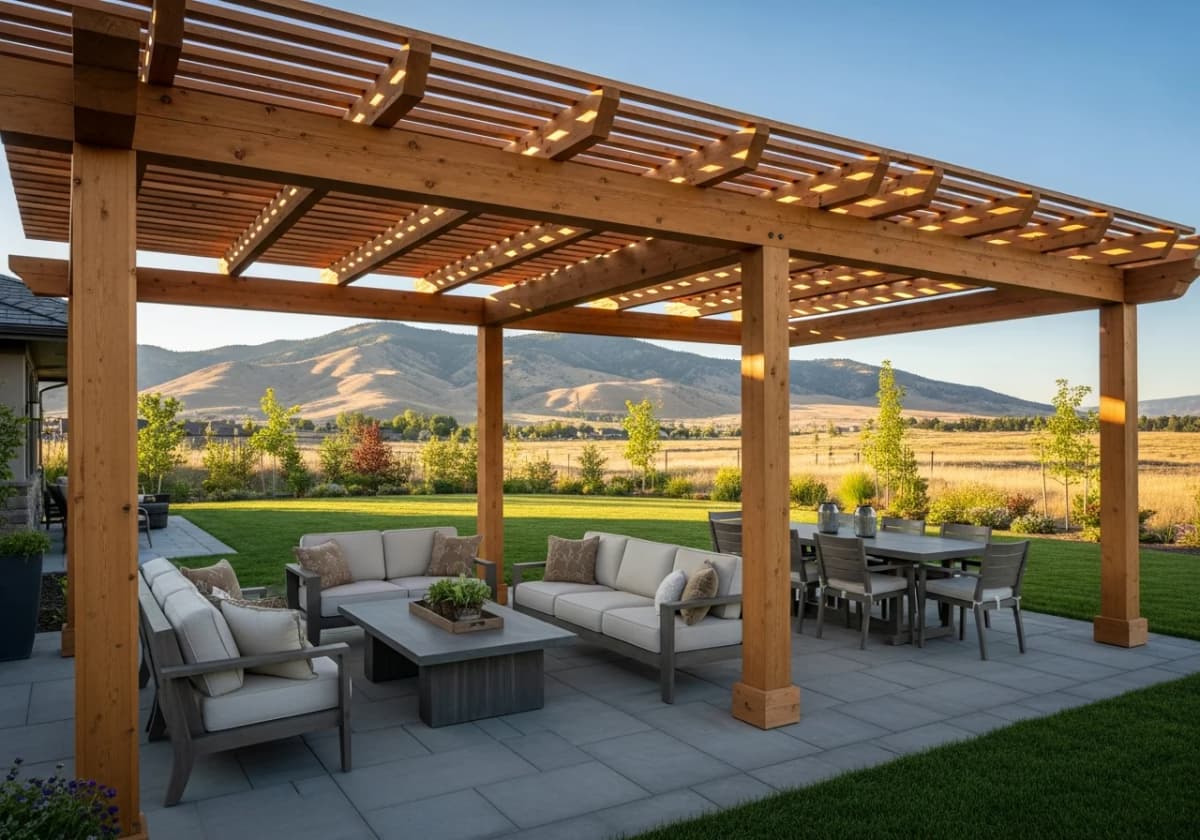
Treasure Valley summers are long, bright, and hot — temperatures regularly climb into the 90s, and the afternoon sun on a west- or southwest-facing patio can make an otherwise great outdoor space almost unbearable from mid-afternoon on. A well-designed pergola solves that. It throws comfortable, dappled shade exactly where you gather, defines an outdoor "room" off your kitchen or living area, and instantly raises both the look and the usable square footage of your home — from established Boise neighborhoods to newer builds in Meridian, Eagle, Nampa, and Star.
A pergola is more than a few posts and beams, though. In our climate it has to handle intense summer UV, gusty wind on open lots, and a winter snow season — Boise's design criteria call for a 20 psf ground snow load, a 25 psf design roof snow load, a 90 mph wind design speed, and footings below a 24-inch minimum frost depth. Get the material, footings, anchoring, and roof style right and you have a structure that looks beautiful and performs for decades. Get them wrong and you have a leaning, fading, sagging frame within a few seasons. Iron Crest Remodel designs and builds pergolas that are engineered for the Treasure Valley, not ordered off a generic kit.
On this page we walk through the real decisions: which material fits your home and budget, whether to attach the pergola to the house or build it freestanding, whether a fixed or adjustable louvered roof makes sense, what Boise and Ada County require for permits, and what a project actually costs locally. The code and design-criteria figures below come from the City of Boise and the adopted Idaho codes; the prices are planning ranges rather than quotes, and we say which is which — so you can plan with confidence before you ever call us.
A pergola is one of the highest-impact outdoor upgrades you can make because it works on several levels at once — comfort, design, and value. These are the reasons we hear most often from Boise-area homeowners:
Beat the afternoon heat
Western and southwestern exposures are the hottest in Boise, so a pergola placed for late-day shade turns an unusable patio into a comfortable space.
Create an outdoor room
Sited off a kitchen, living room, or main patio door, a pergola defines a destination where people naturally gather to dine and relax.
Add living space without an addition
A covered patio expands how you use your home for a fraction of the cost and disruption of building out under roof.
Anchor lighting, fans, and heaters
A solid frame is the perfect place to mount string lights, a ceiling fan, or patio heaters to stretch the season into spring and fall.
Finish the look of the backyard
A pergola gives the back of the house an intentional, finished edge instead of a slab that stops at nothing, and it photographs well. We publish no resale percentage — ask your agent what covered outdoor space is doing in your neighbourhood.
Shelter a hot tub or grill
A pergola gives a defined, shaded home to an outdoor kitchen, spa, or seating group instead of leaving them exposed.
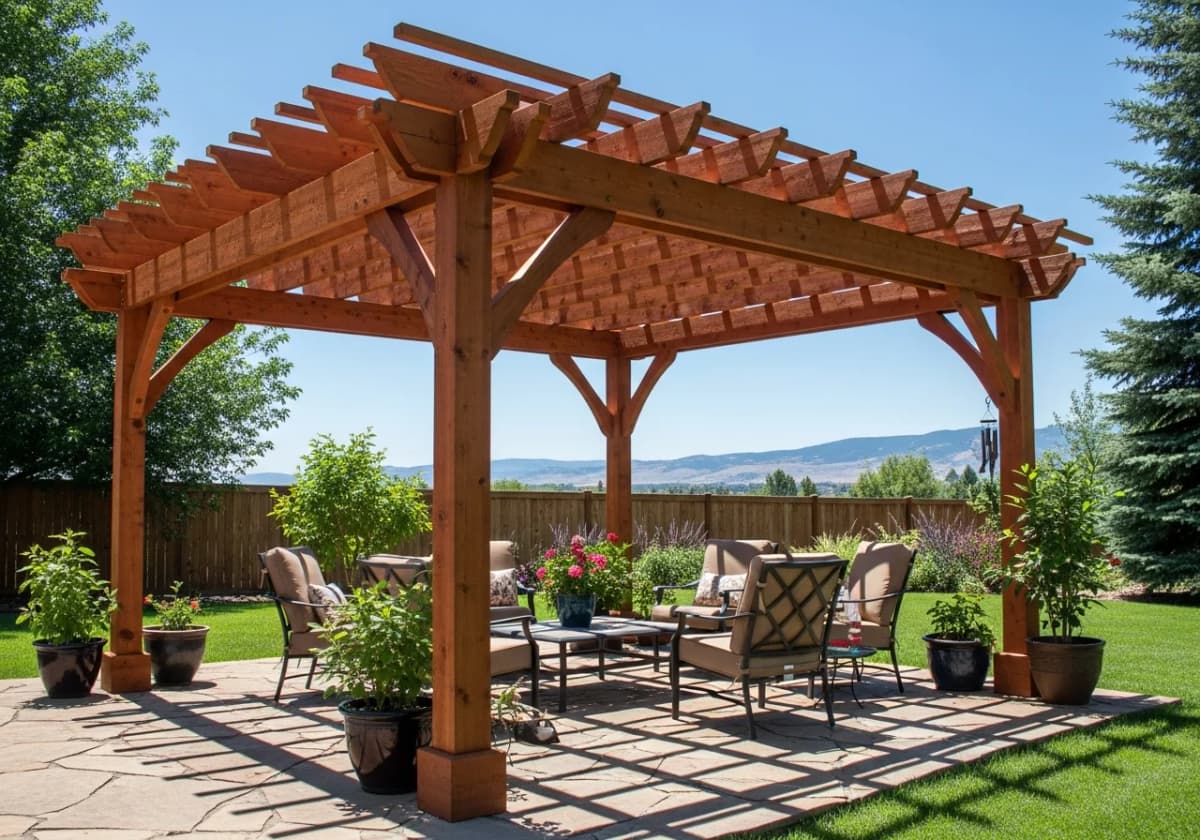
Material is the single biggest driver of how your pergola looks, how much maintenance it needs, and what it costs. Each option behaves differently under Treasure Valley sun, wind, and snow — here is an honest comparison.
Cedar
The warmest, most natural look, with a distinctive color and aroma. Cedar is more rot- and insect-resistant than pressure-treated wood, but it can only be stained (not painted) and needs periodic re-sealing — and it can check, warp, or fade under intense sun. Roughly $25–$35 per square foot.
Aluminum
Essentially maintenance-free — it will not crack or warp, can be powder-coated in any color (including wood-look finishes), and is strong enough for wind-prone lots. Higher upfront cost, but minimal upkeep over its life. Roughly $10–$30 per square foot; about $1,000–$3,000 for a 10'×10'.
Vinyl
Low-maintenance and budget-friendly, resisting rot and fading. It is less sturdy under snow and ice and often needs internal steel or aluminum reinforcement to prevent sagging, with a more limited color palette. Roughly $10–$30 per square foot; about $1,000–$2,500 per install.
A useful way to think about it: wood is cheaper upfront but costs more over its lifetime in maintenance, while aluminum costs more initially but almost nothing afterward. If you plan to stay in your home for ten or more years, aluminum often provides the best total value; if you love the look and feel of real wood and do not mind seasonal upkeep, cedar is hard to beat. We bring samples and walk through the trade-offs in your own light before you commit.
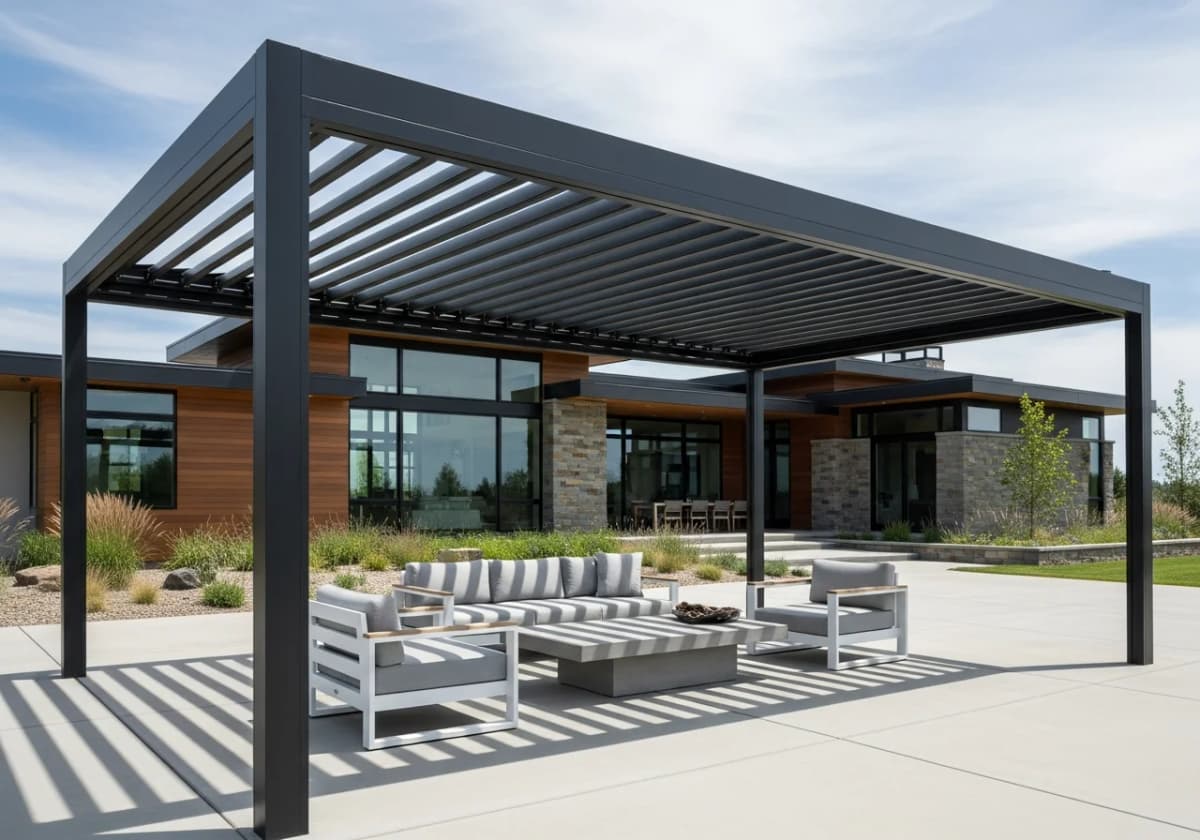
One of the first decisions is whether your pergola connects to the house or stands on its own. Both are great options — the right choice depends on your layout, your budget, and how you want to use the space.
Attached Pergola
Connects to your home along one side, extending your interior living space straight out onto the patio. Because it shares a wall, it usually saves about $500–$1,500 on materials. The catch: it must be securely anchored with a ledger and detailed with proper flashing and sealing so water never reaches the house wall — and an attached cover generally requires a permit.
Freestanding Pergola
Stands on four or more posts, so it can go anywhere — over a detached patio, around a fire pit, near the pool, or out in the yard to frame a view of the foothills. It offers the most placement flexibility but uses more material and needs deeper footings to stay solid in wind and snow.
Placement matters as much as the structure itself. We generally site a pergola off a kitchen, living room, or primary patio door where people naturally gather, and we plan footings around your utilities first — keeping clear of downspouts, drainage swales, and irrigation mains so nothing gets compromised when the posts go in.
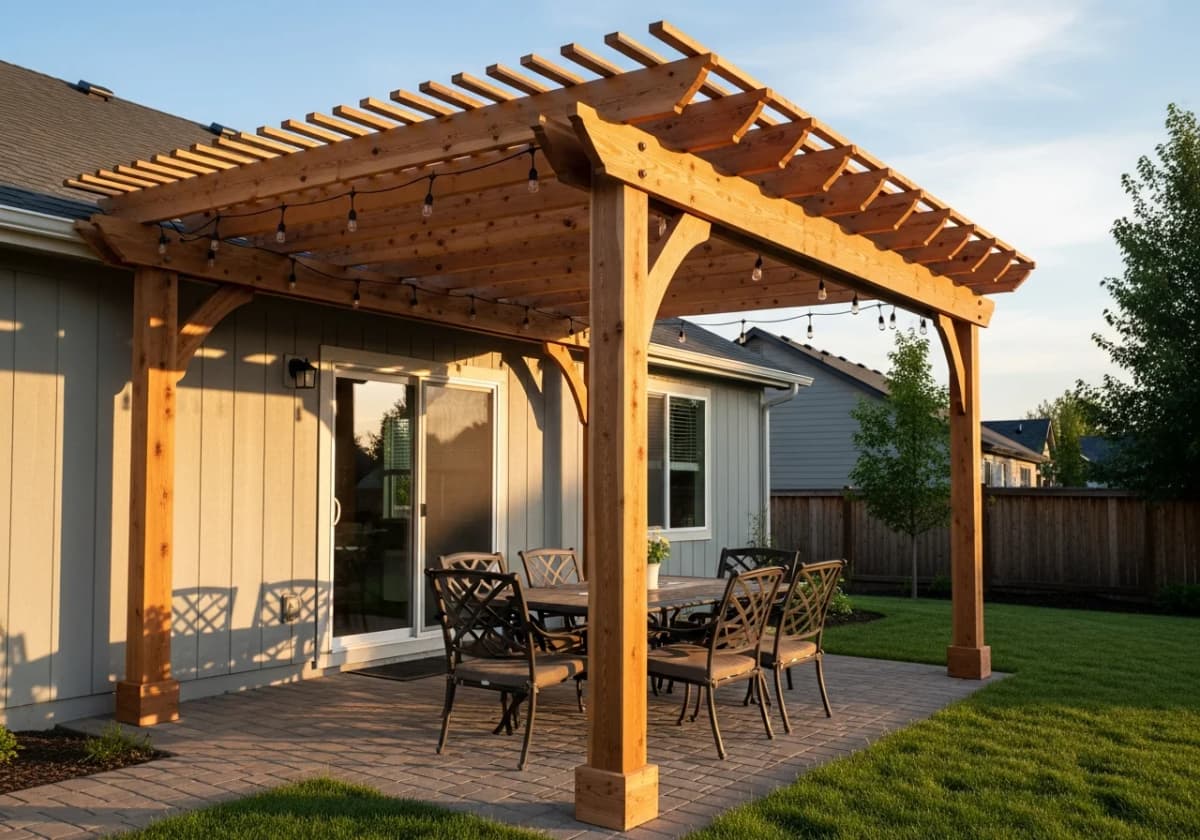
A traditional pergola has fixed slats or lattice that cast shifting, partial shade through the day. That is plenty for many homeowners and the most economical route — a fixed wood-lattice roof runs roughly $25–$50 per square foot, or about $3,600–$7,200 installed for a 12'×12'.
A louvered roof takes it further. Its panels pivot open and closed so you can dial in full sun, dappled light, breeze, or — when a summer storm rolls through — closed, water-shedding coverage, all in seconds. That control costs more: louvered roofs generally run 50% to 200% more than a fixed roof. Manual adjustable systems run roughly $45–$110 per square foot installed, while smart, motorized systems run about $75–$175 per square foot. For a west-facing Treasure Valley patio that bakes every afternoon, the ability to close the roof against the sun (and open it on a cool evening) is often well worth the upgrade.
Fixed slat / lattice. Classic look, partial shifting shade, lowest cost — about $25–$50 per square foot.
Manual louvered. Hand-adjustable panels for on-demand sun, shade, or rain protection — roughly $45–$110 per square foot installed.
Smart / motorized louvered. Remote- or sensor-controlled panels, often with integrated lighting — about $75–$175 per square foot installed.
Add-ons. String or recessed lighting, ceiling fans, patio heaters, privacy screens, and drapes all extend comfort and the usable season.
Whether your pergola needs a building permit comes down to its size and how it is built. Here is what the City of Boise publishes — and we always confirm the specifics for your address, since rules and setbacks vary between Boise, Ada County, and cities like Meridian, Nampa, and Eagle:
Detached and 200 sq ft or smaller. The model code exempts a one-story detached accessory structure of 200 square feet or less, so a small freestanding pergola can sometimes go up without a building permit — but that is the unamended baseline, Boise amends model-code thresholds, and zoning setbacks still apply. A permanent concrete footing or 120-volt electrical usually triggers a permit regardless of size. We confirm the current threshold for your address before we build.
Detached and over the exemption. A larger detached pergola needs a permit, and because pergolas are usually not typical light-frame construction, the city may require structural engineering by an Idaho-licensed engineer.
Attached to the house. Any pergola attached as a patio cover requires a permit because its weight transfers to the home's exterior wall, triggering framing verification and a wind-stability check.
Setbacks. Setbacks vary by parcel, zoning district, and project configuration. We verify the applicable requirements for your lot with Boise Planning & Zoning at (208) 608-7100 during project planning. Boise sets no maximum lot coverage, so the constraint on a backyard structure is the setback, not a coverage cap.
Snow and structure. Boise's design criteria call for a 20 psf ground snow load and a 25 psf design roof snow load on the valley floor, and footings must reach the 24-inch minimum frost depth — so footings, posts, and connectors are sized to carry winter loads, not just summer shade.
The bottom line: you should not have to become a code expert to enjoy your backyard. Iron Crest Remodel confirms the current requirements with the right jurisdiction, handles any engineering, and pulls the permits your project needs so the build is safe, legal, and inspection-ready.
In the Treasure Valley, a custom pergola typically runs about $2,000 to $8,000, with most projects taking one to four weeks. For reference, across the industry the all-in figure is roughly $20 to $60 per square foot including materials and labor. Where your project lands within that range depends on a handful of factors:
Size and span. Larger footprints and longer unsupported spans need bigger beams and more material, raising both cost and engineering needs.
Material. Cedar runs about $25–$35 per square foot, while aluminum and vinyl run roughly $10–$30 — but maintenance over time changes the lifetime math.
Attached vs. freestanding. Attached builds typically save $500–$1,500 on materials; freestanding builds add posts, footings, and material.
Roof style. A fixed lattice roof is the most economical; a louvered or motorized roof can run 50%–200% more for the added sun-and-rain control.
Footings and site access. Deeper footings, hard digging, slope, or tight backyard access all add labor.
Electrical and add-ons. Lighting, fans, heaters, screens, and stain or paint finishes each add to the scope and the final number.
Because every backyard, material, and roof choice is different, we do not hand out a one-size number. We measure your space, talk through how you want to use it, and give you a firm, itemized quote so there are no surprises once the build starts.
Design consultation
We look at your sun angles, layout, and how you want to use the space, then recommend a material, size, attachment, and roof style that fit your home and budget.
Plans, engineering & permits
We finalize the design, arrange structural engineering where the city requires it, and pull the permits for your jurisdiction.
Site prep & footings
We lay out posts around your utilities — clear of downspouts, swales, and irrigation — and set footings sized for Treasure Valley wind and snow loads.
Frame & roof
Posts, beams, and rafters go up true and square, followed by your chosen fixed, louvered, or motorized roof.
Finish & extras
We stain or seal wood, install lighting, fans, heaters, or screens, and detail flashing on attached builds so the house stays watertight.
Walkthrough & cleanup
We pass inspection, clean the site completely, and walk you through care and warranty before you enjoy the space.
Built for our climate. Open lots around Meridian, Star, and Kuna catch real wind, and winters bring snow. We size posts, footings, and connectors for those loads and use exterior-rated hardware so your pergola stays solid and true season after season.
How much does a pergola cost in Boise?
A custom pergola in Boise and the Treasure Valley typically runs about $2,000 to $8,000, with most builds taking one to four weeks. Across the industry the all-in figure works out to roughly $20 to $60 per square foot including materials and labor. Your number depends on size, material, whether it is attached or freestanding, footing depth, and whether you add a louvered or motorized roof. We give you a firm, itemized quote after measuring your space rather than quoting from a national average.
Do I need a permit to build a pergola in Boise?
Often, yes. The model code exempts a one-story detached accessory structure of 200 square feet or less from a building permit, but that is the unamended baseline, not a guarantee — Boise amends model-code thresholds (its deck and patio permit trigger, for example, is 12 inches above grade rather than the model code's 30), and a permanent footing, any 120-volt electrical, or attaching the structure to the house typically triggers a permit regardless of size. An attached pergola is a patio cover: it requires a permit because its weight transfers to your home's exterior wall. Because pergolas are usually not typical light-frame construction, the city may also require structural engineering by an Idaho-licensed engineer. We confirm the current threshold for your address with the Boise Building Division at (208) 608-7070, check setbacks with Planning & Zoning at (208) 608-7100, and pull the permits your project needs.
Cedar, aluminum, or vinyl — which holds up best in Idaho?
All three work here; the right pick depends on your priorities. Cedar gives the warmest natural look and is more rot- and insect-resistant than pressure-treated wood, but it needs periodic re-sealing or staining and can check, warp, or fade under intense Treasure Valley sun. Aluminum is essentially maintenance-free, will not crack or warp, can be powder-coated in any color (including wood-look finishes), and is strong enough for wind-prone lots — at a higher upfront cost. Vinyl is low-maintenance and budget-friendly but is less sturdy under snow and often needs internal metal reinforcement. Over a 10-plus-year horizon, aluminum frequently delivers the best total value.
Should my pergola be attached to the house or freestanding?
An attached pergola shares one wall with your home, which usually saves about $500 to $1,500 on materials, but it must be securely anchored with a ledger and detailed with proper flashing and sealing so water never gets into the house wall. A freestanding pergola stands on four or more posts, can go anywhere in the yard, and offers more placement flexibility, but it uses more material and needs deeper footings. We help you weigh sun angle, sightlines, and how you want to use the space before deciding.
Are louvered (adjustable-roof) pergolas worth it?
They can be, if you want true control over sun and rain. Unlike fixed slats, a louvered roof has panels that pivot open and closed so you can dial in shade, airflow, or full coverage during a summer storm. That capability costs more — louvered roofs generally run 50% to 200% more than a fixed roof. Installed, manual louvered pergolas run roughly $45 to $110 per square foot and smart, motorized systems about $75 to $175 per square foot, versus roughly $25 to $50 per square foot for a fixed wood-lattice roof. We can quote both so you can compare.
How long does a pergola take, and what warranty do you offer?
Most Treasure Valley pergola projects take about one to four weeks depending on size, material, footings, and whether electrical for lighting, fans, or heaters is involved. Iron Crest Remodel backs the work with a 3-year workmanship warranty, and the structural elements of the build carry a 10-year warranty; manufacturer warranties on materials like aluminum or composite apply per their published terms. We confirm the timeline and warranty details in writing before work begins.