
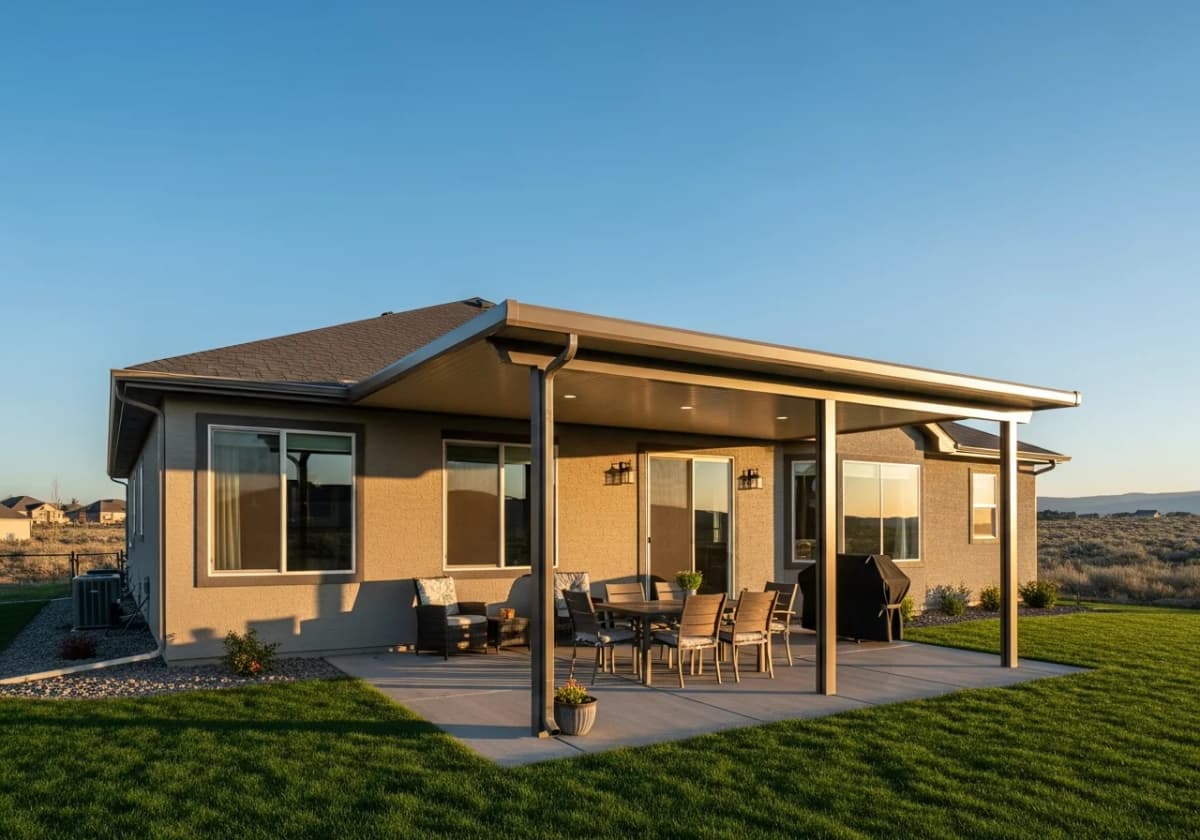
In the Treasure Valley, an uncovered patio spends a lot of the year fighting the weather. July and August deliver long, high-sun afternoons that bake a bare concrete slab; spring and fall bring rain that cuts the evening short; and winter parks snow on the furniture. A well-built patio cover solves all three at once — it throws cool shade over the hottest part of the day, keeps the rain off so you can stay outside after a sprinkle, and protects your outdoor kitchen, dining set, and grill from the elements year-round.
The payoff is more than comfort. A covered patio effectively adds a room to your home — an outdoor living space for dining, entertaining, and relaxing that you can actually use spring through fall, and even on dry winter days with a heater. It shades west- and south-facing windows, which can take some load off your air conditioning, and it gives the back of the house a finished, intentional look instead of a slab that stops at nothing. Done right, it is one of the highest-impact outdoor upgrades you can make.
Iron Crest Remodel designs and builds patio covers as a single, engineered project: we help you choose the right style and material for how you actually use the space, pull the required permit, build to the local snow and wind loads, and finish the structure so it looks like it was always part of the house. The sections below walk through the three main cover types, how aluminum and wood compare, what the code and snow load mean for your build, and what drives the cost here in the valley.
There is no single "best" patio cover — the right one depends on how much sun and rain protection you want and how you plan to use the space. Here is how the three common styles compare.
Solid Roof
A continuous roof of solid panels that delivers full shade and sheds rain. The choice for outdoor kitchens, dining, and protecting furniture. Insulated foam-core panels also cut radiant heat and noise. Aluminum is the longest-lived frame material for this style — see the comparison below.
Lattice
Open cross-slats give filtered light and airflow — roughly 50–80% shade with partial sun. Great for an open, breezy feel and climbing plants, but it is not designed to keep rain out.
Louvered (Adjustable)
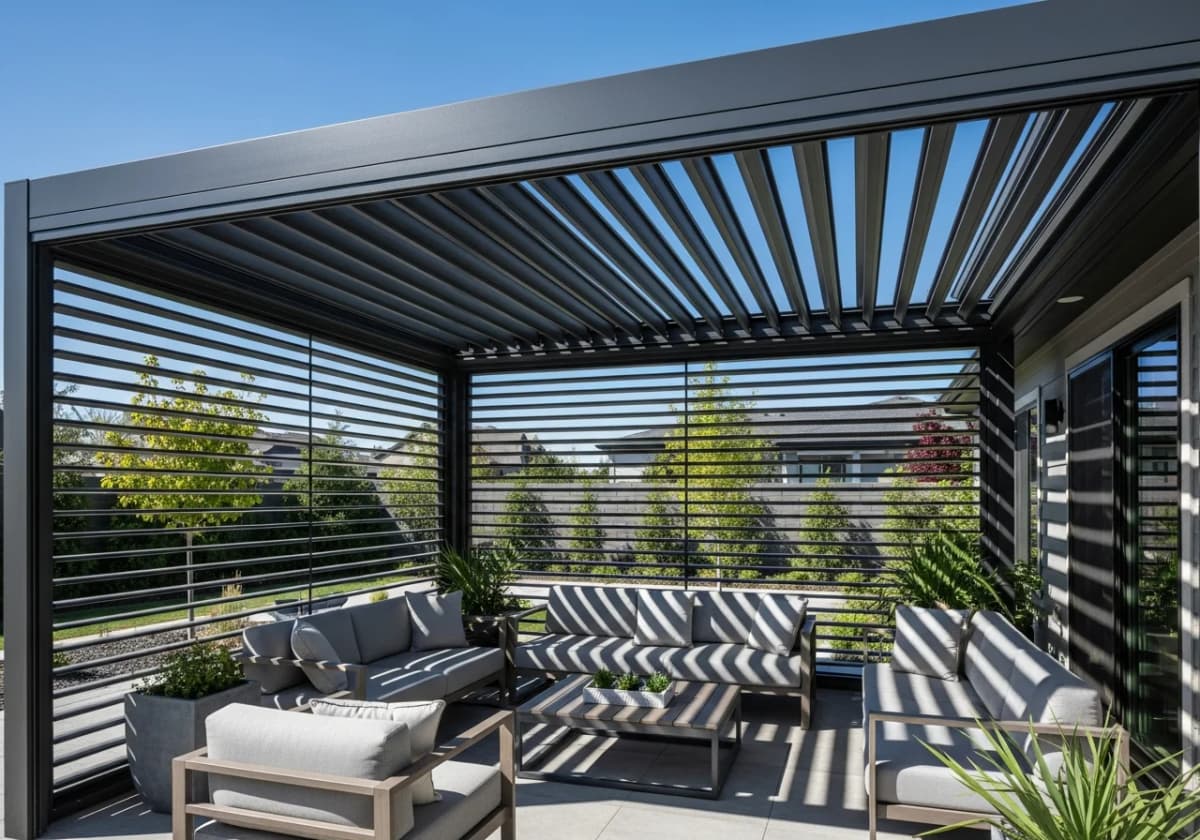
Rotating slats pivot to control sun and airflow, then close to form a water barrier with integrated drainage. Manual or motorized, it is the most flexible — and the premium — option.
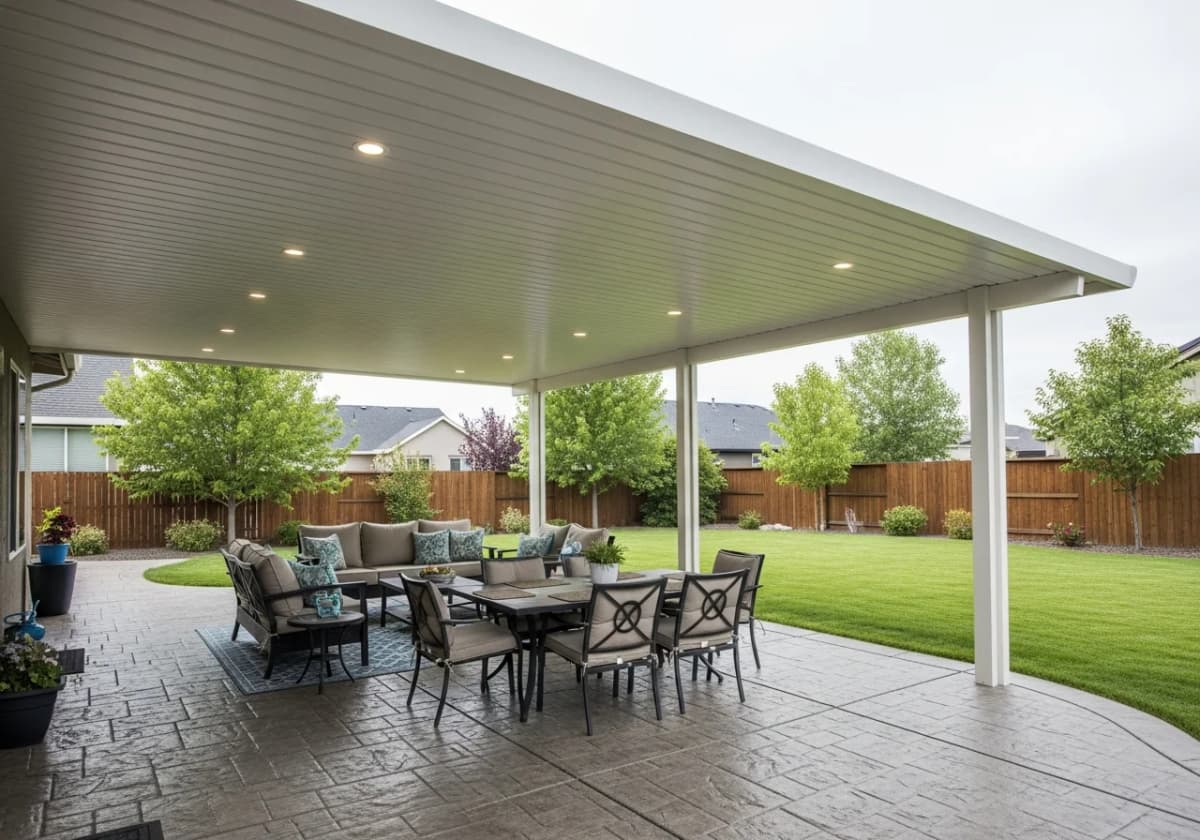
Most Treasure Valley homeowners who want true all-season use lean toward a solid or louvered cover, because both keep rain and sun off the space; lattice is a popular pick when shade and looks matter more than staying dry. We'll show you real examples and help you weigh shade, rain protection, ventilation, and budget against the way you actually entertain outdoors.
Adjustable louvered roofs have become the standout upgrade for a reason: a single structure can do what used to take a compromise. The roof is built from rotating slats — the louvers — that you angle to let sunlight pour in on a cool morning, tilt to cast shade in the afternoon, or close completely so they interlock into a watertight barrier with built-in drainage when a storm rolls through. Motorized versions add a remote or smart-home control so you can adjust the roof without leaving your chair.
That flexibility is a great fit for our climate, where a single day can swing from a sunny morning to a windy, rainy evening. The trade-off is cost: louvered systems sit at the top of the range, with rolled-form aluminum roofs running roughly $25–$45 per square foot and heavier extruded systems $30–$70, while a fully installed louvered pergola often lands somewhere around $6,500–$18,000 depending on size and whether it's manual or motorized. If you want the look of an open pergola but the option to stay dry, this is the style to look at.
After the style, the biggest decision is what the cover is made of. Aluminum and wood both look great when built well, but they live very different lives over the years — especially in a climate that sees snow, wind, and hot, dry summers.
Aluminum
Lasts 30 years or more and is virtually maintenance-free — no painting, staining, or sealing, just an occasional wash. It won't warp, crack, rot, or rust, and it reflects heat so it stays cooler under direct sun. The cleaner, more modern look fits today's architecture. Generally about $20–$50 per square foot installed.
Wood
Offers a warm, natural appearance and can be stained to match your home, and it often costs less up front. It typically lasts 10–20 years depending on upkeep, and needs periodic repainting, sealing, and repair — untreated wood is vulnerable to moisture and temperature swings, especially with snow loads and intense summer heat.
In short: if low maintenance and longevity are the priority, aluminum is usually the smarter long-term value; if a natural, traditional look is what you love, well-maintained wood is hard to beat. We build both and will give you an honest comparison for your specific patio rather than steering you toward one product.
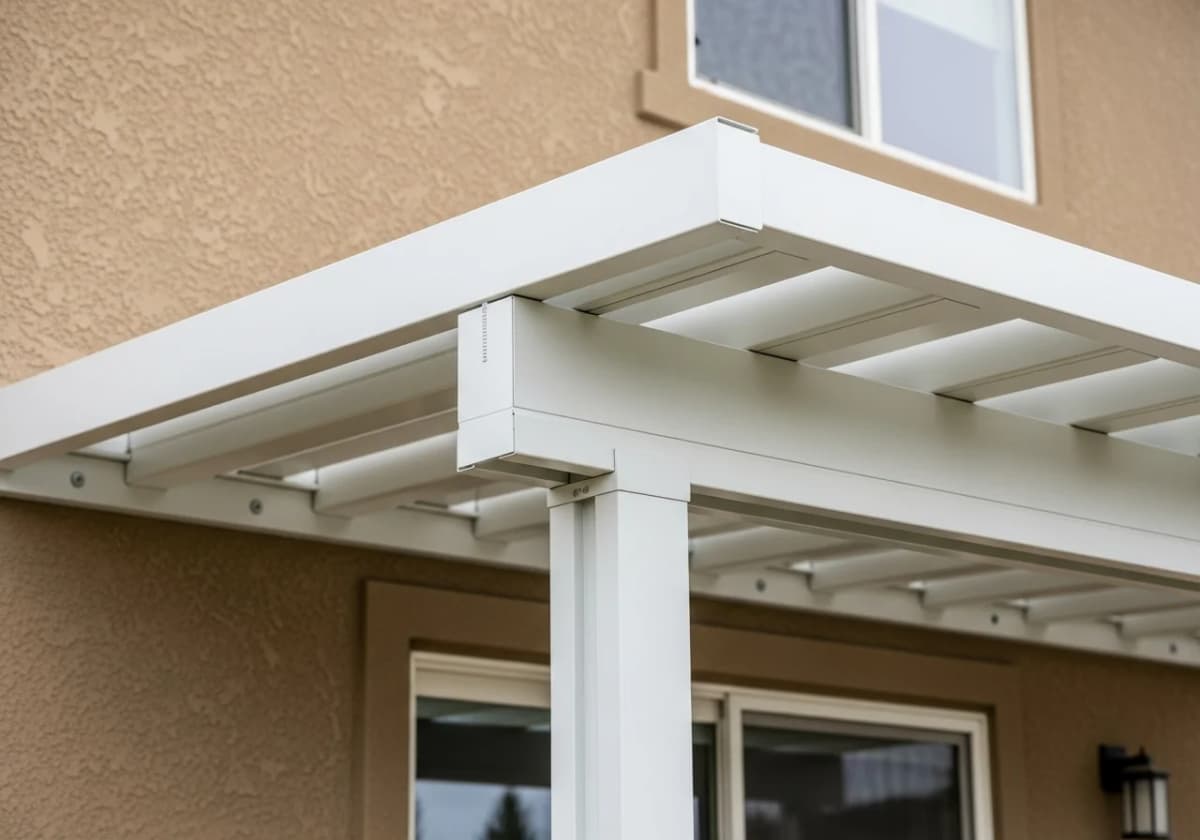
A patio cover is a roof, and in the Treasure Valley a roof has to carry snow and resist wind. That is the whole reason the city requires a permit: the structure has to be engineered, not eyeballed.
Idaho has adopted the 2018 International Residential Code, which governs structural design for a project like this. Your cover is sized to the local snow load and wind speed for your site. The City of Boise's published design criteria for the valley floor are a 20 psf ground snow load, a 25 psf design roof snow load, a 90 mph wind design speed, and Seismic Design Category C, with footings set below a 24-inch minimum frost depth. Foothills and higher-elevation lots can carry a larger snow load, so the exact value is confirmed for your address with the Boise Building Division at (208) 608-7070. For aluminum patio-cover panels, the code also caps total-load deflection at 1/120 of the span, which keeps a loaded roof from sagging. We size the beams, rafters, posts, and footings to those numbers.
How the cover meets your house matters too. An attached cover ties into the exterior wall and transfers its load into the structure, so that connection — and concrete footings set below frost depth — are engineered to handle the added weight and the wind that tries to lift the roof. A freestanding cover stands on its own posts and footings, which is the right call when an attachment isn't practical or you want the structure set out in the yard. Either way, we build the footings and connections to code rather than relying on surface anchors that fail in the first big wind.
The City of Boise homeowner's guide lists building or adding a patio cover, carport, or porch — or enclosing any attached roof area — as work that requires a building permit. The reason is structural: the added weight is transferred to your home's exterior wall, so the framing must be checked for allowable beam, rafter, and post spans, footings may be required for frost protection, and the design has to be shown to provide wind stability. We pull the permit and carry the project through inspection as part of the job.
A few details worth knowing: in Ada County, a small window awning supported by the exterior wall that projects 54 inches or less and needs no extra support is exempt from permitting — but that is an awning, not a patio cover. And under the code's patio-cover provisions, a true patio cover is an open structure used only for recreational, outdoor living — not a carport, storage room, or habitable room — and a large share of its walls must stay open or glazed. If you ever want to fully enclose the space into a sunroom, that is a separate scope and permit, and we'll design the cover so that conversion stays realistic. If you want to confirm your specific project, the city's building line is (208) 608-7070.
Two more things worth knowing. Setbacks are set by your zoning district, not by the size of the cover, so we confirm the applicable rear and side yard setbacks with Boise Planning & Zoning at (208) 608-7100 during design — Boise sets no maximum lot coverage, so the setback is the real constraint on how far a cover can extend. And on lighting: 120-volt line-voltage fixtures under the cover are part of the electrical permit, while low-voltage outdoor landscape lighting requires no electrical permit in Boise (City of Boise Homeowner's Guide).
As a national 2026 reference, a covered patio runs roughly $50–$150 per square foot all-in, while simply adding a roof over an existing slab is closer to $20–$60 per square foot installed. A solid aluminum cover is generally about $20–$50 per square foot, and an insulated foam-core roof about $30–$60. Where your project lands in those ranges comes down to a handful of factors:
Style and material. Lattice is the most economical, a solid roof sits in the middle, and louvered or motorized systems are the premium tier; aluminum and wood price differently up front and over their lifespan.
Size and span. More square footage and longer clear spans mean larger beams and more posts and footings, which raises both material and labor.
Attached vs. freestanding. An attached cover ties into the house wall; a freestanding one needs its own full set of posts and footings, which changes the structure and cost.
Footings and engineering. Concrete footings below frost depth, snow-load sizing, and wind design are non-negotiable here and are built into a permitted, code-compliant cover.
Add-ons. Recessed lighting, ceiling fans, heaters, drop screens, motorization, and finish upgrades each add to the total — and to how much you use the space.
Site access and conditions. Tight backyard access, existing slab condition, and how the cover meets your roofline all affect labor.
Because every patio, roofline, and budget is different, we don't quote off a chart. We measure on site, confirm the snow and wind values for your address, and give you a firm, itemized price so there are no surprises.
Design consult
We look at how you use the space, your home's style, and your budget, then recommend a style (solid, lattice, or louvered) and material (aluminum or wood).
Engineer & permit
We size the structure to the local snow load and wind speed, design footings and connections, and pull the City of Boise or Ada County building permit.
Footings & posts
Concrete footings are set below frost depth and posts are anchored so the cover resists both snow weight and wind uplift.
Build the structure
Beams, rafters, and roofing or louvers go up, attached cleanly to your home or freestanding, finished to match.
Add-ons & finish
Lighting, fans, screens, or motorization are wired and installed, and the structure is finished and detailed.
Inspection & cleanup
We carry the project through final inspection and leave your patio clean and ready to enjoy.
Every patio cover we build is backed by a 3-year workmanship warranty, on top of the manufacturer's own coverage on the materials we install — those are third-party terms that differ by product line, so verify them on the manufacturer's site for the system you choose. Because the cover is permitted and engineered to local snow and wind loads, you get a structure that performs through Treasure Valley winters — not a bolt-on that loosens or sags after the first heavy snow.
Do I need a building permit for a patio cover in Boise?
Almost always, yes. The City of Boise homeowner's guide lists constructing or adding a patio cover, carport, or porch — or enclosing any attached roof area — as work that requires a building permit. A permit is required because the added weight is transferred to your home's exterior wall, so the framing has to be checked for proper beam, rafter, and post spans, concrete footings may be needed for frost protection, and the design must be shown to resist wind (lateral) loads. There are narrow exceptions: in Ada County, a window awning supported by an exterior wall that projects 54 inches or less and needs no additional support is exempt. We handle the permit and engineering as part of the project, and the city's building line is (208) 608-7070 if you want to confirm your specific situation.
Should I choose a solid, lattice, or louvered patio cover?
It comes down to how much sun and rain protection you want. A solid roof gives full shade and sheds rain, so it is the choice for year-round use, outdoor kitchens, and protecting furniture; insulated foam-core panels also cut radiant heat and noise. A lattice cover uses open cross-slats for filtered light and airflow — roughly 50 to 80 percent shade — which is great for plants, partial sun, and a more open feel, but it is not designed to keep rain out. A louvered (adjustable) cover is the most flexible: motorized or manual slats rotate to let sun in or close completely to form a water barrier with integrated drainage. We walk you through the trade-offs against how you actually plan to use the space.
Aluminum or wood — which patio cover lasts longer in the Treasure Valley?
Both work here, but they age differently. Aluminum patio covers typically last 30 years or more and are virtually maintenance-free — no painting, staining, or sealing, just an occasional wash — and they won't warp, crack, rot, or rust. Aluminum also reflects heat, so it stays cooler under our summer sun. Wood has a warm, natural look and can be stained to match your home, and it often costs less up front, but it generally lasts about 10 to 20 years and needs periodic repainting, sealing, and repair; untreated wood is vulnerable to moisture and temperature swings, especially in climates with snow loads and intense summer heat. If low maintenance is the priority, aluminum usually wins; if appearance is everything, properly maintained wood is beautiful.
Will a patio cover hold up to Treasure Valley snow and wind?
It will when it's engineered and permitted correctly, which is exactly why a permit is required. Idaho has adopted the 2018 International Residential Code, and your cover is designed to the local snow load and wind speed for your site. The City of Boise's design criteria for the valley floor are a 20 psf ground snow load, a 25 psf design roof snow load, a 90 mph wind design speed, Seismic Design Category C, and a 24-inch minimum frost depth for footings; foothills and higher-elevation lots can carry a larger snow load, so the value is confirmed for your address with the Boise Building Division at (208) 608-7070. For aluminum patio-cover panels, code also limits total-load deflection to 1/120 of the span. We size beams, rafters, posts, and footings to those numbers rather than guessing.
How much does a patio cover cost?
National 2026 figures are a useful starting point: a covered patio runs roughly $50 to $150 per square foot all-in depending on type and materials, while adding a roof over an existing patio is closer to $20 to $60 per square foot installed. A solid aluminum cover is generally about $20 to $50 per square foot installed, an insulated foam-core roof about $30 to $60, and louvered systems are the premium tier — a full louvered pergola often lands somewhere around $6,500 to $18,000 depending on whether it's manual or motorized. Your real number depends on size, material, attached vs. freestanding, footings, and add-ons like lighting or fans, so we give you a firm, itemized quote after measuring on site.
Can a patio cover be attached to my house — and enclosed later?
Yes to attached. An attached cover ties into your home's wall and roofline and transfers load into the structure, so the connection and footings are engineered accordingly; a freestanding cover stands on its own posts and footings and is a good option when an attachment isn't practical. As for enclosing it: under the building code's patio-cover provisions, a true patio cover is an open structure used only for recreational outdoor living — not a carport, storage room, or habitable room — and a large share of its walls must stay open or glazed. You can absolutely plan ahead for a future enclosure or sunroom, but that's a different permit and scope, and we'll design the cover so a future conversion is realistic.