
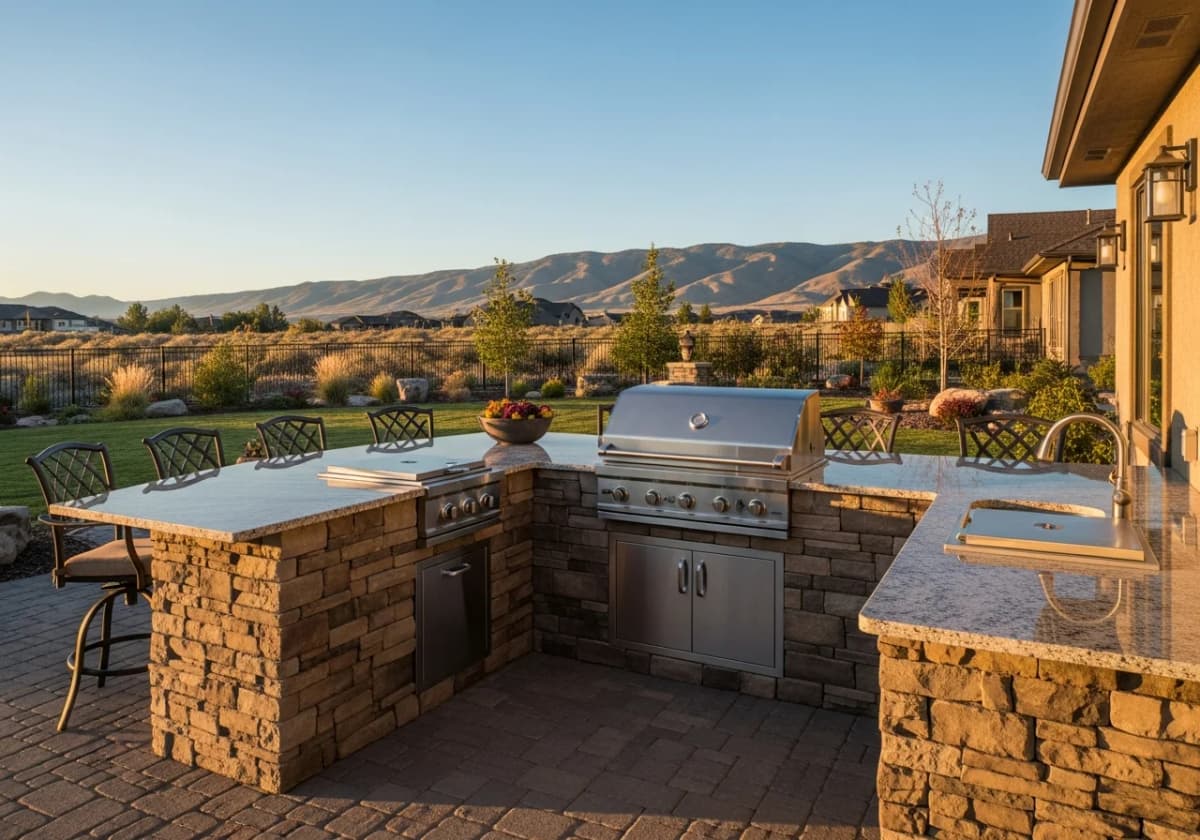
The Treasure Valley was practically built for outdoor living. Long, dry, warm summers, low humidity, and big evening skies mean a backyard kitchen here gets used for months on end — from spring grilling through late-season harvest dinners. An outdoor kitchen takes the heat, smoke, and crowd out of your indoor kitchen and puts the cook right in the middle of the party, looking out over the patio instead of into a wall. For Boise, Meridian, Eagle, and Nampa homeowners who already love their backyard, it is one of the most genuinely livable remodeling investments available.
But an outdoor kitchen is a real construction project, not a patio accessory. Done right, it weaves together masonry or framed cabinetry, a built-in grill and appliances, a gas line, electrical circuits, plumbing, weatherproof finishes, and a solid foundation that can carry the weight — all permitted and inspected, and all built to shrug off Idaho's freeze-thaw winters. Done casually, it becomes a rusting island with a dead grill and a sink that cracks its pipes the first cold snap. Iron Crest Remodel approaches it as the design-build job it really is: we plan the layout around how you cook, coordinate the licensed trades and permits, and finish it with materials chosen specifically for our high-desert climate.
This page walks through everything that goes into a lasting outdoor kitchen: the core components and layouts, how gas, electrical, and plumbing permits work in Boise and Ada County, how we freeze-proof the plumbing for Idaho winters, which countertop and cabinet materials actually survive outdoors, and honest cost tiers so you can plan a budget before you fall in love with a design.
Professional outdoor kitchens are planned around four functional zones — and getting the zones right is what separates a kitchen you use every weekend from a grill island that collects dust. We map your design so the cook can move naturally between heat, cold storage, water, and prep space without crossing traffic or reaching over the fire.
Hot zone
The cooking core — a built-in grill, plus optional side burners, a smoker, griddle, or even a pizza oven for the ambitious.
Cold zone
Outdoor refrigeration: a stainless under-counter fridge, a freezer drawer, or a beverage and wine chiller so drinks and ingredients stay outside with you.
Wet zone
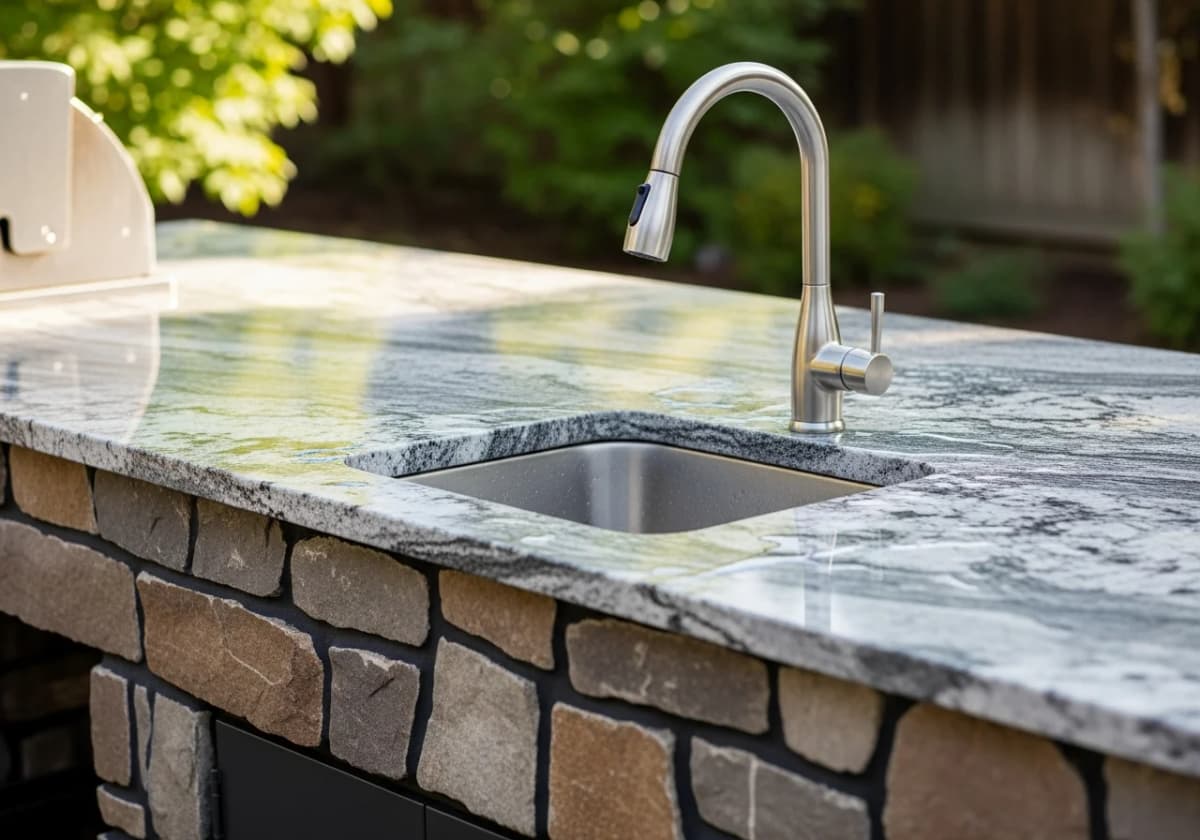
A prep sink with running water for rinsing, cleanup, and filling — the component that drives the plumbing and the winterizing plan.
Dry / prep zone
Generous landing counters and weatherproof storage cabinets for tools, plates, and trash so everything has a place.
Those zones then get arranged into one of three proven layouts. A linear island has the smallest footprint, with the grill centered and counters flanking it — ideal for a tighter patio or a clean, modern run along the house. An L-shape opens up far more counter and storage while keeping an airy, welcoming feel, often putting the grill and sink on one leg and bar-height seating on the other. A U-shape wraps the cook on three sides for the most prep space and guest interaction, perfect when the kitchen anchors a courtyard or a large entertaining patio. We typically set working counters around a comfortable 36-inch height, with raised bar tops for seating, and we plan the whole thing to flow into your existing patio or deck and patio space.
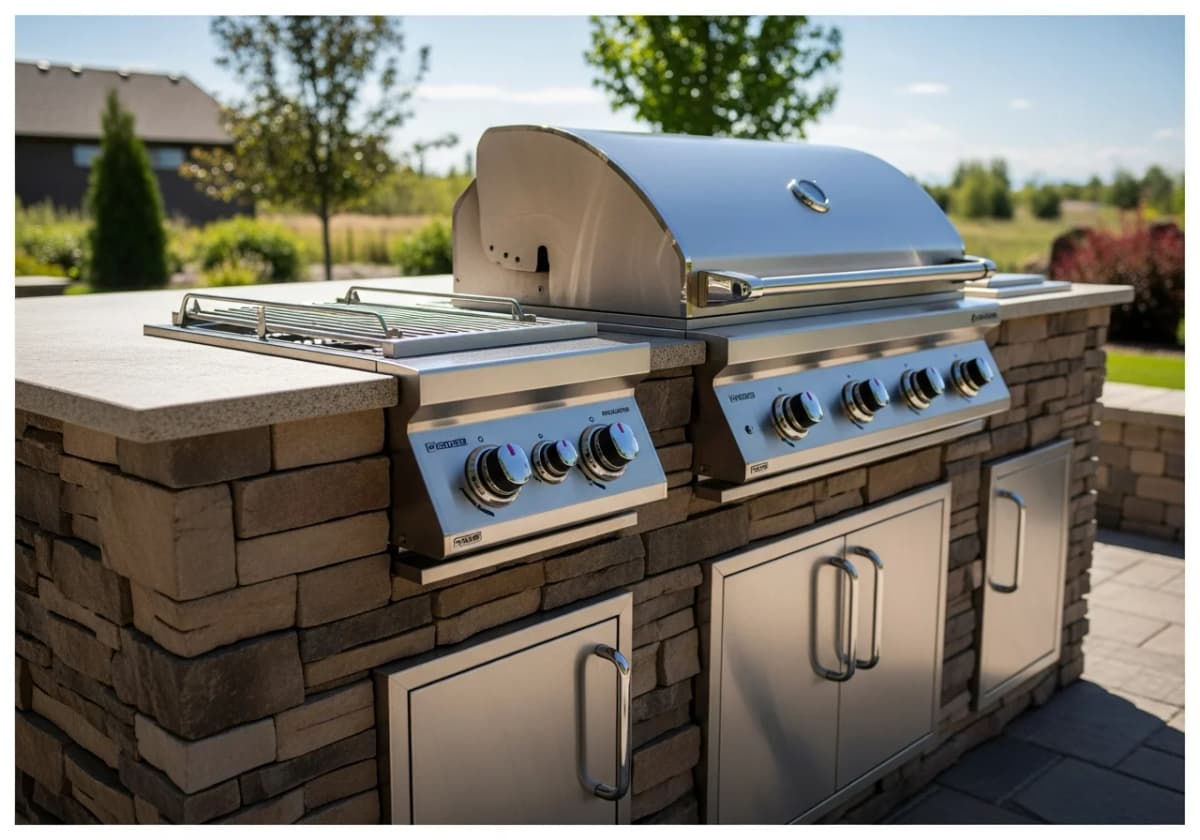
The difference between a real outdoor kitchen and a wheeled grill is the utilities running underground to it — and those utilities are exactly what trigger permits and inspections. A built-in setup commonly involves a natural-gas or propane line to the grill and burners, electrical circuits for refrigeration, lighting, and outlets, and plumbing for the sink. In Boise and Eagle, work that adds new electrical circuits, plumbing, gas lines, or structural elements requires permits; that includes 120-volt line-voltage lighting, and plumbing permits are required when fixtures are added. The one common exception is low-voltage outdoor landscape lighting, which needs no electrical permit in Boise (City of Boise Homeowner's Guide).
Gas
A dedicated line feeds the grill and side burners, sized and pressure-tested for the appliances. Mechanical/gas work must be done by an Idaho-licensed contractor in that trade.
Electrical
Weather-rated, GFCI-protected circuits power the refrigerator, outlets, and task and ambient lighting, wired to the NEC 2023 as adopted in Idaho. 120-volt line-voltage lighting needs a permit in Boise; low-voltage landscape lighting does not.
Plumbing
Supply and drain lines for the prep sink, designed from the start to fully shut off and drain for winter. Licensed plumbing trade, permitted and inspected.
Your permitting authority is set by your address, not your ZIP code. Boise, Eagle, and unincorporated Ada County are three separate jurisdictions — the City of Boise Planning & Development Services (208-608-7070), the City of Eagle Building Division (208-489-8760), and Ada County Development Services (208-287-7900) each handle their own area. We coordinate the permits, schedule the licensed trades, and recommend confirming the exact requirements for your property with your jurisdiction before construction starts.
This is the detail most people never think about until it's too late. Boise sits in a cold semi-arid climate: the NOAA 1991–2020 normals put the average January low at 25.9°F and the average July high at 93.5°F, and the valley runs roughly 87 freeze-thaw cycles a year (30-year mean from Boise Air Terminal daily observations, 1996–2025) — more than enough for hard, repeated freezes every winter. The grill, cabinets, and stone all handle the cold without complaint. The vulnerability is water: any water left standing in a supply line or in the sink's P-trap can freeze, expand, and crack the pipe, turning a fun amenity into an expensive spring repair.
We engineer the plumbing for the freeze from day one rather than bolting on fixes later. That means routing the supply so it can be completely shut off and drained, putting accessible shut-off and drain points where you can actually reach them, and insulating exposed pipe with foam pipe-insulation sleeves. Then we hand you a simple, repeatable fall routine:
Shut off and relieve pressure. Close the supply valves to the kitchen, then open the faucet so the lines depressurize and drain.
Clear the lines. Drain the supply and blow out any remaining water — compressed air through the lines works well — so nothing is left to freeze.
Protect the P-trap. Remove the P-trap, or fill it with a propylene-glycol-based RV or marine antifreeze so the trapped water can't freeze and crack the fitting.
Insulate what's exposed. Wrap any exposed pipe in foam insulation sleeves for the season as a final safeguard.
When we finish your project we walk you through exactly where every shut-off and drain is, so winterizing takes a few minutes each fall instead of a plumber's bill each spring.
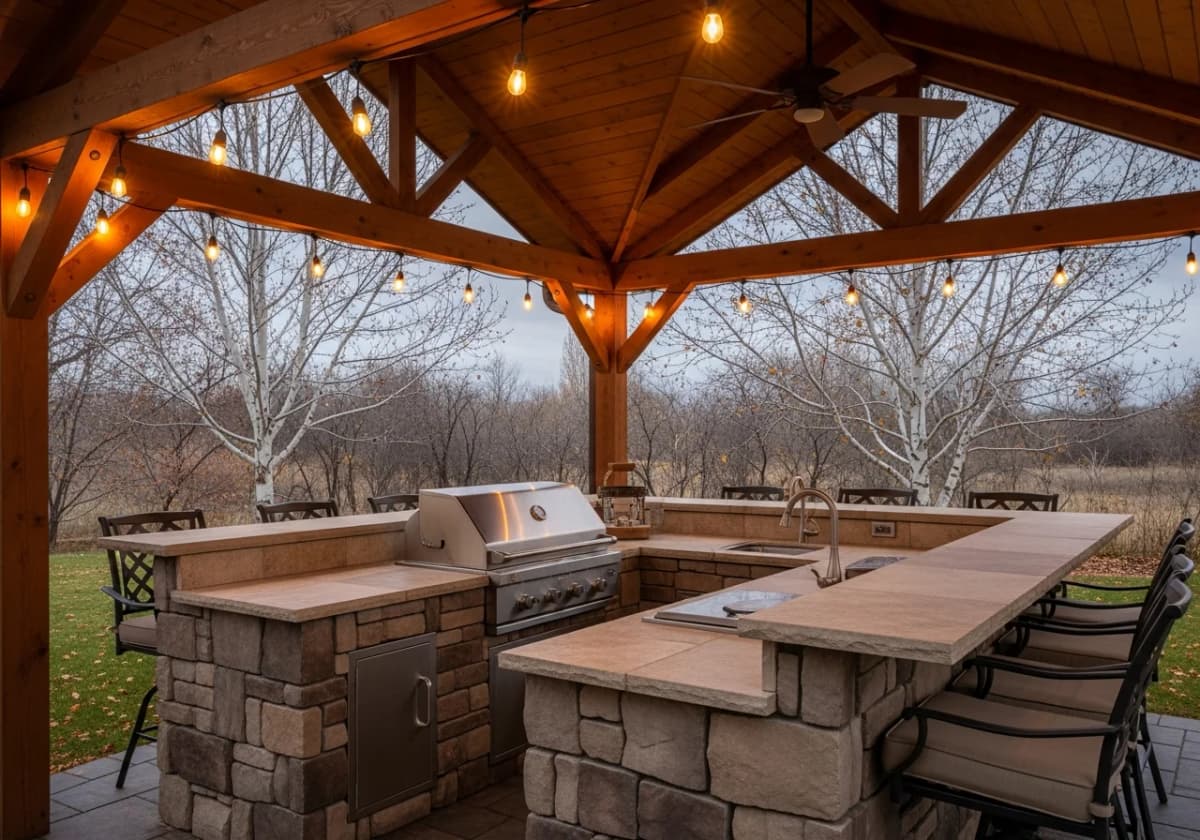
Outdoor materials live a hard life here: intense high-desert UV all summer, freeze-thaw cycles all winter, and zero tolerance for the rust and rot that indoor cabinetry never faces. We specify finishes proven to last outdoors, not whatever looks good on day one.
Cabinets
304 stainless lasts roughly 20–30 years; 316 marine-grade stainless reaches 25–35. Marine-grade polymer (HDPE) is UV-resistant, won't rot or rust, and runs ~20–30 years with almost no maintenance. Masonry bases faced in stone or stucco are also a durable, classic choice.
Countertops
Sealed granite, porcelain, concrete, and glazed tile all hold up outdoors while looking great — they just need periodic sealing. Our stone-work service covers the fabrication and install.
Appliances
Stainless steel is the preferred material for the grill, refrigeration, and any storage near the heat — it handles high temperatures, weather, and UV without fading or rusting under normal use.
Cost is driven by size, materials, and how many appliances and utilities you add. Because pricing varies so widely, we give you a firm, itemized quote after designing your specific layout — but here are honest national reference ranges so you can set a realistic budget before we start designing.
Basic prefab or modular — about $4,000 to $10,000. A grill island and counters from modular components; big-box kits can start near $1,500. A fast way to get cooking with the least site work.
Mid-range custom — about $15,000 to $25,000. A built-in grill, finished counters, real cabinetry, and utilities run to the island. The sweet spot for most homeowners building something permanent.
Luxury custom — about $50,000 to $75,000 and up. Full appliance suites, premium stone, multiple zones, structures, and finishes; high-end material and appliance packages alone can approach $100,000.
For perspective, national cost aggregators put most outdoor-kitchen builds in a band of roughly $6,300 to $27,000, at something on the order of $500 per linear foot for a standard custom project and lower for prefab. Treat those as orientation only: they are national survey figures, not Treasure Valley pricing, and we do not publish them to the dollar because the underlying data does not support that precision. Your real number depends on the choices above — we'll help you get the most kitchen for your budget.
Design & layout
We plan the zones and layout around how you cook and entertain, tie it into your patio or deck, and select weatherproof materials.
Permits & trades
We pull the right permits for your jurisdiction and schedule Idaho-licensed gas, electrical, and plumbing trades for the utility work.
Foundation & rough-in
We build a solid base that carries the weight and run the gas, electrical, and freeze-ready plumbing to the island before it's enclosed.
Cabinetry & counters
Stainless, marine-grade polymer, or masonry cabinetry goes in, topped with sealed stone, porcelain, or concrete.
Appliances & finish
The grill, refrigeration, sink, and lighting are set and connected, then everything is tested and inspected.
Walkthrough & winter prep
We hand over the finished kitchen and show you exactly where the shut-offs and drains are so winterizing is quick and easy.
Iron Crest Remodel is registered with the Idaho Division of Occupational and Professional Licenses (RCE-6681702) and insured, and we stand behind the work. Your outdoor kitchen is covered by our 3-year workmanship warranty; appliances carry their own manufacturer warranties on their published terms — verify those with the manufacturer before you buy. Because the utility work is permitted and inspected and the freeze-proofing is engineered in from the start, your kitchen is built to be enjoyed for years — not patched together for one summer.
Do I need a permit to build an outdoor kitchen in Boise or Ada County?
Usually, yes — for the utility work. A built-in outdoor kitchen typically involves a gas line, new electrical circuits, and plumbing, and each of those generally requires its own permit. Boise, Eagle, and unincorporated Ada County are three separate permitting jurisdictions, and your authority is set by your street address, not your ZIP code. The City of Boise Planning & Development Services (208-608-7070), the City of Eagle Building Division (208-489-8760), and Ada County Development Services (208-287-7900) each handle their own area. Electrical, plumbing, and gas work must be done by an Idaho-registered, licensed contractor in that trade. We coordinate the permitting and trade scheduling and recommend confirming the exact requirements for your address with your jurisdiction before work begins.
How much does an outdoor kitchen cost in the Treasure Valley?
Pricing depends entirely on size, materials, and how many appliances and utilities you add. As national reference ranges rather than Treasure Valley quotes, basic prefab or modular setups run roughly $4,000 to $10,000, a mid-range build with a built-in grill and finished counters runs about $15,000 to $25,000, and a luxury custom kitchen can reach $50,000 to $75,000 or more — high-end material and appliance packages can approach $100,000 on their own. National cost aggregators put most builds between roughly $6,300 and $27,000, at something on the order of $500 per linear foot for a standard custom project. We give you a firm, itemized quote after designing your specific layout.
Can an outdoor kitchen survive Idaho winters?
Yes, when it is built and winterized correctly. Boise sits in a cold semi-arid climate: the NOAA 1991–2020 normals for Boise put the average January low at 25.9°F and the average July high at 93.5°F, and the valley runs roughly 87 freeze-thaw cycles a year. The grill, stainless or marine-grade-polymer cabinets, and sealed stone counters handle the cold fine — the real risk is the plumbing. Any standing water left in a supply line or P-trap can freeze, expand, and crack the pipe. We design the water lines so they can be fully shut off and drained, insulate exposed pipe, and walk you through a simple end-of-season routine so the sink survives the freeze.
What's the best material for outdoor kitchen cabinets and countertops?
For cabinets, the most durable choices are 304 stainless steel, which lasts about 20 to 30 years, and 316 marine-grade stainless, which can reach 25 to 35 years. Marine-grade polymer (HDPE) is a strong, UV-resistant synthetic that won't rot or rust and lasts roughly 20 to 30 years with essentially no maintenance — a great fit for our intense high-desert sun. Masonry bases finished with stone or stucco are also common. For countertops, sealed granite, porcelain, concrete, and glazed tile all hold up well outdoors but need periodic sealing. Stainless is the preferred material for the grill and any storage close to the heat.
How should I winterize my outdoor kitchen sink each fall?
Before the first hard freeze, shut off the water supply valves to the kitchen, then open the faucet to relieve pressure and drain the lines. Clear any remaining water — compressed air through the lines works well — and either remove the P-trap or fill it with a propylene-glycol-based RV or marine antifreeze so trapped water can't freeze. Insulate any exposed pipe with foam pipe-insulation sleeves. We build the plumbing to make this straightforward and will show you exactly where the shut-offs and drains are when we hand over the project.
What can I include in an outdoor kitchen besides a grill?
Outdoor kitchens are usually planned around functional zones: a hot/cooking zone (built-in grill, side burner, smoker, or pizza oven), a cold zone (refrigerator, freezer, or beverage chiller), a wet zone (prep sink), and a dry/prep zone (counters and storage cabinets). From there the layout is yours — a compact linear island, an L-shape for more counter and storage, or a U-shape that wraps the cook on three sides for the most prep space and guest interaction. We design around how you actually cook and entertain, plus how it ties into your existing patio or deck.