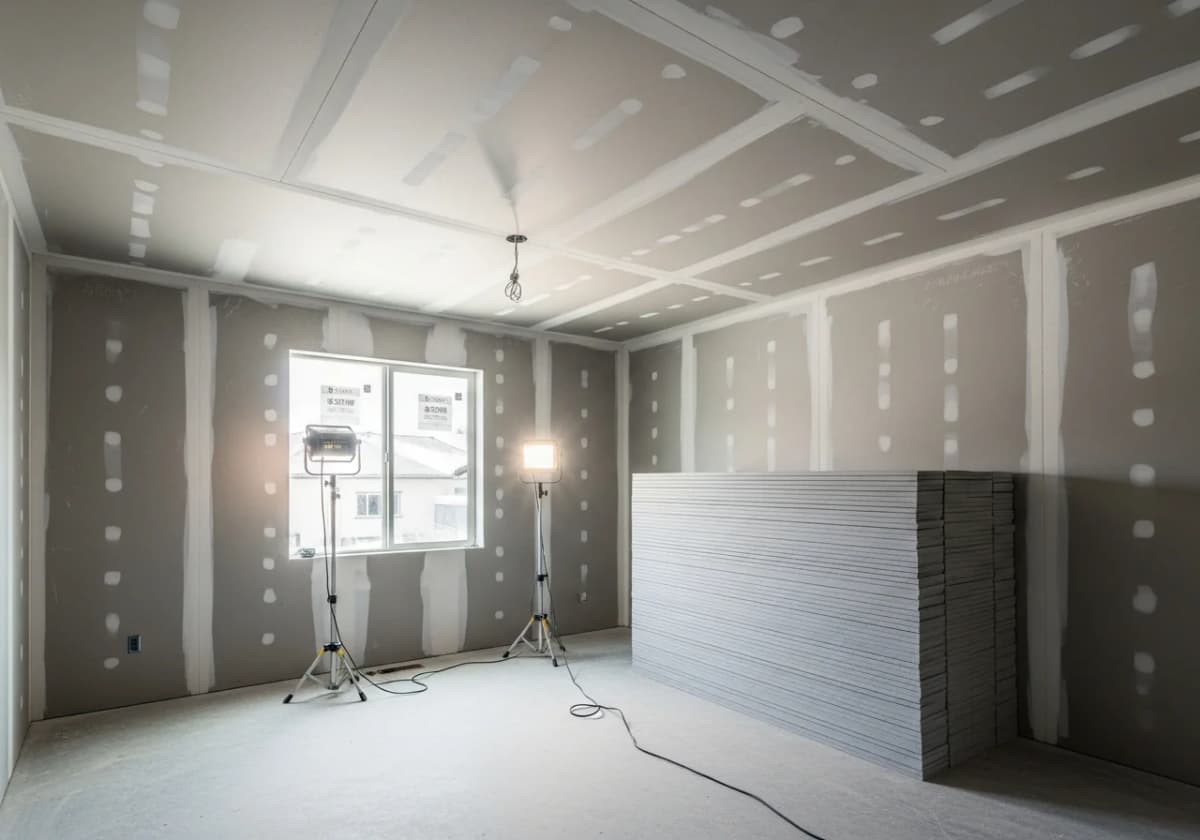
Drywall — also called gypsum board, wallboard, or sheetrock — is the canvas for everything else in a room. Paint, trim, cabinetry, tile, and lighting all read off the walls and ceilings behind them, so a flat, well-finished drywall surface is what makes a remodel look professional rather than amateur. Across the Treasure Valley we install drywall for new additions, finished basements, garage conversions, post-water-damage repairs, and full interior remodels in Boise, Meridian, Nampa, Caldwell, Eagle, and the surrounding communities.
Good drywall work is deceptively hard. Sheets have to be laid out so seams fall in the strongest places, fastened correctly so they never pop or crack, taped and coated so the joints disappear, and finished to a level that suits the paint and the lighting. The wrong board in a wet room, undersized fire-rated board at a garage wall, or a rushed two-coat finish under bright light all show up later — as mold, as a failed inspection, or as shadow lines across a freshly painted wall. The sections below walk through exactly how we hang, tape, and finish drywall, the board types we use and where, the GA-214 finish levels, the code-driven requirements for garages and damp areas, and what drives the cost.
Iron Crest Remodel is a design-build remodeling contractor, so drywall is rarely a stand-alone job for us — it is one stage inside a larger interior project. That means we think about how the walls meet the trim, how the ceilings meet the lights, and what finish the paint will demand, before the first sheet ever goes up. Our workmanship is backed by a 3-year workmanship warranty.
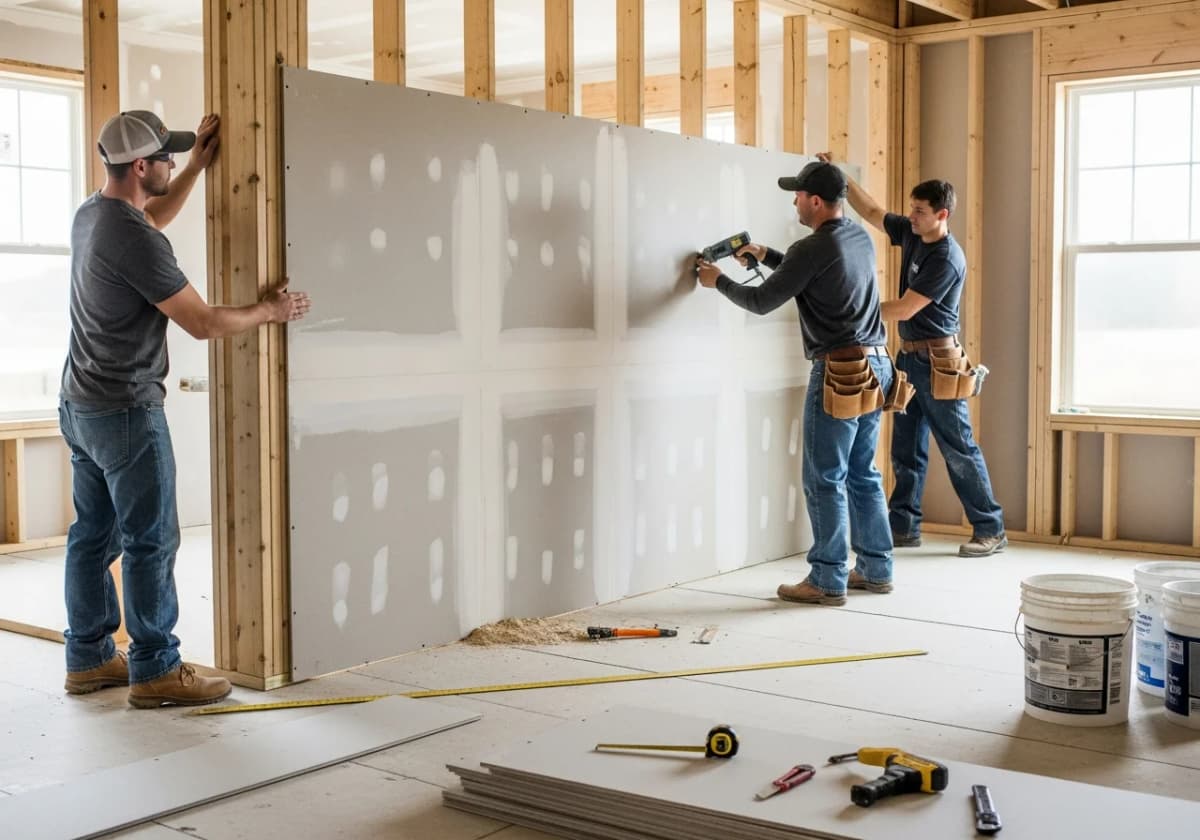
The visible quality of a wall is decided long before the painter shows up. Three stages — hanging, taping, and finishing — each have to be done right, and each builds on the one before it.
Hang the board
Sheets are measured, cut, and fastened to the framing with the vertical seams staggered in a brick pattern so joints never line up row to row — a layout that produces a stronger, flatter wall. Screws are driven roughly every 12 inches along the edges and 16 inches through the field of each sheet, with tighter spacing on ceilings, set just below the surface without breaking the paper.
Tape and embed
A base coat of joint compound is forced into every seam, then paper tape is pressed into the wet compound over the joints and inside corners. This first coat locks the tape down and is the foundation for an invisible joint.
Fill and topping coats
Most jobs get three coats total. After the embedding coat, a fill coat and a final topping coat are feathered progressively wider with larger knives (for example 8 inch then 12 inch) so the buildup blends seamlessly into the surrounding board. Fasteners and corner bead are coated the same way.
Sand and inspect
Each coat is allowed to dry fully before the next, and the final coat is sanded smooth and inspected under good light to catch any high spots, pinholes, or telegraphing before primer goes on.
Because each coat is paced by dry time, the finishing phase usually spans several days even when the hanging itself is quick. Rushing it — skipping the third coat, sanding compound that is still damp, or feathering too narrow — is the single most common reason a paint job later shows cracked joints, ridges, or shadow lines. We do not cut those corners.
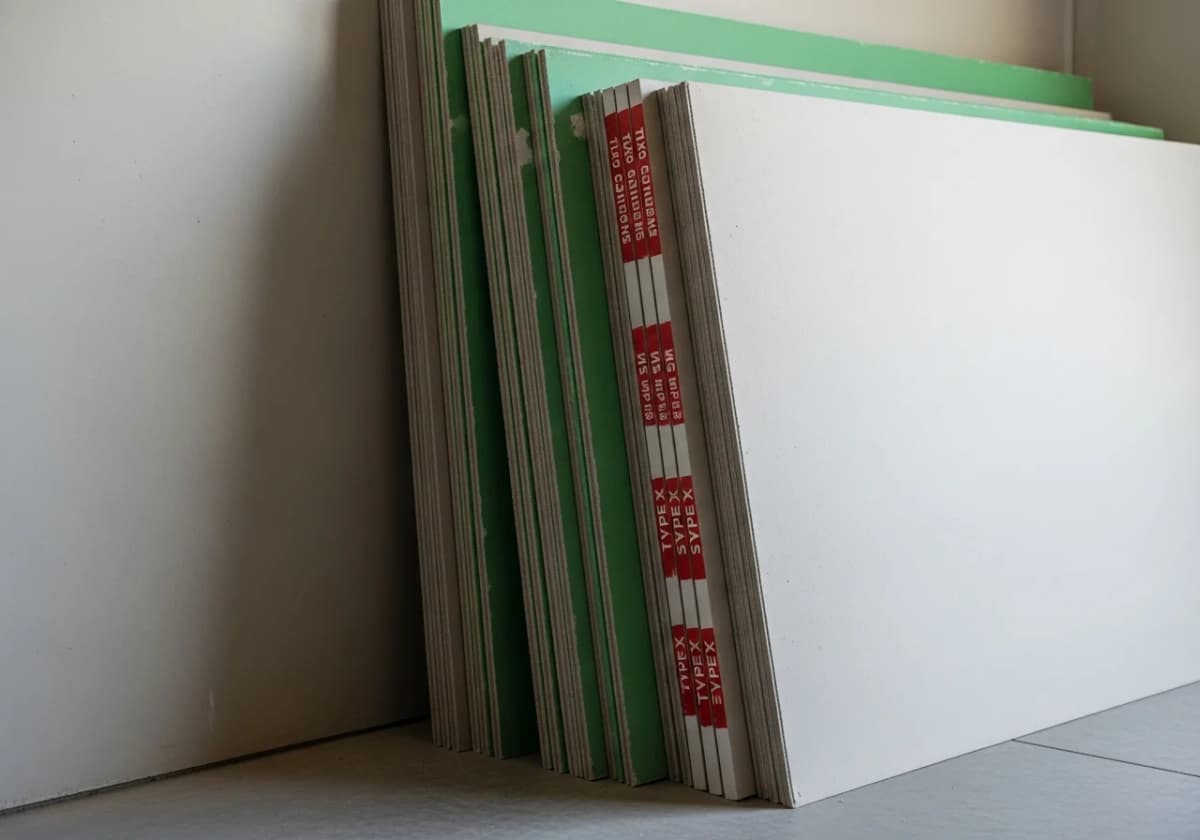
Drywall is not one product. Standard board is gypsum sandwiched between two paper faces and is usually 1/2 inch thick, but several specialty boards exist for specific conditions. Putting the right board in the right room is one of the most important — and most often skipped — decisions in a remodel.
Standard Board
Gypsum core between paper faces, commonly 1/2 inch (also sold in other thicknesses). The default for ordinary interior walls and ceilings in dry, conditioned living space.
Moisture & Mold Resistant
Mold-resistant board — often called green board — and paperless fiberglass-mat panels hold up far better in humidity. Used in bathrooms, basements, laundry rooms, and attics. Note: it is not waterproof and is not a tile-backer substitute inside a shower.
Type X Fire-Rated
A thicker 5/8-inch board with additives designed to pass a one-hour fire-resistance test. Required in garages and multifamily separations and anywhere code calls for a fire-rated assembly.
Sound-Damping
Dense, layered panels (such as QuietRock) that block more noise than standard board. Used in media rooms, home offices, and shared walls where quiet matters. STC performance depends on the full wall assembly, not the panel alone.
Paperless fiberglass-mat board deserves a special mention: because it is faced with fiberglass instead of paper, it resists moisture, mold, and mildew better and is more durable, though its slightly textured face needs a skim of compound to take a smooth paint finish. We talk through these options room by room so your bathroom, basement, garage, and living spaces each get the board they actually need.
The drywall industry uses a standard scale — the Gypsum Association's GA-214 "Levels of Finish" — to define exactly how smooth a surface should be. Specifying the right level matters because it sets both the appearance and the cost. Here is what each level means in plain terms.
Level 0. Board is installed with no taping or finishing at all. Used for temporary construction or when the final decoration has not yet been decided.
Level 1. Tape is embedded in compound at joints and interior angles. Typical for concealed spaces like plenums above ceilings and attics, and some smoke-barrier areas not open to view.
Level 2. A thin coat over the tape and fasteners. Common as a substrate for tile, and in garages, warehouses, or storage where surface appearance is not a concern.
Level 3. A heavier finish for surfaces that will receive a medium or heavy texture, or heavy-duty commercial wallcovering, before final paint.
Level 4. Tape plus compound over joints, angles, fasteners, and accessories, all sanded smooth. This is the standard for most residential painted walls and ceilings with flat or low-sheen paint.
Level 5. A thin skim coat across the entire surface for a uniform finish. Specified for gloss or non-flat paints, dark and deep-tone colors, or critical (raking) lighting, where it minimizes joints photographing and fasteners showing through.
For most Treasure Valley homes painted in typical interior colors, a Level 4 finish is the right call. If you are using a satin, semi-gloss, or very dark paint, or you have large walls washed by raking light from windows or wall sconces, a Level 5 finish is worth the added cost to avoid visible joints. We recommend the level that matches your paint and lighting rather than upselling Level 5 everywhere or quietly delivering less than Level 4.
Garage drywall is a fire-safety assembly, not a cosmetic choice. Under International Residential Code section R302.6, the garage side of walls separating an attached garage from the dwelling generally requires not less than 1/2-inch gypsum board. Where there are habitable rooms above the garage, the garage ceiling must be not less than 5/8-inch Type X gypsum board, with 1/2-inch board on the structural members supporting that floor-ceiling assembly.
We build garage separations to the code edition adopted locally and pull permits where they are required. Because jurisdictions adopt different code editions and can add local amendments, the exact adopted edition for your address in Boise, Ada County, or Canyon County should be confirmed as part of the project — we handle that verification rather than assuming. Getting this right is not optional: it is what protects the living space if a fire ever starts in the garage, and it is checked at inspection.
Damp rooms have their own rules of thumb. Bathrooms, basements, and laundry areas should use moisture- and mold-resistant board or paperless fiberglass-mat panels — but remember that moisture-resistant drywall is not waterproof. Inside a shower or tub surround you need cement board or another approved tile-backer, not green board. We map the board type to every room so your home is both code-compliant and built to last in the spaces that see real humidity.
Drywall pricing is usually quoted by the square foot of surface. National figures for installed drywall commonly run about $1.50 to $3.50 per square foot, with roughly $2.20 to $2.65 per square foot cited as a realistic midpoint for residential and light-commercial work in 2026. Several factors move your number within and beyond that range:
Labor is the biggest line item. Labor is the larger share of the total, with installer labor roughly $1 to $2.10 per square foot, while materials alone run about $0.30 to $0.50 per square foot. Skilled finishing is where the cost — and the quality — lives.
Ceilings and height. Ceilings typically run higher (often $2 to $4 per square foot) because the work is overhead, and vaulted or above-eight-foot ceilings add staging and labor.
Board type. Type X fire-rated, moisture- and mold-resistant, and sound-damping panels all cost more than standard board, and the right room may require them.
Finish level. A Level 5 skim-coated finish takes more material and labor than a standard Level 4, so smooth-wall and gloss-paint rooms cost more to finish.
Access, layout, and repairs. Tight access, lots of corners and openings, and tying new drywall into existing walls all add time compared with large, open, new-construction walls.
Because every project mixes these factors differently — a small bathroom in moisture board finished to Level 4 versus a great room with vaulted ceilings finished to Level 5 — we do not publish a one-size price. We measure your space, confirm the board types and finish levels each room needs, and give you a firm, itemized quote with no surprises.
Walk the project & measure
We review the framing, confirm which rooms need standard, moisture-resistant, fire-rated, or sound-damping board, agree on finish levels, and measure for an itemized quote.
Protect & prep
Floors and adjacent finished areas are protected, and we confirm framing, blocking, and any electrical or plumbing rough-in is complete and inspected before board goes up.
Hang the board
Sheets are laid out with staggered seams, fastened on correct screw spacing, and the right specialty board is installed where code or conditions require it.
Tape, coat & finish
Three coats of compound embed the tape and build the joints, feathered wide and sanded to the specified GA-214 level once each coat is fully dry.
Inspect under light
We check the surface under good lighting for any telegraphing, pinholes, or high spots and correct them before primer.
Clean up & hand off
Debris and protection are removed and the space is left primer-ready or, within a larger remodel, ready for paint, trim, and the next trade.
How long does drywall installation take, and how many coats of mud do you apply?
Most drywall finishing involves three coats of joint compound: a base coat that embeds the paper tape, a fill coat that builds coverage, and a final topping coat feathered out wide and sanded paint-ready. Each coat has to dry fully before the next is applied or before sanding, so the finishing phase is paced by dry time rather than by labor hours. A single room is often hung in a day, then taped and finished over the following days as each coat cures. We give you a realistic schedule for your specific job after we see the space.
What type of drywall should I use in a bathroom or basement?
Damp and humidity-prone areas like bathrooms, basements, and laundry rooms typically use moisture- and mold-resistant board (often called green board) or a paperless fiberglass-mat panel, both of which resist mold and mildew far better than standard drywall. Important caveat: moisture-resistant drywall is not waterproof and is not a substitute for cement board or tile backer inside a shower or tub surround. We match the board to the room so you do not end up with standard paper-faced drywall where moisture will eventually cause problems.
What is the difference between a Level 4 and a Level 5 drywall finish?
Both follow the Gypsum Association's GA-214 standard. A Level 4 finish tapes and coats the joints, angles, fasteners, and accessories and sands them smooth; it is the standard for most residential walls and ceilings painted with flat or low-sheen paint. A Level 5 finish adds a thin skim coat across the entire surface to create a uniform texture. Level 5 is specified where smooth-wall designs use gloss or non-flat paint, dark or deep-tone colors, or where critical (raking) light would otherwise reveal joints photographing or fasteners showing through. Level 5 costs more because of the extra material and labor.
What drywall does building code require in my garage?
Under the International Residential Code section R302.6, the garage side of walls separating an attached garage from the dwelling generally requires not less than 1/2-inch gypsum board. Where there are habitable rooms above the garage, the garage ceiling must be not less than 5/8-inch Type X (fire-rated) gypsum board, with 1/2-inch board on the structural members supporting that floor-ceiling assembly. We build to the code edition adopted locally and pull permits where required; the exact adopted edition and any local amendments should be confirmed for your jurisdiction.
How much does drywall installation cost?
National pricing for installed drywall commonly runs about $1.50 to $3.50 per square foot, with roughly $2.20 to $2.65 per square foot cited as a realistic midpoint for residential and light-commercial work in 2026. Labor is the larger share of that cost, with installer labor in the range of $1 to $2.10 per square foot and materials alone roughly $0.30 to $0.50 per square foot. Ceilings, specialty board such as Type X or moisture-resistant, and a Level 5 finish all push the figure higher. We provide a firm, itemized quote after measuring your project.
Do you install soundproof or other specialty drywall?
Yes. Beyond standard board we install fire-rated Type X, moisture- and mold-resistant board for wet areas, and sound-damping panels for media rooms, offices, and shared walls. Sound-damping products such as QuietRock are denser and layered to block more noise; a 1/2-inch panel can deliver an STC rating around 42 or higher on a typical 16-inch on-center wood-stud wall, while heavier products can reach considerably higher depending on the wall assembly. We recommend the right board for each room rather than defaulting to one product everywhere.