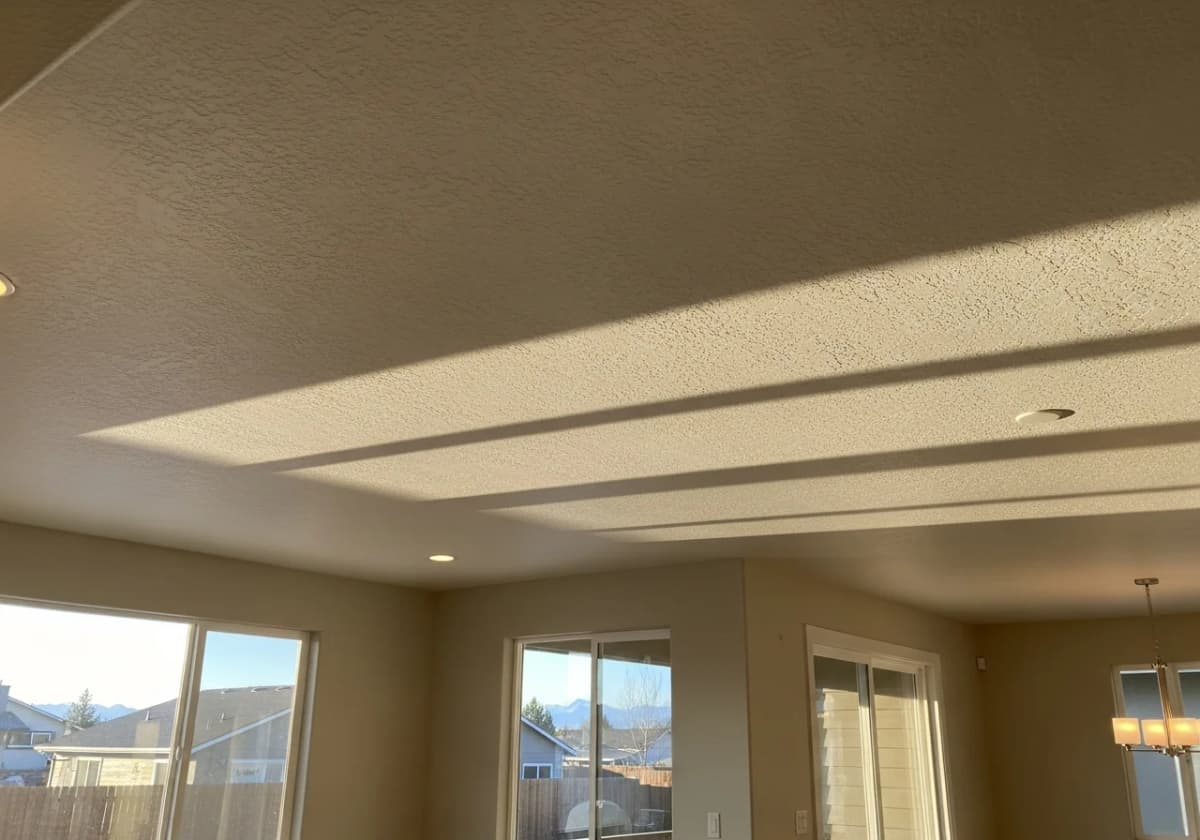
Ceiling texture is one of those details most people never consciously notice — until it's wrong. A fresh, even orange-peel makes a room feel finished. A crisp knockdown adds subtle character and hides the small imperfections every drywall ceiling collects over time. A dead-flat, smooth Level-5 ceiling reads clean and modern. But a botched patch, a mismatched repair, or a tired, yellowed texture pulls the eye straight up and makes an otherwise updated room feel unfinished. Getting the texture right is what separates a professional ceiling from an obvious DIY job.
Across the Treasure Valley, a huge share of homes built from the 1960s through the 1990s — in the Boise Bench, the North End, and established neighborhoods throughout Meridian, Nampa, Caldwell, and Eagle — wear hand- or spray-applied textures of their era. As those homes get updated, the ceiling almost always needs attention: a popcorn ceiling comes down, a water-stained section gets patched, a wall comes out during a remodel, or a homeowner simply wants to trade a dated finish for something current. Each of those moments is a retexturing job, and each one lives or dies on how well the new finish blends with the rest of the home.
Iron Crest Remodel applies and matches every common ceiling texture for Boise-area homeowners — knockdown, orange-peel, skip-trowel, and smooth Level-5 — whether you're finishing a fresh repair, removing old texture and starting over, or texturing a brand-new ceiling. The sections below walk through the main texture types, how we match an existing finish, what to expect when we retexture after repair or popcorn removal, the difference between spray and hand application, and the real cost factors in the Treasure Valley.
There is no single "best" ceiling texture. The right choice depends on how much you want the surface to hide, how the room is lit, how easy you want it to clean, and what already exists in adjoining rooms. Here is how the four most common finishes compare.
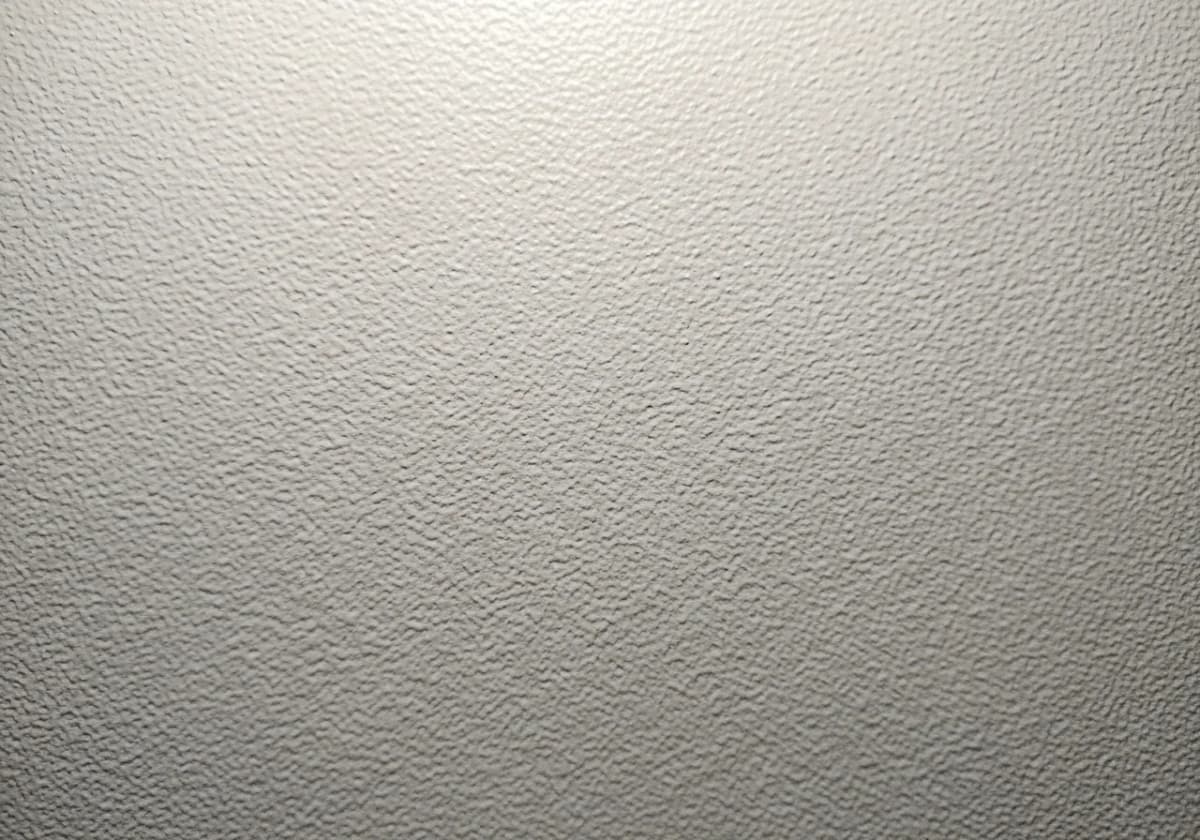
Orange-Peel
Fine, uniform dimpling like the skin of an orange — small, random-but-even bumps with little depth variation. From a few feet away it reads almost smooth. It's the fastest and most affordable texture, sprayed through a hopper gun with a fine nozzle and no trowel pass. It hides minor imperfections and doesn't trap dust and moisture the way a deeper pattern can, which makes it a popular all-around choice.
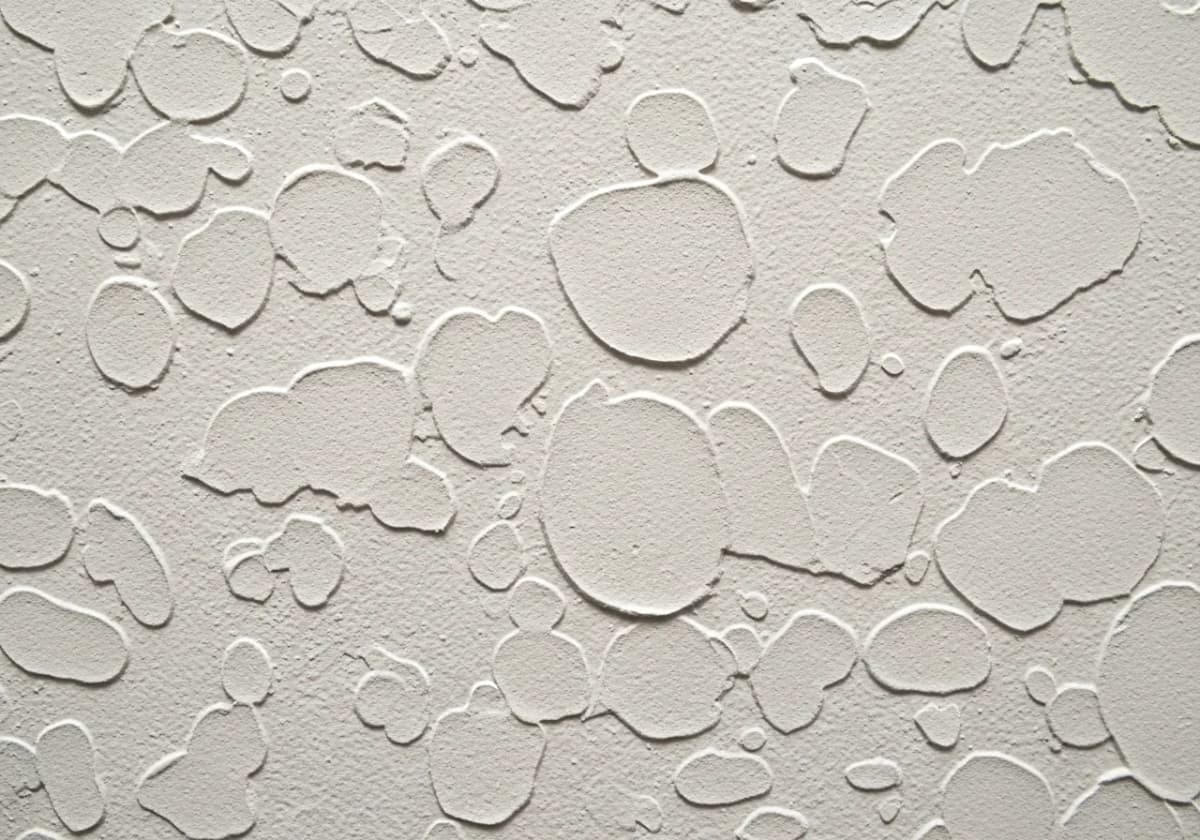
Knockdown
Joint compound is sprayed on in a random splatter, then a wide trowel is dragged across the peaks to leave soft "islands" of texture. It hides more flaws than orange-peel and adds gentle character, but the hand-finishing step makes it run roughly 15–25% more than orange-peel, and the deeper pattern needs a little more attention to keep clean.
Skip-Trowel
A hand-applied finish: a curved knife lays irregular, overlapping strokes over a smooth base, more spaced and spread out than knockdown. It produces a custom, slightly Mediterranean look and hides the most imperfections, but because it's applied by hand it costs more and is the hardest to match later, so it's best chosen for a whole ceiling rather than a small repair.
Smooth / Level 5
No texture at all — the ceiling is taped, mudded, sanded, and skim-coated until it's completely flat. It's the cleanest, most modern look and the easiest to clean, but it's the most labor-intensive finish and it shows everything: every seam, fastener dimple, and wave has nothing to hide behind. It is the most expensive of the four.
When a repair touches only part of a ceiling, the goal is a patch that disappears into the surrounding texture. We'll be straight with you about what's realistic: spray textures are the single most difficult drywall finish to match exactly. The original look depended on variables that are hard to reverse-engineer — the air pressure used, how forcefully the mud was pushed through the hose, and the spray-nozzle size. Hand-applied textures are even more personal: technique varies by region and by the individual tradesperson who first applied it, so even when we can identify the tool that was used, matching the exact rhythm and pressure is genuinely hard.
That doesn't mean a good match is impossible — it means doing it right takes care. Two habits make the difference. First, we test the texture on scrap drywall or cardboard before ever touching your ceiling, dialing in the nozzle, pressure, and timing until the sample matches. Second, we prime the repair first: raw joint compound absorbs moisture differently than the painted ceiling around it, so texturing an unprimed patch can dry unevenly and telegraph the repair. When a ceiling has been patched in many places, or carries a hand texture that simply won't blend, retexturing the whole ceiling is often the cleaner and more cost-effective answer than chasing an invisible patch.
We test before we spray
Every match starts on scrap material — nozzle, air pressure, and timing dialed in until the sample reads identical to your ceiling.
We prime the repair
A prime coat over the patch evens out absorption so the new texture dries uniformly instead of flashing a different sheen.
We blend, not just fill
Texture is feathered out past the repair edge so there's no hard line or 'halo' around the work, especially under raking light.
We'll tell you when to retexture whole
If patches won't disappear, retexturing the entire ceiling delivers a uniform result and often costs less than fighting a mismatch.
Most of the retexturing we do is the final step in a larger job. After a popcorn ceiling removal, the scraped surface is rarely picture-perfect — it needs to be repaired, re-taped where needed, sanded, and then given its new finish. The same is true after we fix water-stained drywall, patch a ceiling where a wall was removed, or open up a ceiling during a remodel. In each case, texturing (or taking the ceiling smooth) is what makes the work disappear.
The sequence matters. We repair and sand first, then prime, and only then apply the texture or skim to smooth — because priming evens out how the surface accepts moisture so the finish dries uniformly across old and new drywall alike. If you're removing an old texture entirely, retexturing that includes scraping the existing finish is a larger scope than texturing a fresh surface, which is reflected in the cost ranges further down this page. Whatever the starting point, the end result is a ceiling that looks like it was always meant to be there.
Repair & sand
We patch gouges, re-tape seams, and sand the surface flat so the texture has a sound, even base to grab.
Prime the surface
A prime coat balances absorption between old painted drywall and fresh compound so the new finish dries uniformly.
Test & match
We sample the chosen texture on scrap, fine-tuning the spray or trowel until it matches adjoining rooms when a match is the goal.
Apply the finish
Orange-peel, knockdown, skip-trowel, or a smooth Level-5 skim — applied across the full ceiling for a consistent look.
Prime & paint
The new texture is primed and painted so the ceiling reads as one seamless surface, ready for the room.
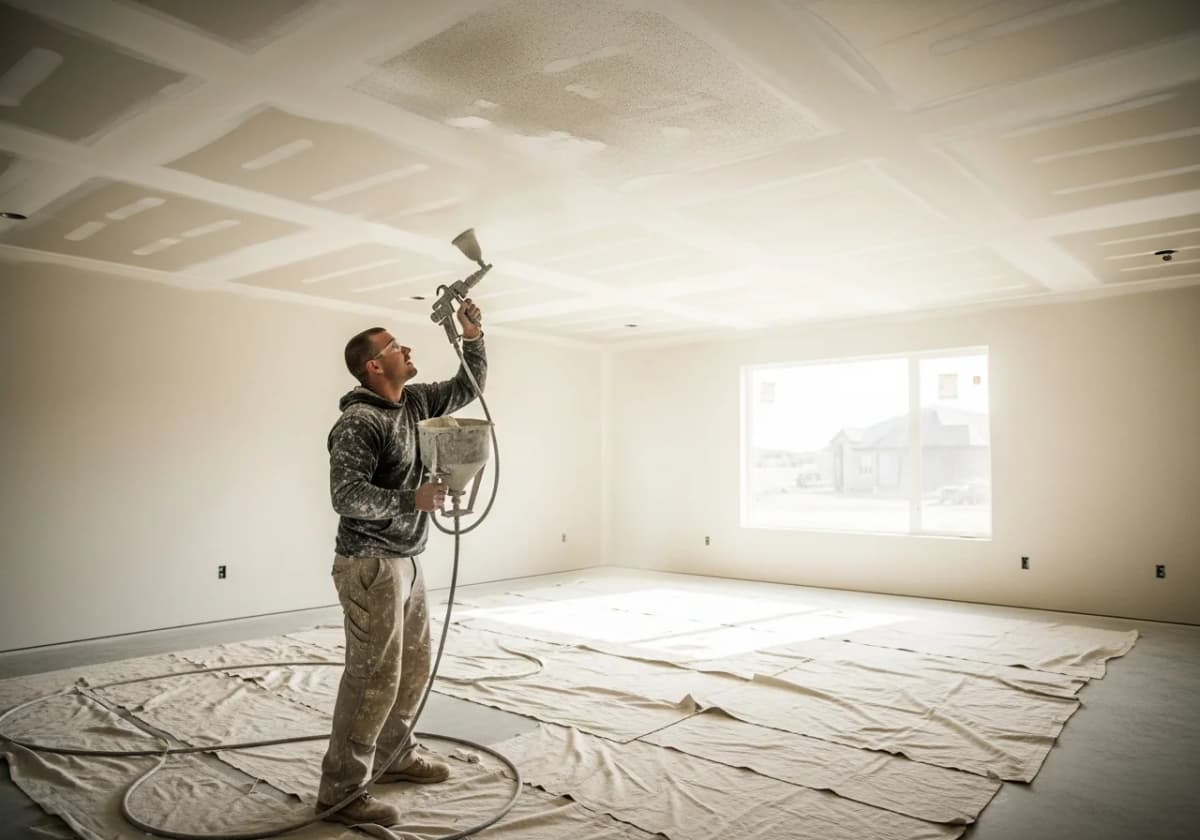
Spray application shoots joint compound from a hopper gun, producing a fine, consistent pattern over large areas quickly — that's how orange-peel and the base coat of knockdown are applied. Hand application, like skip-trowel, uses a curved knife to lay irregular overlapping strokes over a smooth base, creating a more custom, spaced-out look that hides more but takes longer and is harder to reproduce. Knockdown is the hybrid of the two: sprayed on, then flattened by hand with a wide trowel. Each method has a place — the right one depends on the finish you want and what already exists elsewhere in your home.
If you're leaning toward a flat, modern ceiling, it's worth understanding Level 5, the highest drywall finish level. Level 5 includes all the standard Level-4 steps plus a thin skim coat of joint compound over the entire surface, followed by careful sanding and inspection. Industry guidance recommends a Level-5 substrate whenever the final paint will be gloss, semi-gloss, satin, or eggshell, and in areas of critical lighting — strong side light from windows or surface-mounted fixtures that rakes across the ceiling and exaggerates every minor imperfection. In those conditions a flat-painted, lightly textured ceiling can actually be more forgiving than a smooth one, which is exactly the kind of trade-off we'll talk through before you commit.
Rule of thumb: texture hides imperfections and is more forgiving under harsh light; smooth Level-5 is the cleanest look but demands a flawless substrate and is the right call when you want a sheen finish or a contemporary, texture-free ceiling. We'll recommend the finish that fits your lighting, your paint choice, and your budget.
Every ceiling is different, so we provide a firm, itemized quote after seeing the room. To set expectations, here are widely cited national reference ranges — actual Treasure Valley pricing depends on the factors below, and we don't publish a guaranteed local per-foot number we can't stand behind:
Sprayed texture (orange-peel or knockdown). About $0.80 to $1.50 per square foot including labor and materials; ceiling texture averages roughly $1 to $2 per square foot.
Knockdown ceiling specifically. Commonly $1.00 to $2.50 per square foot, or about $500 to $1,250 for a 500-square-foot ceiling.
Full retexture including removing the old texture. Around $1.80 to $3.80 per square foot, because scraping the existing texture off first typically adds about $1.25 to $3.00 per square foot.
Texture type & finish level. Orange-peel is the baseline; knockdown runs roughly 15–25% more for the hand-finishing step; skip-trowel and a true smooth Level-5 finish are the most labor-intensive and cost the most.
Ceiling height & condition. Vaulted or two-story ceilings need staging and add labor, and ceilings with water damage or many cracks need more repair before any texture goes on.
As a real-world reference point, a standard bedroom ceiling of roughly 150 to 200 square feet often lands around $300 to $600 to retexture, depending on how much prep the surface needs. Larger living areas, vaulted ceilings, and jobs that include scraping old texture or significant repair will run higher. We'll measure your ceiling, talk through finishes, and give you a clear quote with no surprises.
A ceiling finish is only as good as the prep underneath it and the hand that applies it. We protect your floors, walls, and fixtures, contain dust, repair and prime properly, and clean up completely when we're done. Our work is backed by a 3-year workmanship warranty — so the ceiling looks right the day we finish and stays that way. Pair retexturing with interior painting and the whole room comes together in a single, coordinated project.
Which ceiling texture should I choose — knockdown, orange-peel, or smooth?
It comes down to how much you want the surface to hide and the look you're after. Orange-peel is the fastest, most affordable, and most uniform — fine, even dimpling that reads almost smooth from a few feet away while still masking minor imperfections. Knockdown hides more flaws with its flattened 'island' pattern but costs roughly 15 to 25 percent more than orange-peel because of the hand-finishing step, and it's a little harder to clean. A smooth Level-5 finish is the cleanest, most modern look and the easiest to wipe down, but it's the most labor-intensive and shows every seam and dimple. We'll show you real samples in your own lighting before you decide.
Can you match my existing ceiling texture for a repair?
We do our best, but it's important to be honest: spray textures are the single most difficult drywall finish to match exactly. The original result depended on variables that are hard to reverse-engineer — the air pressure, how hard the mud was pushed through the hose, and the nozzle size. Hand-applied textures vary by region and even by the individual who applied them. We always test the texture on scrap material first and prime the repair before texturing so the patch dries evenly. When a seamless match isn't realistic on a heavily patched ceiling, retexturing the entire ceiling is often the cleaner, more cost-effective solution.
Should I go with a smooth Level-5 ceiling instead of texture?
Smooth ceilings are popular for a clean, modern look and are the easiest to clean, but a Level-5 finish has specific requirements. Level 5 means all the standard Level-4 steps plus a thin skim coat of joint compound applied over the entire surface, then meticulous sanding and inspection. Industry guidance recommends a Level-5 substrate any time the final paint is gloss, semi-gloss, satin, or eggshell, and in areas of 'critical lighting' — strong side light from windows or surface-mounted fixtures that exaggerates every minor surface difference. If your ceiling gets raking light or you want a sheen, a light texture can actually be more forgiving than smooth.
How much does it cost to retexture a ceiling in the Treasure Valley?
Costs vary with the ceiling's size, height, condition, and the finish you choose, so we give a firm quote after seeing the room. As general national reference ranges: sprayed textures like knockdown and orange-peel run about $0.80 to $1.50 per square foot including labor and materials, and ceiling texture averages roughly $1 to $2 per square foot. A knockdown ceiling is commonly $1.00 to $2.50 per square foot, or about $500 to $1,250 for 500 square feet. Full retexturing that includes removing the old texture first runs higher — around $1.80 to $3.80 per square foot, since scraping the existing texture alone typically costs $1.25 to $3.00 per square foot.
Do you retexture after popcorn removal or drywall repair?
Yes — retexturing is one of the most common final steps after popcorn ceiling removal, a drywall patch, or a remodel that opened up the ceiling. Once the surface is scraped, repaired, taped, and sanded, we prime it first (raw joint compound absorbs moisture differently than painted drywall, so an unprimed patch can dry unevenly), then apply your chosen texture or a smooth finish. If you'd rather eliminate the texture entirely, we can take the ceiling down to a smooth Level-5 finish at the same time.
What's the difference between spray and hand-applied texture?
Spray textures — orange-peel and the splatter base of knockdown — are shot from a hopper gun, which gives a fine, consistent pattern over large areas quickly. Hand-applied textures like skip-trowel use a curved knife to lay irregular, overlapping strokes over a smooth base, creating a more spaced, custom look that hides more but costs more and is harder to match later. Knockdown is a hybrid: sprayed on, then flattened by hand with a wide trowel. The right method depends on the finish you want and what already exists elsewhere in your home.