
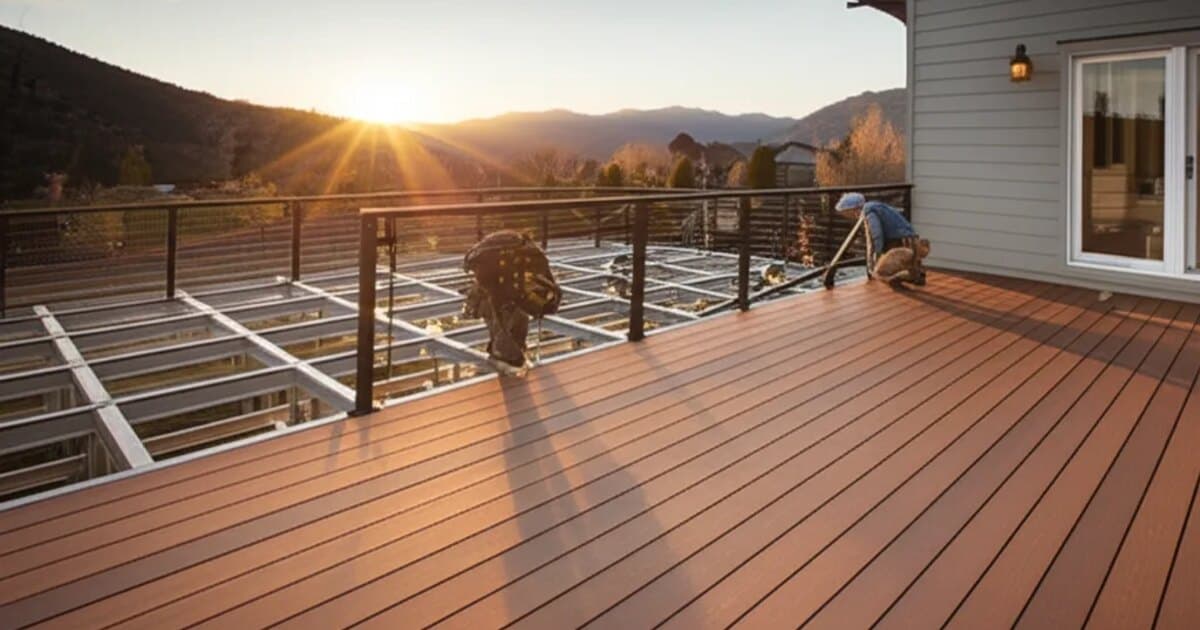
Deck Lighting for Boise Decks
Post caps, stair risers, rail lights, and downlights — the low-voltage LED options that turn a Treasure Valley deck into a genuinely usable outdoor room after sunset. Cost, code, control, and design integration.
Quick answer
For a 300 sq ft Boise deck, a basic post-cap and stair-riser LED lighting package installs at roughly $800–$2,500 all-in, and a comprehensive package (post caps, stair risers, rail downlights, plus accent overhead) runs $2,500–$6,000. Low-voltage LED is the industry standard — safer at points of failure, no electrical permit required when isolated by a listed transformer, and cheap enough to run all night at Idaho Power residential rates. Warm-white (2,700–3,000K) matches interior lighting and works best for evening entertaining. Integrated fixtures during framing beat retrofit installs on cost and visual cleanliness.
Boise summer evenings are long — sunset lands around 9:30 PM in June and July — but even at their longest, the useable outdoor hour after dark is what stretches an unlit deck into an actual room. Without lighting the deck effectively closes at sunset. With lighting the same deck stays functional until midnight or later. For homeowners who invested $12,000 to $30,000 in a deck build, adding another $1,500 to $5,000 in lighting turns a daytime-only surface into an outdoor room that gets four to six additional hours of daily use during the warm months.
Deck lighting also does real safety work. Stair-riser lights make every step visible on the descent to the yard, which matters more than most homeowners realize the first time they walk barefoot down unlit stairs carrying a plate. Perimeter post-cap lights define the edge of the deck so guests do not stumble off. And ambient rail lighting makes it easier to see hazards on the deck surface — a spilled drink, a dropped utensil, or a pet in the walkway.
This guide covers the four most-installed deck lighting types for the Boise market, the cost and code realities, the low-voltage-versus-line-voltage decision, and the integration considerations that separate a clean first-time install from an obvious retrofit.
Post-Cap Lights
Sit on top of railing posts and provide ambient perimeter illumination. The most-installed deck lighting type — every deck with railings can accept post caps, and they are the easiest retrofit if lighting was not included in the original build. Cost: $30 to $80 per fixture (installer cost). Best for: perimeter definition, ambient glow, and the deck's visual outline from a distance.
Stair-Riser Lights
Recessed into each stair riser (the vertical face between treads), lighting every step on the descent. Iron Crest Remodel considers stair-riser lighting the highest-safety-return lighting spec on any deck with more than three risers. Cost: $25 to $60 per fixture, plus install labor for cutting or routing each riser. Best for: safety, and the visual signature of a lit stair run reading from across the yard.
Rail-Integrated Lights
Mount to the underside of the top rail or into the rail profile itself, casting downward illumination onto the deck surface. Rail lights work particularly well on longer perimeter deck runs where post caps alone would leave dark stretches between posts. Cost: $40 to $150 per fixture. Best for: ambient deck-surface illumination on larger decks, and modern-design integration.
Overhead Downlights
Surface- or flush-mounted overhead fixtures installed under a covered deck section, pergola beam, or house eave. Provide focused task lighting for grilling zones, dining tables, or lounge areas. Cost: $80 to $300 per fixture depending on style and dimming capability. Best for: task-focused zones (grill area, outdoor dining) or accent lighting under pergolas and covered sections.
Most Boise deck lighting installs we build use two or three types together — typically post caps plus stair risers as the baseline, with rail lights added for longer perimeter decks and downlights for covered sections or specific task zones.
Iron Crest Remodel's 2026 Treasure Valley installed pricing, on a typical 300 sq ft deck with railings and one stair run:
Basic Package
$800–$2,500 all-in.
Post caps on 6–8 posts plus stair-riser lights on 4–6 risers. Low-voltage transformer, wire runs, and installation. The most-installed spec for Boise decks under $20K total budget.
Mid Package
$1,800–$4,000 all-in.
Adds rail downlights (typically 4–8 fixtures on a 40 LF rail run) to the basic package. Best for decks where perimeter ambient light matters, or where the deck runs longer than 20 feet on any single edge.
Comprehensive
$2,500–$6,000 all-in.
Post caps + stair risers + rail downlights + 2–4 overhead downlights under a covered or pergola section. Full outdoor-room lighting for signature Boise decks.
Line-voltage (120V) installations add $500 to $2,000 above these ranges depending on scope, permit requirements, and access to the existing electrical panel. See our Boise deck cost breakdown for how lighting fits into the full deck budget.
Low-Voltage LED (12V or 24V)
The industry standard for residential deck lighting and Iron Crest Remodel's default recommendation. A listed transformer steps 120V line power down to 12V or 24V, and low-voltage LED fixtures wire to the transformer through indoor/outdoor-rated cable. Advantages: safer at points of failure (a nicked cable is not a shock hazard), no electrical permit required when the transformer is plugged into an existing GFCI receptacle, low current draw for LED operation, and simple to expand or reconfigure over time.
The one design constraint on low-voltage: voltage drop. On runs over about 100 feet from the transformer, LED brightness can taper off if the wire gauge is undersized. Iron Crest sizes wire gauge during design (typically 12/2 or 10/2 for longer runs) so brightness stays consistent from the closest fixture to the farthest.
Line-Voltage (120V)
Line-voltage deck fixtures exist and are used on some architectural applications. They require a permitted electrical installation including GFCI protection at every wet-location outlet, code-compliant conduit or UF-rated cable, and weather-rated fixtures. The install typically requires a licensed electrician and a City of Boise electrical permit. For most residential deck applications, this level of infrastructure is not necessary — low-voltage LED covers 95 percent of the deck lighting use cases at a fraction of the cost.
Where line-voltage does make sense: high-lumen accent lights for large open decks (over 800 sq ft), integrated ceiling fan and lighting combinations on covered decks, or homeowner-specific spec requirements where an existing outdoor 120V circuit is being extended for the deck.
City of Boise permit requirements for deck lighting depend on the voltage class of the wiring:
- Low-voltage (12V or 24V) LED systems do NOT require a Boise electrical permit as long as the low-voltage circuits are isolated from the 120V branch circuit at a listed transformer. The transformer itself must be listed for the load and installed either at a direct-wire connection to a permitted junction box or plugged into a permanent exterior GFCI receptacle.
- The transformer's 120V connection, if newly installed, does require an electrical permit and typically a licensed electrician. If the transformer plugs into an existing exterior GFCI receptacle, no new permit is triggered.
- Line-voltage (120V) deck lighting requires a permitted electrical installation with GFCI protection, weather-rated fixtures, and code-compliant conduit or UF-rated cable.
Iron Crest Remodel handles all permitting through the City of Boise Planning & Development Services department when line-voltage electrical work is part of the deck scope. For most projects, we route the deck lighting on low-voltage LED and use the existing GFCI receptacle at the house exterior wall for the transformer plug — simplest path, no permit trigger, professional install.
The single most consequential decision for deck lighting is timing: install during framing, or retrofit after the deck is done. Two orders of magnitude difference in visible cleanliness.
During Framing (Best Result)
Wire chases route through the framing before decking boards go down. Post-cap wiring runs through the interior of hollow composite posts or into pre-drilled channels in wood posts. Stair-riser fixture cavities are cut into the risers before final assembly. Transformer location is planned with the panel access in mind. The finished deck shows no visible wiring anywhere — every fixture reads as if the deck was designed around it.
Retrofit (Workable but Compromised)
Post-cap lights retrofit cleanly on almost any deck. Stair-riser lights require cutting into completed risers, which can be tight on some construction configurations. Rail lights typically require the rail cap to be removed and re-installed with the wire chase — possible but adds meaningful labor. Some wire runs will be visible on the underside of the deck; we typically route them along beam interiors with paint-color-matched clips, but no retrofit is quite as clean as a first-time install.
For any Boise deck project we build, Iron Crest Remodel discusses the lighting plan alongside the railing and material selection during design. Even if the current budget cannot accommodate full lighting today, roughing in the wire chases and transformer location during framing keeps the future retrofit cost proportional to the fixture cost rather than proportional to the deck rebuild.
Each major composite railing manufacturer publishes its own compatible lighting line. Using manufacturer-matched fixtures keeps the visual profile clean and the warranty coverage intact:
- Trex Deck Lighting — post-cap, recessed rail, and riser lights that integrate with Trex Transcend, Select, and Enhance railings. See our Trex line comparison for which line pairs with which lighting spec.
- TimberTech Advanced Lighting — matches TimberTech AZEK PVC and Composite railing profiles with integrated post-cap and rail systems.
- Deckorators Lighting Solutions — pairs with Deckorators Estate and CXT railings.
- Aluminum-rail lighting — Fortress, Feeney, and Westbury each publish or specify a compatible universal-mount low-voltage system.
For wood decks with cedar or PT railings, DEKOR and Highpoint Deck Lighting produce solid post-cap and stair-riser fixtures that work with any wood rail spec. Universal low-voltage clip-mount fixtures also work on most rail profiles but do not always land cleanly on the visual finish.
Worth It If…
- You use the deck for evening entertaining more than three months a year.
- The deck has a stair run of more than three risers — safety alone justifies riser lights.
- The deck is a signature outdoor-living space in a $500K+ home.
- The deck is elevated 30+ inches above grade — perimeter definition matters.
- Wire chases can be integrated during framing (first-time install).
- You want the deck to extend usable hours 4–6 hours per day in summer.
Skip or Defer If…
- Budget is tight and the deck is primarily daytime use.
- Deck is at grade with no stairs (perimeter definition is less critical).
- You entertain rarely and read the deck as a walking-surface extension of the yard.
- The deck is a small platform under 150 sq ft where minimal ambient light suffices.
- Adjacent house-mounted flood lights or porch lights already illuminate the deck adequately.
For decks where the current budget cannot accommodate full lighting, Iron Crest still recommends roughing in the wire chases and transformer receptacle during framing. Adding fixtures later becomes a fixture-cost-only retrofit rather than a deck-modification retrofit.
Plan Your Deck Lighting with Iron Crest
Free in-home estimate. We design the lighting alongside the railing and framing so wire chases and transformer locations land correctly during construction — no visible retrofits, no compromise on the finished look. Idaho registered contractor, 3-year workmanship warranty.
What types of deck lighting work best for a Boise deck?
The four most-installed deck lighting types in the Boise market: (1) post-cap lights that sit on top of railing posts and provide ambient perimeter light; (2) recessed riser lights integrated into stair risers, which light every step for safe descent after dark; (3) rail-integrated lights that mount to the top or underside of the top rail and cast downward illumination onto the deck surface; and (4) downlights (surface- or flush-mounted overhead fixtures under a covered deck, pergola, or eave). Most Boise deck lighting installations we build use a combination of two or three types — typically post caps plus stair risers, with rail lights added for larger perimeter decks. All four types are widely available in low-voltage LED configurations and integrate with the deck's electrical rough-in during framing rather than being added as a retrofit.
What does deck lighting cost installed in Boise?
Iron Crest Remodel's 2026 Treasure Valley installed pricing runs roughly as follows: a basic LED post-cap and stair-riser lighting package on a 300 sq ft deck lands at $800 to $2,500 all-in, depending on the number of posts and stairs, the specific fixtures selected, and whether a low-voltage transformer plus wiring rough-in already exist. A comprehensive package — post caps, stair risers, under-rail downlights, and a couple of accent downlights on a covered section — typically runs $2,500 to $6,000 on the same deck. Fixture-only prices (installer's cost) run $30 to $80 per post-cap light, $25 to $60 per stair riser light, $40 to $150 per rail light, and $80 to $300 per surface-mount downlight. High-end architectural fixtures (Trex Deck Lighting, TimberTech Advanced Lighting, DEKOR) sit at the top of each range; budget-tier fixtures from Amazon or Home Depot are functional but do not carry the manufacturer warranty of the premium lines.
Should I use low-voltage or line-voltage (120V) for deck lighting?
For residential deck lighting in Boise, low-voltage LED (typically 12V or 24V) is the industry standard and Iron Crest Remodel's default recommendation. Low-voltage systems are safer at points of failure, easier to install without a permitted electrical circuit, less expensive to run because LEDs draw very little current, and simpler to expand or reconfigure over time. Line-voltage (120V) deck fixtures exist and are used on some architectural applications, but they require a permitted electrical circuit, GFCI protection at every wet-location outlet, and code-compliant conduit or UF-rated cable — all of which add cost. The main low-voltage tradeoff is voltage drop: on runs over 100 feet from the transformer, LED brightness can taper off if the wire gauge is undersized. We size wire runs during design so brightness stays consistent across the entire deck.
Do I need a permit for deck lighting in Boise?
Low-voltage (12V or 24V) LED deck lighting systems do NOT require a City of Boise electrical permit as long as the low-voltage circuits are separated from the 120V branch circuit at a listed transformer. The transformer itself is line-voltage and must be installed either as a direct-wire connection to a permitted junction box (which typically requires an electrician and a permit) or plugged into a permanent exterior GFCI receptacle (which does not require a permit if the receptacle already exists). Line-voltage (120V) deck lighting requires a permitted electrical installation including GFCI protection, weather-rated fixtures, and code-compliant conduit or wiring. Iron Crest Remodel handles the permitting through the City of Boise Planning & Development Services department when line-voltage work is part of the scope.
Are LED deck lights energy-efficient enough to leave on all night?
Yes. A typical deck lighting installation running post caps, stair risers, and rail lights across a 300 sq ft deck consumes roughly 20 to 60 watts total when all fixtures are on. Leaving that on for 8 hours a night at Idaho Power's residential rate costs pennies per night — a fraction of what a single interior room's lighting costs. Most Boise deck installations wire onto a photocell (dusk-to-dawn automatic) or an astronomic timer (turns on at sunset, off at sunrise or a set hour) so the lights come on when the sun sets and switch off at a preset time or at sunrise. Motion-activated deck lighting is also an option for security-focused applications, particularly on foothills properties where wildlife or perimeter awareness matters. LED lifespans typically run 25,000 to 50,000 hours per fixture, so a full replacement cycle is 10 to 20 years of nightly use.
What lighting works with composite railings — Trex, TimberTech, Deckorators?
Each major composite railing manufacturer publishes its own compatible lighting line: Trex Deck Lighting (post caps, recessed rail lights, riser lights), TimberTech Advanced Lighting (integrated post-cap and rail systems), and Deckorators Lighting Solutions. Fixtures from one manufacturer typically fit that manufacturer's post caps and rail profile without adapters; cross-brand mixing is possible but sometimes requires custom mounting. For aluminum rail systems (Fortress, Feeney, Westbury), we install manufacturer-compatible lighting or universal low-voltage fixtures that clamp to the rail profile. Iron Crest specifies the lighting alongside the railing selection during design so the fixtures land correctly and the wire chases are integrated during framing rather than retrofitted afterward. Retrofits are possible but always more expensive and more visible than a fully integrated first-time install.
Are solar deck lights a workable alternative to wired LED?
Solar deck lights are the budget-tier option and have their place, but they are not a full substitute for a wired low-voltage system in most Boise applications. What works: solar post-cap lights and standalone solar stair markers on smaller decks with good sun exposure — south, southwest, or west-facing decks that get 4+ hours of direct daytime sun. What does not work well: solar on shaded, covered, or north-facing decks (insufficient charge); solar for critical safety lighting on stair risers (charge levels drop through winter, and any night with cloud cover reduces brightness meaningfully); and solar for whole-deck ambient illumination (the light output per fixture is 5 to 25 percent of a comparable wired LED). Iron Crest recommends solar for supplemental accent lighting on decks that already have wired systems, or as the primary lighting for detached freestanding decks where running low-voltage cable would be impractical.
Can deck lighting be added to an existing deck without rebuilding?
Yes, though the difficulty and cost depend on the existing deck's construction. Post-cap lighting is the easiest retrofit — the caps swap for lit versions and low-voltage wire runs down the outside of the posts, secured with clips or a paint-color-matched channel. Stair riser lights on an existing wood or composite stair are trickier because they typically require cutting into each riser to recess the fixture; on some tight stair configurations the retrofit is not viable without removing the treads. Rail-integrated lights on a retrofit typically require the rail cap to be removed and re-installed with the wire chase, adding meaningful labor. For an existing deck that we did not build, Iron Crest can typically install post-cap and standalone stair marker lighting cleanly, but a full riser-and-rail integrated lighting package is often better as part of a rail replacement or a full deck rebuild than as a standalone retrofit.
What color temperature works best for Boise deck lighting?
Warm-white LED (2,700K to 3,000K color temperature) is Iron Crest Remodel's default recommendation for residential Boise deck lighting. Warm-white looks like traditional incandescent or halogen — it flatters skin tones, blends with interior warm-white living-room lighting for continuity when the sliding door is open, and reads more inviting for evening entertaining. Neutral-white (3,500K to 4,000K) is a reasonable second choice for modern minimalist deck designs where the intended look is cleaner and more contemporary. Cool-white and daylight color temperatures (5,000K+) are generally too clinical for residential deck use and can make outdoor skin tones look washed out. Higher-end fixtures now offer tunable-white LED where color temperature can be adjusted per-scene — a nice feature but not essential for a first deck lighting install. Whatever color temperature you choose, match it across all fixtures on the deck; mixed color temperatures look unintentional and cheap.
Should the deck lighting integrate with smart-home controls?
It can, but the value depends on your household's smart-home footprint. Smart low-voltage transformers (Wemo, Kichler LED Smart Sockets, or Trex's app-controlled system) let you schedule, dim, and scene-control deck lighting from a phone or from a smart-home platform (HomeKit, Alexa, Google Home). This is a nice upgrade for households already using smart lighting inside; it feels overengineered for households that don't. The cost premium is $150 to $500 above a standard photocell-controlled transformer. For most Boise deck installations we use a straightforward photocell or astronomic timer setup — the lights come on at sunset, go off at a preset hour or at sunrise, and require no further attention. If you want smart control, the retrofit path from a standard transformer to a smart transformer is straightforward down the road.