

ADU Floor Plan Planning
Layout options, space planning principles, and site considerations for accessory dwelling units on Boise properties.
Quick answer
A well-designed studio ADU at 350 to 400 square feet can feel comfortable for one or two people when it includes 9-foot ceilings, a full-size bathroom, a functional kitchenette with a two-burner cooktop and under-counter refrigerator, and built-in storage.
Explore our full Boise ADU construction services
The floor plan is the single most consequential decision in an ADU project. A poorly planned 800-square-foot unit can feel cramped, while a thoughtfully designed 400-square-foot studio can feel open and fully functional. Every square foot must serve a purpose because there is no surplus space to absorb layout mistakes. Getting the plan right before construction starts eliminates costly change orders and ensures the finished unit works for its intended use — whether that is rental income, housing a family member, or a home office with guest quarters.
This guide covers ADU layout options from studio to two-bedroom configurations, space planning principles for compact living, kitchen and bathroom design within tight footprints, and site planning considerations specific to Boise lot configurations.
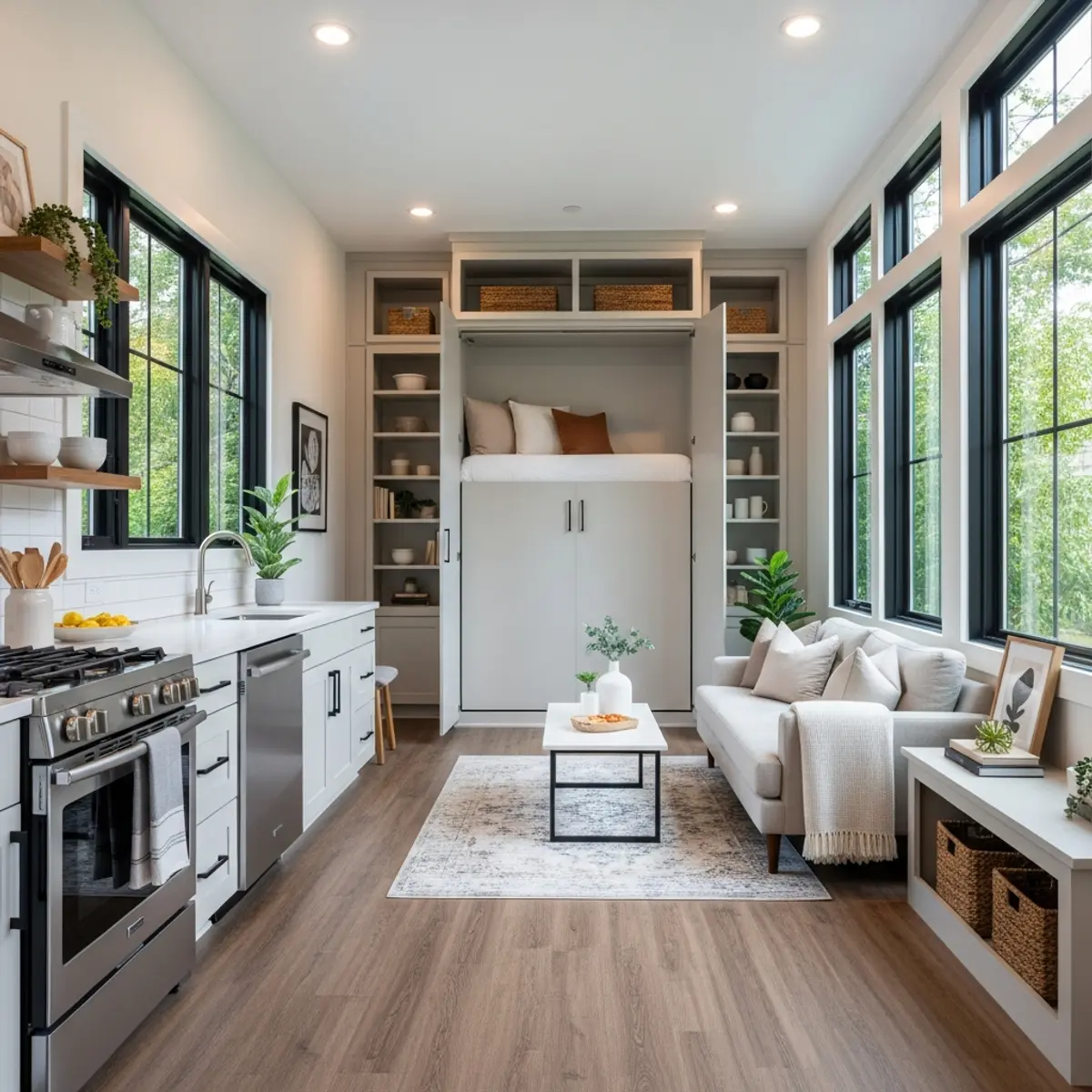
ADU floor plans fall into three general size categories, each suited to different occupant profiles and lot conditions. The right size depends on your intended use, available lot area after setbacks, and budget.
Studio (300–450 Square Feet)
A single open living and sleeping area with a separate bathroom and a kitchenette or compact galley kitchen. Studios work well for single occupants, short-term rental guests, or as a home office that doubles as guest quarters. The key to a livable studio is clear zone separation — using furniture placement, a partial wall, or a ceiling-height bookcase to define sleeping, living, and kitchen areas without closing off sightlines. Studios fit on most Boise residential lots with minimal impact on yard space and are the least expensive ADU to build.
One Bedroom (450–650 Square Feet)
A dedicated bedroom separated by a full wall and door, a living area, a full bathroom, and a more complete kitchen. The one-bedroom layout is the most popular ADU configuration in Boise because it serves the widest range of uses: long-term rental, aging-in-place for a parent, adult child housing, or Airbnb. The enclosed bedroom provides the acoustic and visual privacy that studio layouts lack. At 550 to 650 square feet, there is enough room for a proper galley or L-shaped kitchen with full-size appliances.
Two Bedroom (650–900 Square Feet)
Two enclosed bedrooms, a full bathroom (sometimes with a half bath), a living area, and a full kitchen. The two-bedroom plan suits families, roommate situations, or rental markets where two-bedroom units command significantly higher monthly rents than studios or one-bedrooms. In Boise, the rental premium for a second bedroom is typically $300 to $500 per month. The trade-off is a larger building footprint, higher construction cost, and more demand on lot coverage and setback calculations.
| Layout | Size Range | Cost Range | Best For |
|---|---|---|---|
| Studio | 300–450 sq ft | $95K–$150K | Single occupant, short-term rental, home office |
| 1 Bedroom | 450–650 sq ft | $130K–$200K | Long-term rental, aging parent, adult child |
| 2 Bedroom | 650–900 sq ft | $180K–$280K | Family rental, roommates, maximum rental income |
Compact living demands deliberate planning. Every corridor, doorway, and corner represents either usable space or wasted space depending on how the plan is organized. These principles guide the layout process for every ADU we design in Boise.
- Eliminate hallways wherever possible. Hallways consume floor area in a small unit and serve no function other than circulation. Direct room-to-room flow or an open plan recovers that space for living.
- Group wet walls. Place the kitchen and bathroom on the same wall or back-to-back to share a single plumbing run. This reduces rough-in cost by $2,000 to $5,000 and simplifies utility connections.
- Use 9-foot ceilings instead of standard 8-foot. The added height makes compact rooms feel significantly larger with no increase in footprint. The framing cost difference is minimal.
- Plan furniture placement before finalizing the layout. A floor plan that looks open on paper may not accommodate a queen bed, a sofa, and a dining table without blocking windows or walkways.
- Specify pocket doors or barn doors instead of swing doors. A standard swing door requires 9 square feet of clear floor space for its arc. Pocket doors recover all of it.
- Design built-in storage into walls, under stairs (in two-story plans), and above doorways. Freestanding furniture in a small space blocks sightlines and makes the room feel cluttered.
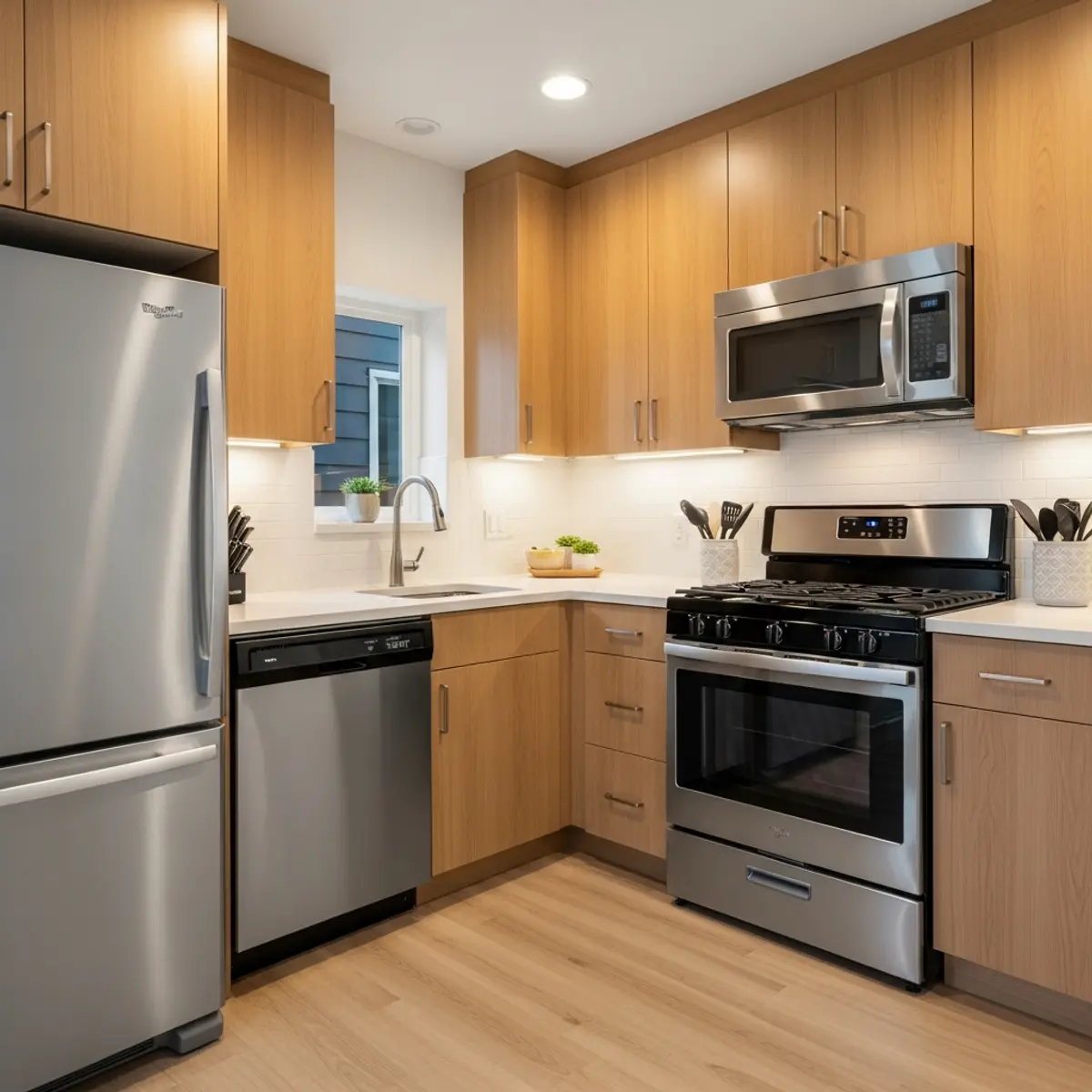
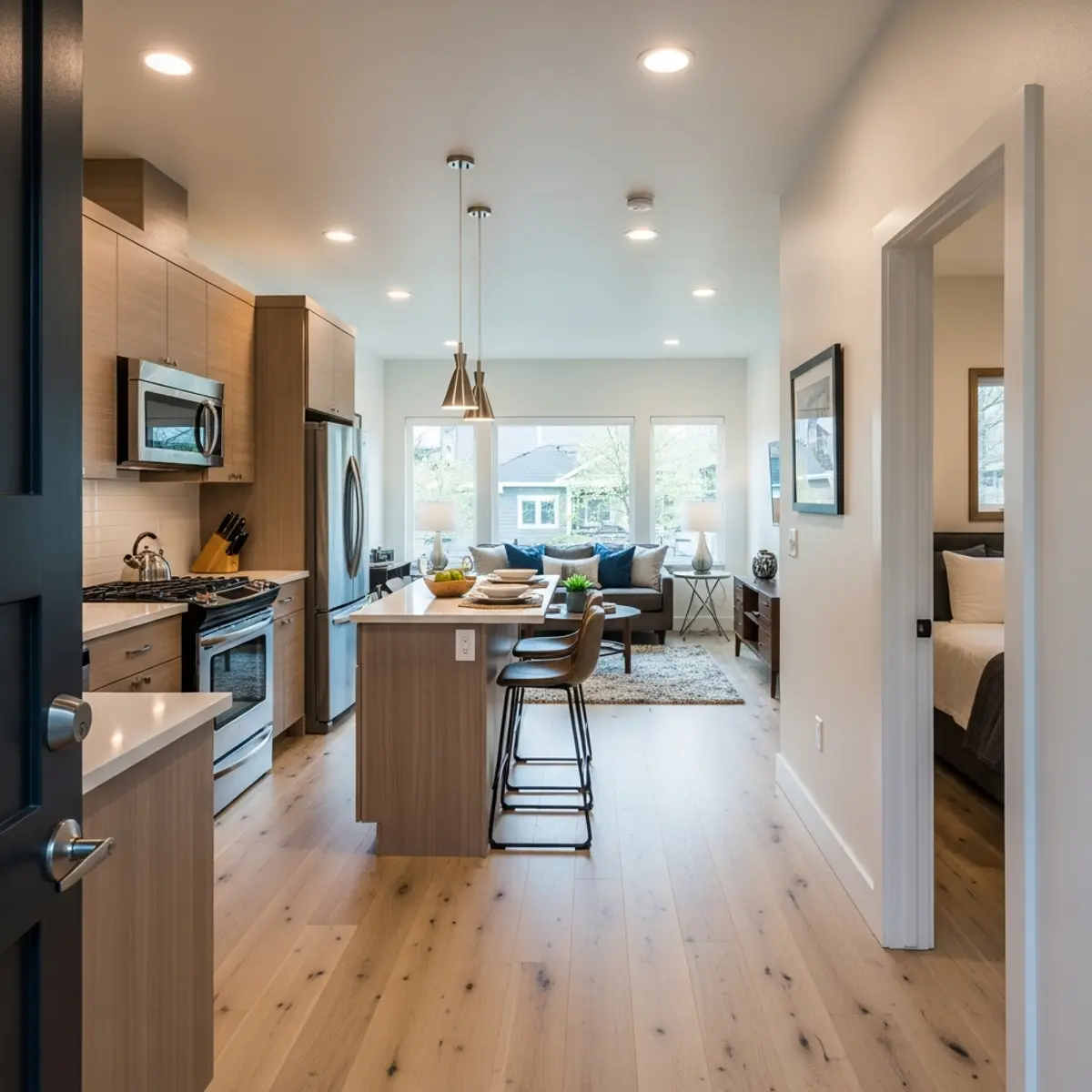
The kitchen is the most complex room in an ADU because it packs plumbing, electrical, ventilation, and storage into the smallest possible footprint. The layout choice depends on the overall unit size and whether the ADU is intended for full-time living or occasional use.
Galley Kitchen (Best for 450–650 Sq Ft ADUs)
Two parallel counter runs in a 5-to-6-foot-wide corridor. The galley provides the most counter and cabinet space per square foot of any layout. Place the sink and cooktop on one wall and the refrigerator and storage on the opposite wall. A galley kitchen in a 5-by-8-foot space delivers 12 to 16 linear feet of counter, a full sink, a 24-inch range, and an under-counter or apartment-size refrigerator. Keep a minimum of 36 inches between facing counters for comfortable movement.
L-Shape Kitchen (Best for 650–900 Sq Ft ADUs)
Cabinets along two adjacent walls meeting at a corner. The L-shape opens the kitchen to the living area, making it the natural choice for two-bedroom ADUs where the kitchen sits within an open-concept great room. It accommodates full-size appliances including a standard 30-inch range and a full-height refrigerator. The corner junction requires a lazy susan or blind-corner pull-out to avoid dead storage space.
Single-Wall Kitchenette (Best for Studios Under 400 Sq Ft)
All appliances and cabinets along a single 8-to-10-foot wall. The kitchenette uses the least floor area and is the simplest to plumb and wire. It typically includes a two-burner cooktop or a 24-inch range, an under-counter refrigerator, a single-bowl sink, and 4 to 6 upper cabinets. The trade-off is limited counter space — plan for at least 24 inches of clear prep surface between the sink and cooktop. A microwave mounted above the cooktop or under a cabinet saves counter space.
ADU bathrooms must deliver full functionality in the smallest practical footprint. A well-planned ADU bathroom fits into 35 to 50 square feet — roughly a 5-by-7-foot or 5-by-8-foot room — while still feeling comfortable.
- A 32-by-32-inch or 36-by-36-inch shower stall with a bench seat is more space-efficient than a tub-shower combo and eliminates the step-over barrier that creates accessibility issues
- A wall-hung vanity with an open shelf below creates visual floor space and makes the room feel larger than a cabinet-style vanity
- A pocket door on the bathroom entry recovers the 9 square feet that a swing door consumes — critical in a 40-square-foot bathroom
- Place the toilet on the wall opposite the shower so the room has a clear walkway between the two fixtures without sidestepping
- A recessed medicine cabinet provides storage without projecting into the room, and lighted mirrors eliminate the need for a separate vanity light fixture
- In two-bedroom ADUs, a half bath (toilet and sink only) near the living area adds convenience and costs only $3,000 to $5,000 to rough in when plumbing lines are already nearby
Built-In Storage Strategies
ADUs cannot rely on walk-in closets or spare rooms for overflow storage. Every storage solution must be built into the architecture. Floor-to-ceiling closets with adjustable shelving maximize vertical space. A platform bed with drawers underneath replaces a dresser. Kitchen upper cabinets that extend to the ceiling (with a small step stool for top-shelf access) add considerably more cabinet volume than standard 30-inch uppers. A bench seat at the entry with shoe storage below and coat hooks above eliminates the need for a separate closet. In two-story ADU plans, the space beneath the staircase accommodates a closet, shelving, or a compact laundry stack.
Natural Light and Window Placement
Natural light is the most powerful tool for making a small space feel larger. Every habitable room should have at least one window, and the floor plan should position the primary living area on the south or west elevation to capture the most daylight. In Boise's climate, south-facing windows gain beneficial passive solar heat in winter while roof overhangs block high summer sun. Clerestory windows (narrow windows placed high on the wall) bring light deep into the room without sacrificing wall space for furniture. Skylights or solar tubes in interior bathrooms eliminate the dark, enclosed feeling that windowless bathrooms create. Specify windows with a low sill height (24 inches instead of 36 inches) in living areas to bring more light in and create a visual connection to the outdoors.
An ADU shares a lot with the main house, so privacy planning affects both the ADU occupant and the primary homeowner. Thoughtful site orientation avoids the fishbowl effect that poorly placed ADUs create.
Window Orientation Relative to the Main House
Position the ADU so that its primary windows (bedroom and living room) face away from the main house or toward a side yard rather than directly at the primary residence. If direct-facing windows are unavoidable due to lot constraints, offset them vertically or horizontally so they do not align with main house windows. Frosted glass or high-sill windows on the wall closest to the main house provide light without sightlines. Bathroom windows should always use frosted or obscure glass regardless of orientation.
Entry and Circulation Paths
The ADU entrance should have its own path from the street or alley that does not route through the main house's private outdoor living area. A separate side-yard walkway or alley-accessed entry gives the ADU occupant independence and prevents the homeowner from feeling that their yard is a shared thoroughfare. In Boise neighborhoods with rear alley access (common in the North End and parts of the Bench), alley-facing ADU entries are the cleanest solution.
Boise Lot Configurations and Common Site Plans
Standard Boise residential lots range from 5,000 to 10,000 square feet with widths of 50 to 75 feet. Rear-yard ADUs are the most common configuration, placed behind the main house with access from a side yard or rear alley. Corner lots offer more flexibility because the ADU can face the side street with its own address and entry. Narrow lots (50 feet or less) typically limit the ADU to a long, narrow footprint oriented parallel to the side property line, which makes a one-bedroom galley plan the natural fit. Wider lots allow a more square footprint that accommodates L-shaped kitchens and more flexible room arrangements. Setbacks define the maximum buildable envelope, and in Boise they come from the underlying zone rather than any ADU-specific rule (Zoning Code Section 11-03-03.2.B(6)) — 5 feet at the interior side and 15 feet at the rear in R-1C, 10 feet and 20 feet in R-1A and R-1B. A site survey is essential before committing to any floor plan.
Understanding utility requirements by layout is essential during the site planning phase, as sewer, water, and electrical connection points influence where the ADU can sit on the lot and how the floor plan is oriented.
Many Boise homeowners build ADUs specifically for aging parents or as a future aging-in-place option for themselves. Building accessibility into the original design costs far less than retrofitting later. Even if the first occupant does not need accessibility features, including them increases the unit's long-term versatility and market appeal.
- Zero-step entry with a flush threshold at the main door eliminates the need for a ramp and meets visitability standards
- 36-inch-wide doorways (instead of standard 32-inch) accommodate wheelchairs and walkers with minimal cost difference during new construction
- A curbless shower with a linear drain allows wheelchair roll-in access and looks modern in any bathroom design
- Lever-style door handles and single-lever faucets require less grip strength than knobs and are standard in most contemporary fixture lines
- Blocking installed behind bathroom walls during framing allows grab bars to be added later without opening walls — a $50 investment during construction that saves $500 or more if needed later
- A single-story floor plan eliminates stair barriers entirely, making the unit fully accessible without mechanical lifts or stairlifts
Boise's residential landscape includes everything from compact North End lots to multi-acre parcels in the foothills and surrounding communities. The lot you already own — its width, depth, total area, and zoning classification — determines which ADU floor plans are physically and legally feasible before any design decisions come into play. Understanding these constraints upfront prevents wasted design time and ensures the floor plan you fall in love with actually fits your property.
Standard Ada County Residential Lot (0.15–0.25 Acres)
The majority of Boise's established neighborhoods — the Bench, West Boise, Southeast Boise, and much of Garden City — feature lots in the 6,500-to-11,000-square-foot range. After applying the zone's setbacks and accounting for existing structures, most of these lots can accommodate an ADU footprint of 500 to 800 square feet. A one-bedroom or compact two-bedroom floor plan is the sweet spot. Boise's residential districts set no maximum lot coverage percentage, so the binding constraint is the setback envelope — most often the rear setback, which is 15 feet in R-1C and 20 feet in R-1A and R-1B. Keeping a detached unit between 121 and 500 square feet and under 14 feet in height qualifies it for the reduced 3-foot side and 9-foot rear setbacks in Table 11-04.4, which can recover a meaningful amount of usable depth on a shallow lot.
North End & East End Lots (Narrow and Deep)
Boise's North End and parts of the East End feature some of the city's oldest residential lots — often just 40 to 50 feet wide but 125 to 150 feet deep. These narrow, deep parcels push ADU design toward shotgun-style layouts: long and narrow floor plans that run parallel to the side property line. A typical configuration on a 45-foot-wide North End lot places the ADU at the rear of the property, accessed via the rear alley (most North End blocks have alley access). On an R-1C parcel the usable building width after 5-foot interior side setbacks on both sides is roughly 35 feet, but the ADU itself often sits on one side of the lot to preserve a side-yard pathway from the street. A 16-by-40-foot footprint (640 square feet) fits a comfortable one-bedroom plan with the kitchen and living area at the alley-facing end and the bedroom at the rear. Shotgun layouts keep plumbing on one wall for the full length of the unit, which cuts rough-in cost compared to layouts that distribute wet rooms across multiple walls.
Meridian & Eagle Lots (Wider, HOA Considerations)
Subdivisions in Meridian and Eagle tend to have wider lots (60 to 80 feet) on 0.15-to-0.30-acre parcels, providing more flexibility in ADU footprint shape and orientation. However, the majority of these neighborhoods are governed by Homeowners Associations with Covenants, Conditions & Restrictions (CC&Rs) that may restrict or prohibit accessory dwelling units outright. Before investing in design work, homeowners must review their CC&Rs and obtain written HOA approval. Where ADUs are permitted, the wider lot format accommodates squarer floor plans — a 24-by-30-foot footprint (720 square feet) for a two-bedroom layout, or a 20-by-25-foot plan (500 square feet) for a roomy one-bedroom. The additional width also makes it easier to orient the ADU entrance away from the main house for maximum privacy. Meridian's zoning code has its own setback and lot coverage rules that differ from Boise's, so a jurisdiction-specific zoning review is essential.
Rural & Acreage Lots (1+ Acre)
Properties with one acre or more — common in northwest Boise, parts of Eagle, Star, and unincorporated Ada County — offer maximum design flexibility. Setback constraints are rarely the limiting factor at this scale. These properties can support larger ADU footprints up to the maximum allowed by local code (Idaho's 2026 ADU law, Senate Bill 1354, sets a floor of 1,000 square feet or 75% of the primary home for cities over 10,000 residents; unincorporated Ada County zones may allow larger). Two-story designs, attached garages, covered porches, and detached workshop-ADU combinations are all feasible. The primary constraint on acreage lots shifts from zoning to infrastructure: septic system capacity (if not on municipal sewer), well water adequacy, electrical service distance from the transformer, and driveway access for emergency vehicles. A larger ADU on an acreage lot may also require a separate septic system or an engineered upgrade to the existing system, adding $8,000 to $20,000 to the project budget.
Setback Requirements by Zone
| Zone | Front Setback | Side Setback | Rear Setback | Max Height |
|---|---|---|---|---|
| R-1A (Large Lot) | 15 ft (20 ft garage) | 10 ft | 20 ft | 35 ft |
| R-1B (Suburban) | 15 ft (20 ft garage) | 10 ft | 20 ft | 35 ft |
| R-1C (Traditional) | 15 ft (20 ft garage) | 5 ft | 15 ft | 3 stories / 40 ft |
| R-2 (Compact) | 10 ft (20 ft garage) | 5 ft | 15 ft (5 ft on an alley) | 4 stories / 45 ft |
| Detached accessory, 121-500 sq ft & under 14 ft | — | 3 ft | 9 ft | under 14 ft |
How to Calculate Buildable Area
Start with the total lot area from your property survey or Ada County parcel records. Subtract the setback zones on all four sides to find the buildable envelope. Then subtract the parts of that envelope already occupied by existing structures (main house, garage, shed) and anything you need to keep, such as a driveway or a side-yard path. The remaining area is what's available for your ADU footprint. Boise does not cap residential lot coverage by percentage, so this is a geometry exercise, not a coverage calculation — on a 9,000-square-foot R-1C lot, a 15-foot rear setback and 5-foot side setbacks are what determine whether an 800-square-foot ADU fits behind the house. Check as well whether staying under 500 square feet and 14 feet in height would let you use the reduced setbacks in Table 11-04.4. A professional site survey (typically $400 to $800 in Boise) verifies property boundaries, identifies easements, and flags utility locations that could affect ADU placement.
How you intend to use your ADU should drive every design decision, from the floor plan layout to the materials you select. A rental unit prioritizes durability, tenant privacy, and market appeal. A family unit prioritizes connection, comfort, and specific lifestyle needs. Designing for the wrong use case creates friction that lasts for the life of the building.
Long-Term Rental ADU Design
A rental ADU must function as a completely self-contained dwelling that a tenant can occupy without depending on the main house for anything. That means a separate, clearly defined entrance — ideally not visible from the primary home's main living areas — with its own address number and mailbox if permitted by your jurisdiction. Include in-unit laundry hookups (a stacked washer-dryer closet takes just 6 square feet of floor area) because tenants strongly prefer in-unit laundry and will pay $75 to $125 more per month for it. Specify durability-first materials: luxury vinyl plank flooring (not hardwood), quartz or solid-surface countertops (not butcher block), semi-gloss paint in high-traffic areas, and commercial-grade cabinet hardware. Design generous closet and pantry storage because tenants bring their own furnishings. Provide at least one dedicated off-street parking space with a clear path that does not conflict with the homeowner's parking. Sound insulation between the ADU and any shared walls or proximity to the main house — using staggered-stud walls, resilient channel, and double drywall — prevents noise complaints that sour the landlord-tenant relationship.
Family Use: Aging Parent
When the ADU is for a parent who needs to live close to family, the design should balance independence with connection. A covered walkway or breezeway between the main house and the ADU allows the parent to move between buildings without exposure to weather — critical during Boise's icy winter months. The entire unit should be single-level with zero-step entries, 36-inch doorways, lever handles, and a curbless shower with grab-bar blocking in all wet walls. Position the ADU bedroom on the quietest side of the property with windows that do not face the main house's children's play area or patio. Include an emergency call system or smart-home integration that connects to the main house. A small covered porch or patio adjacent to the main house's outdoor living area creates a shared social zone where the family naturally gathers. Kitchen design should accommodate aging-in-place considerations: pull-out shelves instead of deep base cabinets, a side-opening wall oven instead of a below-counter oven, and task lighting under every upper cabinet.
Family Use: Adult Child
An ADU for an adult child returning home or launching into independence requires a different emphasis: privacy and acoustic separation. The goal is a space that feels like the occupant's own apartment, not an extension of the parents' home. Separate utility meters (or at minimum a sub-meter for electricity) establish financial independence and avoid awkward conversations about utility usage. Sound insulation between the ADU and main house is even more important than in rental situations because family dynamics make noise sensitivity more emotionally charged. The entrance should be completely separate from the main house entry, ideally on a different side of the property. Design the floor plan to include a small workspace or desk nook — many adult children work remotely and need a functional home office area. A separate HVAC system (a ductless mini-split is the most cost-effective option at $3,500 to $6,000 installed) ensures the occupant controls their own comfort without affecting the main house thermostat.
Short-Term Rental (Airbnb / Vacation Rental)
Short-term rental ADUs in Boise target travelers visiting for outdoor recreation, Boise State events, business trips, and medical stays. Design priorities shift toward upscale finishes, turnkey furnishing, and guest experience. Specify higher-end materials that photograph well: tile backsplashes, pendant lighting, modern fixtures, and a cohesive interior design palette. Include a private outdoor space — even a 6-by-8-foot patio with string lights and two chairs significantly boosts listing appeal and nightly rates. A keyless smart lock eliminates key handoff logistics. Built-in USB charging stations, a stocked kitchenette, and quality linens reduce guest complaints and increase review scores. Note that Boise's short-term rental regulations require a city permit and limit the number of days the unit can be rented in some zones, so verify current rules with the City of Boise Planning & Development Services before committing to a short-term rental design strategy.
Build Cost by ADU Type
We publish what we can stand behind: what these units cost to build. We do not publish Boise rent, occupancy, or property-value figures — we are a builder, not a brokerage, and we have no data source that would make those numbers reliable. For the income side of your pro forma, pull current comparable listings for your own neighborhood and unit size, or ask a local property manager for actual leased rates and days on market.
| ADU Type | Typical Build Cost |
|---|---|
| Studio | $95K–$150K |
| 1 bedroom | $130K–$200K |
| 2 bedroom | $180K–$280K |
Long-term rentals provide consistent, predictable income with lower management overhead. Short-term rentals generate higher gross revenue but require active management, furnishing investment ($5,000–$15,000), cleaning turnover costs, and compliance with Boise's short-term rental permit requirements. A family-use ADU generates no direct income, but it houses someone who would otherwise be paying market rent, and it is a permanent addition to the property.
Every ADU floor plan in Boise operates within a framework of zoning requirements that directly shape what you can build. These are not abstract regulations — they determine ceiling heights, square footage limits, building placement, and even whether you can add a second story. Understanding these constraints before you start designing saves thousands of dollars in redesign costs and prevents permit denials that can delay your project by months.
Maximum Size: 800 Square Feet in Most Zones
The City of Boise caps ADU size at 900 square feet or 70 percent of the primary structure's total floor area, whichever is smaller, with no more than two bedrooms (Zoning Code Section 11-03-03.2B). This means if your main house is 1,200 square feet, your ADU is limited to 840 square feet regardless of lot size. Idaho's 2026 ADU law (Senate Bill 1354) requires Boise to raise that cap to at least 1,000 square feet or 75% of the primary home by February 1, 2027, so confirm the limit in effect with Planning & Development Services. The 900-square-foot cap applies to finished floor area — it does not include an attached garage, covered porch, or unfinished storage area, though they still occupy part of the buildable envelope. For floor planning purposes, a 900-square-foot limit comfortably accommodates a two-bedroom layout with a full kitchen and bathroom but requires careful space planning to avoid wasting square footage on oversized hallways or closets.
No Owner-Occupancy Requirement
Boise's Modern Zoning Code does not require the property owner to live in either the primary dwelling or the ADU, and Idaho's 2026 ADU law (Senate Bill 1354) prohibits cities from imposing such a rule. You may live in either unit or rent both. Because many owners still live on the same lot as the ADU occupant, privacy-focused design — separate entrances, sound insulation, and thoughtful window placement — remains a floor-plan priority, and it also raises achievable rent when both units are leased.
Parking (Not Required, but Plan It)
Boise does not require an added off-street parking space for the ADU, and Idaho's 2026 ADU law (Senate Bill 1354) limits when cities can require one; the only rule is that a garage conversion may not reduce the lot's required parking for the primary dwelling. Tenants still value a dedicated space, so most rental plans include a driveway extension, a new parking pad, or a space within an existing garage. The parking space location affects ADU site planning: if the parking pad is at the rear of the property adjacent to the ADU, it creates a natural arrival zone that supports a separate entrance design. If the parking must go in the front driveway area, the ADU occupant's circulation path to the rear-yard ADU becomes longer and may require a dedicated walkway along the side yard.
Height Restrictions and Two-Story Limitations
Boise caps an ADU at two stories (Zoning Code Section 11-03-03.2.B(3)) and otherwise applies the underlying zone's height maximum — 35 feet in R-1A and R-1B, and three stories not to exceed 40 feet in R-1C. Idaho's 2026 ADU law also bars a city from imposing a height limit lower than the existing house (Idaho Code § 67-6541(2)(f)). One practical trade-off is worth planning around: the reduced accessory-structure setbacks in Table 11-04.4 are available only below 14 feet in height, so a two-story ADU must hold the full zone setback. Two-story ADUs can be an effective solution for tight lots because they double the living area on the same footprint, but they introduce design complications: stairs consume 25 to 35 square feet per floor, the upper story may trigger neighbor notification requirements, and height restrictions can limit roof pitch options that affect interior ceiling height. A two-story ADU with a 400-square-foot footprint can deliver 700 to 750 square feet of living area after accounting for the stairwell — enough for a comfortable two-bedroom plan on a lot that could only support a studio as a single-story structure.
Utility Connection Requirements
Boise allows ADUs to share water and sewer connections with the primary dwelling or establish separate connections. Shared connections are less expensive ($2,000 to $5,000 for the tie-in) but require the main house's service lines to have adequate capacity. Separate connections ($8,000 to $15,000 for new water and sewer taps) are required if the existing lines are undersized or if the ADU is located far from the main house connection points. Electrical service can be shared via a sub-panel or provided through a separate meter — a separate meter adds $1,500 to $3,000 but simplifies utility billing for rental ADUs. Gas service, if needed, typically requires a separate meter. These utility decisions influence floor plan orientation because the kitchen and bathroom should face the direction of the utility connections to minimize underground pipe runs. See our detailed guide on ADU utility hookups in Boise for a complete breakdown.
Common Floor Plan Templates Within Boise's Rules
Given Boise's 800-square-foot cap and typical setback constraints, several floor plan templates consistently work well across the city's most common lot types:
- The 20-by-30-foot rectangle (600 sq ft): a one-bedroom with open-concept kitchen and living area, full bathroom, bedroom closet, and a small entry foyer. Fits on lots as narrow as 40 feet after setbacks.
- The 24-by-32-foot rectangle (768 sq ft): a two-bedroom with a galley kitchen, living area, full bathroom, and two modestly sized bedrooms. Requires a lot width of at least 50 feet after setbacks.
- The 16-by-40-foot shotgun (640 sq ft): ideal for narrow North End lots. Kitchen and living at one end, bedroom at the other, bathroom in the center. All plumbing on one wall.
- The 20-by-20-foot two-story (800 sq ft total): 400 square feet per floor. Main level has kitchen, living, and half bath. Upper level has bedroom, full bathroom, and closet. Minimizes lot coverage on tight sites.
- The 22-by-22-foot studio (484 sq ft): open plan with sleeping, living, and kitchen zones, one full bathroom, and a generous closet. The most affordable and fastest option to build.
When to Request a Variance
If your lot conditions or design goals do not fit within standard zoning rules, the City of Boise allows property owners to apply for a variance through the Board of Adjustment. Common ADU variance requests include reduced setbacks (when the buildable area is too small for a functional ADU) and height exceptions (for designs that exceed the zone's height maximum). Variance approval is not guaranteed — Boise requires applicants to demonstrate a hardship specific to the property (not a personal financial hardship) and show that the variance will not adversely affect neighboring properties. The variance process takes 6 to 12 weeks and costs $300 to $600 in application fees. Realistic expectations matter: variances for minor setback reductions (1 to 2 feet) have a higher approval rate than requests for significant deviations from code. Your designer or contractor should evaluate whether a variance is necessary and winnable before you invest in a floor plan that depends on regulatory approval. Our team can review your lot and advise on feasibility as part of a free ADU consultation.
What is the smallest ADU floor plan that feels livable?
A well-designed studio ADU at 350 to 400 square feet can feel comfortable for one or two people when it includes 9-foot ceilings, a full-size bathroom, a functional kitchenette with a two-burner cooktop and under-counter refrigerator, and built-in storage. Below 300 square feet, most occupants find the space too constrained for daily living. Boise's zoning code sets a maximum ADU size but no minimum, so the practical floor is a livability judgment rather than a code threshold — we recommend 350 square feet.
Can I build a two-bedroom ADU on a standard Boise lot?
Yes, many standard Boise lots of 7,000 square feet or more can accommodate a two-bedroom ADU of 650 to 900 square feet, provided you meet the setbacks of your underlying zone (Zoning Code Section 11-03-03.2.B(6)) — 5 feet at the interior side and 15 feet at the rear in R-1C, 10 feet and 20 feet in R-1A and R-1B. Boise's residential districts do not set a maximum lot coverage percentage, so the setback envelope is what limits the footprint. The two-bedroom layout requires careful site planning to fit the footprint and maintain required separation from the main house. Boise currently caps ADUs at 900 square feet or 70% of the primary structure; Idaho's 2026 ADU law (Senate Bill 1354) raises the floor to 1,000 square feet or 75% by February 1, 2027 — confirm the limit in effect with Planning & Development Services. A site survey and zoning review are the first steps to confirm feasibility.
How much does it cost to build a studio ADU versus a two-bedroom ADU in Boise?
A studio ADU in Boise typically costs $90,000 to $150,000, a one-bedroom ADU runs $130,000 to $200,000, and a two-bedroom ADU ranges from $180,000 to $280,000. The per-square-foot cost tends to decrease as the unit gets larger because fixed costs like permits, utility hookups, foundation work, and the kitchen and bathroom are spread across more floor area. Finishes, site conditions, and utility connection distances are the biggest variables.
Should I choose a single-story or two-story ADU floor plan?
Single-story ADUs are simpler to build, more accessible, and less expensive per square foot for foundation and roofing. Two-story ADUs fit a larger living area on a smaller footprint, which is valuable on tight Boise lots where setbacks limit the buildable area. However, two-story designs cost more for structural framing, require stairs that consume 25 to 35 square feet per floor, and may trigger additional height restrictions or neighbor notification requirements. For most Boise properties, a single-story plan is the most practical choice unless the setback envelope is the binding constraint. Note that Boise caps an ADU at two stories (Zoning Code Section 11-03-03.2.B(3)), and that staying under 14 feet in height is what qualifies a detached unit for the reduced accessory-structure setbacks.
What kitchen layout works best in an ADU under 500 square feet?
A galley kitchen or a single-wall kitchenette works best in ADUs under 500 square feet. A galley layout with two parallel counters in a 5-by-8-foot space provides a full sink, a 24-inch range or two-burner cooktop, an under-counter refrigerator, and 6 to 8 linear feet of counter space. A single-wall kitchenette condenses everything into one 8-to-10-foot run and is the most space-efficient option for studios. Both layouts keep plumbing on one wall, which reduces rough-in costs.
How do I plan for privacy between my main house and the ADU?
Privacy starts at the site plan. Orient the ADU entrance away from the main house so foot traffic does not cross shared outdoor areas. Place ADU bedroom and living room windows on the side or rear walls that face away from the primary residence. Use offset window placement so ADU windows do not directly align with main house windows. Landscape screening with evergreen hedges or a 6-foot fence along the shared boundary adds visual separation. Inside the ADU, position the bathroom and kitchen on the wall closest to the main house because these rooms need fewer and smaller windows.
The following government agencies, industry organizations, and official resources provide additional information relevant to your remodeling project.
ADU Construction reads differently in each Boise neighborhood — different housing era, different permit overlay, different finish-tier expectations. 9 neighborhood-specific guides:
Plan Your ADU Floor Plan With Experts
Free ADU consultations and detailed estimates for accessory dwelling units in Boise, Meridian, Eagle, Nampa, and the Treasure Valley. No obligation.