
ADU Construction Across Vista, Curtis / Targee, Eastern Bench & the Lower Bench
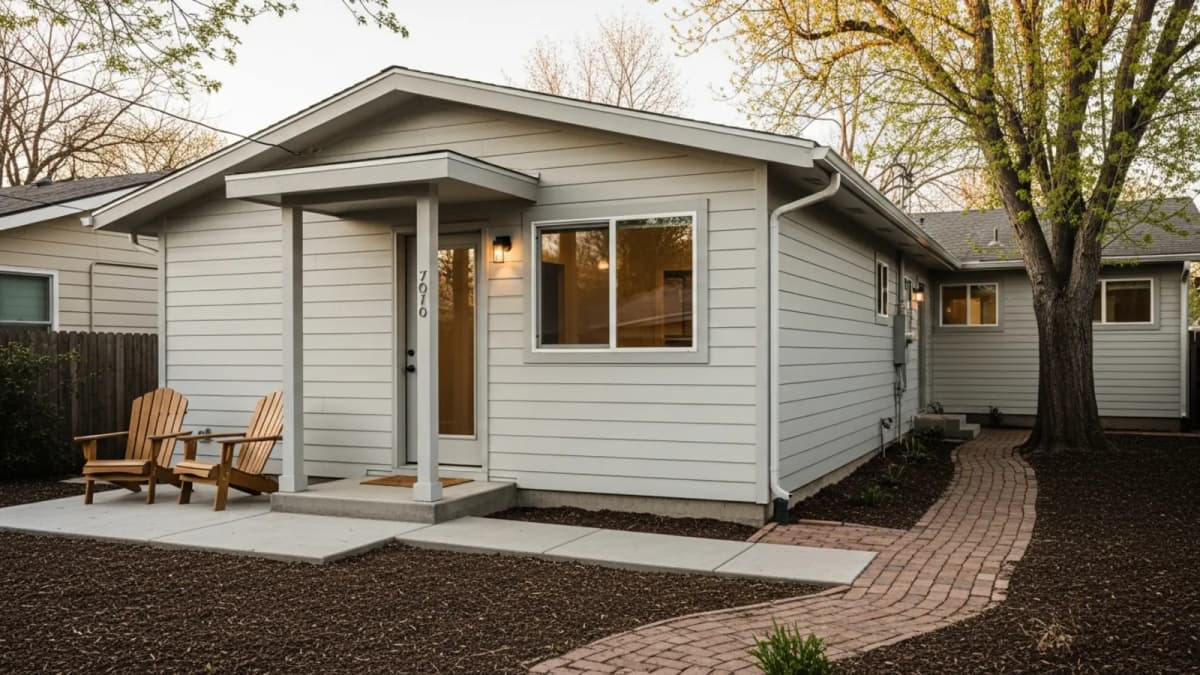
Detached carriage-house ADUs on compact alley-access lots, garage conversions on 1955-era ranch stock, basement ADUs on Eastern Bench splits — built on uniform Bench lot geometry that makes setback compliance easy, without the HPC overlay that comparable North End ADU scope carries.
Quick answer
Almost certainly yes. Uniform Bench lot geometry (compact, with alley access at the rear) makes ADU setback compliance straightforward on virtually every block — at typical Bench lot depth, most lots clear the underlying zone's setbacks for a new-construction detached ADU without variance.
Building an ADU on the Boise Bench is one of the most economically practical ADU programs in Boise right now — and the math is shaped by three patterns specific to this housing stock. The first is uniform lot geometry: virtually every 1948–1965 Vista, Curtis / Targee, Eastern Bench, and Lower Bench lot is compact alley-access lots with alley access at the rear. That uniformity makes setback compliance straightforward — at typical Bench lot depth, most lots clear the underlying zone's setbacks (Boise sets no ADU-specific setback; an ADU meets the dimensional standards of its district per Zoning Code 11-03-03.2.B(6), which in R-1C is 5' at the interior side and 15' at the rear) without variance, which is a meaningful operational advantage over the narrow frontages of Sunset bungalow streets where setback variance ($3,500–$8,500) is common. The second is alley-accessed original detached garages on most pre-1965 Bench blocks — single-stall or two-stall structures from original construction that are sometimes worth converting and sometimes worth replacing. The third is the absence of any Historic Preservation overlay: the Bench isn't within a designated Boise Historic District, so ADU work proceeds at standard City of Boise speed (confirm current turnaround with Boise PDS) without the HPC Certificate of Appropriateness overlay that comparable North End or East End ADU scope carries. The Bench rental market for well-built small units is solid, though it doesn't carry the downtown-walkability premium the Sunset corridor does; we publish no rent figures here, so price the build against current comparable rents from a local property manager rather than against a contractor's estimate. Iron Crest's Bench ADU work is anchored on EPA RRP lead-safe work practices on any conversion of pre-1978 main-residence structure, pre-1980 asbestos pre-screening on garage conversions where original construction sometimes used asbestos-containing materials, alley setback assessment as standard scope at consultation, and Idaho Power separate-meter coordination for rental-tier ADU viability.
ADU strategy on the Bench varies by era because lot geometry, original garage presence and condition, and basement viability all change across the post-war housing waves.
1940–1955 early post-war minimal traditional (Roosevelt Market area, parts of Western Bench)
Smaller original homes on compact lots with alley access. Original detached single-stall garages, where present, are often original to construction and sometimes worth converting. EPA RRP applies on any conversion touching pre-1978 paint surfaces. Some pre-1955 garages have original asbestos-containing materials in roofing felt or interior board — pre-screen testing standard. ADU strategy: new detached carriage-house style ADU off the alley, or single-stall garage conversion with rear addition to reach habitable size (480–720 sq ft).
1955–1965 classic post-war ranch (Vista, Curtis / Targee, Eastern Bench)
Single-story ranches on compact lots with universal alley access. Many original homes have attached single-car garages from original construction rather than detached; some have detached two-stall garages worth converting. Drywall throughout, copper supply standard by this era, cast iron drains still common. EPA RRP applies. ADU strategy: detached carriage-house ADU off the alley (the dominant Bench ADU shape by volume), or attached-garage conversion with new detached garage built elsewhere on the lot to preserve vehicle parking.
1965–1975 expanded ranch and split-level (Eastern Bench / Overland, parts of Lower Bench)
Larger ranches and split-levels on slightly deeper lots. Often have attached two-car garages from original construction. Split-level homes frequently have daylight or full-walkout basements with adequate ceiling height for ADU conversion — uniquely viable basement-ADU stock on the Bench. Modern mechanical baseline. ADU strategy: detached carriage-house off the alley, attached-garage conversion in homes with separate detached garage already present, or basement ADU in walkout-friendly split-levels.
1985+ infill and rebuilds on the Bench
Modern construction with current mechanical systems. ADU strategy: new detached structure or basement ADU when home has finished basement with adequate ceiling height. Less common scope because these homes were built closer to current expectations. No EPA RRP overhead.
Five recurring ADU shapes account for nearly every Bench project. Lot configuration, original garage presence and condition, and basement viability drive which one fits.
1. The Detached Carriage-House ADU (Alley-Access, Dominant Shape)
New 600–800 sq ft single-story detached structure built at the rear of the lot off alley access — the most common Bench ADU shape. Built on a new concrete foundation, full new mechanical systems, painted Hardie or LP SmartSide lap siding matching the main house's mid-century vocabulary, simple modern trim, large casement or picture windows complementing ranch aesthetic. Includes full kitchen, full Schluter-Kerdi-tiled bath, living/sleeping area with possible Murphy bed in studio configurations, separate exterior entry. Dedicated Mitsubishi or Daikin mini-split heat pump. Separate Idaho Power electric meter for rental viability.
Target homes: 1948–1965 Vista, Curtis / Targee, Eastern Bench, and Lower Bench lots with alley access and 600+ sq ft of unbuilt rear-yard area meeting standard 5-foot setbacks. Permit: building permit through City of Boise full plan review; no Historic Preservation Commission review.
2. The 1955-Era Garage Conversion (Single-Stall to ADU)
Conversion of an existing detached single-stall garage to a permitted ADU, typically combined with a 240–360 sq ft rear addition to reach 480–720 sq ft of habitable space. Lower cost than new construction because the foundation and shell of the original garage are typically retained (with reinforcement of original 1955 slab to current ADU loading). Requires substantial reframing for habitable space — insulation upgrade from R-7 or none to R-21 walls / R-49 attic, drywall throughout, new windows and exterior doors, full mechanical systems (electrical sub-panel from main house or new meter, water and drain connection to existing main-house lines, dedicated mini-split heat pump), kitchen and bath additions.
Target homes: Bench lots with structurally sound existing detached single-stall garages. Permit: alteration permit plus new-construction permit for the rear addition.
3. The Garage-Plus-ADU New Build (Two-Story Replacement)
Replace an old detached garage (often beyond economic repair on pre-1955 stock) with a new two-story structure: two-car garage on the ground floor and 600–800 sq ft ADU on the second floor. Excellent solution for owners who need vehicle storage AND want an ADU — the two-story configuration uses the alley-edge footprint efficiently and keeps the rear yard open. Common on Vista and Curtis / Targee blocks where the original 1955 single-stall garage has aged out and the owner wants modern two-car storage plus rental ADU on a single footprint.
Target homes: Bench lots with alley access and an existing garage that's beyond economic repair. Permit: building permit through City of Boise full plan review.
4. The Eastern Bench Basement ADU (Walkout Daylight Conversion)
Conversion of a daylight or full-walkout basement on an Eastern Bench / Overland 1965–1975 split-level into a permitted ADU. Most viable on the split-level stock with proper 7'+ basement ceiling height and existing walkout door or window-well geometry that supports code-compliant egress. New compact full kitchen, full Schluter-Kerdi-tiled bath, dedicated separate entry, full mechanical separation from the main house (separate electrical sub-panel, sometimes separate water service). Lowest-cost Bench ADU shape because the foundation, framing, and shell are existing. Pre-1965 Vista and Curtis / Targee homes rarely qualify because original basement ceilings on ranch stock are 6'8"–6'10" — below code minimum.
Target homes: 1965–1985 Eastern Bench / Overland split-levels with daylight or walkout basements at 7'+ ceiling height. Permit: alteration permit.
5. The Multigenerational Suite (Connected Primary + Kitchenette)
Different from a true ADU in zoning terms but functionally similar: a rear addition or basement conversion that creates a primary-suite-style space with kitchenette, full bath, separate exterior entry, and living area for a parent, adult child, or long-term guest. Doesn't require ADU-specific zoning compliance because it's not legally a separate dwelling unit, but provides similar functional separation. Common on Lower Bench / I-84 frontage stock and Roosevelt Market originals where multigenerational living is the family-use goal rather than rental income.
Target homes: Bench homes where multigenerational living is the goal rather than rental income. Permit: building permit.
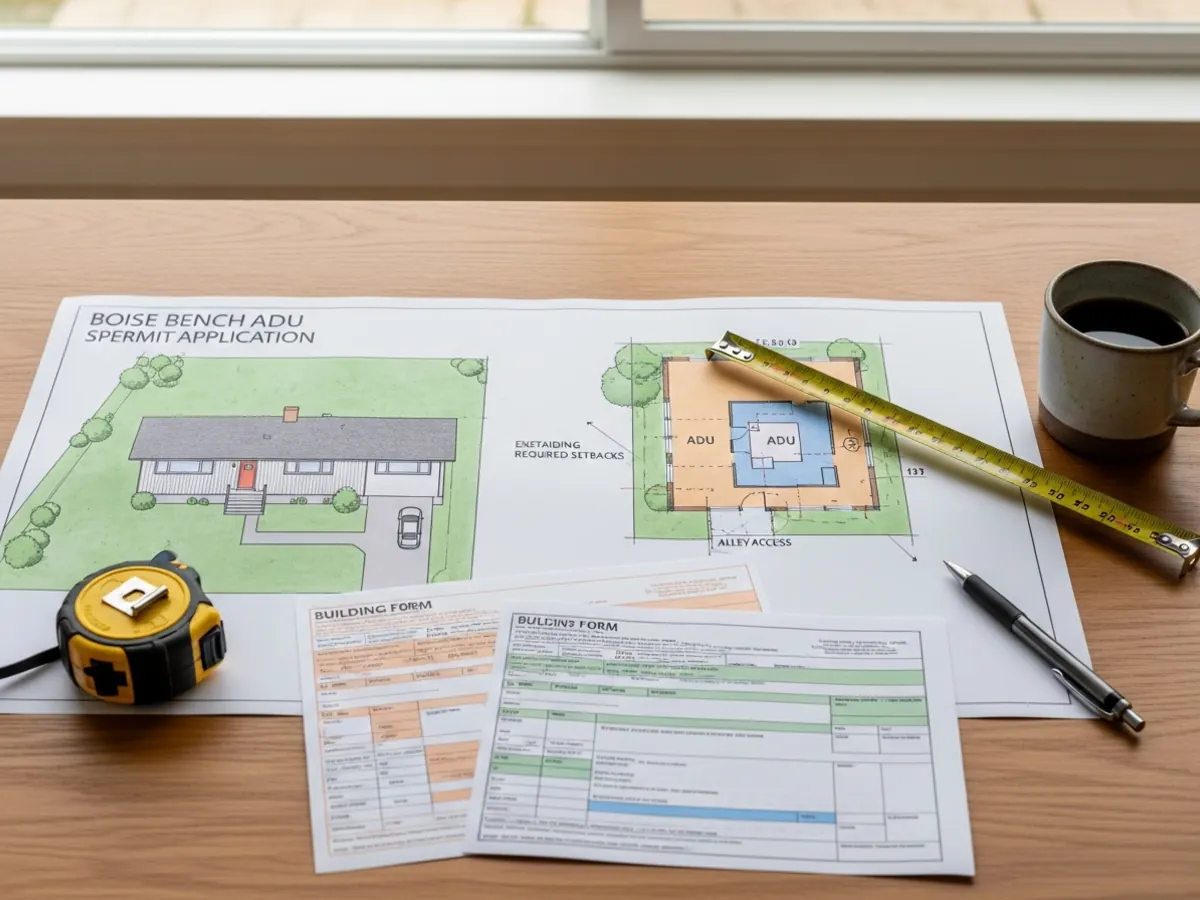
The Boise Bench is made up of distinct sub-neighborhoods, each with its own remodeling personality.
Vista
One of the most recognized sub-neighborhoods on the Boise Bench, centered around Vista Avenue between the Boise River and Overland Road. Post-war homes on uniform lots with mature street trees and good walkability to local commercial corridors. A heavy concentration of small ranch and minimal-traditional homes that respond well to galley-kitchen open-ups, primary-suite additions, and aesthetic modernization.
Central Bench (Curtis & Targee corridor)
The geographic core of the Bench, running along Curtis Road and Targee Street between I-84 and Overland. The City of Boise's Central Bench Neighborhood Plan records that the neighbourhood changed significantly during and after World War II, when agricultural land was subdivided into residential lots, and that new homes were built west of Orchard Street from the mid-1950s through the 1970s. Blueprint Boise designates the Central Bench primarily for compact-neighbourhood form — small lots, typically between 5,000 and 7,000 square feet, predominantly single-family, on an interconnected network of sidewalks and streets. Galley kitchen conversions are the dominant remodeling project type here.
Eastern Bench / Overland
The eastern edge of the Bench around Overland Road, with a mix of ranch and split-level homes. Lots tend to be slightly larger. Closer to mall-adjacent commercial corridors and major transit routes.
Western Bench / Roosevelt Market area
The western edge of the Bench near the Roosevelt Market and Capitol corridor. Some of the older Bench housing stock sits here, with steeper roof pitches and smaller footprints than the post-war ranches further east. Closer to downtown amenities and walkable.
Greenbelt-adjacent Bench
Bench properties along the elevated edges of the Boise River bluff with views down to the Greenbelt and the river. Frequently subject to view-preserving design considerations during exterior work — though without formal Historic District constraints.
Lower Bench (I-84 frontage)
The southern edge of the Bench close to I-84, on smaller lots and often with more traffic noise from the freeway. Common to combine kitchen, bathroom, and primary-suite remodels into a single comprehensive scope.
Most Boise ADU projects run $95,000 to $320,000 — the band published on our Boise ADU page. Pricing reflects three Bench realities: uniform alley-access lot geometry that makes ADU setbacks straightforward (no variance overhead), EPA RRP overhead on any conversion of pre-1978 main-residence structure (universal in the Bench), and the absence of HPC review, which removes the Certificate of Appropriateness step that comparable North End ADU work carries.
Boise Bench adu construction ranges
Eastern Bench basement ADU conversion (Daylight or walkout basement on 1965–1985 split-level converted to ADU): $85,000–$155,000 / 5–8 months end to end
Multigenerational suite (functionally similar, not legally ADU) (Connected primary suite with kitchenette for parent or adult child): $115,000–$215,000 / 5–9 months end to end
Single-stall garage conversion + rear addition (1955-era detached garage converted to ADU with addition to reach habitable size): $135,000–$215,000 / 5–9 months end to end
Detached carriage-house ADU (new build off alley) (New 600–800 sq ft single-story detached cottage on alley-access lot): $215,000–$320,000 / 8–12 months end to end
Garage + ADU new build (two-story replacement) (Replace old detached garage with two-story structure: garage below, ADU above): $255,000–$345,000 / 9–13 months end to end
Pricing assumes Iron Crest's standard Bench scope: City of Boise full plan-review permit (no Historic Preservation Commission overlay because the Bench isn't within a designated Historic District — meaningfully faster than comparable North End ADU work), zoning compliance verification (uniform compact alley-access lot geometry typically clears setbacks without variance), EPA RRP lead-safe work practices on any conversion of pre-1978 main-residence structure, pre-1980 asbestos pre-screen on garage conversions, foundation engineering with original slab reinforcement on garage-conversion scope, full mechanical systems (200A electrical with separate ADU sub-panel or new meter, plumbing tied to main house, dedicated Mitsubishi or Daikin mini-split heat pump), Schluter Kerdi waterproofing in the bath, separate Idaho Power electric meter for rental viability, and our 3-year workmanship warranty. Contingency budget of 10–13% above contract value (lower than older-neighborhood ADU work because Bench mechanical conditions are more predictable than pre-1925 stock).
The City of Boise designates ten historic districts, and the Boise Bench is not one of them and does not sit inside one. There is no Historic Preservation Commission review for exterior modifications, so siding changes, window replacements, additions, and exterior colour changes don't trigger the Certificate of Appropriateness process that constrains North End and East End projects. That removes a review step from the pre-construction schedule on any Bench exterior scope; confirm current review timelines with Boise PDS for your specific project.
City of Boise standard permits still apply for any work involving electrical, plumbing, structural changes, or mechanical systems. A scope that includes new circuit additions, moving a gas line, or removing a load-bearing wall requires a building permit from City of Boise Planning and Development Services. Permit processing for Bench projects takes about two weeks for online plan review per Boise PDS, longer with structural drawings — without the historic-review overlay that North End projects carry. Building Division: (208) 608-7070. Planning & Zoning: (208) 608-7100.
Asbestos and lead paint remain serious considerations on the Bench, despite the absence of Historic District review. Pre-1980 Bench homes (which is most of the housing stock) commonly contain asbestos in floor tiles, joint compound, and sometimes pipe insulation. We test suspect pre-1980 materials and arrange AHERA-accredited abatement when asbestos is confirmed. Pre-1978 Bench homes contain lead paint. The EPA RRP rule requires lead-safe work practices for any renovation in lead-paint homes — including containment, specialized HEPA vacuuming, and proper disposal. Iron Crest follows EPA RRP lead-safe work practices and incorporates them into the standard scope on every pre-1980 Bench project.
Bench-specific permit consideration: setbacks. Blueprint Boise designates the Central Bench primarily for compact-neighbourhood form, with small lots typically between 5,000 and 7,000 square feet, so additions or detached structures must navigate side and rear setbacks carefully. Boise's residential zoning code sets no maximum lot coverage, so the binding constraint on a Bench addition is almost always the setback envelope rather than a coverage percentage. Zoning verification during initial design is critical to avoid late-stage redesigns.
Material decisions for Bench ADUs split into two priorities: cost-effectiveness because rental ROI is part of the business case on most projects, and architectural matching with the main residence so the structure reads as belonging on a Vista or Curtis / Targee block.
Exterior siding and trim — match main house mid-century vocabulary
Painted Hardie fiber cement or LP SmartSide engineered wood lap siding in matching color and reveal to the main house. Most Bench mid-century ranches have 7-inch reveal cedar that's still in place — new Hardie or LP at matching reveal reads continuous. Stock or simple custom trim profiles that echo the main house's mid-century character (clean simple casings, modern eave details). Composite architectural shingle roof in matching color. Cost: $14–$22 per square foot installed depending on substrate.
Foundation — concrete spread footings, reinforced for garage conversions
Standard 18×18 concrete spread footings to 24-inch frost depth for new-construction detached ADU. Foundation cost for new-build ADU: $18,000–$45,000 depending on size and excavation conditions. Garage-conversion scope typically requires reinforcement of original 1955-era slab to current ADU loading (original slabs were sized for vehicle storage, not habitable load). Reinforcement: $5,500–$15,000.
Insulation — high-R retrofit for rental durability
R-49 attic, R-21 walls, R-30 floors target. Closed-cell spray foam at rim joists. Strong tenant retention impact — a Bench ADU competes with new-construction apartments that have modern envelope performance and low utility bills, so cutting insulation cost on the ADU is short-sighted economy.
Windows — performance-tier dual-pane, vinyl acceptable for Bench rental tier
Marvin Essential, Pella Lifestyle, Andersen 100-Series premium dual-pane low-E argon-filled — typical specification for owner-occupant or family-use scope. Premium vinyl (Pella 250, Andersen 100 Fibrex, Milgard Trinsic) acceptable for pure-rental investor ADU because the Bench isn't within a Historic District and there's no period-authenticity constraint that requires wood-clad. Vinyl saves $400–$600 per window vs. wood-clad and is the cost-effective choice for rental ROI optimization.
Kitchen — compact rental-viable spec
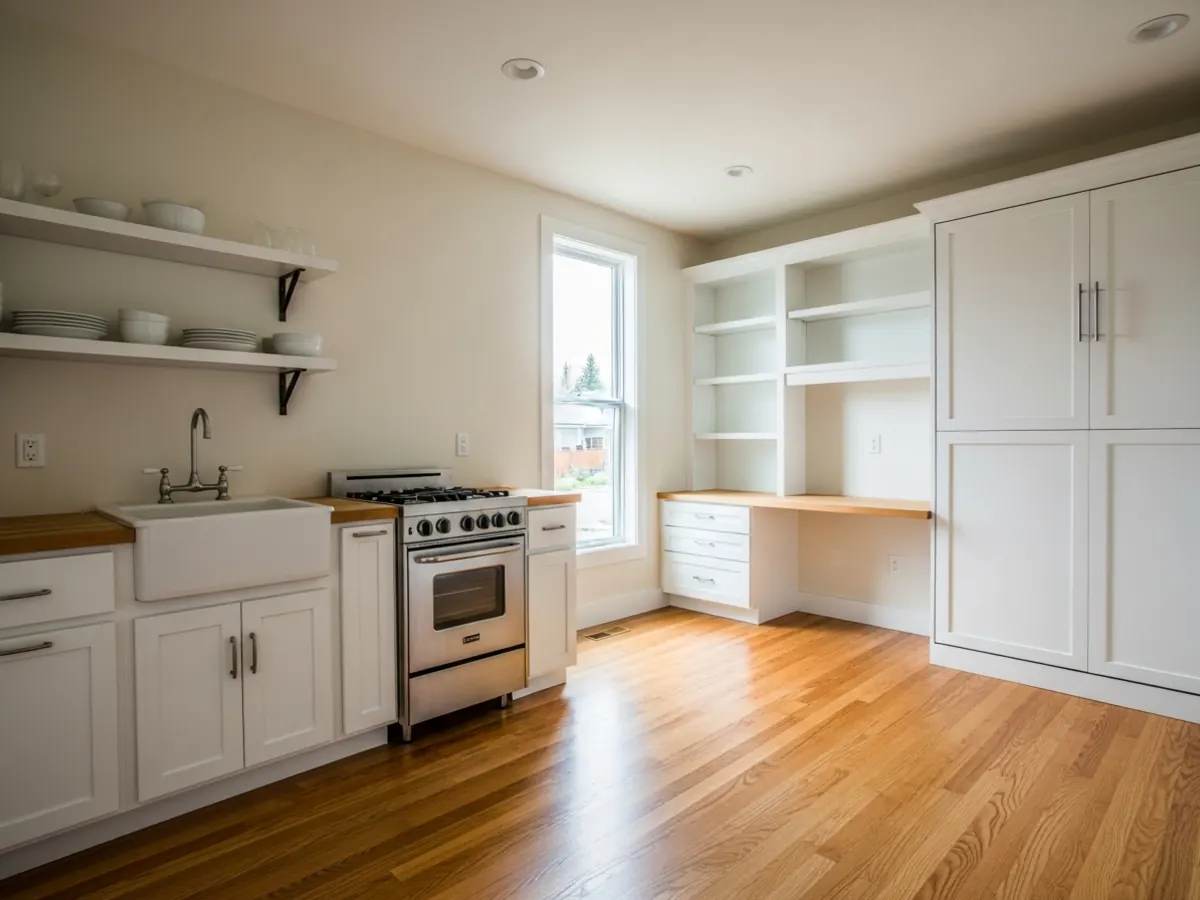
8'–12' linear feet of semi-custom Shaker cabinetry painted in white, sage, or charcoal. Quartz counters (Caesarstone, Cambria, Silestone). Mid-tier appliance suite — Café series or KitchenAid Architect for owner-occupant, mid-tier rental-durable appliances for pure-rental scope. Apartment-size dishwasher (18-inch), full-size refrigerator, 30-inch range, integrated microwave. The Bench rental demographic prices in functional efficiency rather than pro-grade aesthetic that walkable-urban demographics expect.
Bath — Schluter Kerdi-waterproofed, full-tile shower
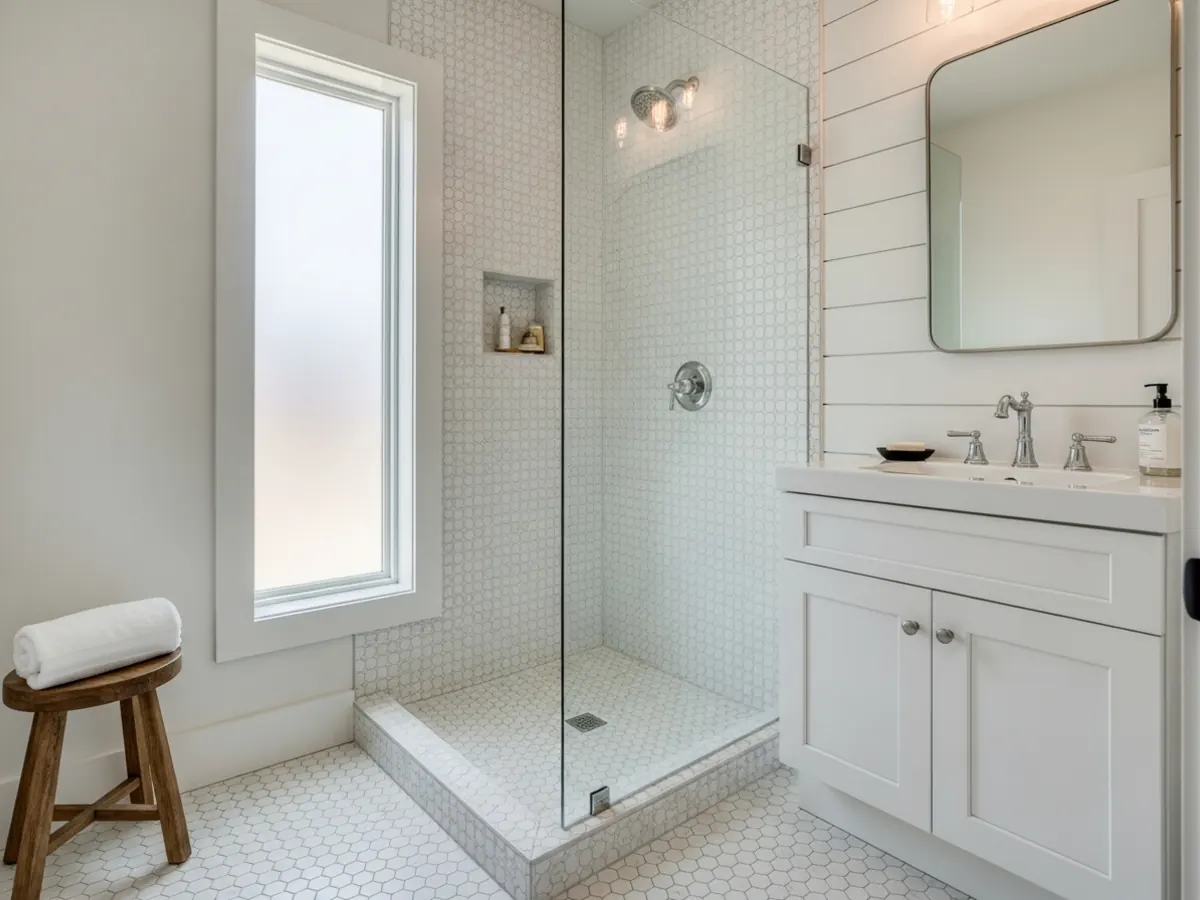
Compact 5'×8' full bath with Schluter-Kerdi-tiled walk-in shower, frameless glass, large-format porcelain floor with optional Schluter Ditra-Heat radiant electric mat for owner-occupant scope (skipped on pure-rental for cost economy), single-vanity 30"–36" with quartz top. Standard Bench ADU bath spec.
Flooring — engineered hardwood for owner-use, premium LVP for pure rental
Engineered red oak (3¼-inch to 5-inch wide) matching the main residence's original or refinished oak flooring for owner-occupant or family-use scope. Premium wide-plank LVP (Coretec Plus, Karndean LooseLay, Shaw Floorté) for pure-rental investor scope — handles tenant turnover better than hardwood at meaningful cost reduction ($4–$8/sq ft installed vs. $12–$28). Reads as wood from a few feet away.
HVAC — dedicated single-zone mini-split heat pump
Dedicated Mitsubishi M-Series or Daikin Aurora single-zone mini-split heat pump per ADU. Avoids load impact on the main residence's existing system, which on pre-1985 Bench stock is often near capacity. Standard Bench ADU spec. Cost: $4,500–$8,500 installed.
Utilities — separate meters for rental viability
Separate Idaho Power electric meter is standard for investor ADU scope (required for clean tenant billing on separate-meter rental arrangement) and recommended for family-use scope. New meter install: $3,500–$5,500 through Idaho Power coordination. Separate water meter sometimes feasible through City of Boise public works coordination but less common on Bench scope than separate electric.
Bench ADU pre-construction surfaces a recurring set of conditions related to lot configuration, original garage condition (when conversion is in scope), and pre-1978 main-residence interaction.
- •Setback envelope on uniform compact Bench lots (usually clears without variance) With 110–130' of depth, most Bench lots clear the underlying zone's setbacks (an ADU follows its district per Zoning Code 11-03-03.2.B(6) — 5' interior side and 15' rear in R-1C) for a new-construction detached ADU without variance — a meaningful advantage over narrow-frontage Sunset bungalow streets. We verify at consultation by measuring buildable envelope. Variance only required in rare cases at $3,500–$8,500 when triggered.
- •Existing electrical service capacity (60A or 100A on pre-1965 stock) Pre-1965 Bench homes commonly have 60A or 100A original electrical service that won't support an ADU sub-panel load. Service upgrade to 200A: $4,500–$11,500. New separate ADU meter: $3,500–$5,500.
- •EPA RRP for any pre-1978 main-residence conversion or tie-in Universal on Bench scope because nearly the entire housing stock predates 1978. Containment, HEPA-only sanding, lead-safe disposal at every connection point with the existing main house. Cost addition: $2,500–$8,500 depending on conversion scope.
- •Asbestos in pre-1980 garage conversion structures Original sheet flooring, mastics, roofing felt, and sometimes original interior board on pre-1980 Bench garages can contain asbestos. Pre-screen testing $300–$700, licensed abatement $3,500–$11,500 when triggered. Standard scope on garage-conversion pricing rather than surprise.
- •Original 1955-era garage slab inadequate for ADU loading Original Bench garage slabs are sized for vehicle loading, not habitable structural load. Garage-conversion scope routinely requires slab reinforcement or replacement. Reinforcement: $5,500–$15,000 depending on garage size and condition.
- •Egress windows for basement ADUs (Eastern Bench split-level scope) Universal requirement for sleeping rooms in basement ADUs. New egress with window well, foundation cutting, structural header: $4,500–$11,500 per opening.
- •Original basement ceiling height inadequate (pre-1965 Vista and Curtis / Targee ranches) Pre-1965 Bench ranch basements often have 6'8"–6'10" ceiling heights — below the 7'+ code minimum for habitable basement space. Lowering the basement floor through excavation and underpinning: $35,000–$80,000. Often pivots project away from basement-ADU shape entirely toward detached carriage-house scope.
- •Galvanized supply lines on pre-1965 main residences affecting ADU plumbing connection Universal in pre-1965 Bench stock. Affects ADU plumbing connection because new PEX has to land on the existing trunk somewhere. Wet-wall galvanized-to-PEX replacement at the connection point: $2,500–$8,500.
- •Sewer and water line capacity at city connection Adding an ADU sometimes requires a City of Boise public-works review of sewer and water line capacity at the home's existing connection. Rare but adds $5,000–$15,000 when line upgrade is required.
- •Existing curb cut and alley access conditions Garage-plus-ADU two-story builds sometimes require new or expanded alley curb cut, with City of Boise Public Works approval. $3,500–$8,500.
Pre-construction (Months 1–3)
On-site assessment with lot survey review. Setback envelope verification on uniform Bench compact alley-access geometry. EPA RRP and asbestos pre-screen on any garage conversion or main-residence tie-in. Initial concept drawings (carriage-house vs. garage conversion vs. basement-ADU shape). Idaho Power separate-meter coordination check.
Schematic and design development (Months 3–4)
Detailed ADU floor plan with rental-viable layout efficiency. Architectural elevation matched to main residence — painted lap siding profile, eave detail, trim. Material direction (vinyl windows for pure rental vs. wood-clad for owner-use scope). Mini-split heat pump sizing.
Construction documents (Months 4–6)
Full construction drawings. Structural engineering — including reinforcement of original 1955 garage slab on conversion scope. MEP coordination. No HOA submittal required (Bench has no HOAs on most blocks).
Permitting (Months 5–7)
City of Boise full plan review on new-construction scope; alteration permit on garage-conversion or basement-conversion scope. Confirm current turnaround with Boise PDS. No Historic Preservation Commission review — the Bench isn't within any designated Boise Historic District, which is the single biggest timeline advantage Bench ADU work has over comparable North End or East End scope.
Site preparation and excavation (Days 1–14 of work)
Site protection. Excavation per plans for new-construction foundation. Original-garage slab assessment and reinforcement plan for conversion scope. Pre-1978 lead-safe containment on any work touching main-residence painted surfaces.
Foundation (Days 14–35)
New 18×18 spread footings to 24-inch frost depth for detached new-construction ADU. Foundation walls and slab. Original-slab reinforcement for garage-conversion scope. City of Boise foundation inspection.
Framing (Days 35–80)
Floor, wall, roof framing per engineering. Painted lap siding matching main residence ready for install. Window and door rough openings sized for selected products.
MEP rough-in (Days 70–110)
Plumbing, electrical, mechanical rough-in. Mini-split heat pump installation. New separate Idaho Power electric meter set on rental-tier ADU scope. Water and drain connection to existing main-house lines through trenching to alley side. City of Boise rough-in inspections.
Insulation, drywall, exterior finish (Days 110–165)
High-R insulation throughout. Drywall hang and finish. Exterior siding and trim — painted to match main residence. Roofing. Window installation.
Interior finish (Days 165–245)
Cabinetry install. Quartz template, fab, install. Schluter Kerdi membrane, tile, grout. Engineered hardwood or premium LVP install. Paint throughout.
Fixtures, lighting, and trim (Days 245–280)
Plumbing fixtures, lighting trim, hardware, mini-split commissioning, appliance install.
Final walkthrough and warranty (Days 280–290)
Final inspections by City of Boise. HVAC commissioning. Punch resolution. 3-year Iron Crest workmanship warranty begins at walkthrough. ADU ready for occupancy or rental.
Bench ADU work needs a contractor fluent in three things: uniform alley-access lot geometry that makes setback envelope assessment quick and reliable, the EPA RRP and pre-1980 asbestos protocols universal on pre-1978 Bench stock (essentially every conversion or main-residence tie-in), and the rental-viable material specification that's appropriate for the Bench rental tier rather than over-building to walkable-urban specifications the local market won't return.
- City of Boise Planning & Development Services — Building, electrical, plumbing, and mechanical permits. Online portal and in-person plan check.
- Idaho DEQ Air Quality (Asbestos) — Testing and abatement guidance for pre-1980 homes via the Idaho Department of Environmental Quality.
- EPA Lead Renovation, Repair and Painting (RRP) Program — Required certification and work practices for renovation in pre-1978 lead-paint homes.
- Idaho Power — Rebates & Offers — Idaho Power's residential incentives: the Heating and Cooling Efficiency Program (heat pumps, central air conditioners, duct sealing, smart thermostats, heat pump water heaters, whole-house fans and similar equipment), the A/C Cool Credit, and the Shade Tree Project. Windows and insulation are not covered.
- Idaho DOPL — Contractor Search — Verify any contractor's RCE registration through the official Idaho DOPL license search.
Can I build an ADU on my Bench lot?
Almost certainly yes. Uniform Bench lot geometry (compact, with alley access at the rear) makes ADU setback compliance straightforward on virtually every block — at typical Bench lot depth, most lots clear the underlying zone's setbacks for a new-construction detached ADU without variance. Boise sets no ADU-specific setback: an ADU meets the dimensional standards of its zoning district (Zoning Code 11-03-03.2.B(6)), which in R-1C means 5' at the interior side and 15' at the rear, and a detached unit of 121–500 sq ft kept under 14' in height may use the reduced 3' side / 9' rear setbacks in Table 11-04.4. Maximum ADU size is currently 900 sq ft or 70% of the primary structure's floor area, whichever is smaller. Idaho's 2026 ADU law (Senate Bill 1354) raises the floor to 1,000 sq ft or 75% of the primary home and allows either one internal or one detached ADU per lot by February 1, 2027 — confirm the limit in effect with Planning & Development Services. Iron Crest's initial consultation includes a lot-feasibility assessment confirming what shape and size of ADU your specific lot can accommodate.
How much rent can I get for a Bench ADU?
We don't publish rent figures — we hold no rent dataset, and a number we invented would be the worst possible input to your underwriting. What we can tell you about the Bench: well-built 600–800 sq ft one-bedroom units in walkable locations (close to a corner grocery, a bus line, or a commercial corridor) lease steadily, and the Bench does not carry the downtown-walkability premium the Sunset corridor does. Before committing to a $215K–$320K detached carriage-house build, ask a local property manager or leasing agent for current comparable rents on your block, and model the project against those.
Will an ADU affect my Bench property value?
An ADU adds a second legal dwelling to the lot, and an appraiser will account for it — but how much it adds is specific to the unit, the block, and the comparable sales available at the time, so we won't quote you a figure or an ROI percentage. If the added value matters to your financing, ask your lender for an appraisal consultation before construction: they can tell you how a detached ADU is likely to be treated on your property. The other half of the return is use — rental income if you lease it, or the housing cost you stop paying if a family member moves in.
Does an ADU on the Bench need Historic Preservation Commission approval?
No. The Boise Bench is not within any designated Boise Historic District (unlike the North End, East End, Harrison Boulevard, or Warm Springs Avenue districts, where HPC review applies). ADU work on the Bench proceeds at standard City of Boise permit speed — no Certificate of Appropriateness, no HPC review overlay. This is the single biggest timeline advantage Bench ADU work has over comparable North End or East End scope.
Can I do a basement ADU in my Bench ranch?
Depends on the era. Pre-1965 Vista and Curtis / Targee ranches typically have 6'8"–6'10" basement ceilings — below the 7'+ code minimum for habitable basement space. Lowering the basement floor through excavation and underpinning is expensive ($35K–$80K) and often pivots the project toward a detached carriage-house instead. 1965–1985 Eastern Bench / Overland split-levels with daylight or walkout basements at 7'+ ceiling height are the most viable basement-ADU stock on the Bench. Iron Crest measures ceiling height during the consultation walkthrough.
How long does a Bench ADU take to build?
5–8 months for a basement ADU on an Eastern Bench split-level. 5–9 months for a single-stall garage conversion with rear addition. 8–12 months for a detached carriage-house cottage. 9–13 months for a garage-plus-ADU two-story new build. Bench ADU timelines run shorter than comparable North End or East End scope because there is no HPC review overlay.
Can I have a separate utility meter for the ADU?
Yes — separate Idaho Power electric meter is standard for investor-tier ADUs and recommended for family-use as well. New meter install runs $3,500–$5,500 through Idaho Power coordination. Separate water meter is sometimes possible through City of Boise public works coordination but less common on Bench scope.
What about EPA RRP for pre-1978 conversions?
Required on every Bench address that involves pre-1978 paint disturbance during conversion or main-residence tie-in — which is essentially every Bench ADU project given the 1948–1965 dominant housing stock. Iron Crest follows EPA RRP lead-safe work practices, which are baked into our standard Bench pricing rather than added as a surprise.
Ready to start your Boise Bench adu construction project?
Free in-home consultation, honest contingency-based budgeting, and the experience Boise homes require. Iron Crest Remodel — Idaho RCE #6681702, EPA RRP lead-safe work practices, $2M general liability, 3-year workmanship warranty.
Get Your Free Estimate