
ADU Kitchen Design for Boise's 900 sq ft Cap: 5 Layouts That Actually Work
Boise's ADU rules cap unit size at 900 square feet (or 70% of the primary structure's floor area, whichever is smaller), which after a bedroom, bathroom, and living area typically leaves 300–450 square feet for kitchen and dining. Idaho's 2026 ADU law (Senate Bill 1354) raises the floor to 1,000 square feet or 75% by February 1, 2027, which loosens the squeeze but doesn't eliminate it. That's not enough space for a conventional layout. Here are the five plans that work.
Quick answer
Below 90 sq ft, the kitchen becomes a kitchenette — adequate for occasional cooking but inadequate for primary-residence use. 90–120 sq ft works for a galley or small L-shape with apartment-size appliances and minimum counter run. 150–200 sq ft is the comfortable range for a functional ADU kitchen that supports daily cooking. 200–300 sq ft (comfortably achievable within a 900 sq ft ADU) allows the more comfortable L-shape, U-shape, or kitchenette+island layouts.
Boise's accessory dwelling unit rules cap ADUs at 900 square feet of finished living space, or 70% of the primary structure's floor area, whichever is smaller (Boise Zoning Code Section 11-03-03.2B, Modern Zoning Code effective December 2023; no more than two bedrooms). Idaho's 2026 ADU law (Senate Bill 1354) requires the city to raise that cap to at least 1,000 square feet or 75% of the primary home by February 1, 2027 — confirm the limit in effect with Planning & Development Services — but even at 1,000 square feet the kitchen math below barely changes. After a 100 sq ft bathroom, a 120–150 sq ft bedroom, and a 150–200 sq ft living area, kitchen and dining together are left with roughly 300–450 square feet at most — and less in smaller units. Once dining is carved out, the kitchen itself is a tight footprint, and the layout decisions that work in a large primary-home kitchen don't translate. Triangle work patterns, island prep zones, multiple cook stations — none of them fit. ADU kitchens are their own design problem with their own solutions.
This article covers the five layouts that work best in Boise ADU projects, the NKBA clearance guidelines that govern each, and the utility-integration decisions (electrical capacity, plumbing, ventilation, gas) that determine which layout is feasible in a given ADU. The focus is on layouts that actually function for daily cooking, not just compliance with minimum code — the difference matters for ADU residents who use the kitchen as their primary cooking space (typical for long-term tenants and multigenerational use) versus light-use ADUs (short-term rental, occasional guest use) where minimum-spec works fine.
For the broader ADU planning context — overall floor plans (studio to 2-bedroom), permit and zoning details, and exterior coordination — see our ADU floor plan planning guide, Boise ADU permits and zoning guide, and the ADU construction service overview. This page is specifically about the kitchen layout problem inside the ADU footprint.
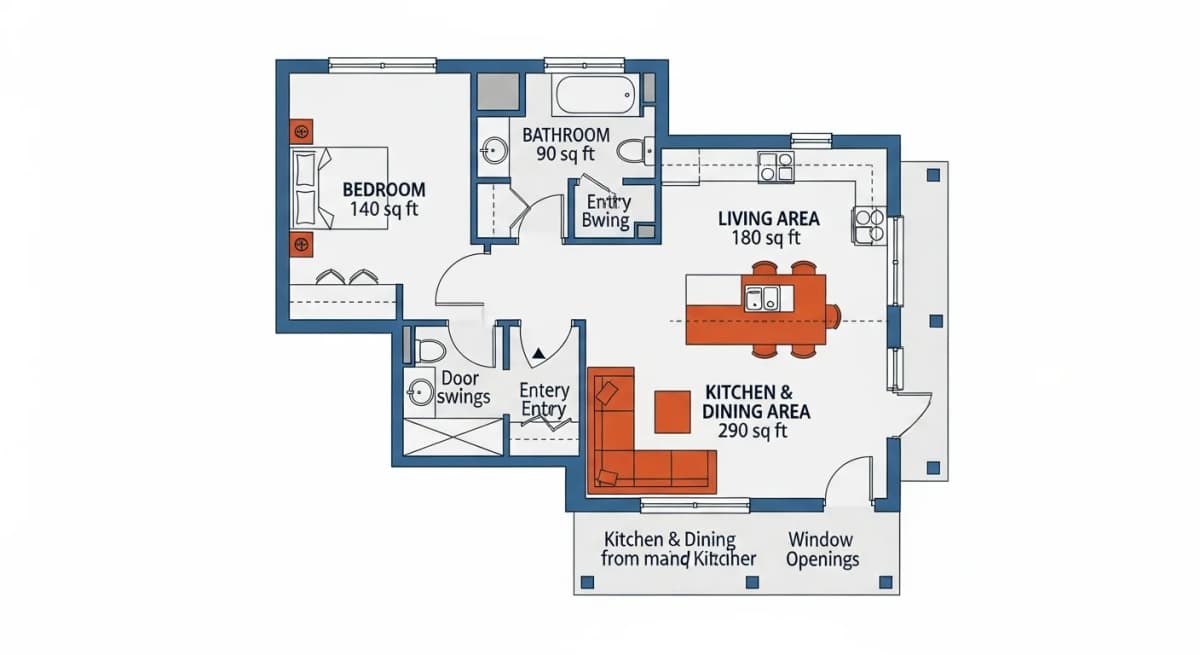
Boise's ADU rules allow units up to 900 square feet of finished living space, or 70% of the primary structure's floor area, whichever is smaller, with a maximum of two bedrooms (Boise Zoning Code Section 11-03-03.2B); the state floor under Senate Bill 1354 (1,000 sq ft or 75%) applies by February 1, 2027. That cap drives the entire interior layout. A typical breakdown:
Bathroom: 80–120 sq ft (smaller is feasible but constrains the layout — most ADU bathrooms are 90–110 sq ft with a walk-in shower, toilet, single vanity).
Bedroom(s): 110–160 sq ft for a primary bedroom that meets IRC minimum (70 sq ft) but is functional. Two-bedroom ADUs are the code maximum and eat most of the remaining footprint.
Living area: 140–200 sq ft for a functional sitting area. Smaller is possible but the unit starts to feel like a studio with no living separation.
Kitchen + dining: Remainder — typically 300–450 sq ft in a unit at the 900 sq ft cap, and less in smaller units. This is usually split into a 150–250 sq ft kitchen plus a dining area, or combined as a single kitchen-with-eat-in-counter.
For comparison, a typical primary-home kitchen is 150–250 sq ft. An ADU kitchen lands at the small end of that range or below it, and it usually has to carry dining too, so conventional layouts with islands and multiple work zones don't fit. The five layouts below are designed for the available footprint specifically.
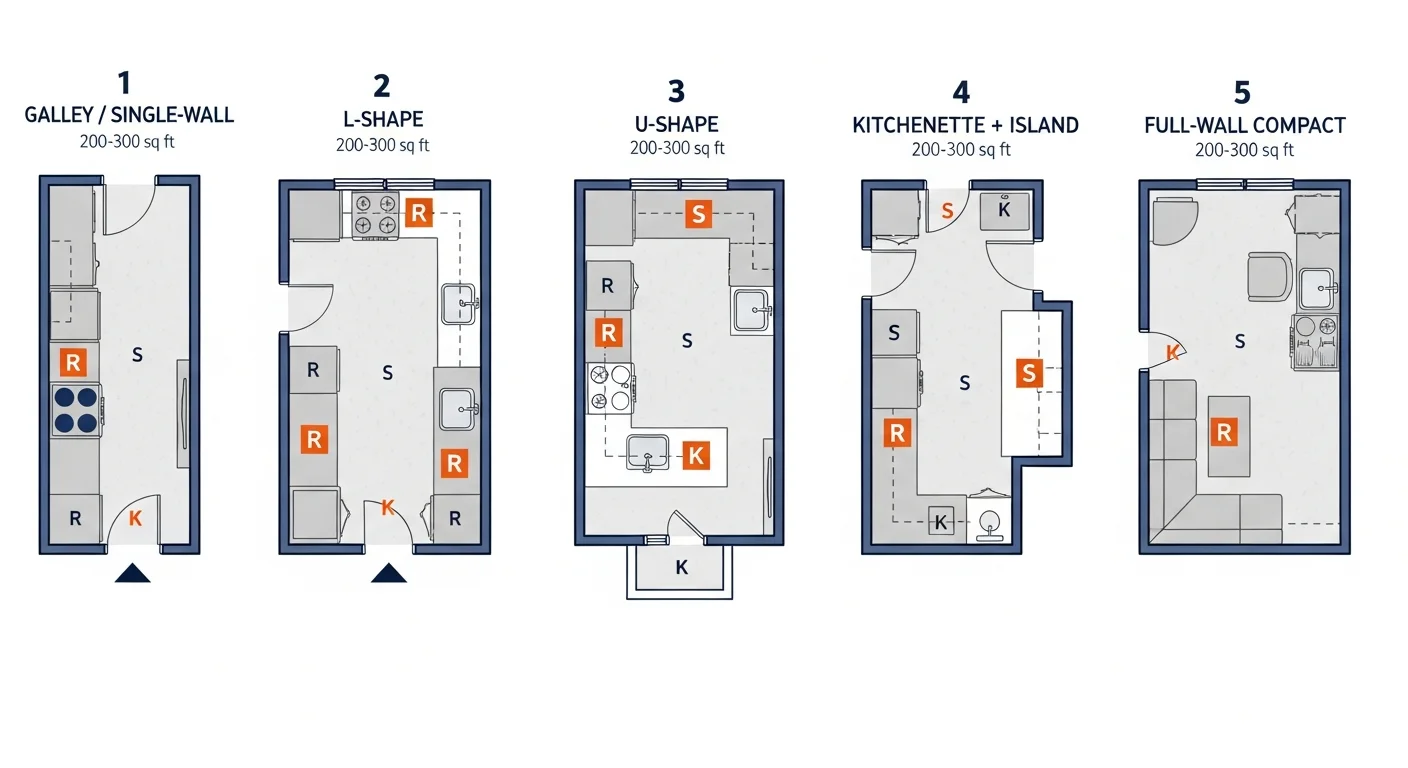
The single-wall galley puts the entire kitchen — refrigerator, range, sink, all base and wall cabinets — along one wall, with the opposite side open to the living/dining area. Counter run length is typically 8–12 feet. This is the smallest-footprint workable kitchen layout, fitting in 90–140 sq ft of dedicated kitchen space.
The advantage: minimum spatial commitment. Frees the largest amount of square footage for living and bedroom. Cleanest sight lines from the living area.
The disadvantage: minimum counter space. Prep area is constrained to whatever counter exists between the appliances. Storage is constrained to whatever cabinets fit along the single wall. Two-cook situations are difficult — there's no second counter run to offer parallel work zones.
Boise cost (estimate): $14,000–$22,000 for the kitchen scope (cabinets, counters, appliances, plumbing, electrical) within an ADU build. The lower-end pricing is achievable with stock cabinets and budget-tier appliances; the upper end allows semi-custom cabinets and mid-tier appliances.
ADUs intended for short-term rental use, single-occupant long-term rental, or supplementary use where cooking is occasional rather than primary. Common in 600 sq ft and smaller ADU plans.
Minimum counter and storage. Inadequate for primary-cooking households who'll be using the ADU as their main residence.
The L-shape kitchen uses two perpendicular walls — typically 8–10 feet on the primary wall (refrigerator, range, sink) and 5–7 feet on the secondary wall (additional prep counter and storage). The remaining two walls of the kitchen footprint open to the living area or are shared with the bedroom or bathroom plumbing wall.
The advantage over the galley: meaningfully more counter and storage in a similar footprint. The L-shape geometry naturally creates a small "work triangle" between sink, range, and refrigerator (compressed but functional). Two-cook situations are workable if the people stay on different legs of the L.
The disadvantage: the corner cabinet at the inside of the L is typically the least usable storage in the kitchen — either it requires a lazy-Susan corner unit (decent but limited), a blind corner cabinet (deep but hard to reach into), or accepts the deep-corner waste. The corner solution accounts for $400–$1,200 of cabinet cost in semi-custom and custom builds.
Boise cost (estimate): $17,000–$28,000 for the kitchen scope. The most common ADU kitchen layout in the Treasure Valley because of the storage-to-footprint ratio.
ADUs intended as primary residences — long-term tenants, aging-parent units, or full-time ADU dwellers who need real kitchen function. The most versatile layout for a 150–300 sq ft footprint.
Corner cabinet is the limiting design element. Plan it during cabinet selection rather than as an afterthought.
The U-shape kitchen uses three walls, typically 8–10 feet on the primary wall and 5–7 feet on each side wall. This is the highest-storage layout in the small-footprint category and provides the most counter space per square foot of any ADU kitchen design.
The advantage: maximum storage, maximum counter, and a true compressed work triangle inside the U. Cooking ergonomics are good. The U-shape also visually separates the kitchen from the rest of the ADU because the kitchen is enclosed on three sides — useful for sound and visual containment in open-plan ADU designs.
The disadvantage: minimum 8' x 8' (64 sq ft) interior dimension required, with practical comfort requiring 9' x 9' (81 sq ft) and most workable at 10' x 10' (100 sq ft). The kitchen consumes more of the ADU footprint than galley or L. The walls also block sight lines to the rest of the ADU, which can make the unit feel smaller overall.
Boise cost (estimate): $20,000–$32,000 for the kitchen scope. Higher than the L-shape because of the additional cabinet linear footage and the third-wall plumbing or electrical requirements.
ADUs at the 900 sq ft cap with a higher allocation to the kitchen (250–300 sq ft kitchen footprint). Best when the ADU's primary use is full-time residence with serious cooking.
Eats footprint from elsewhere in the ADU — typically reduces living-area size by 30–50 sq ft compared to L-shape. Cooking function is excellent; overall ADU spaciousness is reduced.
The kitchenette + island layout uses a short single-wall kitchen (typically 7–10 feet) combined with a small island or peninsula that doubles as eating surface. This is the most open-feeling layout for an ADU because the kitchen reads as part of the living space rather than as a separate room.
The advantage: maximum perceived spaciousness in the ADU. The island provides eating surface for 2–3 people without dedicating a separate dining table. Counter space is functional. The open layout suits short-term rental and guest-use scenarios where the ADU feels generous.
The disadvantage: total counter space is less than L or U layouts. Storage is meaningfully less because the island typically only has lower storage on one side (the cooking side) — the seating side can't have cabinets blocking the eating surface. The island also adds cost — $2,500–$5,500 for a basic island (cabinets, counter, electrical) up to $7,000–$12,000 for a more elaborate island with cooktop or sink.
Boise cost (estimate): $18,000–$30,000 for the kitchen scope including the island. The cost premium over single-wall is real but the perceived-space benefit is meaningful for ADU usability.
ADUs intended for short-term rental (Airbnb, Vrbo) where the open feel drives positive guest reviews, or for ADUs where the homeowner wants the unit to feel more than studio-sized.
Storage and counter are less than other layouts. Best when storage demands are modest and the open feel is the design priority.
Plan your Boise ADU kitchen with realistic square-footage math
ADU kitchen design starts with the overall floor plan and the homeowner's intended use, not with cabinet selection. Schedule a no-pressure consultation and we'll model the right layout, utility approach, and appliance spec for the ADU's actual use case and footprint.
The full-wall compact layout uses a single very-long wall (10–14 feet) for the entire kitchen, with all appliances, sink, and storage along that wall. Differs from the basic galley in two ways: the wall is longer (allowing more storage and counter), and the design typically includes a built-in dining bench or banquette opposite the kitchen wall to define the dining zone.
The advantage: maximum linear cabinet and counter run in a compact footprint. The banquette opposite provides eat-in seating without dedicating square footage to a separate dining table. The whole kitchen-plus-dining zone fits in a 12 x 14 ft area (168 sq ft) with the dining seating effectively becoming part of the kitchen footprint rather than separate.
The disadvantage: requires a longer wall (10–14 ft minimum) which constrains the overall ADU floor plan. The galley between the kitchen and banquette is narrow — typically 36–42 inches — which makes serving feel cramped if more than one person is on the banquette side.
Boise cost (estimate): $19,000–$28,000 for the kitchen scope plus $1,800–$3,500 for the built-in banquette and dining table.
ADU floor plans that have a long wall available (often the wall shared with the main house plumbing rough-in). Common in attached ADU and basement ADU designs more than in detached ADUs.
Requires the long wall geometry. Doesn't work in square ADU footprints.
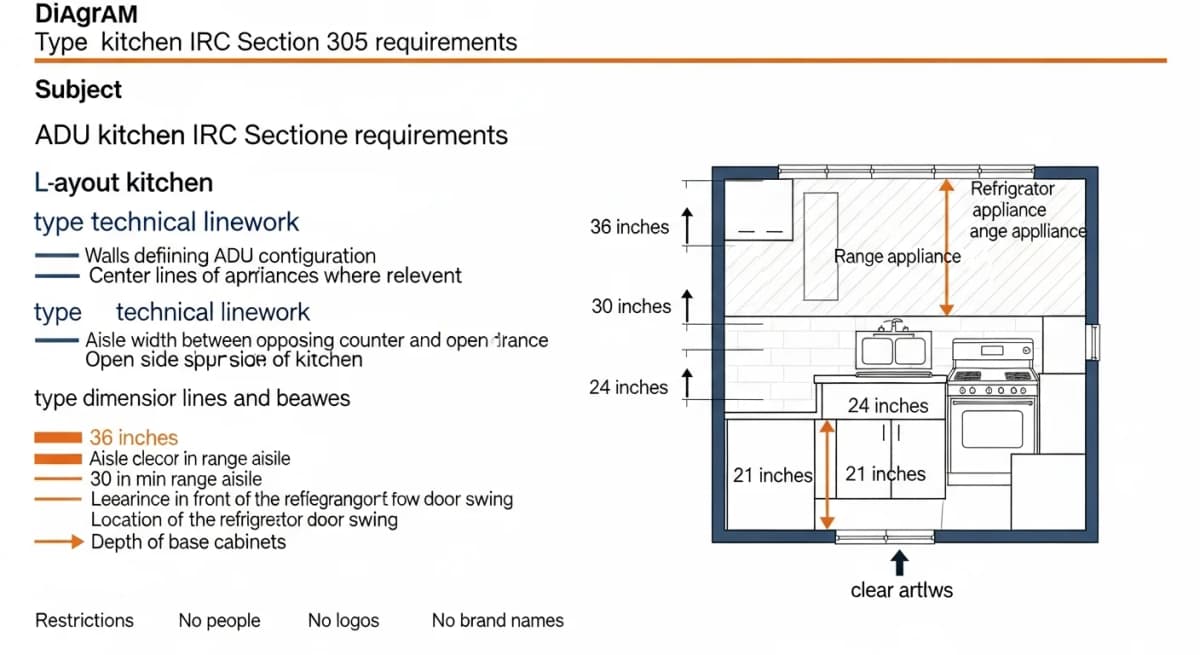
The NKBA Kitchen Planning Guidelines set minimum kitchen clearances. They are not building code and Boise PDS does not inspect for them, but they are what we design to, because they are the difference between a kitchen that works and one that doesn't. The most binding guidelines for compact ADU kitchens:
Aisle width between opposing counters or appliances: 36 inches minimum, 42 inches recommended. Tighter than 36 inches and the kitchen is not practically functional. This is the single tightest constraint in galley-style ADU kitchens.
Range cooking aisle clearance: 30 inches minimum between the front edge of the range and any opposing wall, counter, or fixture. 36 inches is preferred for actual usability.
Refrigerator door swing clearance: 24 inches minimum in front of the refrigerator, more if a French door or pantry-style refrigerator is specified. The refrigerator door swing path can't be blocked by any other component.
Sink clearance: Minimum 21-inch base cabinet depth (standard for residential), with 24 inches preferred. The plumbing connections and trap must fit within this depth.
Cabinet door swing: Cabinet doors must be able to fully open without striking opposing components. In tight ADU layouts, this sometimes requires drawer-only base cabinets or pocket-door cabinets to avoid clearance conflicts.
Fixing a clearance conflict after cabinets are installed means re-ordering and re-installing components, which is expensive. Plan for the clearances at design phase.
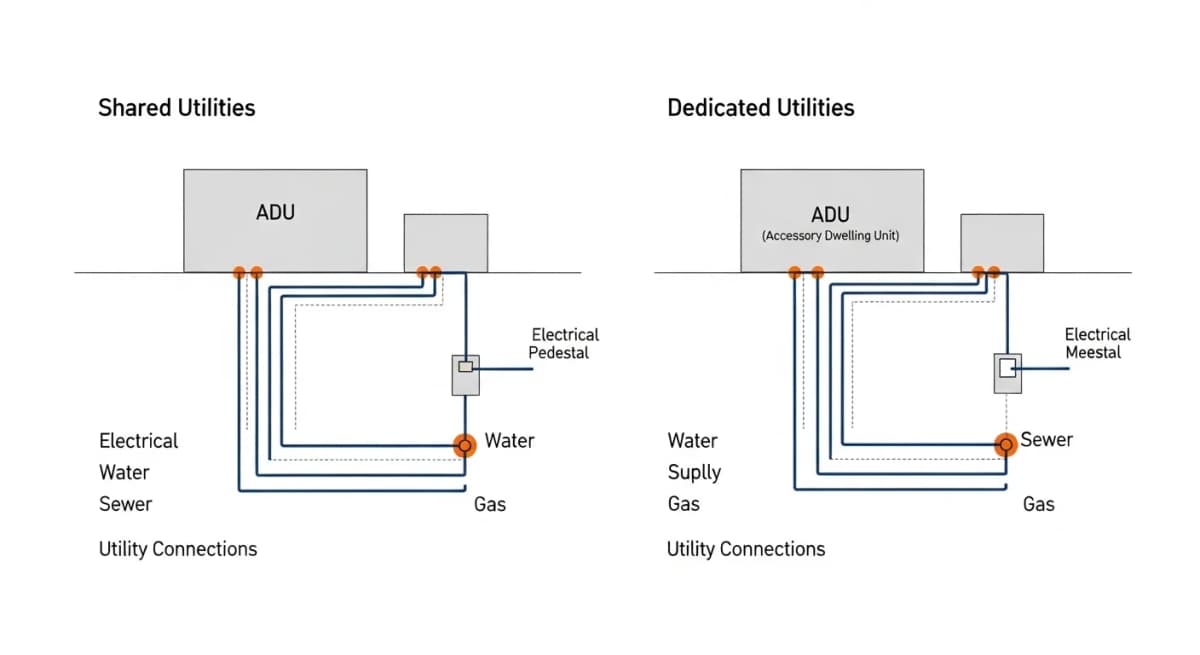
ADU kitchen utility integration is one of the largest cost variables in the ADU build. Two approaches:
Shared utility approach: The ADU kitchen ties into the main house's existing electrical panel, water supply, and gas line (if gas is being used). Cost: lower upfront — typically $4,000–$8,000 in utility-extension work depending on distance from the main house and existing panel capacity. The constraint is the main house's panel must have enough spare capacity to support the additional ADU loads (typically 30–40 amps minimum for an electric ADU kitchen). For pre-1980 Boise homes with original 100-amp panels, this often requires a main-house panel upgrade as a prerequisite (see our panel-capacity analysis for context).
Dedicated utility approach: The ADU has its own electrical meter, panel, water service, and gas service. Cost: meaningfully higher — typically $4,000–$16,000 in additional infrastructure depending on trenching distance, service upgrades, and whether Idaho Power requires a new meter pedestal. The advantage is full independence — separate billing if the ADU is rented, no shared-capacity constraints, and the ADU can be more easily sold or condominium-ized in the future if zoning changes.
For most Boise ADU projects we run, the shared approach is the right call unless: (1) the main house's panel doesn't have spare capacity and upgrading it is expensive, or (2) the homeowner specifically wants the rental separation of independent metering. The shared approach also typically permits faster — fewer additional approvals from Boise PDS and Idaho Power compared to a fully independent infrastructure install.
Compact ADU kitchens have specific ventilation and appliance-sizing considerations:
Range hood: The IRC mechanical-exhaust requirements (2018 IRC M1503) and Boise's elevation correction (see our kitchen range venting article) apply equally to ADU kitchens. For a typical 24-inch gas cooktop (30,000–40,000 BTU output) at Boise elevation, required hood CFM is 330–440 CFM — mostly under the 400 CFM make-up-air threshold. Most ADU kitchens stay under the make-up air requirement because the cooktops are smaller than primary-home ranges.
Appliance sizing: ADU kitchens typically use 24-inch or 30-inch appliances rather than the 36-inch or larger units common in primary kitchens. A 24-inch dishwasher (Bosch 800-24, Miele Compact) is the most common ADU spec because it preserves cabinet linear footage. 24-inch ranges are common; 30-inch is the upper end for ADU spec. Refrigerators are usually 24" wide (counter-depth or apartment-size) or 30" wide; full-size 36" refrigerators rarely fit ADU layouts.
Hot water: ADUs typically use a small electric tank water heater (30–40 gallon, 240V) or a compact tankless water heater (electric, 18–24 kW). The tankless option saves floor space (mounts on wall) but requires higher electrical capacity. Gas tankless is a third option if gas is being run to the ADU.
Iron Crest's ADU kitchen design process starts with the overall ADU floor plan, not the kitchen in isolation. The five layouts above each work better in specific overall ADU geometries — galley and full-wall for long-narrow ADUs, L-shape and U-shape for more square ADU footprints, kitchenette+island for open-plan ADUs. We model the ADU floor plan first, identify which kitchen layouts are geometrically feasible, and then narrow based on the homeowner's intended use (full-time residence, short-term rental, occasional guest, family member). The cost difference between the cheapest and most expensive of the five layouts is meaningful but small relative to the overall ADU build — typically $5,000–$10,000 in kitchen-scope variation in a $140,000–$250,000 total ADU project.
The single most common ADU kitchen mistake we see homeowners make on their own: under-allocating square footage to the kitchen because they want a larger bedroom or living area. ADU residents (whether tenants or family) consistently report the kitchen as the most-used room. Under-sizing it produces an ADU that's hard to live in, which affects long-term rental viability and resident satisfaction. We push back on kitchen-shrinkage during design — the bedroom can be 110 sq ft instead of 140, and that often delivers a better-functioning unit than the reverse. For the broader ADU planning context, see how we run ADU construction in Boise.
What is the smallest functional kitchen size for a Boise ADU?
Below 90 sq ft, the kitchen becomes a kitchenette — adequate for occasional cooking but inadequate for primary-residence use. 90–120 sq ft works for a galley or small L-shape with apartment-size appliances and minimum counter run. 150–200 sq ft is the comfortable range for a functional ADU kitchen that supports daily cooking. 200–300 sq ft (comfortably achievable within a 900 sq ft ADU) allows the more comfortable L-shape, U-shape, or kitchenette+island layouts. Below 90 sq ft, expect resident or tenant complaints; below 60 sq ft, the unit is essentially a hotel room with cooking capability rather than a functional residence.
Can I install a full-size 36-inch range in a Boise ADU kitchen?
Technically yes, but rarely the right choice. A 36-inch range consumes meaningful linear footage that's better allocated to additional counter and storage. The 36-inch range also has higher BTU output (typically 60,000–80,000 BTU) which can push the hood CFM requirement into make-up air territory and adds complexity. Most ADU kitchens function better with a 30-inch range (the standard residential size, no specialty install) or a 24-inch range (compact, common in European-style ADU kitchens). The exception: if the ADU is intended for high-end short-term rental where the kitchen is a marketing feature, the 36-inch range can be worth the trade-off because guest expectations are higher. For long-term residence use, 30-inch is the right default.
Does the Boise 900 sq ft ADU cap include the kitchen, or is the kitchen separate?
The 900 sq ft cap (or 70% of the primary structure's floor area, whichever is smaller) includes the entire interior finished living area, including the kitchen. The cap measures the inside walls (interior dimensions) and includes every room — kitchen, bathroom, bedrooms, living, and any storage/utility space that's part of the conditioned interior. Items NOT counted: exterior walls (the building footprint is larger than the cap because of wall thickness), uncovered porches and decks, detached storage spaces, and any unfinished basement or attic that doesn't meet finished-living-space requirements. The cap is functional living area only. Once Boise adopts the 2026 state floor (1,000 sq ft or 75% of the primary home, deadline February 1, 2027), the same measurement rules apply to the larger number.
Are there ADU-specific permits required for the kitchen install in Boise?
The kitchen install is part of the broader ADU build permit, not a separate permit. The ADU build permit (which Boise PDS issues) covers structural, electrical, plumbing, mechanical, and gas work in the ADU including the kitchen. Inspections happen at standard intervals: framing inspection (before insulation/drywall), rough plumbing inspection (before walls close), rough electrical inspection (before walls close), mechanical inspection for HVAC and ventilation, and a final inspection that verifies appliance installation and code compliance. ADU permit fees in Boise PDS vary with project valuation and complexity; we include them in the estimate. We handle all permitting and inspection scheduling as part of the standard ADU project scope.
Can the ADU kitchen share utilities with the main house, or does it need its own?
Boise allows both approaches; the choice is design-dependent. Shared utilities (no dedicated meter) means the main house's electrical, water, and gas service serve the ADU as additional load. This is cheaper to install but means the homeowner pays the ADU's utility costs and any rental tenant doesn't have separate billing. Dedicated utilities (separate meter, separate panel, separate water/gas service) cost more upfront — typically $4,000–$16,000 in additional infrastructure depending on trenching distance, service upgrades, and Idaho Power's meter-pedestal requirements — but allow separate billing if the ADU is rented and full independence. For long-term rental use, dedicated metering is often worth the upfront cost because it eliminates the homeowner's exposure to tenant utility usage. For family-member use or occasional rental, shared utilities are typically the right call. We help work through this during the design phase.
Is it better to design the ADU kitchen first and the rest of the ADU around it, or vice versa?
Start with the kitchen, then design the rest of the ADU around it. The kitchen has the most binding spatial constraints (IRC clearances, plumbing rough-in locations, range hood ventilation paths, appliance sizing) and the longest cabinet lead times. Other rooms (bedroom, living area, bathroom) have more layout flexibility and can accommodate the kitchen's spatial requirements. We've seen ADU floor plans designed around a desired bedroom layout that ended up with a kitchen that doesn't function well or doesn't meet IRC clearances; reversing the design priority — kitchen first, then everything else — produces better outcomes for ADU livability. The bathroom is the second-most-constrained room (also has plumbing rough-in and clearance requirements) and should be designed third, after the kitchen and overall floor plan. Bedroom and living are the most flexible.
Plan your Boise ADU kitchen with realistic square-footage math
ADU kitchen design starts with the overall floor plan and the homeowner's intended use, not with cabinet selection. Schedule a no-pressure consultation and we'll model the right layout, utility approach, and appliance spec for the ADU's actual use case and footprint.
These pages go deeper on the topics linked from this article. Read them before your consultation and you'll come in with sharper questions and a clearer scope.
The following government agencies, industry organizations, and official resources provide additional information relevant to your remodeling project.