
Kitchen Range Venting at Boise's 2,700-Foot Elevation: 8 Sizing and Make-Up Air Mistakes We See
Boise sits at 2,700 feet. Standard range hood CFM ratings assume sea level. Add a hood big enough to backdraft your gas water heater and now you have a different problem. Here's the math for kitchen ventilation specced correctly for Boise.
Quick answer
Under 2018 IRC M1503.6, yes if your home has any atmospheric-vented gas appliance (a water heater or furnace with a B-vent or draft-hood flue) inside its air barrier — and Boise PDS checks for make-up air where that condition applies.
Range hood sizing in a kitchen remodel is one of the few specifications where Boise's geography genuinely matters — and most remodelers in the Treasure Valley spec hoods using the manufacturer chart on the box, which assumes sea-level air density. Boise sits at roughly 2,700 feet above sea level, which means our air is about 8–12% less dense than the air the CFM rating was tested in. A 600 CFM hood doing 600 CFM at sea level is moving closer to 540 CFM of actual smoke and grease in a Boise kitchen. For most homeowners that gap is invisible. For homeowners with high-output gas ranges or open-concept layouts, it's the difference between a kitchen that handles seared steak and one that fills the living room with smoke.
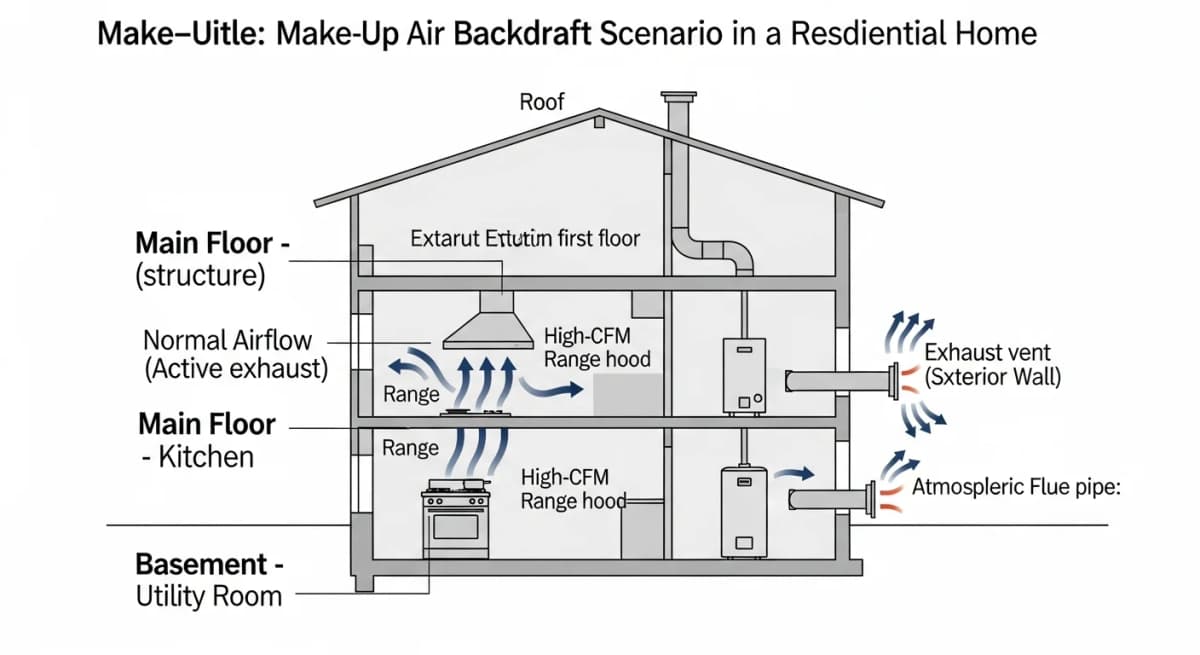
The bigger problem isn't the elevation correction — it's what happens when a contractor compensates by oversizing the hood. Boise homes built before 2010 generally don't have make-up air systems. Any hood rated over 400 CFM triggers the 2018 IRC M1503.6 make-up air requirement when the home has a fuel-burning appliance that is neither direct-vent nor mechanical-draft (an atmospheric water heater or furnace) inside its air barrier, and without make-up air a powerful hood can depressurize the home enough to backdraft an atmospheric gas water heater or furnace — pulling combustion gases (including carbon monoxide) back into the living space. Below are the eight sizing and ventilation mistakes we see most often on Boise kitchen remodels, the math behind each, and what to spec instead.
For broader HVAC system design context, our Boise HVAC upgrade guide covers heating, cooling, and whole-home ventilation; this page focuses specifically on kitchen range venting where the elevation math, make-up air, and combustion-appliance interaction matter most.
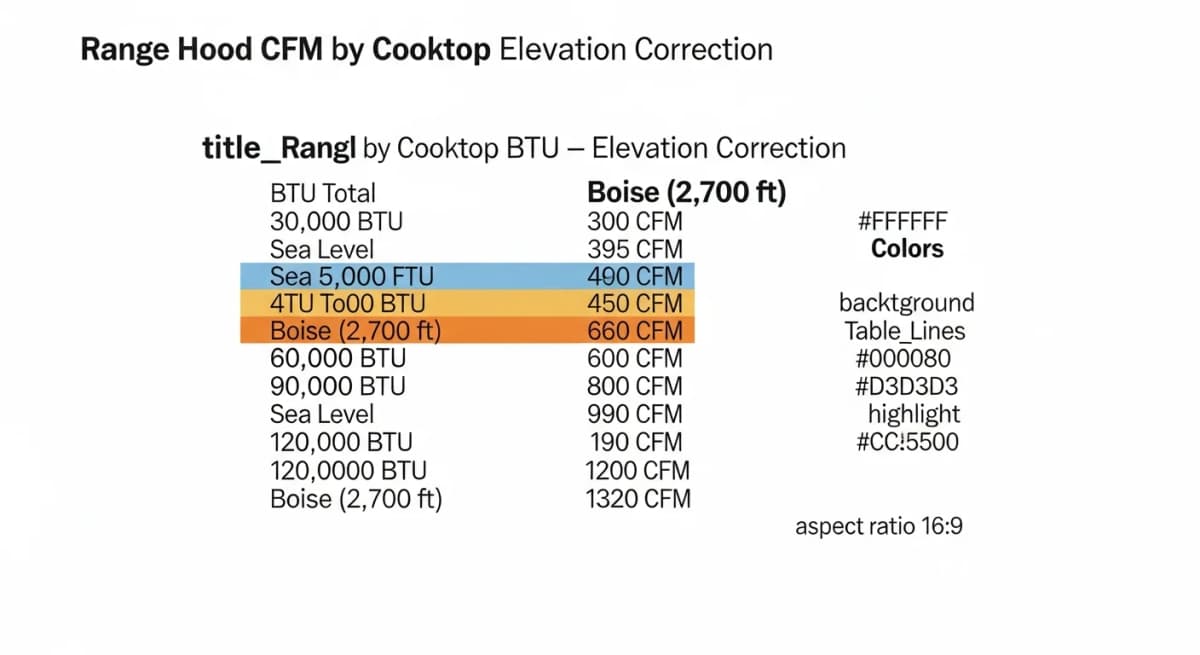
Air density at Boise's 2,700-foot elevation is roughly 91% of sea-level density at the same temperature. Range hood CFM ratings are determined under sea-level test conditions per HVI 916 standards, which means the air mass a hood actually moves in a Boise kitchen is about 9% less than the rating implies. For an 18,000 BTU professional gas burner at full output, that small percentage matters because the smoke and grease load doesn't decrease with altitude — only the hood's ability to move it does.
The practical correction is simple: take the sea-level CFM recommendation for your cooktop and multiply by 1.10 to size for Boise. A range that would call for 600 CFM at sea level should be specced at 660 CFM minimum here. For most mid-range residential cooktops (15,000 BTU total output and below), the elevation correction lands inside the next-size-up hood category without changing the model selection materially. For high-output cooktops (60,000+ BTU total — common in upscale Boise master kitchens), the correction can push the spec into a higher-CFM tier and into make-up air requirements.
Every Boise kitchen with a gas cooktop or range. The correction is small but real.
Negligible cost difference between adjacent hood sizes. Worth specifying correctly.
The industry-standard CFM formulas, both elevation-corrected for Boise:
Gas cooktops: Total burner BTU output ÷ 100 × 1.10 (elevation correction) = required CFM. A typical residential gas range with four burners at 12,000, 15,000, 9,000, and 5,000 BTU totals 41,000 BTU and needs (41,000 ÷ 100) × 1.10 ≈ 451 CFM minimum.
Professional gas ranges: Same formula, larger numbers. A 36-inch pro range with six burners typically outputs 100,000–120,000 BTU and needs 1,100–1,320 CFM. This is well above the 400 CFM make-up air threshold.
Electric / induction cooktops: CFM = cooktop linear width in inches × 10 × 1.10. A 36-inch induction cooktop needs 36 × 10 × 1.10 = 396 CFM minimum. Generally below the make-up air threshold.
The CFM rating on the hood box is the minimum acceptable rating, not the optimal. We typically spec 10–20% above the calculated minimum to provide capture margin for searing, wok cooking, or aggressive grilling — which are the cases where under-specified hoods fail to handle the smoke load. The exception: don't oversize for the sake of oversize. Once you cross 400 CFM you trigger make-up air requirements (next item), which is a significant additional scope.
2018 International Residential Code Section M1503.6, which Boise adopts as part of the Idaho building code, requires that exhaust hoods rated over 400 CFM have a make-up air system where a gas, liquid, or solid fuel-burning appliance that is neither direct-vent nor mechanical-draft (an atmospheric water heater or furnace) sits inside the home's air barrier. The make-up air system replaces the air the hood pulls out, preventing the home from becoming depressurized relative to outside atmospheric pressure. Without make-up air, a 600 CFM hood operating in a closed house draws air down chimneys, through gas-appliance flues, and through any other accessible opening.
The threshold is per-hood, not aggregate. A 350 CFM hood does not trigger make-up air requirements even if there's a separate bathroom exhaust fan running simultaneously. An all-electric home, or one where every gas appliance is direct-vent or power-vented, is outside the code trigger — though make-up air still helps comfort and indoor air quality. The code reasoning is that hoods over 400 CFM represent a concentrated localized depressurization that's qualitatively different from distributed home ventilation.
Boise PDS inspectors check for make-up air where the code requires it. The inspection looks for the make-up air damper or fan, the rough-in routing, and the interlock with the range hood control (the make-up air activates when the hood runs above its trigger speed). Skipping the make-up air during install means failing the inspection and retrofitting before final, which is more expensive than including it from rough-in.
Any Boise kitchen spec with cooktop output above 36,000 BTU, or any pro-style cooktop. The math forces make-up air in most upscale builds.
Make-up air systems add $1,200–$3,500 to the project scope depending on type and complexity. Plan for it from design, not as a change order during build.
This is the failure mode that makes range hood sizing a safety question, not just an air-quality one. When a high-CFM range hood operates without proper make-up air, the home interior pressure drops by 5–15 Pascals relative to outside. That's enough negative pressure to reverse the flow in an atmospheric-vented gas appliance — water heater, furnace, or boiler — pulling combustion gases backward down the flue and into the living space.
Combustion gases from natural gas combustion include carbon monoxide. A 30-minute high-CFM cooking session with an atmospheric gas water heater backdrafting can produce indoor CO levels in the 50–150 ppm range — above NIOSH's 35 ppm recommended 8-hour limit and into the range that triggers measurable physical symptoms (headache, fatigue, nausea). The homeowner doesn't see this because CO is odorless. A working CO detector catches it; an aging or absent CO detector doesn't.
The atmospheric-gas-appliance population in Boise is significant. Many pre-2000 Boise homes still have atmospheric water heaters (the kind with a draft hood and an unpowered flue), atmospheric furnaces (older 80% AFUE systems with B-vent flues), or both. Pre-1985 homes almost always do unless they've been remodeled. The make-up air system isn't just about meeting code — in homes with atmospheric appliances, it's the difference between a safe kitchen remodel and an ongoing carbon monoxide exposure during cooking.
Our standard practice on Boise kitchen remodels with hoods over 400 CFM: verify whether the home has atmospheric or power-vented gas appliances during design walkthrough, spec the make-up air system to match, and recommend hard-wired CO detectors on every level of the home if not already present.
Every pre-2000 Boise home with a gas water heater or furnace. Worth checking even if the existing appliances are newer.
If the existing appliances are atmospheric, the safest move is to upgrade them to power-vented versions at the same time as the kitchen. Bundled cost is meaningfully lower than separate projects.
Spec a Boise kitchen vent system that handles the cooking and the climate
Range hood sizing, make-up air, ducting, and combustion-appliance interaction all need to be designed together — not chosen after the cabinets are ordered. Schedule a consultation and we'll model the air handling alongside the rest of your kitchen remodel scope.
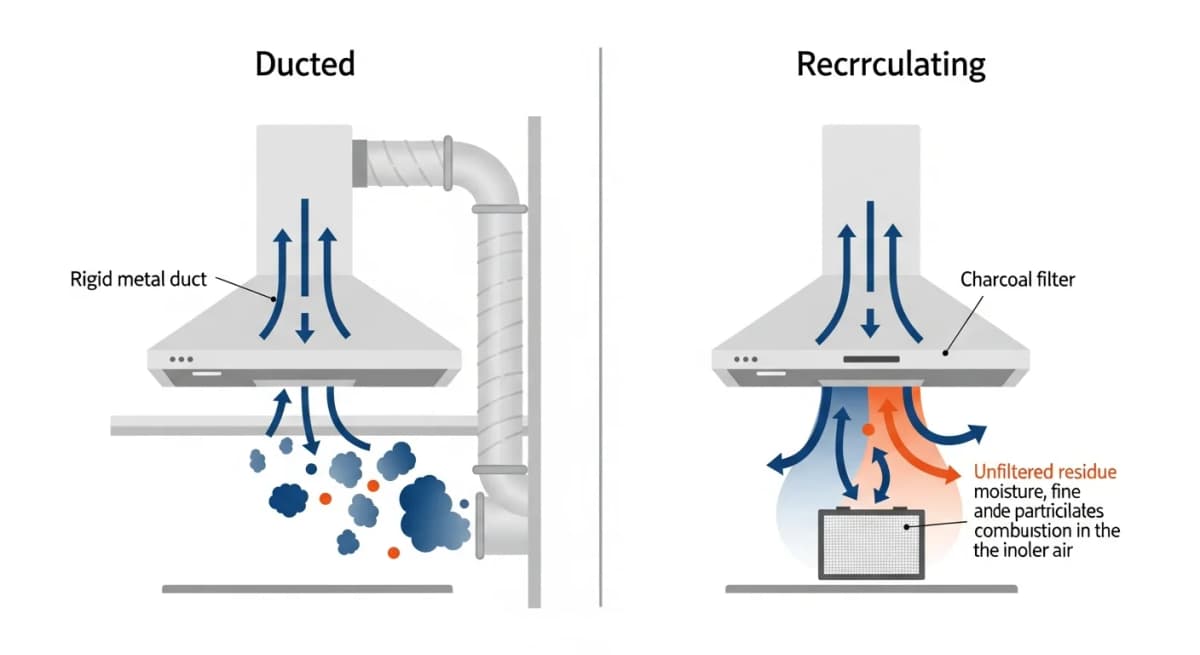
Ducted range hoods route exhaust air through rigid metal ductwork to an exterior wall or roof. Recirculating range hoods pass air through a charcoal filter and return it to the kitchen. Manufacturer marketing tends to treat the two as equivalent options; for Boise specifically they're not.
Three Boise-specific factors push toward ducted:
Wildfire smoke season (August–September): When the Treasure Valley sits under wildfire smoke, indoor air quality is materially compromised even without cooking. A ducted hood removes cooking pollutants entirely from the home rather than re-adding them to already-marginal indoor air. A recirculating hood with a charcoal filter does filter some grease and odor but doesn't remove particulates from the cooking session itself.
Dry-climate moisture management: Boise's <30% winter humidity is generally a comfort benefit, but cooking adds moisture that's beneficial in winter (raising indoor humidity slightly) but counterproductive over the longer term as it deposits on cold surfaces, windows, and exterior walls. Ducted hoods remove this moisture; recirculating hoods leave it in the home.
Combustion-appliance gas removal: Recirculating hoods do nothing for combustion gases from gas cooktops. The water vapor and carbon dioxide from combustion stay in the home. In Boise's sealed winter envelope (homes are tight to retain heat), this matters more than in mild climates where windows open year-round.
Recirculating is acceptable when ducting genuinely can't be routed (some interior kitchen islands in finished homes) but it's a compromise, not an equivalent. We try hard to make ducting work — through a soffit, through an upper cabinet kick, through the floor to a basement run — before accepting recirculating as the spec.
Hood CFM ratings assume a straight, short duct run with minimal restriction. Real installations rarely have that. Each 90-degree elbow in the duct path adds roughly the resistance of 5–15 feet of straight duct. Long runs (over 10 feet) add additional restriction. Reducing the duct diameter from the hood's rated outlet (typically 8 inches or larger for hoods over 600 CFM) drops effective CFM further.
The practical math: a 600 CFM hood with three 90-degree elbows and 15 feet of duct behaves like it is pushing through 30–60 feet of straight duct, and delivers meaningfully less than its rated CFM at the cooktop. Suddenly that "adequate" hood is under-performing. It is common to find Boise kitchen installs where the hood was specced correctly but the ductwork was routed through an aesthetically convenient but functionally bad path (over a cabinet, around a soffit, through a stud bay, down to a basement run, across to an exterior wall) and the result was a high-CFM hood with the performance of a 200 CFM model.
Our standard practice: use rigid metal duct only (flexible duct is not permitted by code for range hood exhaust and underperforms even where used), keep the run under 12 feet straight equivalent, limit to two 90-degree elbows maximum, and maintain the manufacturer's specified duct diameter for the entire run. When the geometry of the kitchen forces longer or more-elbow runs, we upsize the hood CFM rating to compensate or relocate the hood position during design.
Sone ratings measure perceived loudness. Hoods running at high CFM are inherently louder than low-CFM hoods — physics of moving air through ductwork. A typical 600 CFM hood at maximum speed is rated 6–9 sones, which is loud enough to interrupt conversation and discourage homeowners from running the hood at the speed it's specced for. The functional consequence is people use the hood at reduced speed (3–4 sones, 250–350 CFM actual) and the smoke handling that justified the larger hood doesn't happen.
Two approaches address this. Remote blowers place the hood's motor in the attic or on the exterior wall rather than directly above the cooktop, which dramatically reduces perceived sound at the cooktop (typically 50–70% reduction in sones). Adds $400–$900 to the install but the homeowner actually uses the hood at appropriate speed.
Multiple-speed hoods with smart controls let the hood ramp speed automatically based on cooking intensity. Several premium hoods (Wolf, Sub-Zero, Best, Zephyr) have sensor-based auto-mode that runs at low CFM for boiling, ramps to high for searing or grilling. Better usability without the remote-blower complexity.
The pattern we've seen: homeowners who spec a premium high-CFM hood but skip the sone-management features end up under-using the hood and dissatisfied with kitchen air quality. The remote blower or smart-speed feature is usually the difference between a satisfied install and a frustrated one.
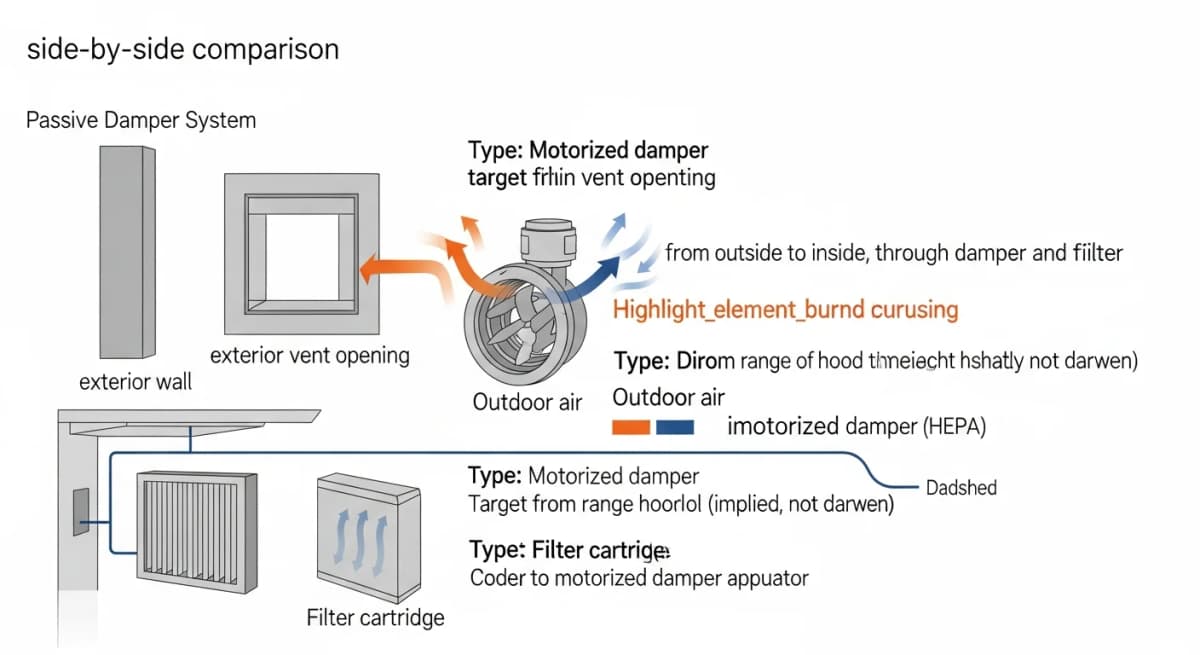
Three make-up air system types exist for Boise kitchen remodels:
Passive damper system ($1,200–$2,000 installed): A motorized damper opens when the range hood activates, allowing outside air to flow into the home through a wall vent. The air is unconditioned — same temperature as outdoor air. Acceptable for shoulder-season cooking but uncomfortable when outdoor temps are below freezing or above 90°F. Simplest to install and inspect.
Active fan system without tempering ($1,800–$2,800 installed): A small fan actively pulls outdoor air in, matching the volume the hood pushes out. Same temperature problem as passive — outdoor air is unconditioned. Active fan ensures the make-up volume is actually achieved (passive systems can underperform if the wall vent is restricted), but it doesn't fix winter comfort.
Active fan with tempering ($2,500–$4,500 installed): The make-up air fan pulls outdoor air through a small heating element (electric or hydronic) that warms it to roughly 50–60°F before introducing it to the home. The added comfort is significant for Boise winters where outdoor air can be 10–30°F when a homeowner is cooking dinner. The tempering element typically adds $700–$1,500 to the system cost depending on capacity and heating type.
For most Boise kitchen remodels with high-CFM hoods, we recommend either tempered active or passive damper systems depending on use pattern. Households that cook seriously in winter (heavy cooktop use during the coldest months) benefit from tempering. Households that mostly do warm-weather cooking can get by with passive. We help work through the use pattern during the design phase.
Iron Crest's standard process for kitchen range venting in Boise starts with the cooktop selection. We can't size the hood until we know the BTU rating of the cooktop, and most homeowners choose cooktop before considering hood. Once the cooktop is selected, we run the elevation-corrected CFM math, check whether the spec crosses the 400 CFM make-up air threshold, identify any atmospheric gas appliances in the home that change the make-up air priority from "code compliance" to "safety mandatory," and route the ductwork using rigid metal with minimal elbows. The make-up air system type gets chosen based on the household's cooking patterns and budget.
Where this work most often pays off is in upscale Eagle, Harris Ranch, and Northwest Boise master kitchens with professional ranges where the homeowner specifically chose the cooktop to handle ambitious cooking. The hood and make-up air spec is what makes that cooking actually feasible in the kitchen without making the rest of the house uncomfortable or unsafe. The integration is part of how we plan every kitchen remodel in Boise.
Do I really need make-up air on a 600 CFM hood in Boise?
Under 2018 IRC M1503.6, yes if your home has any atmospheric-vented gas appliance (a water heater or furnace with a B-vent or draft-hood flue) inside its air barrier — and Boise PDS checks for make-up air where that condition applies. The reasoning behind the code is the worst-case backdraft scenario, which depends on hood capacity rather than how you intend to use the hood. For all-electric homes or homes where every gas appliance is direct-vent or power-vented, the code requirement does not apply and the safety argument is weaker, but the comfort and indoor-air-quality arguments remain. We don't install hoods over 400 CFM in Boise without make-up air. Period.
How do I know if my gas water heater or furnace is atmospheric or power-vented?
Look at the flue at the top of the appliance. Atmospheric-vented units have a draft hood (a sheet-metal shroud over the flue opening, usually with visible gaps around the base) and the flue exits straight up through the roof. Power-vented units have a sealed fan housing on top (you'll hear it run when the appliance is firing) and the flue typically exits horizontally through an exterior wall using PVC or thin-wall metal pipe. If the flue is plastic PVC, the appliance is definitely power-vented. If the flue is double-wall galvanized B-vent rising vertically through the roof, the appliance is definitely atmospheric. Our pre-construction walkthrough verifies this in 60 seconds — it's a key input to the kitchen ventilation design and we check it on every pre-1995 Boise home.
Can I add make-up air retroactively if I already have a high-CFM hood without it?
Yes, but it costs more than including it from the start. Retrofit make-up air installation typically runs $2,500–$4,500 because the wall penetration, ductwork, electrical for the damper or fan, and any tempering coil have to be added into a finished home — often requiring drywall cutting and patching in the adjacent room or basement. Including make-up air during the original kitchen remodel runs $1,200–$2,000 for the passive damper version because the rough-in happens during the same wall openings as everything else. If you have an existing high-CFM hood and atmospheric gas appliances, retrofitting make-up air is a legitimate safety upgrade — we handle this as part of a kitchen project when the situation calls for it.
Are downdraft vents (Jenn-Air, Bosch) a real alternative for Boise kitchens?
Downdraft vents pull air down through a slot at the cooktop level rather than capturing it overhead. They work moderately well for boiling and simmering but poorly for high-heat cooking — searing, frying, grilling — because hot air and grease naturally rise and the downdraft has to work against physics. For Boise specifically, the downdraft option is more attractive for island cooktops (where overhead hoods require dedicated ductwork through the ceiling) than for wall cooktops (where overhead is straightforward). The CFM math is similar to overhead, and the make-up air threshold applies the same way. We've installed downdrafts when the homeowner specifically wanted the design language of a flush-mount cooktop, but we're always explicit that for ambitious cooking, overhead capture remains technically superior. The compromise is real and worth discussing during design.
Does Idaho Power offer rebates on range hood or make-up air installations?
No. Idaho Power's residential offers are the Heating and Cooling Efficiency Program (heat pumps, central air conditioning, duct sealing, smart thermostats, evaporative coolers, whole-house fans, hybrid heat pump water heaters), the A/C Cool Credit bill credit, and the Shade Tree Project. Range hoods, make-up air units, and exhaust fans are not on that list, and there is no Idaho Power weatherization or insulation rebate to stack with them. Budget the ventilation scope on its own merits — capture performance, duct sizing, and make-up air code compliance — rather than on incentive money that isn't there.
How important is range hood selection for a Boise wildfire-smoke season strategy?
More important than most homeowners realize. During Treasure Valley wildfire smoke events (typically 2–6 weeks during August and September), indoor air quality depends on the home's envelope tightness and the family's cooking patterns. A high-quality ducted range hood removes cooking-generated particulates entirely from the home; a recirculating hood adds them back to already-marginal indoor air. Beyond the hood itself, make-up air systems with HEPA filtration can introduce filtered outdoor air during cooking sessions, which is functionally different from drawing in raw smoky outdoor air. For homeowners who plan to be in their Boise home long-term and value indoor air quality, specifying the kitchen ventilation system with wildfire season in mind is worth the extra design conversation. Our standard approach: ducted hood, sized correctly for the cooktop, paired with a make-up air system that includes pleated filtration for the make-up intake.
Spec a Boise kitchen vent system that handles the cooking and the climate
Range hood sizing, make-up air, ducting, and combustion-appliance interaction all need to be designed together — not chosen after the cabinets are ordered. Schedule a consultation and we'll model the air handling alongside the rest of your kitchen remodel scope.
These pages go deeper on the topics linked from this article. Read them before your consultation and you'll come in with sharper questions and a clearer scope.
The following government agencies, industry organizations, and official resources provide additional information relevant to your remodeling project.