

Solid Hardwood Flooring Installation in Boise
The only floor in the house you renew instead of replace — five to seven sand-and-refinish cycles across 50 to 100 years. Iron Crest installs solid hardwood across the Treasure Valley, from species selection and moisture-meter acclimation through final sand-and-finish.
Quick answer
Yes — seasonal gapping is normal and expected with solid hardwood in Boise. The Treasure Valley sits in Idaho’s high desert, and indoor relative humidity routinely falls into the teens once forced-air furnaces run from late November through March.
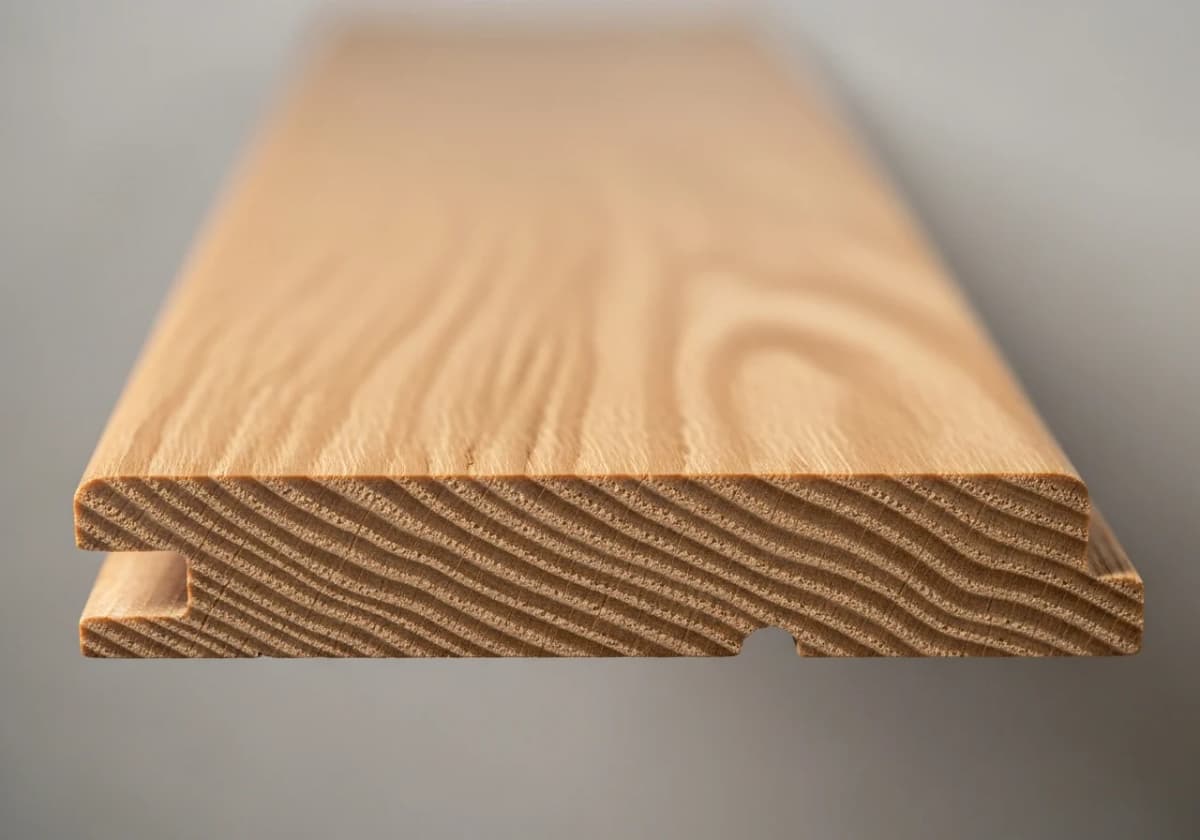
Solid hardwood flooring is milled from a single piece of timber — the residential standard is a 3/4″ board with a tongue-and-groove profile that locks adjacent planks tightly together. The distinction that matters is structural: a solid board is the same species of wood from the wear surface all the way to the bottom. Engineered hardwood, by contrast, is a thin sawn or sliced veneer of real wood bonded over a dimensionally stable plywood or HDF core. Both are “real wood” underfoot, but only solid hardwood carries enough homogeneous material above the tongue to be sanded back to bare wood and refinished again and again.
On a 3/4″ solid board, the usable wear layer above the tongue is roughly 1/4″. A professional sand-and-refinish removes only about 1/32″ of surface wood — enough to erase decades of micro-scratches, dents, and outdated stain in a single pass. Do the arithmetic and you arrive at the figure that defines this material: five to seven full refinish cycles over the life of the floor, which is why a properly maintained solid floor genuinely lasts 50 to 100+ years, while a synthetic floor is replaced rather than renewed when its wear layer is gone. That renewability is the entire economic argument for solid hardwood.
It also explains the trade-off. Because a solid board is one continuous piece of hygroscopic wood with no engineered core to restrain it, it expands and contracts with the humidity around it more than any other flooring product. In a humid climate that is a minor footnote. In Boise — high desert, 2,700 feet, single- digit-to-teens indoor humidity for months — it is the central design consideration, and it is covered in depth below. If you have not yet decided between solid and a more climate-tolerant build, our engineered hardwood and luxury vinyl plank pages cover the alternatives honestly.
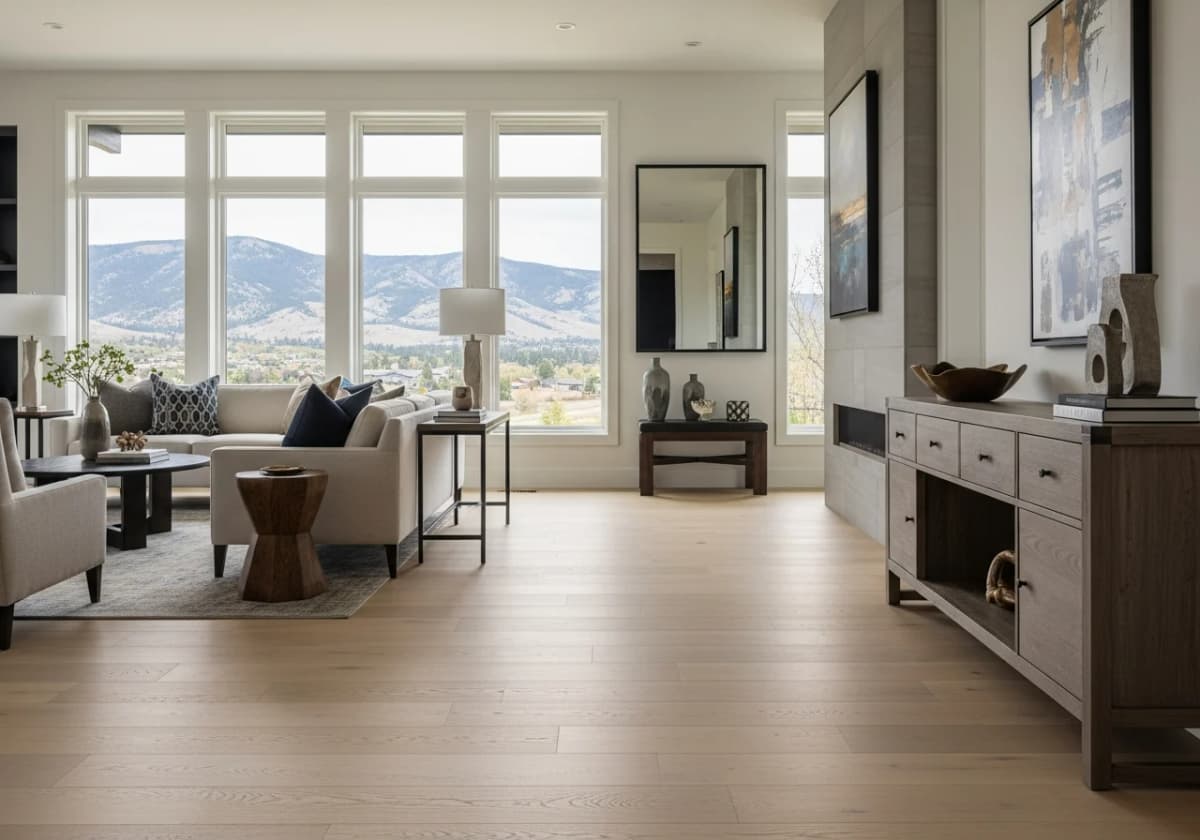
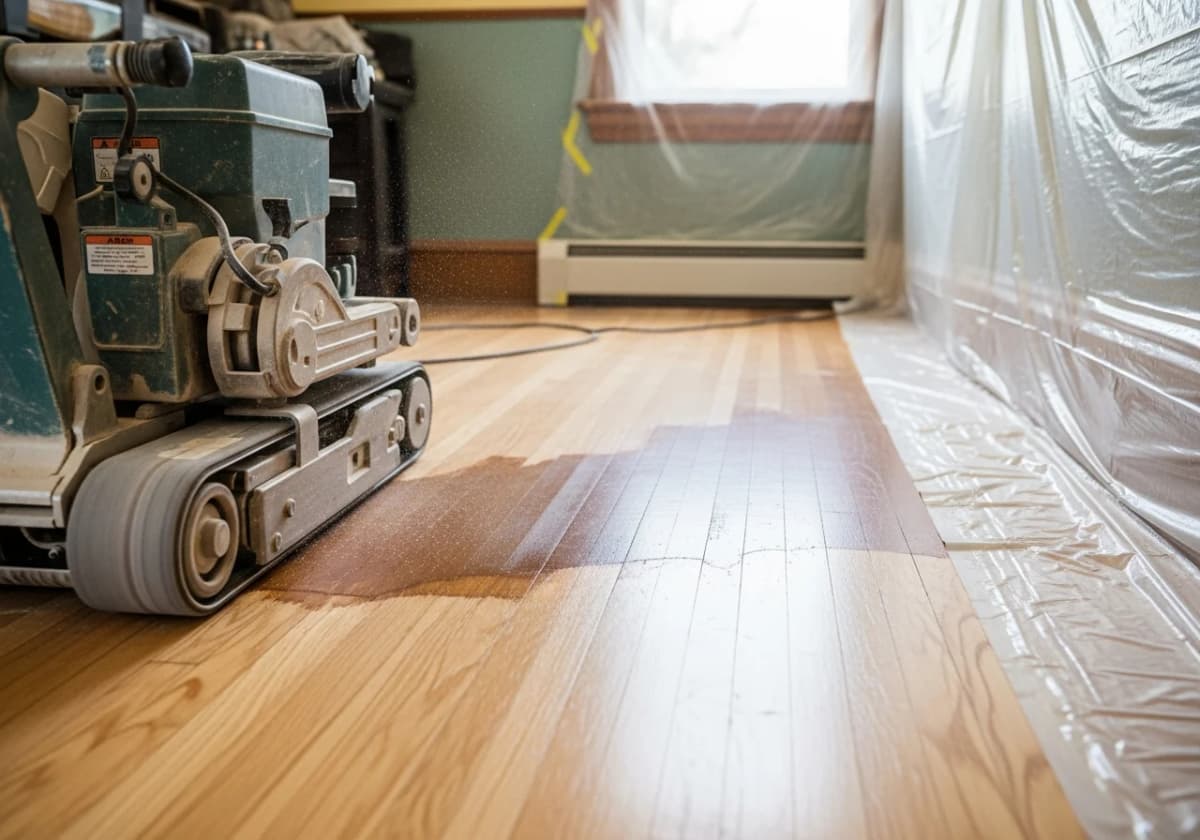
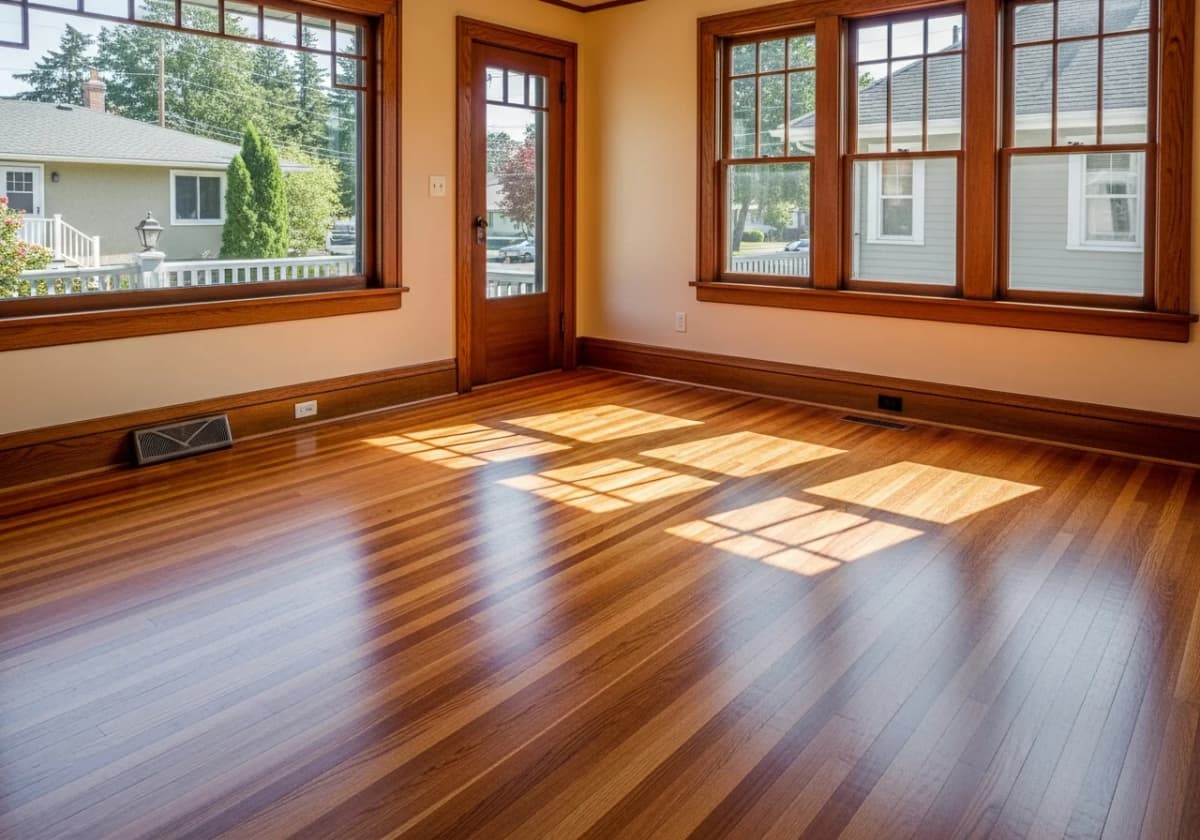
A look at recent solid hardwood work across Boise — from new wide-plank white oak installs in the foothills to belt-sander refinishes on original 1920s strip flooring in the North End.
Janka hardness measures the pounds of force required to press a steel ball halfway into a board (per the USDA Forest Products Laboratory Wood Handbook, Chapter 5). It is a reliable predictor of dent and gouge resistance under chair legs, dog claws, and dropped cookware — but it is not the same thing as scratch resistance, and it says nothing about how a species behaves in dry air or how it accepts stain. Choosing a Boise hardwood well means weighing hardness, dimensional stability, grain figure, and stain behavior together. Here is how the species we install most often actually perform.
| Species | Janka (approx.) | Character & Stain Behavior |
|---|---|---|
| Red Oak | ~1,290 lbf | Open, prominent grain with pink-red undertones. Takes stain very evenly and forgivingly — the most predictable species to color. Slightly more open than white oak, so a touch more seasonal movement. |
| White Oak | ~1,360 lbf | Tighter grain, cooler brown-gold tone, no pink. The most dimensionally stable common domestic species and the best all-around Boise choice. Excellent with everything from natural to deep espresso and the popular weathered-gray and white-oil looks. |
| Hard Maple | ~1,450 lbf | Pale, creamy, very uniform closed grain. Hard, but its dense fiber blotches and goes muddy with dark stain — best left natural or lightly toned. Modern, Scandinavian look. |
| Hickory | ~1,820 lbf | Hardest common domestic species, with dramatic light-to-dark color streaking. The bold grain camouflages seasonal movement, dents, and wear better than anything else — ideal for big dogs and active families. |
| Ash | ~1,320 lbf | Oak-like bold straight grain but lighter and cleaner in tone. Stains well and offers a contemporary alternative to oak. Reasonably stable in dry air. |
| American Walnut | ~1,010 lbf | Rich chocolate brown straight from the mill with flowing open grain — the luxury look, no stain required. Softest of the group, so it dents more readily; best in formal or lower-traffic rooms and more sensitive to humidity swings. |
Two practical points the table cannot fully capture. First, the way a board is cut from the log changes its behavior: plain-sawn boards show the familiar cathedral grain and move more across their width, while quarter-sawn and rift-sawn boards show tight straight lines and are noticeably more dimensionally stable — a real advantage in Boise and worth the premium on wide planks. Second, grade matters independently of species: a clear or select grade is uniform and formal, while a character or rustic grade keeps knots, mineral streak, and color variation. Grade affects price as much as species does, and it dramatically changes how a stain reads across the floor.
Wood moves as a percentage of its width, not as a fixed amount. That one fact governs almost everything about how a solid floor behaves in Boise. A 2 1/4″ strip and a 7″ plank of the same species lose the same percentage of dimension when winter humidity drops — but on the wide board that same percentage is a far larger number of inches, so the gap that opens between planks is correspondingly wider and more visible. Wide-plank solid floors also carry a higher risk of edge cupping if humidity is not controlled, because there is more unrestrained width per board reacting to a moisture gradient through its thickness.
Wide planks are genuinely beautiful and they are what most Treasure Valley clients ask for — 5″ to 8″ reads modern, calm, and high-end, and it suits the open layouts of foothills new construction in the Boise bench, Harris Ranch, and Eagle. We install plenty of it. But in our climate wide solid plank is a commitment: it demands disciplined whole-home humidification, a longer and meter-verified acclimation, tighter installation tolerances, and very often a quarter-sawn or rift-sawn cut to buy back stability. Narrower strip flooring (2 1/4″ to 3 1/4″) is the historically proven, low-drama choice for Boise — it is exactly what is under the carpet in most North End and Hyde Park homes — and it hides seasonal gapping almost completely.
The honest guidance we give: if you want the wide-plank look and can guarantee year-round humidity control, solid is on the table and we will engineer for it. If you want wide plank but cannot promise stable humidity — a vacation home, a busy household that will not babysit a humidistat, an HVAC system without a humidifier — this is precisely the situation where engineered hardwood is the smarter purchase, because its plywood core restrains exactly the movement that wide solid plank amplifies.
More solid hardwood floors in the Treasure Valley fail from humidity neglect than from any installation defect. Boise is high desert at roughly 2,700 feet. Outdoor winter relative humidity sits low, and once forced-air furnaces run continuously from late November into March, indoor humidity routinely falls into the teens. Solid wood responds to that exactly as physics requires — it gives up moisture and shrinks. The good news is that this is entirely manageable when you understand and plan for it.
Winter Gapping Is Normal, Not a Defect
Expect fine gaps between boards every winter and expect them to close again in summer. On narrow strip flooring the lines are usually hairline; on wide plank they are visible. This annual breathing is the nature of solid wood in a dry climate and is not covered as a defect by any flooring manufacturer or by our workmanship warranty — it is the expected behavior of the material you chose. What we warranty is correct acclimation, layout, and fastening; what you manage is humidity.
A Whole-Home Humidifier Is Non-Negotiable
To keep solid hardwood stable in Boise the house must hold roughly 35–45% relative humidity year-round. The reliable way to do that is a bypass or fan-powered humidifier integrated with the furnace and run off a humidistat — not portable room units, which cannot cover a whole home and lull owners into a false sense of safety. We assess your HVAC and humidity capability during the estimate. If the home has no humidifier and no plan to add one, we will recommend against solid hardwood and steer you to engineered or LVP instead. We would rather lose the solid-hardwood sale than install a floor that will disappoint you every January.
Never Below Grade, Never on a Bare Slab
Solid 3/4″ hardwood is never installed below grade and never glued or floated directly on an on-grade concrete slab. Slabs continuously transmit ground moisture by vapor drive; even a Boise basement that feels bone-dry will push enough humidity into solid wood over months to cup, buckle, and fail it. The only correct way to put a wood floor over a slab is to build and moisture-test a proper sleeper or plywood subfloor system so the floor can be mechanically fastened and isolated from the slab. For basements, slab-on-grade additions, and bonus rooms over garages we point clients to luxury vinyl plank or engineered hardwood, which are engineered for exactly those conditions.
Acclimation Is Done on a Moisture Meter, Not a Calendar
“Let it sit a week” is a myth. Real acclimation equalizes the flooring's moisture content with the home's normal living environment. We confirm the HVAC is running at occupied settings, then take pin or pinless moisture-meter readings of both the subfloor and the flooring, opening or distributing the material so it can breathe. We fasten boards only when the wood is within an acceptable few percentage points of the subfloor and inside the manufacturer's target moisture range. In Boise's dry conditions that often takes longer than the box says, particularly for wide planks and dense species. We document the readings. Rushed acclimation is the most common cause of solid-floor failure in this valley and one Iron Crest does not permit.
The installation method for solid hardwood is not a style preference; it is determined by what is under your feet. The overwhelming majority of Treasure Valley homes — 1920s–1950s plank-and-board subfloors in the North End and Hyde Park, mid-century plywood subfloors across the Boise bench, and modern OSB or plywood subfloors in foothills and Eagle new construction — have a wood subfloor over a crawlspace or basement. That is the textbook condition for solid hardwood.
Over a wood subfloor we fasten 3/4″ solid boards with pneumatic cleats or staples driven at an angle through the tongue, every several inches and tight to the joist layout, with the run direction and starting wall chosen so the floor looks intentional and stays flat. On older homes we first flatten and re-secure the subfloor, eliminate squeaks, and address any board cupping or rot — a new floor only performs as well as the deck it is nailed to. We also lay an appropriate underlayment and, over crawlspaces, verify the crawlspace itself is dry and vapor-controlled, because a damp crawlspace will telegraph moisture up into a new floor just as surely as a slab will.
Solid hardwood is fundamentally a nail-down product. It is not engineered to be glued or floated directly over a bare on-grade slab the way LVP and many engineered floors are; attempting that in our climate invites adhesive failure and cupping. When a slab is the only substrate — some single-level Treasure Valley homes and slab-on-grade additions — the correct approach is to build a moisture-tested plywood subfloor or sleeper system over the slab so the solid floor can be mechanically fastened and isolated from ground moisture. If that build-up is not feasible or not in budget, engineered hardwood is the honest recommendation for that space. We confirm your substrate and method before a number ever goes on the estimate.
The reason solid hardwood justifies its higher up-front cost is the renewable wear layer. With roughly 1/4″ of usable wood above the tongue and only about 1/32″ removed per professional sanding, a solid floor supports five to seven full sand-and-refinish cycles — and a refinish is dramatically cheaper than replacement. Each cycle returns the floor to bare wood, lets you change stain color entirely if tastes have moved on, and resets the surface to like-new. A homeowner who refinishes every fifteen to twenty-five years can run a single solid floor across a lifetime and still hand a sound, refinishable floor to the next owner.
This is not theory in Boise. The original oak and fir strip floors in North End and Hyde Park bungalows laid in the 1920s through 1950s are, in many houses, still the floor — refinished two or three times across a century and still carrying wear layer above the tongue. We routinely uncover one of these under carpet during a remodel, screen or fully sand it, repair the handful of damaged boards, and return it to service for a fraction of the cost of new flooring. Before we ever recommend replacement we measure remaining thickness; if there is wear layer left, refinishing costs a fraction of a new floor and ends with the same finished surface.
The economics also frame when solid hardwood does not pay. On a rental, a flip, or a short-hold property, the renewable wear layer is value you pay for and never use — a more disposable floor is the rational choice there. The 50–100 year math only returns its premium when the home and owner will actually run the refinish cycles over time.
The ranges below reflect current Treasure Valley pricing for solid hardwood, fully installed, including standard subfloor preparation, acclimation, installation labor, and basic trim and transitions. They are planning ranges, not quotes — species, grade, plank width, finish method, subfloor repair, stairs, and pattern work all move the number. Installed hardwood in Boise — solid or engineered — sits in an $8 to $18 per square foot band, and every figure below is a slice of it. Iron Crest does not publish or rely on brand-specific pricing; every estimate is built from your actual rooms.
| Species / Tier | Installed Cost / sq ft | Notes |
|---|---|---|
| Red Oak (standard grade) | $9 – $13 | Most economical solid option; very forgiving with stain |
| White Oak | $10 – $15 | Best all-around Boise choice; quarter-sawn adds cost |
| Hard Maple | $10 – $15 | Hard and clean; best natural or lightly toned |
| Ash | $10 – $15 | Oak-like grain, lighter tone, contemporary |
| Hickory | $11 – $16 | Hardest domestic; best for active homes and large dogs |
| American Walnut | $14 – $18 | Luxury tone, softer; formal and lower-traffic rooms |
| Wide plank / select grade / herringbone | top of the band | Moves a species toward $18 rather than adding a separate line |
Whole-House Planning Range
For a typical Boise home with roughly 1,000–1,400 sq ft of hardwood area, the $8–$18/sq ft band works out to roughly $8,000–$25,000 all-in — including removal of old flooring, subfloor prep, meter-verified acclimation, installation, and finish work. Historic-home subfloor repair and stair work push the upper end.
Prefinished vs. Site-Finished Cost
Prefinished is typically $1–$2/sq ft less than site-finished because it removes on-site sanding, staining, and coating labor. Site-finishing adds 2–3 days for sanding and cure but delivers custom color and a seamless, bevel-free surface. Get a tailored figure on the free estimate.
Every solid hardwood project requires two finish decisions: factory-finished versus sanded-and-coated in your home, and which finish chemistry and sheen. Neither is universally “better” — each suits different projects.
Prefinished (Factory Finish)
- Factory-cured aluminum-oxide coating — harder and more abrasion-resistant than any on-site polyurethane
- Faster install — walkable immediately after fastening, no cure wait
- No sanding dust in an occupied home
- Carries a manufacturer finish warranty — a third-party term, so check the length and the exclusions on the manufacturer's own site before you buy
- Micro-beveled plank edges give a defined, board-by-board look
- Typically $1–$2/sq ft less due to reduced on-site labor
Site-Finished (Custom Finish)
- Unlimited custom stain — match existing floors or hit an exact color
- Seamless, flat surface with no micro-bevel between boards
- 3–4 coats applied on site over freshly sanded wood
- The right choice for blending into a historic North End floor
- Adds 2–3 days for sanding, staining, and cure
- Home is vacated during sanding and coating (typically 24–48 hours)
On finish chemistry: oil-based polyurethane ambers over the years, which warms and flatters oak and walnut, is very durable, and costs less, but it is high-VOC and slow to cure. Water-based polyurethane stays water-clear, will not yellow, cures fast, and has far lower odor and VOCs, with commercial-grade formulas now matching oil for wear. Hardwax-oil systems give the very natural, low-sheen look an increasing share of Boise clients want and spot-repair without a full re-coat, though they need periodic re-oiling. Sheen is a separate call from chemistry: matte and satin dominate today because they hide dust, fine scratches, and our dry-climate seasonal movement far better than gloss, which spotlights every imperfection. We bring samples of each and match the system to how you actually live.
Solid hardwood is a natural product and it will show life. Janka hardness predicts resistance to denting — the divot from a dropped pan or a stiletto heel — and there walnut is vulnerable, oak and ash are solid, maple is hard, and hickory is the most dent-resistant common species. But hardness is not scratch resistance. Even very hard maple shows fine surface scratching from grit tracked in on shoes and dog claws, because scratching happens in the finish layer and on the wood fiber regardless of Janka number. Anyone who promises a scratch-proof real-wood floor is selling something.
The good news is that this is exactly the problem solid hardwood is built to solve. Day to day, a matte or satin finish, a bold-grain species like hickory, and a mid-tone stain hide the inevitable scuffs far better than gloss, pale maple, or very dark espresso (which shows every speck of dust and every scratch). Felt pads under furniture, walk-off mats at exterior doors, keeping grit swept, and trimming pet nails handle the rest. And when years of accumulated wear finally show, you do the one thing no other floor can do — sand it back to bare wood and start over. A scratch in LVP or laminate is permanent; a scratch in solid hardwood is temporary by design.
Solid hardwood is a fantastic floor in the right rooms and a liability in the wrong ones. Here is how we advise clients across a typical Boise home.
Excellent Fit
- Living, family, and dining rooms — the showcase rooms, and the ones that justify a refinishable floor
- Bedrooms and home offices — low water risk, low traffic, long life
- Hallways and formal entries above grade — high visual impact, easy to refinish runs
- Open main-level great rooms — one continuous wood plane with no transition strips
Wrong Room — Choose Something Else
- Full bathrooms — standing water and humidity; choose tile or LVP
- Laundry and mud rooms — splash and tracked moisture; choose tile or LVP
- Basements and rooms over a slab — vapor drive cups and buckles solid wood
- Kitchens — a judgment call: workable with diligent spill control, but heavy-splash or pet-heavy households are better with LVP or tile here
A common and excellent Treasure Valley plan: solid hardwood through the main living areas, bedrooms, and hallways; tile in baths and the mud room; luxury vinyl plank in the basement; and carpet in secondary bedrooms or a bonus room for warmth and budget. We design the whole house, not one room.
We turn down more solid-hardwood jobs than most clients expect, because recommending the wrong floor for a home is how a contractor earns a callback and a bad review rather than a referral. Solid hardwood is the wrong call when:
The home has no whole-home humidifier and no plan to add one — solid wood will gap badly and may cup; engineered hardwood or LVP is the right investment instead.
The space is below grade or sits on a slab without a built-up, moisture-tested subfloor system.
It is a rental, flip, or short-hold property where the renewable wear layer is value paid for and never used.
A genuinely waterproof floor is required — a household with heavy spills, pets, or accessibility needs around water.
The budget cannot absorb both the floor and the humidity control it requires — buying solid without humidification is buying a problem.
In every one of these cases the better answer is usually engineered hardwood (real wood, slab- and climate-tolerant) or luxury vinyl plank (fully waterproof, dimensionally stable). We will tell you that on the estimate rather than after the floor fails. Compare every option on the flooring installation hub or read deeper background in our project guides.
The right solid-hardwood approach in our market depends heavily on the era and construction of the home. Iron Crest works across the full Treasure Valley, and the housing stock falls into a few clear patterns.
Historic Boise — North End, Hyde Park, East End. Many of these 1920s–1950s bungalows and cottages still have their original oak or fir strip floors over board subfloors, frequently buried under decades of carpet. The highest-value move here is rarely new flooring — it is a careful sand-and-refinish of what is already there, with board repair and a site-finished stain that respects the home's period. When new wood is needed, narrow strip flooring matched to the original keeps the floor historically correct and minimizes seasonal gapping.
Foothills and new construction — Boise bench, Harris Ranch, Eagle, Meridian, Star. Newer homes favor wide-plank white oak in natural, weathered, and white-oil tones across open main levels. These are beautiful installations and very much on trend, but wide plank in our dry climate is the scenario that most demands disciplined humidification, quarter-sawn or rift cuts for stability, and meter-verified acclimation. Many of these homes also have slab-on-grade additions or basements where solid hardwood does not belong and engineered or LVP carries the look without the risk.
The dry-climate common thread. Whatever the era, the Treasure Valley is high desert. Every successful solid-hardwood floor here shares the same three habits: the right species and cut for the room, honest acclimation on a moisture meter, and year-round whole-home humidity control. Get those right and a solid floor will outlive the mortgage. See where we work on the regions page, or contact Iron Crest to talk through your specific home.
For all its demands, solid hardwood remains the floor that defines a quality home in this valley — for reasons that hold up under scrutiny.
Renewable for Generations
Five to seven sand-and-refinish cycles mean one floor can serve a lifetime and still hand a sound floor to the next owner. No synthetic product comes close.
No Resale Percentage — On Purpose
We publish no resale figure for flooring. We hold no MLS access and no Boise appraisal data that isolates what a floor did to a sale price. Ask your agent or an appraiser about your own neighborhood.
Beauty That Improves With Age
Real grain, real depth, and a patina that develops over decades. Every board is unique in a way no printed product can imitate.
Hypoallergenic Surface
Unlike carpet, hardwood traps no dust, dander, or pollen — a real benefit during Idaho’s sagebrush and grass-pollen seasons.
Honest, Repairable Material
Damage is not permanent. Individual boards can be replaced and the whole floor can be reset to new — a floor you maintain rather than replace.
A Backed Installation
Iron Crest Remodeling Group LLC — registered with Idaho DOPL as RCE-6681702, and insured — stands behind every solid-hardwood install with a 3-year workmanship warranty and free in-home estimates.
Will solid hardwood flooring gap in Boise’s dry winters?
Yes — seasonal gapping is normal and expected with solid hardwood in Boise. The Treasure Valley sits in Idaho’s high desert, and indoor relative humidity routinely falls into the teens once forced-air furnaces run from late November through March. Wood is hygroscopic: as the air dries, each plank gives up moisture and shrinks slightly across its width. On a 3 1/4″ board you may see a hairline; on a 5″ or wider plank the same percentage of movement produces a visibly larger gap. Those gaps generally close again in late spring and summer as humidity climbs back into a healthier range. The single most effective way to limit winter gapping is a whole-home humidifier holding the house at 35–45% relative humidity year-round, paired with a dimensionally stable, quarter-sawn or narrower-plank species such as white oak.
How long does solid hardwood flooring last in a Boise home?
Properly installed and humidity-managed solid hardwood lasts 50 to 100+ years. The working surface above the tongue on a standard 3/4″ board is roughly 1/4″ thick, and each professional sand-and-refinish removes only about 1/32″ — enough for five to seven full refinish cycles across the floor’s life. That is why original oak and fir floors in Boise’s North End and Hyde Park bungalows, many laid in the 1920s through the 1950s, are still in daily service after several refinishes. No other flooring category — LVP, tile, carpet, or laminate — can be renewed this way.
How much does solid hardwood flooring cost to install in Boise?
Installed hardwood in the Treasure Valley runs $8 to $18 per square foot depending on species, grade, plank width, and whether the floor is prefinished or sanded and finished on site. As a rough guide: red oak $9–$13, white oak $10–$15, hard maple $10–$15, hickory $11–$16, ash $10–$15, and American walnut $14–$18. Wider planks, select/clear grades, herringbone or borders, stair treads, and extensive subfloor repair move a species toward the top of that band. For a typical Boise home with roughly 1,000–1,400 square feet of hardwood area, that works out to roughly $8,000–$25,000 all-in. Every Iron Crest estimate is built from your actual rooms, subfloor, and species — not a flat per-foot guess.
Should I choose site-finished or prefinished hardwood for my Boise home?
Both are excellent; the right answer depends on the project. Prefinished boards arrive with a factory-cured aluminum-oxide finish that is harder and more abrasion-resistant than anything that can be applied on site, install faster, create no sanding dust, and carry a manufacturer finish warranty — a third-party term whose length and exclusions you should read on the manufacturer's own site — but they have micro-beveled edges and a fixed color palette. Site-finished floors are installed raw, then sanded flat and coated in your home, which yields a seamless edge-to-edge surface and unlimited custom stain colors. Site-finishing is the better path when you are blending into existing hardwood, restoring a historic North End floor, or want a specific stain that no factory offers. Iron Crest installs both and brings physical samples to the in-home estimate.
Can I install solid hardwood in my Boise basement?
No — solid 3/4″ hardwood should never go below grade. Basement slabs continuously transmit ground moisture by vapor drive, and even a dry-feeling Boise basement will push enough humidity into solid wood to cause cupping, buckling, and adhesive failure over time. Solid hardwood is also not recommended directly on any on-grade concrete slab without a properly built and moisture-tested sleeper or plywood subfloor system. For basements and slab spaces we steer clients to luxury vinyl plank or engineered hardwood, both of which are designed for those conditions.
What is the Janka hardness of the species you install, and does it matter in Boise?
Janka measures the force needed to embed a steel ball halfway into the wood, so it predicts dent and gouge resistance. Common Boise species rank roughly: American walnut ~1,010 lbf, red oak ~1,290, white oak ~1,360, ash ~1,320, hard maple ~1,450, and hickory ~1,820. Hardness matters for dent resistance under chair legs, dropped objects, and dog claws, but it is not the whole story. A high-Janka species like maple still shows fine surface scratches because hardness and scratch-resistance are different properties, and dimensional stability in our dry climate depends more on species, cut, and plank width than on Janka number. We weigh all three together when recommending a species for your household.
Does plank width affect how much my floor moves seasonally?
Significantly. Wood moves as a percentage of its width, so a 5″ plank moves nearly twice as much in absolute inches as a 2 1/4″ strip under the same humidity swing. In Boise’s low-humidity winters that means wide-plank solid floors show larger seasonal gaps and a higher risk of cupping if humidity is not controlled. Wide planks are beautiful and on-trend, but in our climate they demand disciplined whole-home humidification, careful acclimation, and often a quarter-sawn or rift-sawn cut for added stability. If you love the wide-plank look but cannot guarantee humidity control, engineered hardwood is the more forgiving way to get it.
How do you acclimate hardwood before installing it in the Treasure Valley?
Acclimation is about equalizing the wood’s moisture content with the home’s normal living conditions — not just leaving boxes in the house for a set number of days. We confirm the HVAC is running at normal occupied settings, then use a pin or pinless moisture meter to read both the subfloor and the flooring. The goal is to get the wood within a few percentage points of the subfloor and within the manufacturer’s target range before a single board is fastened. In our dry climate that typically means several days of conditioning, sometimes longer for wide planks or dense species. We document the readings; we do not install on a calendar, we install on the meter.
Nail-down, staple, or glue-down — which method will you use in my home?
Over a wood (plywood or board) subfloor, which covers most Boise homes including foothills new builds and older North End houses, we fasten 3/4″ solid hardwood with cleats or staples driven through the tongue — the proven standard for solid wood. Solid hardwood is not appropriate as a direct glue-down or floating floor over a bare slab; on the rare on-grade slab project we build and moisture-test a proper plywood subfloor or sleeper system first so the floor can be mechanically fastened. The method is dictated by the structure under your feet, and we verify it before quoting.
Oil-based or water-based polyurethane — and what about the matte trend?
Oil-based polyurethane ambers over time, adding warmth that flatters oak and walnut, is very durable, and costs less, but it is high-VOC and slow to cure. Water-based polyurethane stays clear (it will not yellow), cures faster, and has far lower odor and VOCs, with modern commercial-grade formulas matching oil for durability. Hardwax-oil finishes are increasingly popular for the very matte, natural look many Boise clients want and they spot-repair easily, though they need periodic re-oiling. Sheen is a separate choice from chemistry: matte and satin are dominant right now because they hide dust, micro-scratches, and our dry-climate seasonal movement far better than gloss. We walk you through the trade-offs at the estimate.
Which rooms are right — and wrong — for solid hardwood in a Boise home?
Solid hardwood excels in living rooms, dining rooms, bedrooms, hallways, home offices, and formal entry areas above grade. It is a poor choice in full bathrooms, laundry and mud rooms, and anywhere with standing-water risk, and it should not be used in basements or finished spaces over a slab without a proper subfloor system. Kitchens are a judgment call: many Boise homeowners love hardwood there, and it performs well with prompt spill cleanup and mats at the sink, but households with heavy splash or pets that track water may be better served by LVP or tile in that room and hardwood everywhere else.
When is solid hardwood the wrong choice, honestly?
We talk clients out of solid hardwood more often than people expect. If the home cannot maintain 35–45% humidity in winter — no whole-home humidifier and no plan to add one — solid wood will gap and possibly cup, and engineered hardwood or LVP is the better investment. It is also the wrong call for below-grade rec rooms, slab-on-grade additions without a built-up subfloor, rental or flip properties where refinishing potential will never be used, and households needing a fully waterproof floor. The renewable 50–100 year value of solid hardwood only pays off when the home and the homeowner can support it.
Does solid hardwood add resale value to a Boise home?
We do not publish a resale figure for flooring. We hold no MLS access and no Boise-specific appraisal or transaction data that isolates what a floor did to a sale price, and national remodeling surveys are not a reliable read on the Treasure Valley. What we can tell you is what the material actually is: solid hardwood is real wood that can be sanded back to bare and refinished five to seven times, so it is the only floor in the house you renew rather than replace. Engineered hardwood is the same real wood on a stable core and goes where solid cannot — slabs, basements, radiant heat. LVP is fully waterproof and the cheapest of the three to install. If resale is the reason you are choosing, ask your agent or an appraiser what flooring is doing in your specific neighborhood and price band before you budget it as an investment rather than a finish you want to live with.
How do you sand and refinish an existing Boise hardwood floor, and is it worth it?
A full refinish means screening or fully sanding off the old finish (and any worn-through stain), repairing damaged boards, re-staining if desired, and applying three to four coats of polyurethane or a hardwax-oil system. It is almost always far cheaper than replacing the floor, and it spends only one of the five to seven cycles the board carries — meaning a 1920s North End oak floor that has been refinished three times still likely has decades of life left. If your existing solid floor is structurally sound and has remaining wear layer above the tongue, refinishing costs a fraction of replacing it and gets you the same finished result. We assess remaining thickness before recommending refinish versus replacement.
Solid hardwood is not the right fit for every room or budget. Iron Crest installs every major flooring type and will help you choose the best material for each space in your home.
We provide flooring installation to homeowners across the Treasure Valley and southwest Idaho. Each city has its own dedicated page with local permitting, climate, and project detail — and each county hub covers the surrounding communities we also serve.
The following government agencies, industry organizations, and official resources provide additional information relevant to your remodeling project.
Primary sources and industry standards consulted for this guide:
- 1.Red oak has a Janka hardness rating of 1,290 lbf at 12% moisture content and serves as the standard industry reference species; all species below it on the scale are expected to dent or wear more easily in residential use. Source (USDA Forest Products Laboratory — Wood Handbook (FPL-GTR-282), Chapter 5, Table 5-3b)
- 2.White oak has a Janka hardness rating of 1,360 lbf at 12% moisture content — harder than red oak by 70 lbf and a common premium alternative for residential floors. Source (USDA Forest Products Laboratory — Wood Handbook (FPL-GTR-282), Chapter 5, Table 5-3b)
- 3.Hickory/Pecan has a Janka hardness rating of 1,820 lbf at 12% moisture content — one of the hardest domestic species and well-suited for high-traffic areas. Source (USDA Forest Products Laboratory — Wood Handbook (FPL-GTR-282), Chapter 5, Table 5-3b)
- 4.Hard maple (sugar maple) has a Janka hardness rating of 1,450 lbf at 12% moisture content, making it harder than white oak and a popular choice for commercial and gym flooring. Source (USDA Forest Products Laboratory — Wood Handbook (FPL-GTR-282), Chapter 5, Table 5-3b)
- 5.Black walnut has a Janka hardness rating of 1,010 lbf at 12% moisture content — softer than red oak and best suited for lower-traffic residential spaces such as bedrooms. Source (USDA Forest Products Laboratory — Wood Handbook (FPL-GTR-282), Chapter 5, Table 5-3b)
- 6.Brazilian cherry (jatoba) averages 2,690 lbf on the Janka hardness scale — more than twice as hard as red oak and among the hardest commercially available flooring species. Source (Hardwood Floors Magazine (NWFA) — Species Specs: Jatoba (Brazilian Cherry))
- 7.For engineered wood flooring, Janka hardness cannot simply be inferred from the wear-layer species name; NWFA states it is inaccurate to claim the same hardness properties as a solid-wood counterpart. Testing must be conducted on the specific engineered product per ASTM D1037. Source (Hardwood Floors Magazine — Janka Misconceptions (Brett Miller, 2021))
Ready for Hardwood Floors?
Get a free, no-obligation estimate for solid hardwood flooring installation in your Boise home. Species selection, moisture-meter acclimation, and expert installation — Iron Crest handles every detail.