

Carpet Installation in Boise
Professional residential carpet installation for bedrooms, basements, living rooms, and stairs. Nylon, polyester, triexta, and wool options with expert stretch-in installation and quality padding.
Quick answer
Carpet lifespan in Boise homes ranges from 8 to 15 years depending on fiber type, traffic levels, and maintenance. Nylon carpet in bedrooms with regular vacuuming and annual professional cleaning can last 12–15 years.
The hard-surface flooring trend has dominated the Boise market for the past decade, with luxury vinyl plank and engineered hardwood claiming most of the main-floor square footage in Treasure Valley homes. But carpet hasn't disappeared — it has retreated to the rooms where it performs best and where no hard-surface material can match its comfort, warmth, and acoustic properties.
In Boise, where winter temperatures routinely drop below freezing from November through February, carpet provides genuine thermal insulation underfoot. Carpet's R-value ranges from R-1.0 for low-pile commercial styles to R-2.5 for thick plush residential carpet — significantly higher than hardwood (R-0.7), LVP (R-0.3), or tile (R-0.05). The U.S. DOE notes thick carpeting acts as an insulating barrier that reduces radiant heating system efficiency. That insulation value translates to warmer bedrooms, lower heating costs in upper-story rooms, and the simple comfort of stepping out of bed onto a soft, warm surface instead of a cold, hard floor during an Idaho winter morning.
Sound absorption is another area where carpet dominates. In two-story Boise homes — especially newer construction with open floor plans and minimal sound-dampening between floors — carpet on the upper level dramatically reduces impact noise transmitted to the rooms below. A quality carpet over a dense pad absorbs far more airborne sound than any hard-surface floor and takes the edge off the footstep noise that plagues upstairs bedrooms with hard-surface floors. We do not publish a decibel or multiplier figure for that, because the result depends on the carpet, the pad, and the floor assembly beneath them.
Safety is the third pillar of carpet's continued relevance. For Boise families with toddlers learning to walk or elderly parents navigating stairs, carpet provides a soft landing surface that reduces injury risk from falls. Carpet on stairs delivers better traction than hard surfaces, especially in socks — a practical consideration that matters more than aesthetics for families with young children. The combination of thermal comfort, sound control, and fall safety makes carpet the best flooring choice for bedrooms, basement rec rooms, and staircases in Idaho homes.
Warmth & Insulation
R-1.0 to R-2.5 thermal value — warmest flooring option for Idaho winters
Sound Absorption
Absorbs more airborne sound than any hard-surface flooring
Fall Safety
Soft landing surface for toddlers, elderly, and stairway traction
Comfort Underfoot
Softest flooring option — ideal for bedrooms and play areas
Design Versatility
Hundreds of colors, textures, and patterns to match any Boise interior
Most Affordable
Lowest cost per square foot of any professionally installed flooring
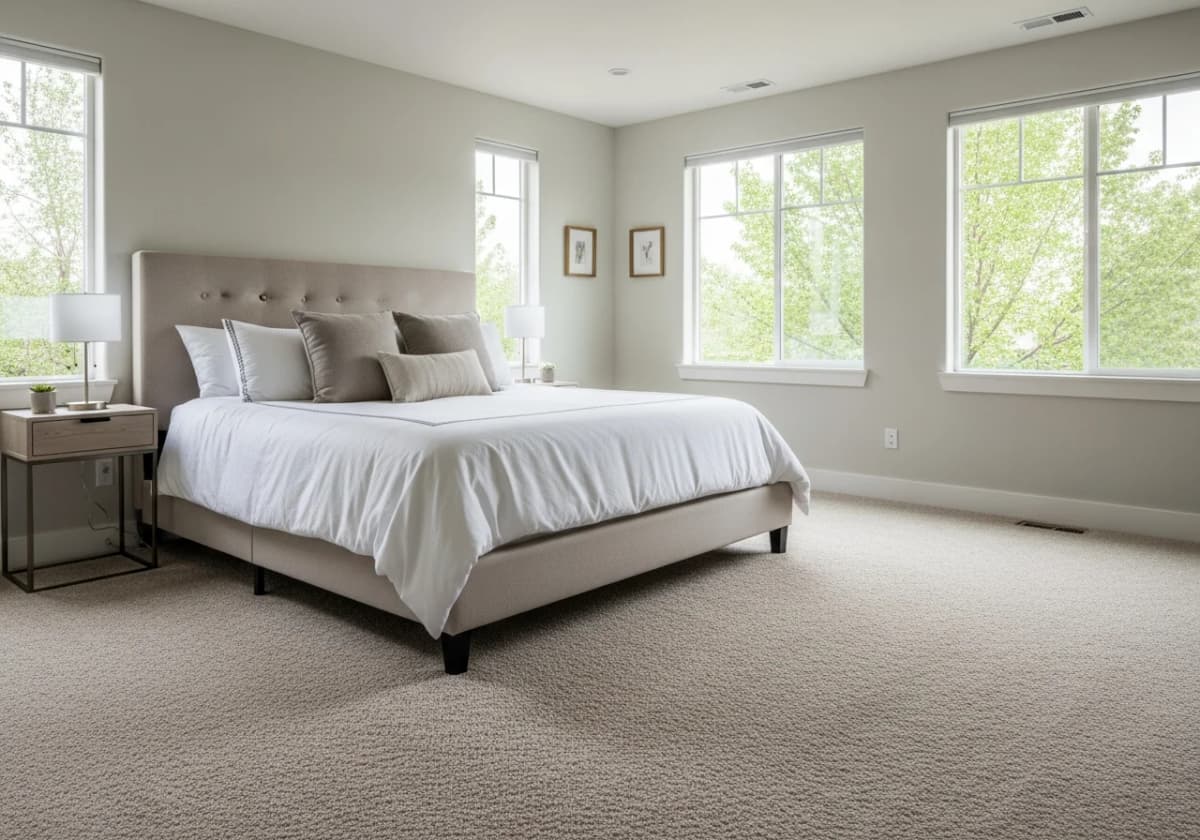
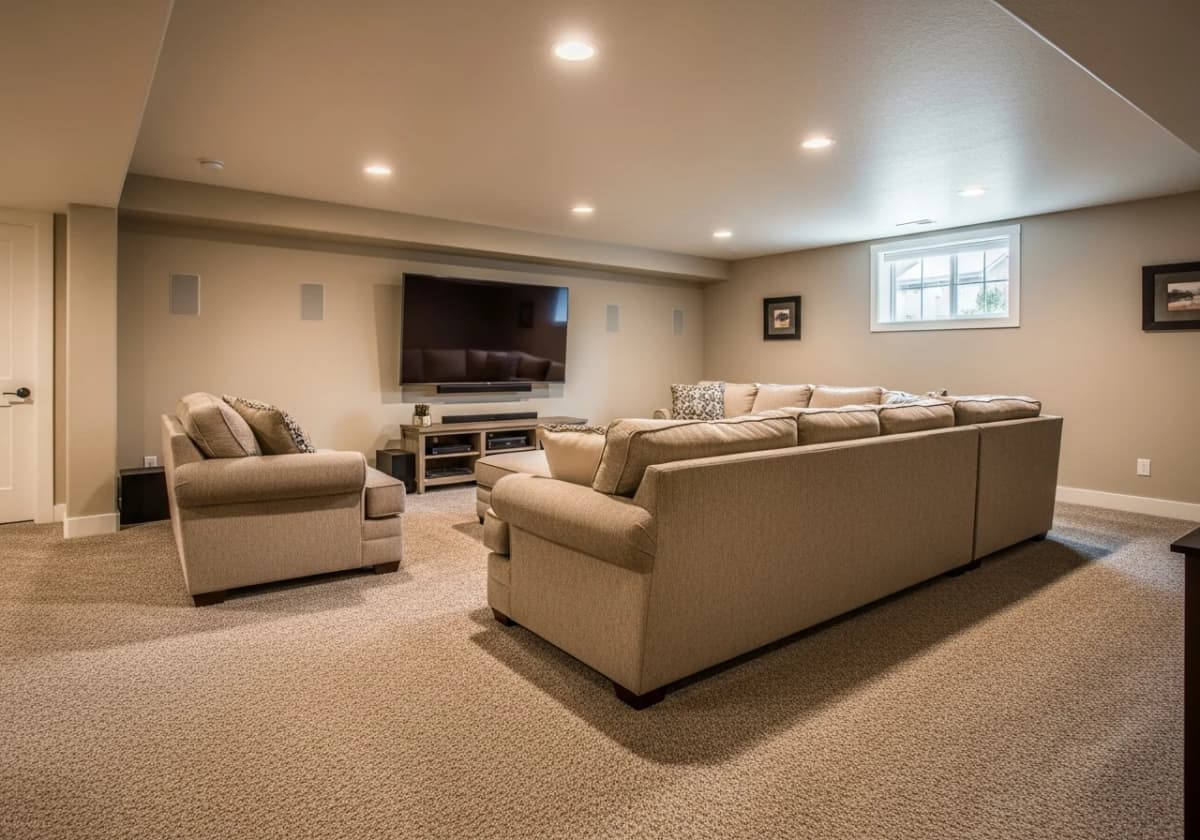
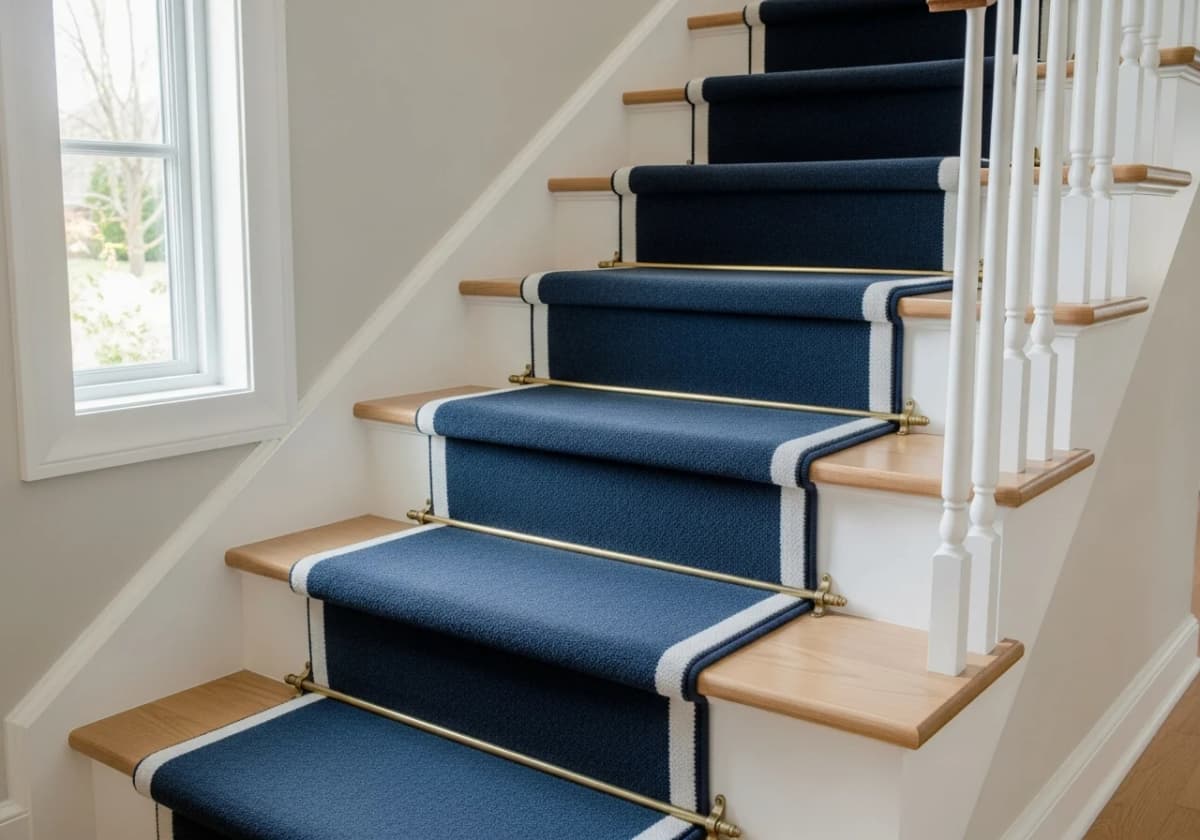
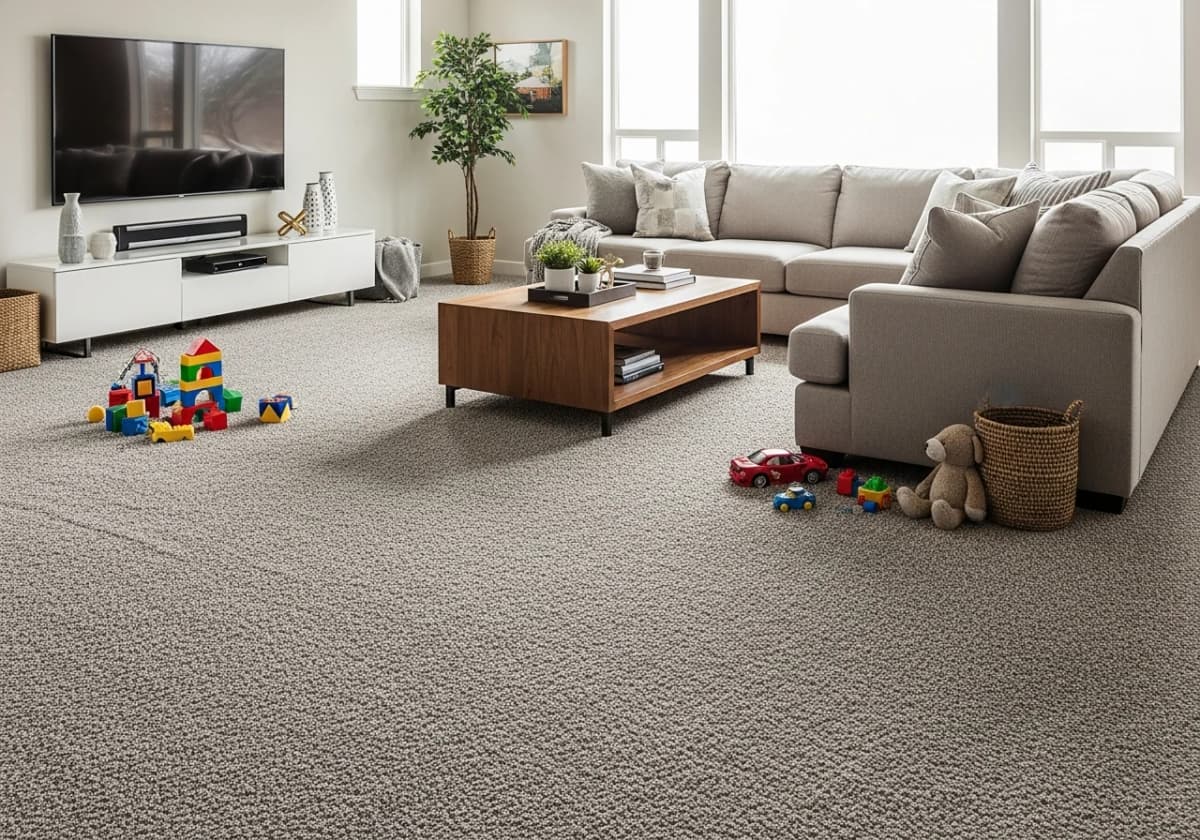
A look at carpet styles and installation concepts for Boise and the wider Treasure Valley — bedrooms, basements, stairs, and family rooms across a range of fibers and pile constructions.
The fiber type determines a carpet's durability, stain resistance, softness, and price. Each fiber has distinct strengths and trade-offs. Understanding these differences ensures you select the right carpet for each room in your Boise home.
Nylon
Best All-Around for Boise
$4 – $6 / sq ft
Installed, including pad and labor
Durability
The most resilient carpet fiber available. Nylon's molecular structure allows it to bounce back from foot traffic, resisting matting and crushing better than any other synthetic fiber. Type 6,6 nylon (Stainmaster, Anso) is stronger than Type 6 nylon and is the preferred choice for families with pets and children.
Stain Resistance
Nylon requires topical stain treatment (applied during manufacturing or after installation) to resist stains. Brands like Stainmaster and Wear-Dated use proprietary treatments that repel liquids and resist soil. Without treatment, nylon absorbs moisture readily and can stain permanently.
Best For
High-traffic areas, living rooms, stairs, family rooms, and any room where pets and kids spend time. The top recommendation for most Boise households.
Polyester / PET
$3 – $4 / sq ft
Installed, including pad and labor
Durability
Polyester is softer than nylon but less resilient. It tends to mat and crush in high-traffic areas more quickly, making it better suited for bedrooms and low-traffic spaces. PET polyester is often made from recycled plastic bottles, making it the most eco-friendly carpet fiber option.
Stain & Fade Resistance
Polyester is naturally hydrophobic — it resists water-based stains better than untreated nylon. It also resists UV fading, which matters in the sun-drenched south- and west-facing bedrooms of a Boise home, where high-desert light comes through the glass hard. However, polyester absorbs oil-based stains readily, so cooking grease and certain cosmetic products can cause permanent marks.
Best For
Bedrooms, guest rooms, and low-traffic sitting areas. Budget-conscious Boise homeowners who want a soft, vibrant carpet in rooms with light foot traffic.
Triexta / SmartStrand
$4 – $5 / sq ft
Installed, including pad and labor
Durability
Triexta (branded as Mohawk SmartStrand) delivers nylon-level resilience with a softer hand feel. It resists crushing and matting nearly as well as nylon, making it suitable for moderate-to-high-traffic areas. Partially made from corn glucose (37% bio-based), giving it an environmental edge over petroleum-based fibers.
Stain Resistance
The standout advantage of triexta is built-in, permanent stain resistance. Unlike nylon's topical treatments that wear off over time, triexta's stain resistance is engineered into the fiber itself and never diminishes. This makes it the top choice for Boise families with pets and young children who need carpet that forgives spills.
Best For
Families with pets and children who want stain protection without sacrificing softness. Bedrooms, playrooms, and living areas where spills are common.
Wool
Quoted individually
A special-order product priced above the standard installed carpet range
Durability
Wool is the original premium carpet fiber. Its natural crimp provides excellent resilience, and wool fibers naturally regulate moisture by absorbing up to 30% of their weight in water vapor without feeling damp. This moisture-regulating property helps maintain comfortable indoor air quality during Boise's dry winter months.
Luxury & Health
Wool is naturally hypoallergenic, flame-resistant, and does not off-gas VOCs like synthetic fibers. It feels noticeably more luxurious underfoot than any synthetic option. Wool carpets also act as natural air purifiers, trapping dust and allergens in the fiber until vacuumed — keeping them out of the breathing zone.
Best For
Master bedrooms, formal living rooms, and home offices in premium Boise homes — particularly in the North End, East End, and Eagle foothills where luxury finishes are expected. Not recommended for pet-heavy households due to susceptibility to permanent staining from acidic liquids.
Iron Crest recommendation: For most Boise families, nylon or triexta carpet provides the best balance of durability, comfort, and value. We install all four fiber types and will help you select the right one for each room based on your household's traffic patterns, pets, children, and budget.
Carpet showrooms lead with color and softness because that is what sells in the first ten seconds. The properties that determine whether a carpet still looks acceptable in eight years are harder to see and almost never on the front of the sample. Three construction specs — face weight, density, and twist — tell you far more about real-world durability than price or feel, and you can evaluate all three yourself with the sample in your hands. Below is the framework we use when a Boise homeowner asks us to compare two carpets that look identical on the rack.
Face Weight — Useful, But Overrated Alone
Face weight is the ounces of fiber per square yard in the pile only — it excludes the backing, so do not confuse it with total weight printed on some samples. Builder-grade carpet typically runs 25–35 oz, mid-grade residential carpet 35–50 oz, and premium carpet 50–70 oz or more. More fiber does generally help, but face weight is routinely used as a marketing number. A loosely twisted, low-density 50 oz carpet will mat and ugly-out faster than a tightly twisted 40 oz carpet. Treat face weight as one input, not the verdict.
Practical Treasure Valley targets: 35–45 oz is ample for bedrooms and guest rooms; 40–50 oz with a tight twist is the sweet spot for stairs, hallways, and family rooms that take daily traffic.
Density — The Number That Predicts Wear
Density is how tightly the tufts are packed into the backing. It is the single best predictor of how a carpet will look years from now, because sparse pile lets foot traffic crush and splay the fibers, exposing the backing in traffic lanes. You can judge density without any tools: fold a carpet sample face-out into a tight U. If you can readily see the backing grinning through the fibers, the carpet is low density and will show wear paths early. A dense carpet shows little or no backing in the bend. A firm thumb press into a dense pile springs back with no lasting dent.
For Boise homes with kids, pets, or both, prioritize density over plushness. A slightly less pillowy carpet that holds its structure will look dramatically better at year five than a soft, sparse carpet that matted flat in the first two winters.
Twist — Why Frieze Outlasts Plush in Traffic
Twist is how tightly each yarn is spun before it is heat-set. Higher twist resists the untwisting and matting that produce the fuzzy, gray traffic-lane look in cut-pile carpet. A twist number around 5 or higher is a reasonable floor for cut pile in busy rooms. Frieze carpet carries the highest twist of any style, which is exactly why it hides footprints and vacuum marks and holds up on stairs and in family rooms. Loop and Berber styles depend less on twist because the uncut loops resist crushing by construction.
When two samples have similar weight and density, the one with the tighter, more defined twist will almost always look better longer in a high-use Treasure Valley household.
Read the Warranty, Not Just the Sticker
Manufacturer warranties separate texture-retention and wear coverage from stain coverage, and they commonly condition coverage on a qualifying pad density, professional stretch-in installation, and documented professional cleaning at the interval the manufacturer sets. Terms and lengths vary by brand and line, so read the warranty document for the carpet you are actually buying rather than a summary. A long warranty number means little if the fine print excludes traffic-lane matting or voids over a thin builder pad. We walk every customer through the actual warranty terms for the specific carpet selected so there are no surprises later.
Bottom line: the carpet that performs is rarely the softest one on the wall. Density and twist, matched to the room's traffic and paired with the right pad, decide whether you are happy in year eight. These figures are general industry guidance — exact numbers vary by manufacturer and line, so use them to compare samples rather than as absolute thresholds.
Carpet installs for $3 to $6 per square foot in the Boise market, including carpet, pad, old-flooring removal, and stretch-in installation labor. That is the full band we quote from — the tiers below show where each fiber and quality level lands inside it. All pricing is per square foot installed.
| Tier | Fiber / Quality | Installed Cost | Best For |
|---|---|---|---|
| Builder Grade | Polyester / PET | $3 – $4 / sq ft | Rentals, guest rooms, budget refreshes |
| Mid-Range | Nylon or Triexta | $4 – $5 / sq ft | Bedrooms, family rooms, stairs |
| Premium | Premium Nylon (Stainmaster) | $5 – $6 / sq ft | High-traffic living areas, homes with pets |
| Luxury | Wool | Quoted individually | Master suites, luxury homes, formal rooms |
Carpet Pad Cost
Quality carpet pad adds $0.50–$1.50 per square foot to the installed price. Standard rebond pad (6 lb density) runs $0.50–$0.75/sq ft. Premium 8 lb density pad costs $0.75–$1.25/sq ft. Memory foam pad ranges from $1.00–$1.50/sq ft. Pad cost is typically included in “installed” pricing above.
Whole-Home Bedroom Estimate
Carpeting all bedrooms in a typical Boise home (600 sq ft across 3 bedrooms) costs $1,800–$3,600 installed, depending on the quality tier you select. Most Boise homeowners choose mid-range nylon or triexta, landing in the $2,400–$3,000 range for three bedrooms. This includes carpet, pad, old carpet removal, and professional stretch-in installation.
Carpet is the right choice for specific rooms and lifestyles — and the wrong choice for others. Here is an honest assessment tailored to Idaho conditions and Treasure Valley living.
Advantages
- Warmest flooring option — R-1.0 to R-2.5 insulation value, welcome on a January morning in Boise, where the normal low is about 26°F
- Best sound absorption of any flooring type — noticeably cuts impact noise between floors
- Softest and most comfortable underfoot — unmatched in bedrooms and play areas
- Most affordable per square foot — $3–$6 installed vs. $4–$20 for hard-surface alternatives
- Highest R-value insulation contributes to lower heating costs in upper-story rooms
- Safest flooring for children and elderly — cushioned surface reduces fall-injury severity
- Widest color, texture, and pattern selection of any flooring category
Drawbacks
- Susceptible to staining from spills, pet accidents, and tracked-in mud — especially common during Boise’s muddy spring months
- Traps allergens, dust, and pet dander — a concern in the Treasure Valley where seasonal pollen counts are high from April through October
- Shorter lifespan (8–15 years) compared to hardwood (25–50+ years) or tile (25+ years)
- Not suitable for wet areas — bathrooms, kitchens, and laundry rooms should use waterproof flooring
- Shows wear paths in high-traffic areas, especially polyester fibers in hallways and living rooms
- Requires regular vacuuming (2–3 times per week) and annual professional cleaning to maintain appearance and indoor air quality
- New synthetic carpet can off-gas VOCs for 24–72 hours after installation — ventilate rooms thoroughly during and after install
We install carpet, but we will not sell it into a room where it is the wrong material. Recommending the right surface for each space is how we keep Treasure Valley clients for the long term. These are the situations where we steer Boise homeowners away from carpet toward a hard-surface option.
Wet & Moisture-Prone Areas
Bathrooms, kitchens, laundry rooms, mudrooms, and any basement with a history of seepage are non-starters for carpet. The porous pad traps water against the subfloor where it cannot dry, producing mold, mildew, and odor that no cleaning can remove. Waterproof luxury vinyl plank or tile is the correct call in these rooms, every time.
Radiant-Heated Primary Rooms
Carpet's insulating R-value works against radiant floor heat — the U.S. Department of Energy warns that thick carpeting acts as an insulating barrier over a radiant system. In a room where radiant is the main heat source, that is a poor trade. Reserve carpet for radiant-free bedrooms, or choose a low-pile, low-R carpet over a thin pad only if carpet there is non-negotiable.
Severe Respiratory Sensitivity
For most allergy sufferers, carpet is manageable with disciplined maintenance and Green Label Plus products. But for a household member with severe asthma or chemical sensitivity that maintenance cannot reliably control, hard surfaces in primary living areas are the safer choice, with carpet limited to bedrooms at most.
Main Floors With a Sale on the Horizon
We publish no resale percentage for flooring, because we hold no Boise appraisal or transaction data that isolates it. What we can tell you is what clients preparing to sell report back: Treasure Valley buyers expect hard-surface flooring in entries, kitchens, and great rooms, and all-carpet public rooms become a talking point. If a sale is on the horizon, ask your agent what buyers in your neighborhood and price band actually expect, then put carpet where it belongs — bedrooms and stairs.
Treasure Valley framing: Idaho's dry climate is actually kind to carpet — low ambient humidity means far less mold and mildew risk than humid regions, so the main caution is winter static (controlled with anti-static fiber and a humidifier) rather than moisture in the living spaces. The real moisture risk is concentrated in basements over slabs and in below-grade rooms in the foothills, which is why basement carpet always starts with a moisture test. In newer foothills and subdivision construction across Eagle, Meridian, and Boise, carpet remains the builder and buyer standard for bedrooms specifically — it is expected there, and it is genuinely the best material for those rooms. Use the regions we serve and our remodeling guides to plan room-by-room, or contact us for a free in-home assessment.
Carpet construction style affects appearance, durability, and maintenance. Each style serves different aesthetic goals and traffic demands. Here is how they compare for Boise homes.
Cut Pile (Plush / Saxony)
The most common residential carpet style. Yarn loops are cut to create an even, upright surface. Plush (velvet) cut pile delivers a smooth, formal appearance with a soft, luxurious feel. Saxony features slightly longer, less dense fibers with a more textured look. Both show vacuum marks, footprints, and furniture impressions readily, which some homeowners consider a drawback.
Best for: Master bedrooms, guest rooms, and formal living spaces in Boise homes where comfort and appearance outweigh high-traffic durability needs.
Loop Pile (Berber)
Yarn loops remain uncut, creating a tight, durable surface that resists crushing and wear. Level loop (all loops the same height) produces a clean, uniform look. Multi-level loop creates subtle patterns and texture variation. Berber-style loop carpet is extremely popular in Boise basements and home offices for its durability and casual aesthetic.
Best for: Basements, home offices, and moderate-traffic areas. Note: loop pile can snag from pet claws — not recommended for homes with cats.
Cut-and-Loop (Patterned)
Combines cut and looped fibers to create geometric patterns, swirls, and textured designs. The pattern variation hides dirt, footprints, and wear more effectively than solid plush or Saxony styles. This style has gained significant popularity in Boise's newer subdivisions as homeowners seek more visual interest than plain carpet offers.
Best for: Living rooms, family rooms, and bedrooms where you want visual texture and the ability to hide everyday wear.
Frieze (Twisted)
Our Top Pick for Boise
Tightly twisted fibers that curl in multiple directions, creating a casual, textured surface. Frieze is the most practical carpet style for active Boise families. The tight twist hides footprints, vacuum marks, and light soiling better than any other style. It resists matting and crushing in high-traffic paths and maintains its appearance longer under heavy use.
Best for: High-traffic family rooms, stairs, hallways, and children's bedrooms. Our most-recommended carpet style for Boise homes that need durability without sacrificing comfort.
Boise-specific recommendation: Frieze or textured cut pile for high-traffic areas like family rooms, stairs, and kids' bedrooms. Plush or Saxony for master bedrooms and guest rooms where luxury feel matters most. Berber loop for basements and home offices where durability and a clean look take priority.
Carpet performs best in rooms where its warmth, softness, and sound absorption deliver the most value. Here is our room-by-room guide for Boise homes.
Bedrooms
Plush or frieze in nylon or triexta
Bedrooms are carpet’s ideal environment — low traffic, maximum comfort, and warmth underfoot for Idaho’s cold mornings. Most Boise homeowners choose mid-range nylon or triexta in a plush or textured cut pile. Soft, warm, quiet, and affordable. Carpet in bedrooms also eliminates the need for area rugs and reduces noise transfer to rooms below in two-story homes.
Basement Rec Rooms
Berber loop or carpet tiles in nylon
Boise basements benefit from carpet’s insulating properties on cold concrete slabs. Use synthetic fibers only (never wool) and install a moisture barrier pad. Carpet tiles are an excellent option for basements — if a section gets water-damaged during a plumbing failure or spring runoff, individual tiles can be replaced without re-carpeting the entire room.
Home Offices
Low-pile loop or textured cut pile
Carpet reduces echo in video calls, provides comfort during long work hours, and allows office chairs to roll smoothly with a quality chair mat. Loop or low-pile textured carpet in a neutral tone creates a professional background for video conferencing while remaining comfortable for barefoot work sessions.
Stairs
Frieze or textured nylon, 30–40 oz face weight
Carpet on stairs delivers critical traction and safety. Frieze or textured nylon in 30–40 oz face weight provides the best combination of grip, durability, and appearance on treads and risers. Stairs are priced per step rather than by the square foot because of the labor involved — as a planning range, about $15–$25 per step for a waterfall installation or $25–$40 per step for a wrapped (Hollywood) installation, quoted after we see the staircase.
The pad beneath your carpet determines how the carpet feels, how long it lasts, and how well it performs over time. A premium carpet over a cheap pad will underperform and wear out faster than a mid-grade carpet over a quality pad. Most Boise homeowners underestimate the importance of pad selection — it is the single most impactful upgrade you can make to extend carpet life.
Density vs. Thickness
Pad density (measured in pounds per cubic foot) matters far more than pad thickness. A thin, dense pad outperforms a thick, soft pad every time. Dense pad supports the carpet fibers, preventing them from crushing and matting under foot traffic. Overly thick, low-density pad allows the carpet to flex excessively, which breaks down the carpet backing and causes premature wear at seams and edges.
For residential carpet in Boise, we recommend 6–8 lb density pad at 7/16-inch to 1/2-inch thickness. This combination provides excellent support, comfortable cushion, and the longest carpet life. For stairs, use a firmer, thinner pad (3/8-inch, 8 lb density) to maintain tread visibility and safe footing.
Pad Types Compared
Rebond Pad (Most Common)
Made from recycled foam scraps bonded together. Available in densities from 5 lb to 10 lb. The standard choice for most residential installations in Boise. 6–8 lb rebond provides excellent performance at $0.50–$1.00 per square foot.
Memory Foam Pad
Premium pad that conforms to foot pressure and slowly recovers. Provides the most luxurious underfoot feel and excellent sound absorption. Costs $1.00–$1.50 per square foot. Best suited for master bedrooms and areas where maximum comfort is the priority.
Fiber Pad
Made from synthetic or natural fibers (felt). Very firm and dense, providing excellent support for loop/Berber carpets that require minimal flex. Fiber pad is the preferred choice for commercial and basement applications where moisture resistance matters.
Longevity impact: A quality 8 lb density pad supports the carpet backing far better than the builder-grade 5 lb pad that comes standard in most Boise new construction, which is why it is the single most cost-effective upgrade on a carpet order. We do not publish a number of years it adds — that depends on the carpet and the traffic — but the upgrade costs a fraction of what replacing the carpet early does. Iron Crest includes 6 lb density pad as our standard and recommends 8 lb for any room that receives daily foot traffic.
How carpet is installed matters as much as what carpet you buy. A premium carpet over a poor installation will telegraph seams, loosen into ripples, and fail at transitions long before its fibers wear out. These are the installation decisions that determine whether your carpet looks tight and clean for its full service life in a Treasure Valley home.
Stretch-In Installation
The residential standard. Tack strips are fastened around the room perimeter, a separate cushion is laid and seamed, and the carpet is mechanically stretched with a power stretcher and hooked onto the strips. Done correctly with a power stretcher — not just a knee kicker — the carpet stays drum-tight, feels soft underfoot, and can be re-stretched years later if it ever relaxes. This is the method we use for virtually every bedroom, living area, and stairway in Boise homes.
A common cause of premature ripples and loosening is an installation stretched only with a knee kicker. Proper power stretching across the full span is what keeps a stretch-in job flat for its full life.
Glue-Down Installation
Carpet is adhered directly to the subfloor, usually with no separate pad or with an attached cushion. It is firmer underfoot and is used mainly for commercial spaces, certain basement slabs where a moisture-managed direct bond is preferable, and heavy rolling-load areas. For nearly all Treasure Valley residential rooms, glue-down is unnecessary and gives up the comfort and re-stretch advantages of a proper stretch-in system.
We recommend glue-down only when a specific slab-moisture or rolling-load condition justifies it, and we will explain why if your project is one of those cases.
Seam Placement & Pattern Match
Broadloom carpet comes in 12-foot (and sometimes 15-foot) widths, so any room wider than the roll requires a seam. Seam quality and placement separate a professional installation from an amateur one. Seams should run in the direction of the primary light source where possible, be kept out of the main traffic path and pivot points, and be heat-sealed with seaming tape so they neither peak nor open over time. Patterned and cut-and-loop carpets must also be pattern-matched across the seam, which consumes extra material — a factor we account for in measuring so your estimate reflects realistic yardage rather than a lowball figure that grows on installation day.
We map seam locations during the in-home measurement and walk you through where any unavoidable seams will fall before the order is placed.
Stairs — Waterfall vs. Wrapped
Stairs are the hardest-wearing carpet location in any home and deserve a durable fiber, a tight twist, and a firmer, thinner pad (around 3/8-inch, 8 lb density) so treads stay defined and footing stays safe. There are two installation approaches. Waterfall installation drapes the carpet straight over the nose of each tread to the next riser — faster, lower cost, and common on basement and secondary stairs. Wrapped (or Hollywood) installation contours the carpet tightly around each tread nose and into the riser for a tailored, upholstered look favored on main staircases in Boise homes. As a planning range, waterfall typically runs about $15–$25 per step and wrapped about $25–$40 per step, with the exact figure depending on stair geometry, spindles, and landings.
Open-sided staircases, winder steps, and bullnose treads add labor and material; we price stairs after seeing them rather than from a generic per-step number.
Transitions to Hard-Surface Flooring
Most Treasure Valley homes pair carpeted bedrooms and stairs with hard-surface flooring elsewhere, so clean transitions matter. Carpet-to-hard-surface transitions are handled with a tack strip and a Z-bar or a metal/wood transition strip sized to the height difference, so the carpet edge is tucked, secured, and protected from raveling at the doorway. Where carpet meets luxury vinyl plank, hardwood, engineered hardwood, or tile, the height difference should be planned before either floor is ordered so the finished doorways sit flush and trip-free. Coordinating both materials under one flooring installation scope avoids the mismatched-height problem that happens when carpet and hard flooring are bought and installed separately.
Carpet does not wear out so much as it gets abraded and matted. The leading cause of a carpet looking tired is not age — it is fine grit ground into the pile by foot traffic. In the Treasure Valley, where dry summers and windborne dust mean more fine particulate tracked indoors, a consistent maintenance routine is the difference between a carpet that looks good for twelve years and one that looks worn at six.
Routine Care
- Vacuum two to three times per week in living areas, more in pet households — abrasive grit caught in the pile is what grinds fiber down ahead of its time.
- Use a sealed-HEPA vacuum with adjustable height so the brush actually agitates the pile without scrubbing the fiber bald.
- Blot spills immediately with a clean white cloth, working inward; never scrub, which untwists fibers and spreads the stain.
- Use walk-off mats at exterior doors to capture the bulk of tracked-in Treasure Valley dust and spring mud before it reaches carpet.
- Rotate or move heavy furniture periodically so the pile does not crush permanently in fixed spots.
Professional Cleaning Cadence
Carpet warranties generally condition coverage on documented professional hot-water extraction at the interval the manufacturer specifies, and they expect you to keep the receipts — check the warranty for your specific carpet, because the required interval is not the same across brands. In practice, a bedroom-only carpet can comfortably go 18 months between deep cleanings, while a high-traffic family room or a home with pets and young children does best on a 6–12 month cycle.
Avoid heavy detergent or rental machines that over-wet the carpet and leave residue, which attracts soil and, in a poorly ventilated room, can lead to slow-drying odor. Proper extraction with adequate dry time protects both appearance and indoor air quality.
Realistic Lifespan & Replacement Cycle
Plan on a residential carpet replacement cycle of roughly 8–15 years. Bedrooms and low-traffic rooms reach the upper end of that range; high-traffic family rooms, hallways, and stairs reach the lower end. Wool and premium dense nylon can stretch beyond fifteen years with disciplined care. The variables that shorten the cycle most are a cheap low-density pad, skipped vacuuming, infrequent professional cleaning, and permanent furniture crush — not the calendar. Investing the small upcharge for an 8 lb density pad is the most cost-effective single decision for extending the cycle, because it protects the carpet backing the entire time the fiber is in service.
These ranges are general planning guidance, not guarantees; actual life depends on fiber, construction, pad, traffic, and upkeep specific to your home. Iron Crest backs every carpet installation we perform with a 3-year workmanship warranty on the installation itself, separate from the manufacturer's product and stain warranties.
Common questions Boise homeowners ask about carpet installation, fiber selection, and carpet care.
How long does carpet last in a typical Boise home?
Carpet lifespan in Boise homes ranges from 8 to 15 years depending on fiber type, traffic levels, and maintenance. Nylon carpet in bedrooms with regular vacuuming and annual professional cleaning can last 12–15 years. Polyester carpet in high-traffic living rooms typically lasts 8–10 years before showing noticeable wear paths. Wool carpet, when properly maintained, can last 15–20 years. Boise’s dry climate actually helps preserve carpet by reducing mold and mildew risk, though the fine dust common in the Treasure Valley means more frequent vacuuming is needed to prevent fiber abrasion.
Is carpet a good choice for Boise basements?
Carpet works well in many Boise basements but requires moisture testing first. Boise’s alkaline soil and seasonal water table fluctuations can cause moisture vapor to migrate through concrete slabs. If moisture levels test below 3 lbs per 1,000 sq ft (calcium chloride test), carpet with a moisture barrier pad is safe to install. For basements with any history of water intrusion, we recommend carpet tiles with waterproof backing instead of traditional broadloom — individual tiles can be replaced if water damage occurs. Always use synthetic fibers (nylon or polyester) in basements, never wool.
Can carpet be installed over radiant floor heating in Boise?
Carpet can be installed over radiant heat, but it works against the system: the U.S. Department of Energy specifically cautions that thick carpeting acts as an insulating barrier that reduces a radiant heating system’s efficiency. Carpet’s R-value (R-1.0 to R-2.5 depending on pile height and density) holds heat below the surface rather than letting it radiate into the room. We do not publish a percentage for that loss — it depends on the system, the carpet, and the pad. If you have radiant heat and want carpet, choose a low-pile, high-density style with a thin pad and confirm the maximum floor-covering R-value your radiant manufacturer allows before ordering. For rooms where radiant heat is the primary heat source, hard-surface flooring like LVP or tile is a better choice.
How do I choose between nylon and polyester carpet for my Boise home?
Choose nylon for high-traffic areas and homes with pets or children. Nylon’s superior resilience means it bounces back from foot traffic and resists matting far better than polyester. Choose polyester for bedrooms and low-traffic spaces where softness and color vibrancy matter most. Polyester is also the better choice for Boise families on a budget — it lands at the bottom of the installed carpet range where comparable nylon sits in the middle or top of it. For the best of both worlds, consider triexta (SmartStrand), which offers nylon-level durability with polyester-level softness and built-in stain resistance.
How much does it cost to carpet three bedrooms in a Boise home?
Carpeting three standard bedrooms in a Boise home (approximately 400–600 sq ft total) costs $1,200–$3,600 installed. Carpet runs $3–$6 per square foot installed in the Boise market: builder-grade polyester at the bottom of that range, mid-range nylon or triexta in the middle, and premium nylon at the top. Those figures include carpet, pad, removal of old flooring, and professional stretch-in installation. Wool is a special-order product quoted individually rather than from this range. Iron Crest provides free in-home measurements and detailed quotes so you know the exact cost before committing. Final pricing always depends on room layout, fiber choice, and seam count, so treat these as planning ranges rather than firm quotes.
What is carpet face weight, and what number should I look for?
Face weight is the ounces of fiber per square yard, measured only in the pile (the part you walk on) and not the backing. As a general rule of thumb, builder-grade carpet runs 25–35 oz, mid-grade residential carpet runs 35–50 oz, and premium carpet runs 50–70+ oz. Face weight alone is not a reliable quality measure, however, because a low-twist, low-density carpet at 50 oz can wear faster than a tightly twisted 40 oz carpet. For most Boise bedrooms, 35–45 oz is plenty; for stairs and high-traffic family rooms, look for 40–50 oz combined with a tight twist and high density rather than chasing weight in isolation.
What does carpet density mean and how do I judge it in a showroom?
Density refers to how closely the individual yarn tufts are packed together. The simplest in-person test is to bend a carpet sample backward into a U shape: if you can easily see the backing through the fibers (called grin-through), the carpet is low density and will mat and show wear paths quickly. A dense carpet shows little or no backing when bent. You can also press your thumb firmly into the pile — dense, well-constructed carpet springs back quickly with no lasting impression. Density typically matters more than face weight for predicting how a carpet will look in five to ten years, especially in Treasure Valley homes with active families and pets.
What is carpet twist, and why does it matter for durability?
Twist (sometimes shown as turns per inch, or the manufacturer’s twist number) describes how tightly the yarn is twisted before it is heat-set. A higher twist number generally means better resistance to untwisting, matting, and the fuzzy, matted look that develops in traffic lanes. A twist number of roughly 5 or higher is desirable for cut-pile carpet in busy areas; frieze carpet has the highest twist of any style, which is why it hides footprints and wears so well in Boise family rooms and on stairs. Loop and Berber carpet rely less on twist because the uncut loops are inherently more resistant to crushing.
Should I choose stretch-in or glue-down carpet installation?
Stretch-in installation (carpet stretched over tack strips with a separate pad underneath) is the standard for residential carpet in Boise homes. It feels softer underfoot, allows a quality cushion that extends carpet life, and lets the carpet be re-stretched later if it loosens. Glue-down installation, where carpet is adhered directly to the subfloor with little or no pad, is used mainly in commercial settings, on some basement slabs with moisture concerns, and on rolling-load areas. For nearly every bedroom, stairway, and living area in a Treasure Valley home, stretch-in over a 6–8 lb pad is the correct method, and it is what we install unless a specific slab-moisture or rolling-load condition calls for glue-down.
Why is carpet a poor choice for bathrooms and moisture-prone basements?
Carpet and its pad are porous and slow to dry. In bathrooms, laundry rooms, and basements with any history of seepage, trapped moisture in the pad creates an ideal environment for mold, mildew, and persistent odor that cannot be cleaned out of the cushion. Even Boise’s dry climate does not prevent this once water gets into the carpet sandwich, because the moisture is held against the subfloor where it cannot evaporate. For these areas we recommend waterproof flooring such as luxury vinyl plank or tile instead. If carpet is desired in a finished basement, it should only go over a slab that has passed a moisture test, with a moisture-barrier pad, and ideally as replaceable carpet tiles rather than wall-to-wall broadloom.
Does carpet make indoor air quality worse for allergy sufferers?
The honest answer is nuanced. Carpet acts as a passive filter that traps dust, pollen, and pet dander in the fibers, which keeps those particles out of the breathing zone until they are vacuumed away. The downside is that without consistent maintenance, that trapped load is re-released into the air when the carpet is disturbed. For Treasure Valley homes during the high-pollen months of April through October, an allergy-sensitive household can use carpet successfully with a sealed-HEPA vacuum used two to three times per week, annual hot-water-extraction cleaning, and Green Label Plus low-VOC carpet and pad. Households with severe respiratory conditions may still prefer hard-surface flooring in primary living areas and reserve carpet for bedrooms only.
What are low-VOC carpet options and how long does new carpet off-gas?
New synthetic carpet, pad, and adhesives can release volatile organic compounds (VOCs) for roughly 24–72 hours after installation, with the strongest odor in the first day. The Carpet and Rug Institute’s Green Label Plus program certifies carpet, cushion, and adhesives that meet low-emission standards, and choosing Green Label Plus products substantially reduces off-gassing. To minimize exposure, ventilate the room with open windows and fans during and for several days after installation, run HVAC on fresh-air mode where possible, and keep sensitive household members out of freshly carpeted rooms for the first two to three days. Wool and many recycled-content PET carpets are inherently lower in synthetic off-gassing.
How often should carpet be professionally cleaned in the Treasure Valley?
Carpet warranties generally condition coverage on documented professional hot-water extraction (often called steam cleaning) at an interval the manufacturer sets, and they expect you to keep the receipts. Terms differ by brand and by line, so check the actual warranty document for the carpet you choose rather than relying on a rule of thumb. In practical Treasure Valley terms, a bedroom-only carpet may go 18 months between professional cleanings, while a high-traffic family room or a home with pets and children benefits from cleaning every 6–12 months. Boise’s fine windborne dust means regular vacuuming (two to three times per week, more in pet households) is just as important as the periodic deep clean, because abrasive grit caught in the pile is the leading cause of premature fiber wear.
Does Boise’s dry climate cause carpet static shock?
Yes, low winter humidity in the Treasure Valley can make static electricity noticeable on carpet, especially with older or untreated synthetic fibers. Modern residential carpet is manufactured with anti-static treatment or conductive filaments built into the yarn, which largely controls the problem. Running a humidifier to keep indoor relative humidity in a comfortable 30–40% range during Idaho’s dry winter months further reduces static and is also better for wood furniture and respiratory comfort. Wool naturally resists static when humidity is reasonable, which is one of its quieter advantages.
What is the typical carpet replacement cycle, and what shortens it?
Plan on replacing residential carpet roughly every 8–15 years, with bedrooms at the longer end and high-traffic family rooms and stairs at the shorter end. The factors that shorten the cycle most are a cheap, low-density pad; skipping regular vacuuming so grit abrades the fiber; infrequent professional cleaning; and oversized furniture that crushes the pile in place. The single best investment for a longer cycle is a quality 8 lb density pad, which can add several years of usable life compared with the builder-grade pad that ships in most Boise new construction.
When is carpet NOT the right flooring choice?
Carpet is the wrong pick for bathrooms, kitchens, laundry rooms, mudrooms, and any space exposed to standing water or frequent spills, where waterproof flooring is the correct answer. It is also a poor fit as the primary surface in rooms heated mainly by radiant floor heat, in homes where a member has severe respiratory sensitivity that cannot be managed with maintenance, and in heavy rolling-load areas. We publish no resale figure for flooring — we hold no Boise appraisal or transaction data that isolates a flooring spend — but the feedback we hear from clients preparing to sell is that Treasure Valley buyers expect hard-surface flooring in entries, kitchens, and great rooms, so ask your agent before carpeting those rooms ahead of a sale. Carpet remains the best choice for bedrooms, basement rec rooms, media rooms, home offices, and stairs — we will tell you honestly when another material is the smarter call.
Carpet is one of five flooring categories we install in Boise homes. If you're comparing options or planning different flooring for different rooms, explore our other flooring type guides.
Planning carpet installation alongside a larger remodeling project? Explore our other Boise-specific services and guides.
Flooring Installation
Our full flooring service overview
Luxury Vinyl Plank
Waterproof flooring for baths, kitchens & basements
Tile Flooring
Porcelain & ceramic for wet areas and entries
Remodeling Guides
Plan your project room by room
Regions We Serve
Treasure Valley cities and counties
Get a Free Estimate
Request your personalized carpet quote
The following government agencies, industry organizations, and official resources provide additional information relevant to your remodeling project.
We provide flooring installation to homeowners across the Treasure Valley and southwest Idaho. Each city has its own dedicated page with local permitting, climate, and project detail — and each county hub covers the surrounding communities we also serve.
Primary sources and industry standards consulted for this guide:
- 1.The U.S. DOE warns that "any covering that insulates the floor from the room will decrease the efficiency of the system," flagging vinyl, linoleum, and thick carpeting as reducing radiant heat performance. Source (U.S. Department of Energy — Radiant Heating)
Ready for New Carpet?
Get a free, no-obligation carpet installation estimate from Iron Crest Remodel, registered with Idaho DOPL and insured. We'll help you choose the right fiber, style, and pad for every room in your home.