

Luxury Vinyl Plank Flooring Installation in Boise
100% waterproof, dimensionally stable in Boise's dry climate, and available in realistic hardwood visuals from COREtec, Shaw, and Mohawk. $4–$8/sq ft installed, with a 3-year Iron Crest workmanship warranty.
Quick answer
Quality LVP installed professionally in a Boise home typically lasts 20 to 25 years. Manufacturer product warranties vary by line and are third-party terms, so check the length and the exclusions on the manufacturer's own site rather than on a retailer's display.
Luxury vinyl plank — commonly abbreviated LVP — is an engineered multi-layer flooring product designed to replicate the appearance of real hardwood at a fraction of the cost while delivering waterproof performance that natural wood simply cannot match. Each plank is manufactured from four distinct layers that work together to create a durable, stable, and visually convincing floor system.
The wear layer is the top surface — a transparent urethane coating measured in mils (thousandths of an inch) that protects against scratches, scuffs, stains, and UV fading. Residential LVP typically features a 12-mil to 28-mil wear layer, with 20 mils being the minimum we recommend for Boise homes with pets or children. Below the wear layer sits the printed design layer, where high-definition digital imaging reproduces the grain patterns, knots, color variations, and surface textures of real wood species. Modern printing technology, paired with embossed-in-register texture that follows the printed grain, makes premium LVP convincing at a glance — though it is still a printed image, not wood, and close inspection or repeated plank patterns will show it.
The rigid core is the structural backbone of the plank. This layer determines the product's stability, dent resistance, and feel underfoot. There are two primary core types — SPC (Stone Polymer Composite) and WPC (Wood Polymer Composite) — each with distinct properties we cover in detail below. The core is where the click-lock profile is machined, enabling planks to snap together in a floating installation that requires no glue or nails. The bottom backing layer provides dimensional stability, moisture resistance from below, and in many products includes an attached cork or IXPE underlayment that adds sound dampening and thermal insulation.
The click-lock floating installation method means LVP can be installed directly over most existing hard-surface floors — concrete, tile, existing vinyl, and even hardwood — without demolition, as long as the subfloor is flat within 3/16" over a 10-foot span. This significantly reduces installation time and cost compared to nail-down hardwood or mortar-set tile, making LVP one of the fastest flooring projects we complete in the Boise market.
Real LVP installations from Iron Crest projects across the Treasure Valley — SPC kitchen flooring, waterproof bathroom continuation, click-lock construction detail, and pet-friendly family-room performance.
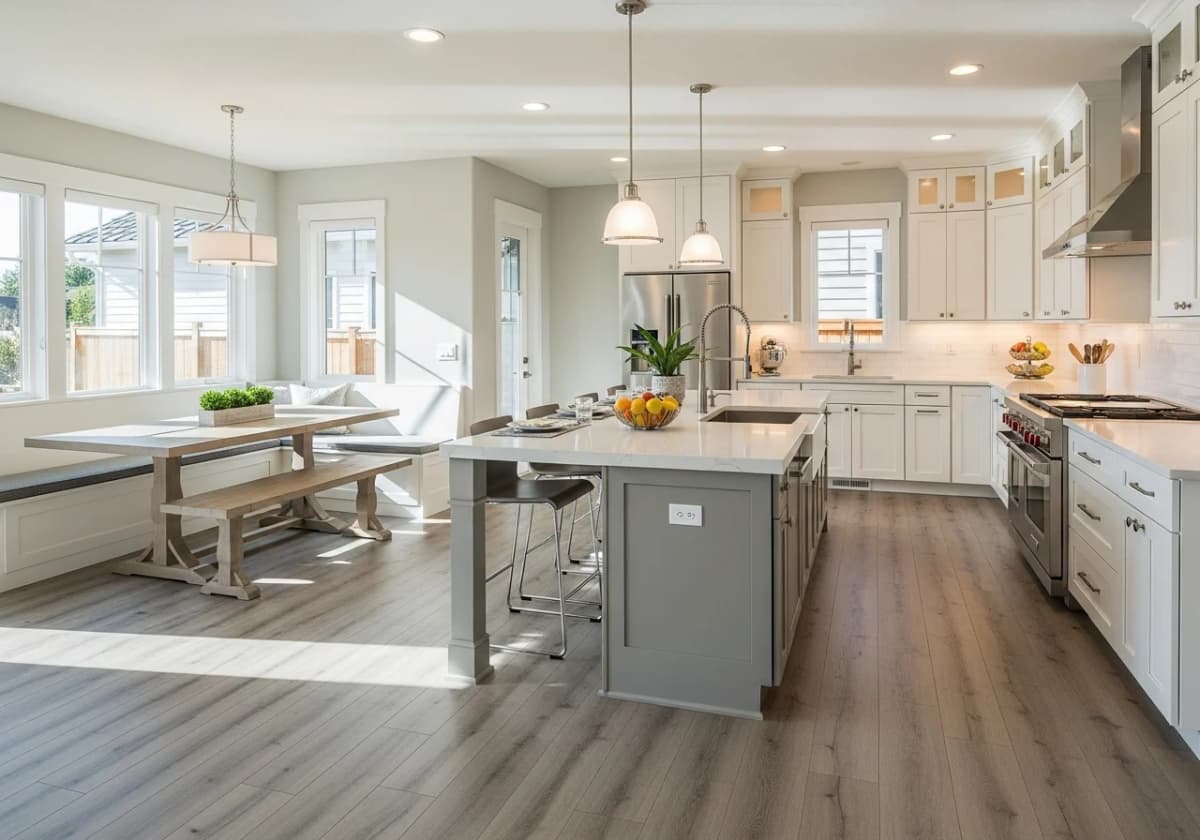
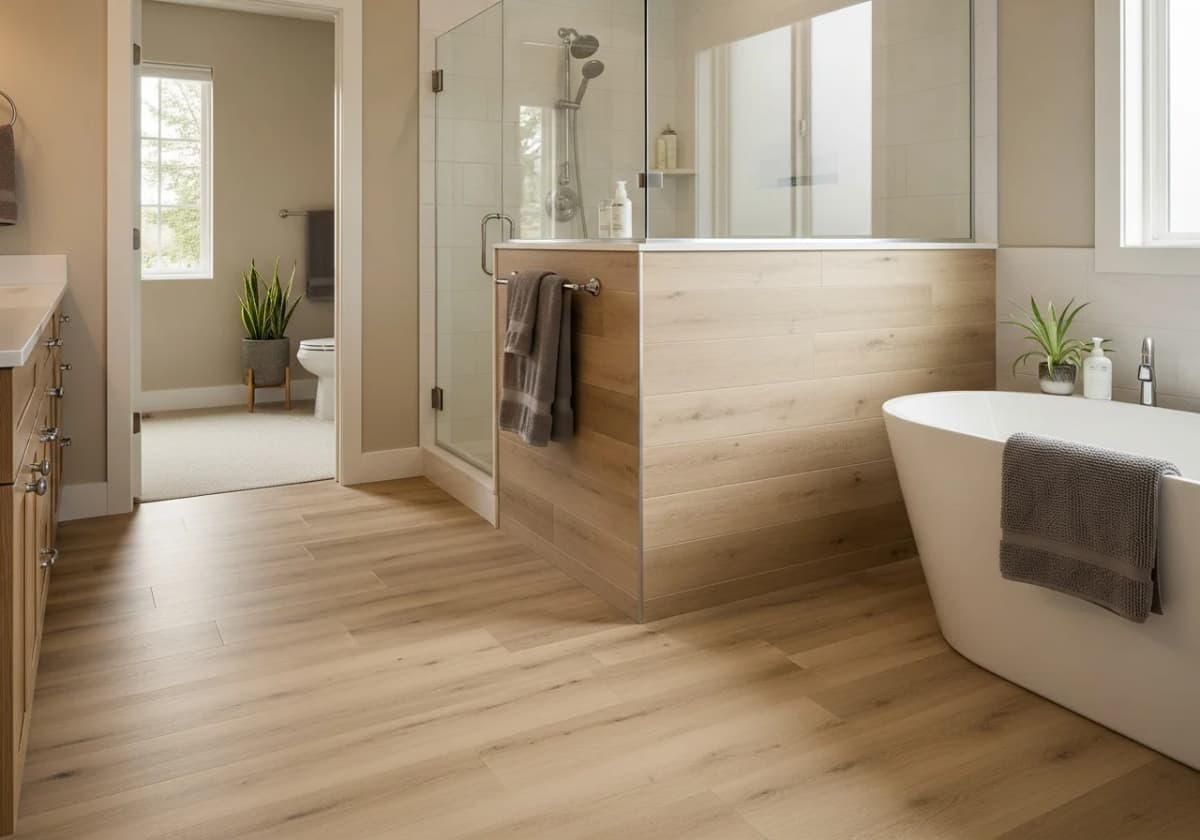
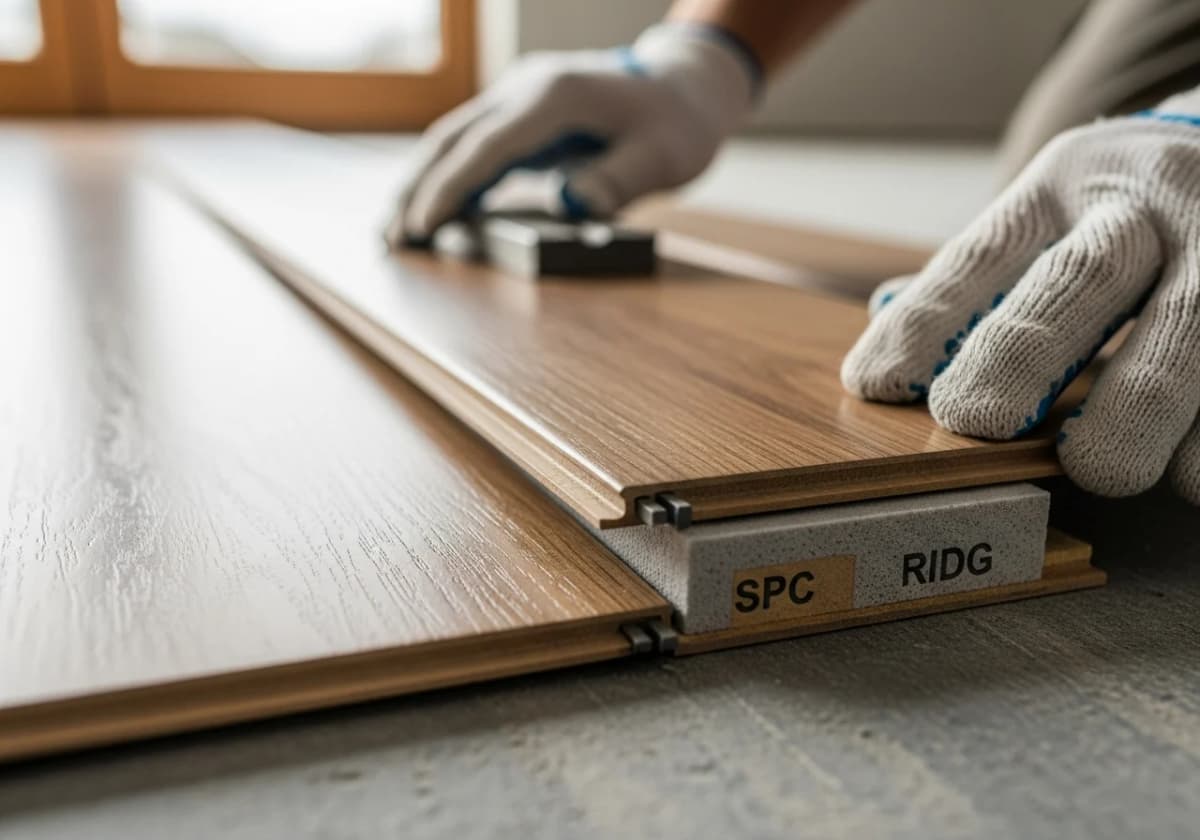
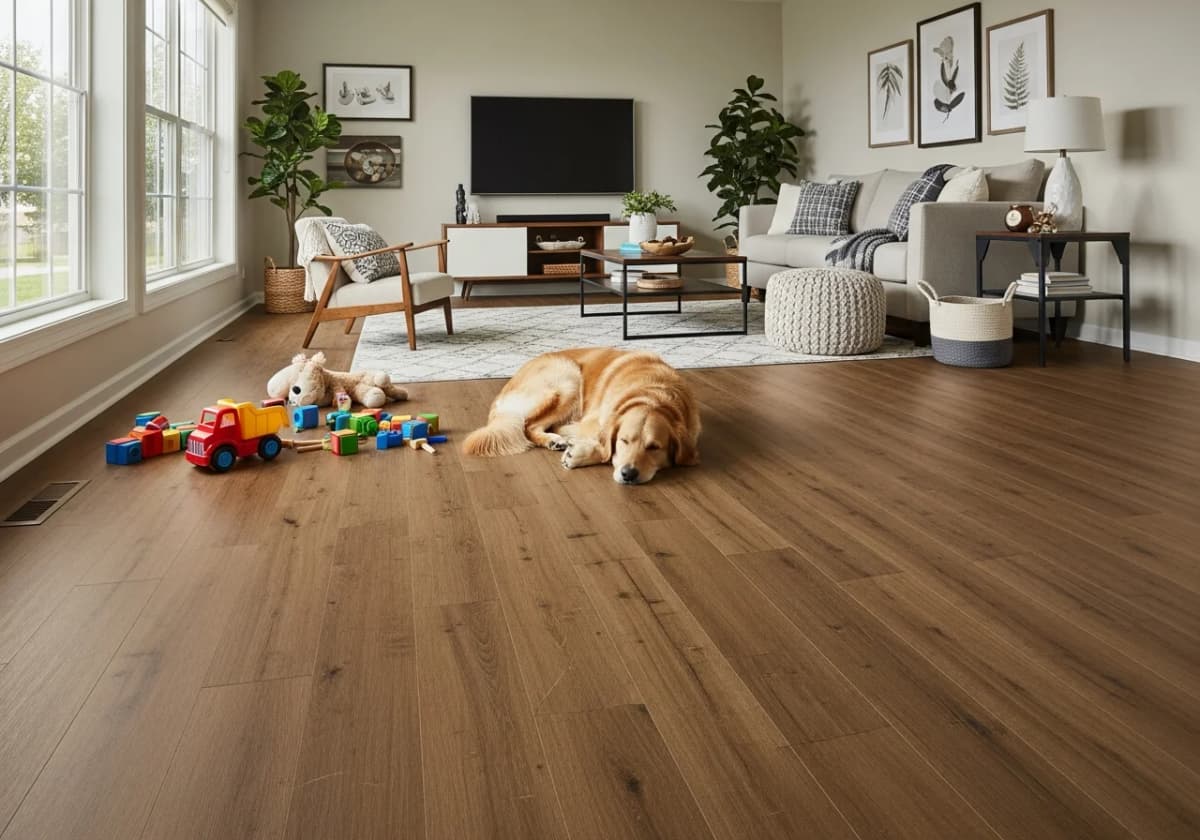
Because it does not care about humidity, and humidity is the thing that breaks wood floors here. Boise's high-desert climate creates a specific set of challenges that make luxury vinyl plank a compelling choice over traditional hardwood. Understanding these Idaho-specific conditions explains why LVP is the material we end up recommending most often across the Treasure Valley.
Dimensionally Stable in Boise's Dry Climate
Boise's indoor humidity swings dramatically between seasons — dropping to 15–25% during winter heating months and climbing to 35–45% in summer. This 15–30 percentage point range is the primary reason solid hardwood floors in the Treasure Valley develop gaps, cupping, and seasonal movement. LVP is completely unaffected by humidity changes. The rigid SPC or WPC core does not absorb moisture and does not expand or contract with seasonal shifts, making it dimensionally stable year-round without the need for whole-home humidifiers or acclimation periods.
Waterproof for Idaho's Mudroom & Entryway Traffic
Idaho homeowners track in snow, mud, slush, and road salt for five to six months of the year. Mudrooms and entryways take a beating from wet boots, dripping coats, and dog paws. Hardwood floors in these areas warp, stain, and deteriorate within a few seasons. LVP handles standing water without damage to the plank itself, making it the ideal material for every transition zone between outdoor and indoor living. From October through March, this waterproof performance is not a luxury — it's a necessity.
Radiant Heat Compatible
In-floor radiant heating has become a standard feature in new Boise construction, especially in Meridian, Eagle, Star, and the Southeast Boise subdivisions. SPC-core LVP is one of the best flooring materials for radiant systems because the dense stone composite core conducts heat efficiently while remaining dimensionally stable under temperature cycling. Most SPC products are approved for surface temperatures up to 85°F, which covers the typical operating range of hydronic and electric radiant systems.
Pet-Friendly Scratch Resistance
Pet-proofing is a top priority for most of the flooring decisions we are asked about. LVP with a 20-mil or thicker wear layer resists scratches from dog and cat nails far better than hardwood, engineered wood, or laminate. The waterproof surface also means pet accidents clean up completely without staining or odor absorption. For households with multiple dogs or large breeds, we recommend products with 22-mil or 28-mil wear layers and textured (embossed-in-register) surfaces that naturally disguise micro-scratches.
Installed LVP in Boise runs $4 to $8 per square foot, and every tier below is a slice of that band, set by product tier, wear layer thickness, and core type. The installed costs below reflect material, standard underlayment, transitions, quarter round, and professional installation labor. Old flooring removal, subfloor repair, and furniture moving are additional.
| Tier | Per Sq Ft (Installed) | Example Brands | 1,200 Sq Ft Home |
|---|---|---|---|
| Budget | $4–$5.50 | LifeProof, TrafficMaster, SmartCore | $4,800–$6,600 |
| Mid-Range | $5.50–$7.50 | COREtec Pro Plus, Shaw Floorte Pro, Mohawk SolidTech | $6,600–$9,000 |
| Premium | $7.50–$8 | COREtec Originals, Shaw Floorte Elite, Mohawk RevWood Premier | $9,000–$9,600 |
Add $1–$2/sq ft for old flooring removal. Subfloor leveling, where needed, adds $2–$4/sq ft for affected areas. Stair treads and risers add $50–$100 per step. Prices reflect the Boise metro market as of early 2026 and include standard installation labor.
Where to invest vs. where to save: We recommend mid-range or premium LVP for high-visibility rooms — kitchens, living areas, and hallways — where you see and feel the floor every day. Budget-tier products work well in basements, rental units, and utility rooms where waterproof performance matters more than aesthetics and feel.
Every flooring material involves trade-offs. LVP has clear advantages for Idaho's climate and lifestyle, but it also has limitations that homeowners should understand before committing to a project. Here is an honest assessment based on our experience installing LVP across the Treasure Valley.
Advantages
100% waterproof at the plank level — handles snow, mud, and pet accidents without damage
Dimensionally stable in Boise’s 15–45% humidity range — no gaps, cupping, or seasonal movement
Roughly half the installed cost of hardwood — $4–$8/sq ft against $8–$18/sq ft
Click-lock floating installation over most existing subfloors — faster and less disruptive than nail-down
Pet-friendly scratch resistance with 20-mil+ wear layers
Radiant heat compatible (SPC core) — ideal for new Boise construction
Wide variety of wood-look styles, colors, and plank widths to match any aesthetic
Limitations
Cannot be sanded or refinished — when the wear layer is depleted, the floor must be replaced
Heavy furniture without proper pads can dent or permanently indent the surface over time
Budget-tier products look and feel artificial — thin wear layers, flat printing, and hollow acoustics
Not real wood — the surface is a printed image under a urethane film, so buyers who specifically want wood will know the difference
New LVP can off-gas VOCs during the first 2–4 weeks — choose FloorScore or GreenGuard certified products
Damaged planks in the middle of the room require disassembly back to the nearest wall for replacement
The core type is the single most important specification when choosing LVP. SPC and WPC cores deliver fundamentally different performance characteristics, and the right choice depends on the specific rooms in your Boise home where the flooring will be installed.
SPC — Stone Polymer Composite
Recommended for Most Boise Rooms
Core Composition
Limestone powder and polyvinyl chloride compressed into a dense, rigid core. SPC is significantly heavier and harder than WPC, providing superior dent resistance and dimensional stability. Typical plank thickness ranges from 4mm to 6mm.
Performance
Best-in-class dent resistance from heavy furniture and appliances. Handles temperature fluctuations from radiant heating systems without expansion or contraction. The dense core transmits less sound than WPC unless paired with a quality underlayment.
Best Rooms
Kitchens, entryways, mudrooms, basements, bathrooms, laundry rooms, and any room with radiant floor heating. SPC is the default choice for high-traffic areas and spaces where moisture exposure or heavy furniture is a factor.
WPC — Wood Polymer Composite
Core Composition
Wood flour and polyvinyl chloride foamed into a lighter, more flexible core. WPC planks are typically 6mm to 8mm thick and feel noticeably warmer and softer underfoot than SPC. The foamed structure provides built-in sound absorption.
Performance
Superior comfort and sound dampening compared to SPC. The softer core is easier on joints for standing and walking and naturally reduces the hollow sound that can occur with rigid-core products on concrete subfloors. However, WPC is more susceptible to denting from heavy point loads and is generally not recommended over radiant heating systems.
Best Rooms
Bedrooms, home offices, living rooms, and family rooms where comfort and quiet acoustics are more important than moisture resistance or heat conduction. WPC is the better choice when the floor is the primary standing surface for extended periods.
Our recommendation for whole-house projects: Use SPC core in kitchens, bathrooms, basements, entryways, and over radiant heat. Use WPC core in bedrooms and living spaces where comfort matters most. Mixing core types within the same home is common and gives you the best of both worlds — just plan transitions between rooms where the core type changes.
If the core type decides how an LVP floor feels and how stable it is, the wear layer decides how long it survives. This is the most misunderstood spec in the entire category, and it is where budget product quietly fails Boise homeowners two to four years after installation. The wear layer is the transparent urethane film bonded on top of the printed image. It carries every footstep, dog nail, dragged chair, and grain of grit tracked in from a Treasure Valley gravel driveway. Once it abrades through to the printed layer in a traffic lane, the floor is finished — there is no sanding it back.
| Wear Layer | Rating | Realistic Boise Lifespan | Best Use |
|---|---|---|---|
| 6–12 mil | Light residential | 5–10 yrs in active rooms | Closets, guest rooms, low-traffic rentals |
| 20 mil | Heavy residential / light commercial | 15–20 yrs | Kitchens, hallways, family rooms, pet homes |
| 22–28 mil | Commercial / heavy residential | 20–25+ yrs | Large dogs, multiple kids, rolling chairs, entries |
| 28 mil+ | Commercial | 25+ yrs | Maximum durability, light-commercial use |
The number that gets advertised on the box — “lifetime residential warranty” — is not the same as how long the floor will look good. Manufacturer warranties on LVP are almost universally prorated, meaning the payout declines every year you own the floor. They typically exclude the failures homeowners actually experience: surface scratches, dents, indentation from heavy furniture, fading from sun exposure, and any damage tied to moisture from below. Crucially, most warranties are void unless the floor was professionally installed over a properly prepared subfloor using the manufacturer's approved underlayment, and unless you can document it. A warranty claim on a DIY or improperly prepped floor is almost always denied. When we install LVP, we follow the manufacturer specification precisely and document the underlayment and prep so the coverage you paid for actually stands behind the floor.
Practical guidance for the Treasure Valley: never go below 20 mil in any room you walk through daily, step up to 22–28 mil with large dogs or rolling office chairs, and reserve 6–12 mil product for closets and seldom-used spaces. The marginal cost to move from a 12-mil to a 20-mil floor is small relative to the cost of replacing a worn floor a decade early.
The overwhelming majority of LVP problems we are called to diagnose — hollow clicking, plank flexing, locked-edge separation, peaking, and premature wear lanes — trace back not to the flooring itself but to the install method and subfloor prep. LVP is unforgiving of a bad foundation in a way carpet and even tile are not. There are three core installation approaches, and choosing correctly for the room is part of the job.
Rigid-Core Click-Lock (Floating)
Planks snap together via a machined locking edge and float over the subfloor without glue or fasteners. This is the right method for most Boise residential rooms: fastest install, goes over most existing hard floors, tolerates minor subfloor imperfection, and sections can be lifted later for access. Requires a perimeter expansion gap and is the most common product on the market.
Glue-Down
Each plank is bonded to the substrate with a full-spread or pressure-sensitive adhesive. Best for very large open runs (eliminates hollow feel and seam creep), rooms with intense unshaded solar gain where a floating floor could lift, and heavy rolling-load areas. Demands a flatter, cleaner, fully dry substrate and is far more labor-intensive to repair or remove.
Flexible Glue-Down Plank
Thinner, flexible LVP without a rigid core, always adhered down. It telegraphs every subfloor flaw, so it requires near-perfect prep, but it is dimensionally solid once set and economical for large light-commercial areas. Less common in Boise homes; we specify it selectively where the substrate justifies it.
Subfloor flatness is the non-negotiable. Most manufacturers require flatness within 3/16" over a 10-foot span, and premium lines tighten that to 1/8" over 6 feet. This is exactly where Boise's housing stock splits in two:
Older North End, East End, and Bench homes (pre-1970s) frequently have settled framing, sloped floors, and original plank or particleboard subfloors that have moved over decades. These almost always need high-spot sanding, plywood patching, fastener re-screwing to silence squeaks, and often a self-leveling underlayment poured across the affected area before any LVP goes down. Skipping it is what lies behind most of the “why does my new floor click and bounce” calls we are asked to diagnose.
Newer foothills, Meridian, Eagle, Star, and Kuna construction on slab-on-grade is generally flatter, but fresh concrete brings its own issues: trowel ridges, localized high spots, and most importantly residual slab moisture. We perform calcium-chloride or in-situ relative-humidity testing on slabs and install a 6-mil taped poly vapor barrier before floating LVP over concrete — standard practice for basements and slab main floors across the valley.
Before we quote any LVP project, we check the existing floor with a straightedge and level, identify what prep the substrate genuinely needs, and put it in writing. An honest subfloor line item in the estimate is not padding — it is the difference between a 20-year floor and a callback in year two.
Idaho's high-desert environment is genuinely hard on flooring, and LVP's biggest practical advantage here is how little it cares about it. Indoor relative humidity in Treasure Valley homes routinely drops to 15–25% during winter heating and climbs to 35–45% in summer. That swing is what cups, gaps, and seasonally moves solid hardwood — and it is exactly the condition a mineral- or polymer-core LVP plank ignores. There is no acclimation drama, no whole-home humidifier dependency, and no seasonal gapping to explain to a buyer at resale. For the climate alone, LVP is the lowest-risk hard surface we install in this market.
Over concrete slabs, LVP is one of the few wood-look options that performs without compromise — provided slab moisture is verified first. Boise basements and slab-on-grade homes can wick ground moisture, and that risk peaks during spring snowmelt and irrigation season in foothill and bench neighborhoods. We test the slab and install an appropriate vapor barrier rather than assuming a dry slab; a floating LVP system with no adhesive to fail is then highly tolerant of the minor seepage events common in valley basements.
Over radiant heat, the core choice is decisive. Dense SPC conducts warmth efficiently and stays dimensionally stable through heating cycles; it is the correct specification and is typically rated to a surface temperature around 85°F. Foamed WPC cores can delaminate under repeated thermal cycling and are generally not approved over radiant. Because hydronic and electric radiant systems are now common in newer Meridian, Eagle, Star, and Southeast Boise builds, we default to verified radiant-rated SPC for those homes and confirm the manufacturer's temperature limit before anything is ordered. The one climate caveat worth stating plainly: strong high-desert sun through unshaded south- and west-facing glass can fade budget LVP within a few years, so for sun-drenched rooms we specify UV-stabilized product and discuss window film as part of the design.
LVP is versatile enough for almost any room, but its waterproof performance and durability make it the standout choice in spaces where other flooring materials struggle. Here are the rooms where LVP delivers the most value for Boise homeowners.
Kitchens
Spills, splashes, and dropped items are daily occurrences. LVP handles all three without staining, warping, or cracking. The softer surface compared to tile is easier on feet during long cooking sessions and more forgiving when glassware hits the floor. SPC core recommended for heavy appliance areas.
Bathrooms
Waterproof performance makes LVP a strong alternative to tile in bathrooms. It is warmer underfoot, less slippery when wet (look for products with textured surfaces), and eliminates grout maintenance entirely. We recommend seam sealant application for full bathroom installations to protect the subfloor from water intrusion between planks.
Basements
Boise basements sit on concrete slabs that can transmit ground moisture, especially during spring snowmelt. LVP with an attached IXPE or cork underlayment installs directly over concrete after moisture testing confirms safe levels. The floating installation means no adhesive that could fail from slab moisture, and the waterproof core protects against minor seepage events.
Entryways & Mudrooms
From October through March, Boise entryways face snow, ice melt, mud, and gravel tracked in on boots and paws. LVP handles all of it without warping, staining, or salt damage. The scratch-resistant wear layer stands up to boot treads and dog nails better than hardwood, and cleanup requires nothing more than a damp mop.
This is the comparison every Boise homeowner asks about. Both materials have legitimate strengths, and the right choice depends on your priorities, budget, and the specific rooms being floored. Here is a side-by-side breakdown based on real-world performance in the Treasure Valley market.
| Factor | Luxury Vinyl Plank | Hardwood |
|---|---|---|
| Cost (Installed) | $4–$8/sq ft | $8–$18/sq ft |
| Water Resistance | 100% waterproof | Vulnerable — warps, cups, stains |
| Scratch Durability | High (20-mil+ wear layer) | Varies by species (Janka rating) |
| Feel Underfoot | Comfortable (WPC) to firm (SPC) | Warm, natural, premium feel |
| Refinishing | Cannot be refinished — replaced when the wear layer is gone | 5–7 full refinishes (solid); 1–3 (engineered) |
| Resale Value | We publish no figure — no MLS access, no Boise appraisal data | We publish no figure — ask your agent or an appraiser |
| Installation Time | 1–3 days (1,200 sq ft) | 3–5 days (1,200 sq ft) |
| Boise Climate Performance | Excellent — no humidity sensitivity | Requires humidity control (35–55% range) |
On the resale row: we do not publish a figure in either column, because we hold no MLS access and no Boise-specific appraisal or transaction data that isolates what a floor did to a sale price. Ask your agent or an appraiser about your own neighborhood and price band before you choose flooring on resale grounds.
Our recommendation: For kitchens, bathrooms, basements, mudrooms, and rental properties, LVP is the better choice in almost every scenario. For primary living spaces where you want a floor that can be renewed rather than replaced, and authentic material character matters to you, hardwood — specifically engineered hardwood for Boise's climate — is the stronger call. Many of our whole-home projects combine both: hardwood in the main living areas and LVP in the kitchens, bathrooms, and basements.
When an LVP floor fails, the homeowner almost always blames the product first. In our experience across the Treasure Valley, the cause is far more often cheap product paired with skipped prep than a defective plank. Knowing the failure modes helps you spec the project correctly the first time.
Hollow clicking and bounce underfoot
An out-of-tolerance subfloor under a floating floor. The planks bridge low spots and flex with each step, eventually stressing the locking edges. Fix is prevention: flatten and stabilize the substrate before installation.
Peaking or buckling at seams
No perimeter expansion gap, fasteners or fixtures pinning the floating field, or intense solar gain on a floating floor with no glue-down. Common in sunrooms and rooms with large unshaded glass; sometimes a glue-down spec is the correct answer instead.
Locked edges separating (gapping between planks)
Subfloor deflection, low-quality locking profiles on budget product, or installation over a too-soft doubled-up underlayment that lets joints work loose. Specifying a quality locking system and a single approved pad prevents it.
Worn traffic lanes within a few years
Wear layer too thin for the traffic — a 6–12 mil product in a kitchen or hallway. Not repairable and not refinishable. The fix is correct wear-layer selection up front.
Permanent dents and indentation
Static point loads from heavy furniture or appliances, more pronounced on softer WPC cores. Load-spreading protectors and SPC in heavy rooms prevent it.
Color shift and fading
Budget product without UV-stabilized wear layer in south- or west-facing Boise rooms. Premium UV-rated product and window film mitigate it.
Edge swelling and adhesive failure
Almost exclusively a moisture problem: untested wet slab, no vapor barrier, or a flood wicking under a floating floor through the unsealed seams. Slab testing and a proper vapor barrier are the safeguard.
Every item on this list is preventable with the right product specification and disciplined subfloor prep — which is precisely what a professional installation buys you over a big-box self-install. If you are weighing materials beyond vinyl, our flooring installation overview and the tile flooring and carpet flooring guides compare the realistic alternatives for each room.
Iron Crest Remodel (Iron Crest Remodeling Group LLC) is registered with the Idaho Division of Occupational and Professional Licenses as contractor RCE-6681702, and insured. Every LVP installation we complete is backed by our 3-year workmanship warranty in addition to the manufacturer's product warranty. Our process is built around the two things that actually determine whether an LVP floor lasts: correct product specification and disciplined subfloor preparation.
1. Free in-home assessment
We measure, check existing-floor flatness with a straightedge and level, evaluate the subfloor and any moisture risk, and discuss how each room is used — pets, kids, sun exposure, radiant heat — so the product spec fits real life, not a showroom.
2. Honest product specification
We match core type (SPC vs. WPC) and wear-layer thickness to each room rather than selling one product for the whole house. Where hardwood or tile is genuinely the better call for a space, we say so.
3. Documented subfloor prep
High-spot sanding, patching, re-fastening squeaks, self-leveling where needed, slab moisture testing, and a proper vapor barrier over concrete. This line item is itemized in writing, never skipped.
4. Manufacturer-spec installation
Correct expansion gaps, approved underlayment (single layer, no doubling), proper acclimation where required, and the right method — floating or glue-down — for the room. We document the build so the manufacturer warranty stays valid.
5. Transitions, trim, and walkthrough
Clean transitions between rooms and material types, quarter round or base shoe, stair treads where applicable, and a final walkthrough before we consider the job done.
We serve homeowners across the Treasure Valley — reach us Monday through Friday, 7 AM to 6 PM, at (208) 779-5551. You can request a free estimate, contact our team, browse our remodeling guides, or see the communities we serve. If you are still comparing materials, our hardwood flooring and engineered hardwood pages cover the climate-smart wood alternatives for Boise's humidity swing.
How long does luxury vinyl plank flooring last in Boise homes?
Quality LVP installed professionally in a Boise home typically lasts 20 to 25 years. Manufacturer product warranties vary by line and are third-party terms, so check the length and the exclusions on the manufacturer's own site rather than on a retailer's display. The key variables for real-world lifespan are wear layer thickness and daily traffic levels. A 20-mil wear layer handles moderate residential traffic well, while homes with large dogs or heavy foot traffic benefit from a 22-mil or 28-mil wear layer. Boise's dry climate is actually favorable for LVP longevity because the material is dimensionally stable regardless of humidity fluctuations, unlike hardwood that shrinks and gaps in our 15 to 25 percent winter humidity. Strong high-desert UV through south- and west-facing glass can cause color shifting in budget products, so choosing planks with UV-stabilized wear layers matters in those rooms.
Can LVP be installed over radiant floor heating in Boise?
Yes, but the core type matters significantly. SPC (Stone Polymer Composite) luxury vinyl plank is the recommended choice for radiant heat systems because its limestone-based core conducts warmth efficiently and handles temperature fluctuations without expanding or warping. Most SPC products are rated for surface temperatures up to 85 degrees Fahrenheit. WPC (Wood Polymer Composite) cores are generally not recommended over radiant heat because the foamed core can delaminate with repeated heating cycles. Radiant floor heating is increasingly common in new Boise construction throughout Meridian, Eagle, and Star, so we install SPC-core LVP over hydronic and electric radiant systems regularly. Always verify the specific manufacturer's radiant heat approval before purchasing.
Is LVP waterproof enough for Boise bathrooms and basements?
LVP is 100 percent waterproof at the plank level. Water will not penetrate the wear layer, printed design layer, or rigid core under any normal residential conditions. This makes it an excellent choice for Boise bathrooms, laundry rooms, kitchens, and basements. However, standing water can seep between plank seams in a click-lock floating installation and reach the subfloor underneath. For bathrooms and laundry rooms, we recommend applying a thin bead of manufacturer-approved seam sealant during installation to create an additional moisture barrier. In Boise basements, where minor moisture intrusion from spring snowmelt is common, we verify slab moisture by calcium chloride test (ASTM F1869, reported in pounds per 1,000 square feet per 24 hours) or an in-situ relative humidity probe, against the specific product manufacturer's stated limit, before installing LVP directly over concrete.
Does LVP decrease home resale value compared to hardwood in Boise?
We do not publish an answer to that as a number, and we will not guess at one. Iron Crest holds no MLS access and no Boise-specific appraisal or transaction data that isolates what flooring did to a sale price, and national remodeling surveys are not a reliable read on the Treasure Valley. What we can tell you is what each material is: LVP is fully waterproof, dimensionally stable in our humidity swing, costs roughly half what hardwood costs installed, and cannot be refinished — when the wear layer is gone the floor is replaced. Hardwood is real wood that can be sanded back and renewed. Our own recommendation is driven by performance, not by a resale theory: LVP where water and traffic are the risk — kitchens, basements, mudrooms, bathrooms, entryways — and hardwood in primary living spaces if you want a renewable floor. If resale is your deciding factor, ask your agent or an appraiser what flooring is doing in your specific neighborhood and price band.
How much does whole-house LVP installation cost in Boise?
Installed LVP in Boise runs $4 to $8 per square foot, so for a typical 1,200 square foot home whole-house LVP works out to roughly $4,800 to $9,600 depending on product tier. Budget-tier LVP sits at the $4 to $5.50 per square foot end. Mid-range products cost about $5.50 to $7.50 per square foot installed. Premium LVP runs $7.50 to $8 per square foot installed. These prices include material, underlayment if not attached, transitions, quarter round, and professional installation labor. Old flooring removal adds $1 to $2 per square foot. Subfloor leveling, if needed, adds $2 to $4 per square foot for the affected areas. We provide free detailed in-home estimates for all Boise-area LVP projects.
What does wear-layer mil thickness actually mean for my warranty and lifespan?
The wear layer is the clear urethane film on top of the printed image, and its thickness is measured in mils, where one mil equals one-thousandth of an inch. It is the single biggest predictor of how long an LVP floor survives real traffic. A 6-mil to 12-mil wear layer is a light-residential rating suited to closets, guest bedrooms, and low-traffic rentals; it will show traffic lanes within a few years in a busy Boise household. A 20-mil wear layer is the practical minimum we recommend for kitchens, hallways, and family rooms, and it is also the threshold where most manufacturers extend their commercial or heavy-residential warranty tier. A 22-mil to 28-mil wear layer is what we specify for homes with large dogs, multiple kids, or rolling office chairs. Note that a thick wear layer does not make the floor refinishable; it only delays the day the printed layer wears through. Read the warranty exclusions closely, because most are prorated, exclude scratches and dents, and require documented professional installation and use of manufacturer-approved underlayment to remain valid.
What is the difference between 100% waterproof LVP and water-resistant laminate?
This distinction matters more in Idaho than almost anywhere, because of how we use entryways and basements. Quality LVP has a solid mineral or polymer core that does not absorb water at all; you can leave a puddle on it for hours and the plank is unaffected. Water-resistant laminate has a wood-fiber (HDF) core with a treated surface and sealed edges that resists surface spills wiped up promptly, but standing water that reaches a seam can swell, the wear layer can peel, and the damage is permanent and not localized. Laminate water-resistance warranties are typically time-limited (often 24 to 72 hours of exposure) and assume immediate cleanup, which is unrealistic in a mudroom during a February melt or a basement during spring snowmelt. For any Boise space where moisture is a genuine risk, LVP is the materially safer specification. The one caveat: a click-lock LVP floor is waterproof at the plank, but the floating seams are not a sealed system, so a large flood can still wick under the floor and require lifting it to dry the subfloor.
Rigid-core click-lock vs. glue-down LVP — which should I choose?
Rigid-core click-lock (floating) LVP is the right choice for the large majority of Boise residential projects. It installs faster, tolerates minor subfloor imperfections better, can go directly over most existing hard floors, and individual sections can be lifted for subfloor access later. Glue-down LVP, where each plank is adhered to the substrate with a full-spread or pressure-sensitive adhesive, is the better specification for very large open spaces (it eliminates the slight hollow feel and reduces seam separation over long runs), for rooms with floor-to-ceiling glass and intense solar gain where a floating floor could expand and lift, and for some commercial and rental applications. Glue-down also feels more solid underfoot and handles heavy rolling loads better. The trade-offs: it demands a flatter, cleaner, fully dry substrate, takes longer, and is far more labor-intensive to remove or repair. We assess the room dimensions, subfloor condition, and solar exposure on-site before recommending one method over the other.
How flat does my subfloor need to be for LVP, and what if it isn't?
Most LVP manufacturers require the subfloor to be flat within 3/16 inch over a 10-foot radius, and some premium products tighten that to 1/8 inch over 6 feet. This is the most common reason an LVP floor fails or feels wrong, and it is especially relevant in older Boise neighborhoods. North End, East End, and Boise Bench homes built before the 1970s often have settled, sloped, or uneven plank or particleboard subfloors that need patching, sanding of high spots, or a self-leveling underlayment poured over the affected area before the LVP goes down. New foothills and Meridian construction on slab-on-grade is usually flatter but can still have trowel ridges and high spots from the concrete pour. We always check flatness with a straightedge and a level before quoting, because skipping subfloor prep is what causes the hollow clicking sound, plank flexing, locking-edge separation, and premature wear that homeowners later blame on the flooring itself.
Does LVP need a separate underlayment?
It depends on the product. Many mid-range and premium LVP planks ship with an attached IXPE foam or cork pad on the backing, and for those the manufacturer typically prohibits adding a second pad underneath because a too-soft cushion stack causes the locking joints to flex and fail. For LVP without an attached pad, a thin, dense, manufacturer-approved underlayment improves comfort, reduces the hollow acoustic on concrete, and adds a small thermal break. Over a concrete slab, regardless of attached pad, we install a 6-mil polyethylene vapor barrier (with seams taped and turned up at the walls) to stop slab moisture vapor from reaching the floor — this is standard practice for Boise basements and slab-on-grade main floors. The wrong underlayment, or doubling up pads, voids most warranties, so this is not a place to improvise.
Will LVP dent, scratch, or fade in a sunny Boise room?
All three are possible and worth planning for honestly. Dents come from static point loads — a refrigerator, a piano leg, a heavy table foot — and softer WPC-core products are more prone to it than dense SPC; we recommend wide non-staining floor protectors under heavy furniture and felt pads under chairs. Scratches are reduced, not eliminated, by a thicker wear layer and an embossed (textured) surface that visually hides micro-marring; entry mats and a no-shoes habit go a long way against grit, which is the real scratch culprit. UV fade is a genuine consideration in the Treasure Valley, where high-desert light through unshaded glass is intense. Budget LVP with a thin wear layer and no UV inhibitors can shift color noticeably in south- and west-facing rooms within a few years; premium products with UV-stabilized wear layers resist this far better. For sunrooms and rooms with large unshaded glass, we discuss UV-rated product and window film as part of the plan.
Is LVP a good choice for homes with pets and kids?
It is one of the best choices available, and it is what we most often specify for busy family homes across Ada and Canyon County. The waterproof core means pet accidents, potty-training misses, and spilled juice clean up completely with no staining, swelling, or trapped odor — something neither hardwood nor laminate can claim. A 20-mil or thicker wear layer with a textured surface resists and disguises dog-nail scratching well. The floor is warmer and more forgiving underfoot than tile for crawling babies and dropped dishes. Two honest caveats for busy households: very large dogs with unclipped nails can still micro-scratch a thin wear layer over time, so go 22-mil or higher; and dragged toys, scooters, and heavy furniture can dent softer cores, so choose SPC in the highest-use rooms.
How do I maintain LVP, especially with Boise's hard water?
LVP is genuinely low-maintenance: sweep or dry-mop grit regularly (grit is the main enemy of the wear layer), and damp-mop with a manufacturer-approved pH-neutral floor cleaner. The Treasure Valley has notably hard water, and that matters here — mopping with plain tap water or generic cleaners leaves a dull mineral and surfactant film that builds up over time and makes the floor look hazy, especially on darker planks and matte finishes. We recommend a microfiber mop, well-wrung, with a cleaner formulated for resilient flooring, and avoiding steam mops (heat and forced moisture can compromise seams and adhesives and void warranties), wax, oil soaps, and abrasive pads. Felt pads under furniture and walk-off mats at every exterior door dramatically extend the life of the finish.
When is LVP the wrong choice for a Boise home?
We tell homeowners this directly because it builds trust and avoids regret. Reconsider LVP if: you specifically want real wood underfoot in the main living areas and a printed wood-look surface would bother you; you want a floor you can sand and restore for 50-plus years rather than replace; you have a sunroom or wall of unshaded south/west glass and are unwilling to use UV-rated product or window film; you place very heavy static loads (gun safes, pianos, commercial-grade appliances) without load-spreading protection; or you simply prefer the unmistakable warmth and acoustic character of solid or engineered hardwood in primary rooms. In those cases we will recommend hardwood, engineered hardwood, or tile instead — the goal is the right floor, not the easiest sale.
LVP is not the right fit for every room or every homeowner. Explore our other flooring type guides to compare options and find the best material for your Boise project.
Flooring installation is often coordinated with other interior remodeling projects. Bundling saves on crew mobilization, reduces overall timeline, and ensures seamless material transitions between rooms.
The following government agencies, industry organizations, and official resources provide additional information relevant to your remodeling project.
We provide flooring installation to homeowners across the Treasure Valley and southwest Idaho. Each city has its own dedicated page with local permitting, climate, and project detail — and each county hub covers the surrounding communities we also serve.
Primary sources and industry standards consulted for this guide:
- 1."Waterproof" flooring has a core that water cannot penetrate and will not swell, whereas "water-resistant" flooring only slows down water absorption and can still be damaged if water stays on it too long. Source (COREtec — Why Waterproof Floors Are Important For Your Home)
- 2.A 12-mil wear layer is rated for residential to light commercial use; MSI's 12-mil Cyrus LVP carries a lifetime limited residential warranty and a 10-year limited light commercial warranty. Source (MSI Surfaces — Cyrus Luxury Vinyl Plank)
- 3.A 20-mil wear layer is commercially rated, suitable for high-traffic environments; MSI's 20-mil Prescott LVP carries a lifetime limited residential warranty, a 20-year limited light commercial warranty, and a 15-year limited commercial warranty. Source (MSI Surfaces — Prescott Luxury Vinyl Plank)
Ready for LVP Flooring?
Get a free, no-obligation estimate for luxury vinyl plank installation in your Boise-area home. Waterproof, pet-friendly, and installed to the manufacturer’s specification by Iron Crest crews.