

Tile Flooring Installation in Boise
Porcelain and ceramic floor tile — the most durable flooring assembly available for Boise and Treasure Valley homes. Waterproof, radiant-heat optimized, and engineered to last 50+ years when the substrate, membrane, and grout are done right by Iron Crest Remodel.
Quick answer
Properly installed porcelain or ceramic floor tile typically lasts 50 years or more in a Boise home, and a well-built porcelain floor over a sound subfloor will often outlast the house itself.
Floor tile is fired clay — clay that is pressed or extruded into shape, often glazed, and then fired at temperatures roughly between 1,800°F for standard ceramic and about 2,400°F for dense porcelain. That firing vitrifies the clay body into one of the hardest surfaces a homeowner can put underfoot. The result resists abrasion, staining, moisture, and UV with effectively zero degradation over decades. But the tile is only one layer in what is really a multi-part flooring assembly — substrate, crack-isolation, mortar bed, tile, and grout — and the assembly, not the tile, determines whether the floor lasts five years or fifty. This page is deliberately specific to that floor assembly. For tile on shower walls, backsplashes, and custom wall patterns, see our tile installation service.
The two materials we install on Boise floors are ceramic and porcelain. Ceramic absorbs more than 0.5 percent water and is fired at lower temperatures, which makes it softer, easier to cut, and less expensive, but less suited to heavy floor abuse. Porcelain is a denser, finer-clay tile fired hotter; it absorbs less than 0.5 percent water and is classified “impervious” under the ASTM C373 standard. On a floor — especially a wet or high-traffic Treasure Valley floor — that density difference is the whole ballgame, which is why nearly every floor we recommend is porcelain.
Porcelain itself splits into two construction types that matter on floors: glazed porcelain, which carries a hard decorative glaze fired onto the body and offers the widest palette of colors and looks; and through-body (full-body) porcelain, where the color and composition run the entire thickness so chips and edge wear never reveal a contrasting clay underneath. Through-body is the most forgiving choice for entries and mudrooms; glazed PEI 4 porcelain is usually the better value for baths and living areas. We explain wear ratings, formats, and the substrate work the rest of this page so you can choose with full information rather than on showroom appearance alone.
A look at recent porcelain and wood-look tile floor installs across the Treasure Valley, plus the uncoupling-membrane step that decides whether a tile floor lasts.
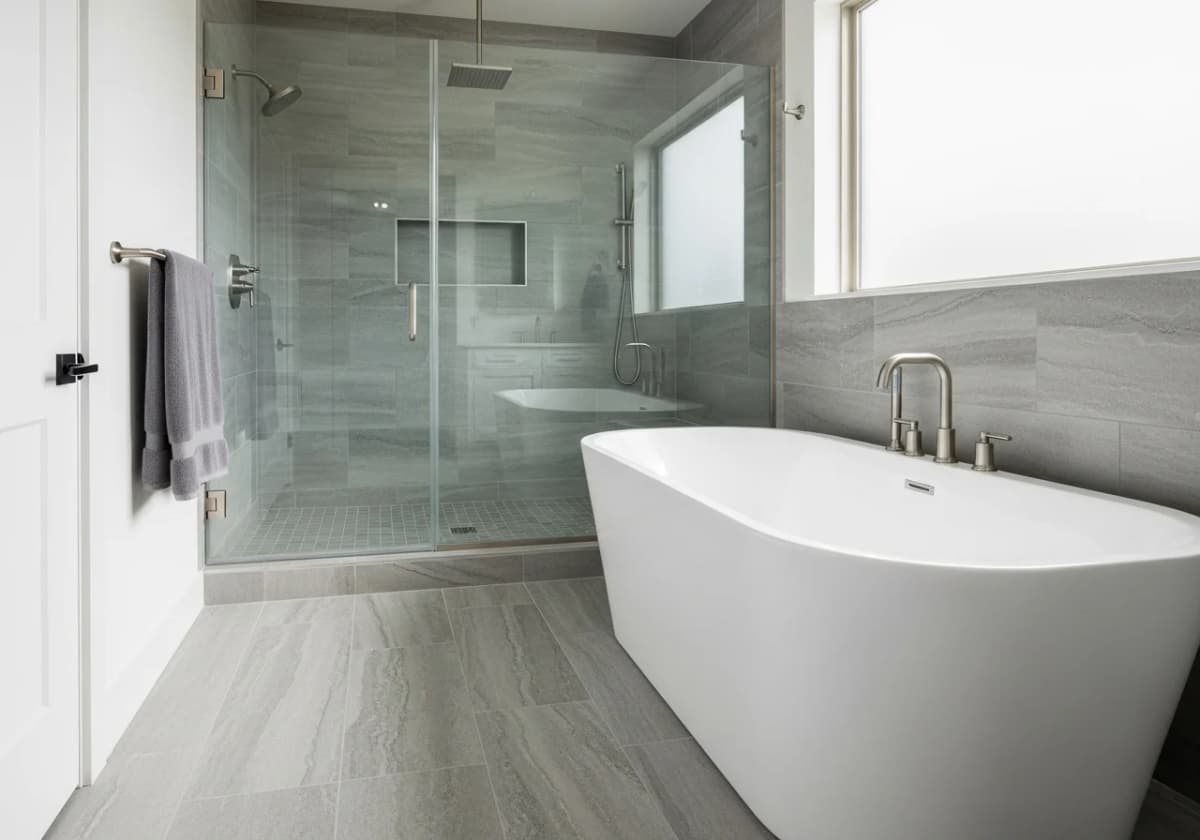
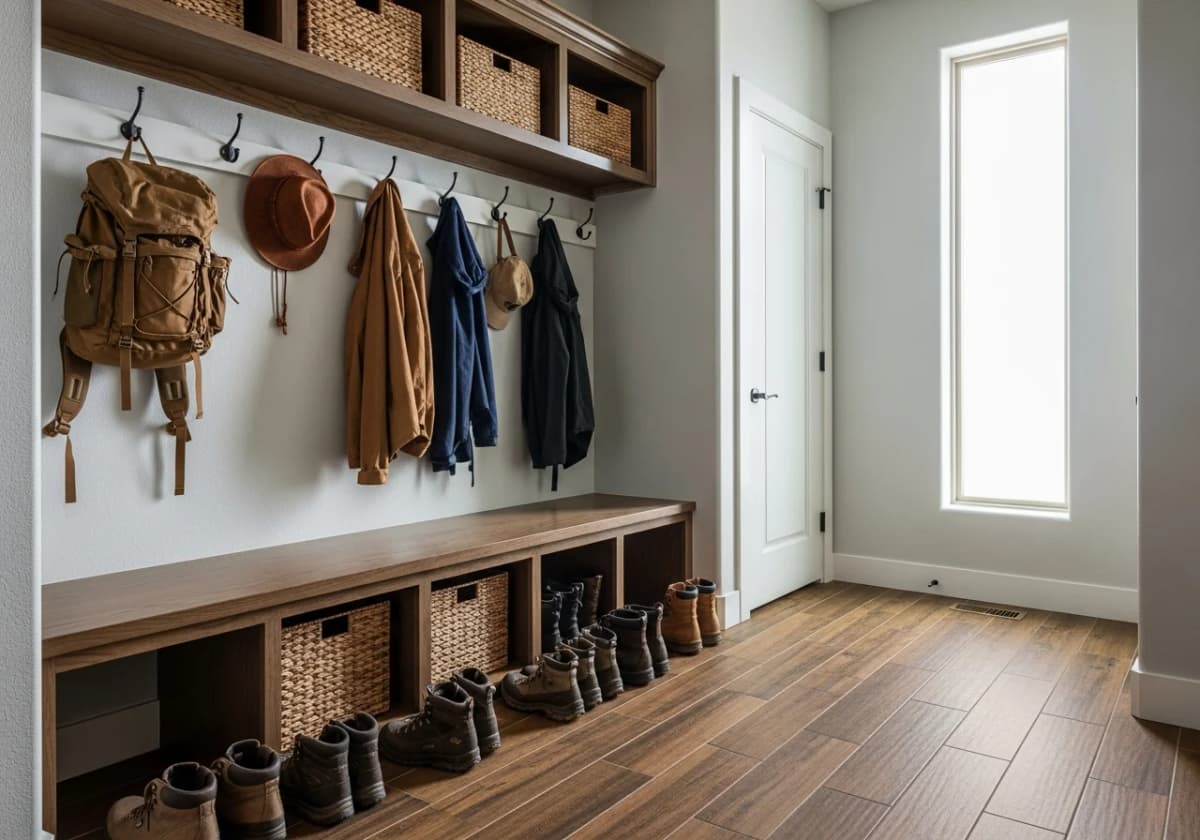
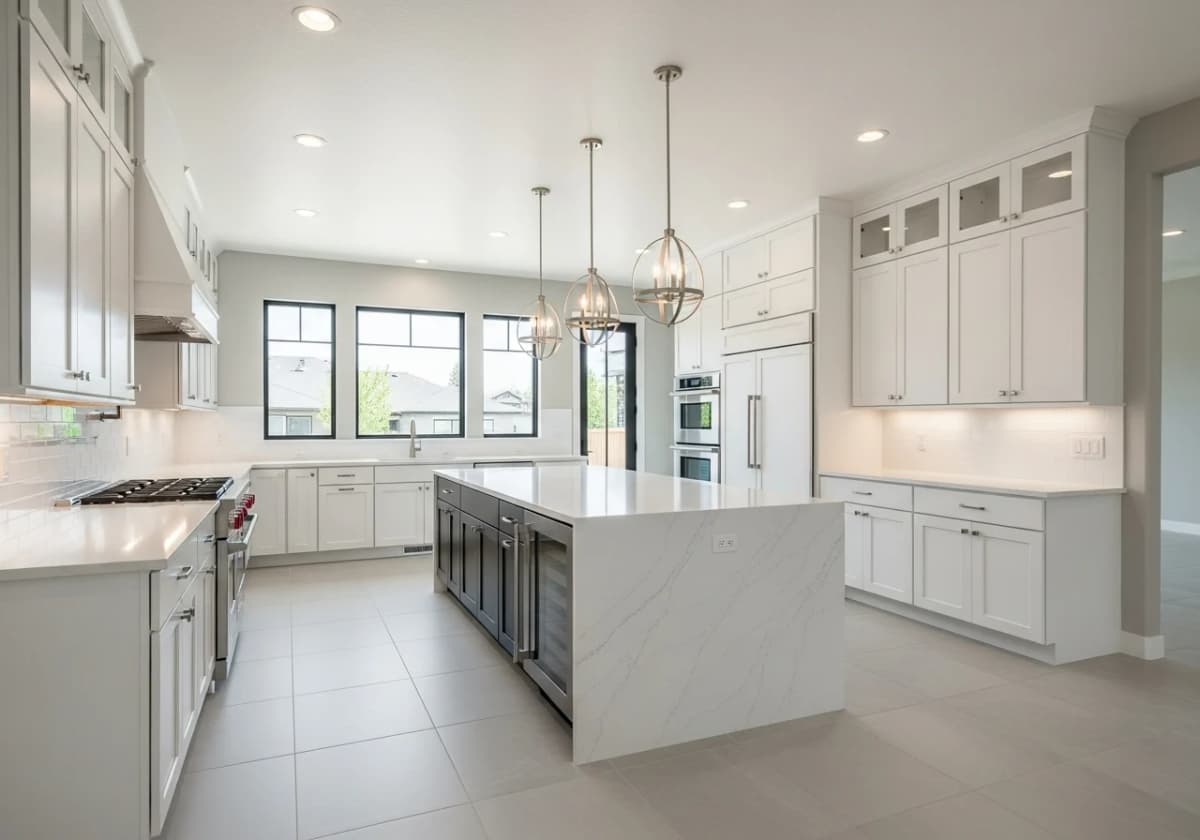
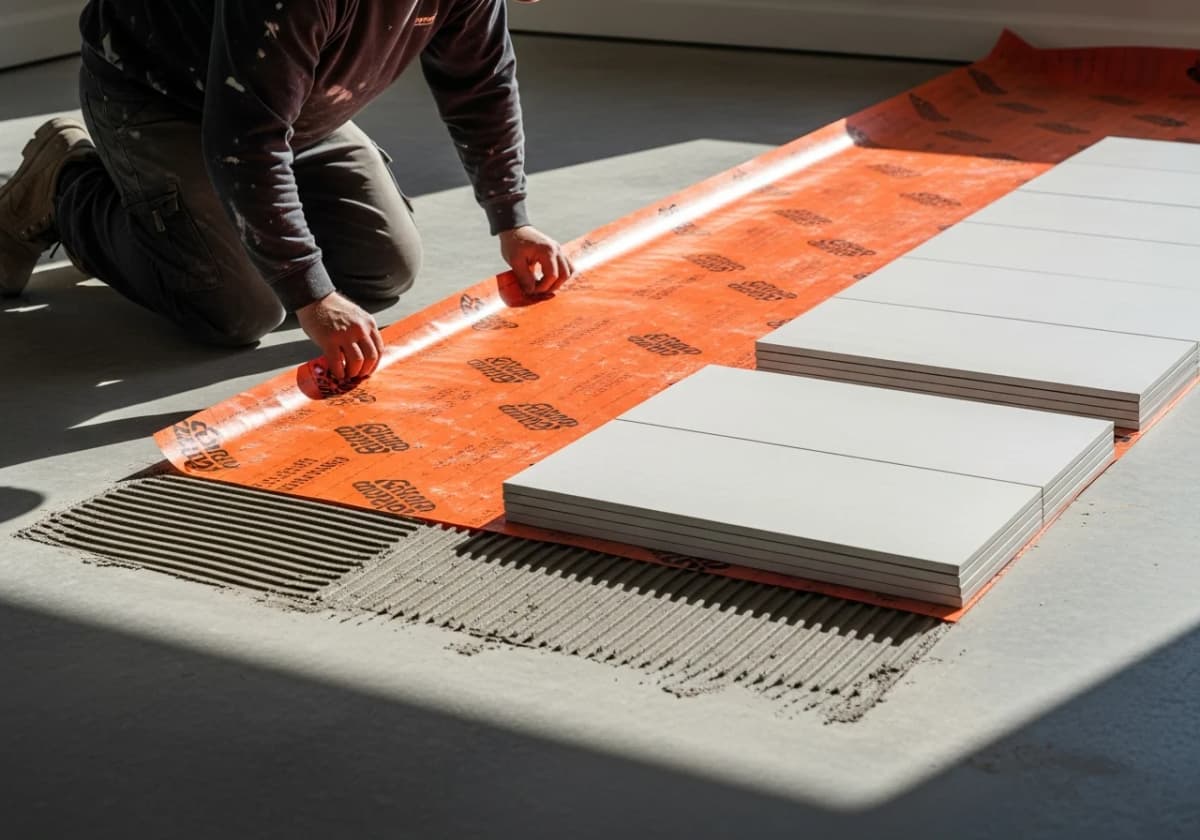
Boise's semi-arid high-desert climate stresses most flooring materials — indoor humidity that swings dramatically by season, intense high-elevation UV, a wide temperature range, and expansive clay soils that move slabs underfoot. Floor tile, installed as a proper assembly, is uniquely suited to every one of those conditions.
Zero Response to Humidity
Boise winter indoor humidity can fall to 15–25%, which gaps and cups solid hardwood. Tile has no dimensional response to humidity at all — it will never expand, contract, cup, or buckle no matter how dry the house gets, so the floor looks identical in January and July.
Best Radiant-Heat Conductor
Tile moves and re-radiates heat from hydronic or electric radiant systems faster and more evenly than hardwood, LVP, or carpet. In a region where radiant-plus-tile is a popular primary-bath and entry pairing, this is tile’s single biggest comfort advantage.
Genuinely Waterproof Surface
Porcelain absorbs under 0.5% moisture. A correctly grouted, sealed (or epoxy-grouted) tile floor handles tracked-in snowmelt, pet accidents, and bathroom splash without harming the surface — the protection of the subfloor still depends on the membrane below.
Built for Mudroom & Boot Grit
Valley entries take road sand, gravel, and salt from October through March. Through-body porcelain rated PEI 4–5 does not scratch, dull, or stain from that grit — the abuse that destroys softer floors barely registers.
No Seasonal Gapping
Unlike solid wood that opens visible winter gaps in dry Boise homes, tile holds exact dimensions year-round. Grout joints are engineered spacers and movement-accommodation, not seasonal stress points.
UV-Immune at Elevation
High-desert sun at this elevation fades LVP and bleaches wood in rooms with big west- and south-facing glass. Both porcelain and ceramic are immune to UV degradation, so those rooms are ideal candidates for tile.
Both are clay-based, but on a floor the differences in density, water absorption, and wear rating decide longevity. The short version: ceramic is a fine wall and budget material; porcelain is the floor material. Here is the detail behind that recommendation.
Porcelain Tile
Recommended for Boise floors
Density & Hardness
Fired hot from fine clay into a vitrified, low-porosity body that resists scratching, chipping, and impact better than any other tile — the reason it carries the highest PEI floor ratings.
Water Absorption < 0.5%
Classified “impervious” under ASTM C373. Suitable for wet rooms, covered exterior transitions, and freeze-thaw conditions that ceramic cannot reliably handle.
Through-Body Option
Full-body porcelain hides chips and edge wear because color runs the full thickness — ideal for entries and mudrooms where worst-case abrasion matters most.
Frost-Tolerant
Near-zero absorption means it will not spall from freeze-thaw, so it is safe on covered porches, sunrooms, and unheated mudroom transitions.
Ceramic Tile
Lower Cost
Ceramic generally runs meaningfully less than porcelain. For low-abuse interior floors and budget-led projects it delivers honest value.
Easier to Cut
A softer body cuts and shapes faster, which helps on intricate layouts and tight cuts around obstacles and reduces labor on detailed work.
Higher Absorption (0.5–3%)
Acceptable in climate-controlled, low-traffic interior floors when properly grouted, but not the right call for entries, mudrooms, or freeze-thaw zones.
Best Used on Walls
Ceramic’s broadest value is on walls, backsplashes, and low-traffic guest baths — not on a floor that has to survive valley boot grit.
Bottom line: specify porcelain for any floor in a high-traffic area, bath, kitchen, entry, or radiant-heated room — through-body porcelain where abrasion is worst, glazed PEI 4 porcelain where the palette matters more. Reserve ceramic for budget interior floors and lean on it for walls and backsplashes through our tile installation service.
The PEI (Porcelain Enamel Institute) abrasion rating is the most useful single number on a tile spec sheet for a floor, because it tells you how the surface holds up to foot traffic and grit. Buying one PEI class for the whole house wastes money in bedrooms and under-specifies entries. We size the rating to the actual room.
| PEI Class | Suited For | Boise Application |
|---|---|---|
| Class 1 | No foot traffic | Walls and backsplashes only — not a floor tile |
| Class 2 | Light traffic | Low-use guest baths with soft footwear |
| Class 3 | Moderate residential | Secondary baths, hallways, most living areas |
| Class 4 | Heavy residential | Kitchens, primary baths, busy family floors |
| Class 5 | Commercial-grade | Entryways and mudrooms taking gravel and grit |
Through-body note: full-body porcelain is often sold without a PEI number because there is no glaze to abrade — the surface and color run the full thickness. For a Boise mudroom or entry, an unrated through-body porcelain frequently outperforms a PEI 5 glazed tile because surface wear simply does not show. We flag this distinction at selection so you are not comparing the wrong numbers.
A tile floor almost never fails because the tile failed. It fails because the layers underneath moved more than rigid tile and grout could tolerate. In the Treasure Valley there are two movement sources we engineer around on essentially every job.
Substrate deflection. Wood-framed floors flex under load. If the framing deflects more than the tile assembly can absorb, grout cracks first and tiles debond next. Before we commit to a method we check joist size and spacing, span, and how the existing floor feels and sounds underfoot, and we stiffen the subfloor or add the correct backer where needed. Cement backer board (CBU) provides a stable, dimensionally stable bonding surface over wood subfloor; it does not, by itself, isolate cracks.
Expansive-clay slab movement. Much of the valley sits on expansive clay that swells when wet and shrinks when dry, and slab-on-grade floors move seasonally with that soil and with our wide annual temperature range. Bond rigid tile straight to a moving slab and the slab will telegraph hairline and structural movement directly into the grout and tile. The engineered answer is an uncoupling or anti-fracture membrane — a sheet membrane such as Schluter-DITRA, or an applied crack-isolation membrane — installed between substrate and tile. It mechanically separates the two planes so in-plane substrate movement is absorbed in the membrane instead of being transferred up into the finished floor. Over questionable slabs, this is not an upgrade; it is the difference between a floor that lasts and one that cracks in its first wet/dry cycle.
Movement joints. The TCNA Handbook calls for soft movement joints at the floor perimeter and at intervals across large fields and at changes in substrate. They look like grout but stay flexible. Filling these with hard grout to “clean up the look” is one of the most common avoidable causes of tile failure, and we install them as specified rather than skipping them.
Waterproofing where it belongs. A tile surface is waterproof; a tile floor is only waterproof if the layer beneath it is. In wet rooms and at shower-floor transitions we install a bonded waterproof membrane and, where the floor drains, build the correct slope to the drain so water leaves the assembly instead of sitting in it. This is detailed thoroughly for showers on our tile installation page; on floors it means the subfloor is protected even if grout is ever compromised.
Grout is the part of a tile floor people actually maintain, so it deserves an honest explanation rather than a sales answer. There are two grout families we use, and we recommend by area rather than defaulting to one for the whole job.
Cement grout is the residential standard: workable, repairable, available in dozens of colors, and cost-effective. Its honest limitations are that it is porous, it can stain, and in wet areas it should be sealed and periodically resealed — figure roughly every two to four years for floor grout in baths and entries, sooner if it sees heavy water. A cracked grout line is not cosmetic; it is a path for water to reach the substrate and should be repaired promptly.
Epoxy grout is denser, effectively stain-proof and waterproof, and needs no sealing. The tradeoffs are real: higher material cost, a tighter installation window, and a slightly different finished texture. For showers, heavy kitchens, and anyone who genuinely does not want grout maintenance, it is often worth it.
Treasure Valley water chemistry changes this calculation. Valley water is moderately hard on average and harder in the well-fed zones, so it carries enough calcium and magnesium to leave deposits. It does not harm the tile — porcelain is impervious — but it leaves a whitish mineral film and water spotting that is most stubborn in porous cement grout, especially in showers, around tubs, and on entry tile that catches snowmelt. Practical, honest mitigations: specify a mid-tone grout instead of bright white in wet areas so film is less visible, choose epoxy grout where film has been a recurring complaint, seal cement grout on schedule, and clean with a pH-appropriate product before deposits build. None of this is a tile defect — it is a maintenance reality we set expectations on at the estimate so the floor still looks right years later.
Large-format porcelain — 12×24, 24×24, 24×48 — dominates current Boise floor installs. A 24×24 tile covers four times the area of a 12×12 with roughly half the linear grout, which means less maintenance, fewer dirt-collecting joints, and a calmer, more open look that suits the open plans common in newer valley construction and in remodels in Eagle, Southeast Boise, and the North End.
The non-negotiable with large format is flatness and lippage control. Lippage is the height difference between adjacent tile edges. The larger and longer the tile, the less the substrate can deviate before edges sit proud of each other and catch a toe or a mop. Industry guidance (ANSI A108.02) targets substrate flatness within roughly 1/8 inch over 10 feet for large format (at least one edge ≥ 15 inches). Achieving that frequently means self-leveling compound or an uncoupling membrane, a properly notched and back-buttered full mortar bed for complete coverage, and tile leveling clips during setting. We check every floor with a 10-foot straightedge before large-format work and correct deviations during prep rather than discovering them after grout.
Wood-look porcelain plank deserves its own treatment because it is one of the most useful upgrades we install in the valley. It reproduces oak, walnut, and weathered-barn looks in long rectified planks while being genuine porcelain: fully waterproof, dimensionally stable, immune to the humidity swings that gap and cup real wood here. That makes it the right answer where you want a wood look but cannot accept water risk — kitchens around the sink and dishwasher, full baths, laundry, mudrooms, and basements — and an excellent partner for radiant heat. The honest tradeoffs: it is harder and cooler than wood underfoot, it cannot be sanded and refinished, and the long narrow format is the most lippage-sensitive of all. Because subtle plank bow is inherent to long tiles, we typically set wood- look plank on a one-third (or smaller) offset rather than a 50 percent brick joint, which keeps edges from running proud at mid-span. A common Treasure Valley plan is real wood in bedrooms and living areas via our hardwood or engineered hardwood service, with wood-look porcelain handling the wet zones.
The honest weakness of tile is that it is cool and hard underfoot, and a Boise winter is long enough that this matters. We will not pretend otherwise. The honest strength is that tile is the best flooring material made for radiant floor heat (the U.S. DOE confirms ceramic tile conducts heat well and adds thermal storage), which directly answers the weakness when the two are paired.
Tile's density and thermal conductivity move heat out of a hydronic or electric radiant system into the room faster and more evenly than hardwood, vinyl, or carpet, and the dense body then holds and re-radiates that heat after the system cycles off. Carpet and many resilient floors actively insulate against radiant heat; tile does the opposite. That is why radiant-plus-tile is such a common pairing in Treasure Valley primary baths and entryways, and why homeowners adding radiant heat are steered toward tile as the surface that gets the most out of the investment.
Without radiant heat, the comfort tradeoff is real and we say so. In a living space, area rugs soften it only partially. In a bath, a heated bath mat covers the worst of the morning chill but the rest of the floor is still cool. This is precisely why we recommend tile by room rather than house-wide: it is the right floor for wet zones, entries, mudrooms, and any radiant-heated room, and frequently the wrong floor for a bedroom where bare feet land first thing in the morning with no waterproofing benefit to justify the cold.
Tile earns its premium where a room demands waterproofing, extreme abrasion resistance, or radiant-heat compatibility. These are the rooms where it delivers the strongest return for Treasure Valley homeowners.
Bathrooms
The benchmark for bath flooring. Matte or textured porcelain provides slip resistance when wet, takes daily moisture without damage, and is the ideal partner for heated floors on cold Boise mornings. Large-format 12×24 or 24×24 reduces grout lines and visually opens the compact baths typical of valley ranch homes.
Kitchens
Tile absorbs dropped cookware, spills, appliance traffic, and constant standing. PEI 4 porcelain is the target. Wood-look porcelain plank is increasingly chosen here because it delivers a wood look with full waterproofing — no water-damage worry around the sink or dishwasher.
Entryways & Mudrooms
The single highest-impact tile room in a Boise house. From October to March this floor takes snowmelt, road salt, gravel, and mud. Through-body or PEI 5 porcelain in a mottled mid-tone hides grit between cleanings and will not scratch or stain after years of boot traffic.
Laundry Rooms
Washer leaks and overflows are a when, not an if. A tile floor over a proper waterproof membrane protects the subfloor from that water. A slight surface texture keeps footing safe on a wet floor, and the surface shrugs off detergent and lint without staining.
Tile flooring runs $8 to $20 per square foot installed in the Boise market. Where a project lands inside that band depends on tile type, format, layout complexity, and — the big variable — substrate condition. The ranges below include tile, mortar, grout, backer or membrane, prep, and labor. They are honest ranges, not quotes; the only accurate number for your home comes from an in-home assessment of the actual substrate.
Tile labor runs higher than other floors for a real reason, not a markup: it is the most labor-intensive flooring assembly we install. Demo, substrate correction, membrane, a full mortar bed set tile by tile, a mortar cure, grouting, then a grout cure — there is no float-and-click shortcut. The labor share of a tile floor is what buys you the 50-year lifespan.
| Tile Type | Typical Installed Range | Best For |
|---|---|---|
| Ceramic Tile | $8 – $12/sq ft | Budget interior floors, low-traffic guest baths, laundry |
| Porcelain Tile | $10 – $16/sq ft | Kitchens, primary baths, radiant heat, high-traffic floors |
| Large-Format / Wood-Look Porcelain | $12 – $18/sq ft | Open living areas, modern kitchens, wet-zone wood look |
| Natural Stone (marble, travertine, slate) | Quoted individually | Premium primary baths and foyer entries — stone is priced per slab or lot and sits above the standard tile range, so we quote it per project |
The substrate is the swing factor. Mortar, grout, backer or uncoupling membrane, waterproofing in wet areas, and self-leveling compound typically add a few dollars per square foot beyond the tile, and a floor that needs subfloor stiffening or significant leveling adds more. We provide detailed, itemized written estimates so you see exactly where the cost is — start one at our free estimate page or contact Iron Crest Remodel directly.
Tile is the most durable floor on the market, and it is the wrong choice for some rooms. Both of those are true. Here is the assessment we give in person.
Advantages
- Most durable floor material available — harder than hardwood, LVP, laminate, and carpet
- 50+ year lifespan when the substrate and membrane are done right
- Genuinely waterproof surface for baths, kitchens, laundry, and mudrooms
- Best flooring for radiant heat — highest thermal conductivity of any option
- Zero humidity response — no gapping, cupping, or buckling in dry Boise winters
- Through-body porcelain hides chips and abrasion almost entirely
- UV-immune — ideal for sun-flooded south-facing rooms
- Easy daily care — sweep and damp mop, no special products on the tile itself
Limitations
- Cool and hard underfoot without radiant heat — a real comfort tradeoff in winter
- Cement grout needs sealing every 2–4 years in wet areas and shows hard-water film
- Slippery when wet unless a matte or textured finish is specified
- Higher installed cost than LVP, laminate, and carpet — it is labor-intensive
- Can crack if the substrate moves — backer and uncoupling membranes are not optional
- Longest install timeline — 2–4 days for a bath, 1–2 weeks for a kitchen
- Heavy — some older upper floors need framing reinforcement to carry it
When tile is NOT right: bedrooms (cold underfoot, no waterproofing benefit), large dry living areas without radiant heat (a comfort compromise rugs only partly fix), and some older upper floors whose framing argues for a lighter material. Where budget rules a large dry area, luxury vinyl plank or carpet is often the smarter call. We recommend by room, not by default.
How long does tile flooring last in Boise homes?
Properly installed porcelain or ceramic floor tile typically lasts 50 years or more in a Boise home, and a well-built porcelain floor over a sound subfloor will often outlast the house itself. The fired clay surface is effectively inert — it does not wear, fade, or break down under normal residential traffic. The maintenance item is never the tile; it is the grout and the substrate. Cement grout in wet areas generally benefits from resealing every two to four years, and any hairline grout crack should be repaired promptly so moisture cannot reach the subfloor. The single biggest predictor of a 50-year tile floor is what is underneath it: a flat, stiff substrate with the correct crack-isolation layer for our expansive Treasure Valley soils. Get the assembly right and the floor is essentially permanent.
Porcelain or ceramic — which should I choose for a Boise floor?
For floors, we recommend porcelain in nearly every case. Porcelain is fired denser, absorbs less than 0.5 percent water (the ASTM C373 “impervious” threshold), and carries higher PEI wear ratings, so it shrugs off grit, snowmelt, and pet traffic that would dull or chip a softer ceramic over time. Ceramic still has a legitimate place — walls, backsplashes, low-traffic guest baths, and budget-driven projects — because it is cheaper and easier to cut. But on a floor, especially a Boise entry or mudroom that sees road sand and freeze-thaw boot traffic from October through March, the porcelain premium is small relative to the durability gained. We help you match the PEI class to the actual room during the in-home estimate.
What is PEI rating and which class do I need?
PEI (Porcelain Enamel Institute) rating measures a glazed tile’s surface abrasion resistance on a 1–5 scale. Class 1 is wall-only. Class 2 suits light-traffic spaces like a guest bath. Class 3 covers most residential floors — living areas, hallways, secondary baths. Class 4 is the right target for Boise kitchens, primary baths, and busy family floors. Class 5 is commercial-grade and ideal for entryways and mudrooms that take gravel and grit year-round. Through-body porcelain is sometimes sold without a PEI number because there is no glaze layer to abrade — the color and surface run the full thickness — which makes it one of the most wear-tolerant floor options regardless of the scale. We size the rating to the room rather than buying one class for the whole house.
Can wood-look porcelain plank really replace hardwood in a Boise home?
In wet and high-abuse zones, yes — and it is one of the most practical upgrades we install. Wood-look porcelain plank reproduces oak, walnut, and weathered-barn visuals in long, rectified planks, but it is genuine porcelain: fully waterproof, dimensionally stable, and immune to the humidity swings that gap and cup real wood in our dry winters. That makes it ideal where you want the look of wood but cannot risk water — kitchens around the sink and dishwasher, full baths, laundry, mudrooms, and basements. The tradeoffs versus real wood are honest ones: it is harder and cooler underfoot (excellent over radiant heat, less so without it), it cannot be sanded and refinished, and a long narrow plank format demands an exceptionally flat substrate and a tighter offset pattern to control lippage. If you want true wood elsewhere in the house, see our hardwood and engineered hardwood pages — a common Treasure Valley plan is real wood in bedrooms and living areas, wood-look porcelain in the wet zones.
Why does tile crack, and how do you prevent it over Idaho clay soils?
Tile itself almost never fails — cracks are an assembly problem. The two causes we see in the Treasure Valley are substrate deflection (a floor that flexes more than the tile and grout can tolerate) and movement transmitted up from the slab. Much of the valley sits on expansive clay that swells when wet and shrinks when dry, and slabs move seasonally with that soil and with our wide temperature range. A rigid tile bed bonded directly to a moving slab will telegraph that movement straight into the grout and tile. The fix is a crack-isolation or uncoupling membrane — a sheet membrane such as Schluter-DITRA, or an applied anti-fracture membrane — installed between the substrate and the tile. It mechanically separates the two layers so in-plane substrate movement is absorbed instead of being transferred to the tile. We also confirm joist spacing and deflection on wood-framed floors and honor movement joints called for in the TCNA Handbook. Skipping these steps to save money is the most common reason a tile floor fails early.
Through-body vs. glazed porcelain — does it matter for floors?
It matters most where wear and chipping are likely. Glazed porcelain has a hard decorative glaze fired onto a porcelain body; it offers the widest range of colors and patterns and performs well for most residential floors. Through-body (full-body) porcelain carries the same color and composition all the way through the tile, so a chip, a scratch, or an abraded edge does not reveal a contrasting clay body underneath — the wear is essentially invisible. For a Boise entryway, mudroom, or commercial-grade application that takes grit and impact, through-body porcelain is the most forgiving choice. For a primary-bath or living-area floor where appearance variety matters more than worst-case abrasion, a quality glazed porcelain rated PEI 4 is usually the better value. We walk through both at selection.
Cement grout or epoxy grout — which is right for my project?
Cement grout is the standard for most residential floors: it is workable, repairable, available in dozens of colors, and cost-effective. Its honest limitations are that it is porous, it can stain, and it should be sealed and periodically resealed in wet areas. Epoxy grout is denser, effectively stain-proof and waterproof, and does not require sealing — which makes it strong for showers, heavy-use kitchens, and anyone who does not want grout maintenance. Its tradeoffs are a higher material cost, a more demanding installation window, and a slightly different finished texture. In Treasure Valley homes on hard water, epoxy grout in showers and around tubs noticeably reduces the mineral-film and discoloration headaches homeowners describe with cement grout. We recommend grout type per area rather than defaulting to one for the whole job.
How does Boise hard water affect tile and grout?
Treasure Valley water is moderately hard on average and harder in the well-fed zones, and that mineral content does not damage porcelain or ceramic itself — the tile is impervious. What it affects is appearance: dissolved calcium and magnesium leave a whitish film and water spots on tile and, more stubbornly, in porous cement grout, particularly in showers, around tubs, and on entry tile that sees snowmelt. Practical mitigations are choosing a mid-tone grout instead of bright white in wet areas, sealing cement grout (or specifying epoxy grout where film is a recurring complaint), and routine cleaning with a pH-appropriate product rather than letting deposits build. None of this is a tile failure — it is a maintenance reality we set expectations on up front so the floor still looks right in five years.
Is tile flooring cold in Boise winters, and how does radiant heat help?
Tile is genuinely cool and hard underfoot, and that is a real consideration during a Boise winter when overnight lows sit below freezing for months. The honest counterpoint is that tile is the best flooring material on the market for radiant floor heat: its density and thermal conductivity move heat from a hydronic or electric system into the room faster and more evenly than hardwood, vinyl, or carpet, and the floor then holds and re-radiates that heat. That is why radiant-plus-tile is such a popular pairing in Treasure Valley primary baths and entryways. Without radiant heat, tile in a living space is best softened with rugs, and a heated bath mat covers the worst of the morning chill. If radiant heat is on your wish list, tile is the flooring that makes the most of it.
What size tile is best, and what is lippage with large-format tile?
Large-format tile — 12×24, 24×24, and 24×48 — dominates current Boise installs because fewer grout lines mean less maintenance and a calmer, more spacious look, especially in the compact baths common in valley ranch homes. The catch is lippage: the height difference between adjacent tile edges. The bigger and longer the tile, the less the substrate can deviate before edges sit proud of one another. Industry guidance calls for substrate flatness within roughly 1/8 inch over 10 feet for large format, often achieved with self-leveling compound or an uncoupling membrane, plus a full mortar bed with back-buttering and tile leveling clips during setting. On long wood-look planks we also limit the offset pattern (commonly a one-third stagger rather than a 50 percent brick joint) because subtle plank bow makes a 50 percent offset lippage-prone. For shower pans that need drainage slope, small mosaic tile is still correct because it conforms to the slope.
How long does a tile floor installation take in a Boise home?
Tile is the most labor-intensive flooring we install, and the timeline reflects real curing, not padding. A typical bathroom floor runs roughly 2–4 working days: demo and substrate prep, membrane and any leveling, tile setting, then a mortar cure before grouting, and a grout cure before the room returns to service. A kitchen or larger open area is commonly 1–2 weeks depending on square footage, layout complexity, and how much substrate correction the existing floor needs. Older valley homes frequently need leveling or subfloor stiffening, which adds time but is the difference between a 5-year floor and a 50-year floor. We give a room-by-room schedule in the written estimate so you can plan around the wet zones being out of service.
Can tile be installed over my existing floor or slab?
Sometimes — it depends entirely on what is underneath. Tile can go over a sound, flat, properly prepared slab, over existing well-bonded tile, or over a correctly built subfloor with cement backer board or an uncoupling membrane added. We do not bond tile directly to bare wood subfloor or to flexing or hollow-sounding existing tile, because tile and grout are rigid and that movement can crack the finished floor within months. On slab-on-grade in the valley we evaluate for cracks and seasonal movement and almost always specify a crack-isolation membrane over expansive-soil slabs. Every estimate includes a substrate assessment — joist deflection on wood floors, flatness, moisture, and existing-floor bond — before we commit to an installation method, because the assembly determines the lifespan far more than the tile you pick.
When is tile NOT the right floor for a room?
We will tell you when it is not. Bedrooms are usually better in carpet or wood — most people do not want a cold, hard surface where they stand barefoot first thing in the morning, and there is no waterproofing benefit there to justify it. Living and family rooms without radiant heat are a comfort compromise that area rugs only partly solve. Upper floors in some older valley homes have framing that needs reinforcement before they can carry tile’s weight and stay stiff enough to prevent cracking — sometimes the better answer is a lighter floor. And if budget is the overriding constraint for a large, dry, low-abuse area, luxury vinyl plank delivers waterproof performance at a lower installed cost. Tile earns its premium in wet zones, entries, mudrooms, and anywhere paired with radiant heat — we steer you toward the right material per room rather than tiling everything by default.
Tile is one of several floor materials we install in the Boise area, and the right house often uses two or three. Compare the alternatives to plan room by room.
Hardwood Flooring
Solid hardwood — warmth underfoot and a surface that can be refinished rather than replaced, for dry Boise bedrooms and living areas.
Luxury Vinyl Plank
Waterproof, budget-friendly, and the lower-cost alternative for large dry areas.
Engineered Hardwood
Real wood veneer over a stable core — suits Boise’s dry climate and radiant heat.
Carpet Flooring
Soft and warm — the comfort choice for bedrooms where tile is the wrong call.
Flooring Installation Hub
Full overview of every flooring service, cost comparisons, and how to choose.
Tile Installation (Walls & Showers)
Shower tile, backsplashes, and custom wall patterns with waterproof systems.
For deeper planning, our remodeling guides walk through material selection and project sequencing, and our regions pages cover the specific Treasure Valley communities we serve.
We provide flooring installation to homeowners across the Treasure Valley and southwest Idaho. Each city has its own dedicated page with local permitting, climate, and project detail — and each county hub covers the surrounding communities we also serve.
The following government agencies, industry organizations, and official resources provide additional information relevant to your remodeling project.
Primary sources and industry standards consulted for this guide:
- 1.ANSI A108.5 requires a minimum average uniform mortar contact area of 80% for ceramic tile installed on interior dry floors, with coverage distributed to give full support under all corners. Source (CTEF — The Perils of Improper Floor Prep)
- 2.ANSI A108.5 requires a minimum average uniform mortar contact area of 95% for ceramic tile in wet areas (showers) and all exterior tile installations. Source (CTEF — The Perils of Improper Floor Prep)
- 3.ANSI A108.02 requires tile substrate surfaces to be flat within 1/8 inch over a 10-foot straightedge for large-format tile (at least one edge ≥ 15 inches). Source (CTEF — ANSI Standards: Tile Installer's Best Friend)
- 4.The U.S. DOE states "Ceramic tile is the most common and effective floor covering for radiant floor heating, because it conducts heat well and adds thermal storage." Source (U.S. Department of Energy — Radiant Heating)
- 5.The U.S. DOE advises that wood flooring over radiant heat "should be laminated wood flooring instead of solid wood to reduce the possibility of the wood shrinking and cracking from the drying effects of the heat." Source (U.S. Department of Energy — Radiant Heating)
- 6.The U.S. DOE warns that "any covering that insulates the floor from the room will decrease the efficiency of the system," flagging vinyl, linoleum, and thick carpeting as reducing radiant heat performance. Source (U.S. Department of Energy — Radiant Heating)
- 7.The 2019 NWFA guidelines "limit the maximum floor operating surface temperatures of the installed wood floor to 80°F," with the note that not all wood floor manufacturers hold to this same limit. Source (National Wood Flooring Association (NWFA))
- 8.Engineered wood flooring is "in general, more dimensionally stable than solid wood flooring" for radiant heat applications; however, engineered products with less-stable species such as hickory, beech, and maple "are not normally best suited over radiant heat unless otherwise suggested by the flooring manufacturer." Source (Hardwood Floors Magazine — Wood Floors and Radiant Heat)
- 9.Most LVP/LVT manufacturers set a maximum floor surface temperature of 80–85°F over radiant heat systems; MSI notes 'while many manufacturers have a restriction of 85 degrees Fahrenheit, it's recommended that the system is below 80' to protect flooring quality. Source (MSI Surfaces — LVP Over Radiant Heating)
Ready for a Tile Floor Done Right?
Get a free, detailed in-home estimate for porcelain or ceramic floor tile in your Boise home. We assess the substrate, recommend the right tile, PEI class, membrane, and grout for each room, and back the workmanship with our 3-year warranty. Iron Crest Remodel — registered with Idaho DOPL, insured, RCE-6681702, (208) 779-5551, Mon–Fri 7 AM–6 PM.