

Engineered Hardwood Flooring in Boise
Real hardwood beauty with the dimensional stability Boise’s dry climate demands. Cross-laminated plywood core resists the gapping and cupping that plagues solid hardwood in Idaho homes. $8–$18/sq ft installed.
Quick answer
Yes. Engineered hardwood has a top layer of genuine hardwood veneer — the same species you would choose in solid hardwood (oak, hickory, walnut, maple). The difference is the core: instead of a single piece of solid wood, engineered hardwood uses a cross-laminated plywood base that provides superior dimensional stability.
Engineered hardwood is a multi-layer flooring product with a top layer of genuine hardwood veneer — typically 2mm to 6mm thick — bonded to a cross-laminated plywood core. The result looks, feels, and sounds identical to solid hardwood underfoot, but the engineered construction provides dramatically better dimensional stability in environments where temperature and humidity fluctuate.
The cross-lamination is the key engineering advantage. Each plywood layer is oriented perpendicular to the one below it, creating a structure that resists expansion and contraction in every direction. When Boise's indoor humidity drops to 15% in January or rises to 45% in July, engineered hardwood stays flat and tight while solid hardwood gaps and cups.
Engineered hardwood is available in virtually every species, color, and finish that solid hardwood offers — white oak, red oak, hickory, walnut, maple, acacia, and more. Plank widths range from traditional 3¼″ strips to wide-plank 9″+ formats. Finish options include wire-brushed, hand-scraped, smooth, matte, satin, and high-gloss. Three installation methods — nail-down, glue-down, and floating click-lock — make engineered hardwood compatible with nearly every subfloor type in Boise homes.
Cross-Laminated Core
Alternating plywood layers resist movement in all directions
2–6mm Hardwood Veneer
Genuine species top layer — the same wood you would walk on in solid
3 Install Methods
Nail-down, glue-down, or floating over any subfloor
A look at engineered hardwood installs across the Treasure Valley — wide-plank great rooms, slab-over-vapor-barrier basements, radiant-heat builds, and mid-century Boise ranches.
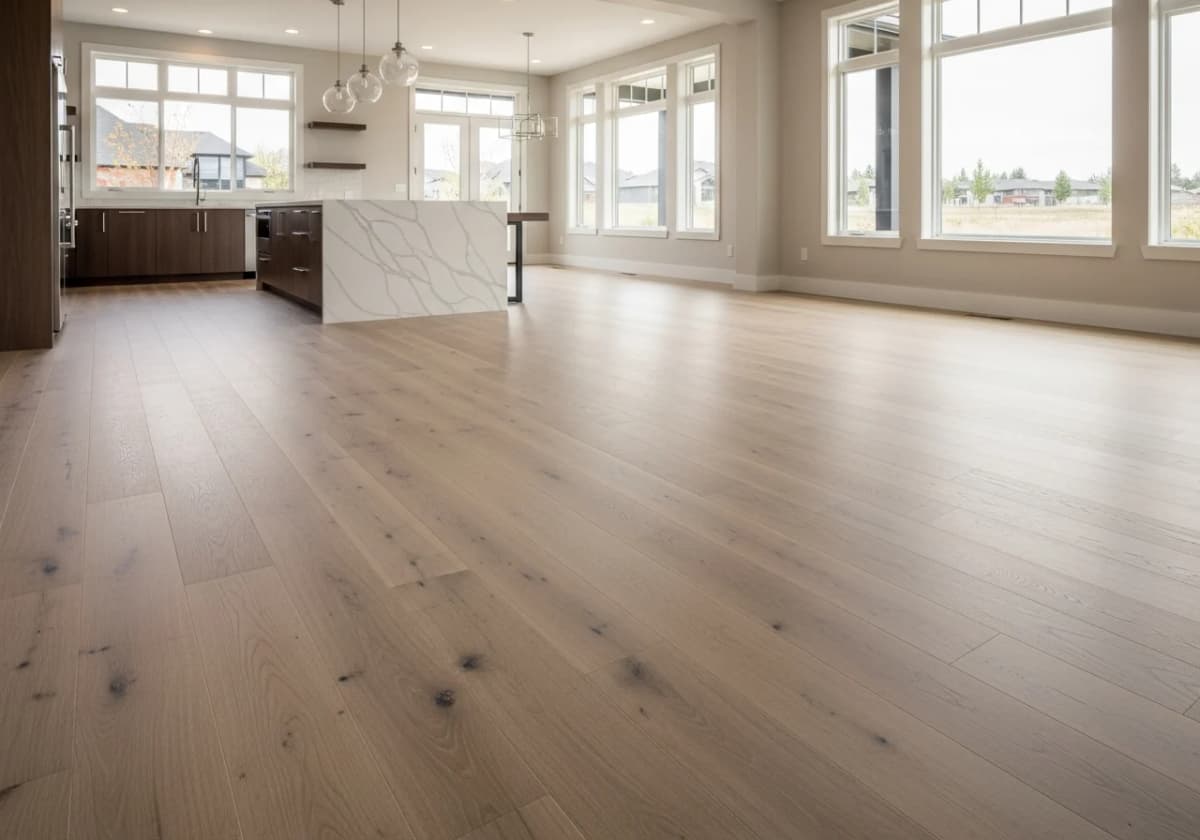
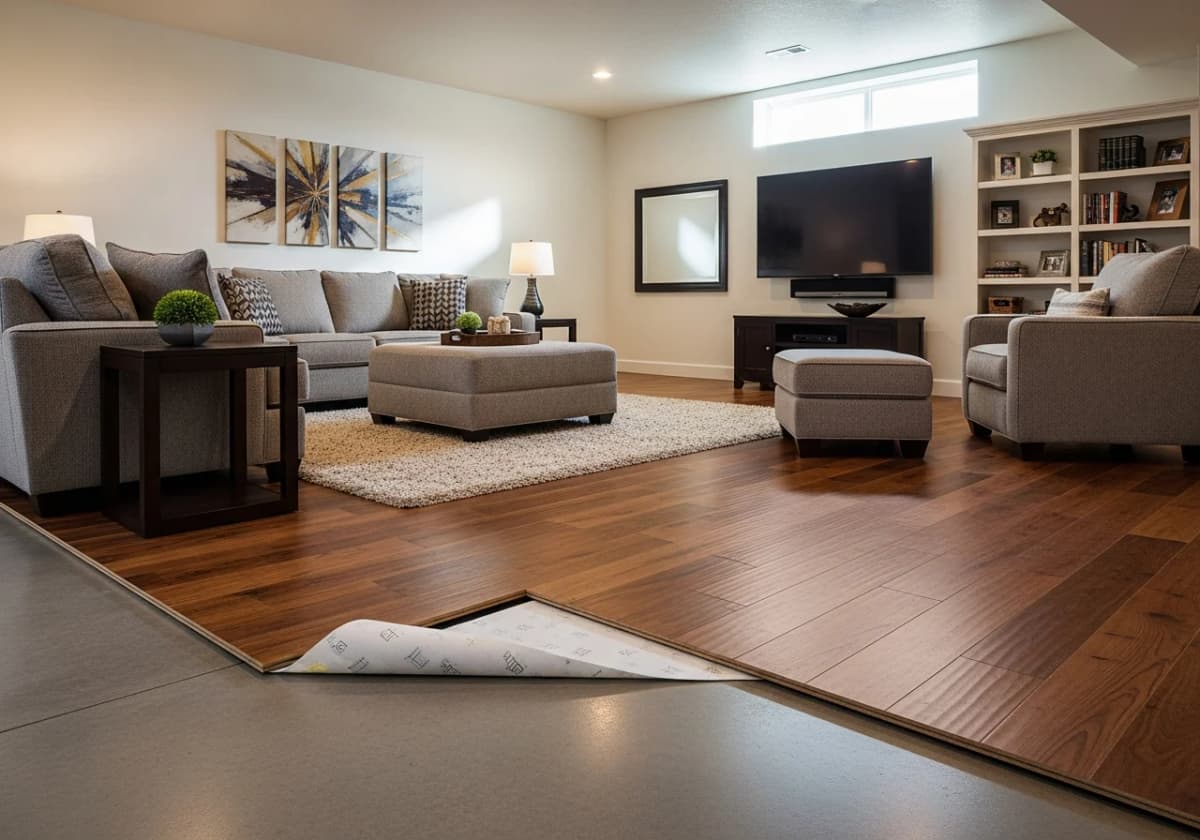
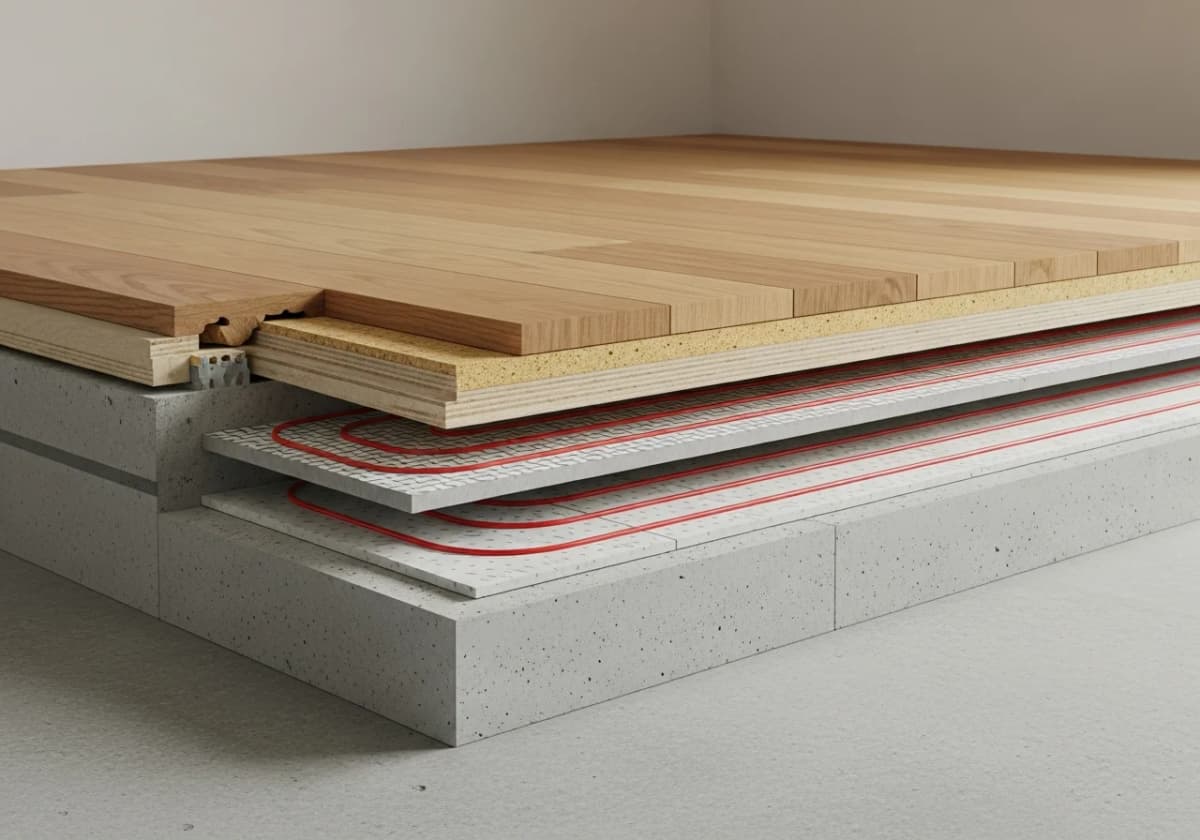
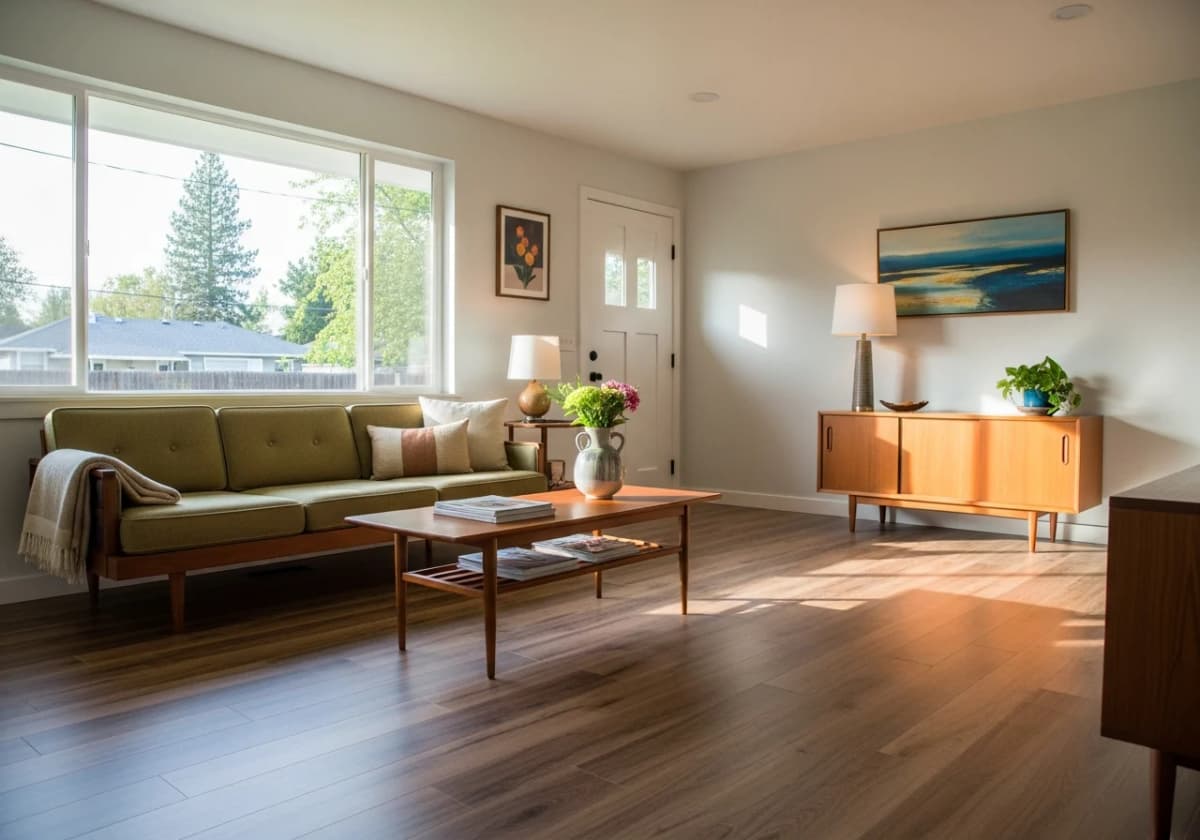
Two engineered hardwood planks can look completely identical lying side by side in a Boise showroom and yet perform very differently after ten years of Idaho humidity cycling. The reason is that the performance lives inside the plank, in three layers a shopper never sees once the floor is down: the wear-layer veneer on top, the core in the middle, and the backing or balancing layer on the bottom. Understanding these three layers is the difference between buying a floor that lasts thirty-five years and buying one that delaminates in eight.
Layer 1: The Wear Veneer (Top)
The top layer is a slice of genuine hardwood — the exact species, grade, and finish you would get in a solid floor. This is the only layer you ever see, walk on, and refinish, so its thickness is the most important number on the entire spec sheet. Veneers run from a wafer-thin 0.6mm on the cheapest imports up to a robust 6mm on premium sawn-face products. Everything about the floor's usable lifespan — how long it resists wearing through to the core, and how many times it can be sanded — is governed by this single dimension. A 2mm veneer cannot survive a full refinishing pass; a 4mm veneer typically allows one; a 6mm sawn face allows two or three. There is no way to add veneer after installation, so this choice is permanent and should be made deliberately, not by price alone.
Layer 2: The Core (Middle)
The core is the engineering. Three constructions dominate the market. A multi-ply plywood core stacks several thin wood plies with the grain of each rotated perpendicular to its neighbors; this cross-lamination cancels out wood's natural directional movement and is the most forgiving, most stable choice for Boise's wide humidity swing. An HDF (high-density fiberboard) core is a dense compressed wood-fiber board, almost always paired with a click-lock floating profile; it installs fast and costs less, but it is more vulnerable to standing water and is usually mated to thinner veneers. A solid-sawn lumber core uses a single thicker piece of wood beneath the veneer, oriented to balance the face — this is the most premium, most stable, and most expensive construction. We always tell a homeowner which core a product uses, because the core, far more than the brand name, predicts how the floor behaves in an Idaho winter.
Layer 3: The Backing / Balancing Layer (Bottom)
The bottom layer is the unsung hero. A balancing or backing veneer is bonded to the underside specifically to counteract the pull of the top veneer. Wood always wants to move; when only one face of the core is sealed with a finished veneer and the other is bare, the plank curls toward the unbalanced side — this is the warping you see on cut-rate engineered floors. A properly balanced plank stays flat for decades. Quality of the adhesive bonding all of these layers matters just as much: cheap glue and poor pressing are the root cause of the dreaded delamination, where the veneer separates from the core and the floor is unrepairable. This is why veneer thickness alone is not the whole story, and why we vet construction quality, not just the headline number, before we install a product in a Boise home.
Plywood Core
Most stable & forgiving — our default Boise recommendation
HDF Core
Fast click-lock installs — thinner veneer, water-sensitive
Solid-Sawn Core
Most premium & stable — highest cost tier
How the wear veneer is cut from the log changes both how the finished floor looks and how much it is worth — and almost no salesperson volunteers this. Three cutting methods are used, and the difference between the cheapest and the most authentic is dramatic once you know what you are looking at.
Rotary-Peeled
The log is mounted like a lathe and a blade peels a continuous thin sheet off the spinning surface, the same way veneer for plywood is made. It is the cheapest, highest-yield method and is used almost exclusively on budget 0.6–2mm veneers. The grain pattern is wide, swirling, and sometimes reads as “plywood-ish” rather than like a real board. If a sample looks vaguely artificial up close, rotary-peeled veneer is usually why.
Sliced
The log is sliced in flat, sequential cuts rather than peeled. The resulting grain looks far closer to a traditional sawn board — consistent, linear, and natural. Sliced veneers are common in the mid-range 2–3mm tier and are a sensible balance of authenticity and cost for most Boise living areas.
Sawn-Face (Dry Sawn)
The veneer is sawn off the log with a blade exactly as solid lumber is milled — just thinner. It produces the most authentic grain possible, visually indistinguishable from solid hardwood, with no peeling artifacts. Sawn-face veneers are found on premium 4–6mm products and are what we specify when a homeowner wants the floor to be genuinely impossible to tell from solid. Sawing wastes more wood than peeling, which is why it costs more.
The practical rule: thicker veneers are usually sliced or sawn and look more authentic; the thinnest budget veneers are rotary-peeled. When you compare samples for a Boise project, we will tell you the cutting method on each, because two oak floors at the same price can look like different products entirely depending on how the veneer was cut.
Boise sits at 2,730 feet elevation in the high desert of southwestern Idaho. Our climate is defined by extremes: scorching dry summers, cold winters with continuous forced-air heating, and indoor relative humidity that swings from roughly 15% in January to 45% in July. That 30-point swing is the single biggest factor in flooring performance here. In Idaho's summer months, outdoor afternoon relative humidity often falls to 15% or lower (Western Regional Climate Center).
Solid hardwood absorbs and releases moisture with each seasonal cycle. In Boise's dry winter months, solid planks shrink, opening visible gaps between boards. In summer, the wood swells and the gaps close — sometimes too aggressively, causing cupping or buckling at the edges. Over years of repeated cycling, solid hardwood can develop permanent deformation, finish cracking, and fastener loosening. Homeowners who install solid hardwood without a whole-house humidifier set to 35–50% RH year-round are especially vulnerable to these issues.
Engineered hardwood's cross-laminated plywood core changes the equation. The alternating grain directions of each plywood layer counteract the wood's natural tendency to expand and contract. The result is a plank that moves substantially less than solid hardwood across its width under the same humidity conditions — we do not publish a ratio, because the actual figure depends on the species, the core construction, and the plank width. For most Boise homes — especially those without dedicated humidification systems — this makes engineered hardwood the more reliable, lower-maintenance choice.
Additional Boise advantage: Engineered hardwood can be installed over concrete slabs, in basements, and over radiant heat systems (the U.S. DOE recommends laminated/engineered wood over solid for radiant applications) — three locations where solid hardwood either cannot go or requires expensive subfloor modifications. Boise's newer subdivisions in Southeast Boise, Star, and Kuna increasingly feature slab-on-grade construction where engineered hardwood is the only way to get real wood flooring without building a plywood sleeper system.
Prices below reflect fully installed costs in the Boise market, including materials, underlayment, standard subfloor prep, installation labor, and basic trim/transition work. Subfloor repairs, stair treads, and complex layouts add to the total.
Cost by Tier
| Tier | Installed Cost | Veneer | Typical Plank Width |
|---|---|---|---|
| Budget | $8 – $9 / sq ft | 2mm — no refinishing | 3¼″ – 5″ |
| Mid-Range | $9 – $12 / sq ft | 3–4mm — 1 refinish | 5″ – 7″ |
| Premium | $12 – $18 / sq ft | 5–6mm — 2–3 refinishes | 7″+ wide-plank |
Cost by Species
| Species | Installed Cost | Hardness (Janka) | Best For |
|---|---|---|---|
| Oak | $8 – $12 / sq ft | 1,290 (Red) / 1,360 (White) | Whole-home, high-traffic areas |
| Hickory | $8 – $14 / sq ft | 1,820 | Families, pets, rustic style |
| Walnut | $10 – $16 / sq ft | 1,010 | Formal rooms, luxury interiors |
| Maple | $8 – $13 / sq ft | 1,450 | Contemporary, light-toned interiors |
Whole-Home Estimate
For a typical 1,200 sq ft Boise home, the $8–$18/sq ft hardwood band works out to roughly $9,600–$21,600 for engineered hardwood installed throughout the main living areas. Mid-range white oak with a 4mm veneer in 5″–7″ planks — the product we install most often in Boise — lands in the $10,800–$14,400 range for 1,200 sq ft. These estimates include old flooring removal, standard subfloor prep, underlayment, material, installation, and basic trim. They are local market ranges, not a quote — your number depends on subfloor condition, layout complexity, stairs, and the specific product.
How Engineered Prices Against Solid Hardwood and LVP
Engineered hardwood sits squarely in the middle of the Boise flooring market. Comparable-species solid hardwood installs inside the same $8–$18/sq ft hardwood band but typically lands higher in it than the same species in engineered form, before counting the extra cost of a plywood sleeper system if the home is slab-on-grade. Luxury vinyl plank runs roughly $4–$8/sq ft installed and is the lower-cost, fully waterproof alternative when genuine wood is not a requirement. The honest framing for most homeowners: engineered hardwood is the choice when you specifically want real wood at a price below solid and in places solid cannot go; LVP is the choice when waterproofing and budget outrank having genuine wood; solid hardwood is the choice when multi-generation refinishing is the priority and the home and climate can support it.
Engineered hardwood is an outstanding flooring choice for most Boise homes, but it is not perfect for every situation. Here is an honest breakdown of its strengths and limitations in our local climate.
Advantages
- Dimensionally stable in Boise’s 15–45% humidity range — minimal gapping or cupping
- Real hardwood appearance that is indistinguishable from solid hardwood
- Installs over concrete slabs, in basements, and over radiant heat systems
- Can be refinished 1–3 times depending on veneer thickness
- Typically lands lower in the $8–$18/sq ft hardwood band than the same species in solid
- Available in wide-plank formats (7″+) that are difficult or impossible in solid
- Faster installation than solid hardwood — especially with click-lock floating systems
Limitations
- Limited refinishing — 1–3 times vs. 5–7 for solid hardwood
- Thinner veneers (2mm) can wear through in high-traffic areas within 15–20 years
- Quality varies dramatically by manufacturer — budget products may delaminate
- Lower-end click-lock products can develop hollow sounds underfoot
- Less sound insulation than solid hardwood — underlayment quality matters
- Cannot easily change stain color after installation (veneer too thin for deep sanding)
Iron Crest's Take
For the majority of Boise homes without whole-house humidification, engineered hardwood offers the best balance of real wood beauty, climate stability, and long-term value. We recommend mid-range products with at least a 3mm veneer for living areas and a thicker 4–6mm veneer for homes where refinishing flexibility is important. Budget-tier engineered hardwood with 2mm veneers is best reserved for rental properties or short-term applications where refinishing is not a priority.
If there is one thing to remember when shopping for engineered hardwood, it is this: veneer thickness is the single most important quality indicator. Everything else — species, finish, plank width, brand name — is secondary. The veneer determines how long the floor will last, how many times it can be refinished, and whether it will feel like genuine hardwood or a thin facsimile.
2mm Veneer
Budget Tier
- Lowest material cost
- Cannot be refinished
- May wear through in 15–20 years
Best for: rental properties, budget-conscious projects, low-traffic rooms
3–4mm Veneer
Most Popular in Boise
- Can be refinished once
- Best price-to-longevity ratio
- 25–35 year lifespan
Best for: owner-occupied homes, main living areas, families
5–6mm Veneer
Premium Tier
- Refinish 2–3 times
- 35–50 year lifespan
- Feels identical to solid hardwood
Best for: custom homes, high-end remodels, long-term investment
How to check veneer thickness: Look at the product's cross-section diagram in the specification sheet. Reputable manufacturers clearly list veneer thickness. If the spec sheet only lists “total thickness” without veneer thickness, that is a red flag — the veneer is likely 2mm or less. At Iron Crest Remodel, we only install engineered products where the veneer thickness is published and verified.
One of engineered hardwood's biggest advantages is installation versatility. Unlike solid hardwood — which can only be nailed to a plywood subfloor — engineered hardwood offers three installation methods, each suited to different subfloor types and project requirements.
| Method | Subfloor | Stability | Speed | Best For |
|---|---|---|---|---|
| Nail-Down | Plywood subfloor | Excellent | Moderate | Traditional feel, crawlspace homes |
| Glue-Down | Concrete slab or plywood | Most stable | Slowest | Basements, slab-on-grade, open floor plans |
| Floating (Click-Lock) | Any flat, dry surface | Good | Fastest | Radiant heat, DIY-friendly, quick remodels |
Nail-Down
The traditional method, using a pneumatic flooring nailer to fasten each plank through the tongue into the plywood subfloor below. Produces the most solid, “traditional hardwood” feel with zero hollow spots. Requires a plywood subfloor at least ¾″ thick. Most common in Boise's older crawlspace homes in the North End, Bench, and East End where plywood subfloors are standard.
Glue-Down
Each plank is adhered directly to the subfloor with urethane adhesive. This produces the most dimensionally stable installation because the adhesive prevents any lateral movement. Ideal for concrete slabs in basements and newer Boise homes. Also provides the best sound dampening. The trade-off is slower installation (adhesive cure time) and more difficult future removal.
Floating (Click-Lock)
Planks interlock at the edges and float freely over an underlayment pad without being attached to the subfloor. Fastest installation method — a 1,200 sq ft home can be completed in 2–3 days. The preferred method over radiant heat because the floor can expand and contract without adhesive resistance. Requires a perfectly flat subfloor (3/16″ tolerance over 10 feet).
Which method for your home? During your in-home consultation, Iron Crest Remodel inspects your subfloor type, measures flatness, tests moisture levels, and identifies your heating system to recommend the best installation method. The subfloor dictates the method — not personal preference.
Engineered hardwood is not a “cheaper alternative” to solid hardwood — it is a different product engineered for a different set of conditions. Both are real hardwood floors. Here is how they compare across the factors that matter most for Boise homeowners.
| Factor | Engineered Hardwood | Solid Hardwood |
|---|---|---|
| Boise Climate Stability | Excellent — minimal movement in 15–45% RH | Poor without humidifier — seasonal gapping and cupping |
| Refinishing Capacity | 1–3 times (veneer dependent) | 5–7 times over lifespan |
| Installed Cost (Boise) | $8 – $18 / sq ft — usually the lower half | $8 – $18 / sq ft — usually the upper half |
| Install Over Concrete | Yes — glue-down or floating | No — requires plywood sleepers |
| Install Over Radiant Heat | Yes — up to 85°F surface | Not recommended |
| Basement Installation | Yes — with moisture barrier | Not recommended |
| Underfoot Feel | Identical to solid when nail-down or glue-down | Dense, warm, natural resonance |
| Lifespan | 25–50 years | 50–100+ years (with refinishing) |
| Species Availability | All major species plus exotics | All major domestic and imported species |
| Wide Plank Options (7″+) | Readily available, stable | Available but prone to cupping in Boise |
| Boise Resale Value | We publish no figure — no MLS access, no Boise appraisal data | We publish no figure — ask your agent or an appraiser |
Bottom Line for Boise Homeowners
If your Boise home has a whole-house humidifier maintaining 35–50% RH year-round and you want a floor that can be refinished five or more times over its lifetime, solid hardwood is a viable choice. For everyone else — which is the vast majority of Boise homeowners — engineered hardwood delivers the same real-wood beauty with dramatically better performance in our dry, high-desert climate. It costs less, installs faster, works in more locations, and requires less ongoing environmental control.
If there is one place engineered hardwood is not just “an option” but the clearly correct choice, it is below grade and on concrete. Solid hardwood simply cannot go directly onto a slab, into a basement, or over radiant heat without expensive workarounds. Engineered hardwood goes into all three. For a growing share of Treasure Valley homes, that is the entire reason it exists.
Slab-on-Grade Construction in the Treasure Valley
A large portion of newer construction in Meridian, Kuna, Star, and Southeast Boise is built slab-on-grade — the home sits directly on a poured concrete slab with no crawlspace or basement beneath the main level. There is no plywood subfloor to nail solid hardwood into. To install solid wood on a slab you must first build a raised plywood sleeper or floating subfloor system, which adds material and labor cost and raises the finished floor height enough to cause problems at doors, transitions, and appliances. Engineered hardwood eliminates all of that: it bonds or floats directly over a prepared slab at near-zero added height. For most slab-on-grade Treasure Valley homeowners who want real wood, engineered is the only practical path.
Basements and Below-Grade Spaces
Basement finishing is one of the most common Boise remodel requests, and homeowners almost always want their basement to feel like the rest of the house rather than a concrete box. Solid hardwood is not recommended below grade because of moisture vapor migrating up through the slab. Engineered hardwood, installed with proper moisture testing and a vapor barrier, performs reliably in finished basements. We are still honest about the limit: a basement with a history of standing water, drainage problems, or a high water table is not a wood-floor candidate at all — that is an LVP or tile situation, and we will say so rather than install a floor we expect to fail.
Slab Moisture Testing & Vapor Barriers
Concrete is never truly “dry.” A slab releases water vapor for months or even years, and newer Treasure Valley slabs in fast-built subdivisions are frequently still curing when flooring goes in. Before any engineered hardwood touches a slab, we test moisture using a calcium chloride or in-situ relative-humidity probe per the product manufacturer's required method and pass/fail threshold. If readings exceed the limit, we install a moisture-mitigation membrane or use a moisture-barrier urethane adhesive system before the floor goes down. This single step — testing and barrier — is the most common thing skipped on failed wood-over-concrete jobs and is non-negotiable on every Iron Crest installation.
Radiant Floor Heat
Radiant in-floor heat is increasingly specified in Boise custom builds and high-end bath and kitchen remodels, and it is brutal on solid hardwood — sustained heat from below drives wood toward extreme dryness and shrinkage. Engineered hardwood's cross-laminated core tolerates that bottom-side heat far better, which is why it is the standard wood choice over radiant. Most manufacturers rate their engineered products for a maximum surface temperature around 85°F, and the floating click-lock method is generally preferred so the floor can expand and contract freely without adhesive resistance. We confirm radiant compatibility on the specific product before recommending it, because not every engineered floor is rated for it, and slow, staged warm-up after install is required to avoid thermal shock.
Engineered hardwood is excellent in most living spaces, good in some, and the wrong call in a few. Here is the honest room-by-room breakdown we give Boise homeowners during an in-home estimate.
| Room | Verdict | Notes |
|---|---|---|
| Living / Family Room | Ideal | The single best use — real-wood look, stable, comfortable underfoot |
| Bedrooms | Ideal | Low traffic, low moisture; even mid-tier veneers last decades |
| Kitchen | Good | Fine with prompt spill cleanup; not for households that flood the floor |
| Hallways / Entry | Good | Choose 3mm+ veneer or harder species — high traffic and grit |
| Finished Basement | Good | Yes with moisture test + vapor barrier; not if water history exists |
| Dining Room | Ideal | Chair-leg felt pads recommended; minimal moisture risk |
| Full Bathroom | Avoid | Standing water and humidity — choose tile or LVP instead |
| Laundry / Mudroom | Avoid | Appliance leak and tracked-in water risk — LVP or tile is honest here |
A contractor who only sells you what they install is not giving advice. Here is when we tell Boise homeowners to choose something else.
- You want to refinish the floor five-plus times over its life — thin engineered veneers cannot, so choose solid hardwood.
- The space must be genuinely waterproof — a full bathroom, a damp basement, a laundry room — where LVP or tile is the correct, honest answer.
- Your budget only reaches a 2mm rotary-peeled veneer — in that price band, quality LVP usually delivers more real-world durability per dollar.
- The room takes extreme abuse and you need deep gouges to be sandable out — that is a job for thick-wear-layer solid hardwood.
- You expect to change the floor’s stain color in the future — a thin veneer cannot be deep-sanded for a true recolor.
For everything else — which is most of a typical Boise or Treasure Valley home — engineered hardwood is the floor we most often recommend. Compare it directly against luxury vinyl plank, solid hardwood, tile, and carpet, or see the full flooring installation overview.
Engineered hardwood is lower-maintenance than solid hardwood in Boise specifically because it does not demand a tightly controlled indoor humidity to stay flat. It is not maintenance-free, though, and a few habits dramatically extend its life in our dry, gritty high-desert environment.
- Sweep or dust-mop regularly — Boise’s fine wind-blown grit is abrasive, and grit ground underfoot is what wears a finish out early.
- Damp-mop only, never wet-mop — use a well-wrung microfiber pad and a manufacturer-approved hardwood cleaner; standing water is the enemy of any wood floor.
- Wipe spills immediately — engineered is water-resistant, not waterproof; minutes matter, not hours.
- Felt pads on every furniture leg and a hard-floor caster or chair mat under rolling chairs — cheapest insurance you can buy.
- Walk-off mats at every exterior door — they trap the grit and de-icing salt that Boise winters track in.
- Keep indoor humidity reasonable — engineered tolerates the 15–45% Idaho swing, but extreme prolonged dryness still benefits from a modest humidifier in deep winter.
- Refinish proactively, not reactively — a screen-and-recoat before the finish wears through protects the irreplaceable veneer; let it go too long and the only fix is board replacement.
Every Iron Crest engineered hardwood installation is backed by our 3-year workmanship warranty, and we walk every Boise homeowner through product-specific care at completion. For broader planning, see our remodeling guides or the areas we serve across the Treasure Valley regions.
Common questions Boise homeowners ask about engineered hardwood flooring.
Is engineered hardwood real wood?
Yes. Engineered hardwood has a top layer of genuine hardwood veneer — the same species you would choose in solid hardwood (oak, hickory, walnut, maple). The difference is the core: instead of a single piece of solid wood, engineered hardwood uses a cross-laminated plywood base that provides superior dimensional stability. When installed, engineered hardwood looks, feels, and sounds like solid hardwood, because the surface you see and walk on is the same species. The layered construction is only visible at the edge of a plank, and that edge is never exposed in a finished floor.
How long does engineered hardwood last in Boise’s climate?
Engineered hardwood lasts 25–50 years in Boise homes with normal maintenance. Its cross-laminated core handles our extreme humidity range (15% in winter to 45% in summer) far better than solid hardwood, which means less gapping, cupping, and seasonal movement over its lifespan. Products with thicker veneers (4–6mm) can be refinished 1–3 times, extending the floor’s usable life significantly. With proper care — regular sweeping, occasional damp mopping with a manufacturer-approved cleaner, and felt pads on furniture legs — engineered hardwood is a multi-decade investment.
Can engineered hardwood be installed over concrete in my Boise basement?
Yes — and this is one of engineered hardwood’s biggest advantages over solid hardwood. Engineered hardwood can be glued down or floated directly over concrete slabs, which are common in Boise basements, slab-on-grade homes, and newer construction. We perform a calcium chloride moisture test on every concrete slab before installation. If moisture vapor emissions exceed manufacturer thresholds, we install a moisture barrier membrane ($0.50–$1.50/sq ft) before laying the flooring. Solid hardwood cannot be installed directly over concrete — it requires a plywood sleeper system that raises the floor height and adds significant cost.
Can I install engineered hardwood over radiant heat in my Boise home?
Yes. Engineered hardwood is one of the best flooring options for radiant heat systems, which are increasingly popular in Boise new construction and bathroom/kitchen remodels. The cross-laminated core resists the drying effect of sustained bottom-side heat far better than solid hardwood. Most manufacturers rate their engineered products for surface temperatures up to 85°F. The floating installation method is typically recommended over radiant heat because it allows the floor to expand and contract freely without adhesive resistance. We verify every product’s radiant heat compatibility before recommending it for your project.
How much does engineered hardwood installation cost in Boise?
Installed hardwood in Boise — engineered or solid — runs $8 to $18 per square foot, and engineered products fill that whole band depending on species, veneer thickness, plank width, and installation method. Budget-tier engineered hardwood (thin 2mm veneer, narrow planks) sits at the $8–$9/sq ft floor of the band. Mid-range products (3–4mm veneer, 5–7” planks, quality species like white oak) are usually $9–$12/sq ft installed. Premium engineered hardwood (5–6mm veneer, 7”+ wide planks, European white oak or walnut) runs $12–$18/sq ft installed. For a typical 1,200 sq ft Boise home, that band works out to roughly $9,600–$21,600 depending on the tier you choose. These are local market ranges, not quotes — your exact price depends on subfloor condition, layout, and product, which we confirm in a free in-home estimate.
What is the difference between a plywood core and an HDF core in engineered hardwood?
The core is the layer beneath the hardwood veneer, and it has a large effect on performance. A multi-ply plywood core is built from several thin wood plies cross-laminated at perpendicular angles — this is the most dimensionally stable and forgiving construction, and it is what we generally recommend for Boise. An HDF (high-density fiberboard) core is a compressed wood-fiber board, almost always used with click-lock floating planks. HDF-core planks are typically less expensive and install fast, but the core is more sensitive to standing water and the veneers on HDF products are usually thinner. There is also a solid lumber (sawn) core, which is the most premium and stable but the most costly. We tell Boise homeowners which core a product uses before they commit, because two floors that look identical in a showroom can perform very differently over a decade of Idaho humidity swings.
How is the veneer cut, and does it change how the floor looks?
Yes — veneer cutting method affects both appearance and value. Rotary-peeled veneer is shaved off a spinning log like unrolling a roll of tape; it is the cheapest method and produces a wide, sometimes wild grain pattern that can look slightly like plywood. Sliced (or sliced-peel) veneer is cut in flat slices and looks much closer to a traditional sawn board. Sawn-face veneer is sawn from the log exactly like solid hardwood lumber, just thinner — it is visually indistinguishable from solid hardwood and is the premium choice. Generally, thicker veneers are sawn or sliced and thinner budget veneers are rotary-peeled. If grain authenticity matters to you, ask for a sliced or sawn-face product; we will tell you which cutting method a sample uses.
Will engineered hardwood gap or cup in winter like solid hardwood does?
Far less. The cross-laminated core resists the seasonal expansion and contraction that causes solid hardwood to gap in Boise’s 15% winter humidity and cup when it rebounds in summer. Engineered planks still acclimate to the home and still have tiny seasonal movement — no wood floor is perfectly static — but the movement is a fraction of solid hardwood’s, and it is spread across many narrow micro-gaps instead of a few obvious ones. Homeowners who run forced-air heat all winter with no humidifier are exactly the people who benefit most from engineered over solid here.
How many times can engineered hardwood actually be refinished?
It depends entirely on veneer thickness, and the honest answer is fewer times than most people expect. A 2mm veneer cannot be sanded and refinished at all — a full sand removes more than 2mm. A 3–4mm veneer can usually take one light sand-and-refinish over its life. A 5–6mm sawn veneer can handle two, sometimes three, light refinishes. Compare that to solid hardwood, which can be refinished five to seven times. If long-term refinishing flexibility is a priority for you, we steer you toward a thicker-veneer product up front, because there is no way to add veneer later.
Can scratches and gouges in engineered hardwood be repaired?
Surface scratches in the finish can be buffed or screen-and-recoated like any wood floor. The honest limitation is deep damage: a gouge that goes through a thin 2mm veneer into the core cannot be sanded out the way it can on solid hardwood, because there is not enough wood above the core to remove. In that case the repair is board replacement rather than sanding. This is one of the few areas where solid hardwood has a genuine durability edge, and it is a real reason to choose a thicker veneer in homes with big dogs, heavy furniture, or kids.
Is engineered hardwood waterproof? How does it compare to LVP in a Boise kitchen?
No — engineered hardwood is real wood on top, so it is water-resistant for spills wiped up promptly but not waterproof. Standing water, a slow dishwasher leak, or a flooded laundry room can still damage the veneer and swell the core. If a space genuinely needs waterproof flooring — a mudroom, a basement with any moisture history, a full bathroom — luxury vinyl plank is the more honest recommendation, and we will tell you so rather than oversell wood. Engineered hardwood is the better pick when you specifically want the look and feel of genuine wood in living areas, kitchens, and bedrooms.
Is engineered hardwood a good choice for Meridian, Kuna, and Star slab-on-grade homes?
It is often the single best real-wood option for them. Many newer Treasure Valley subdivisions in Meridian, Kuna, Star, and Southeast Boise are built slab-on-grade with no crawlspace. Solid hardwood cannot be nailed directly to concrete — it needs a plywood sleeper or subfloor system that raises floor height and adds significant cost. Engineered hardwood glues or floats directly over a properly prepped, moisture-tested slab. We always run a moisture test on the slab first and install the appropriate vapor barrier before any product goes down.
What moisture testing and vapor barrier do you do on a concrete slab?
Before installing over any slab — basement or slab-on-grade — we test the concrete for moisture using a calcium chloride or in-situ relative-humidity probe, following the manufacturer’s required method and threshold. Concrete can release vapor for months or years, especially in newer Treasure Valley builds where the slab is not fully cured. If readings exceed the product’s limit, we install a moisture-mitigation membrane or use a moisture-barrier adhesive system before the flooring goes down. Skipping this step is the most common cause of failed wood-over-concrete installs, so it is non-negotiable on every Iron Crest job.
When is engineered hardwood NOT the right choice?
We will tell you directly when another product fits better. Skip engineered hardwood if: you want a floor you can refinish five-plus times over decades (choose solid hardwood); the room needs to be truly waterproof such as a full bathroom or a damp basement (choose tile or LVP); your budget is tight and a thin 2mm veneer is all that fits (LVP often delivers more durability per dollar); or the space sees extreme abuse and you need gouges to be sandable out (solid hardwood with a thick wear layer). Engineered hardwood is excellent for the majority of Boise living spaces, but it is not a universal answer, and a good contractor says so.
Engineered hardwood is not the right choice for every room or every budget. Compare it against the other flooring types we install in Boise homes.
Luxury Vinyl Plank (LVP)
100% waterproof, $4–$8/sq ft — Boise’s most popular flooring
Solid Hardwood
The classic — $8–$18/sq ft, refinish 5–7 times, 100-year lifespan
Tile Flooring
Porcelain & ceramic — $8–$20/sq ft, waterproof, 50+ year lifespan
Carpet
Soft, warm, budget-friendly — $3–$6/sq ft for bedrooms & bonus rooms
Engineered hardwood installation is often part of a larger remodeling project. Explore related Iron Crest services and planning guides.
Flooring Installation Overview
All flooring types we install in Boise
Flooring Cost Guide
Detailed pricing for every flooring material
Flooring Materials Guide
Side-by-side material comparison
Flooring Timeline
How long your flooring project will take
Whole Home Remodeling
Planning a larger renovation with flooring
Get a Free Estimate
Personalized engineered hardwood quote
The following government agencies, industry organizations, and official resources provide additional information relevant to your remodeling project.
We provide flooring installation to homeowners across the Treasure Valley and southwest Idaho. Each city has its own dedicated page with local permitting, climate, and project detail — and each county hub covers the surrounding communities we also serve.
Primary sources and industry standards consulted for this guide:
- 1.Equilibrium moisture content (EMC) is the moisture level wood reaches when in equilibrium with its surrounding environment. Per USDA Forest Products Laboratory data (Table 4–2), at 70°F and 40% relative humidity the EMC for wood is approximately 7.7%. Source (USDA Forest Products Laboratory — Wood Handbook GTR-282, Chapter 4 (Table 4–2))
- 2.Western Regional Climate Center data indicates that during Idaho summer months, outdoor relative humidity at the time of daily maximum temperature is usually below 25% and often drops to 15% or lower — creating very dry conditions that pull moisture from wood flooring. Source (Western Regional Climate Center (WRCC / Desert Research Institute) — Idaho Climate Narrative)
- 3.NWFA 2025 guidelines state the jobsite environment must be controlled to a relative humidity range of 30–50% and a temperature range of 60–80°F before, during, and after wood flooring installation. Source (NWFA — Wood Flooring Installation Guidelines (© 2025))
- 4.NWFA 2025 guidelines require HVAC systems to be operating for a minimum of 5 days preceding delivery of flooring materials; longer operation may be necessary in tighter building envelopes or wet conditions. Source (NWFA — Wood Flooring Installation Guidelines (© 2025))
- 5.The U.S. DOE states "Ceramic tile is the most common and effective floor covering for radiant floor heating, because it conducts heat well and adds thermal storage." Source (U.S. Department of Energy — Radiant Heating)
- 6.The U.S. DOE advises that wood flooring over radiant heat "should be laminated wood flooring instead of solid wood to reduce the possibility of the wood shrinking and cracking from the drying effects of the heat." Source (U.S. Department of Energy — Radiant Heating)
- 7.The U.S. DOE warns that "any covering that insulates the floor from the room will decrease the efficiency of the system," flagging vinyl, linoleum, and thick carpeting as reducing radiant heat performance. Source (U.S. Department of Energy — Radiant Heating)
- 8.The 2019 NWFA guidelines "limit the maximum floor operating surface temperatures of the installed wood floor to 80°F," with the note that not all wood floor manufacturers hold to this same limit. Source (National Wood Flooring Association (NWFA))
- 9.Engineered wood flooring is "in general, more dimensionally stable than solid wood flooring" for radiant heat applications; however, engineered products with less-stable species such as hickory, beech, and maple "are not normally best suited over radiant heat unless otherwise suggested by the flooring manufacturer." Source (Hardwood Floors Magazine — Wood Floors and Radiant Heat)
- 10.Most LVP/LVT manufacturers set a maximum floor surface temperature of 80–85°F over radiant heat systems; MSI notes 'while many manufacturers have a restriction of 85 degrees Fahrenheit, it's recommended that the system is below 80' to protect flooring quality. Source (MSI Surfaces — LVP Over Radiant Heating)
Ready for Engineered Hardwood?
Get a free, no-obligation estimate for engineered hardwood installation in your Boise home. We will inspect your subfloor, recommend the right product and installation method, and provide transparent, fixed-price estimates; any changes are documented and approved before work proceeds.