
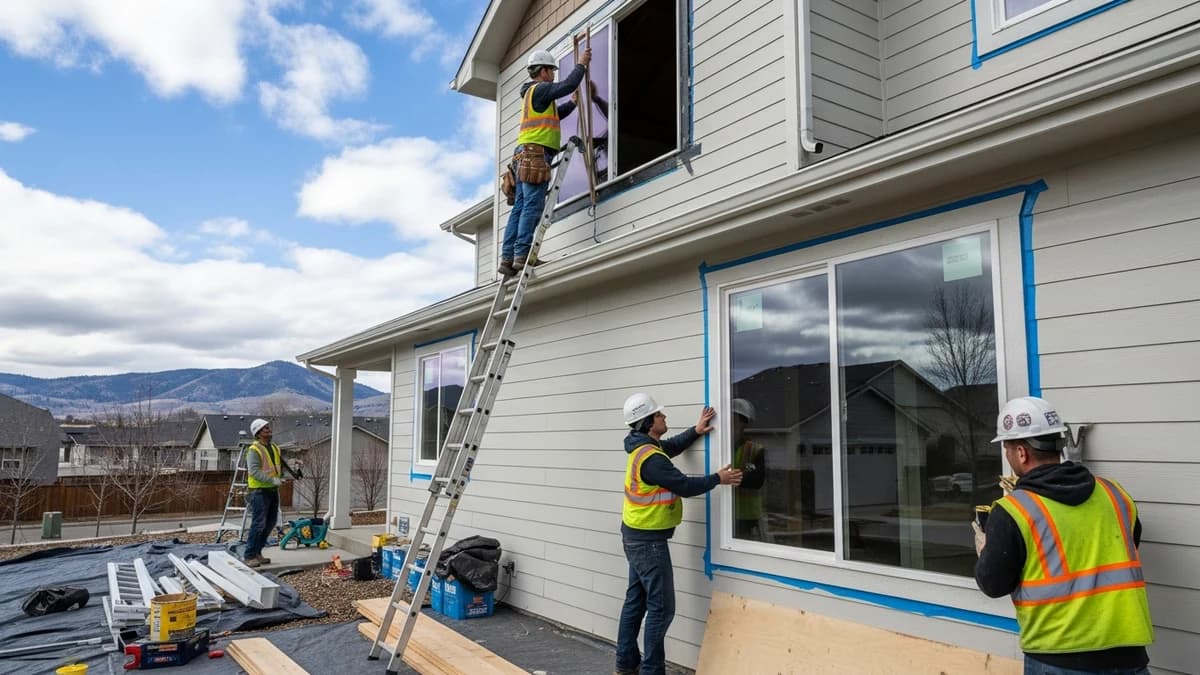
Bay & Bow Windows in Boise
Dramatic projection windows that expand your views, add usable interior space, and transform your home's curb appeal. Expert installation with proper structural support engineered for Boise's Zone 5 climate.
Quick answer
Our cost guide puts a bay or bow assembly between $1,200 and $6,000 and upward installed, and where a given project falls inside that band is driven almost entirely by scope rather than by brand.
Bay and bow windows are projection windows — they extend outward from the exterior wall of your home rather than sitting flush with the wall plane. That single difference changes everything: instead of a hole in the wall filled with glass, you are building a small architectural structure that pushes living space outside the original footprint of the house. Both types create additional interior shelf or seating space, pull in daylight from multiple directions, and add a three-dimensional element that is visible from the curb and from inside the room. Among the windows we install across the Treasure Valley, these are the only ones that genuinely change the silhouette of the house and add usable area to the room behind them.
A bay window is an angular bump-out, almost always three units. The center is a large fixed picture lite that frames the primary view; it is flanked by two side units kicked back toward the wall at an angle. The common factory angles are 30 and 45 degrees, with some manufacturers offering 25- and 35-degree options. The shallower 30-degree kick reads as a subtle facet and projects less; the 45-degree configuration pushes further out and carves a genuinely deep interior nook — deep enough for a banquette. The flankers are the working part of a bay: they are normally operable casement or double-hung units, which is how the room gets its ventilation.
A bow window trades the sharp facets for a gentle curve. It uses four, five, or six equal-sized units, each turned only 10 to 18 degrees from its neighbor, so the assembly sweeps a smooth quarter-arc rather than a hard angle. Because the lites are identical and the curve is shallow, a bow spreads across a much wider section of wall — five to ten feet or more — and delivers a panoramic wash of light. The end units are usually the operable ones; the interior lites stay fixed for an uninterrupted sweep of glass. A bow projects less than a bay (often 10 to 16 inches) but covers more wall, so it gives you a wide shallow shelf rather than a deep narrow seat.
What both share is the consequence of projecting: there is a cantilevered load that has to be carried back to the structure, a cap (a small roof) above the unit that has to shed water and Treasure Valley snow, a soffit below that has to be insulated and air-sealed, and several mulled corner joints that have to stay weathertight through Boise's freeze-thaw cycles. These are the parts that separate a bay or bow that performs for thirty years from one that rots out in six — and they are why this is the most demanding window type we install. In North End Craftsman and bungalow homes, a proportion-correct bay reinforces architecture the house already has. In ranch, split-level, and Bench homes with long flat front walls, a bay or bow is one of the highest-impact ways to break a monotonous facade and add the dimension those elevations lack.
Both project from the wall, but they are different tools. A bay is for depth — a deep nook, a seat, a banquette — on a moderate width of wall. A bow is for breadth — a wide, elegant arc of glass — where you have the wall length and want the sweep rather than the seat. The table below is the side-by-side we walk Boise homeowners through during the in-home measure.
| Feature | Bay Window | Bow Window |
|---|---|---|
| Panel Count | 3 panels (1 fixed center + 2 angled flankers) | 4–6 equal panels |
| Angle / Shape | Faceted — 25°, 30°, 35°, or 45° from wall | Gentle continuous arc — 10°–18° per panel |
| Typical Width | 3.5–6 feet | 5–10+ feet |
| Projection Depth | 16–24 inches (deeper at 45°) | 10–16 inches |
| Interior Space | Deep nook — ideal for a seat or banquette | Wide shallow shelf — broader but not as deep |
| Ventilation | Two operable flankers (casement or double-hung) | Operable end units; fixed center lites |
| Best Rooms | Kitchens, living rooms, breakfast nooks | Primary bedrooms, formal dining, wide living rooms |
| Architectural Match | Craftsman, bungalow, ranch, traditional, transitional | Colonial, Victorian, formal, contemporary |
| Natural Light | Strong — daylight from three planes | Superior — wide panoramic arc gathers more |
| Relative Cost | Lower — fewer lites, narrower opening | More — more lites, wider opening, more joints |
| Install Complexity | High — engineered support + cap required | Higher — wider span, more mulls and flashing to seal |
The decision usually comes down to two questions we ask on site. First, what do you want the space to do — sit in it (bay), or look through a wide sweep of it (bow)? Second, how much unobstructed wall and exterior clearance do you actually have? A bow needs both width and an exterior the arc can reach into; a bay needs less width but more projection room and a header that can take a concentrated point load. There is no universally better choice — there is a better choice for a specific opening, which is what the measure determines.
A bay or bow is not a window; it is a small building bolted to the side of your house. Five parts have to work together, and the failure of any one of them is what causes the rot and cold-seat complaints people associate with projection windows. Understanding these parts is the difference between buying a window and commissioning a structure.
The Header & the Load Above
Everything above the opening — wall, roof, and any snow on it — has to bridge the hole the window sits in. A bay or bow opening is wider and the unit is heavier than a flat window (a glazed wood bow can run several hundred pounds before snow), so the header is sized up: a doubled 2x10 or 2x12, or more commonly an engineered LVL, for openings past about four feet. On a flat-to-bay conversion the existing header almost never carries the new wider span and heavier unit, so it gets replaced — which means temporarily shoring the wall, and that is a structural operation, not a trim job. We verify the bearing path down to the foundation before we commit to a header size.
The Support System — Carrying the Cantilever
The unit hangs out past the wall, so its weight wants to rotate it down and away. Something has to resist that. Cable suspension hangs it from above; knee braces push back from below; cantilever framing carries it on extended floor joists. Whichever method, the load has to land on something that goes to the foundation — not just into sheathing and siding. This is the part unqualified installers fake with a couple of brackets and caulk, and it is the part that sags two winters later. The detailed comparison of the three methods, and when each is right for a Boise wall, is in the Structural Requirements section below.
The Cap — The Little Roof That Takes the Snow
Above the projection is a small cap. In Boise it has to carry the city's 20 psfground snow load (City of Boise design criteria, Boise #301), plus the drift that piles in the inside corners where the cap dies into the wall. A real cap is framed with slope, sheathed, fully covered in ice-and-water membrane that turns up the wall behind the siding, then step- and counter-flashed so meltwater is thrown onto the cladding, never behind it. A flat shelf with a strip of aluminum and a bead of caulk — which is what a too-cheap bid buys — is the single most common reason these windows leak and rot in Boise.
The Soffit & Seat Cavity Below
Under the unit is an exposed underside — the soffit — and behind it the seat or shelf cavity. That cavity sees outdoor air on three sides with only a thin platform between it and your heated room. Left as a hollow box it becomes a cold sink that makes the seat unusable in February and sweats with condensation. It has to be packed with closed-cell spray foam, the soffit air-sealed, and a vapor-control layer kept on the warm side. This is invisible work that costs real labor, which is exactly why corner-cutting installers skip it — and exactly why their customers cover the seat with a pillow they never move.
The Mulled Corners & Wall Junction
A bay or bow is several windows joined by mulled corner posts, and it ties back into the wall on both sides. Every one of those joints is a potential air and water path, and Boise's freeze-thaw cycling works any unsealed joint open over time as trapped moisture expands and contracts. We back-caulk and gasket the factory mulls, integrate the unit into the wall's water-resistive barrier with proper sill pan and head flashing, and tie the whole assembly into the siding so the drainage plane is continuous. The window is only as weathertight as its weakest joint, and on a projection there are far more joints than on a flat window.
This is the most expensive window project per opening in a typical Boise house, and the reason is the four-kinds-of-work-on-one-hole reality covered above. Our window replacement cost guide prices a bay or bow assembly at $1,200 to $6,000 and upward installed, separately from the per-window tiers, because the figure includes the unit, engineered header, support system, cap and flashing, cavity and seat insulation, interior trim and seat board, the permit, and labor. The table below shows where the common configurations fall inside that band. These are working ranges to budget against, not a quote — the opening and wall condition move the number more than the window brand does, which is why we price after measuring rather than over the phone.
| Window Type | Frame Material | Installed Range |
|---|---|---|
| Bay Window | Vinyl | $1,200–$3,500 |
| Bay Window | Wood / Aluminum-Clad | $3,500–$6,000+ |
| Bow Window | Vinyl | $1,800–$4,500 |
| Bow Window | Wood / Aluminum-Clad | $4,500–$6,000+ |
What moves the number within these ranges: a like-for-like replacement of an existing bay/bow sits low; a flat-opening conversion (new header, support system, cap framing and weatherproofing, interior seat) sits high and can exceed the top of the range on wide bows. A second-story install adds staging. Cantilever support is more carpentry than cable. Triple-pane glass, tuned per orientation, adds roughly $150–$300 per lite — meaningful on a five-lite bow. A site-built cap detailed to match a historic North End roofline costs more than a stock factory cap but is often the only correct choice on those homes. The permit and any required structural engineering are real line items we include rather than bury.
Set against that cost: a bay or bow is the only window project that adds floor area you can use and changes the house at the curb. We do not publish a recoup percentage for it — there is no Boise-specific resale study behind the figures that circulate, and national cost-versus-value averages do not transfer to one address — but the before-and-after on a flat-faced ranch or Bench home is as dramatic as any exterior change we make. We do not publish manufacturer brand pricing, and we will tell you when a flanked picture window would get you most of the result for materially less — that honest comparison is part of the estimate, not an upsell conversation.
Bay and bow windows deliver the most dramatic result of any window upgrade, and they carry the most trade-offs. Here is the honest assessment we give before anyone signs — including the cases where we recommend against the project.
Advantages
- Changes the silhouette of the house from the curb — the only window upgrade that does, and the reason agents rank it among top curb-appeal returns on flat-faced Boise homes
- Adds usable floor area — the projection becomes a seat, banquette, plant shelf, or display niche that did not exist before
- Daylight from three planes (bay) or a wide panoramic arc (bow), brightening the whole room rather than one wall
- Two operable flankers (bay) or operable end units (bow) give real cross-ventilation, not just a fixed view
- Builds in a window seat with hidden storage in the cavity — a feature buyers consistently value
- On North End and Craftsman homes, a proportion-correct bay reinforces architecture the house already has
Disadvantages & Honest Caveats
- Highest installed cost of any window in the house — four trades on one opening, not one
- Requires engineered structural support; faked support is the defect that shows up two winters later as a sag
- Leaks if the cap and wall junction are not properly flashed — the number-one cause of water damage on Boise bay/bow windows
- Cold seat and condensation if the soffit and cavity are not foamed and air-sealed — invisible work cheap bids skip
- South- and west-facing units can overheat the room in a Treasure Valley summer without orientation-tuned low-SHGC glass
- Not worth it against a setback, a close fence, a tiny room, or a one-year sale horizon — a flanked picture window is often the smarter spend
The honest “don't do it” cases. If the projection would face a 5-foot side-yard setback, a fence a few feet off the wall, or the neighbor's siding, you are paying a premium for a bump-out with no view and no light gain. If the room is small, the interior projection eats circulation space instead of adding usable area. If the existing framing cannot carry the cantilever without opening the wall for major structural rework, the budget often goes further elsewhere. And if you are selling within a year, the return rarely lands on that timeline. In every one of those cases we recommend a fixed picture window flanked by two casements — most of the light and ventilation for roughly half the installed cost. We would rather tell you that than sell a bay that underperforms. Compare the alternatives on our best window styles for Boise homes guide.
A bay or bow is thermally harder than a flat window because it exposes more of itself to the weather: glass on three or more planes, the cap above, the soffit below, and several mulled joints. In Boise's IECC Climate Zone 5 — winter lows that drop below zero, summer highs past 100°F, and a punishing day-to-night swing — both the heat-loss and the heat-gain side have to be engineered, not assumed. The four cards below are where the performance is won or lost.
The Soffit & Cavity (Heat-Loss Side)
The cavity under the seat and around the projection sees exterior air on three sides with only a thin platform separating it from the heated room. Closed-cell spray foam in that cavity, batt or rigid board in the knee walls, and continuous air sealing at every joint and penetration are non-negotiable in Zone 5. Skipped, the area around the bay runs many degrees colder than the rest of the room in a January cold snap — and that cold surface is where condensation forms.
The Seat Board Thermal Bridge
The seat platform itself bridges the warm room to the unheated cavity below. We run a continuous rigid-foam layer (around R-10) directly under the plywood seat, sealed at every edge, with a warm-side vapor-control layer so moisture cannot condense inside the insulated box. Small grilles in the seat face let heated room air keep the cavity above dew point. This is the detail that decides whether the seat is a usable bench in February or a cold board you avoid.
Solar Gain — South & West (Heat-Gain Side)
A west-facing bay catches low, intense late-afternoon Treasure Valley sun across three glass planes in July; a south-facing bow collects it midday. The answer is orientation-tuned glass, not a smaller window: low-SHGC Low-E on the sun-blasted elevation to cut the heat without dimming the room, and sometimes a higher-SHGC, higher-light glass on a shaded north bay to harvest free winter warmth in the same house. The deep head cap also throws partial shade onto the glass at high summer sun angles — a built-in advantage of the projection if the cap depth is used deliberately.
Glass Package & Condensation Control
Double-pane Low-E with argon is the minimum here; Idaho's code cap is a U-factor of 0.32 in Climate Zone 5, and ENERGY STAR's Northern zone, which covers Ada County, asks 0.22 or lower with an SHGC of 0.17 or higher. On north and east exposures with little solar gain to offset the loss, triple-pane (U-factor roughly 0.18–0.22) is worth the per-lite premium precisely because a projection exposes more glass than a flat window, so the saving is larger. Pair the glass with managed indoor humidity (around 35–40% RH in winter) so the several cold glass planes do not sweat. Frame material matters too — see our window materials guide for how vinyl, clad, and wood behave in Boise.
A bay or bow earns its cost where it does three things at once: gains a real view, gains real light, and gains usable space. That means an unobstructed exterior, enough interior room for the projection without fighting circulation, and a wall orientation that does not turn the room into a summer oven. These are the rooms where it consistently pays off across the Treasure Valley.
Kitchen Sink & Breakfast Nook
A bay over the kitchen sink or in a breakfast nook is the classic Boise application. The projection becomes a herb-and-plant shelf, and the three-plane light makes prep and morning coffee better. At 45 degrees a bay opens enough depth for a built-in banquette seating two or three — ideal looking onto a backyard or the Foothills. Specify the operable flankers as casements here for the tightest seal against kitchen humidity and easy crank operation over a counter.
Front-Facing Living Room
The highest-impact location in Boise. A projection on the front elevation becomes the room's focal point and the house's signature from the street. On the long flat front walls of Bench, West Boise, and Meridian ranch and split-level homes, a bay breaks the monotonous roofline and adds the dimension the elevation lacks — the single biggest before/after we deliver. Watch the west exposure here and tune the glass accordingly.
Primary Bedroom
A bay with a cushioned seat makes a private reading nook with a view; a bow gives a soft, wide wash of morning light without the glare of one big pane. Both add perceived square footage. In Eagle and Meridian custom homes a bow in the primary suite overlooking a landscaped yard or the Boise River reads as a signature feature buyers value — size at least one end unit for egress, which is easy to overlook when the center lites are fixed.
Formal Dining Room
A bow behind the dining table makes the room feel larger and more formal, the curved glass adding grandeur to evening and holiday gatherings. Where the dining area is tight, a bay with a window seat doubles as a banquette — built-in seating that frees the floor of chairs, a genuine space win in smaller older Boise dining rooms and bungalow dining alcoves.
Historic North End Suitability
Boise's North End is a special case worth its own paragraph. Many of its bungalows and Foursquares were built with angled bays, so a proportion-correct replacement is appropriate and adds value — the failure mode is a chunky-framed vinyl unit with a too-shallow factory cap on a house with deep eaves, or a curved bow forced onto a home whose entire vocabulary is straight lines. We favor wood or clad units with simple period-correct trim, knee braces over hidden cable where the home already wears bracket detailing, and a site-built cap pitched and trimmed to match the existing roof rather than a generic stock cap. Because the North End lies within the city's historic preservation area, exterior changes there can require Historic Preservation Commission review; we build that approval into the timeline before any custom unit is ordered, since these are not stock and cannot be returned.
This is the part that separates a bay or bow that lasts thirty years from one that sags or leaks. Unlike a flat window sitting inside the wall framing, a projection window carries its own weight out past the wall — plus snow on the cap, wind pressure, and the expansion and contraction of Boise's extreme temperature swings. Here is what proper installation actually requires, and how we choose the support method for a specific Boise wall.
Pre-Install Inspection of the Existing Opening
Before any unit is ordered we open up and assess the existing condition: is the wall load-bearing; what is the current header and can the bearing path take a wider, heavier opening; is there hidden rot or prior water damage at the old sill; what does the floor framing look like if cantilever support is on the table; and where do the side-yard setback and any historic-district line fall relative to the projection. On a flat-to-bay conversion this inspection determines the entire scope and price — it is not a formality, it is the step that prevents change orders mid-project.
Header & Load Above
The header carries the wall, roof, and snow above the opening across to the jack studs and down to the foundation. For bay/bow openings past about four feet that means a doubled 2x10 or 2x12, or more often an engineered LVL sized for the span and the added weight of the unit. A flat-to-bay conversion almost always needs the header upgraded, which requires temporarily shoring the wall — a structural operation we plan, not improvise. Where the load case warrants it we engage a structural engineer for calculations specific to your framing.
Method 1 — Cable Suspension (Hung From Above)
Steel cables anchor into the roof or wall framing above the opening and run diagonally to the top corners of the unit, hidden behind the head casing, carrying the projection from above. It is the least invasive retrofit — no exterior bracket, minimal disturbance to the wall below — which is why it is the common choice on Boise ranch, split-level, and mid-century homes. It depends on sound framing above to anchor into, so the pre-install inspection has to confirm that anchorage exists before cable is specified.
Method 2 — Knee Braces / Corbels (Pushed From Below)
Brackets mount to the exterior wall below the unit and carry the load down toward the foundation line. They are structural and a styling element at once, which is why they suit Craftsman, bungalow, and traditional homes — including much of the North End, where the house may already wear bracket detailing the braces can echo. They require solid wall structure below to bear on and clean exterior integration so they do not become a water trap; done right they are both the strongest visual choice and a legitimate load path.
Method 3 — Cantilever Framing (Carried From Below by Joists)
Floor joists are extended out through the wall to carry the seat platform from underneath — the most robust method and the standard for heavy wood bows, deep 45-degree bays, and anything you intend to sit, kneel, or stand in. It is also the most carpentry: it needs access to the floor system and ties the projection structurally into the building rather than hanging it on the wall. We favor it whenever a real, used window seat is the goal, since cable and brackets carry the unit but cantilever carries the unit plus people on it.
Continuous Load Path & Second-Story Installs
Whatever the method, the cantilevered load has to follow an unbroken path — through the wall framing, down through the floor system, into a bearing wall or the foundation. On a two-story Boise home a second-floor bay requires verifying the first-floor wall and floor below can take the concentrated load before anything is hung; the load does not disappear at the floor line, it lands somewhere, and that somewhere has to be designed for it. We trace the full path during the pre-install inspection and bring in an engineer when the case calls for it.
Permits & Setbacks in Ada County
The City of Boise requires a building permit — Permit 428 for window work — for the structural modifications a bay or bow involves — which is most installations. Expect to provide a site plan showing the projection relative to property lines, structural details for the header and support, and flashing/waterproofing specs. Side-yard setbacks vary by zoning district and the projection counts toward the dimension — a real constraint on narrower lots, and one worth confirming for your address with Boise Planning & Zoning at (208) 608-7100 rather than assuming a figure. We handle the full permit process, application through final inspection, on every project.
For most Boise homeowners the seat is the entire reason a bay wins over a flat picture window, so it is worth getting the details right rather than treating it as an afterthought. A proper bay seat is a small piece of built-in furniture: a 3/4-inch plywood platform set at chair height — 16 to 18 inches off the finished floor — and 16 to 22 inches deep depending on the projection and the angle. We finish it with a hardwood or painted seat board, edge-banded and scribed to the unit, topped with a 3- to 4-inch high-density foam cushion in a removable, washable cover. The cavity below becomes storage: a hinged lid for bulky items, or drawer fronts where you want to access it without clearing the cushion. None of that works if the cavity is a cold hollow box — the insulation and vapor-control detailing covered in the energy section is what makes the storage usable and the seat warm in a Boise winter rather than a clammy board.
Ventilation is the other decision the seat hides. On a bay the two angled flankers do the venting and you choose between casement and double-hung. Casements crank outward, seal on compression gaskets, and scoop crossing wind — the tighter, more weather-resistant choice and the better cold-climate performer, ideal on a windward Boise elevation and over a kitchen counter where a crank is easier than a lift. Double-hungs slide vertically, never swing into a walkway or planting bed, vent top and bottom for stack-effect cooling on a still summer evening, and read as traditional — the right call on North End and older homes where a cranked-out sash would look wrong against the architecture. On a bow the operable units are normally the two ends with the interior lites fixed for the cleanest arc, and if the room is a bedroom at least one operable unit has to be sized for emergency egress — a code point genuinely easy to miss when the eye is on the big fixed center. We work the casement-versus- double-hung trade-off room by room; the dedicated casement window and picture window guides go deeper on the individual units that make up a bay or bow.
How much does a bay or bow window cost installed in Boise?
Our cost guide puts a bay or bow assembly between $1,200 and $6,000 and upward installed, and where a given project falls inside that band is driven almost entirely by scope rather than by brand. A like-for-like replacement of an existing vinyl bay sits at the lower end. A wood or aluminum-clad unit, a five- or six-lite bow on a wide opening, or a conversion from a flat wall sits at the top of the band and can run past it, which is why the guide prices projection windows separately from the per-window tiers instead of folding them into an average. Those figures include the unit, the engineered header, the support system (cable, knee braces, or cantilever framing), the cap and its flashing, cavity and seat insulation, interior trim and seat board, the permit, and labor. The single biggest swing is whether you are replacing an existing bay/bow like-for-like or converting a flat opening — a conversion adds framing, header, and exterior work that pushes you toward the high end. We give a firm written number after an in-home measure rather than a phone quote, because the opening and wall condition drive the price more than the window itself.
Why is a bay or bow window the most expensive window project in my house?
A flat window replacement is essentially one trade — pull the old unit, set the new one, flash, trim. A bay or bow is four kinds of work stacked on one opening: structural (header and support), carpentry (seat platform, knee walls, jamb extensions), weatherproofing the cap that sheds Treasure Valley snow, and finish (interior trim, seat board, insulation, air sealing). The unit itself costs a multiple of a comparable flat window, because it is really three to six windows joined with mulled corner posts. Add the engineering, the permit, and the fact that the work happens partly outside on a projection rather than flush in the wall, and the per-opening cost is the highest of any window we install. That said, it is also the only window project that adds usable floor area and changes the silhouette of the house from the curb, so the cost-per-impact is often better than it first appears.
What is the real difference between a bay and a bow window?
A bay is angular and a bow is curved. A bay is almost always three units — a large fixed picture window in the center with two flanking units kicked back at 25 to 45 degrees, the 30- and 45-degree angles being the common factory options. It projects further (commonly 16 to 24 inches), creates a deeper nook, and reads as a crisp, faceted bump-out. A bow uses four, five, or six equal-sized units, each turned only 10 to 18 degrees from its neighbor, so they form a gentle quarter-arc. It spans a wider section of wall, projects less (often 10 to 16 inches), and reads as a soft, continuous curve. Practically: choose a bay when you want a deep seat or banquette in a kitchen or living room; choose a bow when you want a wide, elegant sweep of glass across a dining room or primary bedroom and have the wall length to support it.
Do bay and bow windows require a building permit in Ada County?
Almost always, yes. Window work inside Boise city limits runs through the city's Permit 428 process, and a bay or bow is treated as a structural alteration rather than a like-for-like swap, because you are modifying the header, adding a cantilevered load path, and building new exterior surface. A permit is triggered when the rough opening changes size, when framing or the header is altered, or when a cap is built over the projection — which covers nearly every flat-to-bay/bow conversion. The narrow exception is replacing an existing bay or bow with an identical-size unit and no structural change. The projection also has to clear the side-yard setback for your particular zone, and the bump-out counts toward that dimension; setbacks vary by zoning district, so we confirm yours with Boise Planning & Zoning at (208) 608-7100 rather than assuming a number. We confirm scope with the Building Division at (208) 608-7070 before we start and pull the permit ourselves.
How is the projection actually held up — cable, knee braces, or cantilever?
Three methods, and the right one depends on the wall, the weight, and the look you want. Cable suspension hangs the unit from steel cables anchored into the roof or wall framing above and hidden behind the head casing — it is the least invasive retrofit and the most common choice on Boise ranch and split-level homes. Knee braces (corbels/brackets) sit under the unit on the exterior wall and carry the load down to the foundation line; they are structural but also a styling element, which is why they suit Craftsman and traditional homes, including the North End. Cantilever framing extends the floor joists out through the wall to carry the seat platform from below — the strongest option, standard for heavy wood bows and anything you intend to sit or stand in, but it requires access to the floor system and more carpentry. Many of our installs combine an engineered header above with cable or cantilever support so no single element is doing all the work.
How is the roof cap over the projection built to handle Treasure Valley snow?
The little roof over a bay or bow — the cap — is the part most installers underbuild, and it is the part Boise weather punishes hardest. We frame the cap with a real slope (not a flat shelf), sheathe it, ice-and-water shield the entire surface and turn the membrane up the wall behind the siding, then step-flash and counter-flash the wall junction so meltwater is directed onto the wall cladding, never behind it. The cap is sized for the Boise ground snow load of <strong>20 psf</strong> (City of Boise design criteria, Boise #301, which also gives 90 mph wind, seismic category C and a 24-inch frost depth), plus the drift that collects in the inside corners where the cap meets the wall. We also insulate the cap cavity and air-seal it from the heated room so it does not become a warm surface that drives ice damming at the eave of the cap. A correctly built cap is the difference between a 30-year window and a rot repair in year six.
Are bay and bow windows energy efficient in Boise winters?
They can be, but they are not automatically. A bay or bow exposes far more surface to the outdoors than a flat window — glass on three or more planes, the cap above, the seat soffit below, and several mulled corner joints. There are three places heat escapes: the glass, the seat/soffit cavity, and the joints. Idaho's energy code caps fenestration at a U-factor of 0.32 in Climate Zone 5, and ENERGY STAR Version 7.0 certifies at 0.22 or lower with an SHGC of 0.17 or higher in the Northern zone that covers Ada County — that SHGC figure a floor rather than a ceiling. We specify double-pane Low-E with argon as a minimum and recommend triple-pane on north and east exposures where there is little solar gain to offset the loss. The cavity beneath the seat and the soffit gets closed-cell spray foam, the knee walls get batt or rigid board, and every mull and the wall junction is air-sealed. Done this way a projection window holds comfort in a January cold snap; skipped, the seat area runs noticeably colder than the room and sweats with condensation on a cold night.
Will a south- or west-facing bay or bow overheat the room in summer?
It can, and this is a real Treasure Valley consideration that gets overlooked. A west-facing bay catches low, intense late-afternoon sun across three glass planes in July and August, and a south-facing bow acts like a solar collector midday. The fix is glass selection, not avoiding the project: a lower solar-heat-gain (SHGC) Low-E coating on the south and west units, tuned per orientation, knocks down the heat without making the room dim. We will often spec a higher-SHGC, higher-light glass on a north or shaded bay (to harvest free winter warmth) and a low-SHGC glass on the sun-blasted elevation in the same house. Pairing that with the deep head cap, which throws partial shade onto the glass at high summer sun angles, and interior cellular shades in the nook gives you the view without the afternoon furnace.
Casement or double-hung for the operable flanker units?
On a bay, the two angled flankers are the units that vent the room, and the choice matters. Casements crank outward and seal against the frame with compression gaskets, so they are the tighter, more weather-resistant option and they scoop air when the wind crosses the house — ideal on a windward Boise elevation and the better performer in our winters. Double-hungs slide vertically, vent top and bottom, never swing into a walkway or planting bed, and read as more traditional, which is why they suit North End and older traditional homes where a cranked-out sash would look wrong. On a bow, the end units are usually the operable ones and the center lites stay fixed for the cleanest sightline. We size the operable lites for egress where the room is a bedroom — a point easy to miss when the center is a big fixed picture lite. Our casement and double-hung style guides cover the trade-offs in depth.
Can I add a window seat with storage, and will it be cold?
Yes — the seat is the reason most people choose a bay over a picture window, and it does not have to be cold if it is built right. We frame the platform from 3/4-inch plywood at chair height (16 to 18 inches off the floor) and 16 to 22 inches deep, with either a hinged lid or drawer fronts for storage in the cavity below. The cold-seat problem is an insulation failure, not an inherent flaw: the cavity is exposed to outside air on three sides, so we line it with closed-cell spray foam, add a continuous rigid-foam layer (around R-10) directly under the plywood, run a warm-side vapor control layer, and detail small grilles in the seat face so heated room air keeps the cavity above dew point. Built that way the seat is a usable bench in a Boise February, not a heat leak you cover with a pillow.
Is a bay or bow appropriate for a historic North End home?
Often yes, but the details decide whether it looks original or looks bolted on. Many Boise North End bungalows and Foursquares already had angled bays, so a replacement that respects the original proportion, sightlines, and trim profile is appropriate and value-additive. The pitfalls are a vinyl unit with chunky frames and a too-shallow factory cap on a house with deep eaves, or a curved bow on a home whose vocabulary is all straight lines. We favor wood or clad units with simple period-correct trim, knee braces rather than hidden cable where the home already has bracket detailing, and a site-built cap pitched and trimmed to match the existing roof. The North End sits within the city's historic preservation area, so exterior changes can require Historic Preservation Commission review — we factor that approval into the timeline before any order is placed.
When is a bay or bow NOT worth it for my Boise home?
Honest answer: several situations. If the wall faces a tight side-yard setback, a fence a few feet away, or the neighbor's siding, you pay a premium for a projection with no view and no light gain — a large picture or casement is the better spend. If the room is small, the interior projection eats traffic space rather than adding usable area. If the existing header and floor framing cannot carry the cantilever without major structural rework opening up the wall, the budget may be better spent elsewhere. If you are selling within a year, the resale lift rarely returns the full cost on the timeline. And on a strict budget, a picture window flanked by two casements gives you most of the light and ventilation of a bay for roughly half the installed cost, just without the seat or the projection. We will tell you when the math does not favor a bay or bow rather than sell you one that underperforms.
How long does a bay or bow window installation take, and what is warrantied?
A straightforward like-for-like bay or bow replacement is typically one to two days. A flat-to-bay/bow conversion — new header, support system, cap framing and weatherproofing, interior seat and trim — usually runs three to five working days on site, plus the manufacturing lead time for the custom unit, which is several weeks since these are built to your exact opening and angle. Iron Crest Remodel is registered and insured in Idaho (Idaho contractor registration RCE-6681702) and backs every installation with a 3-year workmanship warranty covering the structural support, the cap and flashing, and the air/water seal — separate from the manufacturer's glass and frame coverage. We are reachable Monday through Friday, 7 AM to 6 PM at (208) 779-5551, and in-home estimates for bay and bow projects are free.
A bay or bow is built from individual fixed and operable units, and it is not always the right answer for an opening. These guides cover the windows that make up a bay or bow, the alternative that gets most of the result for less, and the resources that help you decide.
Iron Crest Remodel installs bay and bow windows across the Treasure Valley — Boise, Meridian, Eagle, Nampa, and the surrounding communities. Because every bay or bow is a custom unit built to your exact opening and angle, the project starts with a free in-home measure and an honest conversation about whether a projection is the right spend for that wall.
The following government agencies, industry organizations, and official resources provide additional information relevant to your remodeling project.
Ready for Bay or Bow Windows?
Get a free, no-obligation estimate for professional bay and bow window installation in your Boise home. We handle structural support, the cap and flashing, insulation, and finishing — the complete project under one experienced, Idaho-registered and insured crew.