
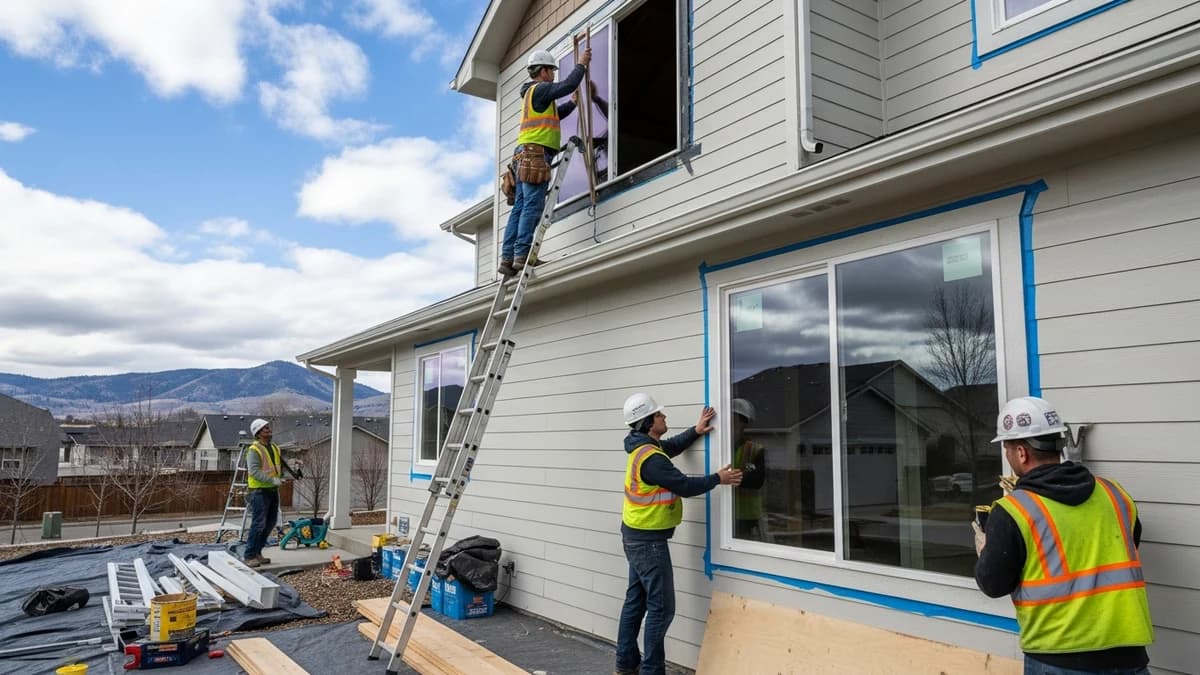
Picture Windows for Boise Homes
Fixed picture windows deliver the most natural light, the widest unobstructed views, and the best energy efficiency of any window type. Custom-sized for Boise Foothills panoramas, Treasure Valley vistas, and dramatic architectural focal points throughout your home.
Quick answer
No. Picture windows are fixed (non-operable) and cannot be opened. They are permanently sealed into the frame, which is precisely why they offer the best energy efficiency and lowest air infiltration of any window type.
Picture windows are fixed, non-operable windows designed to maximize the glass area within a frame. Unlike double-hung, casement, or sliding windows, picture windows do not open. They have no sashes, balances, cranks, locks, or tracks — just a single pane or insulated glass unit permanently sealed into the frame. The result is the largest possible viewing area, the most natural light, and the tightest weather seal of any residential window type.
The name “picture window” comes from the idea that the window frames the outdoor view like a painting. In Boise, that view might be the snow-capped Boise Front ridgeline from a Southeast Boise great room, the rolling Foothills from an East Bench living room, or a mature tree canopy from a North End bungalow. Because the glass area is uninterrupted by meeting rails, mullions, or sash frames, picture windows provide a clarity and openness that no operable window can match.
Picture windows are sometimes called fixed windows, stationary windows, or direct-set windows. Regardless of the terminology, the defining characteristic is the same: they do not open. This simplicity is their greatest strength. No moving parts means no air leakage through weatherstripping gaps, no mechanical failure, no hardware replacement, and no maintenance beyond occasional glass cleaning. For Boise homeowners who want to capture a view or flood a room with daylight without sacrificing energy performance, picture windows are the clear choice.
The mechanical difference from every operable style is the entire reason picture windows perform the way they do. An operable window has a sash that moves relative to a frame; wherever a moving part meets a stationary part there is a gap, and wherever there is a gap there is weatherstripping that degrades over time as gaskets compress and hardware loosens. A picture window has none of that — the insulating glass unit is set directly into the frame and sealed into the rough opening, so there is no sash, no gap, and no infiltration path through the unit itself. Everything that makes an operable window convenient is also what makes it leak; removing all of it is what makes a picture window the tightest window you can buy. That trade should be decided room by room, not house-wide: the real question for each wall is where it needs air, light, view, egress, or all four. The rest of this page walks through those decisions in Treasure Valley terms — the foothills view homes, the high-desert sun, the Climate Zone 5 winters, and the structural realities of large glass.
Boise's geography and climate make picture windows one of the most rewarding upgrades a homeowner can invest in. The Treasure Valley is surrounded by natural beauty — the Boise Foothills to the north, the Owyhee Mountains to the south, Bogus Basin and Shafer Butte to the northeast — and picture windows are the most effective way to bring those views into your daily living space. Neighborhoods like Quail Hollow, Hidden Springs, Avimor, Dry Creek Ranch, and the East End bench areas offer dramatic panoramas that deserve more than a standard window divided by meeting rails and sash frames.
Boise records about 120 clear days and a further 90 partly cloudy ones in an average year (NOAA station 24131), and its clear high-desert skies deliver abundant daylight. Picture windows capitalize on that sunlight better than any other window type because their glass-to-frame ratio is the highest available — through the dark November-to- February stretch, well-placed fixed glass cuts reliance on artificial lighting and lifts the feel of interior spaces.
Architecturally, a floor-to-ceiling picture window in a vaulted great room becomes the visual anchor of the whole space. Contemporary Boise builds in Harris Ranch, Barber Valley, and Southeast Boise use large fixed glass as a deliberate design statement; more traditional North End and West Boise homes keep classic proportions by flanking the fixed unit with operable casements while still gaining the view and light of picture glass. (The energy advantage that makes all of this practical is covered in detail in the dedicated section below.)
Picture windows cost less per square foot of glass than any operable window type because they have no moving parts, no hardware, and simpler manufacturing. The frame material and window size are the primary cost variables. All prices below reflect fully installed costs in the Boise market, including the window unit, old window removal, installation labor, foam insulation, and interior and exterior trim finishing.
| Window Type | Price Range (Installed) | Best For |
|---|---|---|
| Standard Vinyl (3' x 4') | $250 – $500 | Budget-friendly, standard sizes, low maintenance |
| Large Vinyl (4' x 5'+) | $500 – $900 | Larger openings, great rooms, primary bedrooms |
| Fiberglass | $400 – $800 | Large units, structural stability, extreme temperature swings |
| Wood / Wood-Clad | $600 – $1,200 | Historic homes, North End character, interior warmth |
| Oversized Custom (5' x 6'+) | $1,000 – $2,500+ | Foothills panoramas, window walls, architectural statements |
* Prices are Boise-area estimates as of 2026 and include standard double-pane Low-E glass with argon fill. Triple-pane glass adds $75 to $150 per window. Custom shapes (arched, trapezoid, circular) carry a meaningful premium over a rectangle of the same area, quoted per unit rather than as a fixed uplift. Second-story installations requiring scaffolding add $50 to $150 per window. The standard sizes above sit inside the per-window bands on our window replacement cost guide; the oversized custom row sits above them, which is why that guide prices specialty units separately rather than folding them into a per-window average. Picture windows are typically flanked by operable casement or double-hung windows to provide ventilation alongside the fixed glass.
Every window type involves trade-offs. Here is an honest assessment of picture window advantages and limitations based on our installation experience across the Treasure Valley.
Advantages
- Best energy efficiency of any window type — permanently sealed glass means zero air leakage through weatherstripping gaps, sash joints, or meeting rails
- Unobstructed views of the Boise Foothills, Bogus Basin, and Treasure Valley landscapes with no sash frames or mullions dividing the glass
- Maximum natural light — highest glass-to-frame ratio of any window style, bringing in more daylight per square foot of wall opening
- No moving parts means zero mechanical maintenance — no balances, cranks, locks, or tracks to lubricate, adjust, or replace over the lifetime of the window
- Lowest cost per square foot of glass — no hardware, no operating mechanisms, and simpler manufacturing make picture windows the cheapest way to buy a given area of glass
- Architectural focal point — large, uninterrupted glass creates a dramatic design statement in great rooms, stairwells, and primary suites throughout Boise homes
Limitations
- No ventilation — picture windows do not open, so they must be paired with operable casement, double-hung, or awning windows in rooms where airflow is needed
- Cannot be used for egress — building code requires bedrooms to have at least one operable window meeting IRC Section R310 clear opening requirements, which picture windows cannot satisfy
- Large glass areas on west-facing walls create potential heat gain — Boise's intense afternoon sun during summer can push room temperatures well above the thermostat setting without proper Low-E and SHGC specification
- Cleaning the exterior surface requires access from outside — second-story picture windows may need a ladder or professional window cleaning service, unlike tilt-in double-hung sashes that can be cleaned from inside
Picture windows are the most energy-efficient window type available for Boise homes, and it is not close. The reason is simple: a fixed window has no operable components, which means there are no weatherstripping joints, sash channels, meeting rails, or lock mechanisms where air can infiltrate. The glass is permanently sealed into the frame, creating a continuous thermal barrier with essentially zero air leakage. A fixed unit has no operating seal to leak through at all, which is why picture windows carry the lowest NFRC air-leakage ratings of any window type — the rated figure is published per product, so compare labels rather than category averages.
For Boise homeowners in IECC Climate Zone 5, this sealed performance matters. Idaho's adopted energy code caps fenestration at a maximum U-factor of 0.32in this zone and sets no SHGC requirement. ENERGY STAR works from a separate map on which all of Idaho, Ada County included, falls in the Northern zone, where Version 7.0 certifies at U-factor 0.22 or lower with SHGC 0.17 or higher — that SHGC figure a floor rather than a ceiling. Picture windows clear the code cap easily and are the window type most likely to reach the ENERGY STAR bar, because they have no operating seal; a triple-pane fixed unit goes lower again. During Boise's January cold snaps — the normal low is about 26°F and a cold snap runs well below it — the superior U-factor of a picture window keeps the interior glass surface warmer, reducing both heat loss and condensation risk.
West-Facing
West-facing picture windows receive the most intense solar heat during Boise's long summer afternoons. Specify an SHGC of 0.25 or lower with spectrally selective Low-E coatings to block infrared heat while transmitting visible light. Without proper SHGC management, a west-facing picture window will put a room noticeably above the thermostat setting between 3 PM and sunset, and no reasonably sized air conditioner will catch up with it.
Low-E Coatings
Low-E (low emissivity) coatings are essential on every picture window in Boise. At 2,700 feet elevation, UV radiation is measurably stronger than at sea level. Low-E coatings cut UV transmission substantially while allowing most visible light through — protecting hardwood floors, furniture, artwork, and carpet from fading. The figure for a specific coating is published with that glass package; ask for it rather than a blanket percentage. We specify Low-E on every picture window we install regardless of orientation.
Triple-Pane
For north-facing picture windows in Boise, triple-pane glass is the strongest recommendation we make. North exposures receive minimal solar heat gain, so the glass surface stays cold during winter. Triple-pane configurations reach well below the ENERGY STAR Northern-zone threshold of 0.22 — check the NFRC label on the exact unit — keeping the interior glass surface warm enough to prevent condensation even during extended sub-zero cold snaps in January and February.
Strategic placement is what makes a picture window pay off. These are the locations where fixed glass delivers the most value in Treasure Valley homes — the combination configurations that pair them with operable units are detailed in the next section.
Living Rooms with Foothills Views
The classic Boise application: a large center picture window in the main living area maximizes the Foothills view and anchors the room. Homes in Quail Hollow, East End, Southeast Boise, and the Boise Bench with views of the Boise Front ridgeline and Bogus Basin benefit most. The uninterrupted center glass delivers a clarity no operable window can match; flanking operable units (next section) handle the airflow.
Stairway Landings
Stairwells need neither ventilation nor egress, making them ideal for fixed glass. A tall, narrow picture window on a stairwell wall floods the space with light and becomes an architectural feature in its own right — often the most dramatic window in a two-story Boise home because it can span the full stairwell height with no operating-hardware or egress constraints. Arched tops, trapezoids, and tall rectangles complement the staircase lines.
Great Rooms & Vaulted Ceilings
Vaulted great rooms invite oversized and custom-shaped picture windows that fill non-standard openings — triangular, trapezoidal, and arched units in gable ends bring light into the upper volume and make a dramatic statement. These openings are too high for operable windows to be practical, so fixed glass is the only sensible option, and multiple units mulled together create the window-wall effect popular in contemporary Boise custom homes.
High Transoms & Hard-to-Reach Openings
Any opening you cannot comfortably reach to operate — a clerestory band high on a great- room wall, a transom over an entry, glass in a tall foyer — is a natural fixed-window location. There is no point paying for operating hardware on a window no one will ever crank. Fixed glass there is cheaper, tighter, and lower-maintenance, and it adds daylight and visual height without compromising the wall's ventilation handled by operable units lower down.
Picture windows are rarely installed as standalone units. Their real strength emerges when combined — or “mulled” — with operable windows or other fixed panels. Mulled units are structurally joined with aluminum mull bars and sealed as a single assembly. These are the combinations we install most often in Boise homes.
Picture + Casement Flankers
The most popular combination in the Treasure Valley. A large center picture window provides the unobstructed view while narrow casement windows on each side offer crank-operated ventilation with the tightest air seal of any operable companion. Typical proportions are a 4-to-5-foot center unit with 1.5-to-2-foot casements per side. This is the go-to setup for living rooms, great rooms, and primary bedrooms in Boise homes with foothills views.
Picture Over Awning
A large picture window above one or two smaller awning windows. The picture unit captures the view while the awnings below provide rain-protected ventilation — the sash opens outward from the bottom, deflecting rain away from the interior. That makes it ideal for Boise's shoulder seasons, and it is popular in East Bench and Foothills view homes where owners want airflow without closing up every time it rains.
Transom + Picture Configurations
A fixed picture transom above a larger picture window, an operable window, or an entry door. Transoms add height, architectural interest, and daylight without a taller operable unit. In newer Boise construction — Avimor, Dry Creek Ranch, Eagle — transoms above the front entry create a dramatic first impression; in existing homes a transom above a kitchen or living-room window is a low-cost way to add light and visual height. Arched, half-round, and rectangular transoms are all available.
Mulled Picture Window Walls
Multiple picture windows mulled side by side or in a grid to create a window-wall effect, common in contemporary Boise homes where floor-to-ceiling glass is wanted but a true curtain wall is cost-prohibitive — great rooms with vaulted ceilings, lofts, and Foothills primary suites. Structural engineering is required so the header and supporting walls carry the combined glass weight and wind load.
A 6-by-7-foot view wall is not just a bigger version of a 3-by-4-foot bedroom window. Once a fixed lite passes roughly 25 to 35 square feet of glass, a different set of rules takes over — deflection, safety glazing, thermal stress, and weight all scale non-linearly. Boise foothills and ridge-front lots make this more than academic: those are exactly the homes that want the largest glass and that see the highest wind exposure in the valley. Getting the glass makeup right is what separates a picture window that performs for decades from one that bows, stress-cracks, or fails its seal early.
Deflection & Glass Thickness
Every pane bends slightly under wind pressure; the goal is to keep deflection within accepted limits so the seal, frame, and glass are never overstressed — framing deflection is commonly held to about L/175 of the span, with glass governed by industry glazing standards. Thickness is the primary lever: small lites use 3mm glass, mid-size units 4mm, and large Boise view-wall units step up to 5mm or 6mm, sometimes heat-strengthened, to control bow. We size glass to the actual opening and the site's design wind pressure — an exposed Avimor or Boise Front ridge lot does not get the same makeup as a sheltered interior lot in West Boise.
Tempered & Laminated Safety Glazing
Safety glazing on large picture windows is code, not an upsell. Section R308 of the 2018 IRC designates “hazardous locations” requiring tempered or laminated glass: panes within 24 inches of a door, glass below 18 inches above the floor, large lites generally over 9 square feet meeting certain conditions, and glazing near stairs, landings, tubs, and showers. Floor-to-ceiling great-room units, stairwell windows, and most oversized view walls fall into these by default. Tempered glass is roughly four times stronger than annealed and breaks into dull granules; laminated glass holds together on a tear-resistant interlayer, adding security and sound reduction — a popular pick for units facing busy Boise arterials or ground-floor view walls.
Thermal Stress & Edge Cracking
Large lites are uniquely exposed to thermal stress cracking, and Boise's high-desert climate is the trigger: a bright winter morning with part of the glass in full high-altitude sun while shaded edges — under blinds, an overhang, or a snow line — stay cold and restrained. The sunlit center expands against cold edges and an edge crack can start with no impact at all. The defenses are heat-strengthened or tempered glass on high-risk exposures, avoiding tight blinds pressed to the glass, keeping dark backing off the inner surface, and proper edge work. We flag thermal-stress risk on large south- and west-facing units during the estimate.
Dual-Pane vs. Triple-Pane Weight & Support
Glass is heavy and the math is unforgiving: annealed glass runs roughly 2.6 pounds per square foot per millimeter of thickness, so a dual-pane unit of two 5mm lites in a 5-by-7-foot opening carries well over 200 pounds of glass before the frame. Triple-pane adds a third lite and its weight again. That load has to be carried by the header and jambs and supported during handling, and on oversized or mulled assemblies it decides whether the wall needs structural review and whether the install is a multi-person or equipment-assisted set. We weigh the energy gain of a third pane against this weight and cost penalty unit by unit.
A picture window on a Boise Front or East Bench view wall is the hardest glass-specification problem in residential window work. The wall that frames the foothills is usually oriented south or west — the orientations that take the full brunt of high-desert solar gain. At roughly 2,700 feet with thin, clear air and roughly 120 clear days a year (NOAA station 24131), the July solar load on that glass is intense, yet the same large lite that bakes a room from 3 PM to sunset in summer is also the biggest single heat-loss surface on a 10°F January night. You are tuning one pane to win two opposite battles, so there is no single “best” coating — only a correct one for that orientation, exposure, and room use.
Two numbers control this: Solar Heat Gain Coefficient (SHGC), the fraction of solar heat admitted (lower is cooler), and U-factor, the rate of non-solar heat loss (lower is a better winter insulator). Idaho's Climate Zone 5 energy code caps replacement-window U-factor at 0.32, and ENERGY STAR's Northern zone asks 0.22 or lower — a picture window clears both more readily than any operable type; the real work is matching SHGC and Low-E to the wall. Spectrally selective Low-E is what makes a view wall livable — it rejects most invisible infrared heat while passing the visible daylight you want, so you can cut solar gain hard without dim, gray-tinted glass that ruins the view.
| Orientation | Target SHGC | Why — Boise Reasoning |
|---|---|---|
| West-facing | ~0.22 – 0.25 or lower | Worst case in Boise: low afternoon summer sun drives straight into the glass for hours. Lowest SHGC plus spectrally selective Low-E; consider exterior shading where the view allows. |
| South-facing | ~0.25 – 0.30 | Heavy summer gain but useful winter solar warmth from a lower sun angle. A moderate SHGC with deep overhangs can balance both seasons on a foothills view wall. |
| East-facing | ~0.25 – 0.35 | Morning gain only; cooler by the heat of the day. Moderate SHGC; bias lower if the room is used heavily on summer mornings. |
| North-facing | ~0.30 – 0.40 | Almost no direct sun; the priority flips entirely to the lowest U-factor. Favor triple-pane and warm-edge spacers to keep the cold inner surface above the dew point. |
SHGC targets are general guidance for Boise-area exposures, not a code requirement; the right value for your window depends on shading, overhang depth, room use, and how much winter solar gain you want to keep. We recommend a specific glass package per opening during the in-home estimate. Compare full glass and frame options on our window materials guide and see how picture windows fit the overall mix on our best window styles for Boise page.
One Boise caution: do not over-correct. A view wall's entire purpose is the view, so reserve the most aggressive low-SHGC glass for the punishing west and southwest exposures and let protected north and east units keep a high visible transmittance — spectrally selective Low-E still blocks UV and infrared there, protecting floors and furnishings from high-altitude fade without graying out the foothills. The goal is glass that is comfortable in August and warm in January and still looks like a clear pane, not a sunglass lens.
Condensation on Large Fixed Glass
Picture windows resist condensation better than any operable window, but large glass on a cold Boise night is still the coldest interior surface in the room, so indoor moisture shows up there first when warm humid air meets the cold pane. The three controllable defenses are a low U-factor (dual-pane Low-E with argon, or triple-pane on cold north exposures), a warm-edge spacer that keeps the glass perimeter from running cold, and sensible indoor humidity — through a Boise winter, holding relative humidity near 30 to 40 percent makes the largest practical difference. Distinguish surface condensation, which you can manage, from fogging trapped between the panes, which means a failed insulating glass seal and is a glass-unit manufacturer warranty matter.
Handling & Installing Large Units
A large picture window is one of the heaviest, most damage-prone items in a remodel. A single oversized dual- or triple-pane unit can weigh well over 200 pounds, cannot flex, and is unforgiving of a bad lift or a racked opening. Before it arrives we confirm the rough opening is square, plumb, and correctly sized, verify the header carries the load, and plan access, crew size, and any lifting equipment for a window-wall or second-story set. The unit is shimmed and set without twisting the frame — out-of-square installation is a leading cause of premature seal stress on large fixed glass — then sealed, foam-insulated, flashed, and trimmed inside and out. That is why we walk the opening in person during the free in-home estimate; access and structure decide both the price and the method.
Cleaning & Lifetime Maintenance
The honest maintenance story is the best argument for fixed glass: there is almost nothing to maintain. A picture window has no balances to wear, no crank gears to strip, no weatherstripping to compress flat, and no lock hardware to loosen — the failure modes that eventually retire an operable window simply do not exist here. Routine care is glass cleaning with a soft cloth or squeegee and a non-abrasive cleaner, avoiding abrasive pads and following the manufacturer's guidance on coated or tinted glass. The one genuine inconvenience is access: because the exterior face cannot pivot inward like a tilt-in double-hung sash, second-story and stairwell picture windows are cleaned with a water-fed pole, an extension squeegee, or a periodic professional service. Factor that into placement — an enormous fixed lite at the top of a two-story foyer is stunning and will be cleaned twice a year by someone with the right equipment, and that is a reasonable trade for most homeowners as long as it is a decision made on purpose.
It is worth being blunt about where fixed glass is the wrong call. None of these rules out the view — the answer is almost always a combination unit rather than abandoning the picture window — but each is a real reason a standalone fixed pane is the wrong primary window for that opening.
Any Sleeping Room Without Separate Egress
IRC Section R310 requires an operable emergency escape opening in every sleeping room. A fixed pane cannot satisfy it, so a bedroom picture window is always a companion to a code-compliant operable unit, never a substitute for one.
Kitchens & Bathrooms That Rely on the Window for Air
Rooms that need to vent steam, cooking moisture, and humidity need an operable window or a mechanical exhaust path. A fixed window over a kitchen sink or in a bathroom looks clean but removes a practical ventilation option; pair it with an operable companion or confirm adequate mechanical ventilation before going fully fixed.
Tight Budgets Spent on a Single Oversized Unit
Picture windows are the cheapest glass per square foot, but one custom oversized lite with triple-pane and structural support can still consume the budget that would have replaced several failing operable windows elsewhere in the house. On a constrained project, fixing the drafty windows you have often beats one dramatic new one.
Unshaded West Walls With No Solar-Control Glass
A large fixed pane on an unshaded Boise west wall, glazed with ordinary clear dual-pane glass, will overheat the room every summer afternoon. The window is not the problem — the spec is. If the budget or the look will not allow low-SHGC spectrally selective glass or exterior shading on that wall, reconsider the size of the fixed glass there.
In nearly every one of these cases the right answer is the same: keep the view, change the configuration. A fixed center for the panorama, operable casement flankers or awnings for air and egress, and a glass package matched to the exposure delivers everything a standalone picture window would — without the downside. If you are weighing options for a view wall, our team will lay out the honest trade-offs in person. Start with a free in-home estimate or talk through your project with us directly.
Common questions Boise homeowners ask about picture windows.
Can picture windows be opened for ventilation?
No. Picture windows are fixed (non-operable) and cannot be opened. They are permanently sealed into the frame, which is precisely why they offer the best energy efficiency and lowest air infiltration of any window type. For ventilation alongside one, the common Boise solution is to flank it with operable casement windows or place awning windows directly below. Casement flankers catch side breezes and seal with compression hardware; awnings provide rain-protected airflow during Idaho's shoulder seasons. The fixed center keeps the unobstructed view while the operable companions handle airflow.
How much do picture windows cost to install in Boise?
Picture windows are the most affordable window type per square foot of glass because they have no moving parts, hardware, or operating mechanisms. A standard vinyl picture window (3 by 4 feet) with double-pane Low-E glass runs $250 to $500 installed in Boise; large vinyl units $500 to $900; fiberglass $400 to $800; wood or wood-clad $600 to $1,200. Oversized custom units (5 by 6 feet or larger, triple-pane) can reach $1,000 to $2,500 or more. All prices include the unit, old-window removal, labor, foam insulation, and interior and exterior trim. Boise-area estimates as of 2026; final pricing depends on frame, glass, size, and access. We provide free in-home estimates with firm written numbers.
Do picture windows cause overheating in Boise summers?
They can if not properly specified. Boise receives intense solar radiation — about 120 clear days and 90 partly cloudy ones in an average year (NOAA station 24131), on thin high-desert air — and south- and west-facing picture windows without proper glazing can turn a room into a greenhouse during July and August. The key is specifying the right Solar Heat Gain Coefficient (SHGC). For south- and west-facing picture windows in Boise, we generally recommend an SHGC of 0.25 or lower to block excessive solar heat while still allowing visible light. North-facing picture windows can use a higher SHGC of roughly 0.30 to 0.40 because they receive minimal direct sun. Spectrally selective Low-E coatings are essential — they block infrared heat and UV while transmitting visible light. With the correct glass specification, a properly sized picture window does not cause overheating.
Can picture windows meet egress requirements for bedrooms?
No. Picture windows cannot serve as emergency egress because they do not open. The 2018 International Residential Code, adopted statewide in Idaho and enforced in Boise and Ada County, requires every sleeping room to have an operable emergency escape and rescue opening. Under IRC Section R310 the minimum net clear opening is generally 5.7 square feet (5.0 at grade-floor openings), with a 24-inch minimum clear height, 20-inch minimum clear width, and a sill no higher than 44 inches above the floor. A bedroom picture window must therefore be paired with a separate operable window that meets egress — typically a casement or double-hung sized to comply. Confirm current requirements with the City of Boise building division for your project.
What is the best frame material for large picture windows in Boise?
For large picture windows, fiberglass is generally the best frame material for Boise's climate. Fiberglass has a coefficient of thermal expansion very close to that of glass, so the bond between frame and insulating glass unit stays stable through Boise's extreme swings — from single digits in winter to over 100 degrees in summer. That stability protects the edge seal and slows argon loss over time. Fiberglass is also stiffer than vinyl, so it carries larger glass with less deflection. For standard sizes up to roughly 4 by 5 feet, premium multi-chamber vinyl performs well and costs less. Wood and wood-clad frames suit historic North End homes where original character matters, but they require periodic finish maintenance. Compare frame options on our window materials page.
What glass thickness and safety glazing does a large picture window need?
Glass thickness scales with size: small units use 3mm (1/8 inch) lites, mid-size 4mm, and large units — roughly 30 square feet and up, or any oversized foothills view wall — commonly 5mm or 6mm, sometimes heat-strengthened or laminated, to control deflection under wind load. Safety glazing is code-driven, not optional. Section R308 of the 2018 IRC requires tempered or laminated glass in hazardous locations: within 24 inches of a door, less than 18 inches above the floor, large panes over 9 square feet meeting certain conditions, and glass near stairs, landings, tubs, and showers. Many full-height and stairwell picture windows fall into these categories, so safety glazing is specified by default. We size and spec each unit to the opening, exposure, and code.
Will a large picture window flex or bow in the wind?
A correctly engineered one will not. All glass deflects slightly under wind pressure; the question is whether deflection stays within accepted limits (commonly L/175 of the span for framing, with glass governed by industry standards). The variables are glass thickness, lite size and aspect ratio, the site's design wind pressure, and frame and header stiffness. Boise sits in a moderate wind zone, but exposed foothills and ridge-front lots see higher gusts than sheltered valley-floor neighborhoods. We account for that with thicker glass, a stiffer frame, and an adequate header. For very large or mulled assemblies, structural engineering verifies the header, jambs, and mull bars carry the combined glass weight and wind load.
How is condensation managed on a large fixed window in winter?
Interior condensation is almost always cold glass meeting humid indoor air, not a defective window — picture windows actually resist it better than operable units because their continuous seal and warm-edge spacer keep the inner glass surface warmer. The defenses are a low U-factor (dual-pane Low-E with argon, or triple-pane on cold north exposures), a warm-edge spacer, and reasonable indoor humidity; in a Boise winter, holding relative humidity near 30 to 40 percent dramatically reduces the risk. Fogging trapped between the panes is different: that is a failed insulating glass seal, covered by the glass-unit manufacturer's warranty.
Is triple-pane glass worth it for picture windows in Boise?
It depends on orientation and goals. Because a picture window is already the tightest-sealing type, a third pane delivers its clearest benefit on cold north- and east-facing exposures, where it raises the inner glass temperature, cuts heat loss, and suppresses winter condensation during sub-zero snaps. It also improves comfort on large glass near seating areas by reducing the radiant chill you feel beside big panes. On well-shaded north walls in Climate Zone 5 it is often worth the upcharge; on a modest, well-oriented unit a quality dual-pane Low-E package may be the better value. The trade-offs are added cost and significant extra weight affecting handling and structural support on oversized units.
How heavy is a large picture window, and does that affect installation?
Glass weight is a real planning factor. Annealed glass weighs roughly 2.6 pounds per square foot per millimeter of thickness, so a dual-pane unit of two 5mm lites in a 5-by-7-foot opening (about 35 square feet) carries well over 200 pounds of glass before the frame, and triple-pane adds more again. The consequences are practical: large units are often a multi-person set, second-story and window-wall installs may need lifting equipment, and the header must be sized for the load. We assess access during the in-home estimate so the crew arrives with the right manpower and equipment and the opening is prepared before the unit is set.
How do I clean a large or second-story picture window?
The exterior face of a fixed window can only be reached from outside — there is no sash to pivot inward like a tilt-in double-hung. Ground-floor units are a simple job with a squeegee, soft cloth, and non-abrasive cleaner. Tall, second-story, or stairwell units need a ladder, a water-fed pole, or a periodic professional cleaning. Avoid abrasive pads, ammonia on coated or tinted glass per the manufacturer's guidance, and pressure washers at the seal. Routine cleaning is the only ongoing maintenance a picture window needs — no hardware to lubricate, no balance to adjust, no weatherstripping to replace.
When is a picture window the wrong choice?
More often than homeowners expect. A picture window is the wrong primary window in any sleeping room without a separate egress opening, in a kitchen or bathroom relying on the window for ventilation, and in rooms where you want fresh air on demand — a fixed pane cannot deliver it. It is also poor on a low-budget project where one oversized custom unit eats the budget several operable windows would better serve, and on an unshaded west wall with no appetite for solar-control glazing. The fix is rarely "no picture window" — it is the right combination: a fixed center for the view with operable casement flankers or awnings for air and code compliance.
Does Iron Crest's warranty cover picture windows, and are you registered in Idaho?
Yes. Iron Crest Remodeling Group LLC (Iron Crest Remodel) is registered and insured in Idaho — the state registers contractors rather than licensing them, and ours is RCE-6681702 — and every picture window installation we perform is backed by our 3-year workmanship warranty on the installation itself. The window unit and the insulating glass seal carry their own separate manufacturer warranties, which we register and explain in plain terms before the project starts. We provide free in-home estimates throughout Boise and the Treasure Valley and can be reached at (208) 779-5551, Monday through Friday, 7 AM to 6 PM.
Picture windows are one of six primary window types we install across the Boise area. Most homes benefit from a combination of window styles. Explore the other options to find the best mix for your project.
Explore our other exterior remodeling services and in-depth window replacement guides.
The following government agencies, industry organizations, and official resources provide additional information relevant to your remodeling project.
Ready for Picture Windows?
Get a free, no-obligation estimate for picture window installation in your Boise home. We will help you choose the right glass, frame, and configuration for your views, your climate exposure, and your budget.