
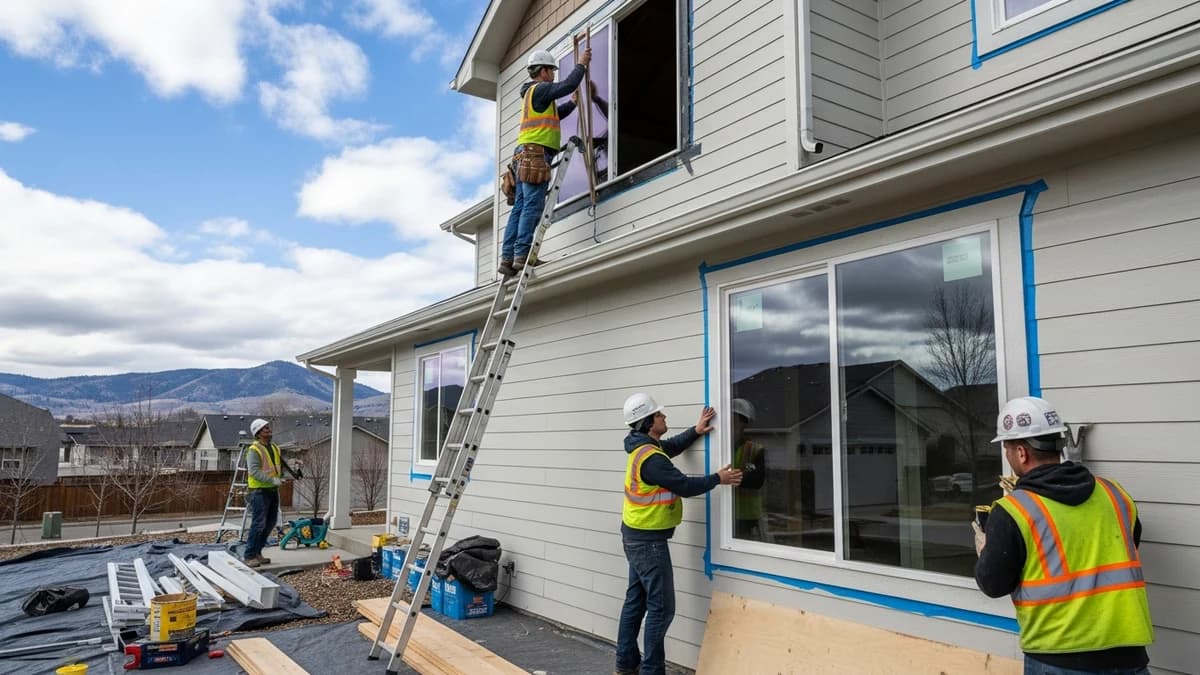
Awning Windows in Boise
Top-hinged, crank-operated windows that provide ventilation even during rain. Ideal for bathrooms, basements, and pairing with picture windows in Boise's Treasure Valley homes.
Quick answer
Yes. Awning windows are hinged at the top and the sash swings outward from the bottom, creating a canopy-like shield over the opening. During Boise's spring and fall rain showers, you can leave awning windows open to maintain fresh airflow without letting water into your home.
Awning windows are hinged along the top edge of the frame and swing outward from the bottom when opened. A crank handle — also called an operator — mounted on the interior side of the frame controls the opening angle, allowing you to precisely adjust how much airflow enters the room. When fully open, the single sash tilts outward at an angle of approximately 25 to 45 degrees, creating a canopy-like shield over the window opening that deflects rain and debris away from the interior.
The name “awning” comes directly from this rain-deflecting function. Just like a retractable awning over a storefront, the open sash acts as a miniature roof over the opening. This makes awning windows the only operable window style specifically designed to provide ventilation during wet weather without allowing water into your home. Unlike double-hung windows that must be closed at the first sign of rain, or casement windows that swing sideways and offer no rain protection, the awning window's top-hinged design channels water down the exterior face of the glass and away from the opening.
Awning windows share mechanical DNA with casement windows. Both use a crank operator, both swing outward on hinges, and both create a compression seal when closed — the sash presses firmly against the frame from the inside. The key difference is hinge placement: casement windows hinge on the side and swing out like a door, while awning windows hinge at the top and swing out from the bottom. This distinction determines where each type works best in your home. Standard awning windows range from 24 to 48 inches wide and 16 to 36 inches tall, though custom sizes are available from all major manufacturers including Andersen, Marvin, Milgard, and Pella.
In Boise homes, awning windows are most commonly installed in configurations of two or three units grouped together, or paired above or below a large picture window to add operable ventilation to an otherwise fixed glass wall. Their compact footprint makes them ideal for accent windows, transom windows, and high-wall installations where privacy and ventilation are both priorities — bathrooms, basements, and above kitchen backsplashes.
Understanding the mechanics helps explain both why awning windows are so good at a few specific jobs and why they are deliberately limited at others. Two hinges — one at each top corner — carry the entire weight of the sash. When you turn the crank, a worm-gear operator drives a pair of scissor-style arms that push the bottom of the sash outward and upward in a controlled arc. Because you are working a gear, the motion is slow and precise: you can stop the sash at a one-inch trickle of air or wind it out to its full angle and anything in between, and it holds wherever you leave it. There is no slamming, no propping, and no fighting the wind to hold a position the way a double-hung sash or a hopper vent can require.
Closing is where the energy advantage lives. As the crank reaches the end of its travel, the operator does not merely shut the sash — it draws the sash inward and presses it squarely into a continuous compression gasket on all four sides. A cam-action lock (or a multi-point lock on larger units) then pulls it tighter still. The result is a closed window that is sealed by pressure, not by a sliding fit. This is the same mechanism that makes casement windows the air-tightness leaders, and it is fundamentally different from a double-hung or slider, where the moving sash has to glide past weatherstrip and therefore can never seal as completely.
The top-hinge geometry is what creates the rain canopy. Because the sash pivots from the top and projects from the bottom, the open glass tips downward and outward like a small shed roof. Rain that lands on the exterior face runs down the glass and drips clear of the opening rather than into the room, while the gap between the bottom of the sash and the sill stays in the “shadow” of that overhang. That is the entire reason the style is named after a fabric awning — it is a window that doubles as its own little roof. The same geometry is also why the opening is limited: a sash hanging from two top hinges and held by operator arms cannot safely swing as far, or be built as large, as a casement that pivots on a vertical edge.
One detail Boise homeowners notice on day one: the insect screen is on the inside. Since the sash swings away from you, the screen mounts on the interior of the frame and the crank handle sits between you and the screen. Quality awning units solve this with a folding or recessed operator handle that tucks flat against the frame so it does not catch the screen or the window covering, and with a screen that lifts out in seconds for cleaning. It is a minor adjustment in habit, not a drawback — but it is worth seeing in person before you commit, which is part of what an in-home walkthrough is for.
Boise's high-desert climate creates specific conditions where awning windows outperform other operable window types. The Treasure Valley receives the majority of its annual precipitation during the spring and fall shoulder seasons — April through June and September through November bring intermittent rain showers that alternate with mild, pleasant temperatures in the 50 to 70 degree range. These are exactly the conditions where you want fresh air flowing through your home but cannot risk leaving standard windows open.
Awning windows solve this problem completely. The top-hinged sash creates a canopy over the opening that sheds rain while allowing continuous ventilation. During Idaho's brief rain showers — which rarely last more than 30 to 60 minutes — you can leave awning windows open without worrying about water entering your home, soaking window sills, or damaging interior finishes. Double-hung and sliding windows must be closed during rain, cutting off ventilation entirely and forcing you to rely on mechanical HVAC systems.
Shoulder Season Ventilation
Boise's most comfortable outdoor temperatures occur during the shoulder seasons when rain is also most frequent. Awning windows let you capture fresh air during April, May, September, and October without closing up the house every time a shower passes through. This reduces HVAC runtime and lowers energy bills during the transitional months when heating and cooling loads are lightest.
Compression Seal Efficiency
Like casement windows, awning windows use a compression seal that presses the sash firmly against the weatherstripping when closed. This creates an airtight barrier that outperforms the sliding contact of double-hung and slider windows. During Boise's cold winters — when temperatures regularly drop into the single digits — the compression seal minimizes air infiltration and reduces heat loss, keeping your heating bills lower.
Unpredictable Weather Resilience
Boise's weather can shift rapidly — a sunny morning can turn into an afternoon thunderstorm with little warning, particularly during May and June. Awning windows are the only operable window type you can leave open without monitoring the weather. If a sudden shower arrives while you are at work or asleep, the awning design protects your interior from water intrusion.
Picture Window Pairing
Many Boise homes in the East Bench, North End, and foothills neighborhoods feature large picture windows to capture views of the Boise Front and Bogus Basin. Pairing a fixed picture window with awning windows above or below it adds ventilation without interrupting the view. This combination is one of the most requested configurations we install in Boise view homes.
Where an awning window sits on the wall matters as much as the window itself. The style's real value shows up in placements that defeat other window types, and those placements are common in Treasure Valley housing stock — the ranches and split-levels of the Bench, the daylight basements throughout Boise and Meridian, and the view-oriented great rooms in the Foothills, Harris Ranch, and Eagle.
High-on-wall privacy placement. The most distinctive use is mounting the unit high — commonly with the sill 60 to 72 inches off the finished floor, above the line of sight from the sidewalk or a neighbor's yard. At that height the window admits daylight and ventilation while the wall below it stays usable for a vanity, a bed headboard, a sofa, a desk, a bookcase, or kitchen cabinetry. This is the reason awning windows dominate Boise bathroom remodels: you get real operable airflow and bright natural light without frosted glass and without anyone outside being able to see in. The same logic applies to a furniture wall in a bedroom or family room where a lower window would conflict with how the room is laid out.
Basement and egress-well pairing. Daylight and walkout basements are everywhere in the Treasure Valley, and they create a specific design problem: code requires a compliant emergency escape opening in any basement bedroom, but you also want everyday ventilation and light in the rest of the finished space. The clean solution is to let a properly sized casement in an egress well carry the legal escape requirement, then use awning units — in the basement bath, the rec room, the utility area — for routine ventilation. The awning's shielded, limited opening is an asset down low near grade, where it resists splash, debris, and casual entry better than a low slider or hopper while still shedding rain.
Stacking with picture windows. In view-facing rooms the awning earns its keep as the operable partner to fixed glass. Mulled directly under a large picture window, it pulls cool air in at the lowest point of the wall while the picture glass carries the Boise Front or Table Rock view uninterrupted. Mulled above one, it becomes a clerestory vent that releases the warm air that collects at a vaulted ceiling — a passive convection loop that takes load off the air conditioner on Boise's hot, dry summer afternoons. Either way the awning sash swings clear of the fixed pane so the view stays clean and the operable function stays out of the way. You can read more about the fixed-glass half of that pairing on our picture windows page.
Side yards and narrow lot lines. Many Boise and Meridian subdivisions are built on lots where one elevation faces a narrow side yard or a walkway only a few feet from the foundation. A side-hinged casement on that wall can swing into the path of foot traffic; an awning's sash projects only a short distance and stays above ground level, which usually keeps the opening out of the way. That said, the inverse caution applies near decks, patios, and entry walks — see the limitations section below for where the projecting sash becomes the problem rather than the solution. For help matching styles room by room across a whole house, our best window styles for Boise homes guide walks through the trade-offs.
Awning window pricing depends on frame material, glass package, size, and installation method. Below are current 2026 price ranges for the Boise market, per window installed. Awning windows are typically used in combination with other window types rather than as whole-house replacements, so most projects involve 2 to 6 units paired with picture windows, fixed glass, or other operable styles.
| Frame Material | Price Range (Installed) | Best For |
|---|---|---|
| Vinyl | $300 – $550 | Budget-friendly, low maintenance, rental properties, basement ventilation |
| Fiberglass | $500 – $850 | Long-term durability, paintable, dimensional stability in temperature swings |
| Wood | $650 – $1,100 | Historic homes, warm interior aesthetic, maximum thermal insulation |
| Clad Wood | $750 – $1,300 | Premium projects, wood interior with weather-resistant exterior cladding |
* Prices are general per-window ranges for the Boise market and include the window unit, removal and disposal of the old window, installation labor, foam insulation around the frame, and interior and exterior trim finishing. Custom sizes, triple-pane glass upgrades, and second-story installations may increase costs. Ranges reflect 2026 Treasure Valley conditions and are estimates only — your written quote will be based on the actual openings, materials, and access at your home.
What Drives the Price on an Awning Project
The single biggest cost lever is frame material, which is why the table is organized that way. Beyond material, three things move an awning quote up or down. First, how the awning is combined: a lone awning replacing an existing same-size opening is the simplest job, while awnings mulled into a picture-window assembly add fabrication and a heavier, more involved install. Second, access and height: a high bathroom unit at grade is straightforward, but a second-story awning or one over a roofline requires staging and slows the work. Third, the glass package: moving from a standard dual-pane Low-E with argon to a triple-pane, foam-filled, north-wall specification is a meaningful upgrade in both performance and price.
Because awnings are almost always part of a mixed window order rather than a whole-house swap, the most useful number is not a per-unit average but a project total that accounts for how the awnings interact with the other styles in the order. That is exactly what a free in-home estimate from Iron Crest Remodel produces — a written, opening-by-opening price with no obligation. For a wider look at how frame materials compare on durability, finish, and Climate Zone 5 performance, see our window materials guide.
Like every window type, awning windows have specific strengths and limitations. Understanding both helps you determine where they fit best in your home and where an alternative window style is the better choice.
Advantages
- Ventilation even during light rain — the top-hinged sash creates a canopy that deflects water away from the opening, keeping airflow moving through your home during Boise’s shoulder season showers
- Compression seal provides excellent air tightness — the sash presses against the frame when closed, matching casement-level energy performance and reducing drafts during cold Treasure Valley winters
- Pairs beautifully below or above picture windows — adds operable ventilation to fixed glass walls without interrupting the view of the Boise Foothills or Bogus Basin
- High placement for privacy — mounted 60 to 72 inches above the floor in bathrooms and bedrooms, awning windows provide light and ventilation while remaining above the sightline of passersby
- Compact size fits narrow spaces — standard awning windows range from 24 to 48 inches wide and 16 to 36 inches tall, making them ideal for basements, above counters, and as accent windows in tight spots
Limitations
- Limited opening size — awning windows typically open only 4 to 6 inches from the frame, which restricts airflow volume compared to casement or double-hung windows that open much wider
- Cannot be used for egress — the limited opening does not meet the 2018 IRC R310 requirements for bedrooms and basement sleeping areas, so rooms with awning windows must have a separate egress-compliant exit
- Exterior cleaning requires outside access — the outward-opening sash means you cannot clean the exterior glass from inside; second-story awning windows need a ladder or professional cleaning
- Not suitable near walkways — the sash protrudes outward at the bottom when open, creating an obstruction hazard at head height near patios, decks, and narrow side yards common in Boise neighborhoods
- Size limited by glass weight on hinge — because the entire sash weight hangs from the top hinge, awning windows cannot be made as large as casement or double-hung units without stressing the hardware
Boise falls in IECC Climate Zone 5, where Idaho's adopted energy code caps fenestration at a maximum U-factor of 0.32 and sets no Solar Heat Gain Coefficient requirement. ENERGY STAR works from a different map on which all of Idaho, Ada County included, falls in the Northern zone, and Version 7.0 certifies there at U-factor 0.22 or lower with SHGC 0.17 or higher— that SHGC figure being a floor rather than a ceiling, because passive solar gain is worth having through a Boise winter. Awning windows clear the code bar comfortably and reach the ENERGY STAR one in their better glass packages, thanks to the same compression seal advantage that makes casement windows the efficiency leaders among operable types.
When the awning sash closes and the lock engages, the sash compresses directly into the weatherstripping on all four sides, creating an airtight barrier — the same geometry as a casement, and for the same reason tighter than the sliding contact a double-hung or slider has to allow. We do not publish comparative leakage figures by style, because the rated number belongs to the individual product: NFRC certifies an air-leakage value for every listed window, and that is the figure to compare across the units you are quoted. The difference matters during Boise's January and February cold snaps, when overnight temperatures drop into the single digits and every gap in the building envelope drives up heating costs.
Awning windows are particularly effective for reducing drafts on north-facing walls, where no solar heat gain offsets conductive heat loss through the glass. Specifying foam-filled frames on north-facing awning windows further reduces thermal bridging through the frame material itself. Combined with Low-E glass coatings and argon gas fill between the panes, a well-specified awning window typically lands between 0.25 and 0.30 in dual-pane configurations and 0.18 to 0.22 in triple-pane ones — code-legal in Boise across that whole span, but only ENERGY STAR certified at the tight end of it.
The smaller glass area of most awning windows also works in their favor from an energy standpoint. Because less total glass is exposed to heat transfer compared to a full-size casement or double-hung unit, the overall thermal impact on your wall assembly is reduced. This makes awning windows an energy-smart choice for adding ventilation to a room without significantly increasing the glazing area — especially when paired below a fixed picture window where the awning unit adds function without substantially adding to the window-to-wall ratio.
U-Factor
0.25 – 0.30
Typical dual-pane Low-E with argon — under the 0.32 code cap
Air Leakage
See NFRC label
Rated per product — compression seal is the reason it runs low
Triple-Pane
0.18 – 0.22
U-factor for maximum north-wall insulation
Awning windows are specialty windows that excel in specific locations rather than serving as the primary window type throughout a home. Here are the rooms and configurations where they deliver the most value in Boise and Treasure Valley homes.
Bathrooms
Bathrooms are the single best application for awning windows in Boise homes. Mounted high on the wall — typically 60 to 72 inches above the finished floor — awning windows provide steam ventilation and natural light while keeping the window well above the sightline of anyone outside. The ability to leave them open during rain means you can ventilate a bathroom after a shower even on a wet spring morning. For ground-floor bathrooms facing a neighbor or sidewalk, the high-wall placement eliminates the need for frosted glass while still providing full privacy.
Below Picture Windows
The most architecturally impactful use of awning windows is pairing them with large fixed picture windows. A common configuration in Boise view homes is a large picture window centered on the wall with one or two awning windows positioned directly below it. This creates a window wall that captures foothills views through uninterrupted glass while providing operable ventilation through the awning units below. The awning sash opens just above ground level, keeping the view window completely uninterrupted.
Basements
Boise basement windows are typically installed above grade where they sit close to ground level on the exterior. Awning windows work well in this position because their limited opening reduces security concerns compared to a larger casement or slider, while still providing natural light and ventilation. The rain protection feature is especially valuable for basement windows, where water intrusion through an open window could cause damage to below-grade finishes. Note that awning windows are not egress-compliant, so basement bedrooms require a separate egress window.
Kitchen Backsplash Areas
Awning windows installed above the kitchen counter or backsplash provide ventilation for cooking heat, steam, and odors without interfering with the workspace below. The crank operator is easy to reach from a standing position, and the outward-opening sash does not intrude into the kitchen interior. For Boise homes where the kitchen window faces a narrow side yard, awning windows avoid the exterior clearance issues that casement windows can create when the sash swings into the path of foot traffic.
Awning windows are rarely used alone as standalone units. Their real strength is in combination with other window types, where they add ventilation capability to fixed or limited-opening configurations. Here are the most popular pairings we install in Boise and Treasure Valley homes.
Picture + Awning Below
The most common configuration. A large fixed picture window provides an unobstructed view of the Boise Foothills, while one or two awning windows positioned directly below provide ventilation. The awning sash opens outward just above ground level, keeping the view window completely uninterrupted. This pairing is the most requested combination we install in East Bench, North End, and foothills homes with mountain views.
Transom Configurations
An awning window positioned above a picture window creates a clerestory ventilation point. Warm air rises to the ceiling and exits through the upper awning window, creating a natural convection loop that reduces reliance on mechanical cooling. This configuration works exceptionally well in great rooms and vaulted-ceiling living spaces common in Boise's newer construction in Eagle, Star, and Southeast Boise.
Paired Awning Stacks
Two or three awning windows stacked vertically beside a fixed panel create a modern, linear design element with adjustable ventilation at multiple heights. Each unit opens independently, allowing you to control airflow precisely. This stacked configuration is popular in contemporary Boise homes in Harris Ranch, the Barber Valley, and newer Eagle and Star subdivisions where clean horizontal lines define the architectural aesthetic.
Fixed Window Light Walls
Large fixed glass walls in living rooms and home offices can incorporate one or two awning windows to add ventilation without disrupting the overall glass plane. By placing awning units at the bottom of a multi-panel fixed window arrangement, you maintain the visual impact of a floor-to-ceiling glass wall while gaining operable ventilation at the lowest — and most thermally beneficial — point. This approach works well for Boise homes facing the Boise River greenbelt or Table Rock.
Frame material affects an awning window differently than it affects a fixed or double-hung unit, because an awning has moving hardware that has to stay aligned for the compression seal to keep working. Here is how each material behaves specifically in an awning application in Boise's climate, where summer attic-adjacent walls can run very hot and winter nights drop into the single digits.
Vinyl
The value choice and a sound one for small awnings — a basement utility vent, a high bathroom unit. Vinyl never needs paint and resists moisture, which suits the damp rooms awnings often serve. Its weakness is dimensional movement: vinyl expands and contracts more than other materials across Boise's wide temperature swing. On a small awning sash that movement is well within tolerance; it is one more reason to keep vinyl awning units modest in size rather than pushing the maximum dimension.
Fiberglass
Often the best all-around match for an awning. Fiberglass barely moves with temperature, so the sash and frame stay square and the compression seal and operator alignment hold up over years of cranking. It is strong enough to carry a larger awning sash without sag, takes paint if you want to change the color later, and shrugs off the moisture of bathrooms and basements. For a Boise homeowner who wants the style's air-tightness to last, fiberglass is the safe specification.
Wood
The warmest interior look and the strongest natural insulator, well suited to North End and historic-district homes where matching original millwork matters. The caution is specific to awnings in wet rooms: an all-wood awning over a shower or in a basement needs disciplined finish maintenance, because the same moisture you are venting also lands on the sash. We usually steer wet-room awnings toward clad rather than bare wood for that reason.
Clad Wood
The premium answer that resolves the wood-in-a-wet-room problem: a wood interior for warmth and an aluminum- or fiberglass-clad exterior that takes the weather and the rain-open exposure without finish upkeep. For a picture-plus-awning view wall in a Foothills or Eagle home where the interior is finished in wood, clad-wood awnings keep the look consistent while standing up to sun, snow, and the moisture the awning itself is there to manage.
A contractor who recommends the same window for every opening is not doing the job. Awning windows are a specialist tool, and there are several situations in Treasure Valley homes where we will tell you a different style is the better answer — often a casement or a double-hung. Knowing the limits up front is part of getting the right house, not just the right window.
Anywhere the opening must serve as egress. A bedroom or a basement sleeping room needs a code-compliant emergency escape opening, and a standard awning does not provide one. The protruding sash and limited travel keep it below the required clear width, height, and area. This is the most important hard limit, and we will always flag it during the walkthrough. For those openings, a properly sized casement window is typically the right call.
Where you need high-volume airflow. Because the sash only swings out a limited amount, an awning moves less air than a casement that opens the full width of the frame or a double-hung you can throw wide open. In a primary bedroom you want to flush with night air, or a great room you want to cross-ventilate on a mild evening, a higher-throughput style serves the room better. The awning is a precision vent, not a wind scoop.
Directly over a deck, patio, walkway, or tight side-yard path. The same projecting sash that sheds rain becomes an obstruction when it opens out at head height over a place people walk or sit. Over a low patio table, beside a deck rail, or along a narrow path between houses, an open awning can be a hazard and an annoyance. In those spots a slider or double-hung that stays flush with the wall is the safer choice.
In tall, narrow openings, or as a whole-house style. Awnings are wider than they are tall by design; force one into a tall narrow opening and both the proportions and the top-hinge geometry fight you. And running awnings throughout a traditional-style Boise home tends to look out of place next to double-hung neighbors. Used as accents and companions they look intentional; used everywhere they look like a compromise.
As an all-weather window. The rain-open advantage is real for the light-to-moderate showers of a Treasure Valley spring or fall, but it is not a winter feature. Snow and ice collecting on the open sash and in the hinge track can stiffen or jam the operator, so awnings should be closed before the first snow and the rain-open habit reserved for the shoulder seasons. If year-round leave-open ventilation is the goal, that expectation needs adjusting regardless of window style.
None of this disqualifies awning windows — it defines where they shine. When the job is privacy ventilation in a bath, a basement vent that resists weather, or the operable partner under a view window, the awning has no equal. When it is not the right fit, we will say so plainly and recommend the style that is. Tell us about the rooms you have in mind through our contact page or browse our window planning guides and the full window replacement service overview, and we serve homeowners across every Treasure Valley community on our service area map.
Common questions Boise homeowners ask about awning window selection, installation, and performance.
Can awning windows stay open during rain in Boise?
Yes. Awning windows are hinged at the top and the sash swings outward from the bottom, creating a canopy-like shield over the opening. During Boise's spring and fall rain showers, you can leave awning windows open to maintain fresh airflow without letting water into your home. The angled sash deflects rain down the exterior face of the glass and away from the interior, making awning windows the only operable window type specifically designed for ventilation during wet weather. This is especially useful during Idaho's shoulder seasons in April, May, September, and October when temperatures are mild but intermittent showers are common. One practical caution: in a hard, wind-driven downpour the protection is not absolute. A steep, gusting rain blowing directly at the window can still carry moisture through the gap, so the rain-open advantage is best understood as reliable for the light-to-moderate showers typical of the Treasure Valley rather than for sideways storm rain.
Are awning windows energy efficient for Boise's Climate Zone 5?
Awning windows are among the most energy-efficient operable window types available. Like casement windows, the sash compresses against the frame when closed, creating a tight seal that resists air infiltration far better than the sliding contact of double-hung and slider windows. Two thresholds apply in Boise. Idaho's adopted energy code caps fenestration at a U-factor of 0.32 in IECC Climate Zone 5 and sets no SHGC requirement there. ENERGY STAR Version 7.0 is stricter: all of Idaho, Ada County included, sits in its Northern zone, where certification asks for a U-factor of 0.22 or lower with an SHGC of 0.17 or higher — that SHGC figure being a minimum rather than a maximum, because winter solar gain offsets heating here. Awning windows with Low-E glass and argon fill clear the code bar easily, and foam-filled frames or triple-pane glass bring them within reach of the ENERGY STAR one. The smaller size of most awning windows also means less total glass area exposed to heat transfer, which further improves the wall's thermal performance.
Where should awning windows be installed in a Boise home?
Awning windows perform best in locations where privacy, ventilation, or pairing with fixed glass is the priority. The most common placements in Boise homes include bathrooms mounted high on the wall for privacy while allowing steam ventilation, basements where ceiling height limits window size, above or below large picture windows to add ventilation to a fixed-glass wall, above kitchen counters and backsplashes where the crank operator is easy to reach, and in laundry and mud rooms where moisture control matters. They also work well in stairwell landings and along narrow side yards where a side-swinging casement would block the walkway.
Can awning windows be used as egress windows in Boise?
No. Awning windows are not suitable for egress in most residential applications. Section R310 of the 2018 IRC, the edition Idaho has adopted, requires emergency escape and rescue openings to provide a minimum net clear opening of 5.7 square feet (5.0 square feet at grade-floor level), with at least 20 inches of clear width and 24 inches of clear height, and a sill no higher than 44 inches above the finished floor. A typical awning sash opens only a limited distance from the frame and the protruding sash itself eats into the clear opening, so a standard awning window will not meet those dimensions. If you need an egress-compliant window in a bedroom or a basement sleeping room, a casement or double-hung window is the correct choice. Awning windows should only be used in rooms that already have a separate code-compliant egress opening or exit.
How much do awning windows cost to install in Boise in 2026?
Awning window installation in Boise generally ranges from about $300 to $1,300 per window depending on frame material, glass package, and size. As a rough guide, vinyl awning windows run roughly $300 to $550 installed, fiberglass roughly $500 to $850, solid wood frames roughly $650 to $1,100, and clad wood (aluminum-clad or fiberglass-clad exterior with a wood interior) roughly $750 to $1,300. These ranges typically include the window unit, removal and disposal of the old window, installation labor, foam insulation around the frame, and interior and exterior trim finishing. Because awning windows are usually used in combination with other window types rather than as whole-house replacements, most projects involve 2 to 6 units, and a per-project estimate from us will always be more accurate than any published range.
How does an awning window differ from a casement window?
Mechanically they are close cousins — both crank outward, both seal by compression, and both use similar operator hardware. The defining difference is hinge location. A casement window hinges on the side and swings out like a door, so it can open fully and is well suited to egress and maximum airflow. An awning window hinges along the top and swings out from the bottom, so it opens a limited amount but sheds rain and can be left open in wet weather. In practice, casements are the workhorse operable window for bedrooms and primary rooms, while awnings are the specialist for bathrooms, basements, high-on-wall placements, and pairing under or over fixed picture glass. Many Boise homes use both.
How wide can an awning window be made?
Because the full weight of the sash hangs from the top hinge and is carried by the operator arms, awning windows are inherently wider than they are tall and are size-limited compared with casements. Most manufacturers cap a single awning unit in the neighborhood of 4 feet wide and around 3 feet tall, with the exact maximum varying by brand, frame material, and glass weight. For a wider span we mull multiple awning units together in a row, or pair awnings beneath a single large fixed picture window, rather than ordering one oversized sash that would strain the hardware and shorten operator life.
Do awning window screens go on the inside or the outside?
On the inside. Because the sash swings outward, the insect screen mounts on the interior face of the frame, the same as on a casement window. That keeps the screen protected from weather and easy to remove for cleaning, but it does mean the crank operator and lock hardware sit between you and the screen. Most modern awning windows use a folding or low-profile operator and a removable screen specifically so the handle does not foul the screen when you crank the window open and closed.
What maintenance does the crank operator need over time?
The operator (the gear mechanism the crank turns) and the hinge arms are the only moving parts, and they are the components most likely to need attention over a window's life. We recommend wiping the hinge tracks clean and applying a light dry lubricant once a year, typically in spring before the heavy-ventilation season, and checking that the sash still pulls in tight against the weatherstrip. A crank that feels gritty, slips, or no longer draws the sash fully closed is usually a worn operator, which is a replaceable part rather than a reason to replace the whole window. Awnings high on a bathroom or basement wall get used less and tend to last longest; kitchen and living-area units that cycle daily wear faster.
Will snow or debris sitting on an open awning sash cause problems?
It can, which is why we generally advise closing awning windows during snow and freezing weather. When the sash is open it presents a small upward-facing ledge of glass to the sky, so wet snow, ice, leaves, and roof grit can collect on it and on the hinge arms. In Idaho winters the bigger concern is ice: meltwater that refreezes in the hinge track or around the operator arm can stiffen or jam the mechanism. The practical rule for Boise homeowners is simple — awning windows are a shoulder-season and warm-season ventilation tool. Close them before the first snow, keep the tracks clear, and reserve the rain-open feature for spring and fall showers rather than winter storms.
Can awning windows be paired with a picture window?
Yes, and it is the single most popular way Boise view homes use them. A large fixed picture window delivers an uninterrupted view of the Boise Front, Table Rock, or Bogus Basin, while one or more awning units mulled directly below (or, less commonly, above) add operable ventilation without breaking up the glass. Placing the awning low in the assembly draws cool air in at floor level and lets it rise; placing it high turns it into a clerestory vent that releases warm air at the ceiling. Either way the awning sash opens clear of the fixed glass so the view stays clean. See our picture window page for the fixed-glass side of that pairing.
Are awning windows a good choice for a basement in the Treasure Valley?
For non-bedroom basement spaces, yes. Boise basement windows usually sit close to grade on the exterior, and the awning's limited, top-shielded opening reduces water-intrusion risk and gives a measure of weather protection that a low slider or hopper does not. They suit basement bathrooms, utility rooms, and finished living areas that already have separate egress. The key restriction is that an awning cannot serve as the required egress window for a basement bedroom — that role calls for a casement or a properly sized window in an egress well. A common Treasure Valley layout is an egress-well casement for the legal escape opening plus awning units elsewhere in the basement for everyday ventilation.
When is an awning window the wrong choice?
Awning windows are a specialist, not an all-purpose window, and there are several situations where another style is clearly better. They are the wrong pick where the opening must serve as egress; where you need large-volume airflow like a primary bedroom or a great room (a casement or double-hung moves far more air); directly over a deck, patio, walkway, or narrow side-yard path where the bottom of the open sash sits at head height and becomes an obstruction; in tall, narrow openings where the aspect ratio fights the top-hinge geometry; and as the primary window throughout a traditional-style home where the horizontal proportion can look out of place against double-hung neighbors. We will tell you plainly during the in-home estimate when a different style serves the room better.
Does Iron Crest Remodel install awning windows throughout the Treasure Valley?
Yes. Iron Crest Remodeling Group LLC (Iron Crest Remodel) installs awning windows for homeowners across Boise, Meridian, Eagle, Star, Kuna, Nampa, Caldwell, and the surrounding Treasure Valley communities. We are registered and insured in Idaho (Idaho contractor registration RCE-6681702), every installation is backed by our 3-year workmanship warranty, and in-home estimates are free. Office hours are Monday through Friday, 7 AM to 6 PM, and you can reach us at (208) 779-5551 or request a written estimate online.
Awning windows work best as accent and companion windows. Explore the other window styles to find the right combination for every room in your Boise home.
Awning windows often pair with other exterior remodeling services. Explore our related resources to plan your full project.
The following government agencies, industry organizations, and official resources provide additional information relevant to your remodeling project.
Ready for Awning Windows?
Whether you need awning windows for a bathroom remodel, basement upgrade, or picture window pairing, Iron Crest Remodel provides free, detailed estimates for Boise and Treasure Valley homeowners. Idaho-registered, insured, and backed by our 3-year workmanship warranty.