
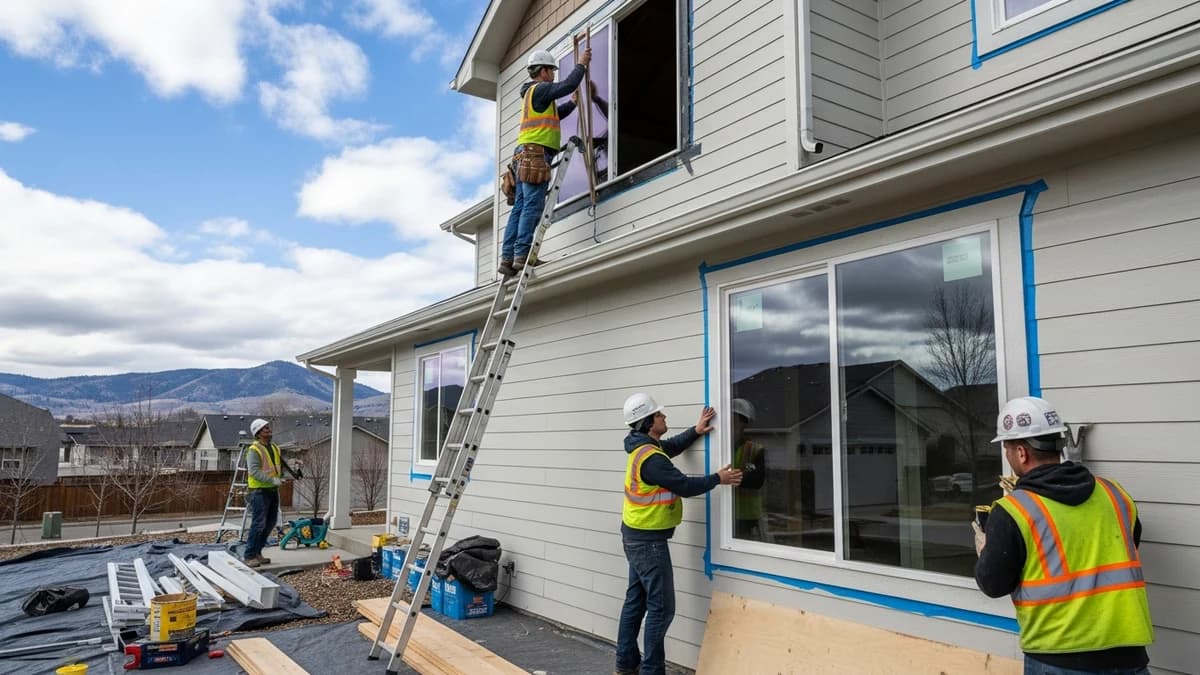
Sliding Windows in Boise
Horizontal slider windows deliver wide panoramic views, effortless operation with no cranks or springs, and a low-profile design that never projects beyond the wall. A complete guide to sliding window types, costs, energy performance, and installation for Treasure Valley homeowners.
Quick answer
Sliding windows in Boise typically cost $250 to $1,100 per window installed depending on frame material, glass package, and configuration. A standard 2-lite vinyl slider with dual-pane Low-E glass and argon fill runs $250 to $450 installed.
Sliding windows — also called horizontal sliders or glider windows — operate by moving one or both sashes horizontally along a track built into the window frame. Think of a double-hung window turned on its side: instead of moving up and down, the sash travels left and right. The mechanical concept is the simplest of any operable window type — a track, a set of precision rollers, and a latch. No cranks, no spring balances, no counterweights.
Sliding windows are manufactured in two primary configurations. A 2-lite slider (industry designation XO) features one fixed panel and one operable panel that slides past it. A 3-lite slider (XOX) uses a fixed center panel flanked by two operable end panels, both of which slide toward the center. The 2-lite configuration is the most common residential format, available in widths from 24 inches to about 72 inches. The 3-lite configuration handles wider openings — typically 72 to 120 inches — where a single operable sash would be too heavy to slide smoothly.
Modern sliding windows bear little resemblance to the thin aluminum sliders common in 1960s and 1970s tract homes across the Boise Bench. Today's sliders feature fusion-welded vinyl or pultruded fiberglass frames, interlocking meeting rails with multi-point weatherstripping, precision-machined stainless-steel roller assemblies, and the same high-performance glass packages — dual-pane Low-E with argon fill, triple-pane options, and tuned SHGC coatings — available in any other window type. The result is a window that retains its fundamental operational simplicity while delivering energy performance that clears Idaho's Climate Zone 5 code cap and, in the better glass packages, reaches ENERGY STAR's Northern-zone threshold for the Treasure Valley market.
The defining trait of a slider is that everything about how it works is reduced to two parts that can fail and both are cheap and serviceable: the rollers and the weatherstripping. A double-hung relies on concealed spring or block-and-tackle balances. A casement depends on a steel scissor operator, a worm gear, and a multi-point lock linkage. A slider has none of that. The sash rests on a pair of nylon or stainless rollers that ride a track, and a simple cam or sweep latch pulls it snug at the meeting rail. For a Boise homeowner thinking about the next 25 years — not just installation day — that mechanical minimalism is the slider's quiet advantage: there is no operator hardware to strip, bind, or seize, and the parts that do wear are visible, accessible, and inexpensive.
A slider also has natural proportions: it almost always reads wider than it is tall. A casement or double-hung is comfortable in a tall, narrow opening; a slider is at its best in a wide, short one. That single fact explains most of where sliders belong in a Treasure Valley home — basement window wells, over counters and laundry sinks, the long low bedroom openings of a Bench or Vista ranch, and broad living-room walls in newer Meridian and Eagle subdivisions. Opening shape, more than taste, usually decides whether a slider is the right tool.
Operating a slider is the most intuitive motion of any window: you push the sash sideways. There is no handle to fold out, no crank to turn through fifteen rotations, no sash to lift against a balance, and no two-handed coordination. You unlock a single latch at the meeting rail and glide the panel. This is why sliders are the window we most often recommend for Boise's aging-in-place remodels — homeowners with reduced grip strength, arthritis, or shoulder limitations can operate a well-adjusted slider with one hand and very little force, where a stiff casement crank or a heavy double-hung sash is a daily struggle.
The 2-lite (XO / OX). Two panels of equal width sit side by side. One is fixed; one slides. The designation tells you which side opens as you face the window from outside: XO means the left panel slides and the right is fixed in some manufacturer conventions, OX the reverse — we confirm orientation per opening so the operable lite faces the direction you actually want airflow and access from. Roughly half the glass area ventilates.
The 3-lite (XOX). A wide fixed center lite is flanked by two narrower operable lites that both slide inward toward the center. The center is typically half the total width, each end quarter operable. You still get about 50 percent ventilation, but it is split to both flanks of the opening, which produces noticeably better cross-flow in a wide room than a single operable end. The fixed center also gives you a large, mullion-light picture view — the reason a 3-lite slider is the standard cost-effective answer for a Treasure Valley great room facing the Foothills.
Tilt and lift-out sashes. Better sliders include sashes that lift out of the track or tilt in for cleaning the exterior glass from inside — genuinely useful on a second-story Eagle two-story or any opening you cannot reach with a ladder over a deck or landscaping. Budget sliders often omit this; if cleaning access matters to you, ask for it specifically before the order is placed, because it is a frame and hardware choice, not an add-on after install.
The Treasure Valley's housing stock, climate, and lifestyle create several conditions where sliding windows outperform other operable window types. Understanding these advantages helps Boise homeowners make confident decisions about where sliders fit within a whole-house window plan.
Wide openings with a low profile. Sliding windows are the most practical operable window for openings wider than 36 inches. A casement sash at that width becomes heavy and unwieldy, and the outward swing arc requires significant exterior clearance. Sliders handle openings up to 10 feet wide in 3-lite configurations while keeping the sash entirely within the wall plane — no exterior projection at all.
Effortless operation. There are no cranks to turn, no springs to fight, and no sashes to lift. A light horizontal push slides the panel open. This simplicity makes sliders the most accessible operable window for homeowners with arthritis, limited grip strength, or mobility challenges — a growing consideration as Boise's aging-in-place remodeling market expands.
Panoramic views of the Treasure Valley. The horizontal format of a sliding window naturally frames wide landscape views. For Boise homes facing the Foothills, Bogus Basin, or the Boise River greenbelt, sliders provide an uninterrupted horizontal sightline that vertical window types cannot match. A 3-lite XOX slider in a living room or great room delivers a near-picture-window view with ventilation on both flanks.
Modern and contemporary architecture. Boise's newer subdivisions in Southeast Boise, Harris Ranch, Barber Valley, and the North End infill projects increasingly feature contemporary and modern farmhouse designs. Sliding windows complement the clean horizontal lines, flat or low-pitched rooflines, and minimalist facades of these styles. They also suit the ranch homes and mid-century modern houses concentrated in the Bench, Morris Hill, and Depot Bench neighborhoods.
Safe where nothing can project outward. This is the single most practical reason Boise homeowners choose sliders over casements. Any window adjacent to a deck, covered patio, walkway, or narrow side yard cannot use a casement or awning design without the outward-swinging sash creating a head-strike hazard or blocking foot traffic. Sliders stay flush with the wall in every position — open or closed — making them the default choice for patio-facing windows, windows above decks, and windows along tight side-yard setbacks common on Boise subdivision lots.
Sliding windows are one of the most affordable operable window types, making them a strong value proposition for Boise homeowners replacing multiple windows. The following pricing reflects current Treasure Valley market rates for standard-sized sliders, fully installed with removal of the existing window, foam insulation, and interior and exterior trim finishing.
| Window Type | Cost Per Window (Installed) | Notes |
|---|---|---|
| Vinyl 2-Lite (XO) | $250 – $450 | Most popular; dual-pane Low-E + argon standard |
| Vinyl 3-Lite (XOX) | $400 – $700 | Wide openings 72"–120"; center fixed |
| Fiberglass | $400 – $750 | Paintable; lowest expansion/contraction rate |
| Wood / Wood-Clad | $600 – $1,100 | Premium aesthetic; best insulation value |
Whole-House Estimate
A full-house sliding window replacement of 15 to 20 units typically costs $4,500 to $20,000 in the Boise market, depending on frame material, glass package, window sizes, and installation complexity. Full-frame replacements (removing the entire old frame down to the rough opening) add 20 to 40 percent over insert (pocket) installations. Iron Crest Remodel provides detailed, itemized, fixed-price estimates, with any changes documented and approved before work proceeds — contact us for a free quote tailored to your home.
This is the single most important technical topic for sliders in the Treasure Valley, because so many slider applications here are basement and bedroom egress retrofits in mid-century homes. Idaho has adopted the 2018 International Residential Code, and section R310 is the governing provision. Every sleeping room and every habitable basement must have at least one emergency escape and rescue opening that meets four hard numbers: a net clear opening of 5.7 square feet (the code permits 5.0 square feet for openings at grade level), a minimum net clear opening height of 24 inches, a minimum net clear opening width of 20 inches, and a finished sill height no more than 44 inches above the floor.
Here is the part homeowners and even some installers get wrong: the clear opening is measured through the part of the window that actually opens, not the whole window. A slider only opens half. So the fixed lite contributes zero to egress, and the operable lite has to single-handedly clear all 5.7 square feet. That means a slider used for egress has to be substantially wider than a casement or double-hung serving the same code requirement.
Work the arithmetic. The clear width of a 2-lite slider is roughly the operable lite's glass width — call it a little under half the overall window width once you subtract the meeting rail and frame. The clear height is roughly the glass height. To net 5.7 square feet you need the operable opening to satisfy both the 24-inch minimum height and the area, so a practical 2-lite egress slider typically lands around 60 inches wide by 36 inches tall or larger, with the exact figure taken from that specific product's published clear-opening chart — manufacturers vary by an inch or two and that inch decides pass or fail. For a grade-floor opening allowed the 5.0 square-foot threshold, the window can be modestly smaller.
Now the Treasure Valley reality. Bench, Vista, Morris Hill, and Depot Bench ranch and split-level homes from the 1950s-1970s commonly have basement window wells and rough openings that are wide but only 24 to 30 inches tall — below the height a code-compliant slider egress opening needs. In those homes an egress retrofit is rarely just a window swap: it usually means enlarging the masonry or framed rough opening, deepening and widening the window well, and adding a code-compliant well ladder or steps if the well is more than 44 inches deep. We size the window against the manufacturer's clear-opening table, confirm the finished sill height after the well work, and verify the plan with the local building department before anything is ordered. Getting this wrong is expensive; getting it checked first is free.
Every window type involves trade-offs. Here is an honest assessment of sliding window advantages and limitations based on our installation experience across the Treasure Valley.
Advantages
- Wide panoramic views from the horizontal orientation — ideal for framing the Boise Foothills and Treasure Valley landscapes
- Easy, intuitive operation with no cranks, no spring balances, and no lifting — just a light horizontal push
- Nothing protrudes when open, making sliders safe for windows adjacent to decks, patios, walkways, and narrow side yards
- Available in a wide variety of sizes, from compact 24-inch basement units to 10-foot 3-lite configurations
- Complement modern, contemporary, ranch, and mid-century home styles found throughout the Boise metro area
- Lower cost than casement windows in comparable frame material and glass — the slider has no crank operator, multi-point lock or reinforced hinge set to pay for
Limitations
- Only 50 percent ventilation — whether 2-lite or 3-lite, only half the total window area can be open at once
- Track requires regular cleaning, especially in Boise's dry climate where fine dust, pollen, and construction particulates accumulate quickly
- Seal is not as tight as casement compression seals — sliders use interlocking rails and pile weatherstripping, which allow marginally more air infiltration
- Rollers can wear after 15 to 20 years of use, causing the sash to drag or stick — replacement is straightforward but necessary
Boise sits in IECC Climate Zone 5, where Idaho's adopted energy code caps fenestration at a maximum U-factor of 0.32 and sets no Solar Heat Gain Coefficient requirement. ENERGY STAR works from its own map, on which all of Idaho — Ada County included — falls in the Northern zone, and Version 7.0 certifies there at U-factor 0.22 or lower with SHGC 0.17 or higher. That SHGC figure is a minimum, not a maximum, because winter solar gain offsets heating in a heating-dominated climate. Sliding windows from quality manufacturers clear the code cap comfortably with dual-pane Low-E and argon; reaching the ENERGY STAR bar generally takes the better glass packages, and it is the NFRC label on the specific unit that settles the question.
Track seal vs. compression seal. The primary energy difference between sliders and casement windows is the sealing mechanism. Casement windows use a compression seal — the crank pulls the sash tight against weatherstripping on all four sides, creating an airtight barrier. Sliding windows rely on an interlocking meeting rail at the center and pile (brush-style) or fin weatherstripping along the track edges. This interlock is effective but inherently allows marginally more air infiltration than a compression seal. NFRC certifies an air-leakage rating for every listed window, and a slider will generally come in above a casement built to the same standard — compare the two labels on your own quotes rather than a category average. We do not put a percentage on what that means for your heating bill, because it would be invented; the practical difference is modest, and it matters most on the wind-exposed elevations in a Zone 5 climate where heating is the largest residential energy expense.
Weatherstripping matters. Not all slider weatherstripping is equal. Budget-tier sliders use single-fin pile strips that compress and lose sealing ability within three to five years in Boise's temperature extremes. We specify windows with dual-durometer weatherstripping systems — a combination of compression bulb seals on the meeting rail and triple-fin pile weatherstripping along the track edges — for all Treasure Valley installations. This dual system holds its integrity through the full annual swing, from a January cold snap below zero to a July afternoon past 100°F.
Low-E and argon. Low-E (low emissivity) coatings on the glass reflect infrared heat back into your home during winter while rejecting solar heat gain during summer. Argon gas fill conducts heat less readily than air, and the benefit it buys is already counted in the whole-window U-factor on the NFRC label, so compare labels rather than adding a separate percentage for the fill. At Boise's 2,700-foot elevation there is less atmosphere overhead to absorb ultraviolet than at sea level, and Low-E coatings cut UV transmission substantially, which is what protects hardwood floors, furniture and artwork from fading; the figure for a specific coating is published with that glass package.
Dual vs. triple pane. Dual-pane Low-E with argon is the standard specification for Boise slider installations and meets Zone 5 energy code. Triple-pane glass pushes U-factors below 0.20 and is a valuable upgrade for north-facing windows that receive no beneficial solar gain, oversized sliders where the glass area represents a significant portion of wall insulation, and rooms where noise reduction matters (near State Street, the freeway corridor, or Boise Airport flight paths). The trade-off is weight: a third pane adds real mass to a sash that has to roll, so specify heavy-duty roller assemblies to maintain smooth operation.
U-Factor
0.32 max
Idaho code cap, Zone 5 — ENERGY STAR Northern zone asks 0.22 or lower
Air Leakage
See NFRC label
Rated per product — a track seal runs above a compression one
SHGC
0.17 min
ENERGY STAR Northern-zone floor — tune lower only on south and west glass
Frame material matters more on a slider than on most window types, and for a specific mechanical reason: a slider is a sliding fit. The sash has to glide freely along the track in January and still glide freely — not bind — in July. Frame materials expand and contract at very different rates across Boise's roughly 130-degree annual temperature swing, and on a horizontal sliding assembly that movement directly affects how the window operates, not just how it seals. The materials comparison below is slider-specific; for the full cross-material breakdown see our window materials comparison.
Vinyl — the default for value. Fusion-welded vinyl is the most common slider frame in the Treasure Valley and the best value for a 2-lite. It never needs paint, resists the moisture of a basement window well, and modern multi-chamber extrusions insulate well. Its weakness is thermal movement: vinyl expands and contracts more than fiberglass, so on very wide sliders or dark exterior colors in full Boise sun, a budget vinyl sash can grow enough to drag late on a hot afternoon. We address this by keeping wide spans to 3-lite XOX (shorter individual operable sashes), specifying heavier-duty rollers, and steering dark colors toward fiberglass.
Fiberglass — the best operational match. Pultruded fiberglass has the lowest expansion-and-contraction rate of any common frame material, almost identical to the glass it holds. For a slider that is precisely the trait you want: the track geometry stays stable through the seasons, so the sash that glides perfectly on installation day still glides at minus-5 and at 105. It is also paintable and exceptionally rigid, which keeps a wide opening from racking. It costs more than vinyl, but on a large or dark-colored slider, or any opening where smooth long-term operation is the priority, it is the material we most often recommend.
Wood and wood-clad — aesthetics and warmth. Wood-clad sliders pair an aluminum or fiberglass exterior with a real-wood interior, delivering the highest insulating value and the warm interior look that suits a North End remodel or a higher-end Eagle build. The trade-off is cost and a small amount of maintenance on the interior wood. The exterior cladding handles Boise sun and weather; the interior simply needs the occasional finish refresh.
Aluminum — what you are likely replacing. The original Bench and Vista sliders are almost all bare aluminum with no thermal break. Aluminum conducts heat aggressively, so those old sliders sweat, frost on the inside in January, and bleed heat at the frame. New aluminum sliders exist with thermal breaks, but for almost every Treasure Valley residential retrofit, vinyl or fiberglass is the better-performing replacement for an old aluminum slider.
Sliding windows are not the right choice for every opening, but they are the strongest option for several common residential scenarios we encounter throughout the Treasure Valley. Here are the four applications where we most frequently recommend sliders.
Rooms Overlooking Decks & Patios
Any window facing a deck, covered patio, or outdoor living area benefits from a slider because the sash never projects beyond the wall. Boise's outdoor lifestyle means most homes have at least one covered patio or elevated deck — casement and awning windows in these locations create head-strike hazards when open. Sliders stay flush in every position, letting you ventilate freely while family and guests move safely along the deck.
Basements & Low-Clearance Areas
Basements often have low-headroom window wells where a vertically-operating window would be impractically narrow. Sliders fill the width of the opening and can be sized to meet the 2018 IRC R310 egress requirements for basement bedrooms — a common remodeling need in Boise's Bench and North End neighborhoods where finished basements add valuable living space. A 48-by-36-inch slider can deliver more than the 5.7 square feet of clear opening from the operable half \u2014 check the figure on the manufacturer's clear-opening chart before ordering.
Wide Openings in Living Rooms
Openings wider than 36 inches are better served by sliders than casements. A 3-lite XOX slider handles openings up to 10 feet wide while maintaining operable ventilation on both ends — ideal for great rooms and living areas in Eagle, Star, and Southeast Boise subdivision homes that face the Boise Foothills. The fixed center panel provides an unobstructed view while the two flanking panels handle airflow.
Contemporary & Modern Architecture
The horizontal emphasis of sliding windows complements the clean lines and minimal profiles of contemporary home designs. Boise's newer developments in Harris Ranch, Barber Valley, and the North End infill market feature modern and modern-farmhouse designs where sliders are architecturally native. They also suit the mid-century modern and ranch homes concentrated in the Bench, Morris Hill, and Depot Bench neighborhoods where the original horizontal window proportions define the facade.
The Treasure Valley is high desert. Boise sits near 2,700 feet in a semi-arid basin where spring and summer wind events carry fine soil, agricultural dust off the surrounding fields, sagebrush and grass pollen, and, in growing subdivisions, construction silt. Any window with a horizontal track sitting at the bottom of the assembly is a place that dust wants to collect. This is the slider's honest maintenance cost, and it is worth being candid about it rather than pretending it does not exist.
The failure mode is gradual, visible, and entirely preventable. Dust does not damage the glass or frame; it accumulates in the track and, if never cleaned, grinds the rollers and bottom weatherstripping over years. A slider vacuumed monthly and lubricated with dry silicone two or three times a year will glide for decades; one that is never touched starts to drag in five to eight years because the track became sandpaper. The single worst mistake we see is petroleum oil or lithium grease sprayed into the track — in Boise that becomes an abrasive paste within a season and accelerates exactly the wear it was meant to prevent.
Three slider design features genuinely help in this climate, and we spec for them on Treasure Valley installs: a tall sill leg with proper sloped weep channels so wind-driven grit and meltwater drain forward instead of damming behind the sash; captured stainless or heavy-duty nylon tandem rollers that ride above the worst of the debris rather than dragging through it; and a removable bottom sash so the track can actually be cleaned all the way to the corners instead of only where a vacuum tip reaches. These are not premium extras for show; in a dusty climate they are the difference between a 10-year and a 25-plus-year service life.
Keep weep holes clear. Every slider drains through small weep slots at the front of the sill. In Boise the failure is rarely water volume — we are dry — it is a weep hole packed solid with dust and dead pollen so the small amount of meltwater or wind-driven rain that does get in has nowhere to go and sits against the bottom rail. A toothpick or compressed air twice a year solves it permanently. Our full routine is in the Iron Crest homeowner guides.
Sliding windows and casement windows are the two primary horizontal-format window types. Both serve wide openings well, but they differ in operation, air sealing, maintenance, and cost. This comparison helps Boise homeowners decide which format fits each opening in the home.
| Feature | Sliding Window | Casement Window |
|---|---|---|
| Operation | Horizontal push — no hardware | Crank handle rotates sash outward |
| Air Sealing | Interlock + pile weatherstrip (good) | Compression seal on all 4 sides (excellent) |
| Ventilation % | ~50% of window area | ~100% of window area |
| Exterior Projection | None — flush with wall | Sash swings outward 90° |
| Maintenance | Track cleaning + roller replacement | Crank/hinge lubrication + operator replacement |
| Cost (Vinyl, Installed) | $250 – $450 | $400 – $650 |
| Aesthetic Fit | Modern, ranch, contemporary | Craftsman, traditional, contemporary |
| Best For | Decks, patios, wide openings, basements | Kitchens, bathrooms, hard-to-reach spots |
Many Boise homeowners use both types in the same home. Casements go in kitchens (above the sink), bathrooms, and bedrooms where maximum ventilation and tight air sealing matter most. Sliders go on patio-facing walls, wide living room openings, basements, and any location where exterior projection is not possible. This mixed approach gives you the best performance characteristics in every room without committing to a single window type throughout the house.
We would rather lose a slider sale than put the wrong window in your wall. A slider is an excellent tool for the right opening and the wrong tool for several others. Here, plainly, is when we will steer a Treasure Valley homeowner away from a slider.
When you need maximum ventilation in a small room. A slider opens half its area; a casement opens essentially all of it and scoops passing air with the swung sash. In a small Boise bedroom, home office, or three-quarter bath where airflow per square foot of window is the priority, a casement or even an awning will out-ventilate a slider of the same size every time.
When the tightest possible air seal matters most. On an exposed north or west elevation that takes the brunt of Boise's winter wind, the casement's four-sided compression gasket is the better seal. If a particular opening is a known cold-air problem and energy performance outranks every other consideration there, we will recommend a casement for that opening and reserve sliders for the patio-facing and wide walls where they shine. Compare the two directly on our casement windows page.
When the opening is tall and narrow. A slider fights a tall, skinny opening — you would end up with a stubby operable lite and awkward proportions. That opening wants a double-hung or a casement. If you are weighing the classic vertical option, our double-hung windows page covers it in depth.
For a strict historic restoration. A North End Victorian or a true period Craftsman bungalow is architecturally a double-hung house. A slider in that facade looks wrong and can hurt resale on a character home. Honor the original style; use sliders elsewhere in the project where they are not visible from the historic streetscape.
When the window is high over a counter or sink and rarely reached. Reaching across a kitchen counter to push a sash sideways is more awkward than turning a casement crank that brings the whole opening to you. For high, hard-to-reach openings, a casement is usually the more livable choice even though a slider would physically fit.
The right answer for almost every Treasure Valley home is a mix. We commonly spec sliders on patio-facing walls, wide great-room openings, basements, and Bench-ranch bedroom retrofits, while using casements in kitchens and on the harshest cold elevations and double-hungs where the architecture asks for them. Matching each opening to the right window is the entire purpose of a free in-home assessment. Get a recommendation specific to your home through our guide to the best windows for Boise homes or request a free estimate.
Where sliders make sense varies noticeably by neighborhood, because the Treasure Valley's housing stock spans seven decades of building styles. Understanding the local context helps explain why we recommend sliders in some areas far more than others.
The Boise Bench and Vista. This is slider country. Built out heavily from the late 1940s through the 1970s, these neighborhoods are dominated by ranch and split-level homes whose original windows were wide aluminum sliders. The rough openings, the facade proportions, and the basement window wells were all designed around the horizontal slider format. Replacing a tired aluminum slider with a modern vinyl or fiberglass slider here is usually the lowest-disruption, best-matching upgrade available — and it is where the egress-retrofit math in the section above comes up most often, because so many Bench basements are being finished into bedrooms.
Morris Hill and Depot Bench. Same mid-century DNA as the Bench — horizontal proportions, original sliders, finished-basement projects driving egress upgrades. A modern slider keeps the period rhythm of the street while finally delivering insulated glass and a frame that does not frost over in January.
Southeast Boise, Harris Ranch, and Barber Valley. Newer and contemporary builds and modern-farmhouse designs where the slider is architecturally native. Here sliders show up most as wide 3-lite XOX units in great rooms and on patio-facing walls overlooking the Foothills and the greenbelt.
Meridian, Eagle, Nampa, Caldwell, Kuna, and Star. Across the broader Treasure Valley, sliders are most common on covered-patio walls and in wide living areas of subdivision homes where a casement's outward swing would conflict with a deck, patio cover, or tight side-yard setback. See our service regions for the areas we cover, or contact Iron Crest Remodel to talk through your specific home.
How much do sliding windows cost installed in Boise?
Sliding windows in Boise typically cost $250 to $1,100 per window installed depending on frame material, glass package, and configuration. A standard 2-lite vinyl slider with dual-pane Low-E glass and argon fill runs $250 to $450 installed. Fiberglass sliders cost $400 to $750. Wood-clad and premium composite sliders range from $600 to $1,100. A 3-lite XOX slider for a wide living-room opening generally runs $400 to $950 in vinyl and more in fiberglass or wood-clad. A whole-house replacement of 15 to 20 sliding windows generally falls between $4,500 and $20,000 total. These prices include the window unit, removal and disposal of the old window, installation labor, low-expansion foam around the frame, flashing where required, and basic interior and exterior trim finishing.
Are sliding windows energy efficient enough for Boise winters?
Modern sliding windows with quality weatherstripping, dual-pane Low-E glass, and argon gas fill perform well in Boise winters, but there are two separate bars to hold them against. Idaho's energy code caps fenestration at a U-factor of 0.32 in Climate Zone 5 and sets no SHGC requirement. ENERGY STAR Version 7.0 is stricter: Ada County sits in its Northern zone, where certification asks for a U-factor of 0.22 or lower with an SHGC of 0.17 or higher — the SHGC being a floor rather than a ceiling, because winter solar gain is worth having here. The honest caveat is the moving seal: a slider closes against brushed pile and an interlocking meeting rail rather than the four-sided compression gasket a casement uses, so it will generally rate looser on the NFRC air-leakage line. That rating is certified per product, so compare labels rather than category averages. On a single-story Bench ranch with ten or twelve sliders the difference is real but modest, and it is dwarfed by the gain from replacing a 1970s aluminum slider that has no thermal break at all.
What is the difference between a 2-lite and 3-lite sliding window?
A 2-lite sliding window (industry designation XO or OX depending on which side opens) has two panels — one fixed and one that slides horizontally. Only the operable half ventilates, so roughly 50 percent of the glass area opens. A 3-lite sliding window (XOX) has three panels: a fixed center panel flanked by two operable end panels that both slide toward the center. The 3-lite handles wider openings, typically 72 to 120 inches, ventilates from both ends, and keeps a large unobstructed center view. A 3-lite costs meaningfully more than a comparable 2-lite but is far cheaper than a bay or bow for covering a wide wall opening, which is why it is the standard choice for Treasure Valley great rooms.
Can a sliding window meet basement bedroom egress code in Idaho?
Yes, if it is sized correctly. Idaho has adopted the 2018 IRC, whose section R310 requires an emergency escape opening of at least 5.7 square feet (5.0 square feet for grade-floor openings), a minimum clear opening height of 24 inches, a minimum clear opening width of 20 inches, and a finished sill no more than 44 inches above the floor. The catch with a slider is that you only get the operable half. A 2-lite slider has to be roughly twice as wide as the required clear width because the fixed lite contributes nothing to egress. As a rule of thumb in our experience, a 2-lite slider needs to be in the range of about 60 inches wide by 36 inches high (verified per the specific product's clear-opening chart) to clear 5.7 square feet. Many older Bench and Vista window wells are too short for that, which is why egress retrofits there often involve enlarging the rough opening and the well. We confirm egress math against the manufacturer's published clear-opening dimensions and the local building department before ordering.
How do I maintain sliding window tracks in Boise's dry climate?
Boise's semi-arid climate produces fine wind-blown dust, sagebrush and grass pollen, and construction particulates that pack into sliding tracks faster than in humid regions. Vacuum the track monthly with a crevice tool, then wipe it with a damp cloth. Every three to six months apply a thin film of dry silicone or PTFE lubricant — never petroleum grease or oil, which turns into an abrasive paste once Boise dust sticks to it. Clear the weep holes at the front of the sill twice a year so meltwater and wind-driven rain can drain instead of pooling. If the sash drags, the rollers are usually the cause; they are an inexpensive, quick replacement that restores smooth glide immediately.
Can I use sliding windows where casement windows won't fit?
Yes, and this is one of the most common reasons Treasure Valley homeowners choose sliders. Casements swing outward and need clear exterior arc — they cannot go where a deck, covered patio, walkway, AC condenser, or shrub bed sits in the swing path. A sliding sash never leaves the plane of the wall, so it is the default choice for patio-facing walls, above-deck windows, and tight side-yard setbacks common on Boise subdivision lots. Sliders are also the better answer for low-headroom basement wells and over-counter openings where a vertically operating window would be impractically narrow.
Why are sliding windows so common in Boise Bench and Vista ranch homes?
The Bench, Vista, Morris Hill, and Depot Bench neighborhoods were built out heavily in the 1950s through the 1970s, and the dominant residential window of that era was the aluminum horizontal slider. Those original wide-but-short proportions are baked into the facade and the rough openings. Replacing them with a modern slider keeps the original architectural rhythm, reuses the existing opening with minimal framing changes, and avoids the awkward look of a tall double-hung crammed into a wide low hole. It is usually the lowest-disruption, best-matching upgrade for that housing stock.
Do sliding windows leak more air than other window types?
Compared to a casement or awning, yes, slightly — because a slider seals with an interlocking meeting rail and brushed pile weatherstripping rather than a four-sided compression gasket that a crank pulls tight. Compared to an old single-pane double-hung or a 1970s aluminum slider, a modern slider is dramatically tighter. The practical answer for Boise: spec a unit with a dual-durometer system (a compression bulb at the meeting rail plus triple-fin pile at the track), compare the NFRC air-leakage rating against the other units you are quoted, and the difference becomes negligible for everyday comfort and heating cost.
What sizes do sliding windows come in?
2-lite sliders are commonly available from about 24 inches up to roughly 72 inches wide and 12 to 60 inches tall, in the wide-but-short proportions that suit basements, over-counter openings, and ranch-style bedrooms. 3-lite XOX sliders typically span 72 to 120 inches wide for living rooms and great rooms. Because sliders are usually wider than they are tall, they are the natural fit for the horizontal openings that dominate mid-century Treasure Valley homes, and they retrofit cleanly into those existing rough openings without reframing in most cases.
How do screens work on sliding windows?
A sliding window screen covers only the operable half and rides on its own exterior track. Because the screen does not have to swing or fold, it provides full, flat insect coverage over the opening that ventilates, and it is easy to pop out for cleaning. This is an advantage over casements, whose interior screens sit between you and the crank and tend to collect dust on the inside. In Boise's dusty, pollen-heavy spring we recommend a higher-visibility tight-mesh screen and a quick rinse each season.
How long do sliding windows last and what wears out first?
A quality vinyl or fiberglass slider should last 20 to 30-plus years in the Treasure Valley. The first wear items are the rollers and the pile weatherstripping, not the glass or frame. Rollers carry the full sash weight every time the window moves and can flatten or seize after 15 to 20 years, especially if grit is never cleaned out of the track. Pile weatherstripping slowly compresses and can lose its seal in 5 to 10 years on budget units. Both are inexpensive, serviceable parts — one reason sliders have a low lifetime maintenance cost despite needing routine track cleaning.
When is a sliding window NOT the best choice?
We will tell you when a slider is the wrong call. Skip it when maximum ventilation matters in a small room (a casement opens the full area, a slider only half); when you want the tightest possible air seal on a cold north or west elevation (a casement's compression seal wins); for tall narrow openings where the proportions fight the horizontal format; for a strict historic Craftsman or Victorian restoration where a double-hung is architecturally correct; and for high openings reached over a sink or counter where a crank casement is far easier to operate than reaching across to push a sash. Matching the window to the opening is the whole point of an in-home assessment.
Can old aluminum sliders be replaced without changing the opening?
Usually yes. Most 1960s-1970s Boise aluminum sliders sit in standard rough openings that accept a modern vinyl or fiberglass slider as either an insert (pocket) replacement or a full-frame replacement. Insert installs are faster and less invasive and keep existing interior and exterior trim; full-frame installs remove everything down to the framing, allow new flashing and insulation, and are the right call when the old frame is rotted, racked, or out of square. The main exception is a basement bedroom that must now meet egress — that often requires enlarging the opening and the window well regardless of install method.
Does Iron Crest Remodel install sliding windows across the Treasure Valley?
Yes. Iron Crest Remodel installs sliding windows throughout Boise, Meridian, Eagle, Nampa, Caldwell, Kuna, Star, and the surrounding Treasure Valley. We are registered and insured in Idaho (Idaho contractor registration RCE-6681702), provide free in-home estimates with itemized written quotes, and back our installation labor with a 3-year workmanship warranty in addition to the manufacturer's product warranty. Call (208) 779-5551, Monday through Friday, 7 AM to 6 PM, or request an estimate online.
Sliding windows are one of several window types we install across the Treasure Valley. The other two horizontal-oriented operable options most often compared with a slider are double-hung and casement. Compare them below, or visit our main window replacement page for the complete overview.
Choosing a slider is one decision inside a larger window project. These resources help you specify the right configuration, material, and per-opening window type for your Treasure Valley home.
The following government agencies, industry organizations, and official resources provide additional information relevant to your remodeling project.
Ready for Sliding Windows?
Get a free, no-obligation estimate for sliding window installation in your Boise home. We measure, specify the right configuration and frame material, and install — backed by manufacturer warranties and our workmanship guarantee.