
Sit-Down Bath Alternatives to Walk-In Tubs in Boise: 5 Designs for Mobility-Limited Adults Who Want a Real Bath
Walk-in tubs are marketed as the only accessible bath option, but they have downsides that don't fit every mobility-limited user. Five alternatives — transfer benches, tilt-back tubs, hybrid shower-bath, side-entry tubs, and accessibility-modified standard tubs — for Boise households evaluating bath access options.
Quick answer
Generally no — bathroom accessibility modifications are typically not insurance-covered home modifications. Some Medicare Advantage plans cover accessibility modifications under specific conditions; check with your insurer. State of Idaho has accessibility-modification grant programs for low-income disabled residents; check Idaho Commission on Aging or local disability advocacy organizations.
Walk-in tubs are aggressively marketed to mobility-limited adults as the accessible bathing solution. They work for many users — but they have specific downsides that don't fit every household:
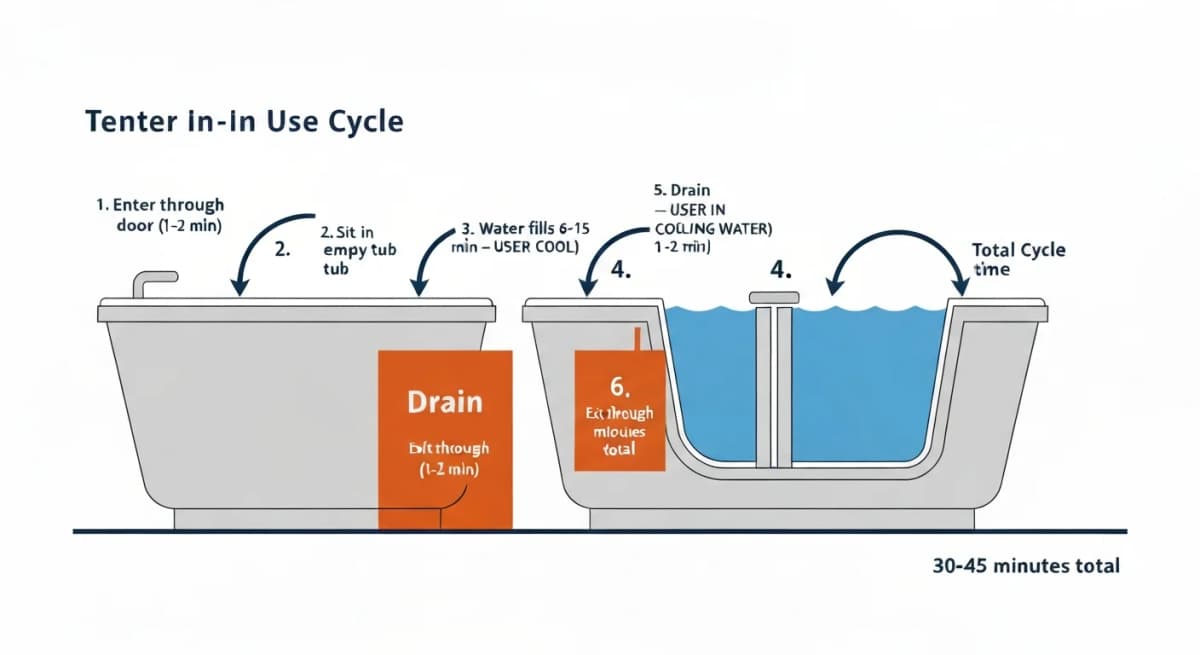
The cool-while-filling problem: Walk-in tubs require the user to be inside before water fills. The user sits in the empty tub while it fills, which takes 6-15 minutes depending on flow rate. During fill, the user is cool/cold without warm bathwater — particularly uncomfortable in Boise's cold winter mornings.
The drain-time problem: Walk-in tubs require complete draining before the user can exit. Drain time is typically 3-8 minutes. The user sits in cooling water during drainage. Combined with fill time, walk-in tub use can require 30-45 minutes — much longer than standard bath.
Footprint and water consumption: Walk-in tubs are typically 36-50 inches wide and 26-32 inches deep — significantly larger than standard tubs. They use 50-80 gallons of water per bath, vs 30-40 for standard tubs.
This article covers five alternatives that may better fit mobility-limited Boise households where the walk-in tub downsides matter.
For broader aging-in-place context, see our aging-in-place remodeling guide for Boise. For accessibility-focused walk-in shower options as alternatives to bath entirely, see our accessible walk-in showers service.
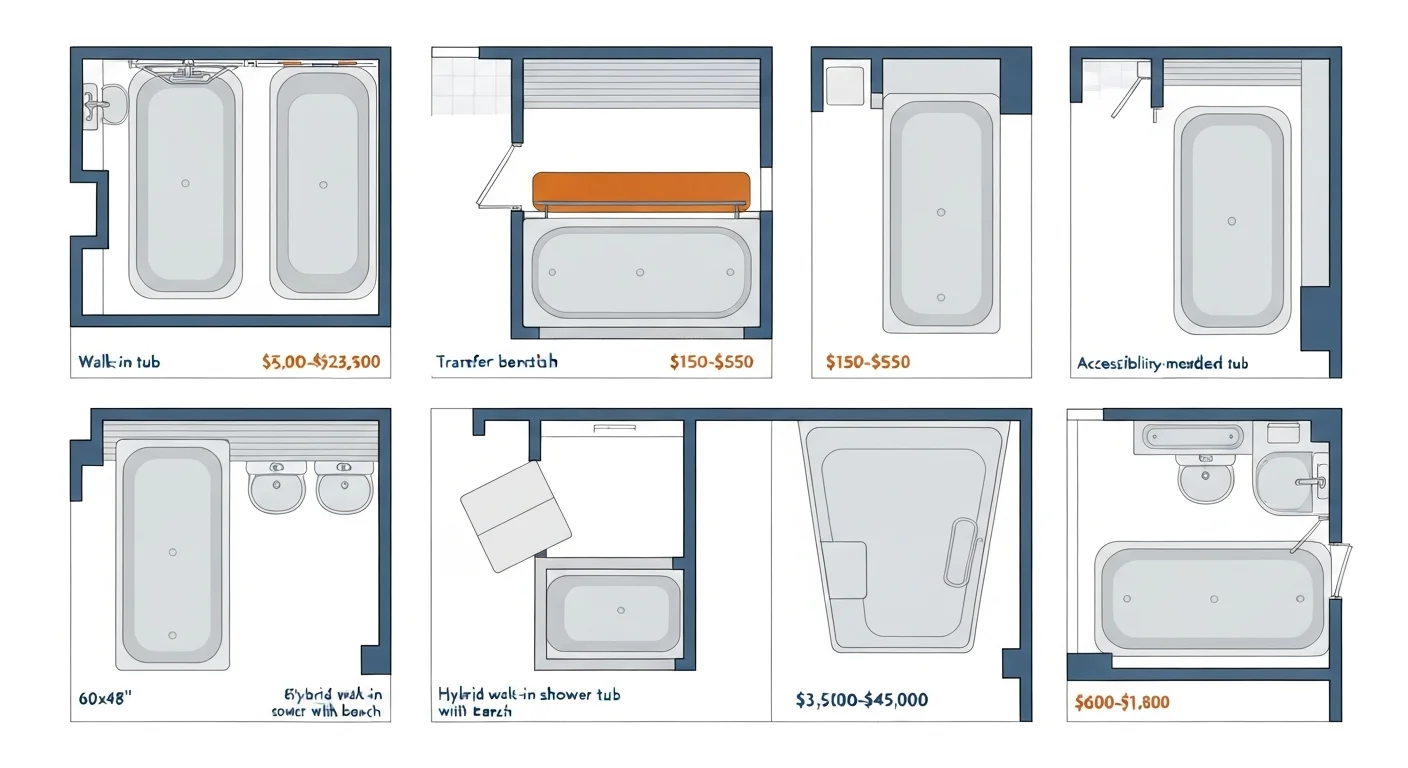
A transfer bench (or sliding bath bench) provides bath access for many mobility-limited users without the walk-in tub downsides. The bench bridges the tub edge, allowing users to sit on the bench outside the tub and slide laterally into the tub.
How it works:
Setup: Bench placed across the tub with two legs inside the tub and two legs outside on the bathroom floor. Sturdy aluminum or steel frame with padded seat.
User flow: User sits on the bench (outside the tub), swings legs over the tub edge, slides laterally into the tub position, lowers into the tub if desired or remains on the bench with water around them.
Cost:
Bench itself: $50-$250 retail. No remodel work required.
Required tub modifications: Often none. Standard tubs accommodate transfer benches.
Grab bars (recommended): $100-$300 installed. Provide additional support during transfer.
Total cost: $150-$550. Dramatically lower than walk-in tub ($5,000-$20,000+).
When transfer benches work:
Users with leg mobility limitations but adequate upper-body strength: Transfer bench requires the user to support themselves during the transfer. Users with arthritis, mild stroke recovery, or general mobility decline often manage well.
Users not requiring full submersion: The bench allows partial submersion (water around the legs and lower body) but not full chest-deep bathing.
When transfer benches don't work:
Severe upper-body weakness: Users unable to support themselves during transfer can't safely use a transfer bench alone. Caregiver assistance or alternative access methods needed.
Wheelchair users with significant disability: Transfer from wheelchair to bench requires specific technique. May not be feasible for all wheelchair users.
Users requiring full chest-deep submersion: The bench keeps part of the body above water. Users with arthritis or muscle conditions who specifically need warm-water full submersion need other options.
For many mobility-limited Boise households, a transfer bench plus properly blocked grab bars delivers most of the practical benefit of a walk-in tub for a small fraction of the cost, and without the long fill-and-drain wait a walk-in tub imposes. The right starting point for many situations.
Users with leg-mobility limitations but adequate upper-body function. Lowest-cost intervention.
Doesn't provide full chest-deep submersion. Requires caregiver if transfer is difficult.
Tilt-back tubs (also called recliner tubs or therapy tubs) have a tilting back wall that allows users to enter at a lower threshold and then recline into a comfortable bathing position.
How they work:
Entry: User enters at standard tub edge height (similar to walk-in tub door but without the door). The back wall is initially upright/forward.
Reclining mechanism: After entering, the user (or caregiver) tilts the back wall backward, providing a comfortable reclining bathing position.
Filling: Water fills around the reclined user. Faster fill experience than walk-in tubs because the user is already in a reclined position rather than waiting in a vertical seat.
Cost: $3,500-$15,000 for the tub plus install. Generally less than walk-in tubs ($5,000-$25,000+).
Advantages over walk-in tubs:
No door seal failure: Walk-in tubs depend on a door seal that fails over time. Tilt-back tubs don't have a door, eliminating one failure mode.
Faster fill experience: User is partially submerged earlier in the fill cycle.
Less wait between fill and drain: The recline position allows faster water level rise. Drainage faster because no door-seal interface.
Disadvantages:
Reclining mechanism reliability: Mechanical tilt mechanism can fail over time. Maintenance considerations.
Reduced bath depth: Reclined position has less water depth than seated walk-in tub. Some users prefer the deeper submersion of seated walk-in.
Cost still significant: Lower than walk-in but still 5-20x the transfer-bench solution.
When tilt-back works:
Users who want a more luxurious bath experience than transfer-bench provides, but find walk-in tubs problematic. Bathrooms with adequate footprint for the larger tub.
Mobility-limited users wanting near-full submersion without walk-in tub downsides.
Premium price. Mechanical complexity.
For some mobility-limited users, the right answer isn't a bath alternative — it's a generous walk-in shower with built-in seating that supports the comfort needs the bath would have provided.
Hybrid configuration:
Curbless walk-in shower: Floor extends from outside the shower into the shower without a threshold. Wheelchair-accessible or easy entry for mobility-limited users.
Built-in bench: Generous bench (60-72 inches wide, 17-19 inches deep) provides seating for relaxed shower use. See our shower bench ergonomics article for sizing.
Multi-head shower system: Adjustable handheld showerhead at standard height, plus ceiling-mounted rain showerhead for hands-free use while seated. See our multi-head shower water pressure article.
Generous size: 60 inches by 48-60 inches minimum. Allows wheelchair turning or caregiver assistance.
Cost: $15,000-$45,000 for curbless walk-in shower with premium features. Higher than transfer-bench, comparable to or higher than walk-in tub.
Trade-offs:
No actual bathing: The shower with seating doesn't provide warm-water full-body submersion. Users specifically wanting baths must look elsewhere.
Better daily experience: For users where shower with seating is acceptable, this configuration delivers far better daily experience than walk-in tub. Shower use is fast (5-15 minutes) vs walk-in tub use (30-45 minutes). Cleaner aesthetics, more flexible, larger usable space.
When hybrid is the right choice:
Users who actually prefer shower over bath: Many adults prefer shower for daily use. Walk-in tub doesn't change this preference. Hybrid shower-with-seat respects the actual preference.
Wheelchair-accessible needs: Curbless shower with bench supports wheelchair-user bathing in ways walk-in tubs don't.
Long-term aging-in-place planning: Hybrid shower-with-seat scales as user needs change. Adding grab bars, switching to handheld shower head, eventually accepting wheelchair use — all accommodated in the same fundamental design.
For many Boise empty-nesters and aging-in-place households, the hybrid shower configuration is the actual right answer rather than walk-in tub. The walk-in tub marketing aggressively positions it as the "accessibility answer," but the broader walk-in shower with seating often delivers better daily life.
Users who prefer shower over bath, or who need wheelchair-accessible bathing.
No actual bath. Doesn't fit users who specifically want bath access.
Bath access designed for your actual needs
Accessibility-focused bathroom consultations don't default to walk-in tubs. We evaluate the full range and recommend the right combination for your household. Schedule a consultation.
Side-entry tubs offer lower thresholds than standard tubs without the walk-in tub door mechanism. Some manufacturers refer to these as "easy access tubs" or "low threshold tubs."
How they differ:
Lower entry threshold: 4-8 inches above the bathroom floor (vs 14-18 inches for standard tubs). Easier to step over.
No door: Standard tub geometry, just with lower wall on one side. Doesn't have the walk-in tub door seal problem.
Side-entry slope: Some designs have an angled tub wall that gradually rises from entry to standard bath depth.
Cost: $1,500-$5,500 for the tub plus install. Mid-range between standard tubs and walk-in tubs.
When side-entry works:
Users with leg mobility limitations but adequate balance: The lower threshold reduces the risk of falling during entry/exit. Users who can step over 4-8 inches safely benefit.
Aging-in-place planning: For users currently mobile but anticipating future mobility decline, side-entry tubs are easier to retrofit into use than standard tubs.
Bathrooms with limited footprint: Side-entry tubs are typically standard tub dimensions, fitting in spaces walk-in tubs don't.
When side-entry doesn't work:
Severely mobility-limited users: Even 4-8 inch thresholds can be challenging. Walk-in tub or curbless walk-in shower may be necessary.
Users with wheelchair use: Side-entry tubs aren't wheelchair-accessible. Transfer is still required.
The role in the lineup:
Side-entry tubs occupy a middle position between transfer benches (cheap, basic) and walk-in tubs (expensive, comprehensive). They provide modest accessibility improvement at modest cost. Good fit for households with gradual mobility decline rather than acute disability.
Mid-mobility-limited users who want improved accessibility without major remodel cost.
Less accessible than walk-in tubs. More expensive than transfer benches.
For households with modest mobility limitations or for those who want to maintain a standard tub aesthetic, accessibility modifications to an existing standard tub can provide significant access improvement without specialized fixtures.
Modifications and their cost:
Grab bars (multiple locations): Wall-mounted grab bars at strategic positions — entry, alongside the tub, in the shower area. Cost: $100-$400 for materials, $200-$500 for installation (includes wall blocking if not already present). Multi-position grab bar systems can be configured for specific user needs.
Anti-slip tub surface: Anti-slip coating applied to the tub interior. Cost: $200-$500 for professional application or $20-$60 for DIY peel-and-stick options.
Hand-held showerhead with slide bar: Replaces fixed showerhead. Slide bar allows height adjustment for seated or standing use. Cost: $80-$250 for the fixture, $100-$200 for plumber install.
Lighted toggle controls (low-effort handle replacements): Standard valve handles replaced with larger, easier-to-grip lever handles. Cost: $80-$200 for the fixtures.
Temperature-limiting valve: Prevents scalding. Particularly important for older users with reduced skin sensitivity. Cost: $50-$150 plus install.
Total cost: $600-$1,800 for a comprehensive accessibility modification of an existing standard tub.
When this approach works:
Users with modest mobility limitations: Some users need accessibility support but don't need walk-in tubs. The modifications provide adequate support.
Households where bathroom remodel scope is limited: Major bathroom remodels aren't budget-feasible. Modifications provide significant accessibility improvement.
Resale considerations: Standard tub with modifications maintains resale appeal better than walk-in tub installation in family-buyer-dominant neighborhoods.
When this approach is inadequate:
Severely mobility-limited users: Modifications can't compensate for severe limitations. Walk-in tub or alternative is needed.
Wheelchair users: Modifications can't make a standard tub wheelchair-accessible.
For aging-in-place planning, accessibility modifications to existing tubs represent the most flexible approach. They can be implemented quickly, scaled over time as needs change, and don't lock in a specific accessibility solution that may not match future needs.
Aging-in-place households with gradual mobility decline; budget-constrained accessibility improvement.
Limited support for severe disability. Doesn't fit acute accessibility needs.
Iron Crest's accessibility-focused bathroom consultation includes the full range of options — not just walk-in tubs. We assess actual mobility patterns, household composition, budget constraints, and long-term planning before recommending specific approaches. For most mobility-limited Boise households, the right solution involves multiple components: transfer bench, grab bars, accessibility-modified tub, plus possibly a separate walk-in shower for daily use. The combined approach typically costs less than walk-in tub installation and provides better daily-use accessibility. For broader aging-in-place context, see our aging-in-place remodeling guide.
Will my homeowner's insurance cover walk-in tub installation or alternatives?
Generally no — bathroom accessibility modifications are typically not insurance-covered home modifications. Some Medicare Advantage plans cover accessibility modifications under specific conditions; check with your insurer. State of Idaho has accessibility-modification grant programs for low-income disabled residents; check Idaho Commission on Aging or local disability advocacy organizations.
How long do walk-in tubs typically last before needing replacement?
Walk-in tubs have a typical lifespan of 12-18 years. The primary failure mode is door seal degradation (door no longer water-tight; tub leaks when full). Door seal replacement is sometimes possible ($300-$1,000) but extensive use eventually requires tub replacement. Operating cost of an aging walk-in tub (water damage from seal failure, mold issues, repair frequency) often makes earlier replacement worthwhile.
Should the bath access choice be made by the user alone or with caregiver input?
With caregiver input where applicable. The user's preferences are primary, but caregiver experience with the user's mobility patterns matters. For severely-limited users, the caregiver may need to assist with transfers — and the bath access design must accommodate this assistance. For independent users, caregiver input is less critical. Consider both perspectives.
What if my needs change after installing one of these solutions?
Different solutions accommodate change differently. Transfer benches and grab bars can be added or removed without modification. Tilt-back tubs and walk-in tubs are large investments that don't adapt to changing needs. Hybrid shower-with-seat configurations scale gracefully — adding more grab bars, switching to seated use only, accommodating wheelchair access — all without replacing fixtures. For homes with anticipated mobility decline, the hybrid approach is often the best long-term value.
Are there Idaho-specific tax credits or rebates for accessibility modifications?
Limited. Some accessibility modifications may qualify for medical expense tax deductions (federal IRS) if they're prescribed for a specific medical condition. Idaho doesn't have specific accessibility tax credits at the state level. Some low-income disabled residents qualify for grants through Idaho Commission on Aging or local Independent Living Centers. Total available financial assistance varies by individual circumstances.
Bath access designed for your actual needs
Accessibility-focused bathroom consultations don't default to walk-in tubs. We evaluate the full range and recommend the right combination for your household. Schedule a consultation.
These pages go deeper on the topics linked from this article. Read them before your consultation and you'll come in with sharper questions and a clearer scope.
The following government agencies, industry organizations, and official resources provide additional information relevant to your remodeling project.