
Shower Bench Ergonomics for Tall Idahoans: 6 Design Decisions When Standard 18-Inch Benches Don't Fit Adults Over 6'2"
Industry-standard shower bench dimensions assume average adult anthropometry. For the 1-in-5 Idahoans over 6 feet tall, those dimensions produce a bench that's structurally there but functionally unusable. Six engineering decisions to make a shower bench work for taller bodies.
Quick answer
Custom-height benches essentially require a custom-built shower. Prefab shower kits (acrylic, fiberglass, modular) come with a fixed bench dimension — typically 18 inches high — molded into the surround. The bench can't be easily modified without compromising the structural integrity and waterproofing of the surround.
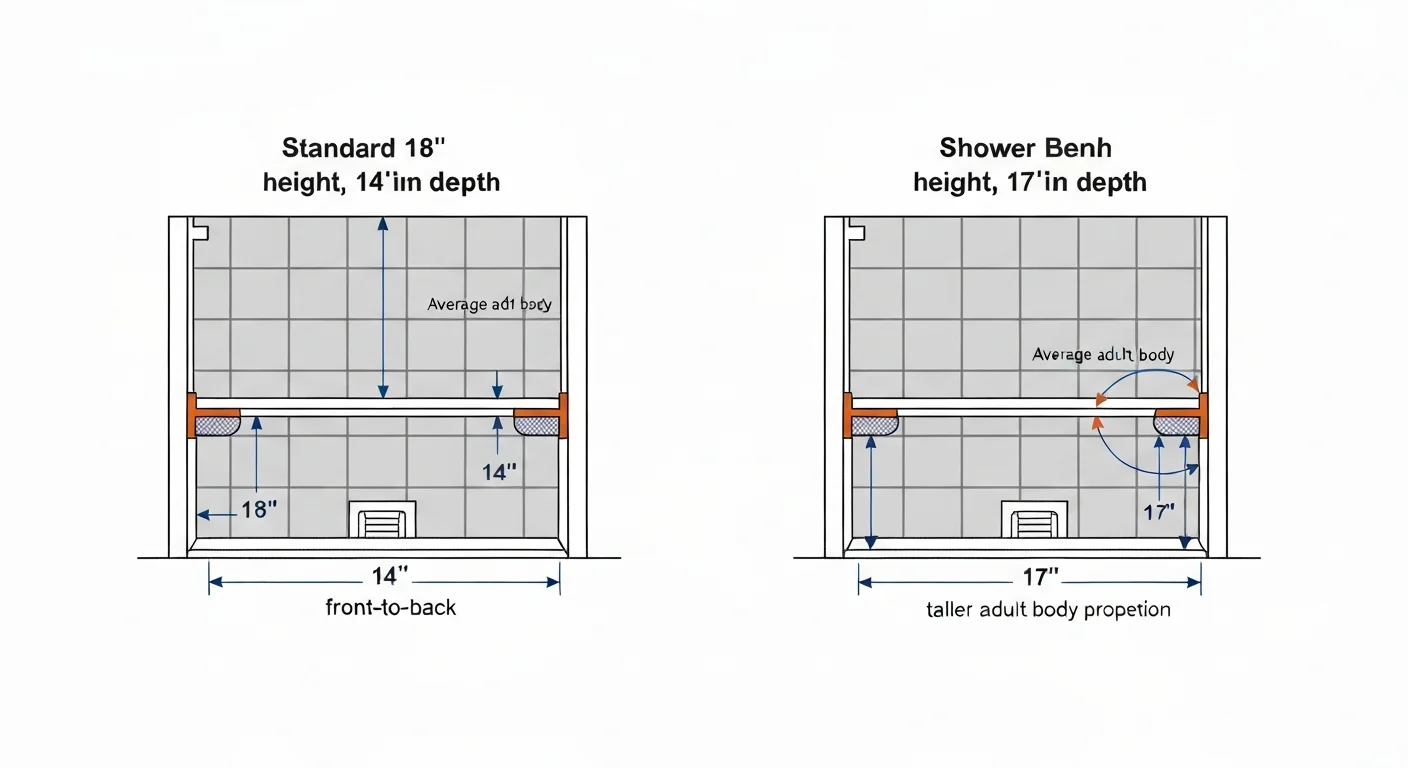
The standard residential shower bench is 18 inches high, 14-16 inches deep, and runs the back wall of a typical shower enclosure. Those dimensions come from ergonomic research that assumed a 50th-percentile adult body — roughly 5'10" tall with proportional limb segments. For users over 6'2" (the 95th percentile for adult men and a meaningful slice of the Idaho population given regional anthropometric trends), the standard bench forces awkward postures: knees up near the chest, lower back unsupported, foot placement too close to the bench legs to maintain stable balance.
The fix isn't complicated — but it requires intentional engineering at design time, because most of the dimensional changes affect framing, plumbing slope, and water management decisions that aren't trivially adjusted after install. This article covers six decisions that make a shower bench actually work for taller users, with the specific dimensional ranges and tradeoffs for each.
For the broader walk-in shower design context — door configurations, threshold heights, layout patterns, glass specification, drainage — see our custom shower design Boise resource. This page focuses specifically on bench ergonomics for users above the 95th percentile in stature, where the standard residential spec produces a functional mismatch.
Adult height in the United States follows a roughly normal distribution centered at 5'9" for men and 5'4" for women, with standard deviations of approximately 3 inches. The 95th percentile for adult men is 6'2"; the 99th percentile is 6'5". For adult women, the 95th percentile is 5'9".
Idaho's population skews slightly taller than the national mean — likely a function of demographics including the state's high proportion of residents of Northern European ancestry, plus dietary and lifestyle factors. Practical implication: roughly 1 in 5 adult men in Idaho is at or above 6 feet tall, and roughly 1 in 12 is at or above 6'2".
The ergonomic significance: standard residential shower bench dimensions were derived from 50th-percentile anthropometric data. A 5'10" user with proportional limbs has a lower-leg length (knee to floor) of about 17 inches and a thigh length (hip to knee) of about 18 inches. The standard 18-inch bench height puts knees at roughly 90 degrees — neutral and comfortable.
For a 6'2" user with proportional limbs, lower-leg length is about 19 inches. The standard 18-inch bench puts the knees above the hips — uncomfortable for sustained sitting, awkward for shaving legs or attending to feet, and physically stressful for the lower back. The user typically compensates by sliding forward, but that destabilizes balance on a wet surface and partially defeats the bench's purpose.
The math: for every inch above 5'10" the user's lower leg is approximately 0.4 inches longer. So 6'2" adds about 1.6 inches to lower-leg length, and 6'6" adds about 2.4 inches. For users at the extreme upper end of the height distribution, the standard 18-inch bench is essentially unusable.
Households where one or more residents are above 6'0" and the shower bench gets daily use.
Non-standard dimensions cost slightly more in framing and tile work — typically $200-$500 above stock pricing.
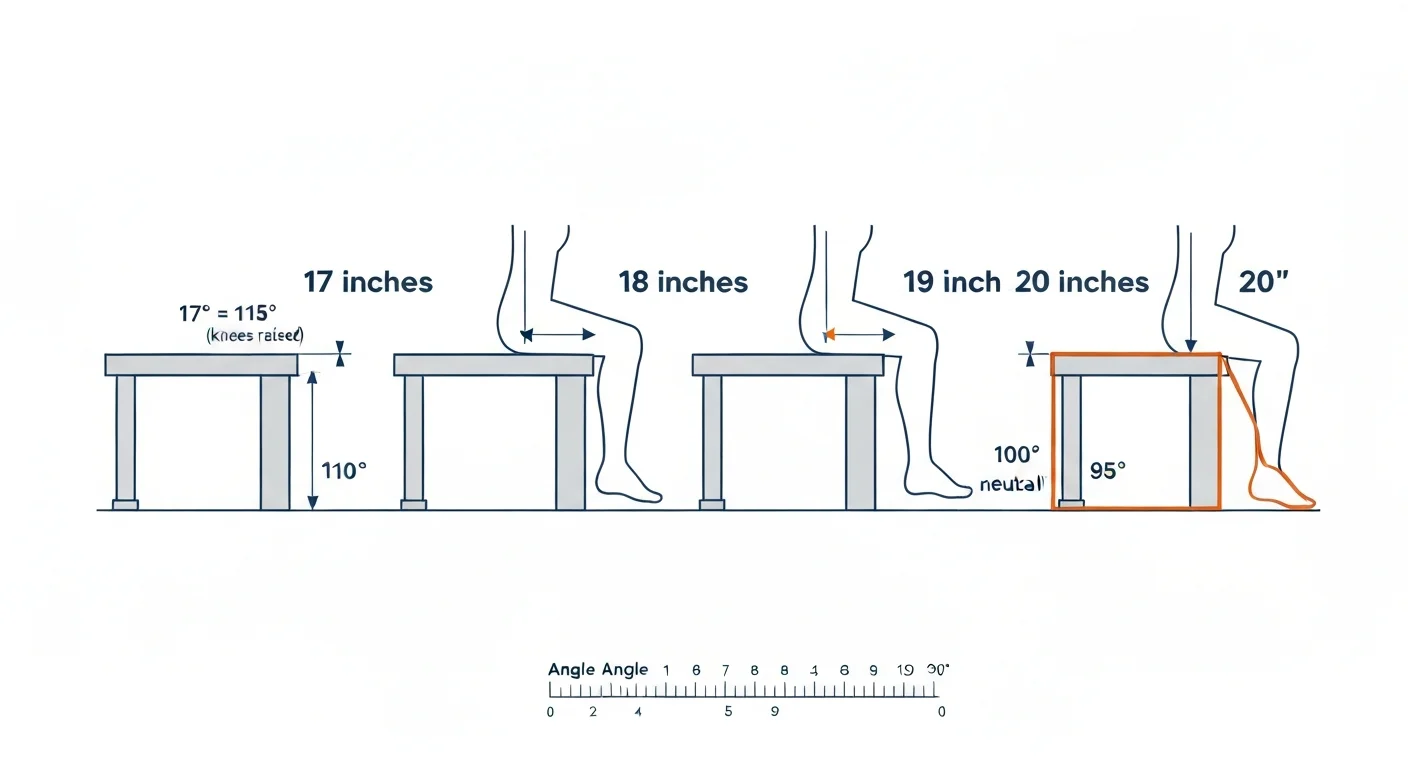
The single most important dimension. Seat height should produce a 95-105 degree knee angle when the user is seated naturally with feet flat on the shower floor — neutral, balanced, and supportive of the lower back.
Sizing guidelines by user height:
Users 5'8" to 5'10": Standard 18-inch seat height. The mainstream spec, and it works.
Users 5'11" to 6'1": 18.5-19 inch seat height. The half-inch matters more than it sounds; the lower-leg geometry shifts measurably.
Users 6'2" to 6'4": 19-20 inch seat height. The standard 18 inches becomes uncomfortable for sustained use; 19-20 inches restores neutral posture.
Users 6'5" and above: 20-21 inch seat height. Above 20 inches, water management and aesthetics start to constrain the design, but for very tall users, the height is necessary.
For households with users at multiple heights — a 6'4" husband and 5'5" wife, for example — the bench can be sized for the taller user and the shorter user uses the bench differently. A 5'5" user on a 19-inch bench has their feet slightly off the floor but can still use it for support and seated activities. The reverse — a 6'4" user on an 18-inch bench — is far more problematic.
Practical example: in a Boise master bathroom where the primary user is 6'4", we built a 19.5-inch seat height in a 60-inch-wide custom shower. The seat depth was 16 inches (one inch above standard), and the front edge was rounded for thigh comfort. The user reports the bench is the highest-value detail in the bathroom — and the dimensional change cost about $300 in additional materials and labor.
Determining the correct seat height for actual users rather than defaulting to the standard 18 inches.
Custom seat heights require custom framing, custom tile cuts, and aren't compatible with prefab shower kits — only custom-built showers.
Standard residential shower benches run 14-16 inches deep (front-to-back). This depth accommodates a typical adult, but for users with longer thighs, 16 inches is the minimum and 17-18 inches is preferable.
Depth implications by user proportions:
Standard thigh length (5'8"-5'11"): 14-16 inch depth. The thigh is fully supported, and the front edge is at the back of the knee, which is the right interface point.
Longer thigh length (6'0"-6'3"): 16-17 inch depth. The thigh is fully supported, with about an inch of clearance behind the knee for circulation.
Very long thigh length (6'4"+): 17-18 inch depth. The thigh is fully supported even with longer femur lengths typical of taller individuals.
The front edge profile matters as much as the depth. A square front edge cuts into the underside of the thigh and creates discomfort during sustained use. The right specification: a rounded "bullnose" or "softened" front edge with a roughly 1/2-inch radius, smoothing the transition between seat top and front face.
For stone benches (quartz, granite, marble), the bullnose adds about $20-$60 per linear foot of bench front to the fabrication cost. For tile-covered benches, the bullnose is achieved by using bullnose-edge trim tile rather than standard field tile at the front edge — a tile-selection decision rather than a fabrication one, with similar minor cost premium.
A second seat-depth consideration: the bench's back edge should sit tight against the wall (no gap that catches soap, dirt, or water). For tile-clad benches, the back-edge tile course is typically tucked behind the wall tile to create a clean seal. For stone benches, the back edge often has a small caulked silicone joint against the wall.
Sustained-use bench scenarios — shaving legs, foot care, post-shower drying — where comfort across longer sit times matters.
Deeper benches consume more shower floor area, which can compete with shower stall size. A 17-inch bench in a 60-inch shower leaves 43 inches of usable floor depth — workable but not generous.
Design a shower bench that actually fits the people using it
Custom shower benches with ergonomic dimensions are part of our standard custom shower design process. Schedule a consultation and we'll size the bench to your household's actual anthropometry rather than the industry default.
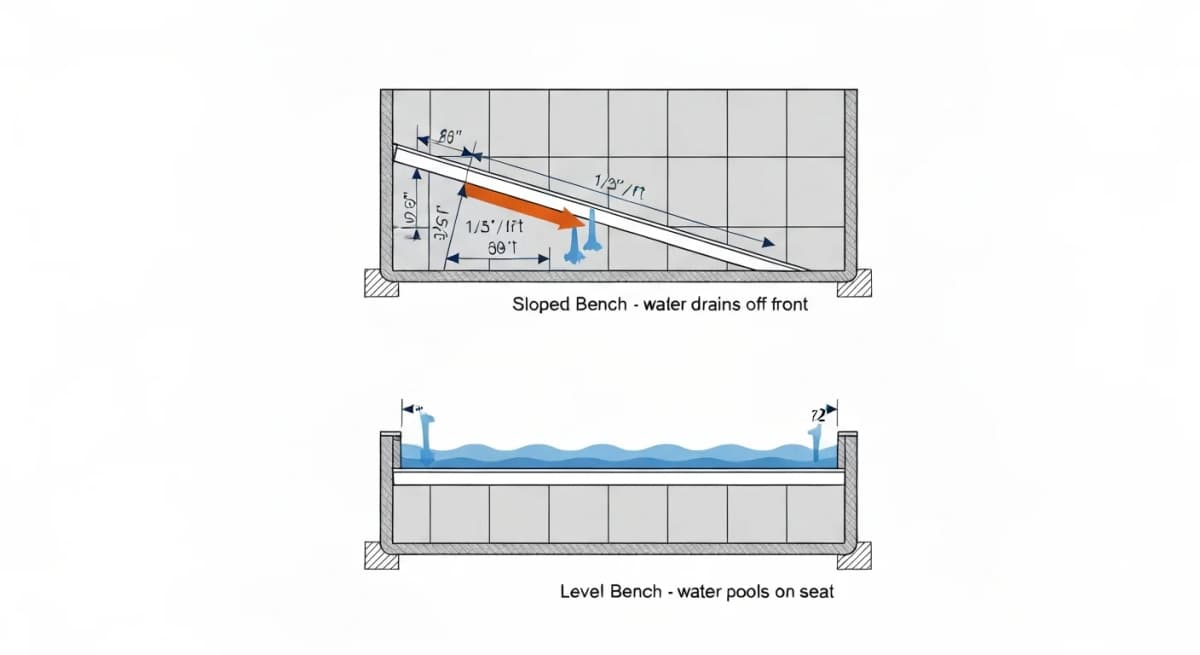
A shower bench should never be exactly level. Even a barely-perceptible slope toward the front edge — 1/4 inch per linear foot — directs water off the bench rather than letting it pool on the seat surface. Pooled water becomes a slip hazard when the user sits, and over time it accelerates wear on the surface finish (especially for stone or grout seal).
The right slope spec:
Slope direction: Always toward the front edge (toward the shower floor). The bench discharges water onto the floor, which has its own slope toward the drain.
Slope magnitude: 1/4 inch per 12 inches of seat depth (so about a 1/4-inch drop across a 16-inch-deep bench). Imperceptible visually but sufficient to direct water.
What slope NOT to do: Sloping toward the back wall (water pools at the back-wall joint and seeps behind tile or stone), sloping toward the sides (creates uneven seat surface and water management issues at the bench-to-wall transitions).
The framing decision: the slope is built into the bench substrate, not into the cladding. For tile benches, the wedge-shape mortar bed creates the slope before tile installation. For stone benches, the slope is cut into the stone slab during fabrication. Adding slope after the fact is essentially impossible without rebuilding the bench.
For Boise's hard water — see our hard-water bathroom fixtures resource — drainage is especially important. Pooled water with high mineral content leaves visible scale rings on the bench surface; consistent drainage prevents these from accumulating. The half-day labor cost of building correct slope at framing is dramatically less than the recurring maintenance cost of dealing with mineral scale on a level bench.
Any custom shower bench. The slope is essentially free at framing time and prevents recurring maintenance issues.
If the bench gets stone or quartz cladding, the substrate slope means the stone slab must be cut to match — additional fabrication cost of $40-$120.
Standard residential shower bench framing assumes a 36-inch-wide bench supporting up to 250 pounds. For wider benches, heavier users, or both, the framing spec needs upgrading.
Framing tiers:
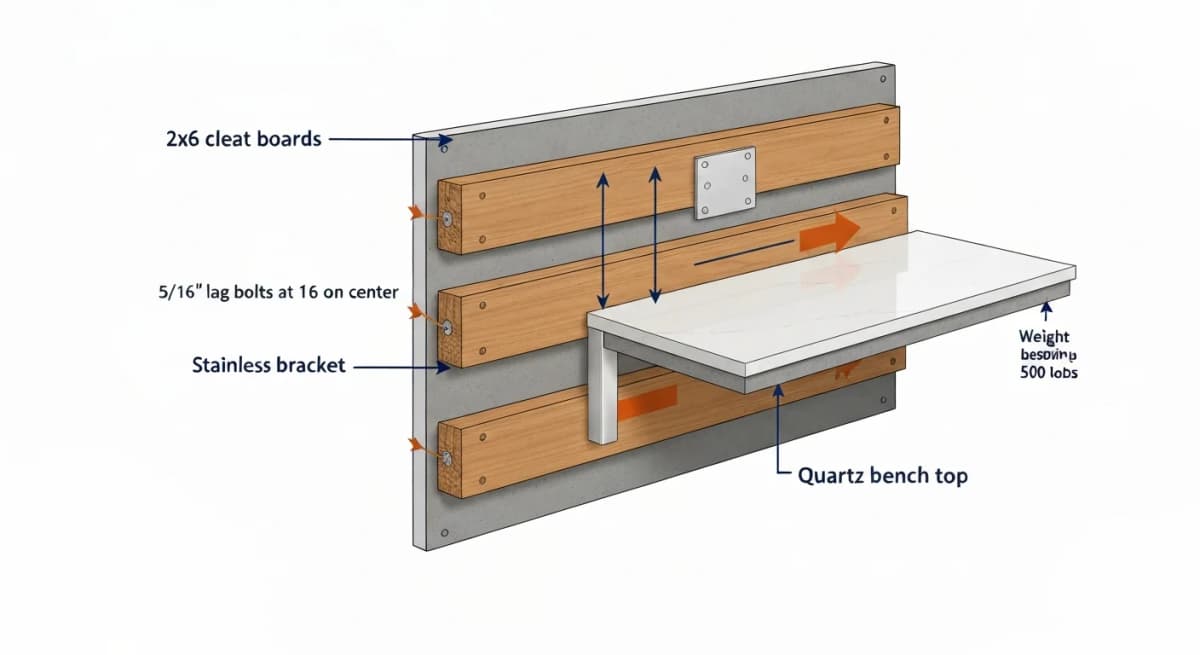
Standard (up to 36" wide, up to 250 lb user): Single 2x6 cleat lag-bolted into 2x4 wall studs at 16" on center. Adequate for typical residential conditions. Bench substrate (concrete board over the cleats) holds the load with minimal deflection.
Heavy-duty (36-48" wide, up to 300 lb user): Two 2x6 cleats stacked, both lag-bolted into studs. Better load distribution and stiffer feel underfoot. Adds about $60-$120 in materials over standard.
Industrial (48-60" wide, or any user over 300 lb): Three 2x6 cleats with stainless steel bracing brackets at corners and one mid-span if the bench is over 48" wide. Lag bolts torqued to spec (typically 50 ft-lb). The brackets are visible during framing but get covered by the bench substrate and cladding, so the final appearance is identical to standard.
Free-standing benches: If the bench doesn't have a wall to anchor into (some custom shower designs use island-style benches), structural steel framing with concrete-bolted feet is the right spec. This is custom millwork, typically $1,200-$3,000 in fabrication cost.
The over-engineering question: is it worth specifying heavy-duty framing for a household without obviously heavy users? Often yes. The materials cost is modest, the install labor is identical, and the bench retains its rigid feel through long-term use. The most common complaint about under-spec'd benches: noticeable deflection when sitting, which feels cheap and ages poorly. For a project where the bench is a prominent feature, the structural upgrade is worth the premium.
Households with users above 250 lb, families with growing children who will use the bench at varying weights over time, or benches wider than 36 inches.
Adds $100-$300 in materials and slight labor premium. No visible difference once finished.
The bench's position within the shower enclosure affects accessibility, water management, and shower flow patterns. Three primary positioning options:
Back-wall bench (most common): Bench runs along the back wall opposite the shower entry. User sits facing the shower entry and the showerhead. Water flow from the showerhead lands in the central shower floor, with the bench remaining mostly dry except for splash. Best for sustained-sit activities (leg-shaving, foot care). Works in showers 24 inches deep or more.
Side-wall bench: Bench runs along a side wall, with showerhead on the opposite wall. User sits sideways to the water flow. Good water management (less direct water exposure on the bench). Works in narrower shower enclosures (32-42 inches deep). Showerhead position becomes more important; should be aimed slightly forward to avoid direct bench spray.
Corner bench: Bench cuts a 45-degree angle across one shower corner. Saves shower floor area compared to a full-wall bench. Less seat depth available (typically 13-14 inches measured perpendicular to the angled seat). Better for short-use scenarios (brief seated rest) than sustained activities.
For taller users specifically, the back-wall option is usually best because it provides the most room for foot placement (knees can extend forward into the central shower floor without obstruction). Side-wall benches force the user to angle their knees toward the shower entry, which can be awkward at extreme heights.
One additional consideration: door swing and bench position interaction. If the shower has a hinged door, the door's swing arc cannot intersect the bench. For benches in glass-enclosed showers, this typically means specifying a sliding door rather than a hinged one, which adds about $400-$1,200 to the door cost. See our walk-in shower installation resource for the full door-configuration discussion.
Optimizing bench placement for the specific shower geometry and primary use pattern.
Each position has tradeoffs — no single option is universally best. The decision is project-specific.
Iron Crest's shower bench design conversations always include explicit anthropometric data on the household members who will use the bench daily. The standard 18-inch seat height is our starting point only if the primary user is in the 50th-percentile height range; for taller users, we adjust upward. We also default to slope (1/4 inch per foot toward the front), heavy-duty framing if the bench is wider than 36 inches or supports users over 250 pounds, and a rounded front edge as standard rather than as an upgrade.
The cost premium for ergonomically optimized bench design typically runs $200-$600 above the standard 18-inch bench spec — a modest investment relative to the bench's daily use over the shower's 20-30 year lifespan. For the broader shower design and installation context, see our Boise shower remodeling page.
Can I add a custom-height shower bench to a prefab shower kit, or does it require a fully custom shower?
Custom-height benches essentially require a custom-built shower. Prefab shower kits (acrylic, fiberglass, modular) come with a fixed bench dimension — typically 18 inches high — molded into the surround. The bench can't be easily modified without compromising the structural integrity and waterproofing of the surround. If you need non-standard bench dimensions, plan on a custom-built tile or stone shower. The cost premium for custom over prefab is typically $4,000-$12,000 depending on size and finishes, with the bench being one part of the broader custom build.
How much weight should a shower bench be designed to support?
Industry baseline is 300 pounds for residential shower benches. The standard framing we describe (single 2x6 cleat) handles this with reasonable safety margin. For benches that may support multiple users simultaneously (parent assisting a child, or a couple using the bench together), spec for 500 pounds — heavy-duty framing tier. For specifically heavy users (over 300 pounds individually), industrial framing is the right call. The framing decision is essentially free at construction time; the upgrade is only relevant if we're building a new bench anyway. Retrofit of structural framing in an existing bench is significantly more expensive.
What's the most common shower bench design mistake homeowners make?
Specifying the bench late in the design process, often after the shower enclosure dimensions have been locked in. The bench dimensions interact with the overall shower floor area, the door configuration, the showerhead position, and the drainage layout. Designing the bench early — at the same time as the shower layout — produces a coherent design where each element fits the others. Designing the bench late often produces compromises: a too-shallow bench because the shower wasn't sized to accommodate a proper one, or a bench that conflicts with the door swing because the door was selected first.
Does a shower bench reduce the value of the shower for resale, since not all buyers want one?
Modestly mixed for resale. Some buyers specifically want a shower bench (older buyers, buyers with mobility considerations, anyone valuing the convenience for leg-shaving and foot care). Other buyers see the bench as consuming valuable shower floor area and prefer a clear walk-in shower. For Boise homes priced below $500,000, the bench is neutral to slightly positive on resale. For homes above $500,000, especially in target demographics for older buyers, the bench is positively valued. The honest install rationale: a shower bench is primarily a use-decision (does the household value it?) rather than a resale-decision. If you'll use it, install it.
Is there a building code requirement for shower bench dimensions or capacity?
No specific residential code requirement. The International Residential Code (IRC) covers shower space minimums (typically 30x30 inch minimum interior dimension) but doesn't specify bench dimensions. Commercial accessibility code (ADA) does specify bench dimensions for accessible-design showers — 17-19 inch height, minimum 15 inches deep, located on the side wall — but residential installations don't have to follow ADA unless the shower is being installed for accessible use specifically. For aging-in-place or universal design installations, ADA-compliant dimensions are a reasonable target even when not legally required.
Design a shower bench that actually fits the people using it
Custom shower benches with ergonomic dimensions are part of our standard custom shower design process. Schedule a consultation and we'll size the bench to your household's actual anthropometry rather than the industry default.
These pages go deeper on the topics linked from this article. Read them before your consultation and you'll come in with sharper questions and a clearer scope.
The following government agencies, industry organizations, and official resources provide additional information relevant to your remodeling project.