
Multi-Head Shower Systems in Boise: How Your Water Pressure Decides Whether It Works
Rain heads, body sprays, and dual-control multi-head showers are a luxury upgrade in upscale Boise master baths. Whether the system delivers the experience depends on your home's water pressure and supply-line capacity. Real numbers, not marketing.
Quick answer
A $15 pressure gauge from any hardware store, threaded onto an outdoor hose bib, reads static water pressure in 30 seconds. Test in the morning before significant household water use (this gives you the baseline static pressure).
Multi-head shower systems — rain heads paired with handheld sprayers, body spray panels along the walls, dual showerheads, and the various combinations of these — are a popular spec in upscale Boise master bath remodels. The marketing imagery shows a thick column of rain water from above paired with body sprays drenching the user from all sides. The reality depends entirely on water pressure and supply-line capacity. A multi-head system specced beyond what the home's plumbing can deliver produces dribbles instead of the experience the homeowner expected.
Boise's municipal water pressure varies considerably by elevation and zone — typical residential pressures range from 45 PSI in low-elevation older Boise neighborhoods to 80+ PSI in newer foothills developments served by booster pumps. Multi-head systems require 8-15 GPM (gallons per minute) of combined flow, which strains 3/4-inch supply lines and produces pressure starvation if the supply infrastructure isn't sized correctly. Below are the calculations, the supply-line decisions, and the pressure-boost option for the configurations that exceed what the home's existing plumbing can support.
For broader luxury shower feature context (rain heads, body sprays, smart controls), see our luxury shower features guide. For shower cost planning across all spec tiers, see our shower remodel cost page. This page is specifically about water pressure and supply-line math that determines whether a multi-head system actually performs.
Multi-head shower systems are governed by two physical parameters: pressure (PSI, pounds per square inch) and flow rate (GPM, gallons per minute). Each fixture has minimum requirements for both. Stacking multiple fixtures means stacking their combined flow rate — and that stacked flow draws from a supply line with fixed capacity.
Typical fixture flow rates at 60 PSI inlet pressure (the standard pressure that fixture manufacturers test at):
Standard showerhead: 2.0-2.5 GPM (federal WaterSense max is 2.5 GPM since 2010). Older heads can exceed this.
Rain head (overhead, 8-12 inch diameter): 2.5-5 GPM depending on model. Premium luxury rain heads (18-inch ceiling-mounted) can run 8-15 GPM.
Handheld showerhead (on slide bar or wall mount): 1.8-2.5 GPM.
Body spray (single panel, 4-jet pattern): 1.5-2.5 GPM each.
Foot wash or shoulder spray: 1.5-2 GPM each.
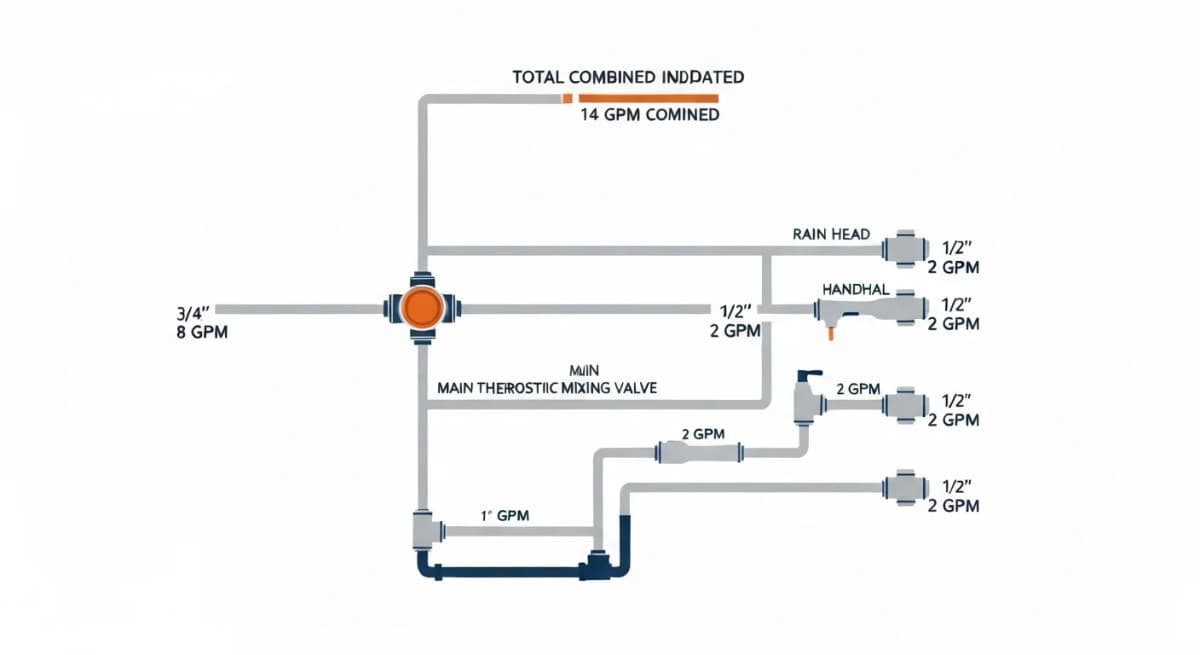
A typical "luxury multi-head" configuration with one rain head (4 GPM), one handheld (2.5 GPM), and three body sprays (2 GPM each = 6 GPM total) requires 12.5 GPM combined flow. That's roughly 5x what a standard single-head shower needs and pushes the supply-line capacity envelope for most residential plumbing.
The math: if the home's supply line can only deliver 10 GPM at 60 PSI, the 12.5 GPM demand causes pressure starvation. Each fixture operates below its rated pressure, and the experience degrades — rain head produces dribbles instead of cascades, body sprays produce sprays instead of streams. The customer gets a system that doesn't perform as the marketing implied.
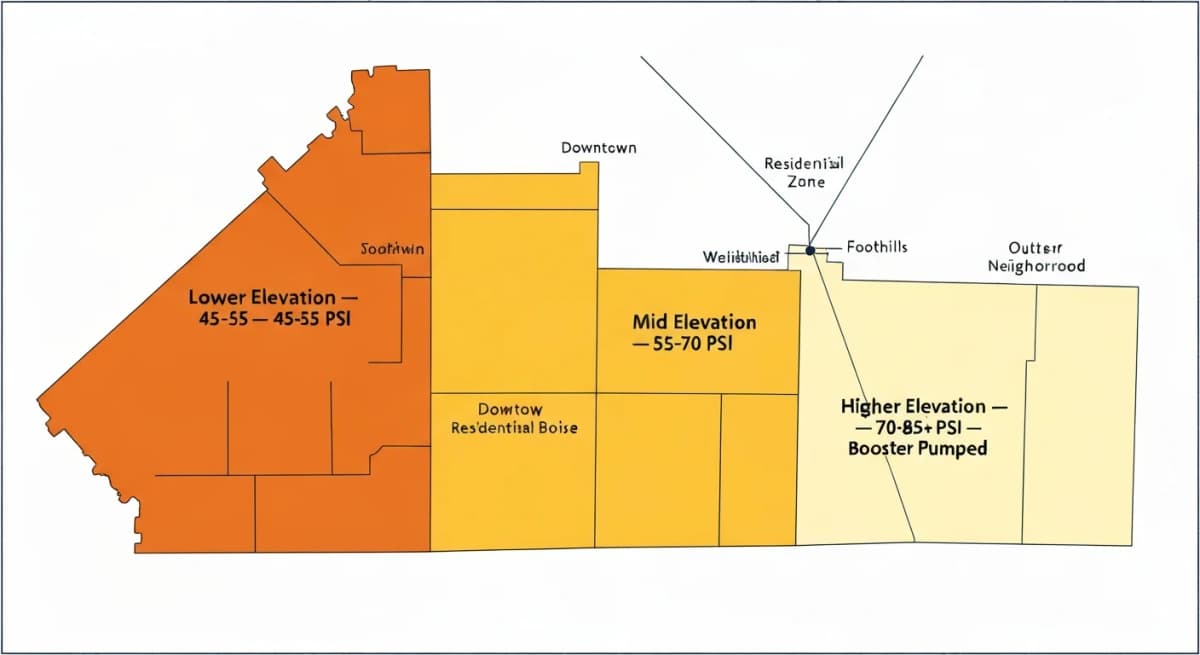
Boise's municipal water system is gravity-driven from elevated storage tanks, supplemented by booster pumps in higher-elevation neighborhoods. Pressure at the residential service entrance varies meaningfully across the metro area:
Lower-elevation neighborhoods (45-55 PSI typical): Downtown Boise core, Bench neighborhoods near State Street, parts of Garden City, lower East End. The pressure is adequate for standard fixtures but marginal for multi-head systems.
Mid-elevation neighborhoods (55-70 PSI typical): Most North End above State Street, East End above Boise River, Southeast Boise, much of Hyde Park, Vista. Adequate for multi-head with proper supply line sizing.
Higher-elevation neighborhoods (70-85+ PSI typical, often booster-pumped): Boise Foothills, Northwest Boise (Hill Road), parts of Eagle, Harris Ranch, Northwest Heights. These areas frequently have pressure-reducing valves on the home side to bring pressure down to a safe range (above 80 PSI is hard on residential plumbing components).
The diagnostic check: a $15 pressure gauge from any hardware store, threaded onto an outdoor hose bib, reads the static water pressure at your home. Run the test in the morning when household water use is low to get a reliable baseline. Document the reading; share with your contractor during shower design.
If your home is in a lower-elevation zone with 45-55 PSI baseline, multi-head systems require either smaller fixture counts (rain + handheld only, no body sprays) or an inline pressure-boost system (see item 7). If your home is in a mid- or higher-elevation zone, multi-head systems work with proper supply-line sizing.
Standard residential plumbing uses 1/2-inch or 3/4-inch copper or PEX supply lines. Each pipe diameter has a different flow capacity at typical residential pressures:
1/2-inch supply line: Approximately 4-6 GPM at 50 PSI. Adequate for one or two fixtures simultaneously. Standard for individual fixture supply (single showerhead, single faucet).
3/4-inch supply line: Approximately 10-14 GPM at 50 PSI, 12-18 GPM at 70 PSI. Standard for kitchen and bathroom branch supplies serving multiple fixtures.
1-inch supply line: Approximately 20-26 GPM at 50 PSI. Required for multi-head shower systems with 12+ GPM combined demand. Less common in residential construction but available.
The supply line sizing math for multi-head:
Configuration A: Rain + Handheld only (6-7 GPM): 3/4-inch supply adequate.
Configuration B: Rain + Handheld + 1 Body Spray (8-10 GPM): 3/4-inch supply marginal at low pressure; 1-inch supply recommended.
Configuration C: Rain + Handheld + 3 Body Sprays (12-15 GPM): 1-inch supply line required.
Configuration D: Full luxury with multiple rain heads, body sprays, foot wash, etc. (15-22 GPM): 1-inch supply line required, often with a dedicated branch from the main service entrance to bypass the home's standard plumbing distribution.
For Boise homes with existing 1/2-inch or 3/4-inch supply lines serving the bathroom (the standard residential build), upgrading to 1-inch for multi-head shower scope requires running new supply lines from the main service entrance or water heater to the bathroom. Cost: $1,200-$3,500 in additional plumbing scope depending on distance and accessibility.
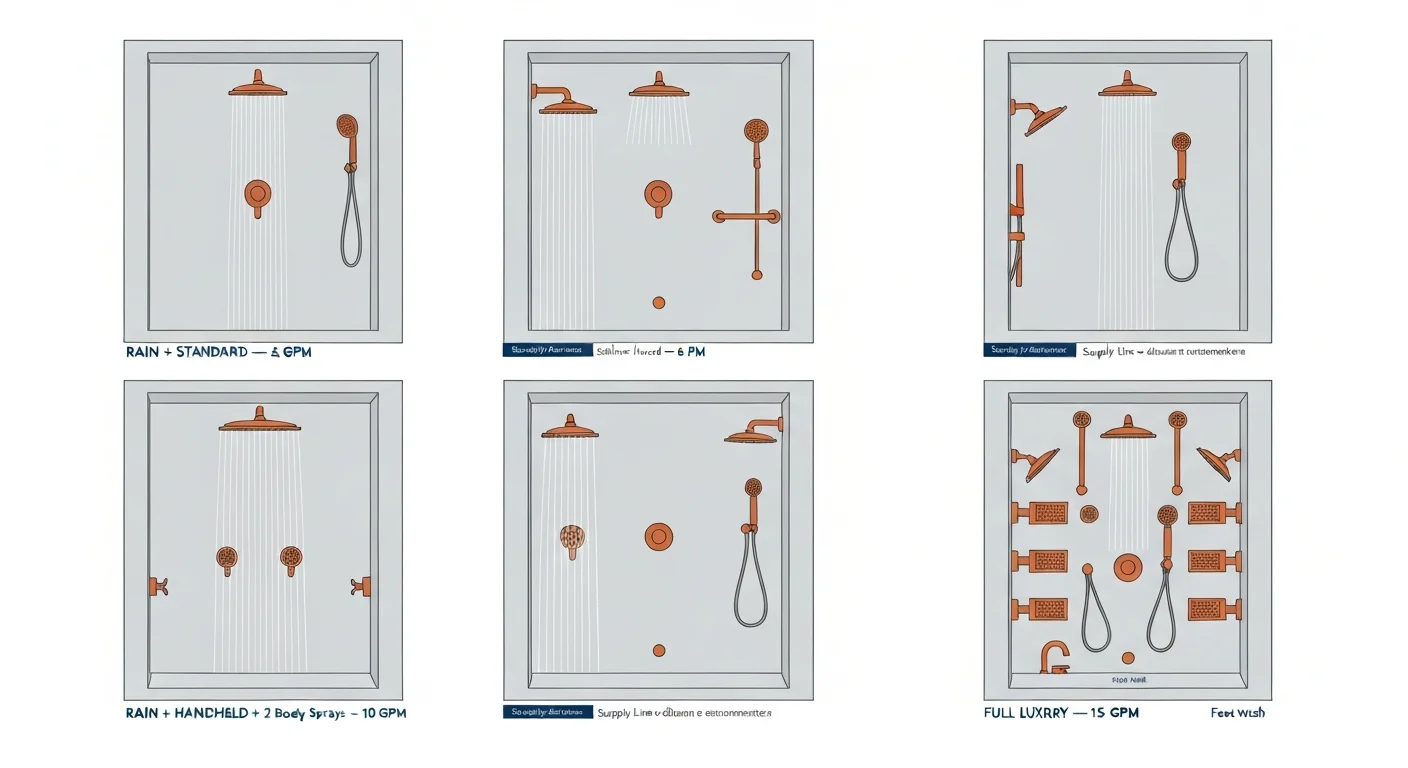
The four configurations we install most often in Boise, with realistic combined flow rates:
Configuration 1: Rain Head + Standard Showerhead (Side-Mount). 4 GPM rain + 2.5 GPM standard = 6.5 GPM combined. Works in any Boise pressure zone with standard 3/4-inch supply. Best value for upscale-feel without supply-line upgrade. Cost: $800-$1,800 for the fixture package.
Configuration 2: Rain Head + Handheld on Slide Bar. 4 GPM rain + 2 GPM handheld = 6 GPM combined. Same supply requirements as Configuration 1. Handheld adds flexibility for cleaning, washing pets, and accessibility. Cost: $1,000-$2,500.
Configuration 3: Rain Head + Handheld + Two Body Sprays. 4 GPM rain + 2 GPM handheld + 2 × 2 GPM body sprays = 10 GPM combined. Requires 3/4-inch supply at minimum, 1-inch recommended for higher pressure environments. Pressure-boost may be needed in low-pressure neighborhoods. Cost: $1,800-$4,500 for fixture package + supply line upgrade if needed.
Configuration 4: Full Luxury (Multiple Rain Heads + Body Sprays + Handheld + Optional Foot Wash). 8-22 GPM combined depending on count. Requires 1-inch supply minimum, often with dedicated main-service branch. Pressure-boost recommended for any Boise neighborhood below 65 PSI baseline. Cost: $3,500-$9,000+ for fixture package + supply line upgrade.
For most Boise multi-head shower remodels, Configuration 2 or 3 is the practical sweet spot — meaningful luxury upgrade over single-head without the supply-line complications of full luxury spec.
Plan a multi-head shower that actually delivers the experience
Multi-head systems succeed or fail based on water pressure and supply-line capacity — not fixture brand. Schedule a consultation and we'll measure your home's pressure, model the configuration math, and quote the install honestly.
Rain heads are the most pressure-sensitive component in multi-head systems. Unlike standard showerheads that use small jet orifices to maintain pressure (and produce more forceful streams), rain heads use a larger-diameter sprinkler-style face that requires consistent high pressure to deliver the "rain" effect across the full surface area.
Rain head pressure requirements by size:
8-inch rain head (small): Operates acceptably from 35 PSI; optimal performance from 50 PSI. Acceptable in any Boise pressure zone.
12-inch rain head (mid-size): Operates acceptably from 45 PSI; optimal performance from 55 PSI. Marginal in lower-elevation Boise neighborhoods.
16-inch rain head (large): Requires 55+ PSI for acceptable performance; 65+ PSI for optimal. Pressure-boost may be needed in lower-elevation zones.
18+ inch ceiling-mounted rain head (luxury): Requires 65+ PSI for acceptable performance; 75+ PSI for optimal. Pressure-boost typically required in lower-elevation zones.
The pressure-vs-flow trade-off: rain heads use the available pressure to push water across the large face area. At low pressure, the water dribbles from the edge ports and barely emerges from the center. At adequate pressure, the rain effect develops across the full face. The visual difference between "marketing rain head" and "actual rain head" is largely a function of inlet pressure, not the fixture brand or quality.
For multi-head systems combining rain head with body sprays, the rain head typically gets the dedicated higher-pressure line to ensure proper performance. Body sprays can tolerate slightly lower pressure without visual impact because they don't depend on covering a large face area.
Body spray panels (also called body jets or shower towers) are wall-mounted fixtures that project horizontal streams at various body heights. Typical configurations include 4-jet panels at standardized heights (calves, hips, lumbar, shoulders) or individual single-jet panels positioned by the user.
Body spray realities:
Flow rate per spray: 1.5-2.5 GPM at 60 PSI. Federal water efficiency standards apply (2.5 GPM max per fixture in most jurisdictions); some premium body sprays operate at 2.0-2.2 GPM by design.
Mounting positioning: Body sprays work best when positioned approximately 30 inches apart horizontally and at heights corresponding to specific body zones (calf level at 18 inches off the floor, hip level at 36 inches, shoulder level at 54-60 inches). Standard residential body spray panels integrate four jets at these heights.
Independent control: Each body spray or pair of sprays typically has independent shut-off control via a diverter valve, allowing the user to activate one set of sprays at a time rather than all simultaneously. This both reduces the effective flow demand and gives the user variable experience.
Common limitation: Body sprays produce streams that the user perceives as the system "doing something." But the actual sensation is less full-body wash than the marketing implies. Most users report adjusting body sprays to lower flow rates once installed because the high-flow experience feels uncomfortable rather than luxurious. The realistic implementation: install 2-3 body sprays rather than 4-6, with independent diverter control for which subset operates at any time.
Code consideration: NEC 110.26 prohibits electrical outlets within 36 inches of body spray heads (and other shower fixtures). For multi-head showers with bodies sprays, the electrical layout has to account for this clearance — typically pushing GFCI outlets and any electrical features further from the shower than would be required for a standard single-head shower.
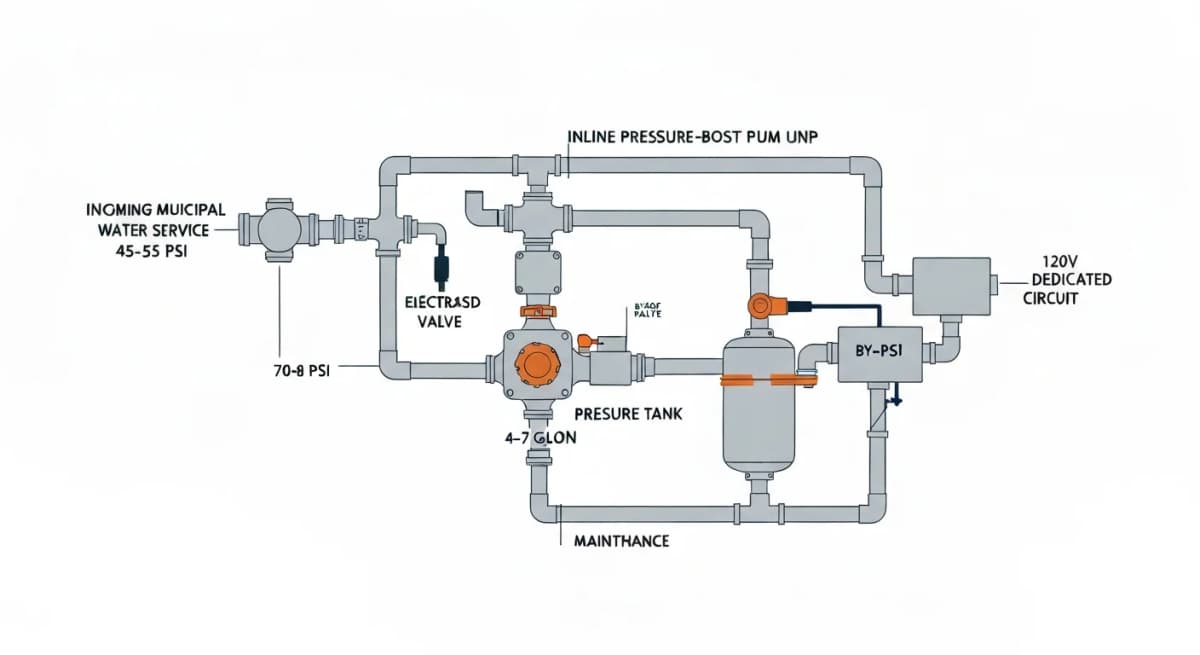
For Boise homes in lower-elevation neighborhoods (45-55 PSI baseline) wanting multi-head shower systems, an inline pressure-boost system is the practical solution. The system uses an electric pump and pressure tank to increase incoming water pressure before it reaches the shower.
Typical pressure-boost system specifications:
Pump capacity: 12-18 GPM at 70-80 PSI. The system increases pressure from the 45-55 PSI baseline to a higher pressure suitable for multi-head fixtures.
Pressure tank: 4.4-7.8 gallon expansion tank to maintain pressure stability during use and reduce pump cycling.
Whole-house vs dedicated: A whole-house pressure-boost system boosts pressure for every fixture in the home. A dedicated shower-supply boost only affects the shower line. The whole-house approach is typically used; it benefits every water-using fixture and prevents pressure imbalances when the shower is in use.
Installation location: Pressure-boost systems install in the main water supply line, typically near where the supply enters the home (mechanical room, basement, utility area). They require electrical service (typically a 120V dedicated circuit) and access for maintenance.
Cost: $1,800-$3,500 installed for a whole-house pressure-boost system. The system has finite lifespan (typically 10-15 years) and requires occasional service.
Trade-offs: Pressure-boost systems add operating noise during pump cycles, increase electrical usage modestly, and add a potential failure point in the home's plumbing system. They're worth it for households committed to multi-head shower experience but not casually justified.
For most lower-elevation Boise neighborhoods considering multi-head shower upgrades, the pressure-boost decision is binary — either the system performs at acceptable pressure or it doesn't. The investment in pressure boost transforms a marginal install into a properly functioning one.
Lower-elevation Boise homes (45-55 PSI baseline) where homeowners want full multi-head systems. Without pressure-boost, the system underperforms.
Adds $1,800-$3,500 to project cost, adds pump as a potential failure point, adds modest operating noise and electrical usage.
Multi-head shower systems require careful temperature control because multiple fixtures share the same hot and cold supply, and pressure fluctuations between fixtures can cause rapid temperature changes (a body spray suddenly running hot if cold supply is drawn elsewhere, for example).
The right valve solution for multi-head systems: thermostatic mixing valves (TMV) rather than pressure-balancing valves. The difference matters:
Pressure-balancing valves (standard residential): Maintain temperature within +/-3°F by adjusting hot/cold ratio when pressure changes. Adequate for single-fixture showers but vulnerable to temperature swings when multiple fixtures operate simultaneously.
Thermostatic mixing valves (premium): Maintain temperature within +/-1°F regardless of pressure changes. Built-in temperature limit prevents scalding. Each shower zone can have its own thermostatic valve, allowing different temperature preferences across zones.
For multi-head systems, the typical configuration is:
Main thermostatic mixing valve: Located behind the shower wall, provides primary temperature control with built-in temperature limit. Sets the base temperature for the entire system.
Zone diverter valves: Allow user to switch between rain head only, body sprays only, handheld only, or combinations. Each diverter has independent water-flow control without affecting temperature.
Optional individual temperature controls: Premium installations allow per-zone temperature variation (rain head slightly cooler than body sprays, for example). Less common but available in luxury spec.
Cost: thermostatic mixing valve setup adds $400-$900 to the rough-in plumbing scope vs standard pressure-balancing. The temperature stability benefit is significant for multi-head systems — without it, the user experience degrades as ambient pressure fluctuations cause uncomfortable temperature swings during use.
Iron Crest's multi-head shower design starts with the home's water pressure measurement — a 5-minute pressure gauge test at an outdoor hose bib that establishes the baseline before any design decisions. The pressure reading determines which fixture configurations are realistic and whether a pressure-boost system needs to be included. We model the supply-line sizing requirements, calculate the combined flow demand of the proposed configuration, and verify that the home's existing supply infrastructure can support it (or quote the upgrade scope if it can't).
The most common Boise multi-head shower remodel project we run is Configuration 2 (rain head + handheld) or Configuration 3 (rain + handheld + 2 body sprays) — meaningful luxury upgrade over single-head without the supply-line complications of full luxury spec. For homes in lower-elevation neighborhoods wanting the full luxury experience, the pressure-boost system is the right addition rather than the wrong spec. For broader shower remodel context, see our shower remodeling service overview and the luxury shower features guide.
How do I know my home's water pressure before talking to a contractor?
A $15 pressure gauge from any hardware store, threaded onto an outdoor hose bib, reads static water pressure in 30 seconds. Test in the morning before significant household water use (this gives you the baseline static pressure). Test again during peak household use (multiple fixtures running) for a working-pressure reading. The difference between static and working pressure tells you how much your home's supply infrastructure can deliver under load. For multi-head shower viability, static pressure of 55+ PSI and working pressure of 40+ PSI under typical household load suggests multi-head systems should work without pressure-boost. Below these thresholds, pressure-boost becomes necessary for proper multi-head performance.
Can I add multi-head fixtures to my existing shower without replumbing?
Sometimes yes for limited configurations, no for ambitious ones. Adding a handheld showerhead on a slide bar to an existing single-head shower typically requires just a tee fitting on the existing supply line — minimal plumbing scope, $300-$700 in additional work. Adding body sprays or upgrading to a multi-head system with rain + handheld + body sprays requires running new supply lines, installing a new mixing valve, and rough-in for each new fixture — typically $1,800-$4,500 in additional plumbing scope. The retrofit approach also typically requires opening the shower wall (existing tile coming off, new rough-in installed, new tile installed) — destructive enough that doing the multi-head upgrade during a planned shower remodel is more cost-effective than as a standalone retrofit.
What's the typical cost for a multi-head shower system in a Boise master bath remodel?
Total fixture and plumbing scope ranges widely: Configuration 1 (rain + standard side-mount): $1,000-$2,200 added to base shower scope. Configuration 2 (rain + handheld): $1,200-$2,800. Configuration 3 (rain + handheld + 2 body sprays): $2,500-$5,500 (includes supply-line upgrade and additional plumbing scope). Configuration 4 (full luxury): $4,500-$12,000 depending on fixture choices and supply-line complexity. Add $1,800-$3,500 if pressure-boost is needed. For most Boise master bath remodels including a multi-head shower upgrade, the total upgrade premium runs $3,000-$8,000 above standard single-head shower scope.
Will a multi-head shower significantly increase my water and energy bills?
Yes, in proportion to use. A typical single-head shower uses 2.5 GPM × 8 minute shower = 20 gallons per shower. A multi-head system at 8-15 GPM combined × 8 minute shower = 64-120 gallons per shower. The water usage increase is 3-6x per shower session. At Boise water rates and assuming daily shower use, the annual water-bill impact is approximately $40-$120 increase. The hot water heating energy increase is proportional — water heater works harder to maintain temperature during high-flow showers. For households with HPWH (heat pump water heater), the recovery time may be inadequate for back-to-back multi-head showers, sometimes requiring water heater capacity upgrade. The operational cost is meaningful but not extreme.
Are multi-head shower systems worth the cost for Boise resale value?
Modestly in upscale price tiers, neutral in mid-range, mildly negative in budget. For homes priced above $700,000 (Eagle, Harris Ranch, foothills, premium North End), multi-head shower in the master is expected by upmarket buyers — its absence is more noticeable than its presence. For homes $400-$700k, multi-head is a positive feature but doesn't drive measurable list-price premium. For homes under $400k, multi-head can read as 'over-improved for the neighborhood' and sometimes triggers buyer questions about maintenance and operating cost. The honest install rationale: multi-head should be a homeowner-use decision, not a resale ROI play. For households who'll actually use the luxury feature, the install makes sense; for households who won't use it, the cost doesn't pay back.
Can I install multi-head shower fixtures myself, or does it require a plumber?
Shower valve and rough-in work requires a plumbing permit and inspection; Idaho lets a homeowner permit work on their own primary residence, but the rough-in is inspected to the same standard. While the visible fixtures themselves (showerheads, body sprays) can sometimes be swapped by a homeowner doing like-for-like replacement, the rough-in plumbing behind the wall (supply lines, mixing valves, diverter valves) requires professional installation. Boise PDS plumbing inspections verify the rough-in work as part of permit compliance. For a typical multi-head shower install, the plumbing labor is 30-50% of the total scope — DIY savings are limited and inspection compliance is more straightforward with professional installation. We don't recommend DIY for multi-head systems.
Plan a multi-head shower that actually delivers the experience
Multi-head systems succeed or fail based on water pressure and supply-line capacity — not fixture brand. Schedule a consultation and we'll measure your home's pressure, model the configuration math, and quote the install honestly.
These pages go deeper on the topics linked from this article. Read them before your consultation and you'll come in with sharper questions and a clearer scope.
The following government agencies, industry organizations, and official resources provide additional information relevant to your remodeling project.