
Caregiver-First Bathroom Design: 7 Features Most Accessible Remodels Miss
Most accessible bathroom remodels design for the person being bathed. The caregiver — adult child, hired aide, spouse — gets whatever's left. Here are 7 features designed for the helper specifically, designed around the caregiver's workflow.
Quick answer
ADA accessible design is written for the individual user — the person with limited mobility, low vision, wheelchair use, or similar — navigating the space alone or with minimal assistance.
Bathing another adult — a parent, a partner, an aging family member — is one of the most physically demanding caregiving tasks. The caregiver bends, reaches, supports body weight, manages water, manages soap, and frequently does all of it while standing in a slippery enclosure that was designed for the person being washed. Standard accessible bathroom remodels in Boise — and the resources that guide them — focus almost entirely on the bather's safety: grab bars, curbless entry, transfer benches, anti-slip flooring. All of those features are necessary. None of them address the helper's body mechanics.
This article covers 7 design features that protect the caregiver's back, knees, and shoulders while supporting better care for the bather. Some are simple geometry decisions made during the bathroom layout (door swing direction, anti-fatigue surface on the caregiver side). Some are plumbing pre-roughs that cost very little during a remodel and a fortune to add later. All work best when the caregiver — usually an adult child caring for an aging parent — is part of the design conversation, so the result is a bathroom that works for both people.
For the broader accessible bathroom design context — grab bars, curbless entry, transfer benches, the bather-focused features that make up most "ADA bathroom" content — see our accessible bathroom remodels guide and aging-in-place remodeling guide. This page is specifically about the caregiver's body mechanics, which most accessibility guides don't cover.
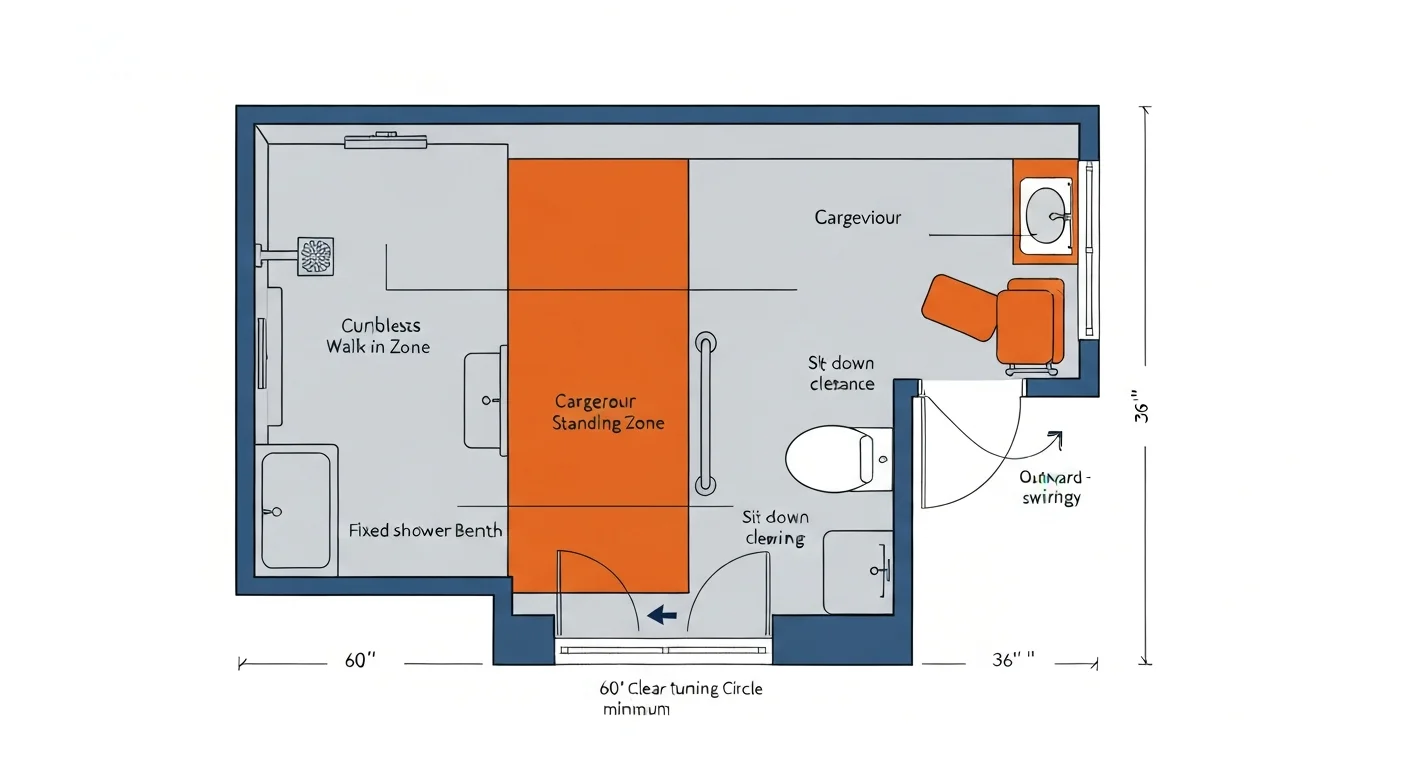
Standard "accessible bathroom" design follows ADA guidelines that were written for an individual user — a person navigating the space alone, possibly with a wheelchair or walker. The design parameters target reach ranges, clearance dimensions, and grab-bar placement for that single user. Caregiver-assisted bathing is a different scenario entirely. The bather is often less mobile than the standard ADA-target user (full or partial transfer assistance required, sometimes seated throughout the session). The caregiver is mobile but doing physically demanding work in a wet environment for 20–60 minutes per session.
The result is that a bathroom designed strictly to ADA accessibility code can be safe for the bather but punishing for the caregiver. The helper stands on cold tile, reaches across the bather's body to operate fixtures designed for the bather's reach range, and bends repeatedly without ergonomic support. After months or years of this, caregivers develop the back, knee, and shoulder injuries that show up in occupational-health data for home health aides.
The seven features below address this gap. Each protects the caregiver's physical health while not compromising — and often improving — the bather's experience. The cost premium for adding all seven during a Boise accessible bathroom remodel is typically $2,000–$5,000 above standard accessible spec. Most are zero or near-zero cost during a remodel but expensive to retrofit later.
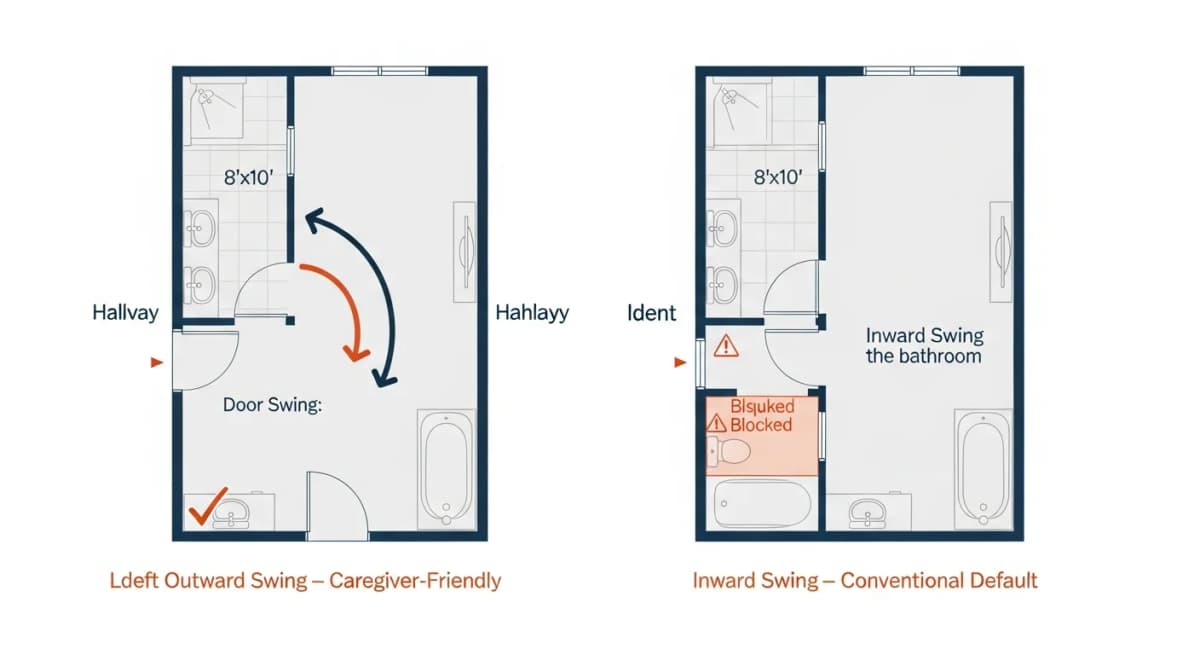
Bathroom doors in U.S. residential construction default to inward swing. The reasoning is privacy and habit — the door blocks the view in when opened. For an accessible bathroom with a caregiver, that default produces two problems: the door consumes 8–10 square feet of usable floor space when open (in a space already constrained by the bather's mobility needs), and if the bather falls or collapses against the door, the caregiver outside can be unable to push the door open against the body.
Outward swing solves both problems. The door swings into the hallway when opened, freeing the full bathroom floor for the caregiver. If the bather collapses against the door from inside, the caregiver can pull the door open without obstruction. The trade-off is that the open door slightly impedes hallway flow — typically manageable in residential corridors that are 36–42 inches wide.
The doorway width itself should be a 36-inch minimum (not the 32-inch residential default) to allow a transfer chair, walker, or two-person assist to pass through. A 36-inch door is meaningfully wider than standard and can require modifying the rough opening during the remodel — typically a $200–$500 framing modification but worth catching during design phase rather than as a retrofit.
Door hardware matters too. Lever handles (not knobs) for both the caregiver (who often has wet or soapy hands) and the bather (who may have arthritis or limited grip strength). Lockable hardware that includes an exterior emergency-release option so a caregiver can unlock the door from outside if the bather closes it inadvertently.
Every caregiver-supported bathroom. Single highest-impact design decision in the list.
Outward swing is non-standard. Some homeowners need 1–2 visits to adapt to the new orientation. None we've worked with has wanted to switch back.
ADA guidelines specify a 60-inch turning circle for wheelchair users. The same dimension is useful for caregiver positioning — it provides enough floor space for the caregiver to stand alongside the bather without crowding, to step backward without bumping into a wall, and to maneuver assistive equipment (transfer board, hoist, walker) in and out of the space.
Standard accessible bathroom layouts often achieve the 60-inch turning circle by positioning the toilet and vanity along a single wall, leaving the opposite side of the bathroom clear. For caregiver scenarios, the clear-side position is critical because the caregiver needs to be on the user's stronger side during transfers (clinical practice — the caregiver assists the weaker side from the stronger side to avoid being pulled down if the bather falls).
In bathrooms tight enough that 60-inch turning is impossible (some retrofit scenarios in pre-1960 Boise homes), the alternative is a 36-inch clear-side aisle and a 30-inch deep "stop zone" at the foot or head of the bather's position where the caregiver can park during long sessions. Less than ideal but workable in space-constrained homes.
Bathrooms with at least 70 sq ft of total floor area, which is most master baths in homes built 1970 or later.
Pre-1960 Boise bathrooms (commonly 40–55 sq ft) cannot achieve 60-inch turning without expansion. Either expand into adjacent rooms or accept the constrained layout.
Standard accessible showers are designed as a single zone — the bather sits or stands under the showerhead, and the caregiver stands wherever they can within the enclosure. The caregiver gets wet, the floor outside the bather's zone gets wet, and the caregiver is operating slippery floor real estate for 20–40 minutes.
Dual-zone design separates the wet and dry zones within the same curbless or low-curb enclosure. The bather's zone has a fixed showerhead positioned to spray within a defined area (typically a 36 x 48 inch zone with a built-in transfer bench), and the caregiver's zone is outside the spray pattern with a hand-held showerhead on a sliding bar that the caregiver can direct toward the bather without entering the spray cone.
The geometry decisions: a wide shower enclosure (60+ inches), a linear drain along the bather's zone (keeps water draining away from the caregiver), and a slight (1/8 inch per foot) slope from the caregiver's standing position toward the bather's zone so any incidental water flows toward the linear drain rather than under the caregiver's feet.
Treasure Valley cost (estimate): $1,200–$2,500 in additional plumbing scope above a standard accessible shower (extra valve, hand-held drop, slope work). The bather has a more controlled bathing experience; the caregiver has a dry standing position with direct visual access to the bather throughout the session.
Every caregiver-supported bath remodel where the budget allows the upgrade. Dramatically improves session ergonomics for the helper.
Adds plumbing complexity and cost. Doesn't fit in tight shower footprints under 48 inches.
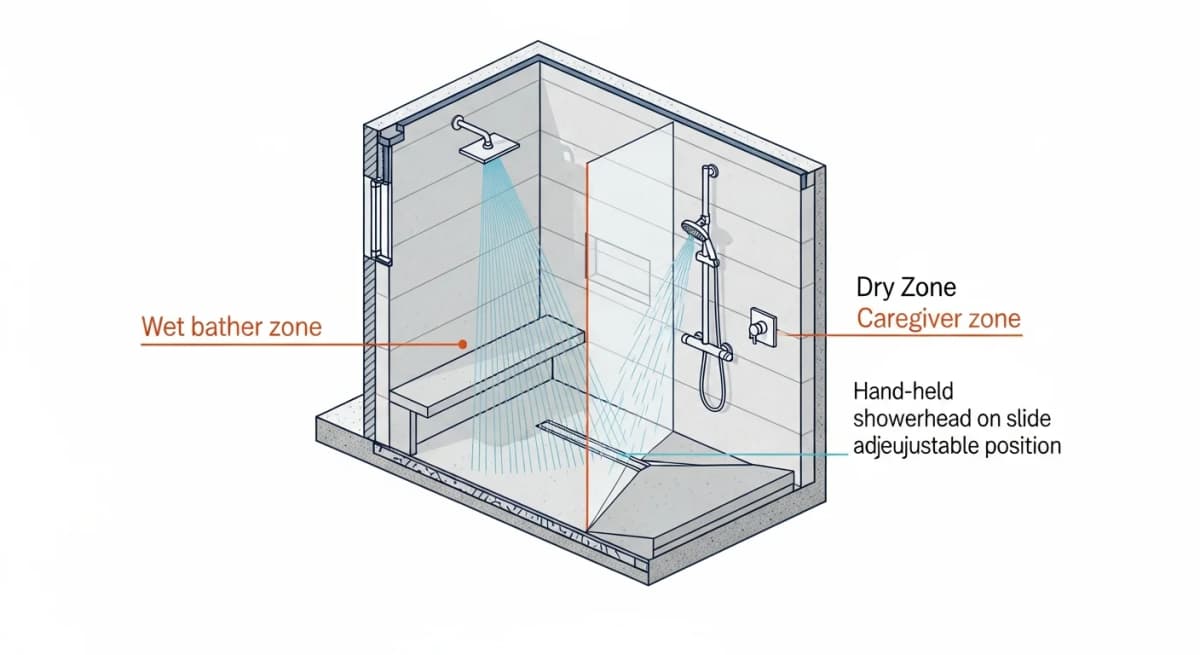
Hand-held showerheads on adjustable slide bars are standard in accessible bathroom design — the bather can adjust height and direction. For caregiver scenarios, the slide bar should be mounted within the caregiver's reach AND height-adjustable so it works for both a 5'4" caregiver and a 6'2" one (caregivers in a household often vary in height).
Standard ADA slide bars are 24–30 inches tall, mounted with the lowest position at about 33 inches off the floor and the highest at 60 inches. For caregiver use, extend the high position to 72 inches so a tall helper isn't bending repeatedly. The bar should be on the caregiver's side of the shower, not the bather's side, so the helper can reach it without leaning across the bather. Spec a magnetic dock or breakaway clip rather than a fixed cradle so the showerhead doesn't fall when the caregiver grabs it quickly.
The shower valve itself matters. Pressure-balanced thermostatic valves (not basic pressure-balancing valves) maintain water temperature within 2–3°F regardless of household water use elsewhere — critical when a caregiver is washing a frail bather and a flush in another bathroom would otherwise cause a temperature spike. Pressure-balanced thermostatic valves cost $200–$500 more than standard valves but eliminate the scald risk that's a real concern in caregiver-assisted bathing.
Design a bathroom that protects the caregiver as much as the bather
Caregiver-first design is rarely covered in standard ADA accessible bathroom planning. Schedule a consultation and we'll model the seven features in this article against your household's actual caregiving pattern — and the cost premium that delivers measurable injury reduction for the helper.
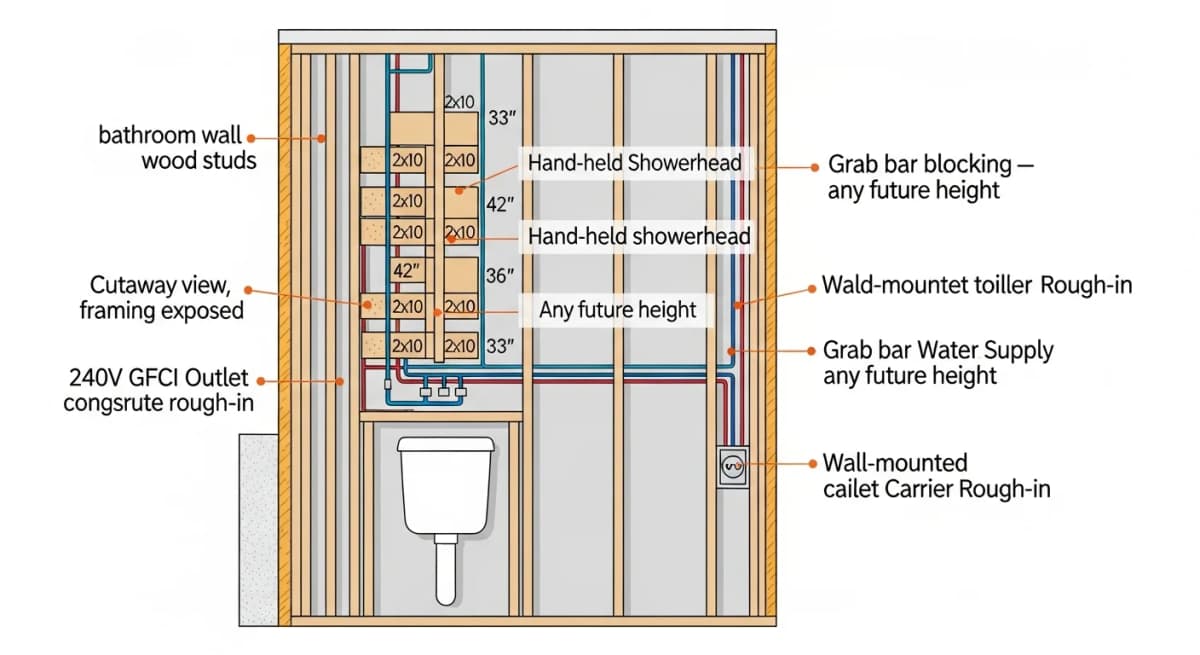
Care needs evolve. The bather who today uses a built-in transfer bench may in three years need a hoist system, an overhead grab bar mounted to the ceiling, or a wall-mounted toilet that wasn't part of the original spec. Adding any of these later is expensive because of the structural and plumbing modifications required.
During a Boise caregiver-bathroom remodel, we pre-rough for the most likely future needs at minimal cost:
Structural wall blocking: 2x10 lumber installed between studs at the 33-inch, 36-inch, 42-inch, and 60-inch heights along every wall in the bathroom. Allows grab bars or accessories to be added at any later date with no wall opening. Adds $300–$600 to the framing scope during a remodel; saves $1,500–$3,000 in retrofitted blocking later.
Ceiling structural blocking for overhead grab bar or hoist: 2x6 lumber between joists at the position where an overhead hoist might be mounted (typically over the bather's primary position in the shower or beside the toilet). $200–$400 during framing; $2,500–$5,000 to add later.
Plumbing pre-rough for wall-mounted toilet: Wall-mounted toilets transfer load to the wall through an in-wall carrier system. Pre-rough during initial install allows a future swap from a floor-mounted to wall-mounted toilet without major demolition. $400–$900 in carrier rough-in during remodel; $3,500–$6,000 to retrofit later.
Extra GFCI outlets at counter height: For future heated towel rails, electric heated mats, or specialty grooming equipment. $80–$150 per additional outlet during electrical rough-in; $400+ to add later.
Total pre-rough investment during a remodel: $1,000–$2,000. Retrofit cost if needed: $7,500–$15,000+. The pre-rough is the most cost-effective insurance against changing care needs.
Every caregiver-supported remodel where the bather's needs are likely to evolve over the next 5–10 years.
Adds upfront cost. Pays back if any of the pre-roughed features are ever needed; sunk cost if they aren't.
Caregivers stand for long sessions — 20–60 minutes for a full bathing session, sometimes longer for grooming and dressing afterward. Hard tile under their feet for that duration produces the back, hip, and knee fatigue that's the most cited physical complaint of home health aides. The solution exists in commercial kitchens, manufacturing facilities, and standing-desk offices: anti-fatigue mats. The application to caregiver bathrooms is straightforward and underused.
Two approaches work in a Boise accessible bathroom:
Built-in anti-fatigue floor zone: A defined area (typically 24 x 48 inches) of the bathroom floor uses a slightly resilient surface material rather than the standard porcelain or ceramic tile. The material options include cushioned vinyl (waterproof, $4–$8/sq ft), rubber tile (waterproof, slip-resistant, $8–$15/sq ft), or composite anti-fatigue panels (specialty product, $15–$25/sq ft). The zone is positioned where the caregiver stands during bathing — typically alongside the shower.
Anti-fatigue mat on hard floor: A removable anti-fatigue mat (typically $40–$120 from commercial kitchen suppliers) placed on the standard bathroom floor in the caregiver position. Less expensive and adjustable, but the mat can slide on wet tile if it doesn't have a proper non-slip backing.
The cost difference is modest ($200–$600 for the built-in approach during a remodel; $40–$120 for the removable approach). The fatigue reduction is meaningful — caregivers consistently report less back and knee discomfort after sessions when standing on resilient surface rather than hard tile.
Every caregiver-supported bathroom. The cost is small; the long-term benefit to the caregiver is real.
Built-in anti-fatigue surfaces have a different aesthetic than tile and may need to be discussed with the homeowner if the bathroom design language is high-end.
Standard accessible bathroom lighting prioritizes bright general illumination — adequate visibility for the bather to navigate the space safely. Caregiver scenarios add a second lighting requirement: the helper needs to see what they're doing at task level (grooming, wound care, dressing) without glare that interferes with their work.
The design solution is a three-layer lighting plan similar to what we recommend for north-facing bathrooms (see our lighting article for the framework), but with a specific caregiver task layer added:
Ambient layer: General room illumination at 500–700 lux average, 3000K, CRI 90+. Standard accessible bathroom default.
Caregiver task layer: Adjustable directional light (recessed adjustable downlight or floor-supported task light) at 1,000+ lux focused on the bather's position during care sessions, with a separate dimmer. The caregiver can ramp up task light during care, ramp down during relaxation or rest.
Bather comfort layer: Low-color-temperature accent lighting (2700K, 200–400 lumens) that the bather can request to soften the room ambiance during long bathing sessions. Provides comfort and reduces the institutional feel of a brightly-lit bathroom.
The three layers are independently controlled. Caregiver can boost task lighting during cleaning or wound care without subjecting the bather to bright general light; bather can use ambient + accent for relaxed bathing without losing the option of task lighting when needed.
Most accessible bathroom designs include a sit-down grooming area for the bather — a vanity with knee space, height-adjustable mirror, and grab-bar support. This is standard accessibility design. Less common is a sit-down option for the caregiver — but it dramatically improves long grooming sessions (hair washing, beard trimming, denture care, etc.) where the caregiver has been standing for an hour and needs to continue for another 20 minutes.
The simplest implementation: a fold-down wall-mounted bench or seat (Pressalit, Ponte Giulio, and similar accessible-bath manufacturers make wall-mounted folding seats rated for adult weight at $300–$700 each plus install) positioned at the grooming-station height. The caregiver can sit while doing tasks that don't require standing reach. The bench folds against the wall when not in use, freeing the floor for the bather's mobility needs.
Pair the fold-down seat with a counter or grooming-station surface at sit-down height (28–30 inches) where the caregiver can rest tools, supplies, and the bather's items during the session. The geometry: caregiver sits at counter, bather is positioned within reach (either in a separate bath chair or on the toilet with toilet-side support bars). Reduces caregiver fatigue dramatically on long sessions.
Iron Crest's caregiver-bathroom design conversations are different from our standard accessible-bathroom conversations. We typically start by asking who's doing the caregiving (adult child, spouse, hired aide, mix), how often, and what types of care happen in the bathroom. The answers shape the design priorities. A bathroom designed for daily caregiver-assisted full bathing has different priorities than one designed for occasional spouse-assist with a mostly-independent bather. Both are accessible bathrooms; both need different layouts.
The seven features above add about $2,000–$5,000 to a Boise accessible bathroom remodel — meaningful but small relative to the broader remodel scope ($28,000–$55,000 for full accessible master baths). For households where the caregiver is family — adult children caring for parents, spouses providing care, multigenerational living arrangements — the cost premium pays back in reduced caregiver injury, longer in-home aging, and better quality of life for both people in the room. For broader context on accessible bath design, see how we run accessible walk-in showers in Boise and our accessible bathroom remodels resource.
How is caregiver-first design different from standard ADA accessible design?
ADA accessible design is written for the individual user — the person with limited mobility, low vision, wheelchair use, or similar — navigating the space alone or with minimal assistance. Caregiver-first design assumes the user is being actively assisted in the space by another adult for extended periods. ADA spec optimizes for the bather's safety, reach, and clearance; caregiver-first spec adds the helper's body mechanics, sightlines, fatigue, and workflow to the design priorities. The features in this article are additive to standard ADA design — none of them violate accessibility code, but most go beyond what ADA requires. For households where caregiving is daily, these additions are the difference between a bathroom that works and one that injures the caregiver over time.
How much does caregiver-first bathroom design add to a typical Boise accessible bath remodel?
The cost premium for adding the seven features above to a standard accessible bathroom remodel runs $2,000–$5,000 in the Boise market. Breakdown: outward door swing modification ($200–$500), dual-zone shower plumbing ($1,200–$2,500), structural pre-roughs and wall blocking ($800–$1,400), anti-fatigue floor zone ($200–$600), caregiver-layer lighting controls ($300–$700), fold-down grooming bench ($300–$700 including install). The total accessible-bath remodel in the Treasure Valley typically runs $28,000–$55,000 depending on scope, so the caregiver-first premium is roughly 5–15% above standard accessible spec. Meaningful but not budget-defining.
Can I add caregiver-first features to an existing accessible bathroom retrofit?
Some yes, some no. Anti-fatigue mats can be added anytime ($40–$120). Lighting controls and additional GFCI outlets can be added with $300–$900 in electrical work plus drywall patching. Outward door swing modification is moderate ($300–$700 if framing modifications aren't required, $800–$1,500 if they are). The features that are hard to retrofit: structural wall blocking (requires opening wall faces), dual-zone shower (requires tearing out the existing shower), wall-mounted toilet pre-rough (requires major plumbing work), and built-in anti-fatigue floor zones (requires removing existing flooring). For households who didn't include caregiver-first design in their original accessible remodel and now need it, the right approach is usually to add what's affordable to retrofit (anti-fatigue mat, lighting, door modification) and budget for the structural items if and when the next bathroom remodel happens.
How do I know if caregiver-first design is worth the cost for my situation?
The math is clearest when caregiving is daily or frequent (at least 3-4 days per week of substantial in-bathroom assistance) and is expected to continue for at least 2-3 years. For households in this pattern, the caregiver-first investment pays back through reduced injury risk, longer caregiver capacity, and the option to keep the bather at home rather than transitioning to assisted living earlier. For households where caregiving is occasional, limited to specific tasks (like helping a recovering surgical patient for a few weeks), the caregiver-first investment is less obviously justified — though the features have value to anyone who eventually uses the bathroom even without caregiving. The single highest-value feature regardless of household type is structural wall blocking for future grab bars — it costs almost nothing during a remodel and gives you full layout flexibility for the next 30 years.
Are there local Boise resources or grants for caregiver-supported bathroom remodels?
Several. The Idaho Area Agency on Aging (Region III, serving Ada and Canyon Counties) provides home modification assessments and connects qualifying households to funding sources. The Idaho Housing and Finance Association offers low-interest home modification loans. The U.S. Department of Veterans Affairs provides grants up to $100,000 (SAH program) or $22,000 (SHA program) for disabled veterans' home accessibility modifications. Medicaid waiver programs in Idaho cover some accessibility modifications for qualifying individuals. For aging-in-place specifically, Medicare Advantage plans increasingly cover bath modifications. We help every accessible-remodel client identify applicable funding sources during the design phase — the application processes are not trivial and the available funding is meaningful for households at qualifying income levels.
How long does a caregiver-first accessible bathroom remodel take in Boise?
Standard accessible bathroom remodels typically run 4–7 weeks. Adding caregiver-first features adds 3–7 working days to the schedule because of the additional plumbing scope (dual-zone shower), structural work (additional blocking and ceiling reinforcement), and electrical scope (additional outlets and lighting circuits). Total project: typically 5–8 weeks from demolition to final inspection. Most of the additional time happens during the rough-in phase (weeks 2–3 of the project) and doesn't extend the finish-out phase materially. For families coordinating caregiving during the remodel itself, the bathroom is unavailable for the duration — we work with families on temporary arrangements (use of another bathroom in the home, family member homes nearby, occasionally short-term apartment rentals for tight situations).
Design a bathroom that protects the caregiver as much as the bather
Caregiver-first design is rarely covered in standard ADA accessible bathroom planning. Schedule a consultation and we'll model the seven features in this article against your household's actual caregiving pattern — and the cost premium that delivers measurable injury reduction for the helper.
These pages go deeper on the topics linked from this article. Read them before your consultation and you'll come in with sharper questions and a clearer scope.
The following government agencies, industry organizations, and official resources provide additional information relevant to your remodeling project.