
Lighting a North-Facing Boise Bathroom Through 8 Hours of Winter Daylight
Boise sits at 43.6° N. At the winter solstice, a north-facing window receives essentially no direct sunlight for nearly four months. For bathrooms — already low-lit spaces that depend on artificial light for morning use — that creates a specific design problem with a specific solution.
Quick answer
Sometimes, with significant caveats. Sun tunnels (Solatube and similar) and conventional skylights both bring direct daylight into rooms that don't have window access — useful in landlocked or interior bathrooms.
If your master bathroom faces north and your bathroom remodel didn't address the lighting design as a specific problem, you'll notice it in January. Boise's 43.6° North latitude puts the sun at roughly 22° above the southern horizon at winter solstice noon — and that low solar angle means a north-facing room receives essentially no direct sunlight for the four months from late October through late February. Indirect ambient daylight through a north-facing bathroom window in this period typically measures under 100 lux at face level, well below the 500–1,000 lux that a vanity application actually needs.
This isn't a problem you can fix with brighter bulbs or one big ceiling fixture. North-facing bathrooms in Boise need a three-layer lighting design that compensates for the missing daylight while still producing the right color rendering and warmth for the morning routine. Below are the design specifications and component choices that work, with the math behind each decision.
For broader lighting-design principles across all room types (kitchen, living areas, hallways, outdoor), our Boise lighting design guide is the comprehensive resource. This page is specifically about one narrower problem — north-facing bathrooms in Boise's winter daylight conditions — where solar geometry, Kelvin selection, and vanity-light placement matter more than in any other room or orientation.
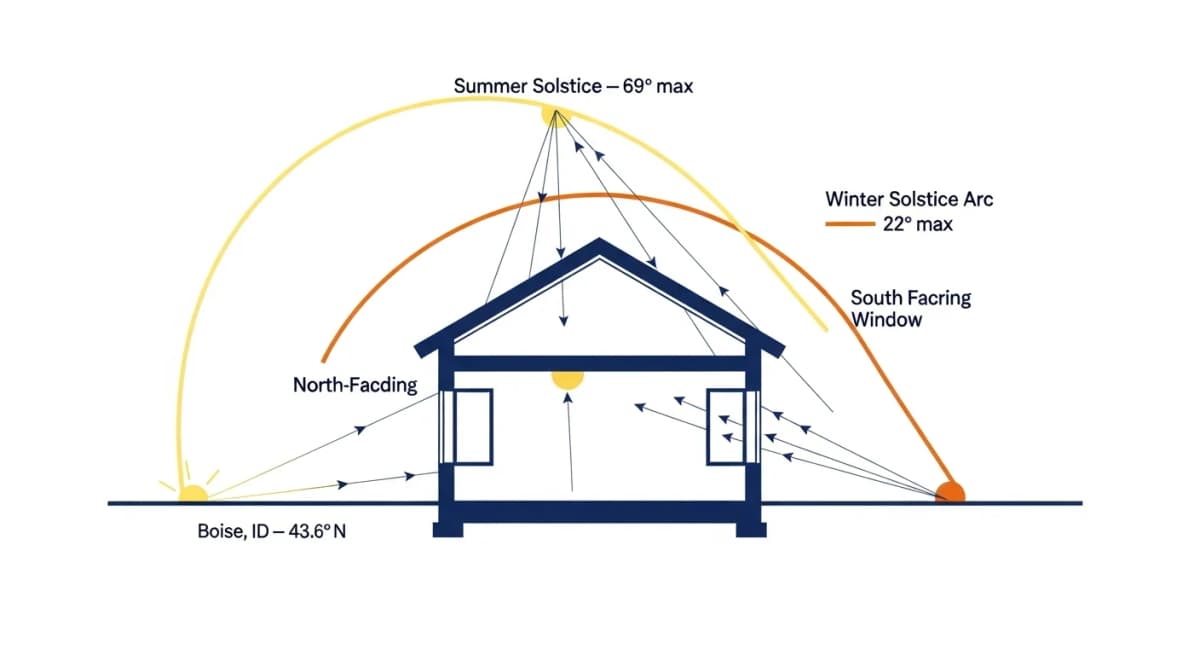
Boise's latitude is 43.6° North. The maximum solar elevation at solar noon varies through the year by approximately ±23.4° (Earth's axial tilt), giving Boise a solstice range of 22° (winter) to 69° (summer). For a north-facing window, this means: summer sun crosses the southern sky high enough to indirectly illuminate the north side of the home through reflection and atmospheric scatter; winter sun stays low in the south and the north side of the home receives only diffuse ambient light from the dome of sky directly above.
The lux numbers tell the story. A south-facing window on a clear summer day in Boise can deliver 8,000–15,000 lux of direct + diffuse daylight at one meter from the glass. The same window on a clear winter day receives 4,000–7,000 lux. A north-facing window in summer delivers around 1,500–3,000 lux (no direct sun, but bright sky). In winter, that same north-facing window typically measures 80–250 lux on a clear day and 30–80 lux on overcast days.
For comparison, IES (Illuminating Engineering Society) recommends 500 lux at the work plane for general bathroom lighting and 1,000+ lux at the face for grooming tasks. Winter daylight through a north-facing bathroom window provides 5–10% of the lux level the activity actually needs. Compensating electric lighting has to make up the entire difference for four months of the year — and even on overcast summer days for some Treasure Valley homes shaded by foothills or mature trees.
Color Rendering Index (CRI) measures how accurately a light source renders colors compared to natural daylight. CRI of 100 is daylight; CRI of 80 is typical of cheaper LED bulbs; CRI of 90+ is "natural daylight quality." For a bathroom where natural daylight is unavailable for four months, CRI above 90 isn't a luxury spec — it's the difference between makeup applied accurately and makeup that looks wrong as soon as the homeowner walks outside.
The reason this matters specifically in Boise: residents adapt to using their bathroom lighting as their only color-rendering source for the majority of the winter. Skin tone, hair color, makeup, and clothing all get evaluated under the bathroom lights and then carried into a meaningfully different light environment outside. Low-CRI sources distort warm skin tones (typically making them look more yellow than they actually are) and undersaturate cool colors (blues and greens appear muted). A CRI 90+ source minimizes this distortion.
The cost premium for CRI 90+ LED bulbs is modest — typically $2–$5 more per bulb in the residential market — but the products are not the default at most local home centers. The bulbs we spec for north-facing Boise bathrooms are typically CRI 95+ in the 800–1,200 lumen range. Several brands stock these: Soraa, Hyperikon, Cree (their higher-end lines), and some Philips and GE specialty product lines.
Every north-facing Boise bathroom where grooming and color tasks happen daily. The cost difference is minimal; the perceptual difference is substantial.
CRI 90+ bulbs are slightly less efficient than CRI 80 bulbs — typically 10–15% lower lumen-per-watt. Negligible operating cost but worth noting.
A single bathroom ceiling fixture, no matter how powerful, cannot replace the missing daylight. The right design is three independently-controlled layers, each addressing a different aspect of the space.
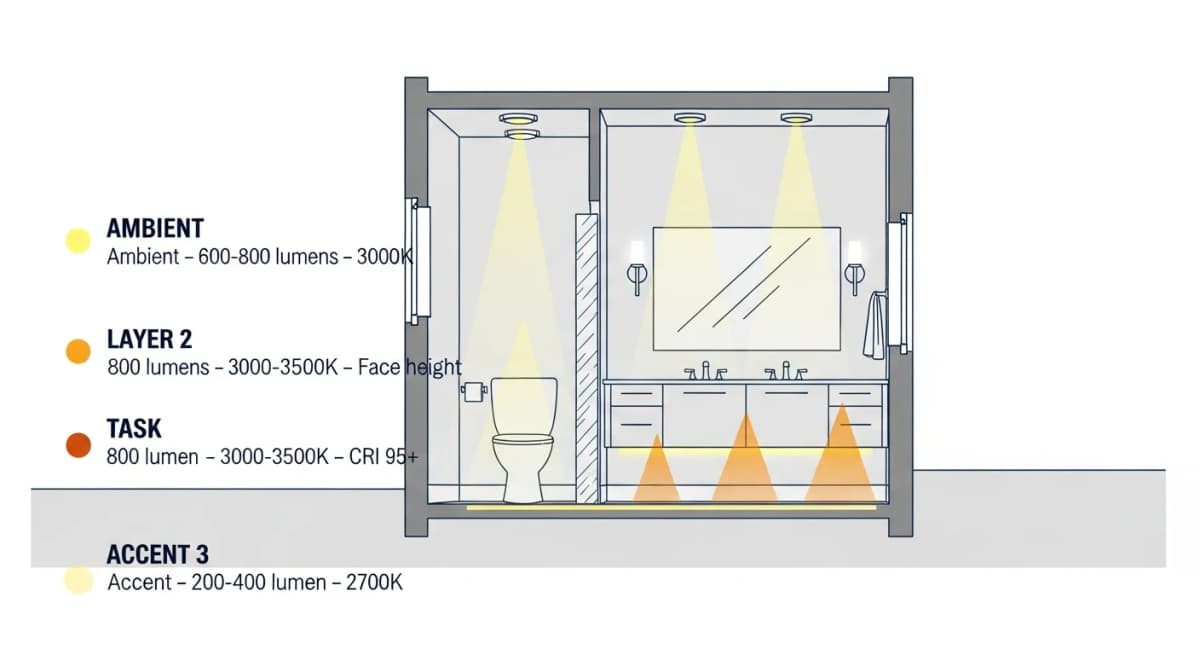
Ambient layer (4–6 recessed lights): 600–800 lumens each, distributed across the bathroom ceiling. Provides general illumination. Target total: 3,000–4,500 lumens for a typical 80–120 sq ft master bath. Kelvin: 3000K for warmth, CRI 90+.
Task layer (vanity sconces flanking the mirror): 600–900 lumens each, mounted at 60–66 inches above the floor (face height for most adults). Provides shadow-free face illumination for grooming. The single most important fixture spec in a north-facing bathroom. Kelvin: 3000–3500K, CRI 95+.
Accent layer (toe-kick LED strip and shower niche light): 200–400 lumens total. Provides depth and indirect lighting for night use without firing up the full system. Kelvin: 2700K for warmth and minimal melatonin disruption for late-night use.
Each layer is on its own dimmer (see item 7 for control logic). Total connected wattage for the three layers is typically 80–140 watts, well within standard 15-amp bathroom circuit capacity.
Master bathrooms and primary bathrooms used daily, especially on the north side of the home.
Three layers require three dimmers and three circuits, which adds $200–$500 to the electrical scope. The function is worth it; the cost is real.
Many Boise bathrooms — particularly in 1990s and 2000s tract builds — are lit by a single ceiling-mounted fixture, often a flush-mount or a builder-grade vanity light over the mirror. The total lumen output is usually adequate (2,500–4,000 lumens) but the distribution is wrong for a north-facing winter context.
Three failure modes:
Eye-level shadow on the face: A ceiling fixture lights the top of the head and shadows the area beneath the chin, the eye sockets, and the area under the nose — exactly where grooming and makeup application happen. No amount of brightness compensates for shadow direction.
Single Kelvin temperature across all activities: Morning routine (alertness needed) and evening winding-down (warmth needed) have different optimal Kelvin temperatures. A single fixture forces one compromise.
All-or-nothing dimming: A single dimmer either lights the whole room or it doesn't. Night use of the bathroom (3 AM trips) requires a much lower level than full daytime use, but a single-fixture system either provides full brightness (jarring) or near-total darkness (unsafe).
The three-layer plan above directly addresses each of these failure modes.
Light a Boise bathroom for the months when the sun doesn't
North-facing bathrooms in Boise need a lighting plan designed for 100-lux winter daylight conditions, not for the manufacturer's chart on the back of a bulb. Schedule a consultation and we'll model the layered design, Kelvin targets, and dimmer integration alongside the broader bathroom remodel scope.
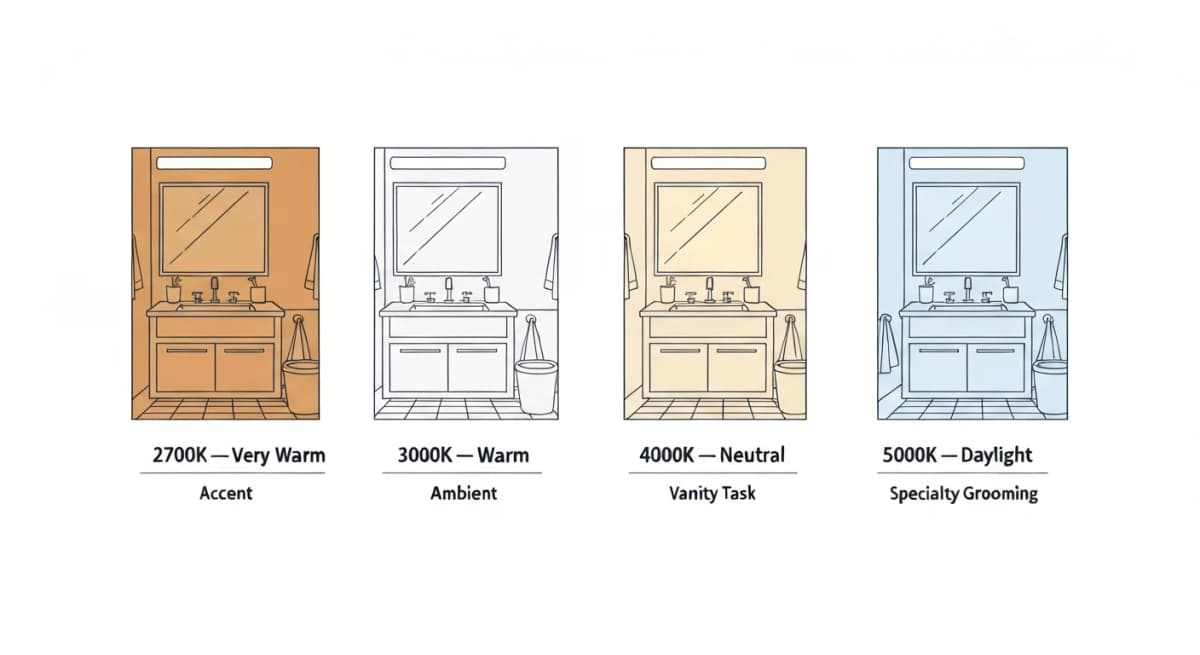
Color temperature in residential lighting is measured in Kelvin. Lower numbers are warmer (more yellow-orange), higher numbers are cooler (more blue-white). The right choice for a north-facing Boise bathroom depends on the layer:
2700K (very warm): Comfortable for evening and night use. Skin tones look slightly warmer than reality. Reduces alertness — appropriate for winding down. Use for accent lighting (toe-kick strip, shower niche).
3000K (warm): The default for residential interiors. Comfortable, flattering to skin tones, doesn't read as clinical. Use for ambient layer (recessed ceiling lights).
3000K–3500K (warm-neutral): The sweet spot for vanity task lighting. Warm enough to be flattering but bright enough that color rendering tasks (makeup, shaving, grooming) read accurately. Use for vanity sconces.
4000K (neutral): Slightly cool. Tends to read as "modern" or "clinical" depending on context. Acceptable in commercial environments; less comfortable in residential bathrooms used for morning routines. Skip in north-facing residential context.
5000K+ (daylight): Mimics noon daylight. Strong alerting effect. Too clinical for most residential bathrooms but occasionally useful in dedicated makeup or grooming stations within a larger bathroom.
The mixed Kelvin design (2700K accent + 3000K ambient + 3000–3500K vanity) creates a layered warmth that adjusts to use case rather than forcing one Kelvin across all activities.
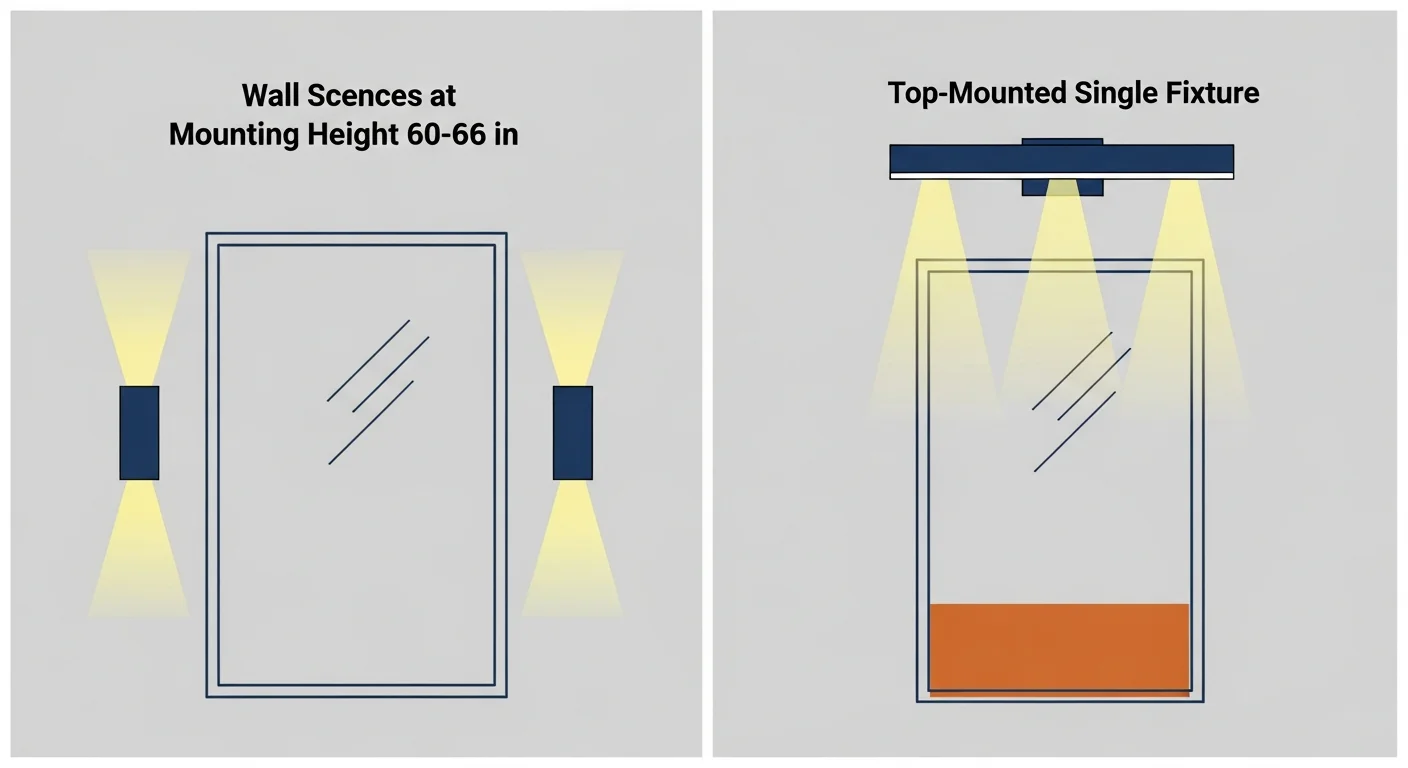
The single biggest mistake in bathroom vanity lighting — independent of Boise context — is mounting the light above the mirror rather than to the sides. Top-mounted fixtures (the classic "Hollywood" bar of bulbs above the mirror) light the top of the head, the forehead, and the upper face, but cast shadow under the eyes, the nose, and the chin. In a north-facing Boise bathroom that has no ambient daylight to fill those shadows in winter, the shadowing is severe.
Wall-mounted sconces flanking the mirror at face height (60–66 inches above floor) light the face directly without shadows. This is the configuration we spec on every Boise master bath where the wall geometry allows. The sconces should be at least 28 inches apart (and typically 36–40 inches apart for double-vanity setups) to allow the user to face the mirror without their head blocking the light from either side.
When wall geometry doesn't allow sconces — narrow mirrors, structural beams, plumbing conflicts — the compromise is a top-mounted fixture with broad reflective coverage, combined with a deliberate ambient ceiling layer to fill the shadows. This works but is meaningfully less effective than proper sconce placement.
An additional option for upscale Boise bathrooms: LED mirror with integrated edge lighting (called a "lit mirror"). These provide effective face illumination from a more contemporary form factor and are increasingly the spec on Eagle and Harris Ranch master baths. Cost: $400–$1,400 depending on size and quality, versus $200–$600 for traditional sconces.
Every master bath and primary bath where the wall geometry allows sconce placement. The shadow problem is universal but matters most in north-facing rooms.
Sconces require wall blocking for mounting (best added during rough-in, not as a finish-stage retrofit). Lit mirrors are a strong contemporary alternative.
Pre-1980 Boise bathrooms — North End bungalows, Hyde Park homes, Bench split-levels — typically have ceiling heights of 7'0" to 7'6", which constrains the ceiling fixture choice. Standard recessed cans are 4–6 inches deep, which fits but requires the ceiling joist bays to be deep enough and accessible. Surface-mount fixtures hang 2–4 inches below the ceiling plane, which is visible in low-ceiling rooms but trades clearance for installation simplicity.
For low-ceiling north-facing bathrooms, our typical spec is shallow-can LEDs ("wafer lights") that are only 1–1.5 inches deep and mount in standard junction boxes without joist access. These cost $25–$50 each, install in 30 minutes, and provide effective ambient lighting without the visual weight of surface-mount fixtures. Several Treasure Valley electrical suppliers stock wafer lights from Halo, Lithonia, and similar brands.
Where wafer lights don't work — vaulted or beamed ceilings that don't accept standard junction-box mounting — the right alternative is a flush-mount or semi-flush fixture with broad lumen distribution. The fixture choice is then a design call, but the lumen target is still 3,000–4,500 total for ambient layer.
The three-layer plan only delivers its full benefit if each layer has independent dimming. The use cases:
Early morning (5–7 AM): Ambient at 60–80%, vanity task at 100%, accent off or low. Bright work plane for grooming, warm-bright general fill, no harsh shadow.
Daytime (8 AM – 6 PM): Ambient at 80–100%, vanity task at 80–100%, accent off. Full lighting for any task.
Evening (6–10 PM): Ambient at 40–60%, vanity at 70–80%, accent on at 60–80%. Warmer feel, still adequate for grooming, sets evening mood.
Night (10 PM – 5 AM): Ambient off or very low (10–20%), vanity off, accent on at 30–50%. Safe navigation for night trips without firing up alertness-inducing bright light.
Three independent dimmer switches handle this directly. For homeowners interested in smart-home integration, Lutron Caseta or Insteon dimmers with scene presets let the user tap one button for "morning," "evening," or "night" instead of adjusting each dimmer individually. The smart-control upcharge is roughly $200–$400 over standard dimmers for a three-layer bathroom and is worth it for households who actually use the layered control. Households who'd just leave everything at one level should save the money and spec standard dimmers.
When Iron Crest runs a bathroom remodel on the north side of a Boise home, the lighting design is a separate design-phase decision, not a finish-stage selection. We model the room's daylight conditions, design the three-layer plan with appropriate Kelvin and lumen targets for each layer, and spec the wiring and switching to support independent dimming. The cost is typically $1,200–$2,500 above a standard single-fixture lighting scope, depending on the number of recessed cans, the sconce choice, and the dimmer system. The function-per-dollar is among the highest payoff decisions in any north-facing bathroom remodel.
The same logic applies to any north-facing or partial-daylight bathroom. East-facing rooms suffer through afternoons; west-facing rooms struggle in mornings. The math is just most severe on the north side because the daylight loss compounds through all four winter months. For broader bathroom design and the rest of the remodel-sequence context, see how we run bathroom remodels in Boise and our master bathroom complete remodel guide.
Can I fix a north-facing bathroom lighting problem with a sun tunnel or skylight?
Sometimes, with significant caveats. Sun tunnels (Solatube and similar) and conventional skylights both bring direct daylight into rooms that don't have window access — useful in landlocked or interior bathrooms. For north-facing bathrooms, the value is partial: a sun tunnel installed in a south-facing roof section can deliver bright direct daylight into the bathroom on sunny days, which addresses the daylight deficit on those days. The catch is Boise's winter sun pattern — even with a sun tunnel facing south, the December solstice sun is low enough that capture is reduced 50–70% from summer levels, and overcast days deliver minimal benefit regardless of tunnel orientation. Sun tunnels are a worthwhile addition to a north-facing bathroom when the budget allows ($1,200–$2,800 installed) but they don't eliminate the need for a properly designed electric lighting layer. They reduce the daily duty cycle on the electric lighting and improve the room's overall feel.
Are LED mirrors a substitute for traditional vanity sconces?
Mostly yes, with one caveat. Quality LED-edge-lit mirrors (Robern, Kohler Verdera, Krugg, and similar premium lines) provide effective face illumination from a contemporary form factor — typically equivalent to two well-placed sconces. Lower-end LED mirrors from Amazon or generic retailers often have inadequate lumen output (under 800 total lumens) and poor color rendering (CRI 70–80), which produces the appearance of face lighting without the function. The caveat to LED mirrors generally: the LED chips have a finite lifespan (typically rated 25,000–35,000 hours) and are integrated into the mirror, so end-of-life replacement is the whole mirror, not a bulb. For homeowners who plan to upgrade their bathroom design within 10–15 years anyway, this is fine; for homeowners who want a forever-mirror, traditional sconces with replaceable bulbs are more future-proof. Functionally, both approaches work for north-facing Boise bathrooms when properly specified.
What's the right wattage of bathroom lighting for a Boise winter?
The right specification is in lumens, not watts — and the target lumen totals depend on bathroom size. For a typical 60–80 sq ft secondary bathroom: 2,400–3,200 total lumens across the three layers. For an 80–120 sq ft master bath: 3,200–4,800 total lumens. For 120+ sq ft master suites with separate water closet and shower zones: 4,800–6,500 total lumens. Wattage depends on LED efficiency — modern LEDs deliver 80–100 lumens per watt, so the wattage for the totals above is typically 40–80 watts (well below the 1,800-watt limit on a standard 15-amp circuit, which is fortunate because the bathroom circuit also feeds heated floors and possibly other loads). Most Boise master bath lighting we install runs at 60–90 connected watts total across all three layers.
Is it worth installing dimmers on every light circuit or just the vanity?
Dimmers on every layer is the design intent. The whole-point of the three-layer plan is independent dimming so the homeowner can tune the room for the time of day and activity. Skipping dimmers on one or two layers — typically saving $30–$60 in dimmer hardware — defeats half the design and produces a more frustrating user experience than a non-layered system would have. We don't spec partial-dimming three-layer plans because they don't deliver the value that justifies the upgrade over a simpler single-fixture system. If budget forces a compromise, the right move is a smaller two-layer plan (ambient + task with independent dimming) rather than a three-layer plan with limited control.
Will improved bathroom lighting actually affect mood and energy during Boise winters?
There's reasonable evidence that bright morning light exposure helps regulate circadian rhythm and reduces winter mood symptoms — particularly for people with seasonal affective patterns. A well-designed bathroom lighting layer that delivers 1,500–2,500 lux at face level for 5–10 minutes during a morning routine isn't equivalent to a dedicated light-therapy device (which targets 10,000 lux), but it's a meaningful contribution to morning light exposure for households who don't otherwise see direct sunlight before noon during winter. The vanity layer at 3000–3500K with CRI 95+ approximates the spectral content of morning daylight and is the layer most relevant to this effect. We don't oversell this — we're not making medical claims — but several clients have commented that their morning routine feels different after a properly-designed bathroom lighting upgrade. Worth knowing as part of the decision context.
Are the LED bulbs I buy at the home center adequate, or do I need specialty bulbs?
Home center LED bulbs are inconsistent on the specs that matter for north-facing bathroom applications. The default bulbs in retail are typically CRI 80–85 (acceptable, not great), 2700K or 3000K (right range), and 800–1,100 lumens (right output). The CRI is the spec most often compromised at retail. Specialty bulbs at CRI 90+ or 95+ are available at most electrical supply houses and through online retailers (Soraa, Hyperikon, Cree's higher-end LR line, some Philips and GE specialty products). The cost difference is $5–$15 per bulb depending on lumens and form factor. For a six-bulb master bath, total upgrade cost is $30–$90 — meaningful but not large. The visible-quality difference is real and immediately apparent. We typically spec the bulbs as part of the design package on Boise bathroom remodels rather than leaving the homeowner to source them post-install.
Light a Boise bathroom for the months when the sun doesn't
North-facing bathrooms in Boise need a lighting plan designed for 100-lux winter daylight conditions, not for the manufacturer's chart on the back of a bulb. Schedule a consultation and we'll model the layered design, Kelvin targets, and dimmer integration alongside the broader bathroom remodel scope.
These pages go deeper on the topics linked from this article. Read them before your consultation and you'll come in with sharper questions and a clearer scope.
The following government agencies, industry organizations, and official resources provide additional information relevant to your remodeling project.