
Multigenerational Two-Cook Kitchens in Boise: 7 Design Decisions for Households Where Two Adults Cook in Parallel
Standard kitchen design assumes one cook at a time. For Boise's growing multigenerational households and partnered couples who both cook, that assumption produces traffic conflicts, prep-zone crowding, and aisle congestion. Seven design decisions for kitchens where two adults cook in parallel.
Quick answer
The diagnostic question: in a typical week, how often do two adults cook in parallel for at least 15 minutes simultaneously? If the answer is 5+ times per week, two-cook design pays back daily.
Treasure Valley demographics increasingly include multigenerational households — adult children moving back home, aging parents joining adult-child households, and partnered couples where both adults cook regularly. Standard residential kitchen design, derived from mid-century single-cook assumptions, doesn't accommodate these living patterns well. The result is daily friction: cooks bumping into each other at the sink, prep zones overlapping, only one usable prep surface at a time, aisle traffic conflicts during the busiest cooking moments.
Two-cook kitchens require different design decisions than single-cook kitchens. Some of these decisions are obvious (more counter space, two sinks); others are subtle (aisle width specifically calibrated for two-body passing, height-variant counter zones for cooks of different statures, traffic-pattern planning that separates active prep from access pathways). This article covers seven decisions that make a kitchen genuinely work for two-cook households.
The cost premium for two-cook design typically runs $5,000-$18,000 above standard residential scope. For households where parallel cooking happens regularly, that premium pays back through reduced daily friction and significantly improved kitchen function across the kitchen's 20-30 year lifespan.
For the broader multigenerational home remodel context — including bathroom design, separate living quarters, mother-in-law suites, and accessibility considerations beyond just the kitchen — see our multigenerational home remodel guide for Boise. For aging-in-place specifically, see our aging-in-place remodeling resource. This page focuses specifically on kitchen design for households where two adults cook in parallel — a different design challenge than single-cook accessibility.
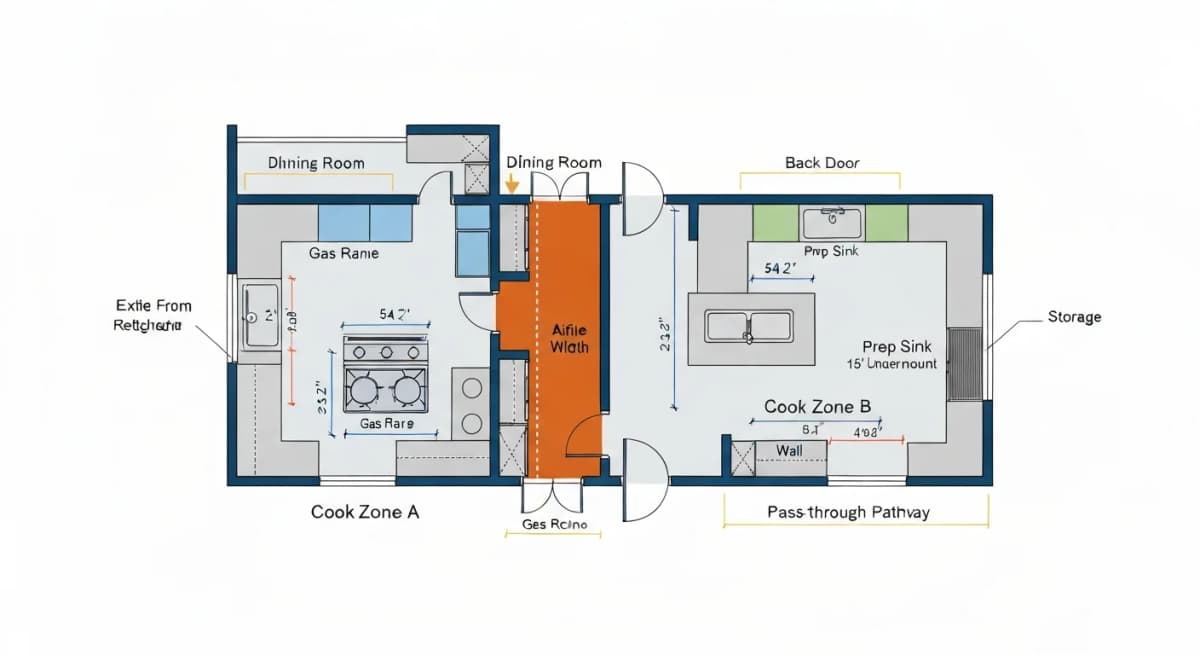
Walk through a typical Sunday dinner in a two-cook household to see where standard residential kitchen design breaks down.
5:00 PM: Both cooks enter the kitchen. Cook A starts preparing a roast — moves to the refrigerator, retrieves meat, walks to the sink to rinse, returns to the counter to season. Cook B starts preparing vegetables — moves to the refrigerator (waiting for Cook A's transit through), retrieves vegetables, walks to the sink (now occupied by Cook A), waits. Already, in the first three minutes, two collisions or waits.
5:15 PM: Cook A places the roast in the oven, returns to the counter for prep work for a side dish. Cook B is at the counter chopping vegetables. The single counter is now serving two simultaneous prep tasks. Cooks routinely bump elbows, share knife space (which creates safety issues), and step on each other's prep area.
5:30 PM: Cook A turns from counter to range. The standard 42-inch aisle is fine for one cook passing, but Cook A's path to the range crosses Cook B's working area at the counter. Cook B has to pause prep, move aside, then return to prep — losing momentum and concentration.
This pattern repeats throughout the cooking session. By the end of meal prep, both cooks are mildly frustrated, the work has taken longer than it would have in dedicated single-cook conditions, and the kitchen design has actively created friction rather than supporting the cooks.
The standard residential kitchen wasn't designed for this scenario. Two-cook design changes the assumptions: dedicated prep zones for each cook, dedicated sinks if possible, wider aisles that support two-person passing without collision, and traffic pattern planning that separates active cook movement from non-cook household traffic (kids passing through, guests entering, family pets, etc.).
Diagnosing whether your household actually has a two-cook pattern and whether two-cook design investment is justified.
Two-cook design consumes more kitchen footprint than single-cook design. For kitchens with limited floor area, the tradeoff has to be made consciously.
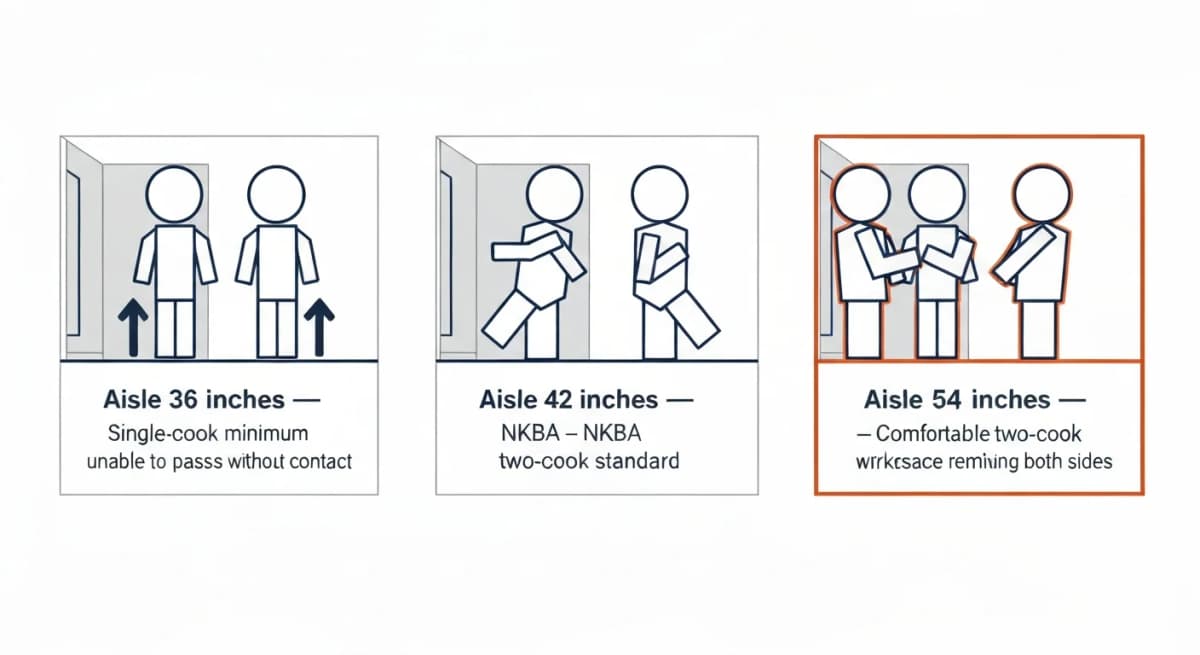
NKBA (National Kitchen & Bath Association) planning guidelines specify 42-inch minimum aisle width for one-cook kitchens and 48-inch minimum for two-cook kitchens. These guidelines are the residential design baseline, but they're conservative — actual two-cook function benefits from wider aisles than the 48-inch minimum.
Aisle width by use case:
36 inches: Single-cook minimum. Just enough for one adult to work, with cabinet doors opening fully and standard appliance access. Inappropriate for any two-cook scenario.
42 inches: Single-cook comfortable. Two cooks can pass each other if both turn sideways, but not simultaneously prep on opposite sides of the aisle. NKBA's one-cook recommendation.
48 inches: NKBA two-cook minimum. Two cooks can pass with reasonable comfort. Still feels tight when both cooks are actively working on opposite sides of the aisle.
54 inches: Comfortable two-cook width. Two cooks can pass with workspace continuing on both sides. The aisle feels "spacious for two" rather than "barely accommodating two." This is the right specification for multigenerational two-cook design.
60+ inches: Generous. Used in larger kitchens, often for islands with bench seating on one side. Workable but may feel sparse if not balanced with other design elements.
The 6-inch increase from 48-inch standard two-cook to 54-inch comfortable two-cook consumes counter or island depth — usually 6 inches off the cabinet run or 6 inches off the island depth. For most kitchens, this tradeoff is well-worth making. The aisle gets used hundreds of times during a single meal prep; saving 6 inches of cabinet depth (which gets used much less frequently) for aisle comfort is correct prioritization.
For galley kitchens (parallel counter runs facing each other), the aisle is between the two parallel runs. For L-shaped kitchens with islands, the aisle is between the perimeter counter and the island. The 54-inch spec applies to all configurations.
Two-cook kitchens of any size where aisle traffic conflicts are a daily reality.
Consumes 6 inches of cabinet or island depth that could otherwise hold storage. For small kitchens, this is meaningful.
The most fundamental two-cook design decision: provide two separate counter zones each suitable for active prep, rather than one large shared counter that both cooks have to negotiate.
Two-prep-zone layouts:
L-shape with island: The perimeter L provides one prep zone (with primary sink and range adjacent), and the island provides the second prep zone. Each cook can claim a zone for their prep without conflict. Best for medium-to-large kitchens.
Galley with extended counter: Two parallel counter runs each long enough for active prep (minimum 4 feet of clear counter per zone). Works in galley layouts; each cook takes one parallel run as their prep zone. Constrained by overall kitchen footprint.
U-shape: Three counter runs form a U. One run is the primary cook station (sink + range), and the perpendicular runs provide secondary prep zones. Each secondary run can serve as a dedicated zone for the second cook. Good for moderate-sized kitchens.
L-shape with peninsula: The peninsula extends from the L into the room, creating a second prep surface. Common in mid-century Boise homes; works adequately for two-cook function if the peninsula is at least 5 feet long.
Each prep zone needs:
Minimum 4 feet of clear counter width for active prep work. This is the working area; longer is better.
Adequate landing zones — counter space on either side of any sink, cooktop, or oven. NKBA specifies 15-18 inch landing zones; for two-cook function, prefer the longer end.
Dedicated outlets at the counter level — small appliances (stand mixer, food processor) plug into the prep zone where they're used. Two-cook kitchens commonly have two stand mixers in use simultaneously; each needs reachable power.
Storage proximate to the zone — utensils, cutting boards, small appliances, frequently-used spices stored within reach of each prep zone. Avoids cross-kitchen reaching during active prep.
The cumulative effect: each cook has a complete working setup that doesn't require crossing the kitchen during prep. Daily friction drops substantially.
Two-cook kitchens where parallel prep is the typical pattern rather than alternating prep.
Requires larger kitchen footprint. Many older Boise homes have kitchens too small for full two-prep-zone design — partial zones may be the practical option.
Standard residential kitchens have one sink. Two-cook kitchens benefit substantially from two sinks — a primary sink for cleanup and a prep sink for produce washing and secondary prep.
Two-sink design:
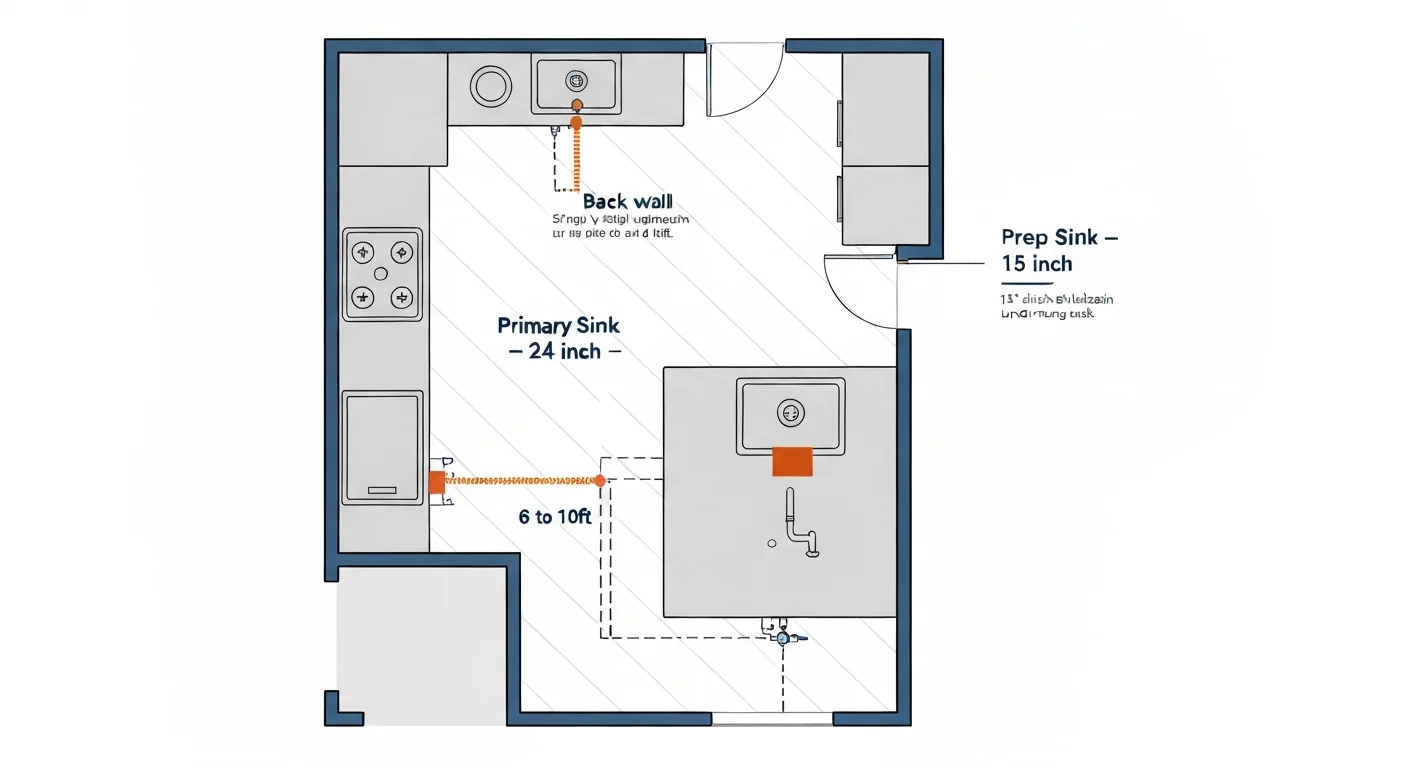
Primary sink: 24-inch or 30-inch single-basin undermount, located at the perimeter wall in the typical sink position. Used for: filling pots, washing dishes during prep, draining pasta, cleaning up after cooking. This is the kitchen's main wet-work station.
Prep sink: 15-inch single-basin (or small double-basin) undermount, located in the island or secondary counter run. Used for: washing produce, draining vegetables, secondary cleanup. Smaller because it doesn't need to handle large pots or full dish loads.
The two-sink advantage: both cooks can wash and rinse simultaneously without conflict. Cook A washing pots at the primary sink doesn't block Cook B from washing vegetables at the prep sink.
Plumbing considerations for the prep sink:
Water supply lines: Hot and cold supply routed from main water lines (typically running through the floor or basement ceiling). Drain line routed from the prep sink to the main waste stack — for islands, this requires running drain through floor/basement and tying into the kitchen's main waste line.
Prep sink garbage disposal: Optional but useful. Adds $200-$400 for the unit plus install.
Prep sink faucet: Smaller and more compact than the primary faucet. Pull-down spray functionality less important since the sink is for shorter-duration tasks.
Total cost premium for adding a prep sink: $1,800-$4,500 depending on layout complexity (island prep sinks cost more due to drain routing).
For homes considering two-cook design but with limited budget, the prep sink is one of the highest-value individual investments. It addresses the most common two-cook friction (both cooks wanting to use the sink simultaneously) more directly than any other single change.
Households where vegetable washing and primary cleanup happen in parallel.
Drain routing complexity for island prep sinks. Plumbing work required in addition to the sink itself.
Design a kitchen where two cooks don't fight over the sink
Multigenerational two-cook kitchen design saves daily friction across the kitchen's 20-30 year lifespan. Schedule a consultation and we'll map your household's actual cooking patterns to the right two-cook design elements for your home.
Two-cook households often need two simultaneous oven operations — main course in one oven, side dish or dessert in another. Standard residential kitchens have one oven (typically built into the range); two-cook kitchens often benefit from a second.
Two-oven configurations:
Range oven + wall oven: The standard range provides one oven; a wall oven (single or double) provides the second. Most flexible configuration; allows different temperatures and timing in each oven. Cost: $1,500-$5,000 for the wall oven plus install (electrical and framing modifications often required).
Double range: A 48-inch or 60-inch professional-style range with two oven cavities. All-in-one configuration; preserves range-style cooking aesthetic. Cost: $4,500-$15,000 for the range. Limited by the kitchen width (needs adequate range cabinet width).
Wall double oven (no range oven): Stack of two wall ovens, with a cooktop instead of a range. Maximum cooking flexibility; allows different temperatures simultaneously. Cost: $3,500-$8,500 for the double wall oven. Requires cooktop separate ($800-$3,500).
For multigenerational households with regular two-cook patterns, the wall oven plus range oven configuration is the most practical. It preserves the range as the primary cooking station, adds capacity for parallel oven operations, and accommodates different oven preferences (older household members often prefer the lower wall oven; younger cooks use the range oven).
Wall oven placement considerations:
Reach height: Wall oven controls should be at 36-48 inches above the floor (NKBA recommendation). For aging-in-place considerations, the lower end of this range (36-42 inches) reduces reaching strain.
Adjacent counter: Provide a landing zone immediately beside or below the wall oven for hot items being removed.
Door clearance: Wall oven doors swing down; allow 24 inches of clear floor area in front for door swing without obstruction.
The total cost premium for two-oven kitchen scope: $1,500-$5,000 above single-oven configuration. For households that regularly run parallel oven operations, the ROI is daily.
Households with frequent multi-course meals or holiday cooking patterns.
Wall ovens consume wall space that could otherwise hold cabinets. Trade-off has to be made consciously.
Standard residential counter height is 36 inches, designed for an average adult body (about 5'10"). For multigenerational kitchens where cooks span a wider range of statures — older adults often shorter, younger adults often taller — varying counter heights serves the household better than uniform 36-inch counters.
Counter-height considerations:
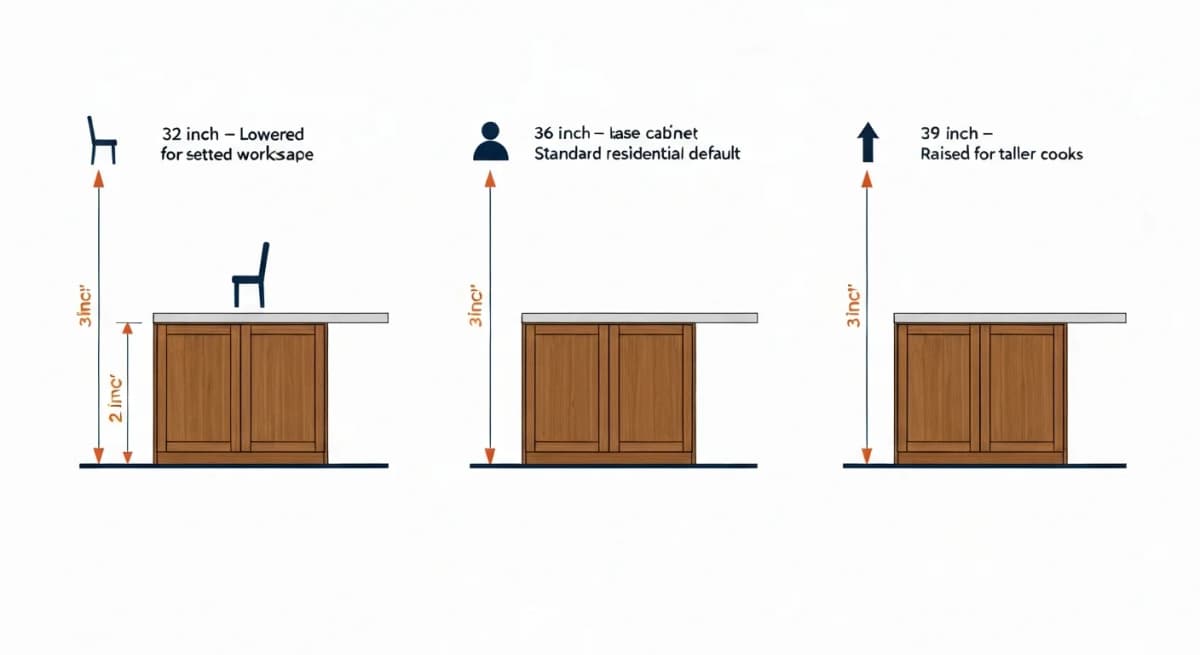
Standard 36 inches: Works for adults 5'6" to 6'0". The dominant counter height for most kitchens. Use this height for the primary cook zones used by adult-average household members.
Lowered 32-34 inches: Works for shorter adults (under 5'6") and seated users. Allows cook to work without bending or reaching uncomfortably. For multigenerational households with an older adult member who's lost height or has back issues, a 32-inch section is genuinely helpful. Reduces back strain during sustained prep work.
Raised 39 inches: Works for taller adults (over 6'0"). Reduces back strain during sustained prep. For households where a 6'2"+ cook does meaningful prep work, a raised counter section is valuable.
ADA-compliant 28-34 inches: If household includes wheelchair users, knee-clearance counter (no cabinet below) at 28-34 inches enables seated work. This is a more substantial design decision — usually addressed as part of accessibility scope rather than two-cook scope. See our accessible remodeling resources for full ADA design.
Multi-height implementation:
Single-height kitchen: All counters at 36 inches. Simplest, lowest cost, fits most households.
Two-height kitchen: Primary counters at 36 inches; one zone at 32-34 inches (often the island or a specific prep counter). Adds modest cost — $400-$1,200 for the height variation in cabinet construction.
Three-height kitchen: Primary counters at 36 inches; secondary zone at 32-34 inches; one zone at 39 inches. Adds more cost — $800-$2,500 for the multiple height variations.
For multigenerational kitchens, the two-height configuration is the typical sweet spot. The standard 36-inch primary counters serve most users; the lowered island or secondary counter serves the older or shorter household member specifically. The accommodation feels natural rather than special-purpose, and it benefits everyone (younger cooks sometimes prefer the lower height for tasks like kneading dough).
Multigenerational households with significant stature variation among regular kitchen users.
Different counter heights require more complex cabinet specification and slightly higher cost.
The final two-cook design decision: organize the kitchen so that non-cook household traffic (kids getting snacks, family members passing through, guests entering) doesn't cross active cook zones. Standard residential kitchens often have a single main path that serves both cook movement and pass-through traffic, creating constant interruption.
Traffic pattern principles:
Separate cook triangle from pass-through path: The cook triangle (sink-range-refrigerator) should be a self-contained zone that pass-through traffic doesn't cross. Configure the layout so that someone walking from the dining room to the back yard doesn't cut through the active cook zone.
Refrigerator placement for pass-through access: Position the refrigerator near the kitchen entrance rather than deep within the cook zone. Family members grabbing snacks can access the fridge without entering the cook zone. This often means the refrigerator goes opposite the range, with the cook triangle wrapping around the perimeter.
Beverage station outside the cook zone: Coffee maker, water dispenser, or beverage refrigerator placed in a perimeter location accessible from the kitchen entrance without crossing the cook area. Especially valuable for households with frequent guest entertaining or kids' beverage needs.
Island as buffer: A kitchen island physically separates the cook zone (perimeter cabinets + range + primary sink) from the pass-through and gathering area (other side of the island). The island provides a natural boundary that defines cook space.
Multiple kitchen entry points: If the kitchen has multiple entries (from dining room, from hallway, from garage), configure circulation so that the secondary entries don't cross the cook zone. Sometimes this requires repositioning cabinets or adding a transitional element.
For Boise homes specifically, many mid-century ranch homes have galley or U-shaped kitchens with single entries that force all traffic through the cook zone. Two-cook remodels in these layouts often benefit from opening up a wall to create a second entry or redirecting an existing entry — substantial scope work but high-value for daily kitchen function.
The combined effect: cook movement happens within a defined cook zone, pass-through traffic happens via a separate pathway, and the cooks don't have to interrupt their work to accommodate non-cook household traffic. Daily function improves significantly even for households that don't realize how much traffic-pattern friction they've been tolerating.
Multigenerational households where multiple non-cook members are in the kitchen during active cooking times.
Often requires wall modification or layout restructuring beyond standard kitchen cabinet replacement. Larger scope project.
Iron Crest's multigenerational kitchen scope discussions start by mapping the actual cooking patterns of the household — who cooks, when, in what combinations. We ask explicitly about parallel-cooking frequency, holiday cooking patterns, daily snack and beverage access needs, and any specific accommodation needs (mobility, vision, stature) for individual household members. The design that emerges reflects the household's actual usage rather than a generic two-cook template.
The typical cost premium for full two-cook design — wider aisles, two prep zones, two sinks, two ovens, varied counter heights, planned traffic patterns — runs $5,000–$18,000 above standard residential scope on a $45–$70k kitchen remodel. For households that genuinely cook in parallel regularly, the ROI is daily and the kitchen lifespan benefit (multigenerational households often own homes longer than single-cook households) compounds. For the broader multigenerational scope including accessory dwelling units and aging-in-place across the whole home, see our multigenerational home remodel guide and Boise kitchen remodeling page.
How do I know if my household actually needs two-cook design or if standard single-cook is sufficient?
The diagnostic question: in a typical week, how often do two adults cook in parallel for at least 15 minutes simultaneously? If the answer is 5+ times per week, two-cook design pays back daily. If the answer is 1-2 times per week (e.g., holiday meals and an occasional Sunday dinner), partial accommodation (a prep sink, slightly wider aisles, dedicated outlets at the island) may be sufficient without full two-cook scope. If the answer is rare, single-cook design is the right call — the two-cook premium isn't justified. The honest household conversation matters; many households think they'll have two-cook patterns and don't develop them, while others develop the pattern after a kitchen forces them to.
Can two-cook design be retrofitted to a standard single-cook kitchen, or does it require a full remodel?
Partially retrofittable. Some elements: a prep sink can be added to most existing kitchens with modest plumbing work ($1,800-$4,500). A wall oven can replace existing cabinet space ($2,000-$5,000). Outlet additions for prep zones run $400-$1,500. Aisle widths and counter heights are layout-dependent — if existing aisles are 36-42 inches, widening them typically requires a full cabinet replacement and is not a retrofit. Counter height variation similarly requires cabinet replacement. So elements like prep sink, second oven, and outlet additions can be retrofit; aisle and counter geometry typically requires full remodel scope.
Is two-cook kitchen design good for resale value in Boise?
Mostly positive but depends on the buyer demographic. For homes priced above $500k targeting family buyers, two-cook features (prep sink, two ovens, generous aisles, well-organized layout) are read as premium features and contribute positively to perceived value. For homes targeting smaller-household buyers (young professionals, retired couples), some two-cook features (prep sink, second oven) may be over-spec'd for their needs but don't actively detract. The most universally positive two-cook features are generous aisles and varied counter heights — these read as 'spacious and accessible' to all buyer demographics. The most niche features are double ovens and prep sinks — universally positive for family buyers, neutral for smaller households.
What's the difference between two-cook design and accessible/ADA design?
Significant overlap, but distinct primary goals. Two-cook design optimizes for parallel cooking by two able-bodied adults — generous aisles, two prep zones, two sinks, traffic pattern planning. Accessible/ADA design optimizes for use by people with mobility, vision, or stature limitations — knee-clearance counters, accessible appliance heights, open floor space for wheelchair turning, pull-out shelving for limited reach. Some features serve both goals (varied counter heights, generous aisles). Others are specific to one goal: pull-out drawers serve accessibility; two ovens serve two-cook function. For households with both two-cook patterns and accessibility needs, the kitchen scope integrates both — typically about 10-15% additional design effort to coordinate the two design frameworks.
How long should a multigenerational two-cook kitchen remodel take vs. a standard kitchen?
Slightly longer than standard, measured from first design meeting to walkthrough; on-site work stays about 1–2 weeks either way, because demolition doesn't start until cabinets and appliances are en route. The additional time reflects: more design phase (mapping household cook patterns, validating two-zone layout), longer cabinet fabrication (more cabinets, often with custom heights), more plumbing work (prep sink), more electrical work (additional outlets and oven circuits), and longer finish-out (more appliances and fixtures to install). For the project planning detail, see our kitchen remodel phasing guide.
Design a kitchen where two cooks don't fight over the sink
Multigenerational two-cook kitchen design saves daily friction across the kitchen's 20-30 year lifespan. Schedule a consultation and we'll map your household's actual cooking patterns to the right two-cook design elements for your home.
These pages go deeper on the topics linked from this article. Read them before your consultation and you'll come in with sharper questions and a clearer scope.
The following government agencies, industry organizations, and official resources provide additional information relevant to your remodeling project.