
Boise Kitchen Remodel Phasing: 7 Sequencing Decisions That Determine Whether 'Cabinets First' Saves Time or Costs You Thousands
Long cabinet lead times tempt homeowners and inexperienced contractors to order cabinets before the design is locked, or to start demolition before cabinets are on the way — both create expensive rework. Seven sequencing decisions, in order, that govern Boise kitchen remodels.
Quick answer
For a typical mid-budget Boise kitchen remodel (semi-custom cabinets, mid-grade appliances, standard layout changes), plan on roughly 3–4 months from first meeting to finished kitchen. The breakdown: 4–6 weeks of design, selections, and exploratory investigation; permitting and cabinet lead time (4–8 weeks semi-custom, 8–12 weeks custom) running in parallel; then 1–2 weeks on site — often just 5–6 days — for demolition, rough-in and inspection, cabinet install, countertop template and install, and finish-out.
The most common project-management mistake on a Boise kitchen remodel isn't budget or scope — it's sequencing. Cabinets carry 4–8 week lead times for semi-custom and 8–12 weeks for custom, so the rookie instinct (homeowner or contractor) is either to order cabinets before the design is finished, or to start demolition and "real work" while waiting. Both are wrong more often than not: one creates rework that can add $3,000–$12,000 to the project, the other leaves the family without a kitchen for the entire lead time.
The actual right sequence depends on the project profile — but the decision point is always the same: what gets locked in by ordering cabinets, and which of those locked-in decisions might be wrong if rough-in inspection reveals something you didn't expect? This article walks through the seven sequencing decisions in the order they should happen, with the Boise-specific factors (lead times, code requirements, climate considerations) that govern each.
For broader whole-home remodel phasing — managing multiple rooms, contractor coordination across trades, and budget pacing across a 6-12 month project — see our phasing a whole-home remodel guide. This page focuses specifically on the sequencing decisions inside a single kitchen remodel, where the constraints are different: tighter trade dependencies, longer single-product lead times, and a single inspection sequence.
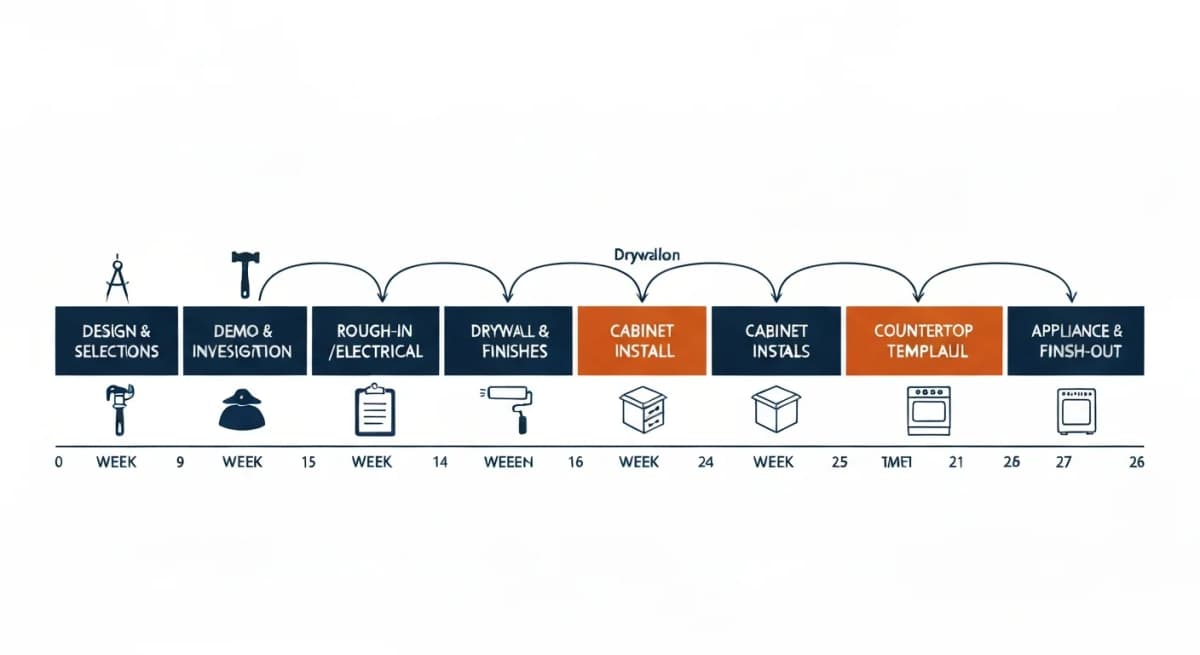
The cabinets-first reasoning sounds airtight: cabinets have 4–8 week lead times for semi-custom and 8–12 weeks for custom. Demo and rough-ins together run about a week. So why not get cabinets ordered immediately, before the design is fully locked, and sort out the details while the cabinets are in fabrication?
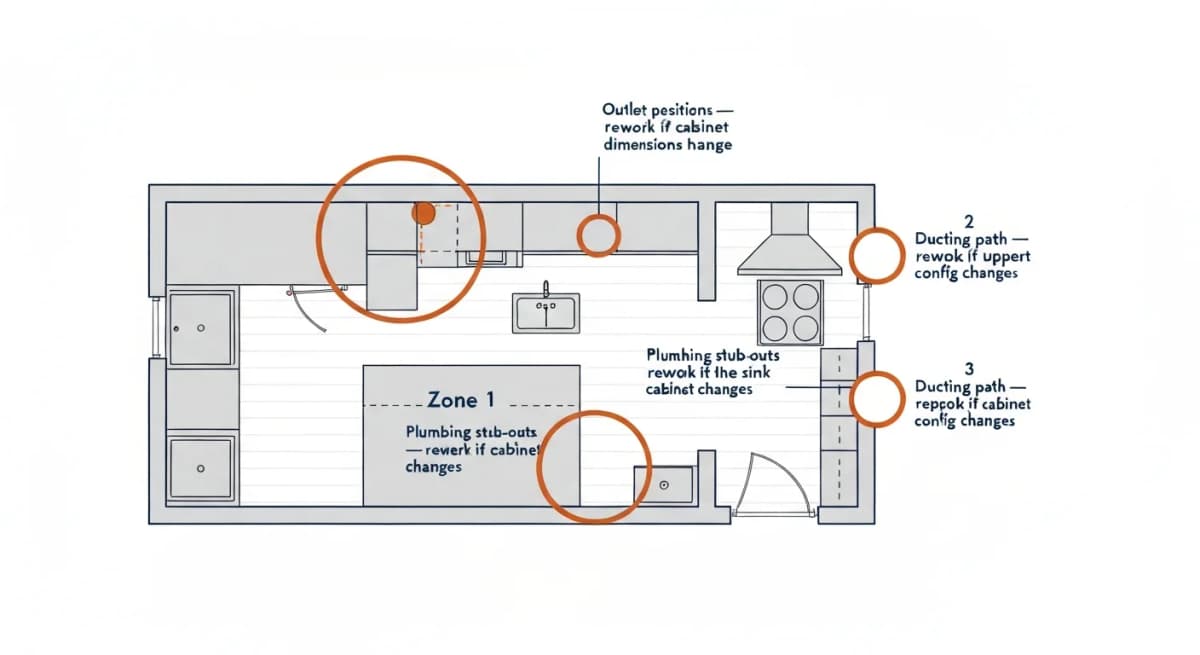
The answer: cabinet specifications lock in dozens of downstream decisions that depend on rough-in inspection results you don't yet have. The most expensive ones:
Sink cabinet dimensions and configuration — determine plumbing stub-out heights and lateral positions. If the cabinet ships with a different sink base than the plumber roughed in for, you re-do plumbing or you accept off-center plumbing that looks bad and complicates future repair.
Cabinet box depths and bulkhead heights — interact with HVAC ductwork running through wall and soffit cavities. If demo reveals a duct in a wall that the cabinet design assumed was clear, you either re-route the duct ($800-$2,500) or accept a furring strip that compromises the cabinet aesthetic.
Cabinet appliance cutouts — locked to specific appliance models. Change from a 30" range to a 36" range after ordering and you re-make the cabinet box for $400-$900 (often more if it's a custom finish).
Upper cabinet positions over the range — determine range hood ducting path. If you discover during demo that the ducting needs to take a different path (joist depth, structural cavity, etc.), the range hood spec and its cabinet interface change.
The fix isn't "never order cabinets first." It's: complete enough investigation that the decisions you lock in by ordering cabinets are decisions you're confident about. Items 2-7 walk through what that investigation looks like and when cabinets-first actually does work.
Understanding the actual decision tree before defaulting to either 'cabinets first' or 'demo first.'
Investigation phase takes 2-4 weeks before any visible progress on site. Homeowners often want momentum and resist this.
The first sequencing decision: complete the design phase to a level that supports cabinet ordering. The deliverable at end of design phase, before cabinet order:
Complete appliance list with specific model numbers. Not just "36 inch range" — the actual model, with the manufacturer's installation specification (cutout dimensions, electrical and gas connection requirements, clearance requirements). Same for refrigerator, dishwasher, range hood, microwave, oven, and any specialty appliances (wine fridge, ice maker, beverage center).
Sink and faucet selection with rough-in dimensions. Sink choice determines sink-cabinet width and the placement of plumbing stub-outs. Faucet choice determines whether you need separate hot/cold supply lines or a single mixed line, and the height of the wall stub-out if you're going with a wall-mount faucet.
Counter material selection. Not the slab itself (which gets templated later), but the material category — quartz, granite, butcher block, concrete, etc. Each material has different weight, edge-profile, and overhang requirements that affect cabinet structural specifications and cabinet-box reinforcement.
Hood configuration and venting path investigated. Whether the range hood will be wall-mount, island, downdraft, or recirculating. For ducted hoods, an investigation of the venting path including duct routing (through joists, up to attic, out to exterior) and any HVAC interferences. This often requires a small exploratory hole in drywall to inspect the cavity above the range — worth doing during design phase before any commitments.
Lighting plan with switch and outlet positions. Pendant lights, under-cabinet lights, in-cabinet lighting, recessed cans — each requires specific electrical rough-in locations. Switch positions affect drywall layout and any tile-backsplash work.
Layout dimensions with all clearances verified. Aisle widths (NKBA recommends 42" minimum for one-cook, 48" for two-cook), appliance clearances (typically 15" landing zones beside cooktops, 18" beside ovens), door swing clearances. The cabinet plan reflects these clearances; verifying them prevents discovering an inadequate aisle after install.
For most Boise kitchens, completing this design phase takes 4-6 weeks (longer for custom designs). The investment is worth it: the cabinet order placed at end of this phase reflects decisions that are unlikely to change.
Owner-occupied homes where the kitchen stays in use through design phase and any disruption needs to be minimized.
Design phase pushes the project start date back 4-6 weeks vs. starting demo immediately and figuring out details later.
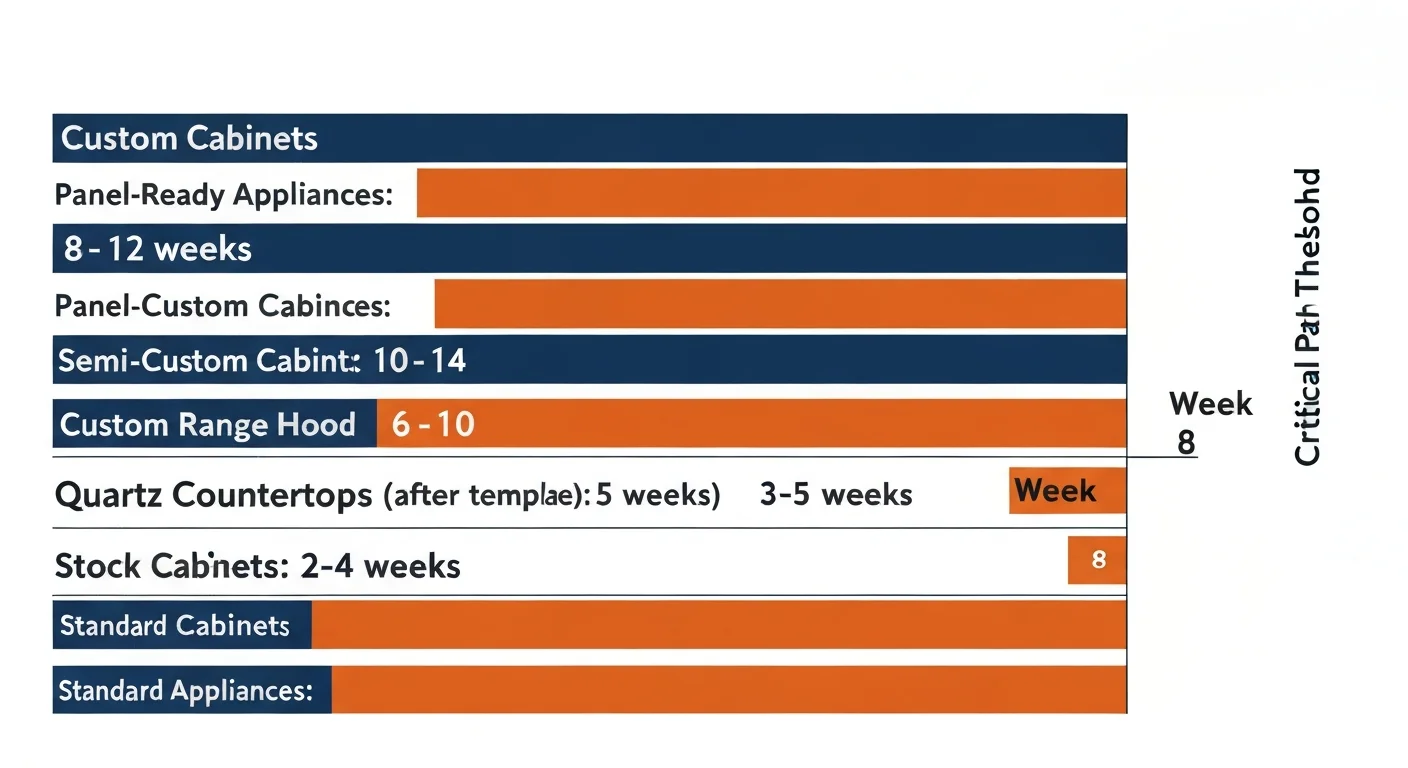
Not all cabinet orders need the same lead time, and the lead time should govern when you commit. Stock cabinets ship in 2-4 weeks; ordering them first makes no sense — the rough-in work takes longer than the lead time. Semi-custom and custom orders are different.
The decision framework:
Stock cabinets (IKEA, Home Depot in-stock, low-cost online): 2-4 week lead time. Order after rough-in inspection, not before. The rough-ins govern the schedule; cabinet delivery falls in line easily.
Semi-custom cabinets (KraftMaid, Merillat, Thomasville): 4–8 week lead time. Critical-path item; the order should happen at design-phase finalization, with permitting and exploratory investigation happening in parallel. The key: design must be locked enough that the cabinet order reflects final decisions, not preliminary ones.
Custom cabinets (local shops, premium brands like Wood-Mode): 8–12 week lead time. Even more critical-path. Order at end of design phase, with all selections finalized. Rework on custom cabinets is more expensive than semi-custom (custom finishes, custom inserts, custom hardware) — so the design discipline matters more.
Panel-ready appliances (Sub-Zero refrigerators with integrated panels, Bosch dishwashers with custom panels): Often longer lead than the cabinets themselves — 8-12 weeks for the appliance, plus the panel fabrication time. These are often the actual critical-path item, not the cabinets. Order earliest, before cabinets if necessary.
Custom range hoods (custom-fabricated metal, plaster, or wood hoods): 6-10 weeks of fabrication time, often longer for ornate designs. If specifying a custom hood, order at design-phase finalization regardless of cabinet timing.
The principle: each critical-path item gets ordered at the point in the schedule where its lead time fits the project timeline. Compress everything into "cabinets first" oversimplifies and creates the rework risk.
Mid-budget kitchens ($45–$70k) where semi-custom cabinets are the right choice and lead times are 4–8 weeks.
Requires more sophisticated project management than 'just order everything first and figure out timing later.'
Even in homes where design phase is exhaustive, there's information that only demo reveals. The right sequence: complete enough demo to see what's in walls and floors before placing the cabinet order — even if the demo is partial.
Two demo approaches:
Full demo before cabinet order. Tear out existing cabinets, drywall, and any flooring being replaced. Inspect wall and floor cavities for structure, plumbing, electrical, and HVAC. Confirm joist depths, identify any abandoned penetrations, verify subfloor condition. This adds 1–2 weeks to the timeline before cabinet order, and it means the kitchen is torn out for the entire cabinet lead time. That is why it is not our default: Iron Crest does not begin demolition until cabinets and appliances are confirmed en route, so the kitchen is out of service for 1–2 weeks rather than months. Full demo before ordering only makes sense where the existing kitchen has serious known issues (water damage history, suspected structural problems) that exploratory holes cannot resolve — and then the family should plan on living without the kitchen for the lead time.
Exploratory demo only. Open targeted holes in drywall to inspect critical cavities (above range for hood ducting, behind sink for plumbing access, in any walls that the design assumes are clear). Doesn't gut the kitchen, so it remains usable during cabinet fabrication. Adds only 2-5 days to the schedule. Appropriate for homes with well-understood existing conditions (recently remodeled, newer construction, or thorough pre-purchase inspection).
The mistake most homeowners make: deferring all demo until after cabinets arrive. The reasoning ("we don't want the kitchen out of service longer than necessary") is understandable but creates the highest-risk sequencing. When demo reveals issues, the cabinets are already in fabrication and changes are expensive — or in storage and re-stocking fees apply.
For Boise homes built before 1970, exploratory demo is essentially mandatory: you may find knob-and-tube wiring, galvanized plumbing, asbestos floor tile, lead paint, or non-code framing. Discovering these after cabinet order creates cascading rework. (See our lath-and-plaster bathroom demo article for the bathroom-side companion to these old-home demo challenges.)
Homes built before 1990, or any home with known prior plumbing or electrical issues.
Extends timeline by 1-2 weeks before any cabinet order. Reduces total project risk significantly.
Get your kitchen sequenced right before you commit
The 4–6 weeks of design and investigation we run before cabinet order typically saves weeks of mid-project rework. Schedule a planning consultation and we'll map your project's critical path before a single decision is locked in.
After demo and any necessary repairs, the rough-in phase begins: framing modifications, plumbing relocations, electrical, HVAC ductwork. The City of Boise (or Ada County for unincorporated areas) requires inspection of rough-in work before drywall closes in the walls. This inspection is the critical lock-in point.
What gets inspected:
Plumbing rough-in: Stub-out positions, drain configurations, water supply lines. Inspector confirms code compliance and that the layout matches the permit drawings. Once approved, plumbing rough-in is essentially locked — changes after this point require re-permit and re-inspection.
Electrical rough-in: Receptacle positions, switch locations, dedicated circuits for major appliances, AFCI/GFCI protection compliance, light fixture rough-ins. The 2023 NEC (adopted in Idaho) requires GFCI protection on virtually all kitchen receptacles and specific dedicated circuit requirements for refrigerator, dishwasher, microwave, garbage disposal, and any specialty appliances. Inspector verifies compliance.
HVAC rough-in: Any new ductwork (range hood vents, supply or return adjustments), and confirmation that existing ductwork doesn't create code issues with the new layout.
Insulation and air-sealing: Idaho energy code requires specific insulation values in exterior walls and air-sealing at penetrations. Inspection happens before drywall.
The sequencing significance: cabinet order should be locked before rough-in inspection, but cabinet installation should not happen until rough-in inspection passes. If inspector requires changes (re-routing a circuit, moving a stub-out), those changes happen before drywall and before cabinet install. If you've already ordered cabinets, the cabinet specification reflected the pre-inspection design — and the inspection-required changes might conflict.
This is why item 1's investigation phase matters. The more thorough the design and demo investigation, the less likely inspection requires changes that conflict with cabinet specifications.
All Boise kitchen remodels requiring permits (which is most kitchen remodels with electrical, plumbing, or layout changes).
Inspection scheduling adds 2-5 days to the timeline. Cannot be skipped.
Once rough-in inspection passes and drywall is up, cabinet installation can proceed. This phase has its own sequencing logic that significantly affects countertop fit and finish.
The right sequence:
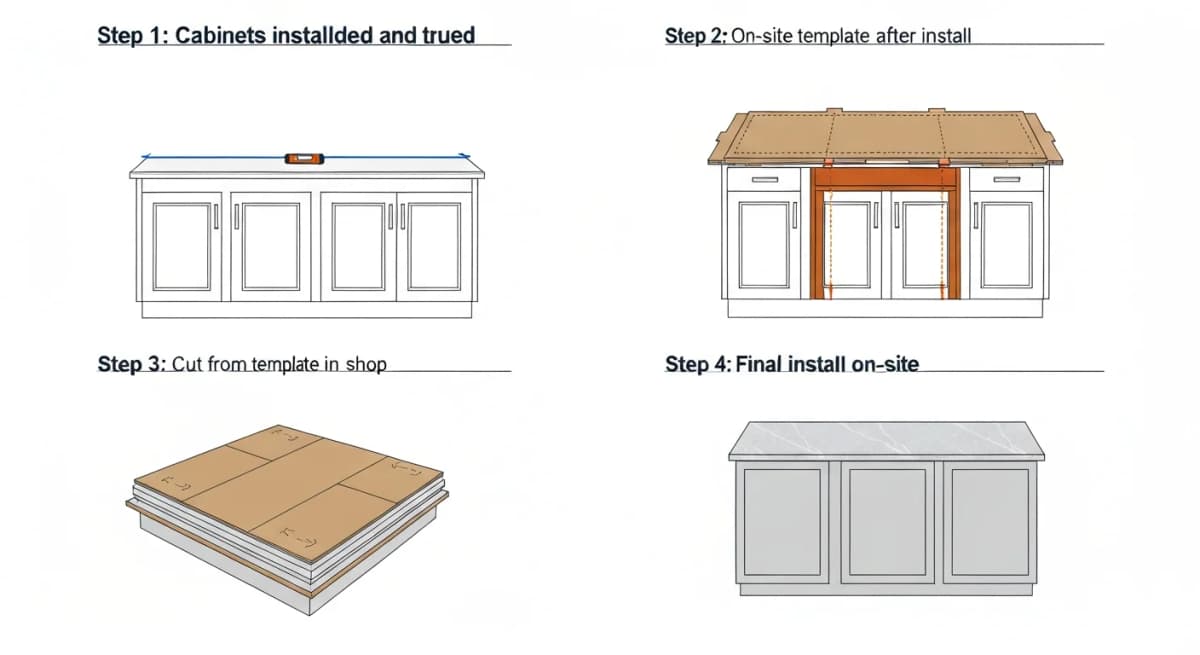
Install base cabinets first. Level base cabinets across the entire run, shimming where the floor isn't perfectly level (which is virtually all Boise homes — slabs and older homes both have variability). Cabinets must be trued to a level laser line, not to the floor.
Install upper cabinets next. Plumb and level to the same reference. Verify clearance to ceiling and to the range hood. Upper cabinets that aren't perfectly aligned with base cabinets create visible problems with countertop seams and backsplash tile.
Template countertops on-site after cabinets are installed. This is non-negotiable for stone (quartz, granite, marble). The fabricator brings template material (cardboard or laser scanner) to the site, takes measurements directly off the installed cabinets, and returns to the shop for fabrication. Counter slabs are then cut to fit the actual installed cabinets — not to drawings.
Template-to-install is the one gap in the on-site schedule. Because we book the fabricator's template and install slots before demolition starts, that gap stays short and the whole on-site phase stays within about 1–2 weeks. During this window, you have installed cabinets but no countertops — typically the kitchen is partially usable (cabinets accept stored items but no countertop work surface).
Sink and faucet install happens after countertops. The fabricator typically cuts the sink hole during fabrication based on template; the installer then drops the sink into the cut and the plumber connects supply and drain.
The common mistake: countertop template from cabinet drawings before installation. Even small cabinet install variances (shim heights, framing tolerances) create countertop fit problems. The right specification: every countertop template happens on installed and trued cabinets. Any fabricator who templates from drawings is one to avoid.
For Boise homes specifically: stone slabs are often shipped from out of state, so any re-fabrication for fit problems means shipping a new slab. The cost of a re-fab is $1,500-$4,500 plus the timeline impact — strong incentive to get template right the first time.
Stone countertops (quartz, granite, marble) where fit precision matters.
A short wait between cabinet install and countertop install, with the kitchen partially out of service — which is why the fabricator's slots are booked before demo.
Cabinets-first sequencing IS the right call in three specific scenarios. Understanding when this approach works prevents over-correction in the other direction.
Scenario 1: New construction (no demo, no existing rough-in). In new-construction kitchens, there's no existing condition to investigate. Designer and contractor specify everything from the ground up, and the rough-in installation follows the design without ambiguity. Order cabinets at the framing stage, get rough-ins inspected before drywall, and install cabinets once drywall is up. Sequencing risk is low.
Scenario 2: Pure cosmetic refresh with no layout change. If the project is "same layout, new cabinets, new countertops, same plumbing and electrical positions" (often called a "drop-in remodel"), then rough-in work isn't significant and cabinets-first works. The plumber simply reconnects to existing stub-outs; the electrician energizes existing circuits. The only risk: if existing electrical or plumbing has hidden issues, the project becomes scope-creep mid-install. For Boise homes built post-1990 with maintained plumbing and electrical, this scenario is reasonable.
Scenario 3: Cabinetry with completely standard dimensions and stock appliances. If the cabinet selections are standard-dimension stock items (typical IKEA SEKTION, 30-inch ranges, standard 30-inch refrigerators, standard 60-inch sink bases) and the kitchen layout is straightforward, the cabinet order has very few variables that could be wrong. Even with limited investigation, the cabinets-first risk is low.
Outside these scenarios — Boise homes 30+ years old, layout changes, custom cabinets, premium appliances, structural modifications, or HVAC changes — cabinets-first is the wrong default. Investment in design and investigation phases pays back through reduced rework.
The honest framing for homeowners: "I want to start work this week" feels urgent, but the cost of waiting 4-6 weeks for design and investigation is usually much less than the cost of fixing decisions that were locked in too early. A well-run Boise kitchen remodel takes roughly 3–4 months from first meeting to finished kitchen, with only 1–2 weeks of that on site. The 4–6 weeks of "no visible progress" at the start typically saves weeks of mid-project rework and re-orders.
Distinguishing the projects where cabinets-first is correct from those where it isn't, before committing to a sequencing approach.
Requires honest assessment of project complexity rather than defaulting to either 'always cabinets first' or 'never cabinets first.'
Iron Crest's kitchen project planning starts with an explicit sequencing conversation in the first design meeting. We map out lead times for each major component (cabinets, appliances, countertops, range hood, lighting, hardware), identify the critical-path items, and lay out the rough-in and inspection windows. The deliverable is a sequencing schedule that names exactly when each commitment must be made, with the dependencies that govern each.
For homes built before 1990 — which describes a meaningful portion of Boise's housing stock, especially North End, Boise Bench, Garden City, and parts of West Boise — we always include an exploratory demo phase before any cabinet order. The 2-5 days of investigation saves orders of magnitude more in avoided rework. For broader project-management context, see our whole-home remodel phasing guide, and for the kitchen scope itself, see our Boise kitchen remodeling page.
How long does a Boise kitchen remodel actually take from contract signing to final walkthrough?
For a typical mid-budget Boise kitchen remodel (semi-custom cabinets, mid-grade appliances, standard layout changes), plan on roughly 3–4 months from first meeting to finished kitchen. The breakdown: 4–6 weeks of design, selections, and exploratory investigation; permitting and cabinet lead time (4–8 weeks semi-custom, 8–12 weeks custom) running in parallel; then 1–2 weeks on site — often just 5–6 days — for demolition, rough-in and inspection, cabinet install, countertop template and install, and finish-out. Iron Crest does not begin demolition until cabinets and appliances are confirmed en route, which is what keeps the on-site phase short. The cabinet lead time is almost always the critical-path item, which is why item 3's lead-time triage matters.
Should I plan to live without a kitchen for the entire remodel, or can I phase the work to maintain partial use?
The kitchen is out of service for the on-site phase — typically 1–2 weeks, and often just 5–6 days, because demolition doesn't start until cabinets and appliances are en route. Before that, the existing kitchen stays fully usable through design, permitting, and cabinet fabrication (exploratory demo opens only small inspection holes). After cabinet install but before countertops, the kitchen has cabinets in place but no work surface — partially usable for storage but limited for prep. The right plan for most Boise homes: set up a temporary kitchenette in another room (laundry room, garage, basement) with a hot plate, microwave, slow cooker, and mini-fridge. Plan on this setup running 1–2 weeks. Restaurant budget during this period is typically $400-$900 per week for a family of four.
What's the cost difference between 'do it right' sequencing and 'rush through it' sequencing on a typical Boise kitchen?
Significant. On a $55,000 mid-budget kitchen remodel, the cost difference between thorough sequencing (design phase, investigation, proper rough-in inspection before cabinet install) and rushed sequencing typically runs $5,000-$15,000 in avoided rework. The biggest specific cost categories: cabinet re-orders or re-fabrication ($1,500-$6,000), countertop re-fabrication if templated incorrectly ($1,500-$4,500), electrical rework if outlet positions were wrong ($600-$2,000), plumbing rework if stub-outs were positioned wrong ($800-$2,500), and HVAC adjustments if ductwork conflicts ($1,000-$3,000). The 4–6 weeks of design phase work that prevents these rework scenarios is part of our process; the homeowner's main investment is time in selections, and it pays for itself in avoided rework.
If my contractor says 'we'll figure that out during construction,' is that a red flag?
Yes, in most cases. The phrase usually translates to either '(a) we haven't done the design work and we don't want to invest the time, or (b) we're hoping the issue won't materialize.' Both are bad outcomes for the homeowner. The exception: certain specific issues are genuinely unknowable until demo (subfloor condition under flooring, what's in wall cavities, condition of existing fixtures behind cabinets). For those, 'we'll address that when we see it' is honest. The distinguishing question to ask: 'What specifically can't be known until demo, and what's our plan for each possible outcome?' A contractor who can answer that question concretely has done the project planning work. A contractor who can't is exposing you to scope-creep risk.
How does the sequencing change if I'm doing a kitchen remodel as part of a whole-home renovation?
Several adjustments. (1) The kitchen sequence integrates with the broader home sequence — typically the kitchen is the last room finished because it's the most disruptive and most homeowners want functional living space sooner. (2) Cabinets often share lead times with other built-ins (entertainment center, bathroom vanities, mudroom storage), so all are ordered together at end of master-design phase. (3) Electrical and plumbing rough-ins for the entire home happen in one phase before any drywall, reducing inspection events and trade coordination overhead. (4) Disruption is spread over a longer total project timeline (often 8-14 months for whole-home), but each room is in transition for fewer cumulative weeks. Our whole-home remodel phasing guide covers this pattern in depth.
Get your kitchen sequenced right before you commit
The 4–6 weeks of design and investigation we run before cabinet order typically saves weeks of mid-project rework. Schedule a planning consultation and we'll map your project's critical path before a single decision is locked in.
These pages go deeper on the topics linked from this article. Read them before your consultation and you'll come in with sharper questions and a clearer scope.
The following government agencies, industry organizations, and official resources provide additional information relevant to your remodeling project.