
Lath-and-Plaster Bathroom Demo: 7 Things You'll Find Behind the Tile in a North End Boise Bungalow
1920s and 1930s North End Boise bungalows hide specific conditions behind the bathroom walls. Plan for the discoveries before demo day — every one of them costs more to address as a surprise than as a planned scope.
Quick answer
Significantly more than equivalent scope in a 1990s+ home. A typical mid-range bathroom remodel in a 2000s Boise home runs $25,000-$45,000. The same scope in a North End bungalow typically runs $38,000-$68,000 once the seven discoveries above are addressed.
The North End is Boise's most architecturally distinctive neighborhood — bungalows, Craftsman-style cottages, and Tudor revivals from the 1910s through 1940s line the streets between State Street and the foothills. These homes have charm that newer construction can't replicate, structural bones that have aged remarkably well, and bathrooms that hide specific 90-year-old surprises behind every wall.
When we run a North End bathroom remodel — particularly the full demo-and-rebuild scope that most pre-1940 bathrooms eventually need — the same seven discoveries appear with predictable frequency. Knowing what's likely behind the wall before demo day lets the homeowner budget for the contingency, plan for the disruption, and avoid the worst version of these projects: the one where the demolition reveals scope that wasn't in the original quote and the budget moves sharply as a result.
For broader historic home remodeling context (lead paint, asbestos, knob-and-tube, foundation issues), see our historic home remodeling guide. For pre-1965 plumbing-specific issues (galvanized supply lines), see our galvanized supply line analysis. This page focuses on the specific bathroom-demolition discoveries we see most often in North End bungalows.
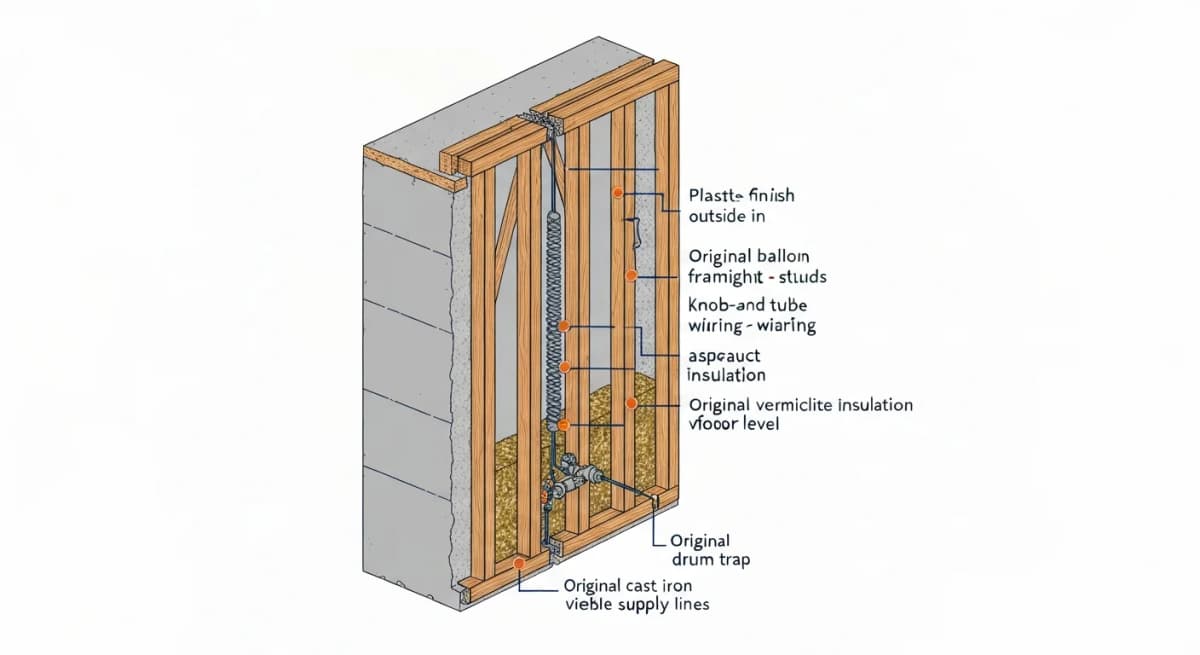
Pre-1945 North End bungalows used lath-and-plaster wall construction — horizontal wood strips (lath) nailed across studs with three coats of lime-and-gypsum plaster applied over them. The system produces walls 1.25-1.75 inches thick (vs modern drywall at 0.5 inches), with excellent sound dampening and surprising durability when intact.
For bathroom remodels, the lath-and-plaster system creates specific challenges:
Removal scope: Lath-and-plaster removal is dustier, slower, and more labor-intensive than drywall demolition. Typical residential drywall demo runs $0.50-$1.50 per square foot. Lath-and-plaster demo runs $2.50-$5 per square foot due to the additional weight, dust containment requirements, and disposal complications.
Wall thickness mismatch: Reframing to modern dimensions (drywall + tile substrate) creates wall thickness differences that have to be addressed at door jambs, window casings, and corners. Custom shim work required at every transition.
Surface condition: Intact lath-and-plaster walls in the bathroom proper are typically being torn out during a remodel; lath-and-plaster on adjacent walls (hallway, bedroom) that meet the bathroom corner have to be preserved without damage during the demo. Requires more careful demolition than typical scope.
The honest math: a full bathroom demo in a North End bungalow costs materially more in demolition labor than the same demo in a 1980s ranch — lath and plaster comes off in dusty fragments rather than sheets, and the debris volume alone changes the day. The discovery of additional hidden conditions during that demo (items 2-7) often compounds the cost.
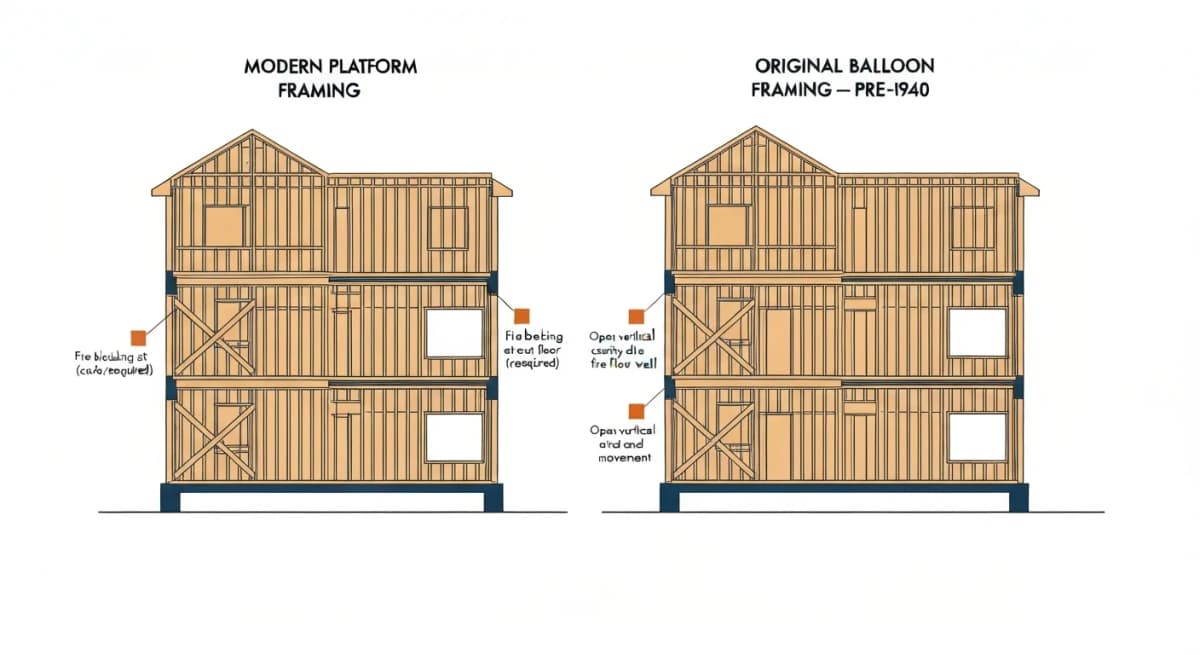
Pre-1940 residential construction in Boise (and most of the U.S.) used balloon framing — wall studs that run continuously from foundation to roof in two-story homes. Modern platform framing uses studs that terminate at each floor level. The difference is invisible until walls open during demo, and it has consequences.
Balloon framing implications during bathroom remodel:
Vertical cavities: The full-height studs create open vertical wall cavities running from basement to attic. In bathrooms, this means moisture, vapor, and odor can travel between floors through the wall cavities. Modern code requires fire blocking and vapor barriers; balloon framing typically has neither.
Fire-safety implications: Open vertical cavities allow fire to spread between floors much faster than modern platform framing. Building codes since the 1960s require fire blocking at each floor level. Adding fire blocking during a bathroom remodel is feasible if the wall is open anyway — typically $200-$500 in additional materials and labor per affected wall.
Plumbing routing: Plumbing runs that travel between floors take advantage of the open cavities. Existing plumbing routed through balloon-framed walls may need to be re-routed when modern fire blocking is added (the blocking interrupts the cavity).
Insulation discovery: Some North End homes had insulation added to wall cavities at later dates. The blown-in insulation (typically cellulose or rock wool) settles unevenly in balloon-framed cavities, creating cold spots and thermal bridges. Bathroom demos often reveal the insulation condition; remediation may be warranted as part of the project.
For most North End bathroom remodels, balloon framing isn't a deal-breaker but adds 5-15% to the structural scope of the project. The fire blocking addition is non-optional once walls are opened — Boise PDS inspectors verify it before drywall.
Vermiculite insulation — a chunky, gold-flecked, mineral-based loose-fill insulation — was widely used in residential applications from the 1920s through 1990. The largest vermiculite producer (Zonolite) sourced from a Libby, Montana mine that contained asbestos contamination. The EPA states that the Libby mine accounted for more than 70 percent of all vermiculite sold in the United States between 1919 and 1990, and advises treating any vermiculite attic insulation as if it contains asbestos unless testing shows otherwise (epa.gov, "Protect Your Family from Asbestos-Contaminated Vermiculite Insulation").
North End Boise bungalow bathroom demolition often reveals vermiculite in two locations:
Attic above the bathroom: Most common location. Vermiculite was a popular blown-in attic insulation. Removing the bathroom ceiling (which may be necessary for fan venting, electrical, or plumbing modifications) exposes the attic insulation directly.
Wall cavities: Less common but seen in some North End homes. Some homeowners added vermiculite to wall cavities as a retrofit insulation in the 1950s-70s.
Asbestos handling requirements:
Idaho follows federal EPA regulations for asbestos. For homeowner-initiated remediation of less than 160 square feet of vermiculite, the work can be done by the homeowner with proper PPE. For commercial or contractor-led remediation, EPA-licensed asbestos abatement contractors are required. The cost difference is significant — DIY removal at $0.50-$2 per square foot vs professional abatement at $10-$25 per square foot.
For North End bathroom remodels, the practical approach: pre-construction sampling of any visible vermiculite to determine asbestos content, professional remediation if asbestos is present and the work involves disturbing the material, and dust containment during all remediation work. Iron Crest coordinates with licensed Boise-area abatement contractors when vermiculite is encountered.
Cost: $1,500-$5,000 for typical vermiculite remediation in a single-bathroom scope. If asbestos isn't present in the sample, much lower ($300-$800 for DIY-compatible removal).
1920s-1940s North End plumbing predates many modern code requirements. One specific violation we find with regularity: black iron pipe (originally installed as gas line) repurposed as a plumbing vent. The pipe runs from a fixture (typically the toilet or sink) vertically through the wall and out the roof, serving as the air-pressure equalizer for the drain system.
The issue:
Modern plumbing code requires vent stacks to be sized appropriately for the drain load and made from approved plumbing materials (cast iron, PVC, ABS). Black iron pipe is not an approved plumbing material — it's designed for gas service, not drain venting. The pipe diameter is typically 1/2 inch (gas pipe standard), well below the 1.5-2 inch minimum vent stack size for residential plumbing.
Why this matters:
Undersized vent stacks fail to maintain proper drain pressure during use, leading to slow drains, gurgling, and (in worst cases) sewer gas backflow into the room. The black iron pipe also corrodes over decades, often developing pinhole leaks that release sewer gas into wall cavities.
Discovery during bathroom remodel:
When the bathroom wall opens for demolition, the gas-pipe-vent is visible alongside the standard plumbing. Recognition usually comes from a Boise plumber who's seen the pattern before — the small-diameter black pipe routing toward the roof is the giveaway.
Remediation:
Replace the gas-pipe-vent with proper PVC or cast iron vent stack. Cost: $400-$1,200 for the new vent installation including roof penetration and flashing. Boise PDS inspector will verify the new vent meets code at final inspection.
Plan your North End Boise bathroom remodel with pre-demolition investigation
Pre-1940 Boise bathrooms hide predictable surprises. Schedule a consultation and we'll inspect, scope, and budget honestly — protecting your project from the demo-day surprises that drive 30-60% cost overruns when contractors don't investigate first.
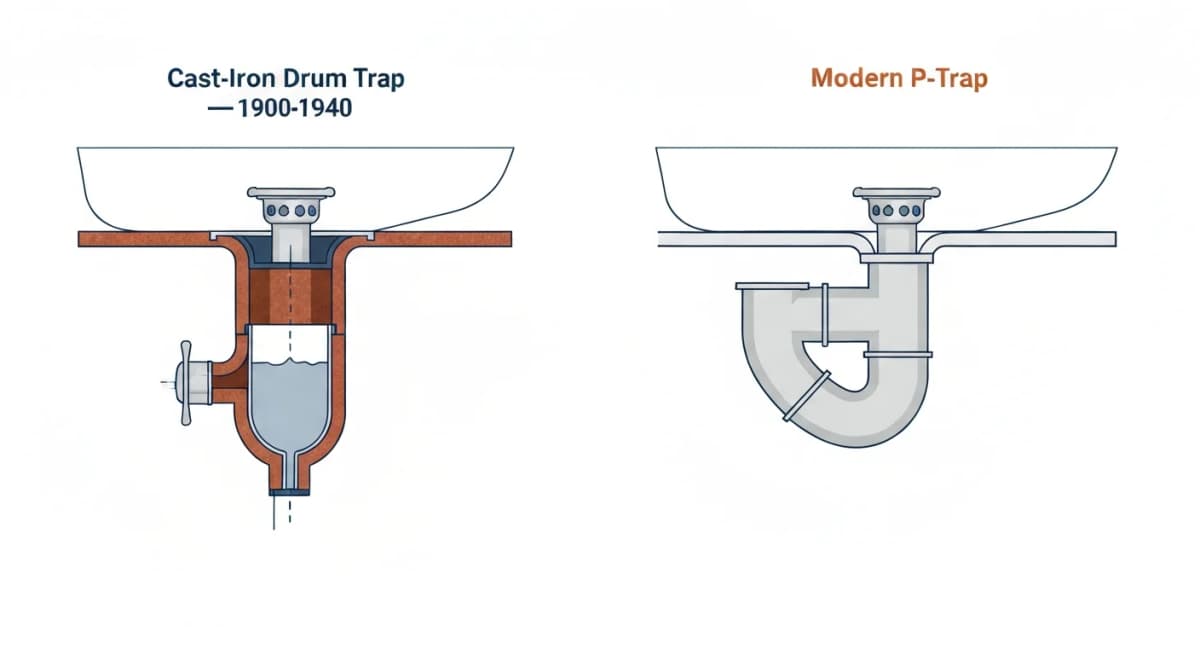
Pre-1940 residential plumbing used cast-iron drum traps under bathtub drains — a 3-4 inch diameter cylindrical chamber with the drain inlet at the top and outlet at the bottom, providing water seal to prevent sewer gas escape. The drum trap is unique to the era; modern plumbing uses standardized P-traps that look nothing like it.
Drum trap issues:
Not code-compliant: Drum traps are no longer permitted in new residential plumbing. Modern code requires P-traps. Bathroom remodels that disturb the drum trap require replacement with code-compliant alternatives.
Aging condition: Cast-iron drum traps that are 80+ years old typically have significant corrosion, mineral buildup, and sometimes pinhole leaks. The cast-iron exterior often appears intact but the interior is degraded.
Cleaning access: Drum traps have a removable cleanout cap, but the seal is typically galvanized steel-to-iron, which corrodes shut over decades. Opening the cleanout cap on a 90-year-old drum trap usually requires destroying it.
Replacement scope:
The drum trap removal triggers a partial subfloor opening (typically a 24-36 inch section around the tub drain) to access the trap and the connecting pipes. New P-trap installation with proper venting (sometimes requiring vent stack modifications addressed in item 4). Cost: $600-$1,500 for typical drum trap replacement during a North End bathroom remodel.
Combined with other plumbing modernization (galvanized supply line replacement per item 6, vent stack upgrade per item 4), the cumulative plumbing scope on a North End bathroom remodel is typically $3,500-$7,500 in additional cost beyond the visible finish work.
North End bathroom remodels almost universally reveal active knob-and-tube wiring in walls, ceilings, or attic spaces above the bathroom. Knob-and-tube was the standard residential wiring system from approximately 1900 through 1945, and Boise's North End was largely wired with it during the home construction era.
For detailed analysis of knob-and-tube issues and the broader pre-1980 Boise wiring context, see our knob-and-tube kitchen wiring analysis — the issues are similar across rooms.
Bathroom-specific knob-and-tube considerations:
GFCI requirements: NEC 210.8 requires GFCI protection on all bathroom receptacles. Knob-and-tube circuits cannot be reliably GFCI-protected because they lack a ground wire. Any active knob-and-tube serving bathroom outlets must be replaced as part of the remodel.
Fixture and fan load: Modern bathroom electrical needs (heated floors, exhaust fan, vanity lighting, GFCI outlets, heated towel rail, etc.) exceed knob-and-tube circuit capacity. Even where knob-and-tube technically works, the load capacity is inadequate for current bathroom standards.
Insurance implications: Idaho insurance carriers typically require disclosure of active knob-and-tube wiring. Pre-remodel inspections may identify the wiring; remediation during the remodel is the natural opportunity to address it.
Scope and cost: bathroom-specific knob-and-tube remediation runs $1,200-$3,500 depending on circuit count and accessibility. If the broader home has additional knob-and-tube outside the bathroom scope, the question becomes whether to expand the project to address whole-home wiring or limit to the bathroom-specific scope.
Pre-1945 North End bathrooms have original 1x6 tongue-and-groove pine subfloor, typically with linoleum or vinyl flooring over it. After 80+ years of bathroom moisture exposure — tub spills, toilet overflows, condensation, occasional plumbing leaks — the subfloor has predictable rot patterns.
Common rot locations:
Around the toilet flange: The wax ring at the base of the toilet often fails over decades, leaking water onto the subfloor at the toilet base. Decades of slow leak produces rot in a 2-3 foot radius around the toilet. Visible as soft spots under the existing flooring.
At the tub-floor transition: Caulking failures at the tub-floor seam allow water to penetrate the subfloor adjacent to the tub. Rot extends 12-24 inches from the tub edge.
Around the sink drain: Less common but seen — usually from old supply line leaks rather than from typical use.
Discovery during demo:
The existing flooring (linoleum, vinyl, or sometimes ceramic tile over a thin underlayment) comes up during demolition. The condition of the underlying subfloor is then visible. Soft, discolored, or visibly rotted sections become obvious; the homeowner and contractor decide on remediation scope.
Remediation:
Partial replacement: If rot is limited (under 25% of the bathroom subfloor), cut out the affected sections and replace with new 3/4-inch plywood patched into the existing tongue-and-groove. Cost: $500-$1,200.
Full subfloor replacement: If rot is extensive (25%+ of subfloor), remove the entire bathroom subfloor and replace with new plywood substrate. Cost: $1,500-$3,500 depending on bathroom size and access to underlying floor joists.
Floor joist remediation: If rot has extended into the underlying floor joists (the structural members), the scope expands significantly. Joist replacement or sister-joist reinforcement may be required. Cost: $2,000-$6,000 in additional scope.
The smart approach is documented at the design phase: probe the subfloor through the existing flooring (small inspection hole) to estimate rot extent before committing to the remodel scope. Avoids the worst-case surprise of demo-day joist discovery.
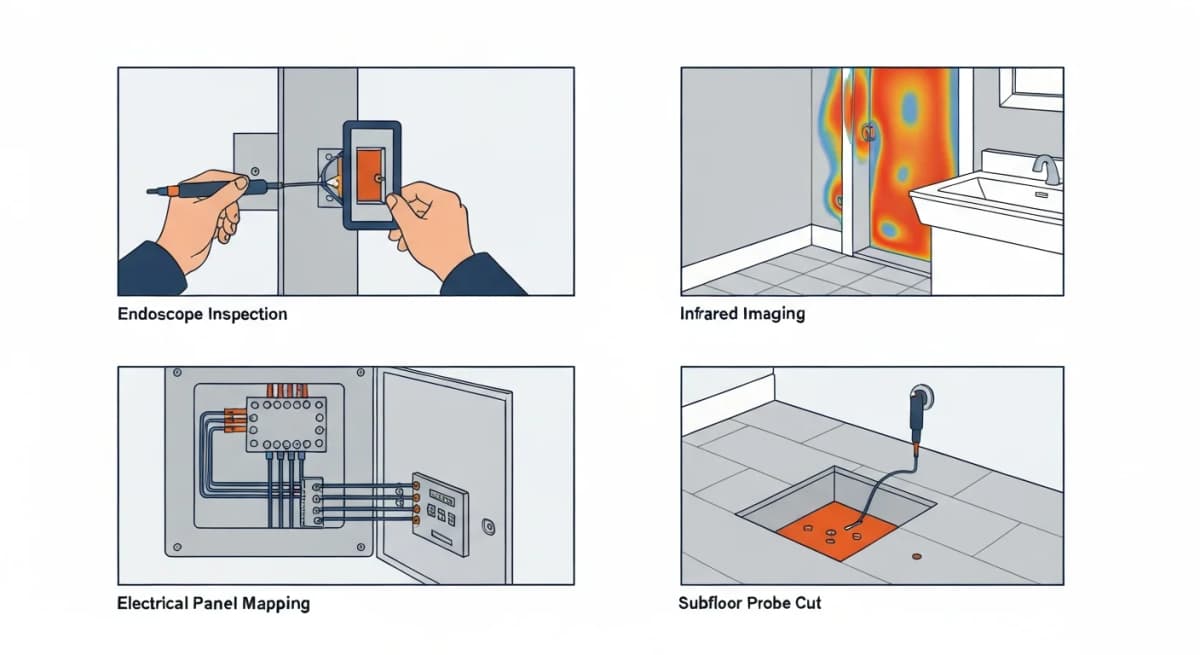
Given the seven discoveries above are predictable for North End Boise bungalows, pre-demolition investigation can identify which of them apply to your specific home — and budget accordingly before the demo phase.
Investigation methods:
Endoscope inspection ($150-$300): Drill small (1/2-inch diameter) inspection holes in non-finished areas and run an inspection camera into the wall cavity. Reveals knob-and-tube presence, balloon framing condition, insulation type, and visible plumbing or electrical issues.
Infrared imaging ($200-$500): Thermal imaging of bathroom walls and ceilings identifies moisture damage, insulation gaps, and electrical hot spots. Reveals plumbing leaks and rot patterns invisible to the eye.
Electrical panel and circuit mapping ($300-$600): Identifies which circuits serve the bathroom, the wiring methods in use, and the panel capacity for the new bathroom load. Includes load calculation for projected new bathroom electrical scope.
Selective subfloor probe cuts ($200-$400): Small (4-6 inch) cuts in the bathroom subfloor at strategic locations (around the toilet base, at the tub-floor transition, near sink drain) reveal subfloor condition before demolition begins.
Asbestos sampling ($150-$400): If vermiculite or other suspect material is visible, sample collection and lab testing confirms asbestos presence before remediation planning.
Total pre-demolition investigation cost: $1,000-$2,200 depending on scope. The investment typically returns 3-5x its cost by allowing accurate scope-and-budget planning before the project starts.
Most North End bathroom remodel projects we run include some level of pre-construction investigation. Homeowners who skip it are the ones who end up absorbing demo-day surprises as change orders, at a point in the schedule where there is no cheap way to absorb them.
Iron Crest's process for North End Boise bathroom remodels includes pre-demolition investigation as standard scope. We endoscope-inspect at least three wall locations, run infrared imaging, map the bathroom electrical circuits, and probe the subfloor at strategic points. The investigation findings inform a written scope that includes contingency for the predictable surprises identified through the inspection. Homeowners walk into the project with realistic expectations rather than being surprised on demo day.
For the broader pre-1940 Boise home context — historic preservation requirements, lead paint considerations, structural integrity assessment — see our historic home remodeling guide. For bathroom-specific scope including the discoveries detailed above, our bathroom remodeling service overview covers the full project flow we use on North End and similar pre-1940 Boise neighborhoods.
How much does a typical North End Boise bathroom remodel cost given these hidden conditions?
Significantly more than equivalent scope in a 1990s+ home. A typical mid-range bathroom remodel in a 2000s Boise home runs $25,000-$45,000. The same scope in a North End bungalow typically runs $38,000-$68,000 once the seven discoveries above are addressed. Breakdown of the premium: lath-and-plaster demo ($1,500-$3,000), balloon framing/fire blocking ($500-$1,200), asbestos vermiculite remediation if present ($1,500-$5,000), gas-pipe-vent replacement ($400-$1,200), drum trap replacement ($600-$1,500), knob-and-tube remediation ($1,200-$3,500), subfloor remediation ($500-$3,500), and structural scope premiums for older framing tolerances ($1,000-$2,500). The premium is real but reflects honest scope. Homeowners considering a North End bath remodel should budget for the higher range.
Should I expand the project to address the whole home's pre-1940 issues at once?
Often yes from a cost-efficiency standpoint, but be honest about scope. When walls are already open for the bathroom remodel, addressing adjacent room knob-and-tube, fire blocking, and balloon-framing issues is significantly cheaper than re-opening the walls later. The combined scope (bathroom + adjacent rooms) can be 30-50% cheaper than the same work split across multiple later projects. The trade-off: significantly larger project scope, longer timeline, higher initial commitment. We discuss this during the design phase and let the homeowner make the call based on their long-term plans for the home and budget flexibility. For homes the owner plans to keep 10+ years, the combined approach typically pays back. For shorter ownership horizons, the bathroom-only approach may be more appropriate.
Do I need a historic preservation permit for a North End bathroom remodel?
Depends on specific location and modification scope. Boise has historic districts (North End Historic District, Hyde Park Historic District) that require Certificate of Appropriateness (CoA) review for exterior modifications. Interior bathroom remodels typically don't trigger CoA review unless they affect windows, exterior doors, or visible exterior features. Most bathroom remodel scope (interior fixtures, finishes, plumbing, electrical) is exempt from CoA. Verify your specific property is within a historic district through the Boise PDS Historic Preservation office — interior modifications are usually clear, exterior modifications may require additional approval.
How long does a North End bathroom remodel typically take?
Longer than equivalent scope in newer homes. Typical 2000s Boise bathroom remodel runs 4-6 weeks. North End equivalent typically runs 7-10 weeks. The additional time comes from: more careful demolition (lath-and-plaster vs drywall), surprise-condition remediation (each item in this article adds 1-3 days), inspection scheduling (more involved due to mixed-era systems), and material lead times for specialty items (matching trim profiles, period-appropriate tile, etc.). Plan for the longer timeline and don't compress the schedule artificially.
Can I preserve any of the original 1920s charm during a bathroom remodel?
Yes, and many North End homeowners prefer to. Specific charm elements that can be preserved: original wood trim and casings (carefully removed during demo, refinished, reinstalled), original windows (energy-efficient retrofits available that maintain original aesthetic), original tile or ceramic features (if intact, can be carefully removed and reused in accent applications), original light fixtures (rewired for modern code but retained as design elements). The preservation approach adds 15-25% to project labor cost vs full replacement, but produces a bathroom that respects the home's architectural character. For homes in the Historic Preservation District, this approach is often required for any exterior-visible elements; for interior bathroom features, it's discretionary.
Are there contractor specialties I should look for when hiring for a North End bathroom remodel?
Yes, three specific capabilities matter: (1) experience with lath-and-plaster demolition (different technique from drywall, requires proper dust containment and disposal practices), (2) familiarity with pre-1945 plumbing systems (drum traps, gas-pipe-vents, galvanized supply lines), and (3) experience working with mixed-era electrical (knob-and-tube remediation alongside modern circuit installation). Ask specifically how many pre-1940 Boise bathroom remodels the contractor has completed in the last 24 months. The answer should be at least 5-10 for a contractor working primarily in this segment. Contractors who primarily work on newer construction often struggle with the surprise-management aspects of historic home work.
Plan your North End Boise bathroom remodel with pre-demolition investigation
Pre-1940 Boise bathrooms hide predictable surprises. Schedule a consultation and we'll inspect, scope, and budget honestly — protecting your project from the demo-day surprises that drive 30-60% cost overruns when contractors don't investigate first.
These pages go deeper on the topics linked from this article. Read them before your consultation and you'll come in with sharper questions and a clearer scope.
The following government agencies, industry organizations, and official resources provide additional information relevant to your remodeling project.