
Galvanized Steel Supply Line Failure in Pre-1965 Boise Bathrooms: 6 Warning Signs Before You Demo
Pre-1965 Boise homes — North End bungalows, East End cottages, Hyde Park duplexes, parts of Bench — were plumbed with galvanized steel supply lines. Those lines are now 60+ years old. Spot the failure signs before demo day, not during.
Quick answer
Three quick checks. First, the home's age — pre-1965 construction in Boise is almost universally galvanized originally, post-1980 is almost universally copper or PEX, and 1965-1980 is mixed depending on builder and any subsequent renovations.
Galvanized steel was the default residential water supply material in U.S. residential construction from roughly 1900 through the mid-1960s, when copper began replacing it. Boise homes from this era — most of the North End, the older parts of Hyde Park and East End, the East Bench, and pockets of older Garden City — were originally plumbed with galvanized steel supply lines. Manufacturer ratings on galvanized steel suggest a 40-50 year service life. We're now 60+ years past most original installations. The lines are at or past end-of-life and the failure timeline accelerates as the corrosion advances.
This article covers the six warning signs that indicate galvanized lines are approaching failure — visible signs you can identify without opening walls, and visible-at-cut signs you'll see during demolition. Most bathroom remodels in pre-1965 Boise homes that don't address the galvanized lines proactively end up addressing them reactively, on demolition day, with the crew on site and the project clock running. The unplanned scope adds $4,000–$15,000 to the project depending on how extensive the replacement needs to be. The planned approach — identifying line condition before demolition and budgeting accordingly — is significantly cheaper and more controllable.
For broader plumbing remodel context — supply lines, drain lines, fixture selection, softener integration — see our Boise plumbing remodel guide. This page goes specifically into the pre-1965 galvanized line identification problem and the pre-demolition decision math.
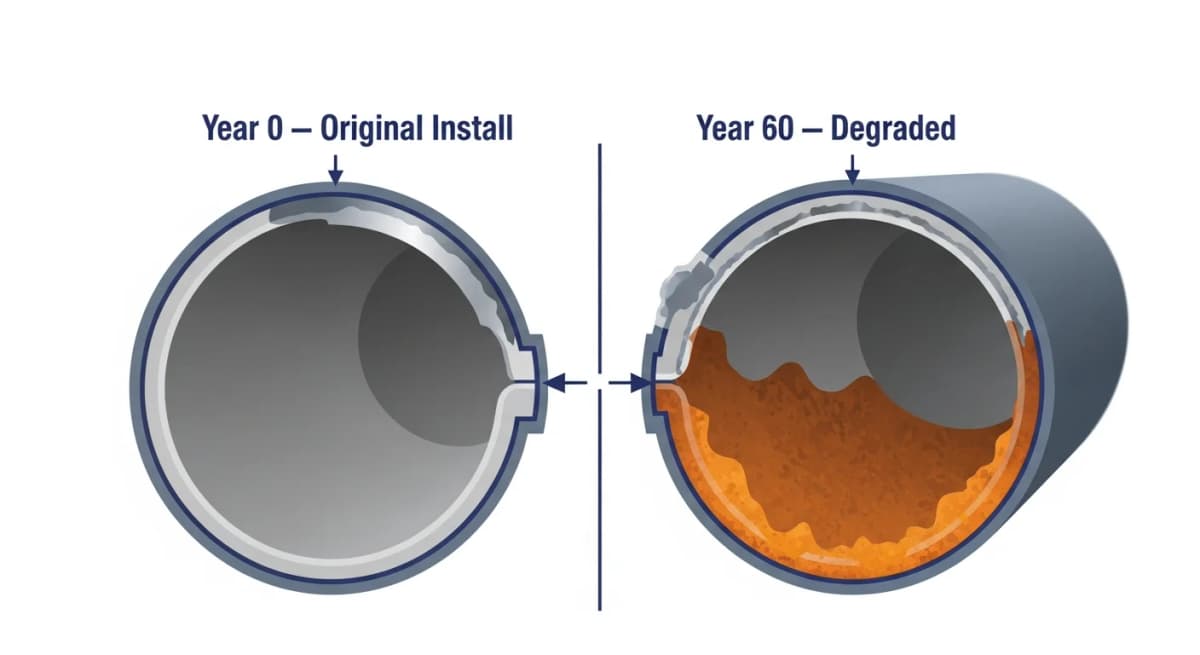
Galvanized steel pipe is steel pipe coated inside and out with a zinc layer that protects the underlying steel from corrosion. The protection works while the zinc layer is intact. As the zinc gradually erodes through decades of water flow (especially in hard-water markets like Boise where minerals accelerate the process), the steel beneath is exposed and begins to corrode. The corrosion happens primarily on the inside of the pipe (where the water is) and produces rust that progressively narrows the internal diameter while weakening the wall thickness.
The 40-50 year manufacturer lifespan rating is generous in markets like Boise. Treasure Valley water hardness (up to ~13 grains per gallon; ~6 average) accelerates internal zinc erosion compared to soft-water markets. Most pre-1965 Boise homes that still have original galvanized supply lines are in failure-progression mode — not failed yet, but visibly degrading. The question for any pre-1965 bathroom remodel is not whether the lines will need replacement but when, and whether the current project is the right opportunity.
Three failure modes drive replacement decisions: (1) pinhole leaks that develop when wall thickness drops below structural threshold; (2) flow restriction from accumulated internal rust scaling; (3) discolored water from sloughing rust particulate. Each is visible without opening walls if you know what to look for.
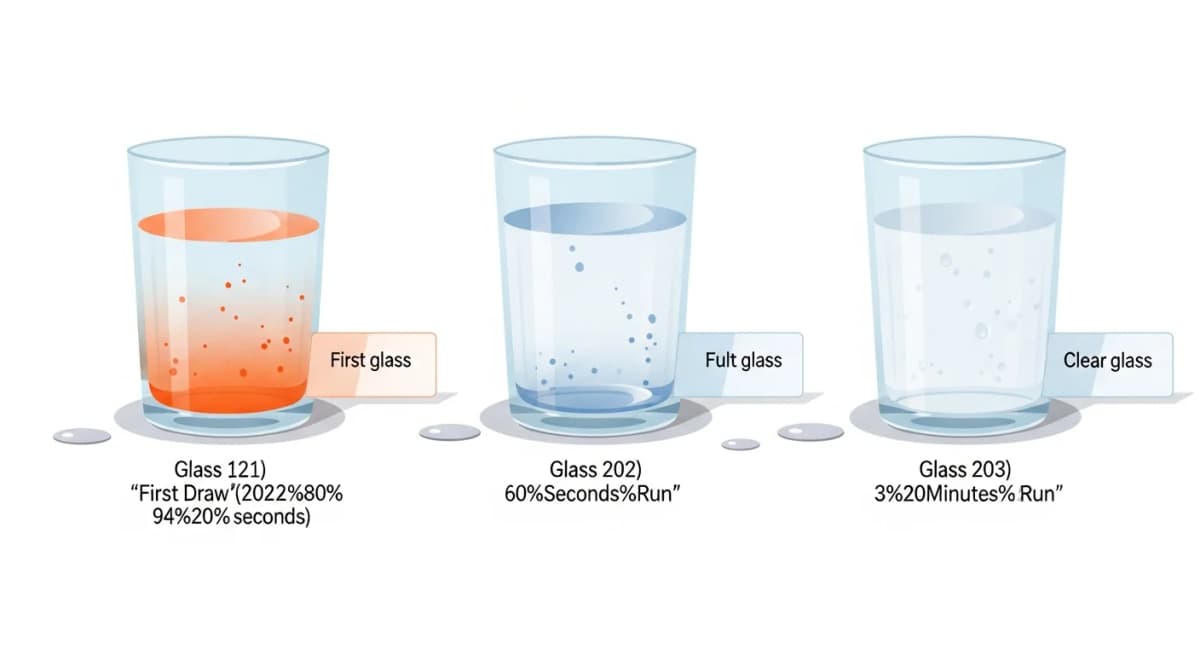
The most reliable visible indicator of galvanized line degradation is colored water from the affected fixture, particularly at first draw after the line has sat idle for several hours. The color comes from iron oxide (rust) that's loose inside the pipe and gets carried with the water on first draw, before the line is flushed.
The diagnostic test: select a fixture that hasn't been used in 4+ hours (typically the morning's first faucet open). Run cold water into a clear glass and observe color. Distinct orange or reddish-brown tint indicates dissolved iron from a corroding galvanized line somewhere between the city main and the fixture. Run the faucet for 60 seconds and re-test — if the second sample is clear, the issue is in the supply line to that specific fixture and the rust deposits are being flushed out. If the second sample still shows color, the problem is more advanced or upstream in the system.
What confirms it's galvanized rather than city-main issue: the discoloration appears only at first draw and clears with flushing; the same test from a different fixture in the home shows different timing (suggesting fixture-specific line issues). City-main rust appears consistently across all fixtures simultaneously.
Not every pre-1965 Boise home will show distinct discoloration at every fixture. Lines that are partially original-galvanized and partially copper retrofitted (from earlier repairs) show discoloration only at fixtures fed by the remaining galvanized sections. Mapping which fixtures show the issue tells you where the original lines remain.
Quick non-invasive screening of pre-1965 Boise homes before committing to bathroom remodel scope.
Doesn't quantify how much line is failing — just confirms that some failure is happening.
As internal rust accumulates inside galvanized supply lines, the effective interior diameter shrinks. Water still flows through the line, but the volume that can be delivered at acceptable pressure drops. The effect is most pronounced at the fixture farthest from the water service entrance because the pressure loss compounds across the length of restricted pipe.
The diagnostic test: turn on multiple fixtures simultaneously to load the supply system, then observe pressure at the farthest fixture. In a healthy supply system, the farthest fixture's pressure drops modestly (15–25%) under multi-fixture load. In a system with significant galvanized restriction, the farthest fixture pressure drops dramatically (40–70%) or the fixture cuts off entirely.
In typical Boise pre-1965 home layouts, the "farthest fixture" is often a second-floor bathroom shower or a basement utility sink. Test by running the kitchen sink, the master bath shower, and the upstairs bathroom shower simultaneously, then check the affected fixture's pressure. Significant pressure starvation indicates supply line restriction somewhere in the home's plumbing tree.
Pressure issues alone don't always mean galvanized; they can also indicate pressure regulator failure (less common) or undersized supply mains (also less common but seen in some pre-1950 builds). When pressure issues coincide with discolored water, galvanized is the near-certain cause.
Galvanized lines that have advanced to wall-thickness failure develop pinhole leaks — typically near fittings, threaded joints, or sections of pipe that have been mechanically stressed. The leaks start small (slow drip, visible water mark) and progress to actual flow over weeks or months.
In pre-1965 Boise homes, common pinhole locations are: (1) at the threaded fittings entering the water heater, (2) at fixtures shut-off valves where the supply line connects to the angle stops, (3) at joints in basement or crawl-space runs where the lines are accessible. The pinhole develops at the weakest cross-section of the pipe — typically where wall thickness has degraded fastest because of corrosion-pattern variations.
A pinhole leak from a galvanized line that the homeowner can see is not the first failure — it's the first visible failure. There may be additional pinholes inside walls or under finished ceilings that haven't been detected yet. Once any pinhole has developed in a home's galvanized system, the rest of the system should be assumed to be in similar condition and the replacement decision becomes more urgent.
Repair-versus-replace: a single pinhole can be repaired with a clamp-on patch ($30 part, $100–$200 plumber service call). A second pinhole within 6 months of the first triggers the replace-the-system conversation. Pinhole patterns are not random; they indicate the lines are at end-of-life across the system.
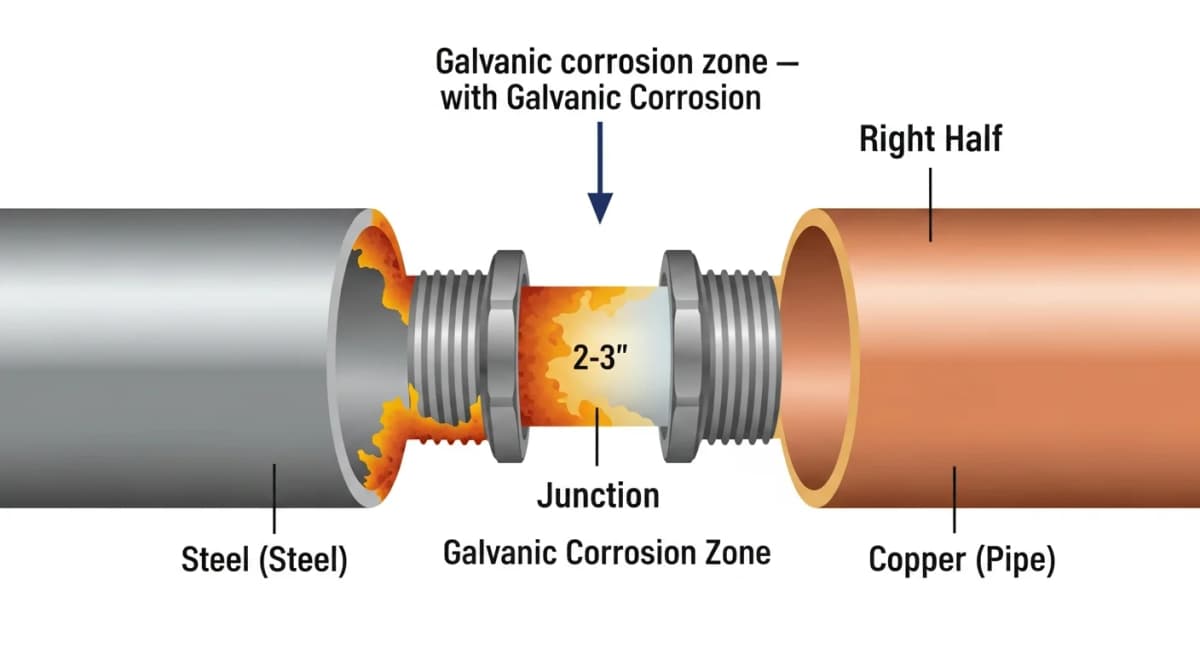
Many pre-1965 Boise homes have had partial plumbing repairs over the decades — particularly during 1970s-1990s kitchen and bath remodels when copper was the standard upgrade material. The result is a hybrid plumbing system where original galvanized lines connect to newer copper repair sections via threaded transition fittings. These transition fittings are the most accelerated corrosion points in the entire plumbing system.
The reason: dissimilar metals in electrical contact through an electrolyte (water) form a galvanic cell. The more reactive metal (steel) becomes the sacrificial anode and corrodes preferentially at the junction with the less reactive metal (copper). The corrosion concentrates in the half-inch of steel pipe adjacent to the copper transition, creating accelerated wall-thickness loss exactly where the homeowner can't see it without opening walls.
Dielectric unions (a fitting designed to separate the two metals electrically) prevent this — they should have been used at every transition during the original repair work but often weren't. In Boise homes built before 1980, we routinely find direct steel-to-copper threaded connections with no dielectric isolation, and these connections are typically the first place the entire plumbing system fails.
The diagnostic indicator: if you can see a transition fitting (in a basement, crawl space, or open utility area), inspect the steel side for visible heavy corrosion. Significant rust buildup at the joint indicates dielectric corrosion is advancing.
Catch galvanized line issues before demo day, not during
Pre-construction supply-line assessment is standard scope on every Iron Crest pre-1965 Boise bathroom remodel — included in the project quote, not an extra charge. Schedule a consultation and we'll evaluate the existing plumbing condition, scope the replacement appropriately, and protect the budget against demo-day surprises.
The most definitive evidence is the pipe interior itself, visible only when a section is cut during demolition or repair. Healthy galvanized pipe interior should be smooth, gray-silver from the intact zinc coating, with no visible deposits or surface irregularities. Failing galvanized pipe interior shows progressive stages: first, white-gray scale (mineral deposits + zinc oxide); then orange-brown rust scale (zinc layer compromised, steel oxidizing); then heavy crust formation (significant wall material gone to corrosion).
During pre-1965 bathroom remodel demolition, we cut an accessible section of the supply line (typically the line entering the bathroom) and visually inspects the interior. The condition we find determines the replacement scope:
Smooth interior, light scale: Line has 5+ years of remaining life. Plan for future replacement but not urgent.
Heavy mineral scale, some rust: Line is 1–4 years from failure progression. Replacing the bathroom supply lines now (during the remodel) is the cost-effective approach. Leaves the rest of the home's lines for future replacement.
Heavy rust scale, reduced diameter: Line is at or past replacement threshold. Whole-home replacement decision should be on the table. The bathroom-only replacement is a temporary fix that the rest of the system will compound on.
The inspection cost is essentially zero (the crew is cutting the line anyway as part of the remodel). The information it provides shapes the replacement decision authority.
A subtle indicator that's often missed: hot water from the affected fixture shows the discoloration described above, but the cold water from the same fixture runs clear. The cause is the water heater itself. Galvanized supply lines feed the water heater; sediment from the lines accumulates inside the water heater tank; the hot water draws from a sediment-laden tank.
The diagnostic test: at the same fixture (typically a bathroom sink), run cold water for 60 seconds — if clear, no cold-side issue. Then run hot water for 60 seconds — if discolored, the issue is in the water heater feed line or accumulated sediment inside the heater itself.
This pattern indicates the galvanized issue has been ongoing for years (sediment accumulation takes time) and that the water heater may also need attention. Flushing the water heater (a standard 1-hour maintenance task for $150-$300 in service) often resolves the hot-water discoloration temporarily, but the underlying supply line issue will continue to feed sediment back into the tank within months or years.
For homeowners doing a bathroom remodel and a water heater replacement during the same project, this is the right time to address the supply lines feeding both. Doing all three together (bathroom + supply lines + water heater) eliminates the system-wide failure mode at once rather than dealing with each independently.
If the signs above confirm galvanized failure, the next decision is scope: replace only the bathroom supply lines (the lines visible during the remodel demolition), or replace the whole-home supply tree.
Bathroom-only replacement ($2,500–$5,500): Replace the supply lines from the existing valves serving the bathroom up to the new fixtures. Faster, cheaper, doesn't disrupt the rest of the home. Disadvantage: leaves the rest of the home's galvanized lines in place, which will eventually need their own replacement. Often a 3-5 year delay before the next failure forces the next replacement.
Whole-home replacement ($8,000–$22,000): Replace all galvanized lines in the home with copper or PEX. Comprehensive solution; eliminates the entire system's failure risk. Triggered most often during major remodels (kitchen + bath + utility) where multiple walls are open simultaneously, making the additional access cost-effective. Disadvantage: significantly higher upfront cost; some disruption to areas of the home not in the active remodel scope.
The decision math depends on intended ownership horizon and existing line condition. For homes the owner plans to keep 10+ years: whole-home replacement during a major remodel is almost always the right call because the access advantage is real and eventual failure is expected. For homes the owner plans to sell within 5 years: bathroom-only addresses the active remodel needs and lets the buyer make the whole-home decision (with appropriate disclosure of the partial replacement).
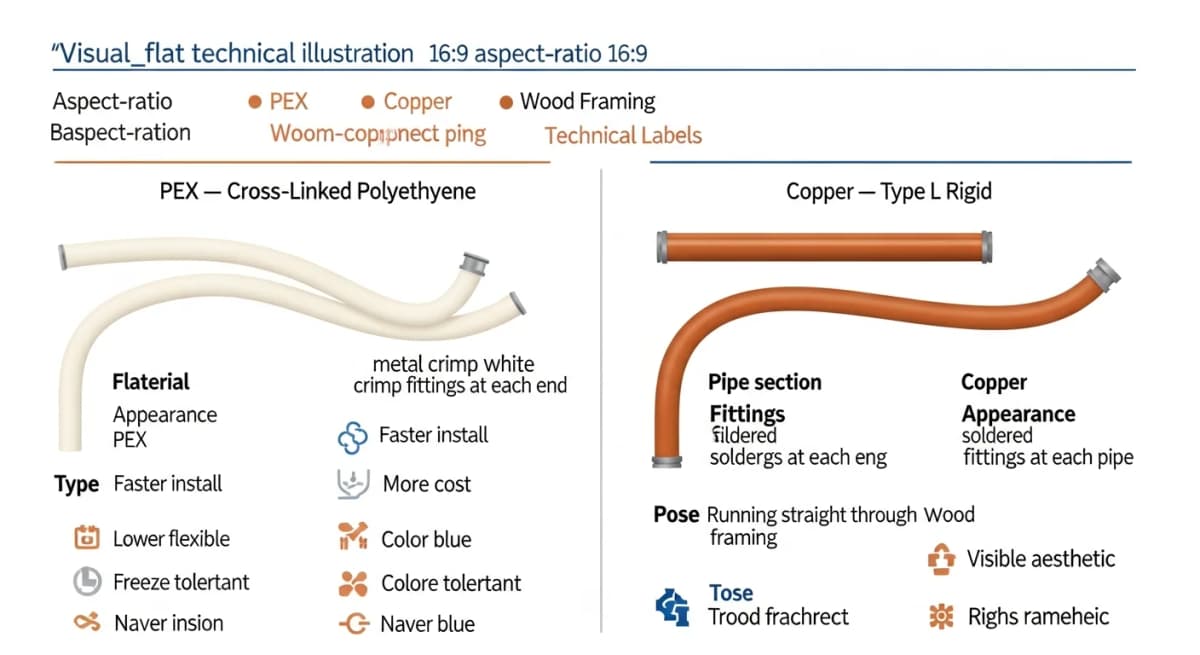
Both PEX (cross-linked polyethylene) and copper are acceptable replacement materials for residential supply lines, with different trade-offs:
PEX advantages: Significantly faster install (no soldering, fewer fittings), lower material cost ($0.40–$0.80 per linear foot vs $2.50–$4.50 for Type L copper), more flexibility (one continuous run can navigate framing without joints, reducing failure points), better freeze tolerance (expands slightly without bursting). PEX is now accepted by every Boise jurisdiction we work in and is the default residential replacement material in 2026.
Copper advantages: Visible aesthetic in exposed runs (basements, utility rooms) — copper is more attractive than PEX; longer track record (PEX has been in residential use since the 1980s, copper since the 1940s, so longer-term performance data exists for copper). Less subject to rodent damage (some homes have issues with mice or rats chewing through PEX in attics or crawl spaces).
For a Boise bathroom-line replacement in 2026, PEX is the default unless: (1) the homeowner specifically wants visible copper in exposed sections (basements, utility rooms), or (2) there's a known rodent issue in the home that puts PEX at risk. The cost savings on PEX (typically 30–50% lower total installed cost vs copper) are meaningful enough that most homeowners choose it.
Hybrid systems work too: copper for visible runs (the basement section where the homeowner walks past it) and PEX for in-wall runs where aesthetics don't matter. Saves cost without compromising the visible portions.
Iron Crest's process for pre-1965 Boise bathroom remodels includes a pre-construction supply-line assessment as standard scope. We test for visible signs (discolored water, pressure drop) during the initial walkthrough, identify any accessible transition fittings or visible pipe sections that confirm the supply-line situation, and quote the remodel scope with the supply-line replacement explicitly priced — either included if the assessment indicates it's necessary or pre-priced as a change order if discovered during demolition. The transparent-scoping approach prevents the most common pre-1965 remodel failure mode: a homeowner who budgeted for a $25,000 bathroom remodel and ended up with a $45,000 project because the supply-line scope was unanticipated.
For homeowners with confirmed galvanized issues planning a bathroom remodel, the right scope is almost always to include the bathroom supply lines in the project and to plan for whole-home replacement during the next major remodel (kitchen, utility room, or whole-home remodel). The bathroom remodel becomes the start of a multi-stage plumbing replacement rather than a one-time event. For broader plumbing-remodel context, see our Boise plumbing remodel guide and the bathroom remodeling service overview.
How can I tell if my Boise home has galvanized supply lines without opening walls?
Three quick checks. First, the home's age — pre-1965 construction in Boise is almost universally galvanized originally, post-1980 is almost universally copper or PEX, and 1965-1980 is mixed depending on builder and any subsequent renovations. Second, check accessible plumbing in the basement, crawl space, or utility room — visible original supply lines from the era will be clearly galvanized (gray-silver metal with threaded fittings versus the smooth uniformity of copper or the flexible cream-white of PEX). Third, check the water heater connections; original galvanized at the heater is a strong indicator that the rest of the system is also original. Combined with the discolored-water and pressure tests from the article, you can typically determine the situation with high confidence without invasive inspection.
Does Boise PDS require permits for residential supply-line replacement?
Yes, supply-line replacement requires a plumbing permit from Boise PDS or the appropriate city authority. The permit cost is modest ($150-$400 for typical scope) and triggers a rough-in inspection (before walls close) and a final inspection (after fixtures are connected). The inspection sequence catches dielectric isolation at any remaining steel-to-copper connections, proper pipe routing and support, and shut-off valve placement. The permit is on top of the bathroom remodel permit if both are happening; some jurisdictions combine them into a single project permit. Iron Crest handles all permitting as part of standard project scope.
Is a whole-home repipe disruptive enough to require moving out?
Sometimes, depending on the scope and the homeowner's tolerance. A whole-home repipe typically involves opening sections of drywall in 8–15 locations to access supply runs, working in attic or crawl space areas, and shutting off water for 4–8 hours per day during active install. Total project duration: 4–8 working days for the repipe portion alone. Most homeowners stay in the home but lose water access during active install hours (typically 9 AM to 4 PM with restored service by evening). Households with young children, mobility-limited residents, or who can't tolerate the dust and disruption sometimes choose to stay elsewhere for the active install period. Iron Crest works with families on whichever approach fits — staying or relocating temporarily.
Are there health concerns from drinking water through old galvanized lines?
Yes, two specific concerns. First, lead contamination: pre-1986 galvanized pipe (the cutoff year for federal lead restrictions) can contain lead in the steel itself and in the solder used at joints. Lead leaches at low rates into water that sits in the lines, with first-draw water having the highest lead content. EPA's Safe Drinking Water Act sets a 15 parts per billion (ppb) action level for lead in tap water; pre-1965 galvanized homes can test above this level, particularly at first draw. Second, iron and zinc oxide ingestion: while not as serious as lead, prolonged consumption of high-iron water can cause gastrointestinal discomfort and tooth discoloration. The EPA secondary standard for iron is 0.3 mg/L. Pre-1965 Boise homes with confirmed galvanized degradation often test above this level at first draw. For households drinking from these systems, the right approach is either (1) replace the lines, or (2) install a point-of-use filter for drinking water until replacement is feasible. A test kit from a hardware store or a free test from a local water treatment company gives you exact numbers for your home.
Can a Boise homeowner replace galvanized supply lines themselves?
A supply-line repipe requires a plumbing permit and inspection. Idaho does let a homeowner pull a permit for plumbing on their own primary residence, but the work is inspected to the same standard as a licensed plumber's. Beyond the regulatory issue, supply-line repipes involve specific skills: proper soldering or crimping technique, correct pressure testing, correct dielectric isolation at any remaining transitions, and correct shut-off valve placement at every fixture. DIY repipes that miss these elements often fail inspection or develop slow leaks within a few years. For households with mixed DIY skill levels who want to reduce cost, the right compromise is to do the demolition and access work yourself (removing drywall, exposing the existing lines) and hire the plumber for the actual pipe replacement. Saves 15–25% of the project cost without compromising the technical work.
How long does a typical bathroom-only supply line replacement add to a Boise bathroom remodel?
Bathroom-only supply line replacement (replacing the lines from the existing main-line tee or stub to the new bathroom fixtures) adds 1–3 working days to a bathroom remodel timeline. The work happens during the rough-in phase (typically week 2 of the project) and runs in parallel with electrical and other rough-in scope. The plumbing inspection adds 1 additional day to the schedule between rough-in and close-up. The remodel timeline impact is modest — typically 1–2 days of total schedule extension because most of the work happens in parallel with other phases.
Catch galvanized line issues before demo day, not during
Pre-construction supply-line assessment is standard scope on every Iron Crest pre-1965 Boise bathroom remodel — included in the project quote, not an extra charge. Schedule a consultation and we'll evaluate the existing plumbing condition, scope the replacement appropriately, and protect the budget against demo-day surprises.
These pages go deeper on the topics linked from this article. Read them before your consultation and you'll come in with sharper questions and a clearer scope.
The following government agencies, industry organizations, and official resources provide additional information relevant to your remodeling project.