
Adding Heated Bathroom Floors to a Pre-1990 Boise Home: The Panel-Capacity Conversation Most Homeowners Skip
Heated floors feel luxurious until the panel disagrees. For pre-1990 Boise homes with original 100-amp panels, adding the heated-floor circuit means doing real load math first. Here's what we calculate before quoting the work.
Quick answer
Three options for getting real load data, in order of cost and accuracy. (1) Visual panel inspection: a licensed electrician can review the panel, identify circuit assignments, sum the breaker amperage, and produce a load-estimate based on assumed circuit utilization.
Heated bathroom floors are one of the most-requested upgrades in Boise master bath remodels. The combination of cold winter mornings, tile floors, and the relatively modest cost of electric heated cable systems makes it an obvious add. The conversation most homeowners don't have until demolition day: the heated floor circuit needs panel capacity that pre-1990 Boise homes frequently don't have. The 800-1,400 watt continuous load adds up fast when stacked with the existing bathroom electrical demands (hair dryer at 1,800W, lighting, GFCI receptacles for grooming tools, exhaust fan, sometimes a heated towel rail or steam-shower control).
This article covers the real load math for adding heated floors to a pre-1990 Boise bathroom remodel. The numbers aren't dramatic in absolute terms but they push many older homes past the 100-amp service threshold when combined with other modern bathroom electrical demands. Below are the calculations, the three viable paths forward (full panel upgrade, dedicated subpanel, or hydronic floor system that bypasses the electrical issue), and the controller-programming strategy that lets a moderately-loaded panel still support heated floors when full upgrade isn't justified.
For the broader pre-1980 electrical context (knob-and-tube, aluminum branch wiring, panel capacity for kitchens), see our knob-and-tube and panel-capacity analysis. For the general electrical remodel guide across all rooms, see our electrical remodel guide. This page is specifically about heated-floor circuit load and how it interacts with pre-1990 bathroom electrical scope.
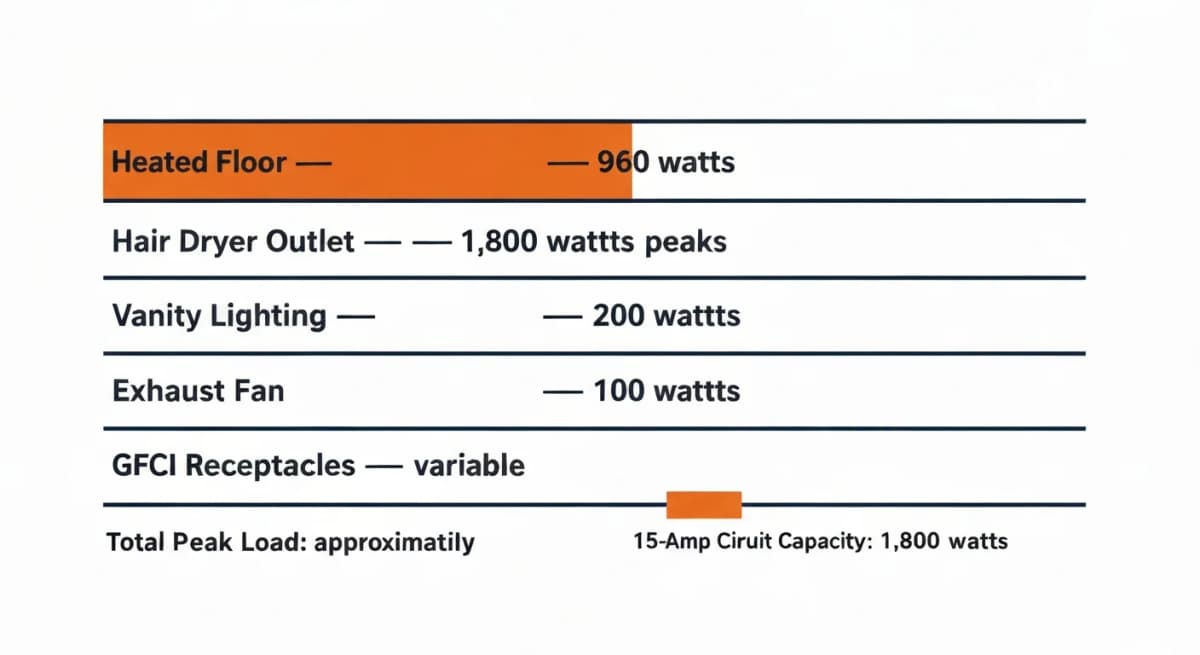
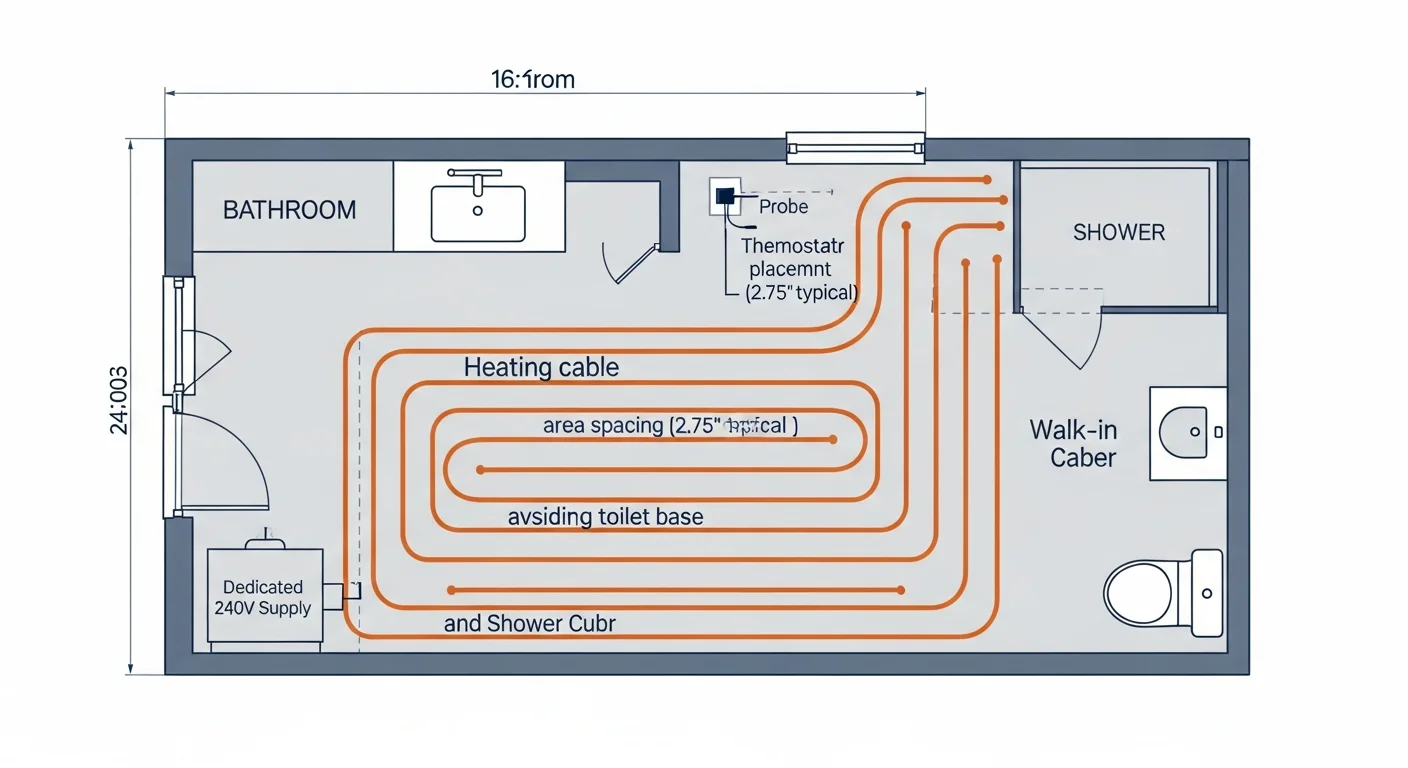
Electric heated floor systems for residential bathrooms (Schluter DITRA-HEAT, Suntouch, WarmlyYours, NuHeat) are rated at approximately 12 watts per square foot of heated floor area at 240V. Some manufacturers offer 120V options for smaller installations and lower-density systems at 10-15 W/sq ft. The 12W/sq ft figure is the practical design baseline for Boise installations.
The math for typical Boise bathrooms:
Small bathroom (45-60 sq ft): 540-720 watts continuous load.
Standard master bath (70-100 sq ft): 840-1,200 watts continuous load.
Large master bath or master suite bath (110-150 sq ft): 1,320-1,800 watts continuous load.
These numbers represent the peak instantaneous load when the heated floor is calling for full output (typically the first 30-60 minutes after the system activates from a cold start). The continuous-operating load is significantly lower because the system cycles on and off via the thermostat — typical duty cycle is 20-40% during normal operation, producing an average operating load of 250-500 watts for a master bath.
For electrical-panel capacity calculations, the peak instantaneous load is what matters. NEC requires sizing the circuit conductors and breaker for the maximum continuous load the appliance can draw, not the average operating load.
The original Boise electrical service installed in pre-1990 homes was almost always 100 amps. Some upscale homes received 150-amp service. The 200-amp service that's the modern default became common only in the 1990s onward. For most pre-1990 Boise homes that haven't had a panel upgrade in their history (which is most), the home is operating on 100-amp service today.
The capacity reality at 100 amps:
Original 1960s-70s load: Lighting, receptacles, range, dryer, water heater, central AC (sometimes), refrigerator. Total connected load typically 60-85 amps when sized to NEC of the era. Plenty of margin within 100-amp service.
Modern load on the same home: The same circuits plus modern additions — central air handler, two-stage AC compressor, electric oven AND cooktop (vs single range), separate microwave, dishwasher, garbage disposal, multiple TVs, computers, smartphone chargers, EV charging (in some homes), water heater (sometimes HPWH adding load), kitchen GFCI circuits, expanded bathroom circuits. Total connected load on a 1970s home updated through 2026 typically reaches 95-130 amps of nominal capacity.
When the home's existing load is at 95-130 amps on a 100-amp service, the service is operating at or above capacity for parts of the day. The home doesn't trip the main breaker continuously (because not every load operates simultaneously), but adding a new heated-floor circuit at 800-1,400 watts can push the simultaneous load over the main breaker's threshold during peak periods (winter mornings: heated floor active + AC active + oven active + multiple lights and appliances).
The diagnostic check: Boise electricians can pull historical load data from the electrical panel's main breaker logs (some smart panels do this; otherwise the electrician uses a clamp meter over a representative 7-day period). The data confirms whether existing load supports the additional heated-floor circuit or whether a panel upgrade is required.
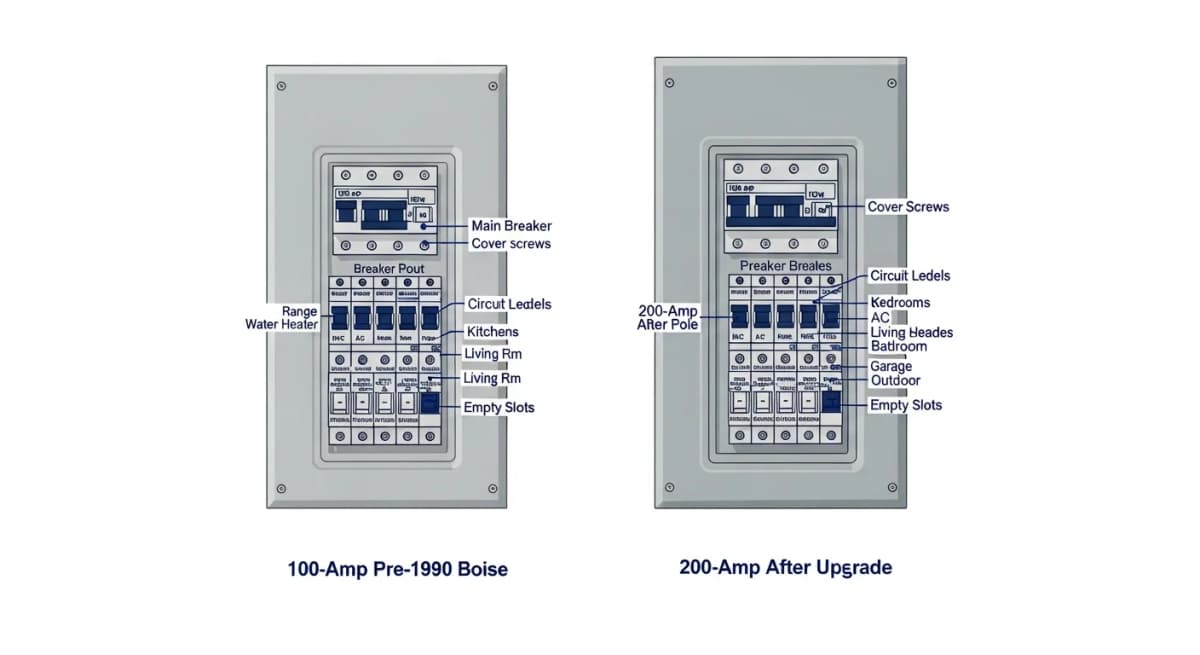
The bathroom circuit load picture is denser than most homeowners realize. NEC requires GFCI protection on all bathroom receptacles and dedicated branch circuits for high-current appliances. Most pre-1990 Boise bathrooms were wired with a single 15-amp circuit serving all bathroom electrical needs — adequate for the era but undersized for modern bathroom demands.
Modern bathroom circuit load profile (Boise master bath):
GFCI receptacles for grooming tools: Hair dryer (1,500-1,875W peak), curling iron (700-1,500W), beard trimmer (5-20W), electric toothbrush (4-8W). Peak when hair dryer + curling iron used simultaneously: roughly 2,500-3,000W.
Lighting layer: 200-400W total across recessed cans, vanity sconces, and accent lighting (LED-era loads).
Exhaust fan: 30-100W during operation.
Heated towel rail (if applicable): 60-200W during operation.
Heated floor: 800-1,400W during active heating (as detailed above).
Total peak load during high-demand moments (winter morning routine): 3,800-4,800W. Compared to a 15-amp circuit's 1,800W capacity, this is 2.1-2.7x the existing circuit capacity. The bathroom needs at least two dedicated 20-amp circuits in modern spec — one for the GFCI receptacles, one for the heated floor — with lighting on a separate 15-amp circuit.
The panel-side question: does the panel have 3 spare breaker positions to support proper modern bathroom circuit division? Most pre-1990 panels don't, which is what forces the upgrade decision when heated floors are added.
The National Electrical Code Section 210.11 sets specific requirements for bathroom circuits:
NEC 210.11(C)(3): At least one 20-amp branch circuit must serve receptacle outlets in the bathroom. This circuit shall have no other outlets — meaning the GFCI receptacles get their own dedicated 20-amp circuit not shared with lighting or fixtures in other rooms.
NEC 210.8(A)(1): All receptacles in bathrooms must be GFCI-protected.
NEC 424.44 (heated floors specifically): Floor heating cables and mats must be on dedicated branch circuits sized for the installed load, with appropriate ground fault equipment protection (GFEP) — separate from standard GFCI on receptacles but functionally similar.
NEC 210.52(D): Receptacle outlets at lavatory countertops in bathrooms must include at least one within 36 inches of the outside edge of each lavatory basin.
Practical implications for the panel: Code-compliant Boise master bath needs minimum 3 dedicated circuits (GFCI receptacles, heated floor with GFEP, lighting). A code-compliant 5-fixture master bath with heated floors AND heated towel rail AND specialty controls might need 4-5 circuits. The panel must support those new circuits without overloading the service.
Boise PDS inspectors verify these requirements on every bathroom remodel that triggers an electrical permit. Skipping any of these triggers a fail-inspection, requiring rework before final approval.
Plan heated bathroom floors around your home's actual electrical capacity
Heated floors are a luxury upgrade that depends on the home's electrical infrastructure to support. Schedule a consultation and we'll run the panel-capacity math, model the realistic options (full upgrade, subpanel, or hydronic), and quote the work transparently before any commitments.
The major residential heated floor systems available in Boise:
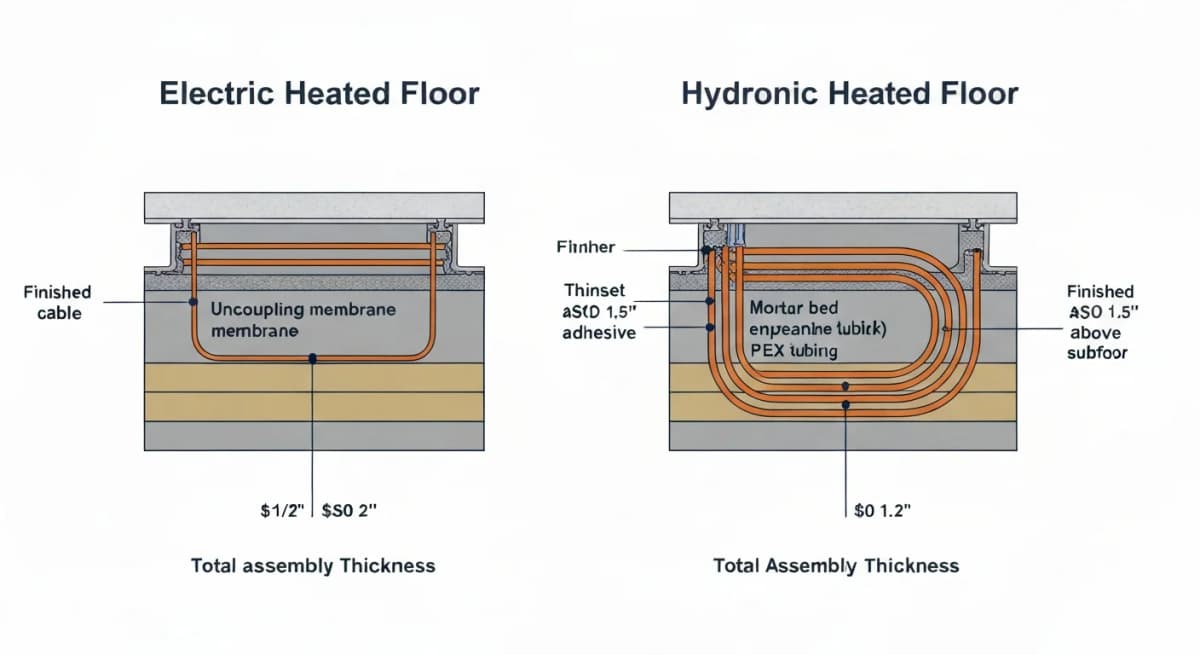
Schluter DITRA-HEAT (cable + uncoupling membrane): The most-installed system in the Treasure Valley. Cable runs at 12 watts per square foot, 240V or 120V depending on installation. The DITRA-HEAT membrane serves dual purposes — mechanical uncoupling for tile (reduces crack risk) and cable routing channels for the heating element. Installed thickness: roughly 1/4 inch above the substrate. Cost: $12-$22 per square foot installed (membrane + cable + thermostat).
NuHeat mats (pre-fabricated grids): Pre-sized heating mats that simplify installation for standard-shape rooms. Less flexible for unusual bathroom shapes but faster to install. Cost: $14-$24 per square foot installed.
SunTouch (cable on tape or pre-made mats): Mid-tier option, similar performance to DITRA-HEAT but without the uncoupling membrane benefit. Cost: $10-$18 per square foot installed.
WarmlyYours (cable, mats, or membrane systems): Multiple product lines spanning the price range. Similar performance to competitors at comparable price points.
Power specifications are essentially identical across these systems (12W/sq ft at the recommended density). The choice between them is driven by floor-build-up height, installation complexity for the room's geometry, warranty terms (10-25 year manufacturer warranties), and contractor familiarity with the specific product.
Boise installer note: most Treasure Valley tile contractors have most experience with DITRA-HEAT because of Schluter's strong market presence. Asking for DITRA-HEAT specifically gets you a contractor base familiar with the system. Other systems are available but installation-experience varies.
For pre-1990 Boise homes where the existing 100-amp service has marginal capacity for the new bathroom load but a full 200-amp upgrade isn't justified by other scope, a dedicated subpanel near the bathroom is an option. The subpanel takes a 40-60 amp feed from the main service and provides 8-12 new breaker positions specifically for bathroom-related loads.
Subpanel installation cost: $1,500-$2,800 for a 60-amp residential subpanel in a typical Boise bathroom remodel context. Significantly cheaper than the $3,500-$6,500 full 200-amp upgrade. The trade-off: subpanel still draws from the existing 100-amp service, which means the home is operating at the same total capacity limit. The subpanel just relocates the breaker space — it doesn't add net capacity.
The subpanel works when: (1) the existing 100-amp service has 30-50 amps of headroom at peak periods (verified with clamp-meter load study); (2) the additional bathroom load doesn't push peak demand past 100 amps; (3) future expansion plans don't include other major load additions (EV charger, HPWH on a non-electric replacement, second AC system, etc.).
The full 200-amp service upgrade is the better long-term choice when: (1) existing peak load is already at or above 90 amps; (2) the homeowner is planning multiple electrification upgrades over the next 5-10 years (EV charging, HPWH, induction range, heat pump HVAC); (3) the home will be in the family long-term and the panel work is worth doing once.
We help clients work through this math during pre-construction. Many Boise homeowners end up choosing the subpanel option for the cost savings; some choose the full upgrade for the future-proofing. Both are reasonable choices depending on situation.
Hydronic heated floors (PEX tubing carrying warm water from a boiler or water heater under the tile) bypass the electrical-panel question entirely because the heating energy comes from the home's water-heating system, not from a dedicated electrical circuit. For households where electrical-panel constraints rule out electric heated floors, hydronic is an option worth considering.
The trade-offs are real:
Installation cost: Hydronic floors run $18-$35 per square foot installed for a small-scale single-bathroom application — significantly higher than electric systems at $10-$22 per square foot. The cost premium comes from the PEX tubing, the manifold and zone valve assembly, and the boiler/water heater integration.
Source heat: Hydronic floors need a heat source — either a dedicated boiler (high upfront cost, $5,000-$12,000 just for the boiler if not already present) or an integration with the existing water heater (limits the floor temperature and requires careful sizing). For single-bathroom applications, the existing water heater integration is the realistic path.
Floor build-up: Hydronic systems typically require 1-1.5 inches of mortar bed above the substrate to embed the PEX tubing and provide thermal mass. This increases finished floor height noticeably — a real consideration when the bathroom transitions to adjacent rooms at the same height.
Response time: Hydronic floors are slower to warm up than electric (1-3 hours to reach setpoint vs 15-30 minutes for electric). They're also slower to cool down, which can be a benefit (thermal mass) or a frustration (heat lingers when the homeowner wants the floor cool).
For most single-bathroom Boise applications, hydronic floors don't pencil out — electric is cheaper, simpler, and adequate for the bathroom-scale application. Hydronic shines for whole-home or whole-floor applications where the boiler infrastructure can serve multiple zones, but that's a fundamentally different project than a single bathroom remodel.
The peak load of a heated floor system happens during initial heating cycles. If the system runs at full power continuously, the home's electrical demand is high; if the thermostat manages the system to avoid peak demand periods, the average load is much lower and the panel-capacity concern is reduced.
Programmable thermostats (most modern systems include this — Schluter DITRA-HEAT thermostat, NuHeat Signature, SunStat Pro) allow scheduling that minimizes panel-side conflict:
Pre-warming schedule: Set the floor to begin heating 45-60 minutes before the household typically uses the bathroom. The floor reaches setpoint during low-demand household periods (early morning before other appliances kick in, mid-afternoon before evening cooking) rather than competing with peak-demand periods.
Setback during peak: Reduce the floor temperature target during high-demand household hours (typical 5-7 PM in Boise homes when cooking, lighting, AC, and entertainment electronics are all active). The floor coasts on residual heat during these hours.
Smart-home integration: Wi-Fi-enabled thermostats can be controlled remotely (warm up the floor while driving home from work, turn off when away on weekends). Saves energy and reduces peak-demand conflicts.
Load-shedding (advanced): Some smart-panel installations (Span, Lumin) can automatically shed the heated floor circuit when other high-demand loads activate, preventing main-breaker trips. This is an advanced setup but allows running the heated floor system on a constrained panel by automatically managing the load.
For Boise homes on tight electrical service that don't want a full panel upgrade, the combination of subpanel + smart thermostat + thoughtful scheduling can make heated floors workable without the electrical scope premium. The arrangement is more setup-intensive but cheaper than the panel upgrade.
Iron Crest's pre-construction process for any pre-1990 Boise bathroom remodel that includes heated floors starts with the electrical-panel assessment. We pull historical load data when available, run a clamp-meter study when not, calculate the projected total load including the new heated-floor circuit, and present the homeowner with the three viable paths (full panel upgrade, dedicated subpanel, or hydronic alternative). The choice depends on long-term plans for the home, existing panel condition, and budget. The conversation happens at design phase, not at demolition, so the homeowner makes an informed choice with full cost transparency.
The electrical scope is one of the largest cost variables in pre-1990 bathroom remodels. Done correctly, it future-proofs the home for additional modern loads (EV charging, HPWH, more demanding appliances). Done minimally, it produces a bathroom that works today but constrains future upgrades. We help clients work through this trade-off as part of the broader project planning. For broader pre-1980 electrical context, see our knob-and-tube and panel-capacity analysis and the bathroom remodeling service overview.
How do I know my home's actual current electrical load?
Three options for getting real load data, in order of cost and accuracy. (1) Visual panel inspection: a licensed electrician can review the panel, identify circuit assignments, sum the breaker amperage, and produce a load-estimate based on assumed circuit utilization. Cost: $150-$300 for a thorough panel survey. Accuracy: moderate — works well for understanding circuit capacity but doesn't capture real-time peak load. (2) Clamp meter study: an electrician installs a clamp meter at the service entrance for 5-14 days, recording actual current draw across all conditions including peak periods. Cost: $400-$800. Accuracy: high — captures real usage patterns. (3) Smart electrical monitor: a permanent installation (Sense, Emporia Vue, or similar) provides ongoing load data and can identify load-management opportunities. Cost: $200-$500 plus install labor; $400-$800 total. Accuracy: very high; also useful long-term for energy monitoring. For most pre-1990 Boise homes considering heated floors, the clamp meter study is the right diagnostic — definitive answer to whether the existing service supports the new load.
Can I install heated floors on the existing bathroom circuit instead of a dedicated one?
No, per NEC 424.44 — heated floor cables require a dedicated branch circuit with ground fault equipment protection. Sharing a circuit with bathroom receptacles or lighting is a code violation. The reasoning is safety (heated cable failures could be masked or amplified by other loads on the same circuit) and capacity (the heated floor's 800-1,400W load doesn't fit on a shared 15-amp circuit alongside other bathroom needs). Boise PDS inspectors verify the dedicated circuit on every heated-floor installation; sharing with another circuit will fail inspection. The dedicated circuit is non-negotiable.
How much does a heated bathroom floor add to my electric bill in Boise?
Less than most homeowners expect. A typical Boise master bath (80-100 sq ft of heated floor) draws roughly 12 watts per square foot while the cable is energised, and the thermostat cycles it on and off rather than running it continuously — so the monthly kWh figure is a fraction of nameplate. Take the system's rated wattage off the manufacturer's spec, estimate the hours it will actually be calling for heat, and multiply by the per-kWh rate on your own Idaho Power statement; that gives you a number for your bathroom rather than an average one, and it only applies during heating season. Compared to other home heating costs ($100-$300/month in winter for central heating), heated floors are a small line item. The bigger budget question is the upfront installation cost ($800-$2,500 for the cable system + electrical work for typical Boise master bath); the ongoing operating cost is modest.
Will Idaho Power require approval for a panel upgrade triggered by heated floors?
Yes for the panel upgrade itself. Idaho Power coordinates the meter base swap and service drop work that's required when upgrading from 100A to 200A service. The process: the electrician applies for the upgrade through Idaho Power's residential service portal, Idaho Power schedules the meter work (typically 10-15 business days from application), the actual swap day requires temporary power shutoff for 2-4 hours, and Idaho Power inspects the new service entrance before re-energizing. The Boise PDS electrical permit is separate from this Idaho Power coordination — both are required. We handle all coordination as part of the project scope for our clients.
Are heated floors worth installing in a guest bathroom or just the master?
Almost always master bathroom only for budget reasons. The household uses the master bathroom daily — heated floors there improve quality of life consistently. Guest bathrooms see episodic use (1-4 times per month for most homes) and don't justify the same investment. The exception: if the household frequently hosts overnight guests (in-laws living in the home extended periods, multigenerational households, frequent extended visits), guest-bathroom heated floors can be worth it. For typical Boise households, master-only is the standard recommendation. The cost difference between master-only and master-plus-guest is roughly $1,800-$3,500 for the second bathroom's heated floor installation; the function value to most households doesn't justify the second installation.
Can I add heated floors during a bathroom refresh, or do I need a full remodel?
Full remodel scope is typically required. Heated floors require removing the existing floor tile, installing the heating cable or mat system, and re-tiling. The work is destructive of the existing floor — there's no path to add heating without removing the existing surface. For homeowners doing a 'refresh' (vanity swap, paint, hardware updates without floor work), heated floors don't fit the project scope. The right time to add heated floors is during a full bathroom remodel where the floor is being replaced anyway. Adding them as a standalone retrofit project costs $3,500-$6,500 including demolition and floor replacement — significant relative to the heated-floor benefit alone.
Plan heated bathroom floors around your home's actual electrical capacity
Heated floors are a luxury upgrade that depends on the home's electrical infrastructure to support. Schedule a consultation and we'll run the panel-capacity math, model the realistic options (full upgrade, subpanel, or hydronic), and quote the work transparently before any commitments.
These pages go deeper on the topics linked from this article. Read them before your consultation and you'll come in with sharper questions and a clearer scope.
The following government agencies, industry organizations, and official resources provide additional information relevant to your remodeling project.