
Sequencing the Idaho Power Heat Pump Water Heater Incentive with Your Boise Bathroom Remodel: 7 Decisions
Your existing water heater is approaching end-of-life. You're planning a bathroom remodel. Done in the right sequence, the combined project captures the Idaho Power heat pump water heater incentive and shares the permit, plumbing, and electrical scope. Done in the wrong sequence, you pay for the same mobilizations twice.
Quick answer
Confirm eligibility before you buy the unit. The Heating and Cooling Efficiency Program is first-come, first-served and is not paid retroactively, and it allows one incentive per home — so a model that doesn't qualify, or a program year that has already committed its funds, is not something you can fix after the fact.
Most Boise homeowners don't think about their water heater until it fails. By then, the replacement happens fast — call a plumber, install whatever they have in stock, write the check, move on. The result: a like-for-like standard electric or gas tank water heater that misses the one utility incentive actually available here (Idaho Power's Heating and Cooling Efficiency Program includes hybrid heat pump water heaters) and ignores the opportunity to coordinate with other home improvements that share permitting, plumbing access, and electrical scope.
If you're already planning a Boise bathroom remodel and your water heater is past 10 years old — and scale shortens a tank's service life, which is why we raise it early on hard-water addresses (see our hard water guide for context) — the sequencing decision matters significantly. Below are the seven decisions that determine whether you capture the available incentive or leave it behind, and the realistic 2026 cost math for the typical Boise homeowner planning both projects.
For the broader energy-efficiency remodel context across the whole home, see our energy-efficient remodeling guide and sustainable green remodeling guide. This page is specifically about timing the heat pump water heater (HPWH) decision with bathroom remodel scope to capture the utility incentive and the shared-scope savings.
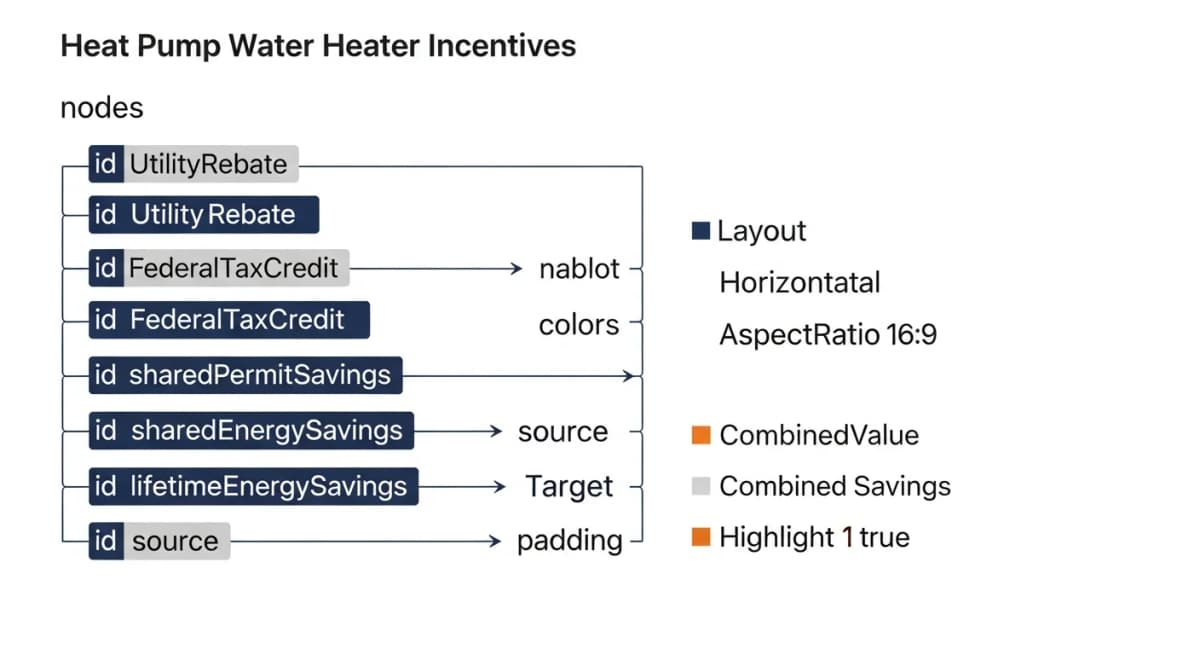
A standard electric tank water heater replacement costs $1,200-$2,000 in the Boise market, including the heater itself ($600-$1,000), plumber labor ($300-$500), permit and inspection ($100-$200), and disposal of the old unit ($50-$150). A heat pump water heater (HPWH) replacement costs $2,800-$4,500 in raw scope — the HPWH unit itself is $1,800-$3,200, installation labor is slightly higher because of the electrical work and the larger footprint, and the project triggers a more involved Boise PDS permit.
On raw cost, HPWH is $1,600-$2,500 more expensive than standard. Three things close that gap:
The Idaho Power incentive: Hybrid heat pump water heaters are covered by Idaho Power's Heating and Cooling Efficiency Program. Idaho Power does not publish the incentive amount on the program page, so treat it as a confirm-before-you-buy item rather than a budget line — and note the program terms: one incentive per home, first-come first-served, and not paid retroactively.
Shared permit and plumbing savings: When the HPWH install happens during a bathroom remodel, the permit scope can be combined ($150-$300 savings vs separate permits), the plumber's mobilization cost is amortized across two scopes ($100-$200 savings), and the electrical work to add the dedicated 240V HPWH circuit is cheaper if a kitchen-remodel-or-bathroom-remodel panel upgrade is happening simultaneously ($300-$500 savings).
Lifetime energy savings: a heat pump water heater moves heat rather than generating it, so it draws substantially less electricity than a standard electric resistance tank doing the same job. For a dollar figure that applies to your house, take the unit's rated annual kWh off its ENERGY STAR / EnergyGuide label, do the same for the resistance tank you'd otherwise buy, and multiply the difference by your own Idaho Power rate — that is a calculation you can verify, unlike a savings range quoted by a contractor.
What that adds up to: $550-$1,000 in shared permit, plumbing, and electrical scope, plus the operating-cost difference over the unit's service life, plus whatever Idaho Power's current incentive is worth. Against a $1,600-$2,500 upgrade premium, the shared scope and the energy savings alone carry the decision — the utility incentive shortens the payback rather than being the reason to do it. Note what is not on this list: the federal 25C Energy Efficient Home Improvement Credit is no longer available for property placed in service after December 31, 2025, so a 2026 Boise project cannot claim it.
The first sequencing decision is whether to do the water heater swap as part of the bathroom remodel project or as a separate project later. The math heavily favors during. Three reasons:
Permit consolidation: Boise PDS accepts combined permits for related plumbing scope. A bathroom remodel plumbing permit can include the water heater scope at minimal additional cost ($75-$150 incremental) vs a separate water heater permit ($150-$300 standalone).
Plumber time efficiency: Already-mobilized plumber doing your bathroom remodel can install the water heater during the same project. Saves the second mobilization fee ($150-$300) and reduces total plumber-days.
Electrical coordination: If the bathroom remodel includes any electrical scope (and most do — new lighting, vanity outlets, exhaust fan), the electrician's scope can be extended to add the dedicated 240V HPWH circuit at the same time. Saves a second electrician mobilization and lets the panel-side work happen once rather than twice.
The exception: if the existing water heater is actively failing right now (leaking, no hot water) and the bathroom remodel is 6+ months out, replace now. Don't live without hot water waiting for project sequencing. The incentive math is good but it's not worth weeks of cold showers.
Any Boise homeowner whose water heater is over 8 years old and whose bathroom remodel is planned within 6 months. The combined scope is straightforwardly cheaper.
Marginally extends the bathroom remodel timeline (typically 1-2 days for the water heater work). Schedule it during the plumbing rough-in phase.
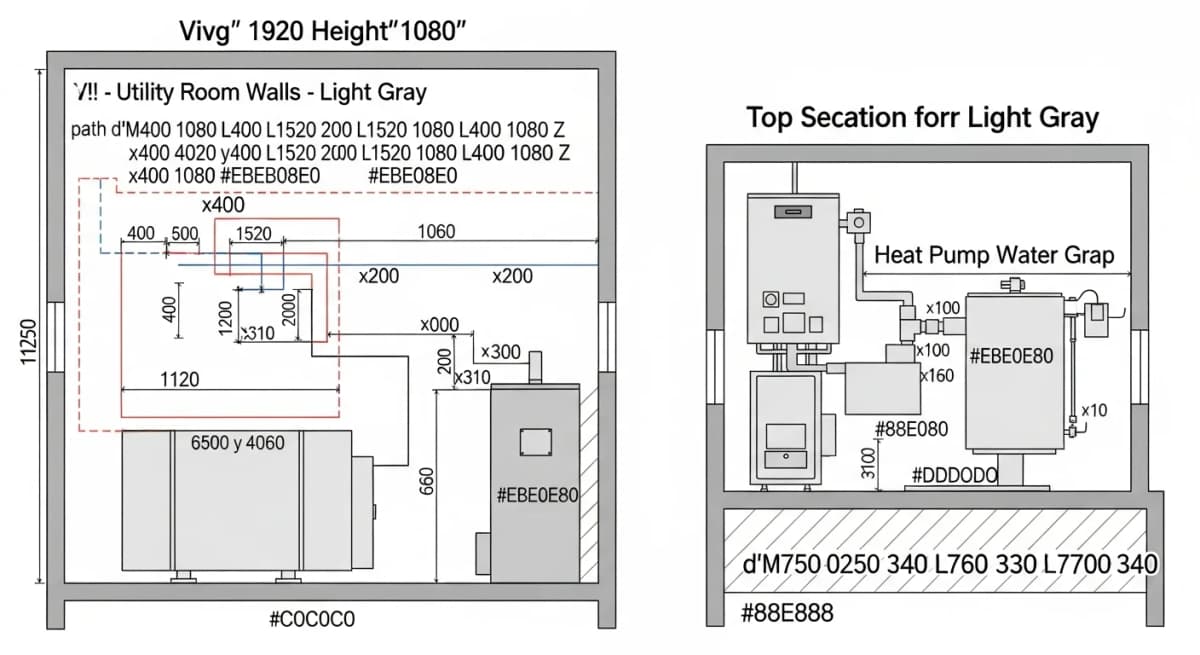
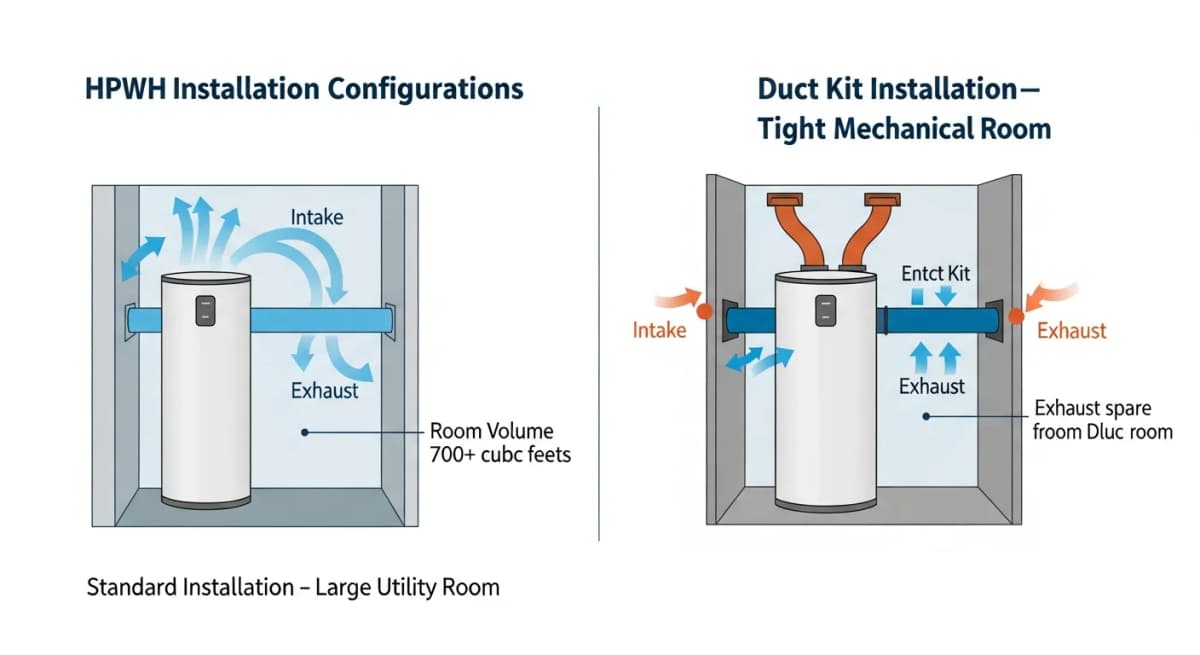
HPWHs require specific installation conditions that standard water heaters don't. The single most binding constraint is air volume around the unit — HPWHs extract heat from surrounding air, so they need adequate air supply to operate efficiently. ENERGY STAR specs and most manufacturer documentation specify 700 cubic feet minimum air volume in the room where the HPWH is installed.
For a typical Boise mechanical room or utility closet (often 4x6 feet floor with 8-foot ceiling = 192 cubic feet), this is well below the minimum. Three approaches address it:
Install in a larger space: Garage installations are common (typical residential garage is 2,000+ cubic feet) and meet the air-volume requirement easily. Trade-off: HPWH cools the surrounding air during operation, which in winter slightly reduces garage warmth. Most Boise homeowners find this acceptable.
Use a manufacturer duct kit: Several HPWH manufacturers (Rheem, A.O. Smith, State) offer duct kits that route intake and exhaust air to/from adjacent spaces. Allows installation in smaller utility rooms by drawing air from the larger volume of the rest of the house. Cost: $200-$400 for the duct kit; installation labor adds another $200-$400.
Hybrid mode operation: Most modern HPWHs include a backup electric resistance element that can operate when heat pump mode is impractical. The unit operates less efficiently in this mode but doesn't require the air-volume specs. Compromise: about 60-70% of the energy savings vs full heat pump operation.
The footprint check should happen at design phase, not installation phase. We verify air volume and duct routing options during pre-construction walkthrough so the right HPWH model and installation approach are specified before the project starts.
Hybrid heat pump water heaters are one of the equipment categories in Idaho Power's Heating and Cooling Efficiency Program. The process is straightforward but the sequence is unforgiving — the incentive is not paid retroactively, so the qualification step has to happen before the unit is bought:
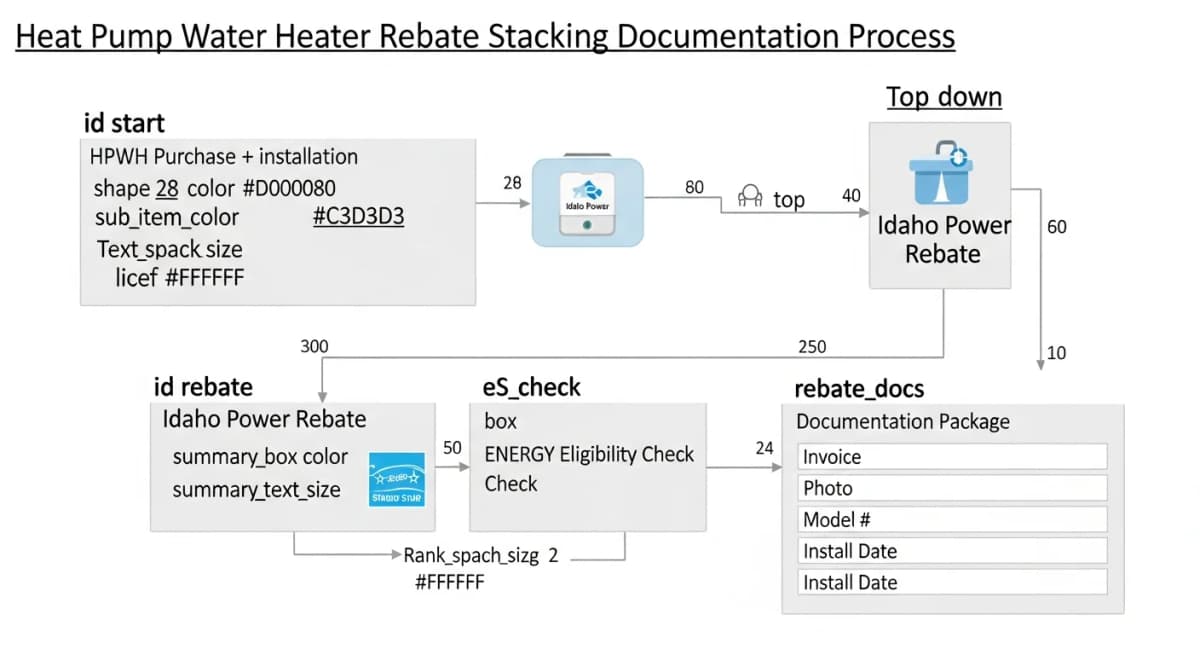
Pre-installation: Confirm with Idaho Power that the specific model qualifies, and confirm the program is still accepting applications — it is first-come, first-served and funded annually. Also confirm no one has already claimed an incentive on the home: the program allows one incentive per home.
During installation: Keep the installation invoice with itemized line items including model number, installation date, and contractor information. Take a photo of the installed unit with the model and serial number tag visible.
Post-installation: Submit the application through the Heating and Cooling Efficiency Program page at idahopower.com. Required documents: the installation invoice, a photo of the installed unit with the model and serial tag visible, and the signed application form.
Coordination during bathroom remodel: Iron Crest handles the documentation as part of the project closeout. The homeowner files the application, but the supporting documentation is provided by us — invoice, photos, model verification, installation date confirmation.
On the amount: Idaho Power does not publish a dollar figure for the equipment categories on that page, and we will not quote one. Call Idaho Power or check the program page during design, get the current number in writing, and treat it as a reduction in net cost rather than as money you have already budgeted.
Sequence the water heater upgrade with your Boise bathroom remodel
Time your water heater upgrade with your bathroom remodel and you share the permit, the plumber, and the electrician — and keep the Idaho Power incentive in play. Schedule a consultation and we'll model the right HPWH spec, installation approach, and sequencing.
If you have read an older guide to heat pump water heaters, it almost certainly told you to stack a federal tax credit on top of the utility incentive. That advice is out of date, and it is the single most common reason a homeowner's HPWH math no longer works out the way they expect.
Section 25C — the Energy Efficient Home Improvement Credit — is not available for property placed in service after December 31, 2025. The termination came in the July 2025 budget reconciliation law (P.L. 119-21); the IRS states it on its own Energy Efficient Home Improvement Credit page. Section 25D, the residential clean energy credit that covered solar and geothermal, was terminated on the same date.
What that means for a Boise project being built today:
- A water heater installed in 2026 cannot claim 25C, regardless of ENERGY STAR certification
- There is no Form 5695 filing to plan for on this scope
- The "30% up to $2,000" figure still circulating in manufacturer literature and older articles does not apply to your installation
The practical consequence is that the decision has to stand on the remaining three legs: the Idaho Power incentive, the scope shared with the bathroom remodel, and the operating-cost difference over 12-15 years. Those are real and they are enough for most households — but they are a slower payback than the pre-2026 stack, and any contractor still quoting you a federal credit on a 2026 installation is working from stale information.
If your project was placed in service in 2025 or earlier, that is a different question and one for your tax preparer, not for us.
HPWHs typically require a dedicated 240V circuit at 30A capacity. Most existing residential electric water heaters use a similar 30A 240V circuit, so for like-for-like electric replacement the existing circuit often works. For homes upgrading from gas water heaters to HPWH (an increasingly common Boise scenario), the new circuit needs to be installed.
The electrical scope cost depends on panel capacity and routing distance:
Existing panel has spare capacity, short circuit run (under 30 feet): $300-$600 in electrical work to add the 30A 240V circuit. The cheapest scenario.
Existing panel has spare capacity, longer circuit run (30-80 feet): $600-$1,200 in electrical work. Conduit, wire, and labor increase with distance.
Existing panel needs upgrading first: $3,500-$6,500 for a 200A service upgrade (see our panel capacity analysis for the broader pre-1980 Boise context). If the panel upgrade is independently needed (often the case in pre-1980 Boise homes), the cost is attributable to the panel project rather than purely to the HPWH.
Coordination opportunity: if your bathroom remodel triggers panel upgrade (heated floor, additional bathroom circuits), the HPWH circuit can be added during the same panel work at incremental cost ($300-$600 above standard panel upgrade). The combined project captures the synergy.
Residential HPWHs are typically sized in gallons (40-80 gallon tank capacity) with heat pump capacity rated separately. The right model for a Boise home depends on household size, hot water use pattern, and installation location:
40-50 gallon HPWH: Suitable for 1-3 person households with average use patterns. Smaller footprint fits tight Boise utility rooms better. Slower recovery (3-5 hours to reheat full tank) requires moderate use spacing. Cost: $1,800-$2,400 unit only.
60-66 gallon HPWH: The 'standard' family-home size for 2-4 person households. Better recovery time (4-7 hours) handles teen/adult shower clustering during morning rush. Cost: $2,200-$2,900 unit only.
80 gallon HPWH: Larger 4+ person households or higher-end demand (multiple showers, soaking tub, etc.). Slowest recovery but largest reserve capacity. Cost: $2,600-$3,500 unit only.
For most Boise homes upgrading from standard electric water heater, like-for-like tank size is the default — if the existing is 50 gallons, the new HPWH should be 50-60 gallons (not less). HPWHs heat slightly slower than standard electric resistance heaters during peak heating events, so retaining or slightly increasing tank capacity gives the household the buffer to absorb the slower recovery without running out of hot water.
Specific brand performance: Rheem Performance Platinum series and A.O. Smith Voltex series both perform well in Boise's water hardness and indoor air conditions. State Tankless Heat Pump and GE GeoSpring are also rated similarly. Compare the written warranty term on the specific model rather than the tier — budget units often carry materially shorter coverage than the mainstream brands, and service support in the Treasure Valley is thinner for models without a local parts channel.
Within the bathroom remodel project timeline, the water heater replacement can happen at different stages:
Pre-construction (week 0-1): Replace the water heater before bathroom demolition begins. Easier to coordinate, doesn't share rough-in inspection scope with bathroom plumbing. Slightly more expensive because the plumber has to mobilize specifically for the WH work. We use this approach when the existing WH is actively failing and the homeowner can't wait for the project flow.
Rough-in phase (week 2-3): Replace the water heater during the bathroom plumbing rough-in work. Most efficient sequencing — the plumber is already on site, doing supply-line work, and the WH swap is a natural extension of that scope. Single Boise PDS plumbing inspection covers both the bathroom rough-in and the WH installation. Our default sequencing for most bathroom remodels.
Post-construction (week 7-8): Replace the water heater after the bathroom is complete. Sometimes makes sense for homeowners who want to spread the cost across budget cycles or who haven't decided on HPWH yet during the bathroom design phase. Less efficient sequencing but acceptable.
The right sequencing for your project depends on the existing water heater condition, the household's tolerance for project disruption, and budget timing. We discuss this during the bathroom remodel design phase and coordinate the schedule accordingly.
Iron Crest's bathroom remodel process includes an existing-water-heater assessment as standard scope. We check the unit's age, capacity, current condition, and whether it makes sense to replace during the project. For homes where the WH is 8+ years old and the bathroom remodel is happening anyway, we recommend the HPWH upgrade — the combined-project math is almost always favorable, and the homeowner captures shared-scope savings that wouldn't be available with sequential separate projects.
The documentation work for the Idaho Power application is part of standard project closeout. We provide itemized invoices, installation photos, model verification, and ENERGY STAR confirmation packaged so the homeowner can submit the application without scrambling for documents months after the project. For broader energy-efficiency context across the whole home, see our energy-efficient remodeling guide and our bathroom remodeling service overview.
Does the Idaho Power HPWH incentive require anything before installation?
Confirm eligibility before you buy the unit. The Heating and Cooling Efficiency Program is first-come, first-served and is not paid retroactively, and it allows one incentive per home — so a model that doesn't qualify, or a program year that has already committed its funds, is not something you can fix after the fact. The application itself is submitted after installation with the invoice, a photo of the installed unit showing the model and serial tag, and the signed form. Confirm the current process and amount on the Heating and Cooling Efficiency Program page at idahopower.com during design, not at closeout.
How long do HPWHs typically last in Boise's hard water?
HPWH lifespan in Boise's 12-17 grain-per-gallon water typically runs 12-15 years with standard maintenance — comparable to high-quality standard electric water heaters. The heat pump components (compressor, fan) are largely separate from the hard-water-exposed tank, so scaling failures that affect heating elements in standard electric WHs don't affect HPWH operation as directly. Tank degradation from hard water is similar to standard tanks but slightly slower because the HPWH operates at lower tank temperatures (typically 120°F vs 130-140°F for standard) which slows mineral precipitation. Adding a whole-house water softener extends HPWH lifespan to 15-20+ years for households making the broader Boise-water investment.
Will an HPWH cool my house in summer?
Yes, slightly, depending on installation location. The HPWH extracts heat from surrounding air to heat water; the displaced cool air goes into the room where the unit is installed. In summer, this is a small bonus (the basement or garage where the unit typically sits gets slightly cooler from HPWH operation). In winter, this is a small cost (the same space gets slightly cooler, which the home's central heating has to compensate for). The summer benefit and winter cost roughly cancel out across the year in Boise's climate. For HPWHs installed in conditioned space (interior utility rooms rather than garages), the winter cost is more pronounced; for garage installations, the summer benefit dominates.
Can I install an HPWH myself to save labor cost?
Water heater installation requires a permit and inspection covering the gas/electrical connections, T&P valve, and code-required clearances; Idaho lets a homeowner permit work on their own primary residence, but the standard is the same. DIY HPWH installation typically voids manufacturer warranties (most major brands require professional installation for warranty validation) and puts the Idaho Power incentive at risk, since the application asks for installation documentation. The labor cost savings ($400-$800) aren't worth the warranty and incentive forfeiture. We don't recommend DIY HPWH installation for any Boise homeowner.
What if my bathroom remodel doesn't include water heater scope but I want to add it?
Easy to add. We can extend an active bathroom remodel project to include water heater replacement at any point before final inspection. The incremental cost is the HPWH unit + installation labor + electrical work + permit modification — typically $2,800-$4,500 total before the Idaho Power incentive and before the scope savings from sharing the plumber, electrician, and permit with the bathroom project. For homeowners considering this addition, the right time to mention it is during pre-construction walkthrough so we can coordinate the plumber's scope, schedule the electrical work, and verify footprint compatibility before the bathroom rough-in begins. Adding the scope mid-project is doable but less efficient.
Are gas water heaters or tankless water heaters also eligible for rebates?
Not from Idaho Power — it is an electric utility, and its Heating and Cooling Efficiency Program covers the hybrid heat pump water heater, not gas equipment of any kind. The gas side is Intermountain Gas, which pays $325 on a .91 UEF tankless water heater in an existing home, for customers who heat water exclusively with Intermountain Gas natural gas. Electric tankless units qualify for nothing here; they draw enormous instantaneous load and deliver none of the efficiency multiplier that makes the heat pump unit worth incentivizing in the first place.
Sequence the water heater upgrade with your Boise bathroom remodel
Time your water heater upgrade with your bathroom remodel and you share the permit, the plumber, and the electrician — and keep the Idaho Power incentive in play. Schedule a consultation and we'll model the right HPWH spec, installation approach, and sequencing.
These pages go deeper on the topics linked from this article. Read them before your consultation and you'll come in with sharper questions and a clearer scope.
The following government agencies, industry organizations, and official resources provide additional information relevant to your remodeling project.