
Which Dishwashers Actually Survive Boise's Hard Water: Brand-by-Brand 5–10 Year Failure Patterns
Boise's hard water — about 6 grains per gallon on average, up to ~13 gpg in well-fed zones — is the single biggest factor in residential dishwasher lifespan in the Treasure Valley. The brand you choose can be the difference between replacing at year 6 and year 14.
Quick answer
Meaningfully — roughly 3–5 years. A KitchenAid that would survive 8 years in unsoftened hard water typically survives 11–13 years with a softener. A Whirlpool that would survive 6 years extends to 9–10.
Most Boise homeowners don't know they need a hard-water-friendly dishwasher until their second one fails inside seven years. The first failure is treated as bad luck. The second one — usually the same brand on the same install, same diet of Boise tap water — is when the pattern becomes obvious. The dishwasher brands on the showroom floor at the big-box retailers are not equivalent in Boise water. Two units at the same price point with the same feature set can have dramatically different five-year reliability patterns because of internal-component choices that matter very little in soft-water markets and matter enormously here.
This article covers the six brands most commonly specified across the Treasure Valley and how they tend to hold up in Boise's water (about 6 grains per gallon on average, up to ~13 gpg in well-fed zones). The guidance below reflects industry-reported patterns combined with published manufacturer durability specifications — general observations, not a measured dataset, and individual units vary. The point isn't that some brands are bad; it's that some brands are meaningfully better in Boise's specific water chemistry, and that information should be available before the homeowner is staring at a $700–$1,500 appliance at the showroom.
For broader kitchen appliance selection context (refrigerators, ranges, ice makers, ventilation), our kitchen appliance selection guide is the comprehensive resource, and our Boise hard water fixture guide covers the whole-home softener strategy. This page goes deep on one specific appliance — dishwashers — where the brand-by-brand differences in hard water are sharply differentiated.
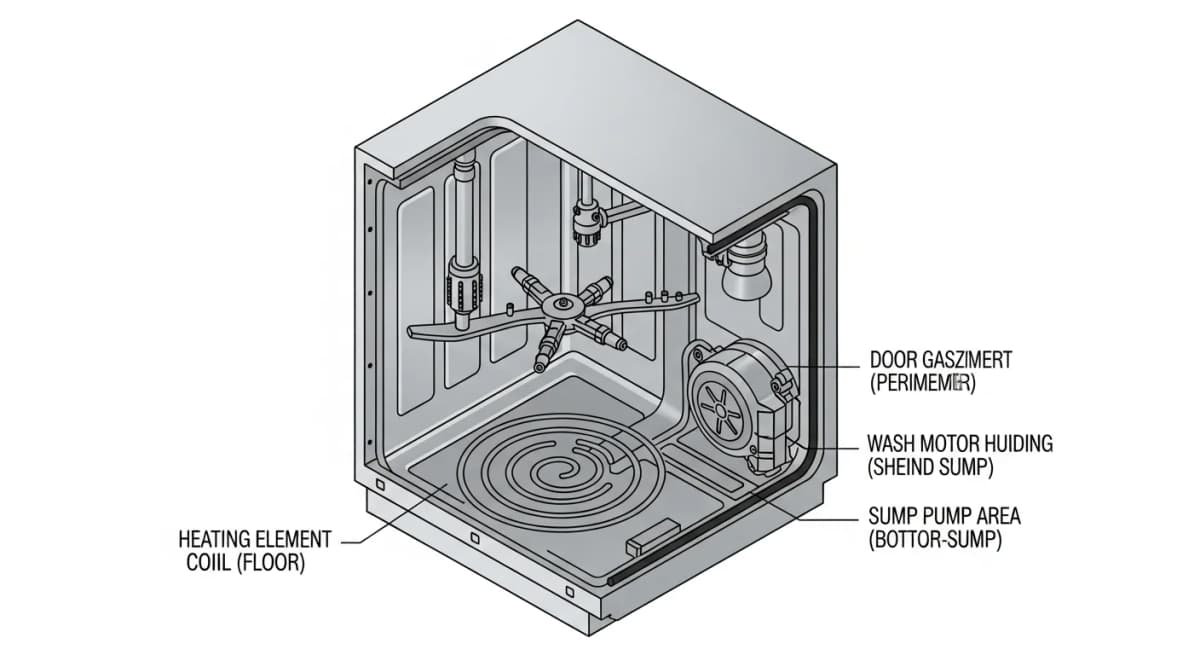
Dishwasher failure in hard water happens at five specific points, not as general wear-and-tear:
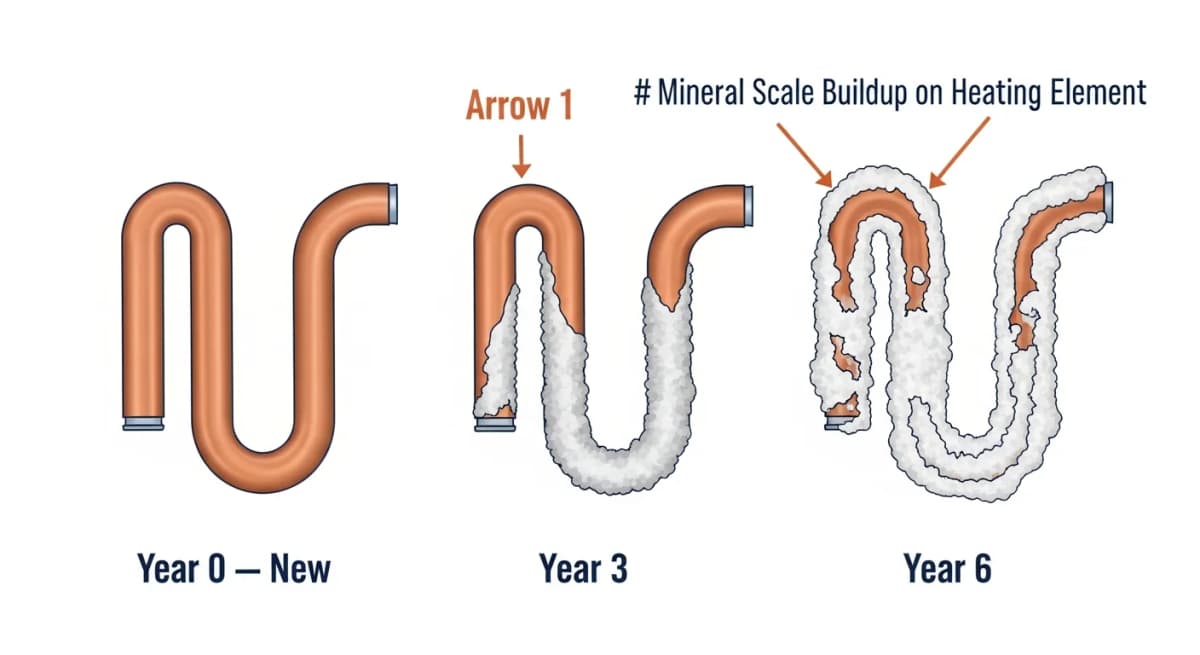
Heating element: Calcium scale accumulates on the exposed coil in dishwashers that use heated drying. Scale acts as thermal insulation, forcing the element to work harder for the same drying performance, and accelerating element-failure timeline by 2–4 years. Heat-pump or condensation-drying dishwashers (Bosch, Miele) skip this entirely because they don't use a heating element for drying.
Spray arm bearings: The plastic or ceramic bearings that let the spray arms rotate accumulate calcium deposits at the bearing surface. Over time, the bearing seizes or develops resistance that reduces spray arm RPM. Lower RPM means weaker wash action and more cycle re-runs. Premium brands use sealed metal-bearing assemblies that resist scaling; budget brands use plastic bearings that fail sooner.
Sump pump impeller: The pump that drains wash water has an impeller that runs through scaled water for years. Scale on the impeller blades reduces draining efficiency, eventually causing slow-drain symptoms and water-residue complaints.
Wash motor seal: The seal between the wash motor and the tub is exposed to scale-laden water continuously. Seal failure is the most common catastrophic failure mode — water leaks into the motor housing, electrical components fail, and the dishwasher needs replacement or major service.
Door gasket: Calcium deposits accumulate at the door seal, eventually compromising the seal's flexibility and causing leaks. This is the most easily-repaired failure (gasket replacement is $80–$200) but represents the cosmetic deterioration of the appliance.
Bosch dishwashers dominate the upper-mid tier in Boise installations and consistently deliver the longest service life of any mainstream brand we see. Two design choices drive this:
Condensation drying: Bosch units use the stainless steel tub itself as the drying surface (water condenses on the cool tub walls rather than being evaporated by a heating element). This eliminates the most aggressive scale-accumulation point in the appliance. Bosch heating elements (used for water heating during wash, not for drying) are smaller and less exposed than full drying elements.
Self-cleaning cartridge filter: The bottom-of-tub filter is a removable cartridge that traps food debris and mineral particulates before they reach the spray arms or sump pump. Cleaning the filter takes 30 seconds monthly; the design extends pump and spray arm life materially.
Typical Boise survival in unsoftened water in the harder zones: 9–14 years before requiring major service. With a softener: 14–18+ years. Common failure modes when they occur: door latch ($60–$150 service), control board ($200–$400), wash motor ($350–$600). Bosch dishwashers price at $700–$1,500 for the 100/300/500 series, $1,500–$2,500 for the 800 series and premium Benchmark series.
Most Boise mid-to-upscale kitchens. The price-to-survival ratio is the strongest in the mainstream market.
Condensation drying leaves more residual moisture on plastic items than heated drying. Most users adapt quickly; some prefer heated drying for that reason.
Miele is the premium-end manufacturer and the longest-surviving dishwasher we see in the Boise market. The build quality difference compared to mainstream brands is real — fully stainless tubs, heavier internal componentry, and an integrated water softener. Confirm the current warranty term and the parts-availability commitment with Miele before you buy, since those are the terms that decide whether a twenty-year service life is achievable rather than theoretical.
The integrated water softener Miele builds into every dishwasher is the differentiator most relevant to Boise. The softener uses salt-pellet regeneration (similar to a whole-house unit but compact and dishwasher-integrated) and delivers softened water to the appliance only. This extends component lifespan because every internal part operates in softened water, regardless of what the rest of the home does. The trade-off is the homeowner has to refill salt every 1–2 months.
Typical Boise survival: 12–18+ years in unsoftened tap water (the integrated softener handles it). With a whole-house softener: 18–22+ years. Common failure modes when they occur: control board ($400–$700), water pump ($500–$900). Both are rare. Miele dishwashers price at $1,200–$2,500 for the Classic and Active series, $2,500–$4,500 for the higher-end lines.
Upscale Boise kitchens (Harris Ranch, Eagle, foothills) where the appliance investment matches the cabinetry investment. Particularly relevant for households who don't want a whole-house softener but want softened-water performance from their dishwasher.
Highest upfront cost in residential dishwashers. Service network in the Treasure Valley is more limited than Bosch or KitchenAid.
KitchenAid is owned by Whirlpool and represents the upper tier of Whirlpool's product portfolio. Stainless tubs, decent build quality, and a service network that's well-supported in Boise. KitchenAid dishwashers use heated drying (a heating element), which is the primary lifespan-limiting factor in unsoftened Boise water.
KitchenAid units typically run 7–11 years in unsoftened water in Boise's harder zones before the heating element or sump pump develops issues. The most common failure mode is heating element scale-related failure at year 6–8, followed by sump pump issues at year 8–10. Replacing the heating element costs $200–$400 in service; replacing the sump pump costs $400–$700. Both are sometimes economical, sometimes pushing toward whole-unit replacement.
KitchenAid pricing: $700–$1,400 for mid-tier models, $1,400–$2,200 for premium models with enhanced features (third rack, ProWash sensor system). The value tier sits between Bosch 300 series and KitchenAid mid-tier; the upscale tier sits below Bosch 800 series and Miele Classic.
Boise homeowners who want a name-brand mainstream dishwasher with broad service network availability and don't want to step up to Bosch's price point. Common spec in mid-tier kitchen remodels.
Heated drying means scale accumulates on the element from year 1 onward. Survival is meaningfully shorter than Bosch unless a softener is installed.
Whirlpool standard line (not KitchenAid) sits in the budget-to-mid market segment and is the entry-level standard at most Boise builders for new construction. Common failure modes in Boise water are accelerated by the design choices that hit the lower price point: plastic tub on lower-end models (scales but doesn't corrode), basic-spec heating element (scales aggressively in heated drying), plastic bearings on spray arms (seize earlier than ceramic or metal bearings).
Typical Boise survival: 5–9 years in unsoftened water in the harder zones, with the lower end being common. Failure modes follow a predictable sequence: door latch issues at year 3–4, spray arm RPM reduction at year 4–6 (manifesting as "dishes not getting clean"), heating element failure at year 5–7, sump pump issues at year 6–9. Many of these are individually repairable but the cumulative pattern often pushes homeowners to replacement around year 6–8.
Whirlpool standard pricing: $400–$900 for the basic and mid models. The honest math: a $500 Whirlpool replaced at year 6 is approximately the same total ownership cost as a $1,200 Bosch lasting year 12, but with more service inconvenience and replacement disruption. For homeowners who plan to replace the dishwasher every 5–7 years anyway, Whirlpool is the rational choice. For long-term ownership, the math favors the more expensive option.
Rental properties, vacation homes, and households where the lower upfront cost is the priority and replacement at year 6–8 is acceptable.
Total cost of ownership over 10–15 years is roughly equal to mid-tier brands but with more service inconvenience. Plastic tubs on lower-tier models retain odors and stains more than stainless.
Spec a dishwasher built for Boise water — not the showroom default
The dishwasher conversation in a Boise kitchen remodel includes water hardness, softener integration, and brand-by-brand survival math — not just feature comparison. Schedule a no-pressure consultation and we'll plan the right appliance, softener rough-in, and installation alongside the rest of the kitchen scope.
Samsung has been a meaningful player in the U.S. dishwasher market for the last 10–15 years and has gained share in Boise particularly in builder-installed new-construction kitchens. The brand strengths are aggressive feature sets (Wi-Fi connectivity, advanced wash modes, large interior capacity, third rack) at competitive price points. The brand weaknesses are electronics-heavy designs that have shorter durability than the appliance's mechanical components.
Samsung dishwashers typically run 5–8 years in unsoftened water in Boise's harder zones before significant issues develop. The two dominant failure modes are unique to electronics-heavy designs: (1) control board failure from circulating moisture (sometimes traceable to scale-related leaks elsewhere in the appliance reaching the board) and (2) sensor degradation from mineral accumulation on the sensor surfaces. Samsung's service network in Boise is functional, but check warranty-service turnaround before buying — it matters for a critical appliance.
Samsung pricing: $600–$1,100 for mainstream models, $1,200–$1,800 for premium models with their full feature set. Worth noting: Samsung's premium Bespoke line uses higher-quality internal components that approach Bosch and KitchenAid reliability levels, but the price gap to those brands narrows enough that the value calculation shifts.
Households who specifically value Samsung's design language and feature set and accept that the electronics may need service in the 5–7 year window. Common in mid-range new construction.
Electronics complexity is the primary lifespan-limiting factor. Service availability for warranty repairs is acceptable but not as broad as Bosch or KitchenAid in the Treasure Valley.
LG dishwashers follow a similar pattern to Samsung in Boise water. Mainstream LG units use a direct-drive motor (no belt) which is a reliability advantage; they also use heated drying, which is the lifespan-limiting factor in Boise water. The brand's design philosophy emphasizes feature set and design aesthetics, and the build quality reflects mid-tier rather than premium choices.
Typical Boise survival: 5–8 years in unsoftened tap water. Failure modes include the universal Boise issues (heating element scaling, spray arm wear) plus LG-specific issues (motor mount bushings that develop noise around year 4–5 from mineral-particulate-induced wear). LG's service network is similar to Samsung's — functional, with warranty response times worth checking in advance.
LG pricing: $650–$1,200 for mainstream models, $1,200–$1,700 for premium models. The brand has been gaining market share in the Treasure Valley, particularly in 2020–2024 builder installations.
The pattern across the six brands ranks them at fundamentally different lifespan tiers in Boise water. The reasons are specific and design-driven, not random variation:
Drying method: Condensation drying (Bosch, Miele) eliminates the heating element as a scaling failure point. Every brand using heated drying has this single biggest scale-related weakness.
Tub material: Fully stainless tubs (Bosch, Miele, KitchenAid premium, Bosch 800+) resist scale accumulation and odor retention better than plastic tubs (lower-tier Whirlpool, lower-tier Samsung, lower-tier LG). Stainless interior is the single largest tub-material upgrade.
Spray arm bearing material: Sealed metal or ceramic bearings (Miele, Bosch 800+) outlast plastic bearings (most mid-tier and lower brands) by 2–4x in hard water. Visible-bearing assemblies on cheaper units accumulate scale faster.
Filter design: Cartridge filters that the user removes monthly (Bosch, Miele) prevent scale-laden food debris from reaching the wash motor and spray system. Older-design self-cleaning grinders (some Whirlpool and Samsung models) chop food into smaller particles that combine with scale to reach the pump.
Electronics protection: Sealed control boards (Bosch, Miele) resist moisture and mineral exposure. Electronics in less-protected enclosures (Samsung, LG, some Whirlpool) are more vulnerable to scale-related leak damage.
The brands that score well on multiple of these design choices outperform the brands that score on only one. Premium pricing largely reflects these design choices accurately.
For households making a one-dishwasher-now decision, two paths produce similar long-term outcomes:
Path A: Premium dishwasher (Bosch 500/800 or Miele) without whole-house softener. Upfront cost: $1,200–$2,500. Boise lifespan: 9–14+ years. No salt refilling, no plumbing changes elsewhere in the home.
Path B: Mid-tier dishwasher (KitchenAid, Whirlpool, Samsung) with whole-house softener. Upfront cost: $700–$1,300 for the dishwasher, $1,500–$3,000 for the softener install. Boise lifespan: 10–14+ years (the softener extends the mid-tier appliance to premium-level survival). The softener also benefits every fixture, water heater, and other appliance in the home.
For homeowners doing a kitchen remodel (the moment when plumbing is most accessible and softener loops are cheapest to install), path B has broader benefits. The softener pays back across multiple appliances and fixtures, not just the dishwasher. For homeowners replacing only the dishwasher with no other remodel context, path A is the simpler choice and avoids the softener install complexity.
Middle option: point-of-use softener under the kitchen sink that treats only the dishwasher cold water line. Cost: $400–$800 installed, much smaller than whole-house. This is sometimes a good fit for rental properties or vacation homes where appliance longevity matters but whole-house softening isn't justified.
Every Boise kitchen with a new dishwasher install. The right answer depends on whether a kitchen remodel is in scope and whether the rest of the home would benefit from softening.
Whole-house softeners require salt refilling every 1–2 months (typical 40-pound bag at $8–$15 from any hardware store). Some homeowners view this as a chore; most adapt within a few months.
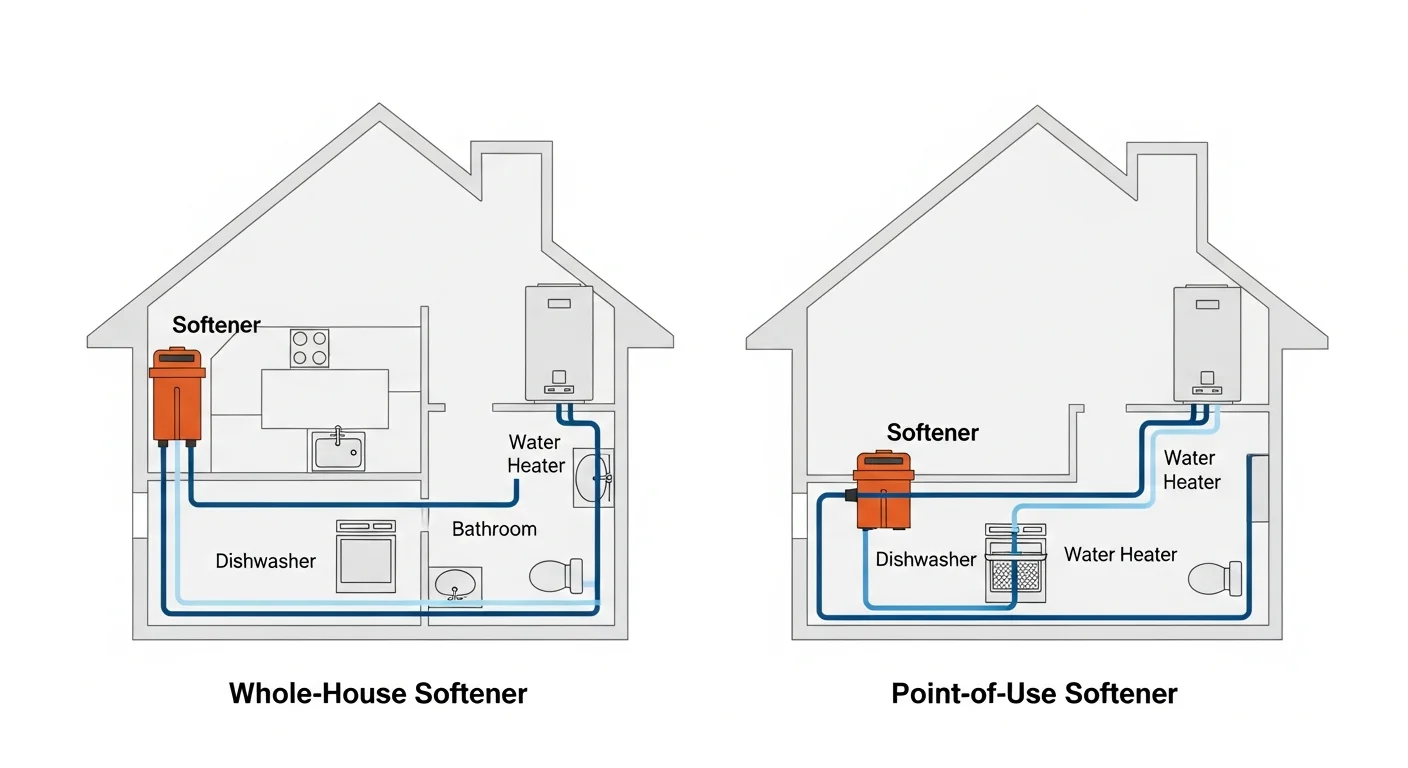
When Iron Crest runs a kitchen remodel in Boise, the dishwasher selection happens during the design phase with the homeowner's water-hardness situation and ownership horizon in mind. For homeowners doing a kitchen remodel without a softener and not planning to add one, we generally recommend Bosch 500 or 800 series — the price-to-survival ratio is the strongest in the mainstream market and the brand's service network in the Treasure Valley is reliable. For homeowners adding a softener during the remodel (we rough in for a softener loop; the softener itself comes from a plumbing supplier), the dishwasher choice opens up because the softened water dramatically extends mid-tier appliances. For upscale projects, Miele's combination of build quality and integrated softening capability is the standout choice.
The single most common mistake we see homeowners make on their own: buying a dishwasher based on aesthetic and feature set without checking how the brand performs in Boise water. The showroom comparisons don't include lifespan data, and the manufacturer warranties (typically 1 year on parts, 2 years on tub) don't reflect the actual ownership reality in hard-water markets. Our team handles the appliance-selection conversation as part of every kitchen remodel in Boise.
How much does a whole-house water softener actually extend dishwasher life in Boise?
Meaningfully — roughly 3–5 years. A KitchenAid that would survive 8 years in unsoftened hard water typically survives 11–13 years with a softener. A Whirlpool that would survive 6 years extends to 9–10. The effect is most pronounced on heating-element-drying units because the heating element is the most aggressive scaling failure point and softened water eliminates it. The cost of a whole-house softener ($1,500–$3,000 installed during a kitchen remodel) is recovered through extended dishwasher life alone if you're keeping the home long-term, before factoring in the benefits to water heater, faucets, ice maker, and other water-touching components.
Is the Miele integrated water softener worth the upcharge over a standard Miele model?
For Boise specifically, yes. Every Miele dishwasher includes a built-in water softener at no extra cost, and it delivers softened water to the dishwasher regardless of what the rest of the home's water situation is. For homeowners who don't want a whole-house softener (it requires salt refilling and adds plumbing complexity) but want the appliance-life benefits of softened water, the integrated softener is the right call. The model has to be refilled with salt every 1–2 months — similar maintenance to a whole-house unit but localized to one appliance.
Are 'extended warranty' contracts on dishwashers worth it in Boise?
Generally no — but check the actual terms on the model you're buying rather than assuming, because base coverage differs by brand and changes between model years. Extended warranties typically extend parts coverage to 3–5 years for $150–$300. The economic math: if the dishwasher fails within the extended warranty period, the warranty pays back. If it doesn't fail, the warranty is sunk cost. For mid-tier and premium brands (Bosch, KitchenAid, Miele) that typically run 9–14 years, the failure during the extended warranty period (year 2–5) is uncommon, so the warranty rarely pays back. For lower-tier brands (Whirlpool, Samsung, LG) where failures sometimes happen in years 4–6, the warranty can pay back — but the better economic choice is usually to buy the more reliable brand in the first place. Skip the extended warranty; spend the money on a better dishwasher or a softener.
How much does dishwasher installation cost in a Boise kitchen remodel?
Standard like-for-like dishwasher installation (replacing an existing unit with a new one in the same location, no plumbing or electrical relocation) costs $150–$300 in labor on top of the appliance cost. For new installs (no existing dishwasher in the location), the cost is higher: $400–$900 because the plumbing supply, drain connection, and electrical circuit have to be added. For installs that include a point-of-use softener loop for the dishwasher cold water line, add $200–$500 for the additional plumbing and softener unit. Most kitchen remodels we run include dishwasher installation as part of the bundled scope rather than as a standalone item. For homeowners installing a dishwasher outside of a remodel, the appliance retailer often offers installation as a bundled service, which is sometimes cheaper but with less attention to softener-loop options or warranty documentation.
Can I install my own dishwasher in Boise?
Technically yes for like-for-like swaps, but check what permits and warranty requirements apply. Permits are required for plumbing modifications, and some appliance manufacturer warranties require professional installation by an authorized installer for warranty validation. For a homeowner with strong DIY skills doing a same-location dishwasher swap (the existing supply line, drain, and electrical are reused), the install is technically straightforward and doesn't require a permit. For new installs or any plumbing modification, a permit is required. Check your brand's warranty terms — several require professional installation for warranty validation. Beyond the warranty question, getting the appliance level, the connections leak-free, and the drain loop correct is finicky work. We typically recommend professional installation even for like-for-like swaps because the time saved isn't worth the leak risk.
Does the dishwasher placement in the kitchen affect its lifespan?
Slightly, in two specific ways. First, dishwashers installed adjacent to a heat source (next to a range, against a hot wall, or in a sun-exposed cabinet run) experience higher operating temperatures and slightly accelerated wear on electronics and seals. The effect is small (3–6 months of expected lifespan) but real. Second, dishwasher placement determines the water-supply path length and water-arrival temperature. A dishwasher with a long supply line from the water heater receives cooler water on first cycle, which the heating element has to bring up to wash temperature, increasing heating-element wear. Most Boise kitchens have short enough supply runs (under 15 feet) that this is negligible. Worth being aware of in larger Eagle and Harris Ranch master kitchens with longer plumbing paths.
Spec a dishwasher built for Boise water — not the showroom default
The dishwasher conversation in a Boise kitchen remodel includes water hardness, softener integration, and brand-by-brand survival math — not just feature comparison. Schedule a no-pressure consultation and we'll plan the right appliance, softener rough-in, and installation alongside the rest of the kitchen scope.
These pages go deeper on the topics linked from this article. Read them before your consultation and you'll come in with sharper questions and a clearer scope.
The following government agencies, industry organizations, and official resources provide additional information relevant to your remodeling project.