
Boise Kitchen Faucets and Hard Water: Which Brands Hold Up, and Why
Boise's water — about 6 grains per gallon on average, up to ~13 in well-fed zones — doesn't wear every kitchen faucet brand the same way. Here's how the major brands hold up — by mechanism, by finish, and by what to spec instead.
Quick answer
Yes, and the extension is meaningful. A salt-based softener removes the calcium and magnesium that drive every one of the five failure modes — aerator clog, cartridge scaling, sprayer-mechanism clog, internal valve corrosion, and finish blistering.
If you're standing in a Boise plumbing showroom right now and the salesperson is telling you which kitchen faucet is best, they're probably telling you about the finish. Brushed nickel hides spots, matte black is forgiving, polished chrome is a maintenance nightmare. That's true, and we've written about it before. But finish is the question most people ask before they should be asking the harder one: which brand actually survives Boise's hard water (about 6 gpg on average, up to ~13 gpg in well-fed zones) for 10+ years?
This is a different decision. Two faucets with identical brushed-nickel finishes can have completely different internal mechanisms, and the difference shows up at year 3, year 5, and year 8. Faucets that fail in hard-water markets fail in consistent ways — by mechanism, by finish, and by age. Below is that guidance, drawn from manufacturer specifications and remodeling experience, organized by the eight brands most commonly specified in Treasure Valley kitchens.
For finish-level guidance — which brushed, matte, or PVD surface holds up best in Boise's hard water — see our Boise hard water fixture guide. This page is a step deeper: once you've decided on a finish, which brand, by name, should you actually spec?
Moen is the workhorse brand in Boise kitchens. Their proprietary 1255 Duralast cartridge is a ceramic-disc design that's quietly one of the most resilient cartridges in the budget-to-mid tier — it is common to find older Moen faucets where the cartridge is still operating cleanly even though the finish has blistered through. Cartridge longevity is Moen's real virtue, and it survives Boise's up to ~13 gpg (avg ~6) water better than most price-equivalent brands.
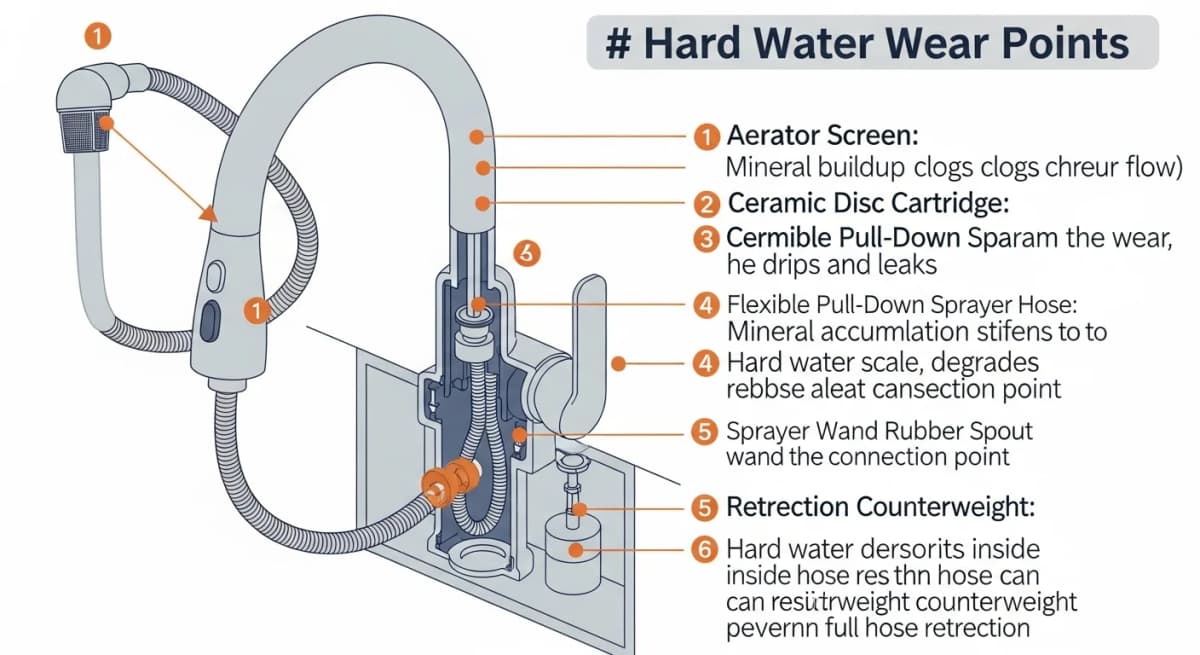
The weakness shows up elsewhere. Moen's standard pull-down sprayer hose is a polymer-lined design that tends to crack at the retraction-counterweight connection around year 5–7. The retraction weight itself collects calcium scale, which gradually degrades the spring-pull until the sprayer stops returning fully into the dock. And Moen's "Spot Resist" finish is electroplated — it hides water spots well on day one, but in Boise's harder water zones micro-blistering around the spout base can show up by year 6–8.
What lasts longer: the cartridge. What fails first: the sprayer hose and the electroplated finish.
Budget-to-mid-range Boise kitchens where cartridge longevity matters more than premium finish. Common in Bench, Vista, and Treasure Valley starter homes.
Plan on a sprayer hose replacement around year 6 and a finish refresh (or full replacement) by year 8–10 if you're particular about appearance.
Delta's DIAMOND Seal Technology uses a diamond-impregnated coating on the cartridge's moving valve, and it's genuinely more scale-resistant than a standard ceramic disc. We see Delta cartridges run cleanly past year 10 in Boise water, including in homes where the rest of the faucet is wearing visibly. Delta also uses what they call a "MagnaTite" docking magnet to retract the sprayer — which is mechanically simpler than Moen's counterweight-and-spring approach and has fewer parts to scale-clog.
Delta's "Brilliance" finish is a PVD (physical vapor deposition) coating on most of their Trinsic, Essa, and Leland lines. PVD is the right call for hard-water markets — the finish is bonded at the atomic level rather than electroplated, so scale doesn't penetrate to the base metal and trigger the bubbling that kills electroplated chrome. We rarely pull Delta Brilliance faucets for finish failure alone.
The weak point: Delta's pull-down sprayer wand has a sweep-spray button that uses small rubber jets, and those jets clog with calcium scale within 18–24 months. Functionally the faucet still works, but the wide-spread spray pattern collapses. Easy to fix (soak the wand in vinegar quarterly) but worth knowing before you spec.
Boise homeowners willing to spend in the mid-to-upper tier ($350–$700) for a faucet that holds its appearance and cartridge performance for 12+ years.
Sweep-spray jets need quarterly descaling. The MagnaTite magnet collects fine ferrous particles — wipe it down during cleaning.
Kohler's standard cartridge is a ceramic-disc design that's reliable but not differentiated from the field. Where Kohler stands out for Boise water is their Vibrant finishes — these are true PVD coatings (Kohler's PVD process is one of the most established in the industry), and Vibrant Stainless, Vibrant Brushed Nickel, and Vibrant Polished Nickel all hold up exceptionally well in up to ~13 gpg (avg ~6) water. Finish blistering is rare on Vibrant lines even past year 10.
The named weak point on Kohler kitchen faucets — and one we've replaced repeatedly — is the Simplice sweep spray. The sweep-spray mechanism on the Simplice pull-down uses a small ceramic disc that scales up faster than the main cartridge, leading to spray-pattern collapse around year 3–4. Kohler will warranty the wand, but the second one usually develops the same issue at the same interval if you don't soften the water.
The Artifacts, Bellera, and Sensate lines don't have this issue. If you want Kohler in Boise water, those three lines are the safer specs.
Upscale Boise kitchens (Harris Ranch, Eagle, Northwest Boise) where the Vibrant finish appearance matters and the budget allows $450–$900 per faucet.
Simplice is Kohler's most-marketed kitchen line but has the sweep-spray weakness. Spec Artifacts or Bellera instead if you want the Kohler PVD finish without the sweep-spray issue.
Pfister sits in the budget tier alongside lower-end Moen lines, and the trade-offs show. Their Pforever Seal cartridge is a ceramic-disc design covered by Pfister's limited lifetime warranty on finish and function, which is the brand's strongest feature — read the current terms on Pfister's own warranty page before relying on it. It is common to find older Pfister faucets where the cartridge is still functional even though the rest of the faucet has aged hard.
The rest of the faucet is the problem. Pfister bodies are typically zinc-alloy rather than solid brass, and zinc corrodes faster in mineral-heavy water. We see internal corrosion at the cartridge seat around year 6–8, which is invisible from the outside but causes pressure-drop and intermittent leaks. Their pull-down sprayer hoses are also polymer-lined and crack around year 5. Pfister finishes are electroplated — same blistering pattern as electroplated Moen, on a similar timeline.
For a Boise homeowner on a tight budget, Pfister is the right call if you understand you're buying a faucet that will need replacing — not refurbishing — around year 7–9. Comparable Moen lines tend to last longer overall, but the price gap is real.
Budget kitchens, rental properties, or properties being prepped for sale where the goal is a presentable installation that will outlast the listing period but isn't expected to last 15 years.
Zinc-alloy body means internal corrosion is the eventual failure mode. The lifetime cartridge warranty matters less than it sounds because the cartridge isn't usually what fails.
Brizo is Delta's premium sub-brand, and the engineering pedigree shows. The cartridge is the same DIAMOND Seal Technology platform as mid-range Delta, but the body is solid brass throughout, and the finish line — Brizo calls it Luxe — uses a thicker PVD deposition than standard Delta Brilliance. In Boise's hard water, Luxe finishes are among the most durable in production-volume faucets, and 10-year-old Brizo Litze and Artesso faucets commonly still look essentially new.
The complications start with the SmartTouch electronics that come on many Brizo lines. SmartTouch lets you turn the faucet on with a touch anywhere on the body, which is genuinely useful — but it adds an electronic module and a battery that scale-laden water doesn't help. SmartTouch modules can need replacement around year 7–9 where mineral buildup on the contacts causes intermittent activation. The fix is straightforward (Brizo sells replacement modules), but it's an extra cost a non-SmartTouch faucet doesn't have.
If you want a non-electronic Brizo, the Litze and Artesso pull-downs are excellent specs. If you want SmartTouch, plan on softening the water — softeners are particularly worth it for electronic kitchen faucets in Boise.
Upper-tier Boise remodels ($600–$1,400 faucets) where finish longevity matters more than the price gap to Delta or Kohler.
SmartTouch electronics introduce a wear category that non-electronic faucets don't have. The non-SmartTouch variants are arguably the better long-term spec in Boise water.
Spec a kitchen faucet that survives Boise's water
When we plan a Boise kitchen remodel, faucet selection happens during design — not at the showroom. Get a no-pressure consultation, a faucet recommendation matched to your water hardness and household use, and a quote that includes softener integration if it makes sense for your home.
Grohe's SilkMove cartridge is a ceramic-disc design with silicone-grease-lubricated discs, and it's one of the smoothest-operating cartridges in the industry. The German engineering shows in the handle feel and the operating life — SilkMove cartridges are commonly still moving cleanly at year 12+. Grohe also pioneered EasyMaintenance aerators that are designed to be unscrewed and descaled in 30 seconds without tools, which is a meaningful feature in hard water, where aerators in Boise's hardest zones can clog every 12–18 months.
Grohe's StarLight finish is PVD and holds up well, on par with Kohler Vibrant. The pull-down sprayer hose on most Grohe kitchen lines is a textile-braided design that lasts longer than polymer-lined hoses — we rarely see Grohe hose failures even past year 10.
The Grohe weak point is their AirPower aerator technology on certain Concetto and Essence lines. AirPower injects air into the water stream for a softer feel, but the small air channels scale up faster than the main aerator screen. Either spec a non-AirPower aerator or plan on quarterly descaling. The good news is the EasyMaintenance design makes that quarterly descale a 30-second job.
Boise homeowners who want German engineering and don't mind that Grohe is harder to find in local showrooms (some Eagle and Meridian retailers stock it; otherwise it's special-order).
AirPower aerators need quarterly descaling. Replacement parts have longer lead times than Moen/Delta because they come from Europe.
Hansgrohe is a separate German company from Grohe, with its own engineering. Their cartridges are similar in quality — ceramic-disc, smooth operation, long life. Hansgrohe's standout feature for Boise is the Pull-out vs. Pull-down design choice available on Talis and Metris lines. Pull-out (where the entire faucet head separates) tends to last longer than pull-down (where only the sprayer wand extends on a hose) because there's no flexible hose to wear, just a rigid metal pipe inside the spout column.
Hansgrohe finishes are PVD and durable. The construction is solid brass throughout on the kitchen lines we install. Where we see Hansgrohe wear is the small rubber gasket where the pull-out head seats back into the spout — that gasket compresses over thousands of pull-and-return cycles and starts leaking around year 8–10. The fix is a $20 gasket and 15 minutes; the same job on a polymer pull-down hose is a $150 hose replacement.
Like Grohe, Hansgrohe's challenge is availability. The Treasure Valley has limited local retailers — most installs are special-order through plumbing supply houses or online.
Boise homeowners who want pull-out (not pull-down) functionality and are willing to accept longer lead times for a faucet that fails on cheaper parts than its competitors.
Limited local retail availability. The pull-out mechanism is more resilient than pull-down but offers less reach.
ROHL is the premium Italian-engineered (and Italian-manufactured, in most cases) end of the kitchen faucet market. Solid brass bodies, European ceramic-disc cartridges, and finish-process control that is rarely matched. ROHL kitchen faucets commonly run past year 15 with only routine aerator descaling and minor seal swaps.
The trade-offs are real. ROHL prices start at $700 and run past $2,500 for the more elaborate bridge faucets. Replacement parts come from Europe and can take 4–8 weeks for non-standard items. The pull-down sprayer designs are sometimes less elaborate than Moen or Delta because ROHL has historically focused on traditional and bridge-style kitchen faucets, not modern pull-downs.
For a Harris Ranch or Eagle Foothills kitchen where the faucet is a permanent design element rather than a 7-year consumable, ROHL is the right call. For a Bench-area starter home, the math doesn't work — a $1,200 ROHL on a $35k kitchen is overkill; spec Delta or Moen and put the money into cabinetry or counters.
High-end Boise kitchens where the faucet is design-led rather than function-led, and the budget treats it as a 15-year investment.
Long replacement-part lead times. Pull-down spray functionality is less developed than American brands. Plumber familiarity varies — make sure your installer has installed ROHL before.
Brand differences matter, but five failure mechanisms are universal in Boise's up to ~13 gpg (avg ~6) water. Understanding them is what lets you spec around the worst of each brand's weaknesses.
1. Aerator clog (all brands, 6–18 months). The aerator's fine mesh accumulates calcium scale and reduces flow rate. Easy fix: unscrew, soak in white vinegar overnight, rescrew. Schedule it twice a year and you'll never notice.
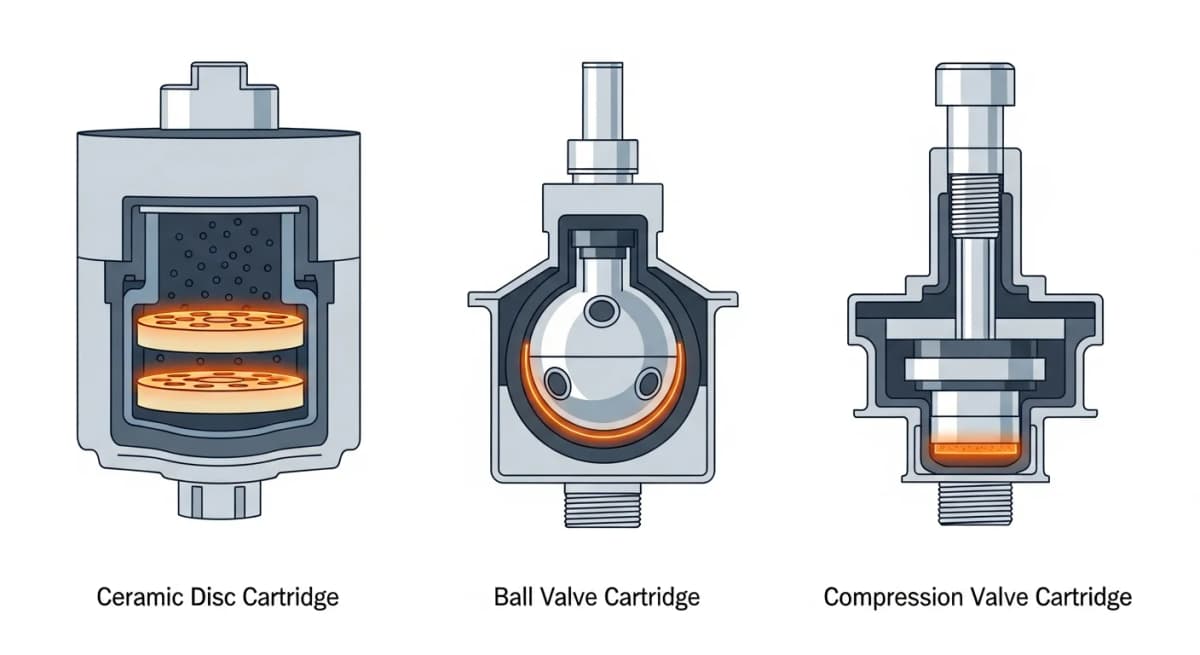
2. Cartridge slow-failure (varies hugely by brand, 5–15 years). The most expensive failure mode but also the most differentiated by brand. Delta's diamond-coated discs, Moen's Duralast, and Grohe's SilkMove all run 10+ years. Cheaper cartridges seize at year 5–7.
3. Pull-down sprayer hose failure (varies by hose type, 3–10 years). Polymer-lined hoses crack at the retraction-weight connection. Textile-braided hoses (Grohe, some Brizo) last 2–3x longer. If your spec sheet doesn't say which type of hose, assume polymer.
4. Sprayer-wand mechanism scale-clog (varies by wand design, 18 months to 3 years). Sweep-spray jets, AirPower channels, and "rain mode" sprayer faces clog faster than the main aerator. The simpler the wand, the longer it lasts. If you don't need sweep mode, don't spec a wand that has it.
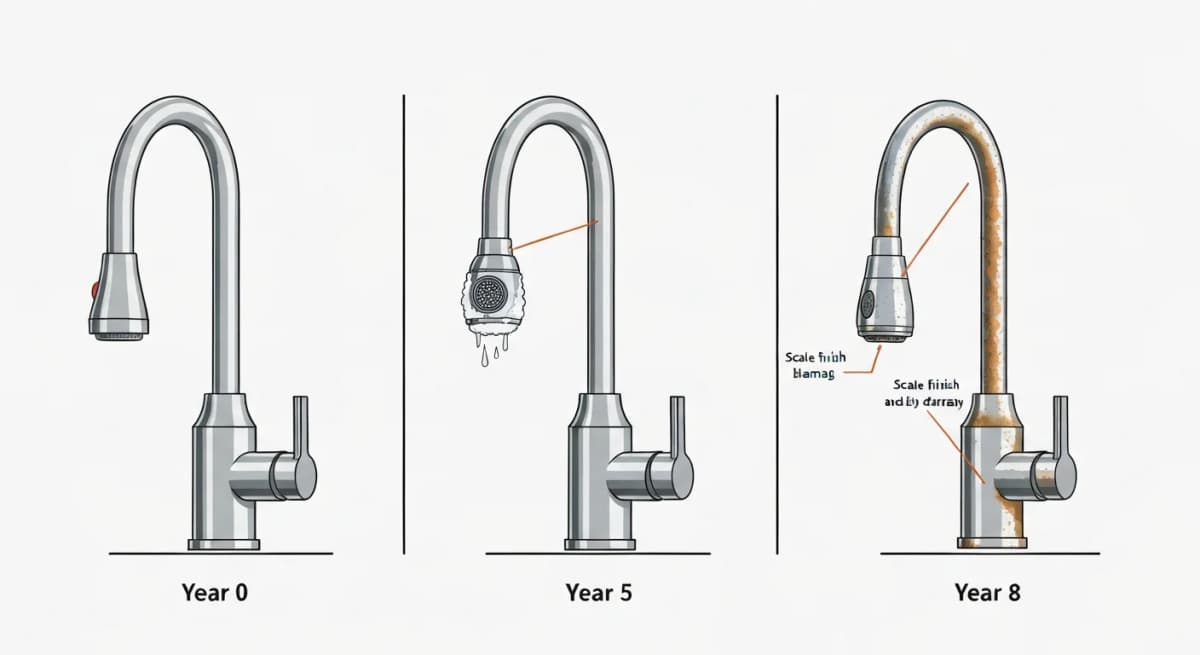
5. Finish blistering (electroplated 6–10 years; PVD 12–25 years). The single largest brand-by-brand difference in Boise. If you want the faucet to look new at year 10, spec PVD finishes (Brizo Luxe, Kohler Vibrant, Delta Brilliance on most modern lines, Grohe StarLight). Electroplated chrome and nickel will eventually blister in hard water, sooner in Boise's well-fed zones. PVD will not.
The single most cost-effective Boise hedge: install a whole-house water softener before the new faucet goes in. A $1,500–$3,000 softener installed during the remodel extends every faucet, dishwasher, water heater, and shower-glass install by 3–5 years. That's covered in the broader Boise hard water fixture guide and one of the highest-ROI decisions we recommend during a kitchen remodel.
When we run a kitchen remodel for a Boise homeowner, the faucet selection happens during the design phase — not at the showroom alone. We pull the homeowner's water hardness from their utility report (or test it on-site for homes outside the City of Boise system), match it against the household's daily use volume, and recommend a brand-line combination that fits both the budget and the expected service life of the kitchen. For most Boise mid-range remodels that means Delta Trinsic or Brizo Litze with PVD Luxe finish; for budget-conscious projects it means Moen Arbor or Sleek with the Duralast cartridge; for high-end Eagle and Harris Ranch projects it's typically Brizo, ROHL, or specified Kohler Artifacts.
The single biggest spec mistake we see homeowners make on their own is choosing a beautiful electroplated finish in a hard-water market. The faucet looks perfect the day it's installed and starts blistering at year 6. PVD costs slightly more upfront and saves the replacement cost in year 7. That kind of decision is the difference between a Boise kitchen that ages well and one that needs a refresh inside a decade. Our team handles the faucet spec, the supply-line sizing, and the softener integration as one design package — it's part of how we plan every kitchen remodel in Boise.
Will a whole-house water softener really make a kitchen faucet last longer in Boise?
Yes, and the extension is meaningful. A salt-based softener removes the calcium and magnesium that drive every one of the five failure modes — aerator clog, cartridge scaling, sprayer-mechanism clog, internal valve corrosion, and finish blistering. Electroplated chrome faucets in softened-water Boise homes commonly still look new at year 12. The same faucet in unsoftened water in Boise's harder zones often needs replacement by year 7–8. If you're already remodeling the kitchen, adding a softener loop during rough-in is the cheapest time to install one — typically $200–$500 in additional plumbing work versus $800–$1,500 for a retrofit after the kitchen is finished. For a fuller breakdown see our Boise hard water fixture guide.
Are touchless or smart-touch kitchen faucets a bad idea in Boise's hard water?
Not bad, but they introduce an additional wear category that purely mechanical faucets don't have. The touch and capacitive sensors are unaffected by water hardness directly, but mineral scale on the metal contacts inside SmartTouch modules can cause intermittent activation around year 7–9. Brizo SmartTouch is the most common one we see in Boise homes. The fix is a module replacement — Brizo stocks them — but it's an additional service cost. If you want a touchless faucet, the Kohler Sensate and Delta Touch2O lines have held up well on the installs we service, and pairing them with a water softener essentially eliminates the failure mode.
Is it worth replacing just the cartridge instead of the whole faucet when scale damages it?
It depends on the brand and the age of the rest of the faucet. Cartridge replacement is straightforward on Moen, Delta, Kohler, Pfister, and Grohe — typically a $30–$60 part and 30–45 minutes of labor. If the faucet body, finish, and sprayer assembly are still in good shape, replacing the cartridge buys another 5–10 years of life. If the finish has already blistered, the sprayer hose has cracked, or there's visible base corrosion, the cartridge is the only good part of an otherwise-failed faucet and you're better off replacing the whole unit. We assess this during a remodel — sometimes a $50 cartridge swap is the right call, sometimes a $400 replacement is genuinely cheaper over five years.
Which faucet brand should I avoid entirely for a Boise kitchen?
None of the eight brands above are bad — they each have a price-point use case. The brands we steer Boise homeowners away from are the unbranded or off-brand fixtures sold on Amazon and direct-to-consumer sites, particularly those advertised at $80–$150 with vague country-of-origin labeling. These commonly fail at year 2–4 with seized cartridges, finish failures, and internal leaks. Idaho's plumbing code requires fixtures be NSF/ANSI 61 certified for potable water; many of these unbranded units have certification that's either expired or covers a different product than what's shipped. If you're shopping at a price point below $150 for a pull-down kitchen faucet in Boise, spec the entry-level Moen or Pfister rather than going off-brand. The price difference is small; the lifespan difference is significant.
Does it matter whether I buy my kitchen faucet at a Boise plumbing supply house versus a big-box retailer?
It matters for two reasons that aren't immediately obvious. First, model-number variation: brands like Moen, Delta, and Kohler frequently make different SKUs for big-box (Home Depot, Lowe's) versus plumbing supply (Ferguson, supply houses). The big-box SKUs are typically cost-reduced — different cartridge supplier, polymer hose instead of braided, electroplated finish instead of PVD — and may have a different warranty path. Second, warranty support: most premium brands route warranty claims through their professional dealer network. A faucet purchased at Ferguson or a Boise-area supply house typically gets faster warranty support than the big-box version. The price gap is sometimes $50–$100 for a meaningfully better product. For mid-tier and premium specs, the supply house is usually the right channel.
How often should I descale my kitchen faucet aerator in Boise?
Twice a year is the right cadence for most Boise homes on unsoftened water. The job is unscrew the aerator (a 12-mm wrench or sometimes hand-tight), drop it in a small dish of white vinegar overnight, rinse, screw back on. Total time: 30 seconds upfront, then leave it overnight. Households with softened water can stretch the interval to once a year. Faucets with sweep-spray, AirPower, or other multi-mode wands need the same treatment applied to the wand head, not just the aerator — and a quarterly cadence is more realistic for those. Skip the descaling and the flow rate falls off noticeably — the aerator screen is the first thing scale narrows, and you feel it long before you see it. Do it on schedule and the faucet keeps its original spray pattern.
Spec a kitchen faucet that survives Boise's water
When we plan a Boise kitchen remodel, faucet selection happens during design — not at the showroom. Get a no-pressure consultation, a faucet recommendation matched to your water hardness and household use, and a quote that includes softener integration if it makes sense for your home.
These pages go deeper on the topics linked from this article. Read them before your consultation and you'll come in with sharper questions and a clearer scope.
The following government agencies, industry organizations, and official resources provide additional information relevant to your remodeling project.