
Kitchen Pantry Design for Treasure Valley Canning, Preserving, and Bulk Buying
The Treasure Valley's strong canning and home-preserving culture demands kitchen pantry design that handles 60-80 lb jar loads per shelf, water-bath canners, and sealing-station ergonomics. Standard pantry guides don't address this.
Quick answer
The pantry premium for canning-specific design typically runs $1,500–$5,000 above a standard walk-in pantry of equivalent size, more if a root cellar zone is added. The pieces: jar-weight shelving ($1,200–$3,200), a sealing station counter and electrical, enhanced lighting and ventilation, and a dedicated bulk-produce zone in additional cabinetry.
The Treasure Valley has one of Idaho's most active home-preserving cultures. Boise farmers' markets, fruit orchards in the foothills and Snake River Plain, and the broader Idaho agricultural economy combine to make canning, pickling, fermenting, and bulk-buying common household activities. For homeowners who actively can or preserve, kitchen pantry design needs to address specific functional requirements that standard pantry guides don't cover.
Our general pantry design guide covers the broader pantry-design question — layout, lighting, cabinet selection. This page goes deeper on one specific use case: kitchens designed around active preserving workflows. The features add 5-15% to pantry scope ($1,500-$5,000 above standard pantry) and produce a pantry that genuinely supports the canning workflow rather than fighting it.
For broader pantry design context (butler's pantries, walk-in pantries, kitchen-adjacent storage), see our pantry and butler's pantry design guide. This page focuses specifically on the canning-and-preserving workflow that's common in Treasure Valley households but not addressed in standard pantry design content.
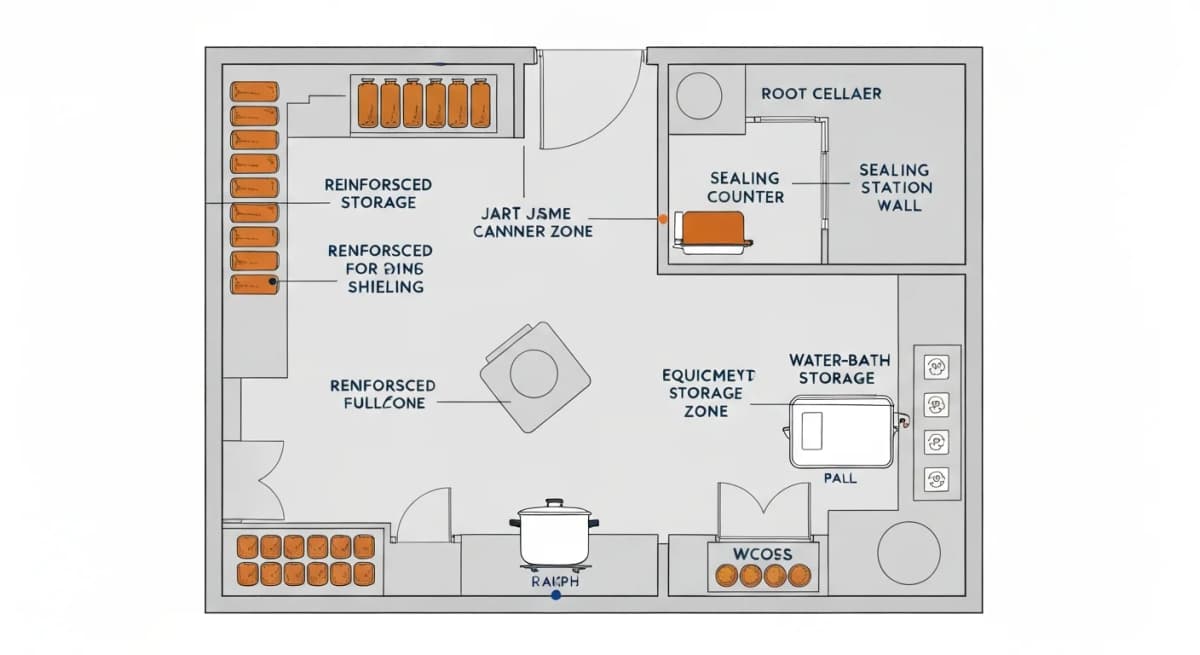
The Treasure Valley's canning and preserving culture has multiple drivers: extensive local agriculture (Treasure Valley farms grow tomatoes, peaches, apples, sweet corn, berries, and dozens of other preservable crops), strong Idaho Extension home-economics programming (University of Idaho Extension has published canning guidance for the region for 80+ years), a strong home-preserving tradition, and a cultural orientation toward self-sufficiency that runs across rural-and-urban Treasure Valley households alike.
The result: many Boise households that actively can or preserve put up well over a hundred jars a year. The volume needs storage, the process needs equipment, and the workflow needs design support.
Common Treasure Valley preserving activities and seasonal patterns:
Late June - August: Stone fruits (peaches, apricots, cherries). Production peaks in July; typical household produces 30-80 quarts of canned peaches and 10-30 quarts of cherries per season.
July - September: Tomatoes and salsa. Peak production July-August; typical household produces 40-100 quarts of tomatoes, salsa, sauce, and related products.
August - October: Apples, pears, hard fruits. Apple sauce, apple butter, pear preserves; 30-80 quarts per typical household.
August - October: Pickling cucumbers, peppers, green beans. 20-60 quarts per household.
September - November: Sauerkraut, fermented vegetables. Smaller volume but specific storage requirements (cool, dark).
Cumulative peak: a typical actively-preserving Treasure Valley household has 200-400 quart-equivalent jars in inventory by mid-October, decreasing through the year as the household consumes the stock.
The minimum pantry size that handles active canning workflows depends on annual production volume. The math:
Annual production 100-200 quart-equivalents: Active hobbyist level. Pantry size minimum: 40-60 square feet. Linear shelf footage minimum: 60-80 linear feet of jar-rated shelving.
Annual production 200-400 quart-equivalents: Active preserving household. Pantry size minimum: 60-80 square feet. Linear shelf footage minimum: 80-120 linear feet.
Annual production 400+ quart-equivalents: Serious preserving household, possibly with farmers-market or church-bazaar sales. Pantry size minimum: 80-120 square feet. Linear shelf footage minimum: 120-180 linear feet plus dedicated sealing-station counter space and equipment storage.
For comparison, standard residential walk-in pantries are typically 20-40 sq ft. The canning-workflow pantry is meaningfully larger — typically 1.5-3x standard pantry footprint.
The trade-off in kitchen design: the larger pantry footprint comes from somewhere — typically from kitchen counter space, eating area, or adjacent room. For active preserving households, the trade is usually worth it; the pantry's daily-use value exceeds the alternative counter space's value. For households who don't actively preserve, oversizing the pantry produces dead space.
The right design conversation includes: how many jars/year does the household actually preserve, is preserving expected to continue or grow, and what's the household's tolerance for reduced kitchen counter space in exchange for pantry capacity. The answers shape the pantry-vs-kitchen space allocation.
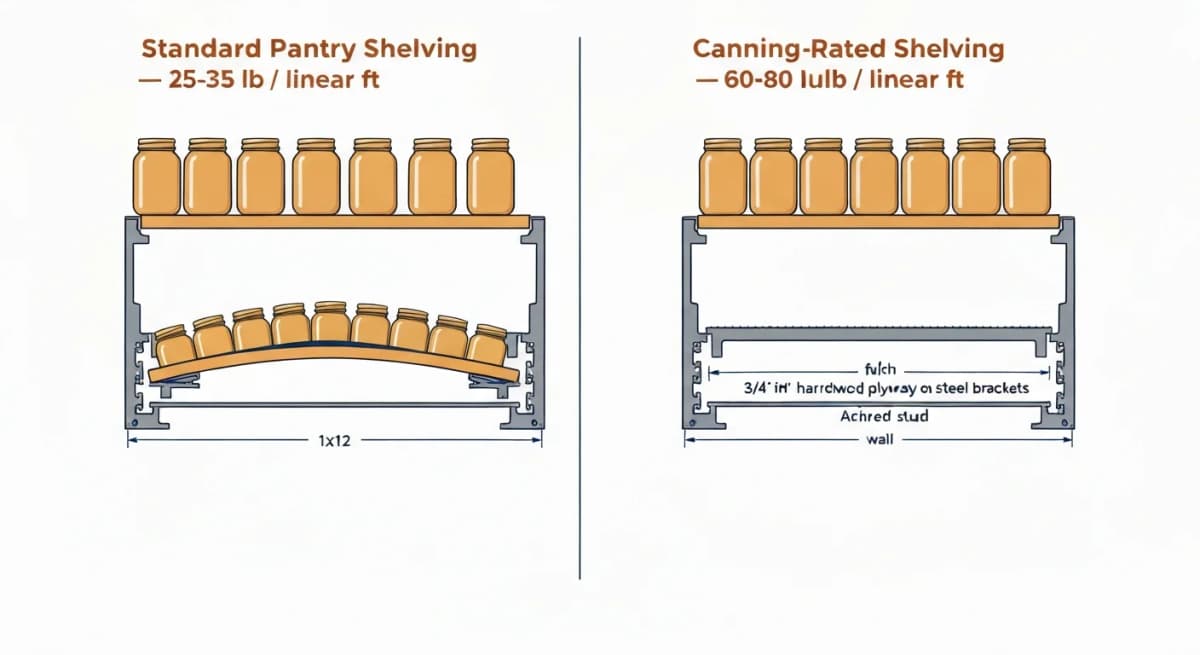
Standard residential pantry shelving — 1x12 pine boards on light brackets, or single-rail wire shelving — is rated 25-35 lb per linear foot. This handles dry goods (flour, cereals, canned goods at light density). It does not handle canning loads.
The math: a quart jar of canned tomatoes weighs approximately 2.2-2.5 lb. A typical pantry shelf 12 inches deep can hold 4-6 jars per linear foot. That's 8-15 lb per linear foot for a single row. With deeper shelves or stacked jar rows, the load reaches 60-80 lb per linear foot.
Standard residential shelving fails under canning loads through three failure modes:
Shelf board deflection: 1x12 pine board on light brackets sags visibly under 50+ lb per linear foot. Over time, the deflection becomes permanent and the shelf board needs replacement.
Bracket failure: Light-duty shelf brackets (typically 1/8 inch steel) bend under heavy loads. Eventually the bracket fails and the shelf collapses.
Wall attachment failure: If the wall studs aren't directly behind the shelf brackets, the drywall anchors can't support the load. The brackets pull out of the wall, taking drywall with them.
Canning-rated shelving spec:
Shelf material: 3/4 inch hardwood plywood or 3/4 inch finger-jointed pine, not thin pine boards. The structural thickness handles the load without deflection.
Brackets: Heavy-duty steel brackets (typically 3/16 inch minimum thickness) rated 100+ lb per pair. Spacing 24-32 inches max.
Wall attachment: Lag bolts directly into wall studs (not drywall anchors). For shelving running across stud bays, full-height standards anchored to studs at top and bottom carry the load down to floor structure rather than relying on wall mounting alone.
Cost premium: canning-rated shelving adds $15–$40 per linear foot vs standard pantry shelving. For a typical 80-linear-foot canning pantry, that's $1,200–$3,200 in additional cost. Worth it for the load capacity and longevity.
Active canning households own multiple large pieces of equipment that need dedicated storage:
Water-bath canner (boiling-water canner): Large enameled steel pot, typically 21-22 quart capacity, 12-14 inches deep, 12-14 inches diameter. Used for fruit, jams, pickles, tomatoes. Many households have two — one for processing while the other is being filled.
Pressure canner: Heavy aluminum or stainless pot with locking lid and pressure gauge, typically 16-23 quart capacity. Used for low-acid foods (vegetables, meat, beans). Required for safe canning of these foods per USDA guidelines. Cost: $200-$400 for quality units.
Steam canner: Newer option that uses steam rather than full water immersion, more energy-efficient. Adopted by some households alongside water-bath canners. Cost: $50-$120.
Dehydrator: For drying fruits, vegetables, herbs, jerky. Typically 12-24 inches diameter, 12-18 inches tall. Multiple trays often store separately.
Fermenting crocks and jars: Ceramic crocks or large mason jars for sauerkraut, kimchi, fermented vegetables. Volume varies but 5-7 gallon ceramic crocks need substantial storage space.
Storage approaches:
Dedicated equipment shelf: A bottom-shelf area in the pantry, 24+ inches deep and 18-24 inches tall, sized for the water-bath canner stored upright. Allows easy access during canning season.
Pull-out drawer: Deep drawer (24x36 inches) for canner storage with full extension hardware. Allows access without lifting the canner from a shelf — useful given the canner's 8-12 lb empty weight.
Above-counter or in-cabinet storage: Smaller equipment (steam canner, dehydrator trays, smaller crocks) can store in upper cabinets or pantry mid-shelf areas.
The right configuration depends on the equipment inventory and household frequency. For households canning 3-6 times per year, dedicated equipment shelf at floor level is the cheapest and most reliable approach.
Design a pantry that supports your Treasure Valley canning workflow
Active canning households need pantry design beyond standard residential templates. Schedule a consultation and we'll size the pantry for your production volume, equipment inventory, and household use pattern.
The sealing station is where the actual canning work happens during processing days. The workflow: bring jars from the canner (hot, 200°F+ on water-bath, 240°F+ on pressure canner), fill with prepared food, wipe rims, attach lids and rings, place in canner for processing. The work happens in 1-3 hour sessions; ergonomics matter for repeated bending and lifting.
Sealing station spec:
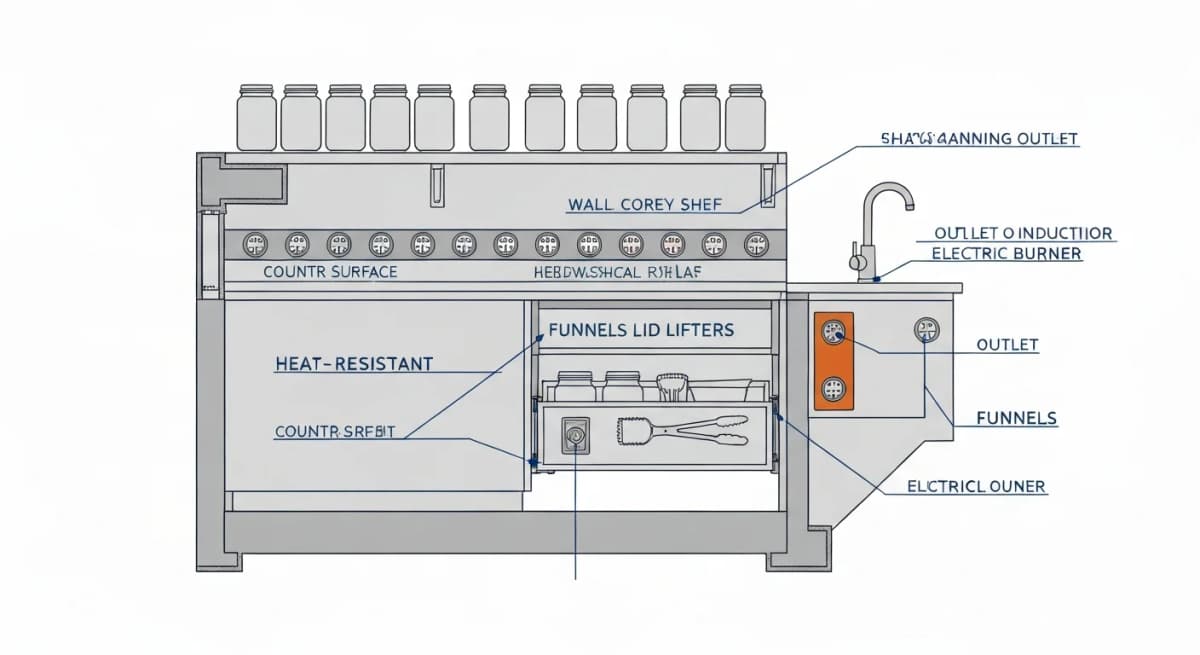
Counter height: Standard 36-inch kitchen counter is appropriate for stand-up canning work. For households with sit-down canners (older household members, longer canning sessions), a 30-inch (table-height) section is more comfortable. Combination is ideal: most counter at 36 inches with a section at 30 inches for tasks that benefit from sit-down work.
Counter material: Heat-resistant material is essential — the canners produce 200°F+ surfaces that contact the counter. Quartz, granite, solid-surface (Corian), or stainless steel all handle this. Laminate counters degrade with repeated heat exposure.
Electrical outlets: Multiple GFCI outlets within reach. Standard residential code requires GFCI for kitchen counter outlets. Canning workflows use: induction or electric burner for the water bath (some pantries include a dedicated countertop burner area), steam canner, dehydrator, electric kettle, food processor for prep work, sealing/lid-tightening tools. The outlet count should be 4-6 minimum.
Tool storage: Drawer or wall-mounted storage for canning-specific tools (funnels, lid lifters, jar tongs, headspace gauge, magnetic lid lifter, ladles). Sized for the specific tools rather than generic kitchen drawer.
Sink access: A sink within 6 feet of the sealing station for jar washing, hand washing, and rim cleaning during canning. Pantry-adjacent sink is ideal; kitchen sink works if proximate.
Cost premium: dedicated sealing station adds $1,500-$3,500 to pantry scope (counter, electrical, plumbing if sink). The cost is recouped through better canning ergonomics if the household actually uses the pantry for active canning.
Active canning households often buy produce in bulk from local farms. Idaho farmers sell #1 quality peaches in bushels (50-60 lb), tomatoes in flats (25-30 lb), apples in bushels (40-45 lb), and similar quantities for other crops. The bulk produce arrives during a 1-3 day processing window and needs storage that supports the workflow.
Bulk storage requirements:
Floor space: Pantry or kitchen-adjacent storage area sized for bulk containers. Bushel baskets are typically 18 inches diameter; multiple bushels at once need 20+ sq ft of floor area.
Temperature control: Some produce (stone fruits, particularly) ripens rapidly at warm temperatures. Cool storage extends the processing window. Boise's basement temperatures (60-65°F in summer) work for short-term bulk storage; pantry at room temperature (70-75°F) requires faster processing.
Air circulation: Bulk produce produces ethylene gas that accelerates ripening. Air circulation slows the effect. Mesh-bottomed shelves or wire racks improve airflow.
Adjacent food storage: Other foods stored adjacent to bulk produce may absorb ethylene and ripen prematurely. Keep bulk-produce storage separate from finished canned goods, dry storage, and produce intended for fresh eating.
The practical solution: a dedicated bulk-produce area at the back of the pantry or in a kitchen-adjacent unfinished area (mudroom, garage during cool seasons). The area should have temperature stability, air circulation, and isolation from other food storage. Cost: minimal for the storage area itself; the pantry size and layout decisions support the function.
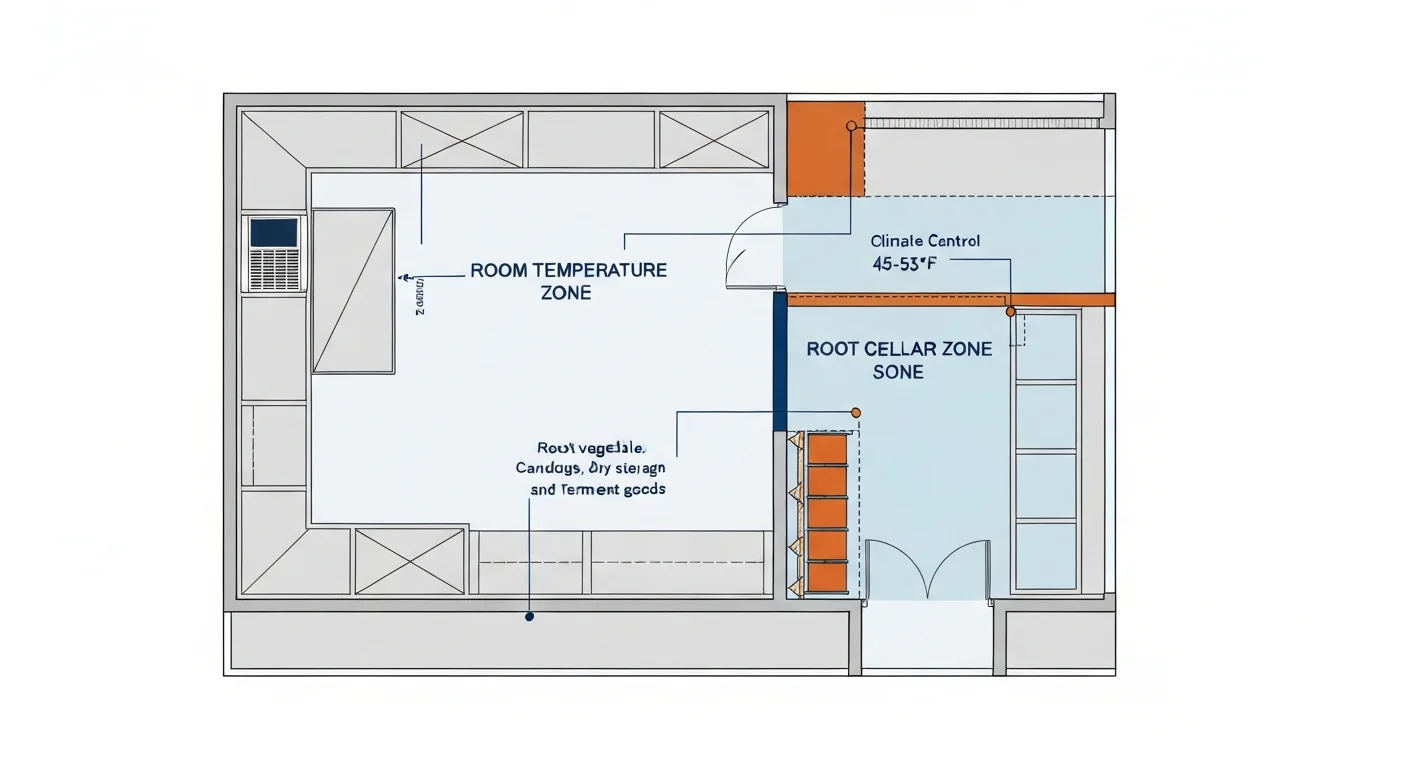
Some preserving households integrate a small temperature-controlled root cellar zone within or adjacent to the pantry. The zone maintains 45-55°F for root vegetables (potatoes, carrots, beets, turnips), winter squash, apples, and certain fermented foods (sauerkraut, kimchi) that benefit from cool storage.
Root cellar zone specifications:
Size: Typically 16-32 cubic feet (4x4x2 ft to 4x4x4 ft) for typical household needs. Larger for serious gardening households or those storing significant winter vegetable supplies.
Temperature control: Maintain 45-55°F via small refrigeration unit (the same units used in wine cellars — Whisperkool, Wine Guardian) or via cool-air ventilation if pantry is below grade and ambient temperature is appropriate.
Humidity control: Root vegetables need 85-95% RH; significantly higher than typical home interior. Humidity stabilization may require small humidifier in the zone.
Insulation: The cool zone needs insulation similar to wine cellar requirements to maintain temperature and humidity without affecting adjacent pantry zones.
Air circulation: Light circulation prevents stagnation and mold growth. Small fan adequate.
Cost: $2,500-$6,000 to add a small root cellar zone to an existing pantry. The cost is roughly equivalent to a small wine cellar conversion because the climate-control infrastructure is similar.
For Treasure Valley homes with active gardening and preserving cultures, the root cellar zone justifies its cost through extended storage of fresh-storage produce. For homes without active gardening, the cost is harder to justify — canned goods don't need the temperature control.
Active canning pantries have specific lighting and ventilation requirements that exceed standard pantry design:
Task lighting: The sealing station counter needs 800-1,200 lumens of focused work lighting for reading labels, judging headspace, checking jar rims for chips. Standard pantry overhead lighting (single ceiling fixture) is inadequate. Specify: under-cabinet LED strip at the sealing station counter, plus 2-3 recessed cans across the pantry for ambient lighting.
Color rendering: CRI 90+ lighting is appropriate because canners visually evaluate food color and clarity. Standard residential lighting (CRI 80-85) shifts perceived colors enough that some canners report difficulty judging jar contents.
Heat ventilation: During active canning sessions, the water-bath canner or pressure canner produces significant steam. Pantry ventilation should handle this — typically a 50-80 CFM exhaust fan vented to exterior. The vent prevents condensation buildup on pantry walls, shelving, and stored items.
Cooler air during sessions: Active canning makes the pantry warm — sometimes uncomfortably so during summer sessions. A small air-conditioning vent into the pantry, or a portable cooling unit during active sessions, makes the work more sustainable. Particularly relevant for August canning sessions when ambient outdoor temperature is 90-100°F.
Cost: lighting and ventilation upgrades for a canning pantry add $800-$2,000 above standard pantry scope. Reasonable cost for the functional improvement.
Iron Crest's pantry design for canning-household clients starts with an inventory: how many jars/year are produced, what equipment is owned, what bulk-buying patterns the household follows, and what produce storage requirements exist. The answers shape the pantry footprint, shelving spec, sealing station inclusion, root cellar consideration, and ventilation requirements. Most active Treasure Valley canning households produce 200-400 jars annually and benefit from a 60-80 sq ft walk-in pantry with the features above.
The pantry-design conversation typically happens during a broader kitchen remodel because the pantry footprint affects the overall kitchen layout. We coordinate the pantry sizing with kitchen counter space, dining area, and adjacent room allocations during the design phase. For broader pantry design context, see our pantry and butler's pantry design guide and the kitchen remodeling service overview.
How much does a canning-workflow pantry add to a typical Boise kitchen remodel?
The pantry premium for canning-specific design typically runs $1,500–$5,000 above a standard walk-in pantry of equivalent size, more if a root cellar zone is added. The pieces: jar-weight shelving ($1,200–$3,200), a sealing station counter and electrical, enhanced lighting and ventilation, and a dedicated bulk-produce zone in additional cabinetry. On a typical $45,000–$70,000 full kitchen remodel that includes a pantry, the canning-design premium represents 5–15% of the pantry scope. Modest premium for households where the function matters.
Do I need a permit for adding a canning pantry to my Boise home?
Standard residential pantry build doesn't require a permit unless it involves new electrical circuits (typically yes for a canning pantry given the multiple GFCI outlets needed), plumbing changes (yes if adding a sink), or structural modifications (sometimes yes for load-bearing wall changes or significant size increases). For most canning pantry projects we run, the electrical and plumbing scope triggers permits. The combined permit cost is typically $200-$500 in addition to any broader kitchen remodel permit.
Is a root cellar zone worth it if I'm not an active gardener?
Generally no. The root cellar zone's primary value is for storing fresh produce that benefits from 45-55°F temperature. If the household isn't growing or buying significant quantities of root vegetables, winter squash, or fresh-storage produce, the climate-control investment doesn't pay back. For households that primarily can rather than fresh-store, standard room-temperature pantry storage works fine for canned goods. The root cellar is a niche feature; honest assessment of household behavior justifies it.
Can I retrofit canning features into an existing pantry?
Some yes, some difficult. Replacing standard shelving with jar-rated shelving is straightforward — typically $1,500-$3,500 for a typical pantry. Adding a sealing station requires electrical and possibly plumbing work, more invasive. Adding a root cellar zone to an existing pantry typically requires significant remodel scope (insulation, climate control, vapor barrier). For most homeowners retrofitting an existing pantry for canning, the practical approach is upgrading shelving and adding sealing-station infrastructure, leaving the root cellar for a future major remodel if interest develops.
Are there Idaho Extension resources that inform pantry design?
Yes. University of Idaho Extension has published canning and preservation guidance specific to Idaho for decades. The Extension office in Ada County runs workshops on canning techniques, pressure canner safety, and home preservation methods. The Extension materials reference equipment lists and storage approaches that inform pantry design. For active preserving households, the Extension is the right starting point for understanding canning workflow requirements before the kitchen remodel design conversation.
Does a serious canning pantry affect home resale value in Boise?
Modestly positive in some markets, neutral in others. In neighborhoods with active preserving culture (some Bench areas, North End, certain Eagle and Meridian neighborhoods), a serious canning pantry is a positive feature for buyers in similar households. In other markets, the pantry size and features may read as 'overbuilt' rather than valuable. For homeowners considering this investment, the right rationale is household use rather than resale ROI. The pantry pays back in canning convenience and household value over years; the resale impact is uncertain and not a primary justification.
Design a pantry that supports your Treasure Valley canning workflow
Active canning households need pantry design beyond standard residential templates. Schedule a consultation and we'll size the pantry for your production volume, equipment inventory, and household use pattern.
These pages go deeper on the topics linked from this article. Read them before your consultation and you'll come in with sharper questions and a clearer scope.
The following government agencies, industry organizations, and official resources provide additional information relevant to your remodeling project.