
Wine Storage in Boise Kitchens: Cellars, Wine Walls, and Snake River AVA Considerations
Boise's proximity to the Snake River AVA — Idaho's premier wine region — makes wine collecting a real Treasure Valley hobby. Kitchen storage choices that handle 200+ bottles, dry air, and proper temperature.
Quick answer
Modestly yes. At 2,700 feet elevation, atmospheric pressure is roughly 91% of sea level. This affects wine in two minor ways: cork pressure equilibrium happens slightly slower at altitude (wines benefit from a longer rest period before drinking after shipment, particularly bottles shipped from sea-level distribution centers); and altitude affects perception of wine flavors slightly (some perceived tannins read differently at altitude).
The Snake River Valley AVA — Idaho's first federal wine region, established in 2007 — includes Ada County at its eastern edge, and its Sunnyslope winery cluster near Caldwell and Marsing is a 30–45 minute drive from Boise. The region produces increasingly serious Cabernet Sauvignon, Syrah, Tempranillo, and Riesling that's earning recognition outside the state. For Boise homeowners who've connected with the local wine scene, the kitchen wine-storage decision moves from "wine fridge or no wine fridge" to "what configuration handles a growing collection."
This article covers the kitchen-integrated wine storage options for serious Boise wine enthusiasts, including dual-zone refrigeration, under-counter wine drawers, dedicated wine walls, walk-in pantry conversions to cellars, and the Boise-specific climate considerations (sub-30% winter humidity affects cork integrity differently than humid markets). The features add $1,200-$8,000 to a typical kitchen remodel depending on scale.
For broader kitchen storage planning (pantries, appliance integration, custom cabinetry), see our kitchen storage solutions guide and pantry design guide. This page focuses specifically on wine storage integration into the kitchen remodel scope.
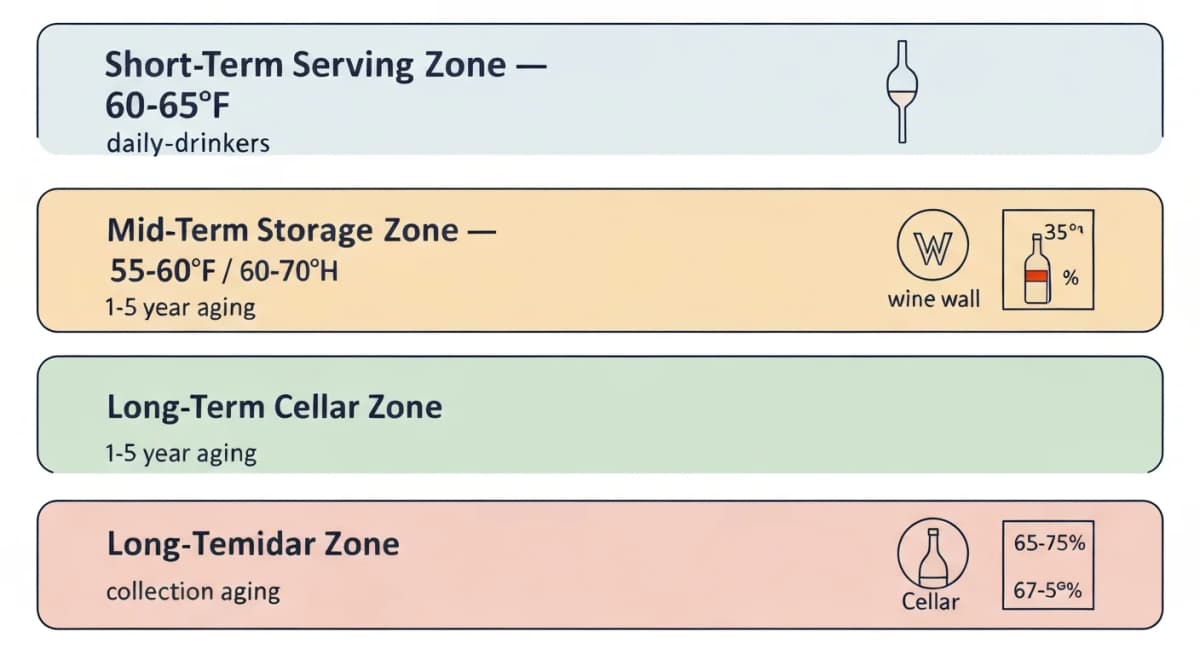
Idaho's Snake River Valley AVA was federally established in 2007 and is now home to dozens of wineries, most of them within an hour of Boise. The region's volcanic soils, warm growing-season days, and cold nights produce serious wines — particularly Bordeaux varietals (Cabernet Sauvignon, Merlot, Cabernet Franc) and Rhône varietals (Syrah, Viognier). Production is small but quality is climbing rapidly, and the wines are increasingly available at Treasure Valley retailers and direct from wineries.
For Boise residents who've gotten into Idaho wine, the typical collection trajectory:
Year 1: 24-48 bottles, mostly current-vintage drinkable wines from regular shopping. A countertop or built-in 24-bottle wine fridge handles this comfortably.
Year 2-3: 60-120 bottles as the collector starts buying special bottles for cellaring, joining wine clubs, and stocking favorite wineries. The 24-bottle fridge becomes inadequate; the collector adds a second fridge or upgrades to a 60-100 bottle unit.
Year 4+: 150-400+ bottles for serious collectors. The fridge approach hits limits; dedicated wine wall, under-counter wine drawer arrays, or cellar conversion becomes the practical answer.
The kitchen remodel design conversation is best positioned when the homeowner has 60-120 bottles and is on the trajectory to 200+. Designing wine storage at this collection size produces a kitchen that supports continued collection growth without requiring re-remodel work later.
Wine collection in Boise faces one specific climate challenge: dry winter air affects cork integrity in ways that humid-market wine cellars don't experience. Indoor relative humidity in Boise winters routinely drops below 25-30%, well below the 60-75% range that's optimal for long-term cork preservation.
The cork-integrity science:
Natural cork (used in most premium wine bottles) maintains a tight seal against the bottle neck through cork's natural elasticity. The seal depends on the cork maintaining proper moisture content — too dry and the cork shrinks, allowing oxygen to enter the bottle and oxidize the wine over time. In high-humidity environments (60%+), cork moisture content stabilizes naturally. In Boise's dry winter air, cork can lose moisture faster than ideal, leading to slow oxidation over years.
The mitigation:
Wine refrigerators with humidity control: Premium wine refrigerators (Sub-Zero, EuroCave, Vinotemp, Marvel) include humidity stabilization features that maintain 60-70% RH inside the unit regardless of ambient conditions. The humidity control adds $200-$600 to the unit cost but is essentially mandatory for serious Boise wine storage.
Bottle orientation: Wines stored horizontally keep the cork in contact with wine, slowing moisture loss. All proper wine storage stores horizontally.
Screw cap or alternative closures: Wines bottled under screw cap or composite alternative closures are immune to the cork-integrity issue. Many Idaho Snake River AVA wineries use alternative closures, partially because of regional climate awareness. For homes without humidity-controlled wine storage, focusing collection on alternative-closure wines is a workable adaptation.
Standalone humidifier in wine area: For dedicated wine walls or cellars in Boise, a small humidifier maintaining the wine-storage zone at 60-70% RH protects cork integrity during winter months. Cost: $100-$300 for a quality unit.
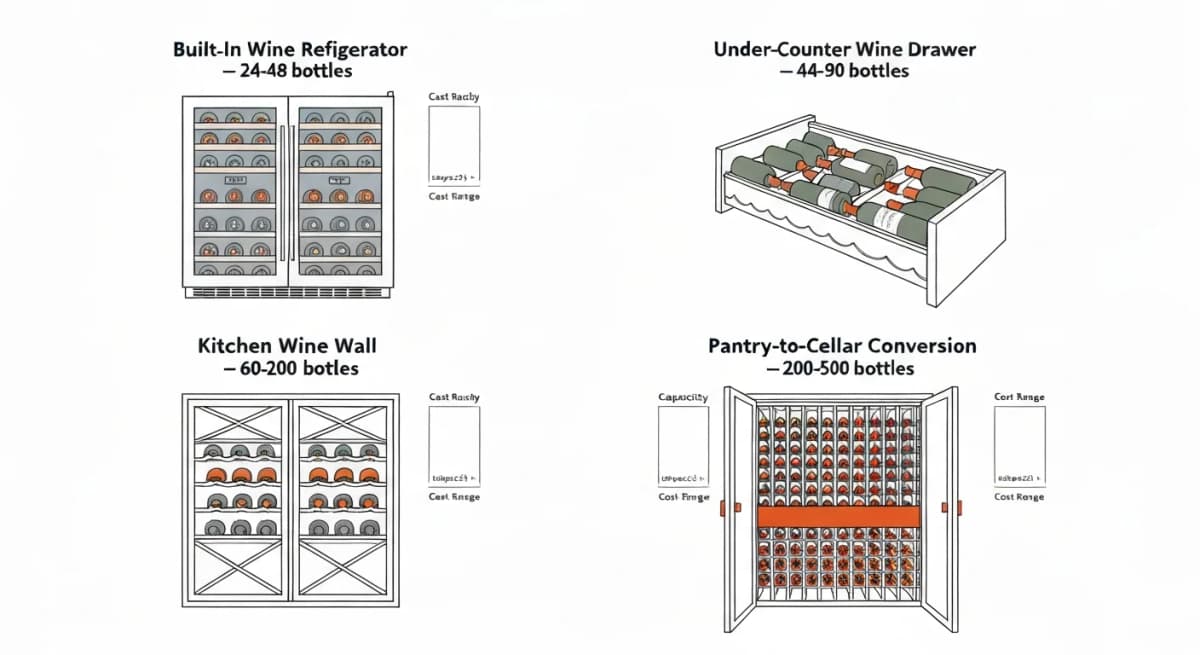
The entry-level kitchen wine storage option: a built-in dual-zone wine refrigerator. Dual-zone units have independent temperature controls for upper and lower compartments, allowing the upper zone for whites and Champagne (40-45°F serving temperature) and the lower zone for reds (55-60°F drinking temperature).
Typical specifications:
Capacity: 24-44 bottles depending on unit. The 24-bottle and 30-bottle units fit standard 24-inch undercounter cabinetry; the 44-bottle units require 30-inch openings.
Dimensions: 24 inches wide × 24 inches deep × 34 inches tall for the 24-bottle units (standard undercounter height). 30 inches wide × 24 inches deep × 34 inches tall for 44-bottle units.
Cost: $1,200-$3,000 for the unit + $200-$500 for installation (water line if humidity-stabilized, electrical rough-in for a dedicated 120V outlet, drainage tie-in if applicable).
Brands worth considering: Sub-Zero (premium, $2,500-$5,000 for built-in 24-bottle), EuroCave (premium, similar pricing), Marvel (mid-premium, $1,800-$3,200), KitchenAid (mid-range, $1,200-$2,000), and various manufacturer alternatives at $800-$1,500 for budget-tier units.
For Boise wine collectors at the 24-48 bottle stage, a built-in dual-zone wine fridge is the right kitchen integration. It fits cleanly into typical kitchen design, provides proper temperature and (in premium units) humidity control, and produces a tidy aesthetic that doesn't distract from the kitchen's primary design language.
For collectors at the 60-120 bottle stage who want more capacity than a wine fridge but less than a wine wall, under-counter wine drawers are an emerging option. These are essentially dual-zone wine refrigerators in a drawer form factor — typically 24-30 inches wide, 24 inches deep, 34 inches tall, with the drawer mechanism allowing pull-out access to individual bottle slots.
Specifications:
Capacity: 44-60 bottles depending on configuration. Some manufacturers offer 90-bottle units in 36-inch widths.
Access: Drawer pulls out fully, displaying all bottles at once for selection. Better visibility than rack-style fridges.
Cost: $2,500-$5,500 for the unit + $400-$700 installation. Premium options (Sub-Zero, EuroCave) at the upper end; mid-tier (KitchenAid, GE Profile) at the lower.
Limitation: Less efficient temperature distribution than rack-style units (drawer mechanism creates slight thermal stratification). Higher capacity but lower efficiency per cubic inch.
For Boise kitchens that want more wine capacity than a wine fridge, two drawer units can be stacked vertically (one above the other) or run horizontally as a unit-pair, producing 88-120 bottles of integrated storage. The aesthetic and capacity sweet spot for collectors in the 80-150 bottle range.
Design kitchen wine storage that scales with your Snake River AVA collection
Wine storage integration into your kitchen remodel should match your actual collection trajectory, not a one-size template. Schedule a consultation and we'll model the right approach for your bottle count, drinking patterns, and budget.
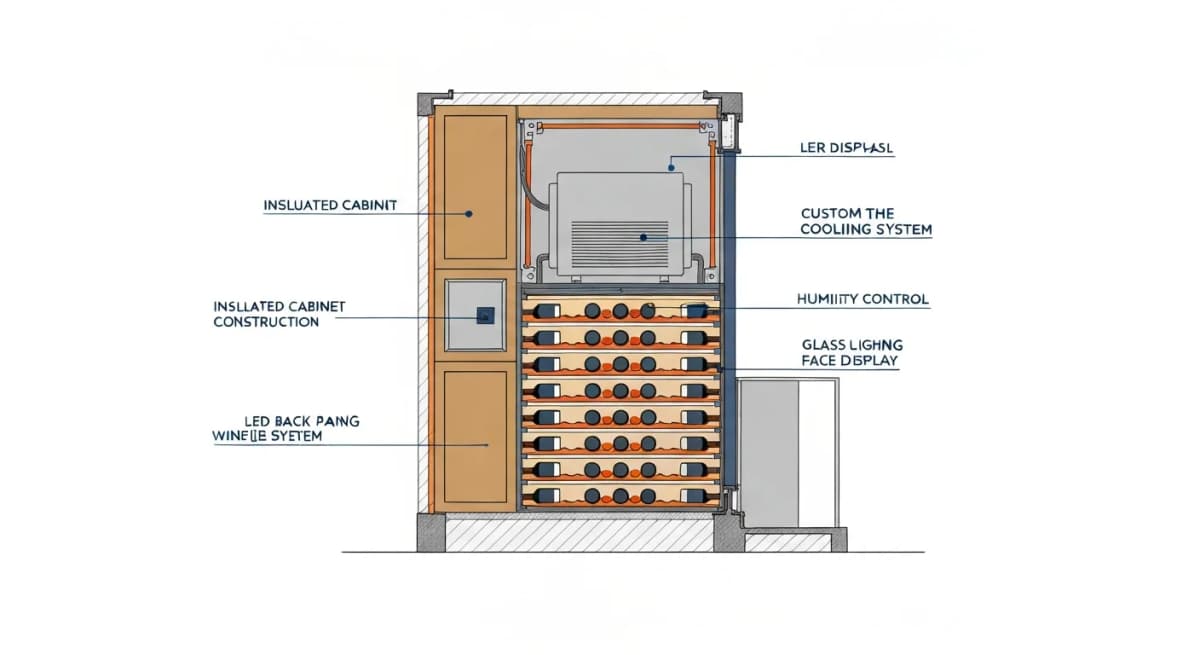
For collectors at the 150-300 bottle stage with kitchen space for a dedicated wine wall, this approach creates a climate-controlled wine display integrated into the kitchen design. The wine wall is essentially a custom-cabinet wine refrigerator with a glass face that doubles as a kitchen design feature.
Specifications:
Capacity: 60-200 bottles depending on width (typically 36-72 inches wide × 24 deep × 72-96 tall).
Components: Insulated cabinet construction, dedicated cooling unit (typically Whisperkool or similar 1/4 to 1/2 HP units), custom wood or metal racking, LED lighting, glass face for display, humidity control system, vibration isolation for proper aging.
Cost: $5,500-$15,000 for the wall installation depending on size, racking quality, and finish level. Premium installations (custom hardwood racking, integrated cabinetry that matches the kitchen) at the upper end; basic installations (metal racking, factory cabinets) at the lower.
The aesthetic benefit is meaningful: a wine wall reads as a serious design feature in the kitchen, signaling the homeowner's relationship with wine. The functional benefit: proper temperature and humidity control for collection-level storage in a footprint that fits typical Boise master kitchens.
The trade-off: wine walls consume kitchen wall space that could otherwise be cabinetry, pantry, or open counter. The decision is whether the wine collection is enough of a priority to justify the wall allocation.
For serious collectors at the 300+ bottle stage, converting an existing walk-in pantry to a wine cellar produces dedicated storage at scale. The conversion happens during the kitchen remodel scope and integrates with the kitchen design while creating an enclosed climate-controlled cellar space.
Conversion scope:
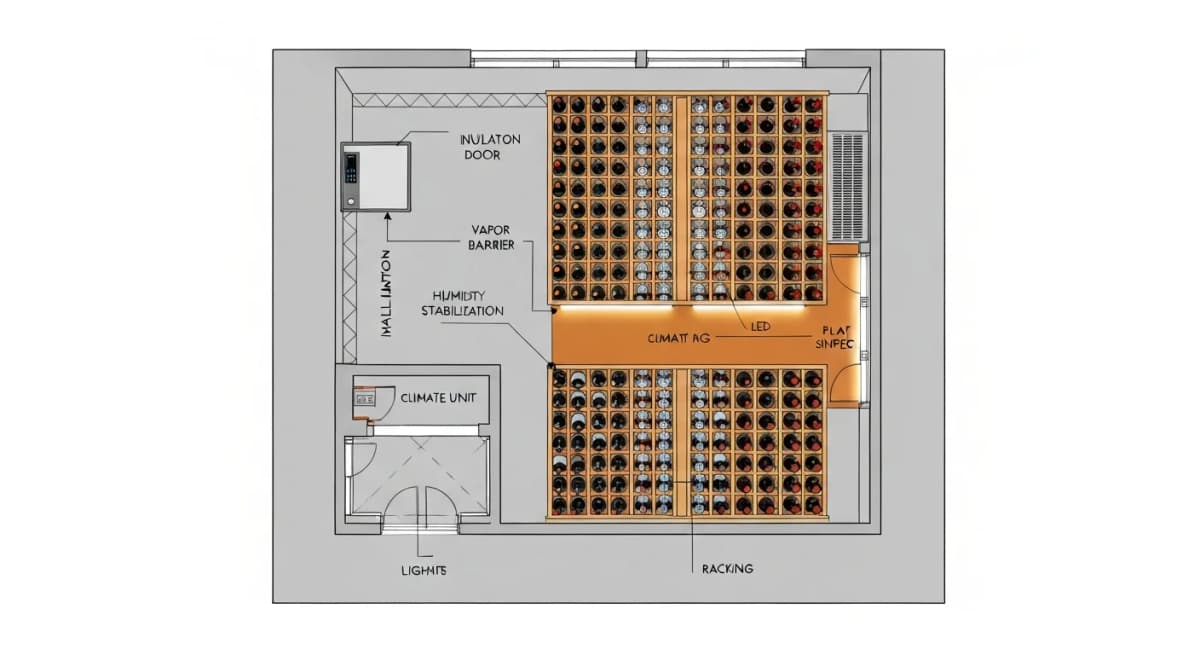
Insulation: Walls, ceiling, and floor of the pantry get insulated (typically R-19 walls, R-30 ceiling) to maintain stable temperature regardless of kitchen ambient changes. Cost: $1,500-$3,500.
Vapor barrier: Continuous polyethylene barrier or sprayed-in-place vapor barrier prevents moisture exchange with the kitchen, supporting the cellar's higher humidity setpoint. Cost: $300-$700.
Cooling unit: Cellar-specific cooling system (Whisperkool, Wine Guardian, or similar) sized for the cellar volume. Typical 1/3 HP units handle 150-250 sq ft cellars. Cost: $1,500-$3,500 for the unit + $400-$800 installation.
Humidity control: Integrated humidifier maintains 65-75% RH in the cellar. Critical for Boise's dry climate. Cost: $300-$800.
Custom racking: Wood or metal racking systems sized for the cellar capacity. Custom hardwood (mahogany, redwood) at $40-$80 per bottle slot for installation; modular metal at $15-$30 per bottle.
Door: Insulated cellar door with proper weatherstripping. Custom doors at $1,500-$4,500; pre-fab cellar doors at $800-$2,000.
Lighting: LED-only (UV emissions from incandescent and fluorescent damage wine over years). Cost: $300-$800.
Total conversion cost: $7,000-$18,000 depending on cellar size and finish quality. Significant addition to a kitchen remodel scope but transforms an underutilized walk-in pantry into a serious wine collection asset.
For Boise homes considering serious wine storage, a key decision is whether to integrate storage into the kitchen itself or create dedicated storage in an adjacent space (pantry, mudroom, basement adjacent to the kitchen).
Kitchen-integrated approaches (options 1, 2, 3 above) put the wine where the homeowner is cooking and entertaining. The bottle selection happens during meal preparation; the visibility supports impromptu wine-by-the-glass moments with guests. Capacity is limited to the kitchen wall and cabinet footprint.
Adjacent-space approaches (cellar conversion, dedicated mudroom wine storage, basement cellar accessed from the kitchen) put wine in dedicated space with maximum capacity. The selection requires a trip from the kitchen — minor friction for daily use but acceptable for a serious collection.
The honest math for most Boise wine collectors:
Under 60 bottles: Single kitchen-integrated wine fridge is the right answer.
60-150 bottles: Kitchen-integrated wine drawer or small wine wall + secondary location for overflow (mudroom, pantry).
150-300 bottles: Larger kitchen wine wall (in the 100-200 bottle range) + dedicated cellar conversion for the long-term aging portion of the collection.
300+ bottles: Smaller kitchen-integrated storage for serving bottles (40-60 bottles) + significant cellar conversion for the long-term collection.
The split approach (serving storage in kitchen + aging storage in dedicated cellar) works well because the two zones have different functional requirements. Serving wine needs immediate access and presentability. Aging wine needs strict climate control and minimal disturbance. Trying to serve both functions in a single storage system creates compromises that the split approach avoids.
Boise's proximity to Snake River AVA changes the wine storage conversation in a few specific ways:
Direct-from-winery purchases: Snake River AVA wineries (Sawtooth Estate, Cinder, 3 Horse Ranch, Koenig, Fujishin, etc.) sell direct to consumers from tasting rooms. The buying patterns include larger-quantity case purchases (typically $200-$500 per case) and wine club memberships that ship 4-12 bottles quarterly. The collection grows in case quantities, which means storage needs to scale in 12-bottle increments rather than 1-bottle additions.
Idaho wine drinking patterns: Snake River AVA wines tend toward Bordeaux and Rhône-style reds that benefit from medium-term aging (3-8 years). That pushes most local collections red-heavy, which matters because reds and whites want different storage temperatures. Temperature requirements: red drinking temperature 60-65°F, red cellaring temperature 55-58°F. White drinking temperature 45-55°F, white cellaring temperature 50-55°F. Dual-zone storage that handles both is essential.
Seasonal patterns: Snake River AVA vintage releases happen in spring (May-June for whites, August-November for reds depending on style). Direct purchases concentrate in those months, so a collection that fits comfortably in February can overflow in June. Size the storage for the post-release peak, not the annual average.
Regional networking: Boise hosts wine clubs (Idaho Wine Club, local restaurant sommelier events), wine tastings, and the annual Idaho Wine Festival. These events generate additional purchases and connection with other Boise collectors. The social dimension of wine collecting in Boise is more active than in many similar-sized markets.
For Boise homeowners building wine storage that supports active Snake River AVA collection, the design should account for: case-quantity intake (12-bottle additions, not single bottles), seasonal release peaks (storage capacity to handle 30-50% growth during release months), and the social dimension (serving-wine visibility and access for entertaining).
Iron Crest's wine storage design conversations start by asking about the collection: current bottle count, growth trajectory, drinking vs cellaring patterns, and the importance of visibility vs capacity. The answers shape the right integration choice. A casual collector with 30 bottles and no growth trajectory gets a quality built-in wine fridge as part of the kitchen scope. A serious collector with 200+ bottles and active Snake River AVA collection gets a kitchen wine wall plus a cellar conversion. Most Boise collectors fall in between, requiring some hybrid approach.
The wine storage scope typically runs $1,500-$15,000 depending on configuration — small relative to a full kitchen remodel ($45–$70k typical), but meaningful as a kitchen design feature. For wine enthusiasts, the function justifies the spec. For broader kitchen remodel context including wine storage integration, see how we run kitchen remodeling in Boise and our kitchen storage solutions guide.
Does Boise's altitude affect wine storage requirements?
Modestly yes. At 2,700 feet elevation, atmospheric pressure is roughly 91% of sea level. This affects wine in two minor ways: cork pressure equilibrium happens slightly slower at altitude (wines benefit from a longer rest period before drinking after shipment, particularly bottles shipped from sea-level distribution centers); and altitude affects perception of wine flavors slightly (some perceived tannins read differently at altitude). Neither significantly affects storage design — temperature and humidity remain the primary considerations. Storage at Boise's elevation is functionally equivalent to storage at any altitude below 5,000 feet.
Can I use a regular refrigerator for wine storage instead of a wine fridge?
Short-term yes, long-term no. Regular refrigerators run at 35-40°F — much too cold for wine drinking temperature and meaningfully too cold for long-term storage (cold accelerates certain chemical reactions in wine and dulls flavor perception). Regular refrigerators are also too dry for corks and carry food odors, both of which can affect cork integrity and wine aroma over time. For under-2-week storage of bottles you'll drink soon, a regular refrigerator works. For longer-term storage, a wine refrigerator or proper cellar is necessary. The temperature differential between drinking temp and refrigerator temp also makes it impractical to use a regular fridge as serving storage — you'd need to remove bottles 1-2 hours before serving to let them warm to proper temperature.
What's the lifespan of a wine refrigerator in Boise's hard water?
Wine refrigerators don't typically interact with hard water directly because most don't include ice makers or water dispensers. The hard water concern primarily affects appliances that heat or process water; wine fridges only cool. Wine fridge compressor and electronics lifespan is approximately 8-12 years for premium units (Sub-Zero, EuroCave, Marvel), 5-8 years for mid-tier units, and 4-7 years for budget tier. The wear modes are compressor failure, control board electronics failure, and door seal degradation. Routine maintenance includes cleaning the condenser coils (annually), checking the door seal, and ensuring proper ventilation around the unit. Wine fridges with ice makers have hard-water concerns similar to standard kitchens; that integration is unusual for serious wine storage applications.
Are walk-in wine cellars typically a basement feature in Boise homes?
Often but not exclusively. Basements in Boise homes typically run cooler year-round than living areas (10-15°F lower in summer) and are easier to climate-control because the surrounding earth provides thermal mass and humidity stability. Basement cellars in 1990s-2000s Boise homes are common in custom builds. For pre-1990 Boise homes without basements, walk-in pantry conversions to cellars (as detailed in this article) are the practical alternative. For modern construction with finished basements, dedicated cellar zones can be planned during construction. The cost difference between basement and main-floor cellar is modest because the conversion scope (insulation, vapor barrier, cooling) is similar regardless of location.
Does kitchen wine storage affect home resale value in the Treasure Valley?
Modestly positive in the upscale segment, neutral elsewhere. For homes priced above $700k (Eagle, Harris Ranch, foothills), serious wine storage signals the home was designed for entertaining and reads as a positive feature. For mid-range homes ($400-$700k), wine storage is moderately positive — appeals to wine-interested buyers but doesn't drive measurable list-price premium. For homes under $400k, wine walls and cellars can read as 'over-improved' and sometimes raise buyer questions about ongoing climate-control costs. The honest install rationale: wine storage should be a homeowner-use decision based on actual collection size, not a resale ROI play. For households with active wine collections, the storage adds livability; for households without, it doesn't.
Are there Snake River AVA wineries that ship to Boise residents?
Most Snake River AVA wineries sell direct to consumers including local Boise residents. Direct shipping to Idaho residents is permitted under Idaho law for wineries with appropriate licenses. Major Snake River AVA wineries (Sawtooth Estate, Cinder Wines, Koenig Vineyards, 3 Horse Ranch Vineyards, Fujishin Family Cellars, and others) have either tasting room sales or wine club programs that ship quarterly. The wineries are clustered between Caldwell, Marsing, and Nampa — a 30–45 minute drive from Boise for in-person visits. The Idaho Wine Commission maintains a directory of all licensed wineries.
Design kitchen wine storage that scales with your Snake River AVA collection
Wine storage integration into your kitchen remodel should match your actual collection trajectory, not a one-size template. Schedule a consultation and we'll model the right approach for your bottle count, drinking patterns, and budget.
These pages go deeper on the topics linked from this article. Read them before your consultation and you'll come in with sharper questions and a clearer scope.
The following government agencies, industry organizations, and official resources provide additional information relevant to your remodeling project.