
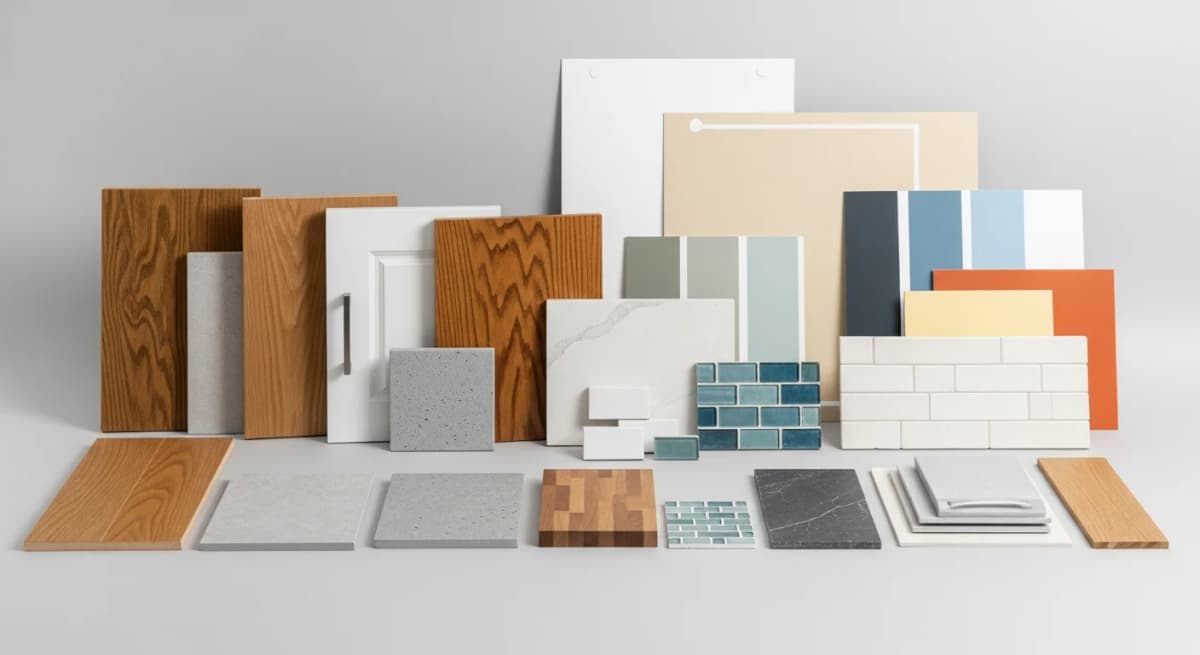
ADU Construction Materials Guide
A comprehensive guide to every material decision in your accessory dwelling unit build — from foundation and framing to finishes and smart upgrades — with Boise-specific pricing, code requirements, and product recommendations.
The foundation is the most critical structural decision in your ADU build. Boise's frost line sits at 24 inches, meaning all footings must extend to that depth regardless of foundation type. The Treasure Valley's soil conditions — ranging from sandy loam in West Boise to clay-heavy in parts of Meridian and Nampa — also influence foundation design and material choices.
Concrete Slab on Grade
Most Popular for ADUs
$7 - $12
Per square foot, including footings
Specification
4-inch minimum slab thickness with 4,000 PSI concrete (standard for residential in Boise). Thickened edge footings extending 24 inches below grade to meet frost line requirements. 6x6 W2.9/W2.9 welded wire reinforcement or #4 rebar at 18-inch centers. 10-mil polyethylene vapor barrier over 4 inches of compacted gravel base.
Vapor Barrier Considerations
Boise's high water table areas — particularly near the Boise River, Garden City, and parts of South Boise — require a robust vapor barrier. Standard 10-mil poly is adequate for most lots, but high-water-table sites benefit from 15-mil or Stego Wrap for superior moisture protection.
Best For
The majority of detached ADU builds. Cost-effective, fast to pour, and compatible with radiant floor heating. Slab-on-grade eliminates crawlspace moisture issues common in the Treasure Valley.
Crawlspace Foundation
$10 - $18
Per square foot, including footings & stem walls
Specification
Continuous poured concrete stem walls on 36-inch-deep footings, 18 to 24 inches of clearance minimum. Vented or conditioned crawlspace options. Requires a 6-mil ground cover vapor barrier. Stem walls typically 8 inches wide with #4 rebar reinforcement at 48-inch centers vertically and horizontally.
Advantages
Provides accessible space for plumbing, HVAC ductwork, and electrical runs. Easier to repair or modify mechanical systems after construction. Raises the living floor, which can improve flood protection on lower-lying Boise lots.
Best For
ADU builds on sloped lots (common in Boise's foothills and North End), sites where utility connections require under-floor routing, and homeowners who want future access to mechanical systems.
ICF Foundation
$12 - $20
Per square foot, 10-20% premium over poured
Specification
Insulated Concrete Forms (ICF) use interlocking expanded polystyrene (EPS) blocks that stay in place as permanent insulation after concrete is poured inside. Typical R-value of R-23 to R-26 for the foundation wall assembly. Brands like Fox Blocks and Nudura are available through Boise-area distributors.
Energy Performance
ICF foundations eliminate thermal bridging and reduce heating costs by 20-30% compared to standard poured concrete with exterior foam. Combined with a well-insulated above-grade envelope, an ICF foundation can contribute to meeting net-zero energy targets for ADUs — increasingly popular with Boise homeowners investing in long-term energy savings.
Best For
Energy-conscious homeowners, ADUs designed as long-term rental income properties where lower utility costs improve ROI, and builds where the foundation extends above grade (walkout or daylight basement ADU configurations).
Framing defines the skeleton of your ADU and directly impacts construction timeline, insulation options, and structural performance. Boise's building code requires framing systems to handle 30 PSF ground snow loads and 85 MPH wind speeds — standard for the Treasure Valley but important when selecting materials and engineering.
Stick-Built (Conventional Lumber)
$12 - $22 / sq ft framed
Standard 2x6 exterior wall framing at 16-inch centers is the default for Boise ADU construction. Allows R-21 batt insulation in wall cavities. Boise lumber prices in 2026 have stabilized from the pandemic-era spikes, with SPF (spruce-pine-fir) 2x6 studs running $5.50 to $7.50 per stud and LVL beams at $3.50 to $5.00 per lineal foot. Stick-built offers maximum flexibility for custom floor plans, is well-understood by every framing crew in the valley, and supports the widest range of insulation strategies. On-site framing typically takes 5 to 10 days for a 600-800 square foot ADU.
Best for: The majority of Boise ADU builds. Best value, broadest contractor availability, and maximum design flexibility for custom floor plans and roof lines.
SIPs (Structural Insulated Panels)
$14 - $28 / sq ft panelized
Factory-manufactured sandwich panels with OSB skins bonded to a rigid EPS or polyurethane foam core. SIPs deliver R-24 to R-40 wall assemblies depending on panel thickness (4.5-inch to 8.25-inch panels). Panels arrive pre-cut to your floor plan, reducing framing time by 50% and significantly reducing waste. SIPs create an exceptionally tight building envelope, often achieving 1.0 ACH50 or better on blower door tests. The superior air sealing and insulation translate to meaningfully lower heating and cooling costs over the life of the ADU — important for Boise's hot summers and cold winters.
Best for: Energy-focused ADU builds, homeowners targeting high-performance or net-zero construction, and projects where minimizing on-site construction time is a priority.
Steel Frame
$18 - $35 / sq ft framed
Light-gauge steel framing uses C-shaped steel studs and tracks in place of dimensional lumber. Steel is non-combustible, dimensionally stable (no warping, twisting, or shrinking), and immune to termite and rot damage. However, steel framing creates significant thermal bridges that must be addressed with continuous exterior insulation, and most Boise residential framing crews are not experienced with steel construction. Fastening drywall, cabinets, and trim to steel studs requires different techniques and screws.
Best for: Commercial-style ADU builds, projects in wildfire-prone areas near the Boise foothills, and situations where non-combustible construction is required or preferred.
Engineered Lumber for Open Floor Plans
ADU floor plans often demand open living areas within compact footprints, which requires longer spans than dimensional lumber can handle. Engineered lumber products solve this problem and are standard in Boise ADU construction:
LVL Beams (Laminated Veneer Lumber)
$3.50 - $5.00 per lineal foot. Used for headers over large windows and doors, and ridge beams in vaulted ceilings. Can span 20+ feet depending on depth. Consistent strength without the knots and defects found in solid lumber.
I-Joists (TJI)
$3.00 - $4.50 per lineal foot. Engineered floor joists that span longer distances with less depth than dimensional lumber. Available in 9.5-inch to 16-inch depths. Pre-punched knockouts allow easy routing of plumbing and HVAC within the floor system.
Glulam Beams
$6.00 - $12.00 per lineal foot. Laminated beams for exposed structural applications. Popular in mountain-modern ADU designs where the beam is left exposed as a design element. Available in stock sizes from Boise Cascade and other regional suppliers.
The exterior envelope — siding, roofing, and weather-resistive barrier — protects your ADU from Boise's temperature extremes, UV exposure, wind-driven rain, and occasional wildfire smoke. Material choices here affect both curb appeal (often required to match or complement the main house) and long-term maintenance costs.
Siding Options
LP SmartSide
$4 - $8 / sq ft installed
Pros
- Excellent impact resistance
- Lightweight, easy to cut and install
- Treated for termites and fungal decay
- Available in lap, panel, and board-and-batten
Cons
- Requires painting (not pre-finished)
- Wood-composite can swell if cut edges unsealed
- Not fireproof (Class C fire rating)
Boise note: LP SmartSide is the most popular siding for Boise ADUs due to its balance of cost, aesthetics, and durability. Its engineered wood substrate handles Idaho's dry climate without the cracking issues that plague natural wood siding.
HardiePlank (Fiber Cement)
$6 - $12 / sq ft installed
Pros
- Non-combustible (Class A fire rating)
- Immune to rot, termites, and woodpeckers
- ColorPlus factory finish with 13-year warranty
- 50-year product warranty
Cons
- Heavier — requires more labor to install
- Higher material and installation cost
- Can crack if nailed improperly
Boise note: HardiePlank is the premium choice for ADUs near the foothills where wildfire risk is a concern. Its Class A fire rating provides peace of mind, and the ColorPlus factory finish eliminates the need for on-site painting.
Vinyl Siding
$3 - $6 / sq ft installed
Pros
- Lowest cost siding option
- Never needs painting
- Fast installation
- Wide color selection
Cons
- Can become brittle in extreme cold
- Lower perceived quality and resale impact
- Can warp or melt near heat sources
Boise note: Vinyl is the budget option for ADU builds, but many Boise neighborhoods and HOAs require the ADU's exterior to match the main house. If the main house uses LP SmartSide or fiber cement, vinyl on the ADU may not be permitted.
Board-and-Batten
$6 - $14 / sq ft installed
Pros
- Modern farmhouse aesthetic
- Works as full exterior or accent element
- Vertical lines add visual height to small ADUs
- Available in LP SmartSide and fiber cement
Cons
- More material and labor than lap siding
- More caulk joints to maintain
- Higher cost per square foot
Boise note: Board-and-batten is trending strongly in new Boise construction and is the most requested ADU siding style for modern farmhouse and contemporary designs. Often combined with horizontal lap siding on the front elevation for visual variety.
Roofing Materials
Architectural Shingles
$4 - $7 / sq ft installed
Dimensional asphalt shingles with a layered, textured appearance that mimics natural slate or cedar shake. 30 to 50-year warranties depending on brand and product line. GAF Timberline HDZ and CertainTeed Landmark are the most common in the Boise market. Class A fire rated and rated for 130 MPH wind uplift.
Boise consideration: Architectural shingles are the standard roofing material for Boise residential construction. Choose lighter colors (weathered wood, slate, pewter gray) to reflect heat during Boise's 105°F summer peaks and reduce cooling costs.
Standing Seam Metal
$10 - $18 / sq ft installed
26-gauge or 24-gauge steel panels with concealed fasteners and raised seams. 50+ year lifespan with minimal maintenance. Excellent for snow shedding, which reduces structural snow load concerns. Reflects solar radiation more effectively than asphalt, reducing summer cooling costs by 10-25%. Available in 30+ colors from local suppliers like Idaho Sheet Metal and Treasure Valley Steel.
Boise consideration: Metal roofing is increasingly popular for Boise ADUs, especially contemporary and mountain-modern designs. The higher upfront cost pays back through longevity and lower maintenance. Ideal for low-slope roof designs common in modern ADU architecture.
House Wrap & WRB
The weather-resistive barrier (WRB) is the critical layer between your sheathing and siding that prevents bulk water intrusion while allowing moisture vapor to escape the wall assembly. For Boise ADU construction, the three main options are:
Tyvek HomeWrap
$0.50 - $0.75 / sq ft. The industry standard. Mechanically fastened with cap nails or staples, with all seams taped using Tyvek tape. Adequate for most Boise ADU builds with lap siding or shingle siding.
ZIP System Sheathing
$1.50 - $2.50 / sq ft (sheathing + tape). Integrated WRB built into the OSB sheathing panel. Seams sealed with ZIP tape for a continuous air and water barrier. Faster installation and fewer steps than separate sheathing plus house wrap. Our preferred WRB system for ADU builds.
Henry Blueskin VP100
$1.00 - $1.75 / sq ft. Self-adhered membrane that bonds directly to sheathing. Superior air sealing and water protection. Used on high-performance and premium ADU builds where maximum envelope protection is the priority.
Boise sits in IECC Climate Zone 5, which imposes strict insulation and air sealing requirements for new construction — including ADUs. These are not optional minimums; they are code requirements that must be met to pass final inspection and receive a certificate of occupancy.
Boise Zone 5 Code Minimums (2021 IECC)
R-20
Exterior Walls (continuous) or R-13 + R-5ci
R-49
Attic / Ceiling Assembly
R-30
Floors Over Unconditioned Space
3 ACH50
Maximum Air Leakage (Blower Door Test)
Spray Foam Insulation
Closed-Cell ($1.50 - $2.50 / sq ft / inch)
R-6.5 to R-7.0 per inch. Acts as both insulation and air/vapor barrier. 2 inches of closed-cell in a 2x6 wall cavity plus batt fill achieves R-30+ wall assemblies that far exceed code. Adds structural rigidity to the wall assembly. The premium option for Boise ADU builds.
Open-Cell ($0.75 - $1.25 / sq ft / inch)
R-3.5 to R-3.8 per inch. Fills cavities completely for excellent air sealing but is vapor-permeable and requires a separate vapor retarder in Climate Zone 5. More affordable than closed-cell but requires full cavity fill to achieve comparable R-values.
Batt Insulation
Fiberglass Batts ($0.50 - $1.00 / sq ft)
R-21 in 2x6 walls (5.5 inches). The most cost-effective wall insulation. Requires careful installation to avoid gaps, compression, and voids that reduce performance. Must be paired with a separate air barrier strategy (sealed drywall approach or continuous exterior air barrier) to meet the 3 ACH50 requirement.
Mineral Wool Batts ($1.00 - $1.75 / sq ft)
R-23 in 2x6 walls. Denser and more rigid than fiberglass, making it easier to install without compression. Naturally fire-resistant (withstands temperatures above 2,000°F) and provides better sound attenuation. Rockwool ComfortBatt is the most common brand in the Boise market.
Blown-In Insulation
Cellulose ($0.75 - $1.25 / sq ft)
Made from recycled newspaper treated with borate fire retardant. Dense-packed cellulose in wall cavities provides R-3.5 per inch with excellent air sealing properties. The most common attic insulation in Boise, achieving R-49 at approximately 14 inches of depth. Cost-effective for large attic areas.
Fiberglass Blown-In ($0.60 - $1.00 / sq ft)
Loose-fill fiberglass for attic applications. R-2.5 per inch, requiring approximately 19 inches to achieve R-49. Lighter than cellulose and does not settle as much over time, but provides less air sealing than dense-packed cellulose.
Idaho Power Rebate Programs
Idaho Power offers rebates for new construction that exceeds minimum energy code requirements. For ADU builds, the most relevant programs include:
- Above-code insulation rebate: $0.10 - $0.20 per square foot of conditioned floor area for exceeding wall, ceiling, or floor insulation minimums by 20% or more.
- High-performance window rebate: $2.00 - $4.00 per window for ENERGY STAR Most Efficient rated windows (U-factor ≤0.20).
- Heat pump rebate: Up to $800 for qualifying ductless mini-split heat pumps (HSPF2 ≥10.0, SEER2 ≥16.0), the most common HVAC system for Boise ADUs.
- Air sealing verification: Bonus incentive for achieving 2.0 ACH50 or better on the blower door test (code requires 3.0 ACH50).
Windows and doors are the weakest thermal link in any building envelope. Boise's energy code requires a U-factor of 0.30 or lower for all fenestration in new construction, including ADUs. Beyond code compliance, strategic window selection balances natural light, solar heat gain, privacy, and energy performance.
Window Performance Requirements
U-Factor: 0.30 or Lower (Code Minimum)
U-factor measures heat transfer through the window assembly. Lower is better. Standard double-pane low-E windows meet the 0.30 threshold. Triple-pane windows achieve U-factors of 0.18 to 0.22 for significantly better performance, but at 40-60% higher cost. For most Boise ADU budgets, quality double-pane low-E is the sweet spot.
SHGC (Solar Heat Gain Coefficient)
SHGC measures how much solar radiation passes through the window. For Boise ADUs, we recommend a strategic approach by exposure: south-facing windows should use SHGC of 0.25 to 0.40 to capture beneficial winter solar heat gain while limiting summer overheating. North-facing windows should use SHGC of 0.25 or lower since solar gain is minimal. East and west-facing windows benefit from lower SHGC (0.25) to reduce morning and afternoon heat gain during Boise's hot summers.
Frame Material Options
Vinyl Frames ($300 - $600 / window installed)
The most cost-effective option for ADU budgets. Modern vinyl frames offer good thermal performance, require zero maintenance, and are available in white and limited color options. Multi-chamber vinyl extrusions from brands like Milgard, Simonton, and PlyGem provide adequate structural rigidity for standard window sizes. The clear choice for budget-conscious ADU builds.
Fiberglass Frames ($500 - $900 / window installed)
Superior structural rigidity, minimal expansion and contraction with temperature changes, and a more refined appearance than vinyl. Pultruded fiberglass frames from Marvin, Pella, and Andersen are paintable and available in more color and profile options. Better longevity than vinyl, with 40+ year expected life spans. Worth the premium for owner-occupied ADUs.
Entry Doors & ADA Considerations
Fiberglass Entry Door ($400 - $1,200)
Our recommended entry door material for ADUs. Fiberglass does not warp, rot, or rust, and provides excellent insulation (R-5 to R-8). Available in smooth or woodgrain finishes that mimic real wood. Multi-point locking systems are standard for security. Weather-sealed threshold assemblies prevent air infiltration.
Steel Entry Door ($250 - $800)
The most secure and affordable entry door option. Foam-core insulation provides R-5 to R-6. Durable and low-maintenance, but can dent and may show wear at high-use touch points over time. Best for rental ADUs where security and cost are the primary concerns.
ADA & Accessibility
While not required for all ADUs, many Boise homeowners building ADUs for aging parents or future accessibility choose 36-inch-wide entry doors (32-inch clear opening), lever-style handles, low-threshold entries, and ADA-compliant deadbolts. These features add minimal cost during construction but are expensive to retrofit.
ADU fixture selection is unique because you are often choosing between two strategies: rental-grade materials that prioritize durability and cost-effectiveness, or owner-grade finishes for a personal living space. Boise's hard water (up to ~13 grains per gallon; ~6 average) adds another consideration — fixture finishes must withstand mineral deposits.
Rental-Grade Selections
Durability + Value Focus
Kitchen Faucet: Moen Adler or Delta Foundations ($80 - $150)
Brushed nickel finish hides water spots from Boise's hard water. Single-handle pull-down spray design. Lifetime limited warranty from both manufacturers. Brushed nickel resists fingerprints and mineral buildup far better than chrome or matte black.
Kitchen Sink: Stainless Steel Undermount ($200 - $350)
Single-bowl, 18-gauge stainless. Easy to clean, durable, and inexpensive to replace if a future tenant damages it. Sound-dampening pads reduce noise.
Bathroom Fixtures: Glacier Bay or Project Source ($50 - $100 each)
Basic brushed nickel faucets, standard toilet (1.28 GPF WaterSense), and a 36-inch fiberglass shower/tub combo. Functional, code-compliant, and easily replaced if needed.
Countertops: Laminate or Builder-Grade Quartz ($15 - $40 / sq ft)
Modern laminate in stone patterns or entry-level quartz (Silestone, Allen + Roth). Both resist Boise's hard water deposits and clean easily.
Compact Appliances
24-inch refrigerator, 24-inch range, and 18-inch dishwasher for ADU-scale kitchens. Whirlpool and Frigidaire offer the best value in this size category. Budget $2,000 - $3,500 for a complete compact appliance suite.
Total Rental-Grade Fixture Budget:
$15,000 - $25,000
For a 600-800 sq ft ADU kitchen + bathroom
Owner-Grade Selections
Style + Performance Focus
Kitchen Faucet: Kohler Artifacts or Brizo Litze ($300 - $600)
Matte black or brushed gold finishes for a designer look. Touchless or touch-activated operation. PVD finishes that resist scratching and tarnishing. Note: matte black shows hard water spots more readily — consider installing a water softener if choosing dark finishes in Boise.
Kitchen Sink: Composite Granite or Fireclay ($400 - $900)
Blanco Silgranit or Kohler Whitehaven farmhouse sink for a statement piece. Heat resistant, scratch resistant, and available in colors that complement the countertop.
Bathroom Fixtures: Kohler or Delta Select ($200 - $500 each)
Coordinated suite in brushed gold, matte black, or polished nickel. Comfort-height toilet (17-inch seat), frameless glass shower enclosure, and wall-mounted vanity with undermount sink.
Countertops: Mid-Range Quartz or Natural Stone ($50 - $100 / sq ft)
Cambria, Caesarstone, or MSI quartz in marble-look or concrete-look patterns. Non-porous, zero-maintenance, and immune to Boise's hard water staining.
Full-Size Appliances
30-inch range, counter-depth refrigerator, and standard 24-inch dishwasher. KitchenAid, Bosch, and GE Profile offer the best combination of performance and value. Budget $5,000 - $8,000 for a complete mid-range suite.
Total Owner-Grade Fixture Budget:
$25,000 - $45,000
For a 600-800 sq ft ADU kitchen + bathroom
Hard Water Tip: Boise's municipal water averages about 6 grains per gallon (moderately hard; harder in well-fed zones). If your ADU will have its own water softener, you can confidently choose any fixture finish including matte black and polished chrome. Without softening, stick to brushed nickel or brushed gold finishes that naturally mask mineral deposits.
ADU flooring must balance durability, moisture resistance, comfort, and cost — often in a compact space where a single flooring choice may run through most of the unit. The right selection depends on whether the ADU will serve as a rental unit, guest house, or owner suite.
Luxury Vinyl Plank (LVP)
$3 - $8 / sq ft installed
Pros
- 100% waterproof — ideal for open floor plans
- Scratch and dent resistant (20-mil+ wear layer)
- Click-lock installation over concrete slab
- Unaffected by Idaho's low humidity
Cons
- Cannot be refinished
- Can dent under very heavy loads
- Quality varies widely by brand
ADU note: LVP dominates Boise ADU builds and is our default recommendation for the main living area, kitchen, and bathroom. A single LVP floor throughout the unit creates visual continuity in a compact space. Choose a 20-mil or thicker wear layer for rental durability. COREtec, Shaw Floorte, and LifeProof are the top-performing brands in the Boise market.
Porcelain Tile
$6 - $14 / sq ft installed
Pros
- Completely waterproof and stain-proof
- 50+ year lifespan
- Compatible with radiant floor heating
- Wood-look and stone-look options available
Cons
- Hard and cold underfoot without radiant heat
- Grout lines require periodic sealing
- Higher installation cost and longer timeline
ADU note: Best used in the bathroom and as an accent material in the kitchen or entry. For ADUs with radiant floor heating (common in slab-on-grade builds), tile is an excellent primary flooring throughout. Large-format tiles (12x24 or 24x24) reduce grout lines and make compact spaces feel larger.
Carpet (Bedrooms Only)
$2 - $6 / sq ft installed
Pros
- Warm and soft underfoot
- Excellent sound absorption
- Lowest cost flooring option
- Adds warmth in Boise's cold winters
Cons
- Stains and wears in high-traffic areas
- Not suitable for kitchens or bathrooms
- Requires replacement every 8-12 years
ADU note: Carpet is typically used only in bedrooms for owner-suite ADUs where comfort is prioritized. For rental ADUs, LVP throughout (including bedrooms) is preferred for easier turnover and maintenance. If using carpet, choose a solution-dyed nylon in a neutral color with a moisture barrier pad.
Radiant Floor Heating
$8 - $15 / sq ft (materials + install)
Pros
- Even heat distribution, no cold spots
- Silent operation, no ductwork
- Compatible with slab-on-grade ADU foundations
- Can eliminate need for baseboard or forced-air
Cons
- Must be installed during construction (not a retrofit)
- Higher upfront cost
- Does not provide cooling (pair with mini-split)
ADU note: Hydronic radiant floor heating embedded in a concrete slab is the most efficient option for slab-on-grade ADUs. Electric radiant mats are better suited for smaller areas (bathrooms) or wood-framed floors. Pair radiant heat with a ductless mini-split for cooling to create a complete, ductless HVAC system.
Interior finishes define the character and livability of your ADU. In a compact space, material and finish choices have outsized visual impact — making thoughtful selection even more important than in a full-sized home.
Walls & Ceilings
Standard Drywall ($1.50 - $3.00 / sq ft)
1/2-inch regular drywall for walls, 5/8-inch type X fire-rated for ceilings (required when the ADU is within 5 feet of the main house or property line). Level 4 finish (smooth, paint-ready) is standard for ADU construction. Moisture-resistant (green board) drywall in bathrooms.
Shiplap Accent Walls ($4 - $8 / sq ft)
Tongue-and-groove or nickel-gap shiplap on one accent wall adds character and visual interest to a compact ADU without overwhelming the space. Pre-primed MDF shiplap is the most cost-effective option. Real wood shiplap (pine, cedar) costs more but adds authentic texture.
Vaulted or Exposed Beam Ceilings
Vaulting the ceiling in the main living area creates a sense of openness in a compact ADU. Exposed glulam beams or faux wood beams add architectural interest. Budget $2,000 - $5,000 for ceiling treatment upgrades.
Paint & Trim
Paint Grades for ADU Longevity
Use eggshell or satin finish on walls (Sherwin-Williams Duration or Benjamin Moore Regal Select) for washability and durability. Semi-gloss on trim, doors, and bathroom/kitchen walls for moisture resistance. Flat/matte ceiling paint only. For rental ADUs, choose lighter, neutral colors (agreeable gray, alabaster white) that photograph well for listings and minimize touch-up visibility.
Trim Profiles ($1.50 - $4.00 / LF installed)
For attached ADUs, match the main house's trim profile (baseboard, casing, crown) for a cohesive look. Standard 3.25-inch baseboard and 2.25-inch door/window casing in MDF or primed pine. Craftsman-style square-edge profiles are the most popular in Boise new construction. Skip crown molding in ADUs with standard 8-foot ceilings — it makes compact spaces feel shorter.
Cabinets for Compact Kitchens
Stock Cabinets ($100 - $250 / LF)
Pre-manufactured cabinets from Hampton Bay, Diamond Now, or similar lines. Available in shaker, flat-panel, and raised-panel styles. Standard sizes (12, 15, 18, 24, 30, 36-inch widths) work well for most ADU kitchen layouts. Lead time: 1-3 weeks.
Semi-Custom Cabinets ($200 - $500 / LF)
Modified dimensions, more finish options, and better construction quality. Important for ADU kitchens where non-standard dimensions are common. Plywood boxes, soft-close hardware, and dovetail drawers are standard at this level. Lead time: 4-8 weeks.
Space-Maximizing Features
Tall upper cabinets (42-inch instead of 30-inch) maximize vertical storage. Pull-out pantry cabinets, lazy susans, and drawer organizers make every inch count in a compact ADU kitchen. Budget an extra $500 - $1,500 for interior organizer accessories.
Building a new ADU is the ideal time to incorporate smart home technology and green building materials. Pre-wiring and roughing-in during construction costs a fraction of what retrofit installation would cost later. These upgrades improve livability, reduce operating costs, and increase rental appeal in the Boise market.
Solar-Ready Wiring
Pre-install a conduit from the electrical panel to the roof and reserve 20 amps of panel capacity for a future solar array. Cost during construction: $300 - $600. Cost to retrofit later: $1,500 - $3,000. Boise averages 206 sunny days per year, making solar an excellent long-term investment for ADUs.
Materials: 1-inch EMT conduit, junction box at roof penetration point, labeled circuit breaker space in panel.
Mini-Split HVAC
Ductless mini-split heat pumps are the standard HVAC system for Boise ADUs. They provide both heating and cooling from a single unit, require no ductwork, and operate at 300-400% efficiency (COP 3.0-4.0). A single 18,000-24,000 BTU head handles a 600-800 sq ft ADU comfortably.
Materials: Indoor wall-mounted head unit, outdoor compressor, refrigerant line set (pre-charged), condensate drain line, dedicated 240V circuit. Mitsubishi Hyper-Heat and Fujitsu XLTH models are rated for -15°F, well below Boise's typical winter lows.
Tankless Water Heater
Tankless (on-demand) water heaters are ideal for ADUs because of their compact size and endless hot water supply. Wall-mounted units free up floor space that a 40-gallon tank would consume. Natural gas units provide higher flow rates; electric units are simpler to install.
Materials: Rinnai or Navien wall-mounted unit ($800 - $1,500), stainless steel vent kit for gas models, dedicated electrical circuit for electric models, isolation valves and service ports for maintenance. Mount on an exterior wall to minimize venting complexity.
Smart Home Pre-Wire
Pre-wiring during construction ensures your ADU is ready for smart home technology without visible cables or surface-mounted devices. Essential for modern rental appeal and owner convenience.
Materials: Cat6 ethernet to living room and bedroom ($150 - $300), smart thermostat wiring with C-wire ($50), smart lock prep with WiFi-connected deadbolt power ($75), USB-C outlet in kitchen and bedroom ($30 - $50 each), exterior security camera conduit and power ($100 - $200). Total pre-wire package: $400 - $800.
Common questions from Boise homeowners about selecting materials for their ADU build.
What foundation type is best for an ADU in Boise?
For most Boise ADU projects, a reinforced concrete slab on grade is the most cost-effective and practical choice, typically running $7 to $12 per square foot. Boise's frost line sits at 24 inches, so footings must extend to that depth regardless of foundation type. Crawlspace foundations add $3,000 to $8,000 but provide access to plumbing and HVAC runs underneath. ICF foundations cost 10-20% more than poured concrete but deliver superior insulation and can reduce long-term heating costs by 20-30%.
Does Boise's energy code require specific insulation for new ADU construction?
Yes. Boise falls in IECC Climate Zone 5, which requires R-20 continuous insulation or R-13 cavity plus R-5 continuous for exterior walls, R-49 for attic/ceiling assemblies, and R-30 for floors over unconditioned spaces. New ADU construction must also meet an air leakage rate of 3 ACH50 or less as verified by a blower door test. Idaho Power offers rebates for exceeding these minimums.
Should I use stick-built framing or SIPs for my Boise ADU?
Stick-built (conventional 2x6 lumber framing) is the most common and cost-effective choice at $12 to $22 per square foot. SIPs cost 10-15% more upfront but reduce framing time by 50% and deliver significantly better insulation values. SIPs are an excellent choice if energy efficiency is a top priority or if you want to minimize on-site construction time.
What siding material works best for ADUs in Boise's climate?
LP SmartSide and HardiePlank (fiber cement) are the top two choices. LP SmartSide costs $4 to $8 per square foot installed and handles Boise's dry summers and cold winters well. HardiePlank costs $6 to $12 per square foot installed and is non-combustible with a 50-year warranty. Many Boise neighborhoods require the ADU's exterior to match the main house, which may dictate your siding choice.
What window specifications does Boise require for new ADU construction?
Boise's energy code requires windows with a U-factor of 0.30 or lower. South-facing windows should have an SHGC of 0.25 to 0.40 to allow beneficial solar heat gain in winter. Vinyl frames ($300-$600 per window) are the most cost-effective option, while fiberglass frames ($500-$900) offer superior longevity. All windows must be ENERGY STAR certified for the Northern climate zone.
How do I choose between rental-grade and owner-grade finishes for my ADU?
For rental ADUs, prioritize durability and ease of maintenance: LVP flooring, quartz or laminate countertops, brushed nickel fixtures, and semi-gloss paint. Budget $15,000 to $25,000 for rental-grade finishes in a 600-800 square foot ADU. For owner-suite ADUs, invest in higher-end finishes like engineered hardwood, natural stone countertops, and designer fixtures at $25,000 to $45,000. Many Boise homeowners build rental-grade initially and upgrade later if converting to personal use.
Materials are one piece of the ADU puzzle. Explore our other guides to plan your Boise ADU project from every angle — costs, timelines, permits, floor plans, finishes, and utility connections.
ADU Construction Service
Our full ADU construction service overview
ADU Construction Cost Guide
Detailed pricing for Boise ADU builds
ADU Construction Timeline
Phase-by-phase scheduling breakdown
Boise ADU Permits & Zoning
Permit requirements, setbacks, and zoning rules
ADU Floor Plan Planning
Layout strategies for 400-1,200 sq ft ADUs
Rental-Ready ADU Finishes
Material selections that maximize rental income
ADU Utility Hookups in Boise
Water, sewer, electrical, and gas connections
Get a Free Estimate
Request your personalized ADU construction quote
Ready to Select Materials for Your Boise ADU?
Our team walks you through every material decision, provides product samples, and ensures your selections meet Boise's building code requirements. Schedule a free ADU consultation to get started.